Japan CAD Modelling Software Market Size & Growth Rate
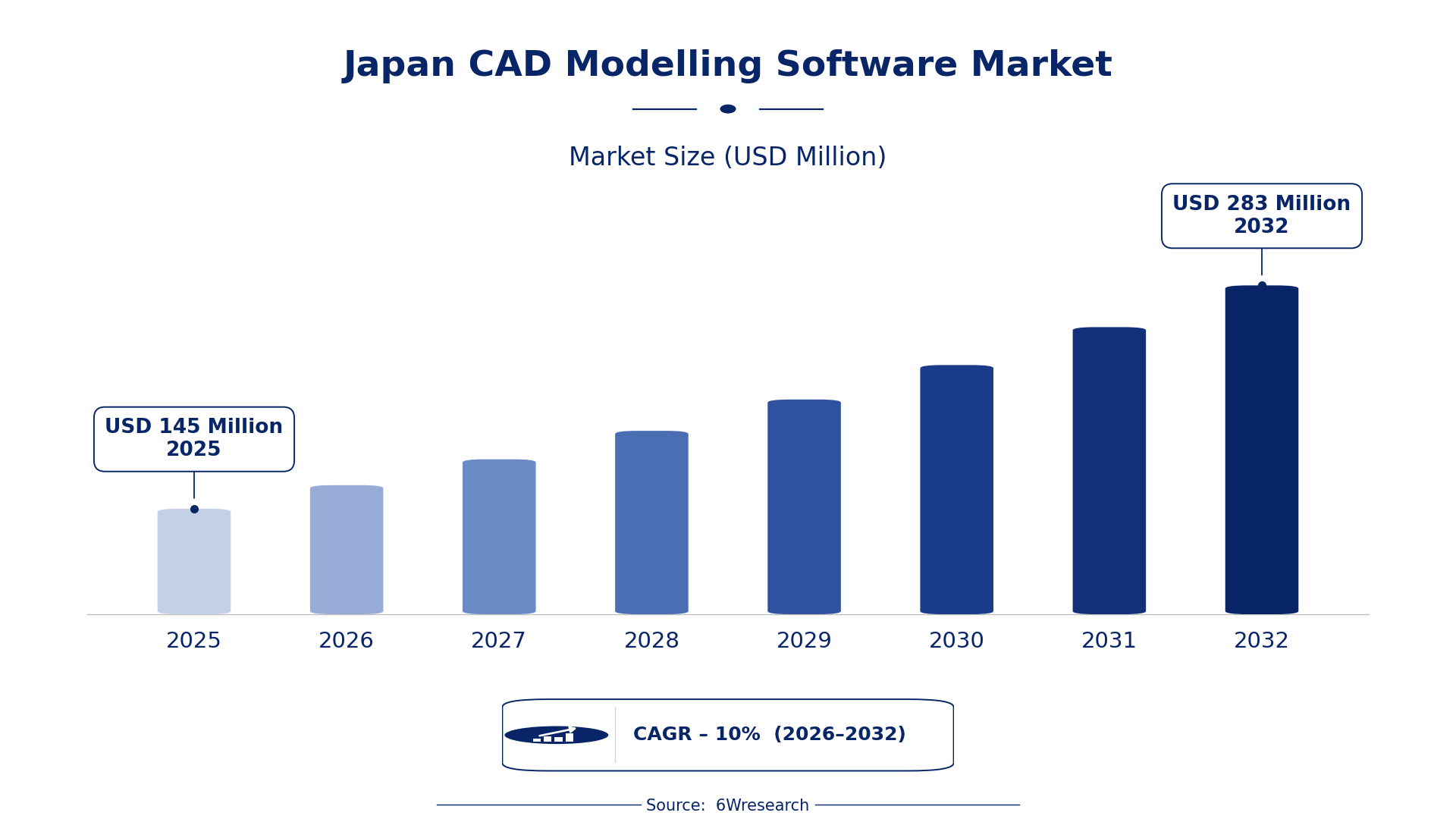
According to 6Wresearch internal database and industry insights, the Japan CAD Modelling Software Market was valued at USD 145 Million in 2025 and is projected to reach USD 283 Million by 2032, growing at a CAGR of approximately 10% during 2026–2032.
Japan CAD Modelling Software Market Highlights
| Report Metric | Details |
| Report Name | Japan CAD Modelling Software Market (2026-2032) |
| Market Size 2025 | USD 145 Million |
| Market Size 2032 | USD 283 Million |
| Absolute Growth 2025–2032 | USD 138 Million |
| CAGR 2026–2032 | 10% |
| Peak Annual Growth | 11.3% in 2030 |
| Forecast Period | 2026–2032 |
| Historical Data | 2022–2025 |
| Base Year | 2025 |
| Leading Software Type, 2025 | Parametric (47% share) |
| Leading Application, 2025 | Product Design (54% share) |
| Leading End User, 2025 | Designers (44% share) |
| Leading Features, 2025 | Real-Time Updates (54% share) |
| Fastest-Growing Software Type | Direct (13.6% CAGR) |
| Fastest-Growing Application | Reverse Engineering (13.0% CAGR) |
| Fastest-Growing End User | Engineers (12.5% CAGR) |
| Fastest-Growing Features | High Precision (13.1% CAGR) |
| Growing Sector | Engineering and Product Design |
| Key End Users | Designers, Engineers, Artists |
Japan CAD Modelling Software Market Year-wise Growth Rate and Key Drivers (2022–2032)
This graph illustrates the annual growth rates of the market from 2022 to 2032, highlighting a steady upward trajectory and projected market expansion over the forecast period.
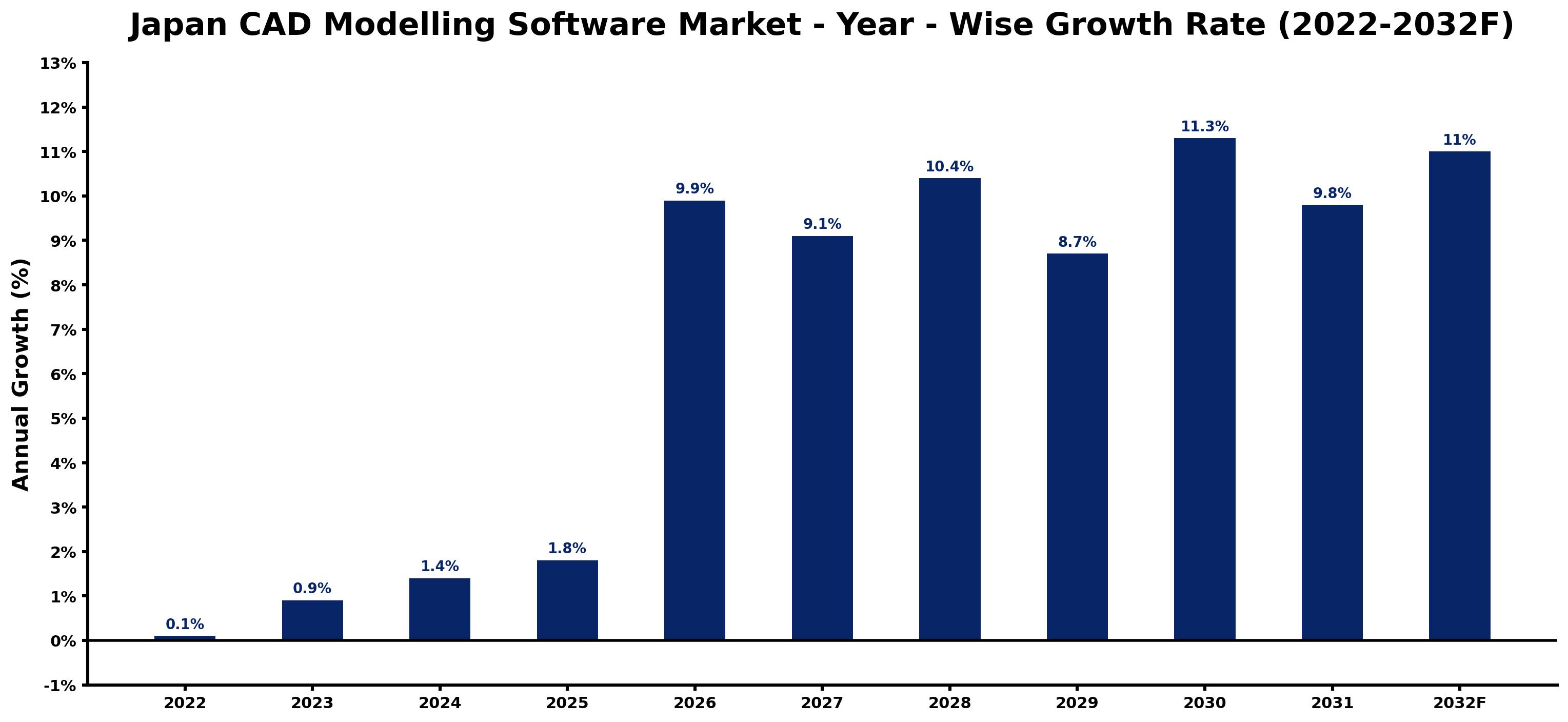
Annual growth estimates for each year appear below with the principal reason behind them, explaining the shifts that set the pace of the market.
| Year | Estimated Annual Growth (%) | Market Rationale |
| 2022 | 0.1 | The market showed minimal growth due to cautious spending by buyers. |
| 2023 | 0.9 | Increased interest in CAD technology led to faster growth compared to the previous year. |
| 2024 | 1.4 | The expansion of product design projects contributed to continued growth in the market. |
| 2025 | 1.8 | Growth accelerated as more designers adopted advanced CAD tools for their projects. |
| 2026 | 9.9 | Investment in CAD technologies is expected to surge, driving demand across various sectors. |
| 2027 | 9.1 | A slight slowdown is projected as market growth moderates after rapid expansion. |
| 2028 | 10.4 | Increased adoption of high-precision tools is expected to revitalise growth in the CAD sector. |
| 2029 | 8.7 | Growth is anticipated to slow again as the market adjusts to previous high levels of demand. |
| 2030 | 11.3 | The market is expected to peak with strong investments in CAD technology and design capabilities. |
| 2031 | 9.8 | A slight moderation in growth is projected as the market stabilises after peak levels. |
| 2032 | 11.0 | Continued investment in CAD software is expected to maintain growth. |
Note: Market size estimations and growth projections presented in this report are based on 6Wresearch's proprietary forecasting methodology, utilizing the latest available industry data, government publications, and primary research inputs.
Japan CAD Modelling Software Market Synopsis
CAD Modelling Software is essential for creating precise digital drawings and models, primarily used in product design, engineering simulations, and creative projects. The Japan CAD Modelling Software Market is growing due to over 1 million registered designers and strong demand for high-precision tools. The Tokyo metropolitan area serves as a key development hub, while government initiatives, such as the CAD technology enhancement program launched in 2023, stimulate market expansion.
Market Dynamics Impact Analysis (2026–2032)
| Factor | Type | Impact | Primary Segment Affected |
| Increased investment in design technology | Driver | High | Product Design |
| Growing demand for high-precision tools | Driver | High | High Precision |
| Expansion of digital art interest | Opportunity | Medium | Creative Design |
| Rising number of engineers adopting CAD | Opportunity | High | Engineers |
| High costs of software licensing | Restraint | High | Parametric |
| Limited awareness of CAD benefits among SMEs | Restraint | Medium | Parametric |
| Shortage of skilled CAD professionals | Challenge | High | Parametric |
| Technological advancements requiring constant updates | Challenge | Medium | Parametric |
Evaluation of Drivers in Japan CAD Modelling Software Market (2026–2032)
The main growth drivers and the segments they affect most are set out below.
| Drivers | Primary Segment Affected | Why It Matters (Evidence) |
| Investment in CAD technology by designers | Product Design | Over 1 million registered designers in Japan drive demand for CAD software, increasing purchases for advanced tools. |
| Adoption of high-precision CAD tools | High Precision | The need for accuracy in engineering tasks leads to increased demand for high-precision CAD software, with significant projects requiring such capabilities. |
| Growth in engineering projects | Engineers | With over 300,000 engineers projected by 2025, demand for CAD software continues to rise, particularly in infrastructure development. |
| Increased interest in digital art | Creative Design | The growing popularity of digital art has led to higher demand for CAD tools among artists, with many seeking innovative design solutions. |
| Government initiatives promoting CAD adoption | Parametric | The CAD technology program launched in 2023 aims to boost CAD usage in SMEs, facilitating wider access to advanced tools. |
Spending rises because investment in CAD technology by designers is strong, with over 1 million registered users in Japan. The need for high precision in engineering tasks drives demand for advanced CAD tools, as significant projects require accuracy. Interest in digital art is increasing, leading to higher CAD tool purchases among artists. This combination of factors is creating a strong market for CAD software across various sectors.
Evaluation of Restraints in Japan CAD Modelling Software Market
The main factors holding the market back are set out below.
| Market Restraint | Primary Segment Affected | Why It Matters (Evidence) |
| High costs of software licensing | Parametric | The average cost of CAD software licenses can deter smaller firms from investing, limiting market growth. |
| Limited awareness of CAD benefits among SMEs | Parametric | Many SMEs lack knowledge about the advantages of CAD, hindering wider adoption and usage. |
| Shortage of skilled CAD professionals | Parametric | The lack of qualified professionals affects project timelines and quality, impacting buyer satisfaction. |
| Technological advancements requiring constant updates | Parametric | Rapid changes in technology necessitate ongoing investment in training and software updates for users. |
| Competition from free or low-cost alternatives | Parametric | The availability of cheaper software options can limit the market share of premium CAD solutions. |
Japan CAD Modelling Software Market Challenges
In 2023, annual demand for CAD software in Japan is estimated at 200,000 licenses, yet supply chain disruptions limit timely access for buyers in manufacturing and architecture. Rising operational costs arise from Japan's national minimum wage increasing to JPY 1,055 per hour, placing financial strain on buyers seeking affordable solutions. A shortage of skilled professionals in CAD technology hampers production capabilities, resulting in project delays for suppliers. Increased competition from international markets compels local suppliers to innovate rapidly, risking quality and reducing satisfaction for end-users.
Trends in the Japan CAD Modelling Software Market
The shifts below are changing how Japan CAD Modelling Software Market products are bought and supplied.
- Shift towards High Precision Tools: In 2023, the demand for high precision CAD tools surged, as engineering projects increasingly require accuracy. This trend is reflected in the projected growth of the High Precision segment, which is expected to expand significantly.
- Increase in Digital Art Applications: The growing interest in digital art since 2022 has led to a rise in Creative Design applications. This shift is reflected in increased sales of CAD software tailored for artists, with a notable increase in adoption.
- Emergence of Collaborative CAD Platforms: Since 2024, collaborative CAD platforms have gained traction, facilitating real-time updates among teams. This trend is reshaping workflows in the design process, improving efficiency and productivity.
- Adoption of CAD Standards: The implementation of JIS Z 8301 standards in 2023 has improved software quality across the market. This standardisation is building confidence among buyers and encouraging wider adoption of reliable CAD solutions.
Investment Opportunities in the Japan CAD Modelling Software Market
Investors looking at the Japan CAD Modelling Software Market should consider the following areas.
- Partner with local CAD developers: With the CAD market expanding, forming partnerships with local developers can facilitate market entry. The Tokyo metropolitan area is a key hub for CAD software innovation, providing ample opportunities for collaboration.
- Invest in high-precision CAD tools: Now is an ideal time to supply high-precision CAD tools, as demand is rising among engineers for advanced solutions for their projects. This segment is projected to grow significantly in the coming years.
- Support digital art initiatives: The growing interest in digital art presents an opportunity to supply tailored CAD software. Artists in Japan are looking for tools that cater to their creative needs, driving demand for innovative solutions.
- Engage with government programs for SMEs: Engaging with government initiatives can facilitate entry into the market. The CAD technology program aims to boost adoption among SMEs, providing support for implementation and training.
Government Initiatives in the Japan CAD Modelling Software Market
The Act on Japanese Industrial Standards, established in 1949 and amended in 2019, governs quality standards for CAD software. This law ensures that products meet specific criteria, benefiting buyers by providing reliable options in the market, with compliance ensuring product credibility.
The Digital Agency, established in September 2021, leads efforts to promote digital transformation in Japan. This agency supports initiatives that improve the adoption of CAD technologies, helping buyers access improved tools and resources, with funding allocated to enhance digital capabilities across sectors.
Future Insight of the Japan CAD Modelling Software Market
The launch of new CAD technology programmes will transform software functionalities, benefiting both buyers and suppliers. By 2032, widespread adoption of ISO 10303 standards will streamline data exchange across various sectors. Government initiatives aimed at boosting CAD technology use in SMEs will expand market opportunities considerably. In 2022, CAD software exports reached approximately 15 billion yen, reflecting robust international demand that will drive local advancements.
Market Segmentation Analysis
Japan CAD Modelling Software Market report covers a detailed analysis of the following market segments:
By Software Type – Parametric Leads, Direct Expected to Grow Fastest
According to Bhawna Singh, Assistant Manager at 6Wresearch, Parametric accounted for 47% of the market by software type in 2025. Parametric modeling is the most utilised software type in Japan, serving over 1 million registered designers who depend on its features for creating intricate models. Its prevalence is particularly notable in sectors such as manufacturing and architecture, where precision is critical. The quickest growth will come from Direct, forecast to expand at a CAGR of 13.6% between 2026 and 2032. The Direct modeling segment is experiencing rapid growth as it caters to users looking for efficiency in straightforward design tasks, with an increasing number of designers opting for this method. As adoption rises, the lead of Parametric modeling will likely continue to expand due to its established user base. Suppliers should prioritise improving functionalities in Direct modeling to meet the surging demand.
By Application – Product Design Leads, Reverse Engineering Expected to Grow Fastest
In 2025, Product Design led the application split with a 54% share. Product Design commands the largest share due to its critical role in developing consumer and industrial products, with a high annual demand for CAD software licenses underpinning its importance. This application is especially prominent in the Tokyo metropolitan area, a hub for design activity. Reverse Engineering is projected to grow fastest, at a CAGR of 13.0% during 2026–2032. Reverse Engineering is experiencing the fastest growth as firms aim to recreate existing products for enhancements, driven by government initiatives promoting CAD technology adoption. This shift indicates a growing interest in leveraging CAD for both new designs and the optimisation of existing products. Buyers will gain from suppliers that provide solutions facilitating the Reverse Engineering process.
By End User – Designers Lead, Engineers Expected to Grow Fastest
The largest end user category in 2025 was Designers, at 44% of revenue. Designers represent the largest user group for CAD software, as they are the primary creators of detailed designs across various sectors. The high number of registered designers in Japan highlights the extensive reliance on CAD tools for their work. Over 2026–2032, Engineers are expected to post the fastest growth, at a CAGR of 12.5%. Engineers are the fastest-growing user group, with increasing support for technical and structural designs as the CAD market expands. This growth reflects the industry's need for precise engineering solutions, further solidifying the role of CAD in engineering tasks. Suppliers should tailor their offerings to meet the specific needs of engineers to capture this growing segment.
By Features – Real-Time Updates Lead, High Precision Expected to Grow Fastest
Real-Time Updates held 54% of the Japan CAD Modelling Software Market by features in 2025. Real-Time Updates are critical for collaborative projects, allowing teams to implement immediate changes and ensuring efficiency in design processes. This feature is particularly valued in environments where multiple stakeholders are involved in project development. High Precision is set to record the highest CAGR in this split, 13.1% over 2026–2032. High Precision is gaining traction as industries demand greater accuracy in engineering and design tasks, driven by the need for quality assurance in product development. As precision becomes a priority, the demand for software that delivers high accuracy will continue to rise. Suppliers must prioritise high precision capabilities in their software to meet the evolving expectations of users.
Key Attractiveness of the Report
- 10 Years of Market Numbers
- Historical Data Starting from 2022 to 2025
- Base Year 2025
- Forecast Data until 2032
- Key Performance Indicators Impacting the Market
- Major Upcoming Developments and Projects
Key Highlights of the Report:
- Japan CAD Modelling Software Market Outlook
- Market Size of Japan CAD Modelling Software Market, 2025
- Forecast of Japan CAD Modelling Software Market, 2032
- Historical Data and Forecast of Japan CAD Modelling Software Revenues & Volume for the Period 2022-2032
- Japan CAD Modelling Software Market Trend Evolution
- Japan CAD Modelling Software Market Drivers and Challenges
- Japan CAD Modelling Software Price Trends
- Japan CAD Modelling Software Porter's Five Forces
- Japan CAD Modelling Software Industry Life Cycle
- Historical Data and Forecast of Japan CAD Modelling Software Market Revenues & Volume By Software Type for the Period 2022-2032
- Historical Data and Forecast of Japan CAD Modelling Software Market Revenues & Volume By Parametric for the Period 2022-2032
- Historical Data and Forecast of Japan CAD Modelling Software Market Revenues & Volume By Direct for the Period 2022-2032
- Historical Data and Forecast of Japan CAD Modelling Software Market Revenues & Volume By Freeform for the Period 2022-2032
- Historical Data and Forecast of Japan CAD Modelling Software Market Revenues & Volume By Application for the Period 2022-2032
- Historical Data and Forecast of Japan CAD Modelling Software Market Revenues & Volume By Product Design for the Period 2022-2032
- Historical Data and Forecast of Japan CAD Modelling Software Market Revenues & Volume By Reverse Engineering for the Period 2022-2032
- Historical Data and Forecast of Japan CAD Modelling Software Market Revenues & Volume By Creative Design for the Period 2022-2032
- Historical Data and Forecast of Japan CAD Modelling Software Market Revenues & Volume By End User for the Period 2022-2032
- Historical Data and Forecast of Japan CAD Modelling Software Market Revenues & Volume By Designers for the Period 2022-2032
- Historical Data and Forecast of Japan CAD Modelling Software Market Revenues & Volume By Engineers for the Period 2022-2032
- Historical Data and Forecast of Japan CAD Modelling Software Market Revenues & Volume By Artists for the Period 2022-2032
- Historical Data and Forecast of Japan CAD Modelling Software Market Revenues & Volume By Features for the Period 2022-2032
- Historical Data and Forecast of Japan CAD Modelling Software Market Revenues & Volume By Real-Time Updates for the Period 2022-2032
- Historical Data and Forecast of Japan CAD Modelling Software Market Revenues & Volume By High Precision for the Period 2022-2032
- Historical Data and Forecast of Japan CAD Modelling Software Market Revenues & Volume By Flexible Workflow for the Period 2022-2032
- Japan CAD Modelling Software Import Export Trade Statistics
- Market Opportunity Assessment By Software Type
- Market Opportunity Assessment By Application
- Market Opportunity Assessment By End User
- Market Opportunity Assessment By Features
- Japan CAD Modelling Software Top Companies Market Share
- Japan CAD Modelling Software Competitive Benchmarking By Technical and Operational Parameters
- Japan CAD Modelling Software Company Profiles
- Japan CAD Modelling Software Key Strategic Recommendations
Market Covered
This report examines the market across the segments below.
By Software Type
- Parametric
- Direct
- Freeform
By Application
- Product Design
- Reverse Engineering
- Creative Design
By End User
- Designers
- Engineers
- Artists
By Features
- Real-Time Updates
- High Precision
- Flexible Workflow






































