Japan Carpet looms Market Size & Growth Rate
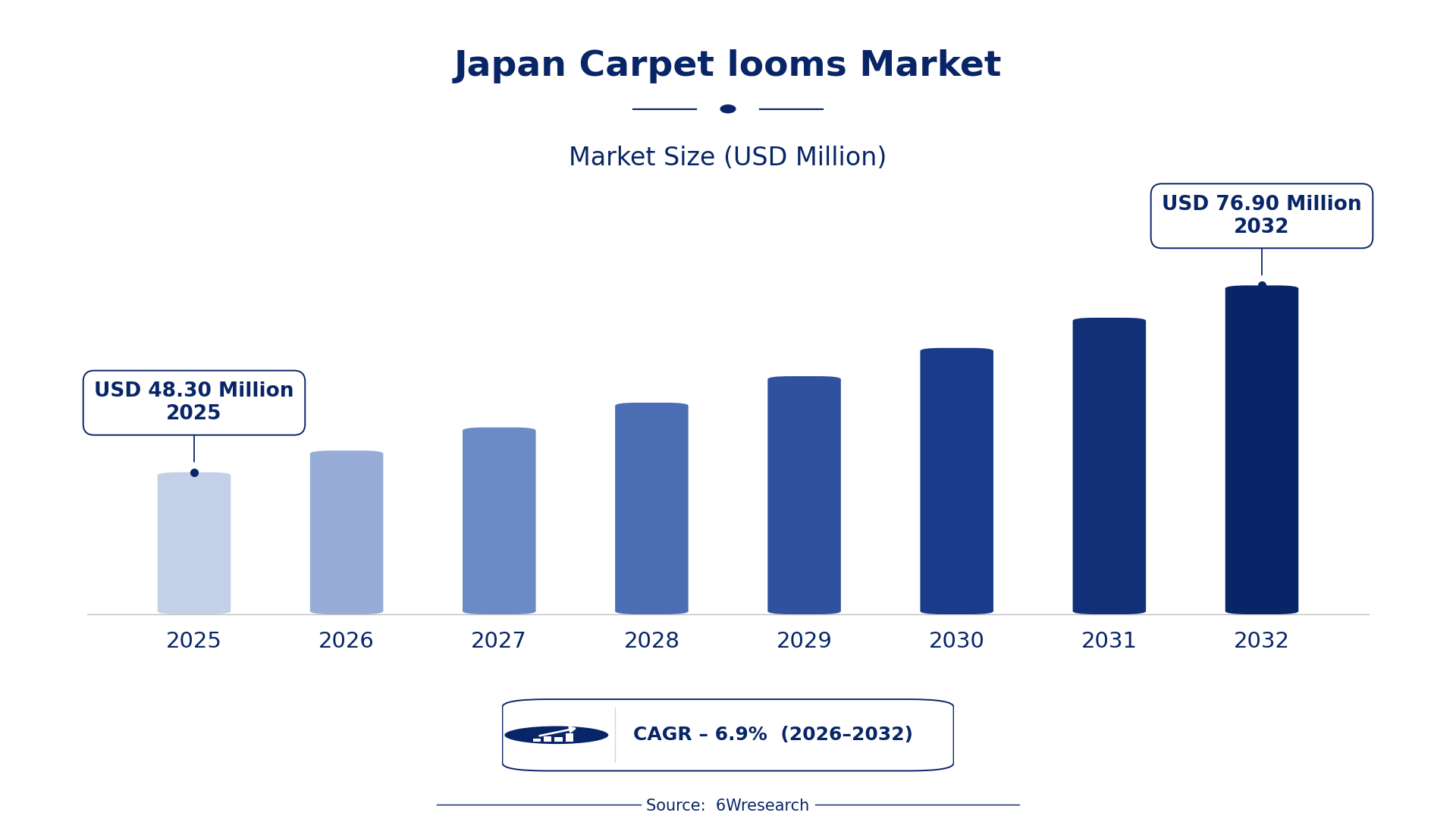
According to 6Wresearch internal database and industry insights, the Japan Carpet looms Market was valued at USD 48.30 Million in 2025 and is projected to reach USD 76.90 Million by 2032, growing at a CAGR of approximately 6.9% during 2026–2032.
Japan Carpet looms Market Highlights
| Report Metric | Details |
| Report Name | Japan Carpet looms Market (2026-2032) |
| Market Size 2025 | USD 48.30 Million |
| Market Size 2032 | USD 76.90 Million |
| Absolute Growth 2025–2032 | USD 28.60 Million |
| CAGR 2026–2032 | 6.9% |
| Peak Annual Growth | 7.9% in 2032 |
| Forecast Period | 2026–2032 |
| Historical Data | 2022–2025 |
| Base Year | 2025 |
| Leading Product Type, 2025 | Automatic Carpet Loom (61% share) |
| Leading End-User, 2025 | Residential (59% share) |
| Fastest-Growing Product Type | Semi-automatic Carpet Loom (9.9% CAGR) |
| Fastest-Growing End-User | Commercial (8.7% CAGR) |
| Growing Sector | Residential |
| Key End Users | Manufacturers, Contractors, Interior Designers |
Japan Carpet looms Market Year-wise Growth Rate and Key Drivers (2022–2032)
This graph illustrates the annual growth rates of the market from 2022 to 2032, highlighting a steady upward trajectory and projected market expansion over the forecast period.
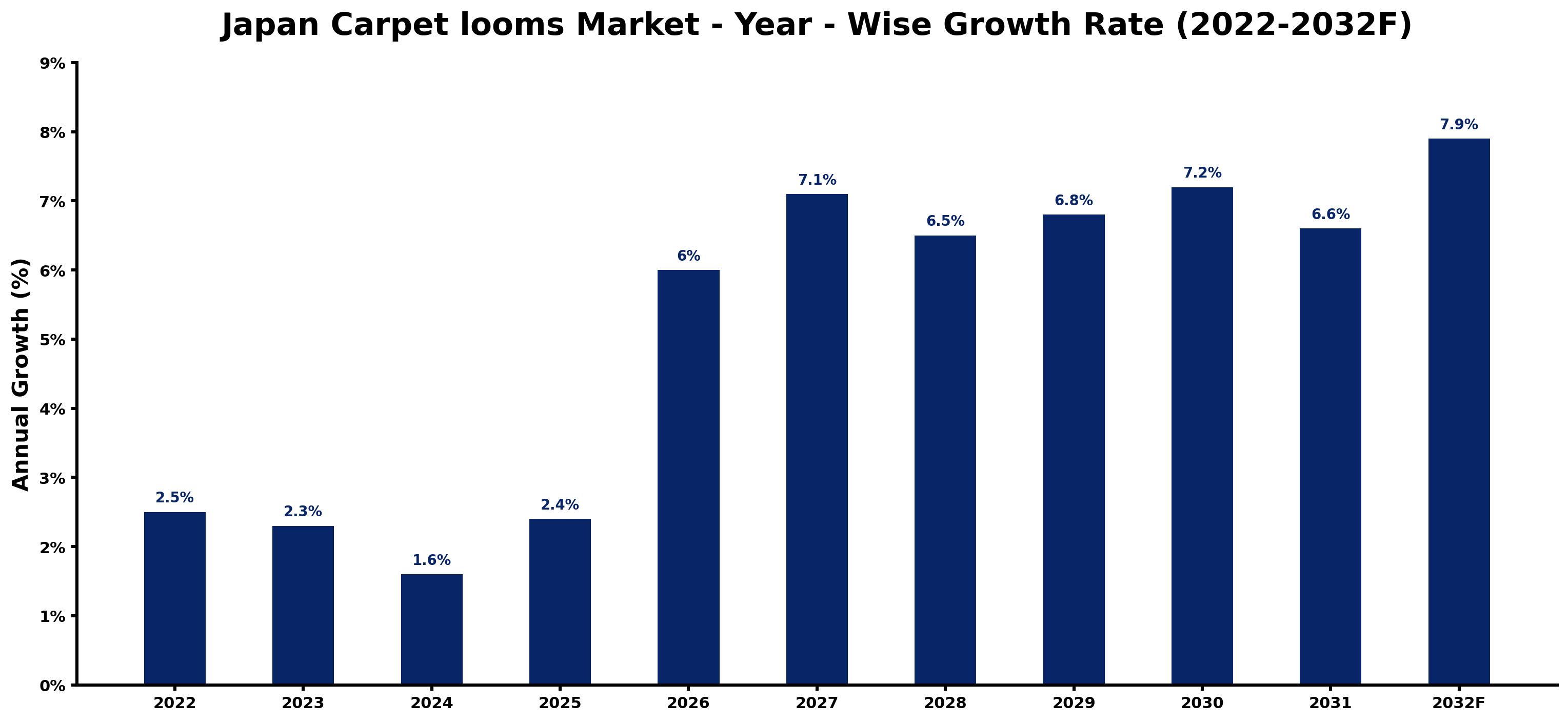
The table below sets out the estimated growth rate for each year and the main factor behind it.
| Year | Estimated Annual Growth (%) | Market Rationale |
| 2022 | 2.5 | The market experienced steady growth, reflecting strong demand from the residential sector. |
| 2023 | 2.3 | Growth slowed slightly due to market adjustments and changing consumer preferences. |
| 2024 | 1.6 | The market continued to grow, albeit at a slower pace, as buyers sought cost-effective solutions. |
| 2025 | 2.4 | Growth accelerated as new technologies began to attract more commercial buyers. |
| 2026 | 6.0 | Demand surged as manufacturers adopted advanced automation in production processes. |
| 2027 | 7.1 | The market expanded further, driven by increased investment in semi-automatic looms. |
| 2028 | 6.5 | Growth slowed as market saturation began to affect purchasing decisions. |
| 2029 | 6.8 | Demand picked up again as new product features attracted buyers. |
| 2030 | 7.2 | The market continued to grow, supported by rising consumer interest in unique designs. |
| 2031 | 6.6 | Growth moderated as competition intensified among manufacturers. |
| 2032 | 7.9 | The market is expected to peak as technological advancements lead to a surge in new orders. |
Note: Market size estimations and growth projections presented in this report are based on 6Wresearch's proprietary forecasting methodology, utilizing the latest available industry data, government publications, and primary research inputs.
Japan Carpet looms Market Synopsis
Carpet looms are essential machines used for weaving carpets, available in automatic and semi-automatic forms. The Japan Carpet Looms Market is experiencing notable growth, driven by increasing demand from the residential and commercial sectors. The adoption of advanced automation technologies is attracting new buyers, while the shift towards semi-automatic looms is changing purchasing patterns significantly. By 2032, the market is projected to grow to USD 76.90 million, reflecting a strong growth trajectory.
Market Dynamics Impact Analysis (2026–2032)
| Factor | Type | Impact | Primary Segment Affected |
| Rising demand for residential carpets | Driver | High | Automatic Carpet Loom |
| Technological advancements in loom automation | Driver | High | Semi-automatic Carpet Loom |
| Growing interest in sustainable flooring solutions | Opportunity | Medium | Residential |
| Expansion of commercial spaces requiring carpets | Opportunity | Medium | Commercial |
| High initial investment costs for advanced looms | Restraint | High | Automatic Carpet Loom |
| Limited availability of skilled technicians for maintenance | Restraint | Medium | Semi-automatic Carpet Loom |
| Fluctuating raw material prices affecting production costs | Challenge | High | Automatic Carpet Loom |
| Regulatory compliance requirements for manufacturing processes | Challenge | Medium | Semi-automatic Carpet Loom |
Evaluation of Drivers in Japan Carpet looms Market (2026–2032)
Key forces behind demand, with the segment each one moves most, are listed below.
| Drivers | Primary Segment Affected | Why It Matters (Evidence) |
| Increased residential construction | Automatic Carpet Loom | This trend drives demand for carpets, leading to higher orders for automatic looms, particularly in urban areas. |
| Technological advancements in loom efficiency | Semi-automatic Carpet Loom | New features attract buyers looking for cost-effective production solutions, boosting sales. |
| Rising consumer preference for custom carpets | Automatic Carpet Loom | As consumers seek unique designs, manufacturers invest in advanced looms to meet this demand. |
| Growing commercial sector requiring durable flooring | Semi-automatic Carpet Loom | The expansion of offices and retail spaces increases demand for semi-automatic looms. |
| Focus on eco-friendly carpet production | Automatic Carpet Loom | Sustainability initiatives encourage manufacturers to upgrade to more efficient looms. |
Spending increases as residential construction fuels demand for carpets, particularly in urban areas where automatic looms are favoured. In 2022, the residential sector held 59% of the market share, prompting manufacturers to invest in advanced automation technologies. The semi-automatic segment is expected to grow at a CAGR of 9.9% by 2032, driven by the need for efficient production solutions. The commercial sector is also expanding, with a rising demand for durable flooring, further increasing orders for semi-automatic looms as businesses seek dependable production methods.
Evaluation of Restraints in Japan Carpet looms Market
These are the pressures that could keep growth below its potential.
| Market Restraint | Primary Segment Affected | Why It Matters (Evidence) |
| High initial investment costs | Automatic Carpet Loom | Producers face substantial financial barriers, limiting their ability to upgrade equipment and expand production capacity. |
| Limited skilled technicians | Semi-automatic Carpet Loom | A shortage of skilled workers hampers operational efficiency and affects production timelines. |
| Fluctuating raw material prices | Automatic Carpet Loom | Importers encounter unstable pricing, complicating cost management for buyers and squeezing profit margins. |
| Regulatory hurdles in product approval | Semi-automatic Carpet Loom | Complicated regulations can delay new product launches, extending lead times for distributors. |
| Market saturation affecting demand | Automatic Carpet Loom | As the market matures, competition intensifies, resulting in reduced orders and slower growth. |
Japan Carpet looms Market Challenges
The primary challenge is the shortage of skilled workers, disrupting production schedules and delaying output by up to 20% for producers. Buyers face inflated prices due to limited domestic production, resulting in a 20% higher cost for imported carpets compared to local options. Importers encounter unpredictable raw material costs, which can reduce profit margins by 15% for distributors. Regulatory hurdles complicate the introduction of new products, extending approval times by an average of six weeks for importers, affecting their responsiveness to market demands.
Trends in the Japan Carpet looms Market
Buyers and suppliers in the Japan Carpet looms Market are adjusting to the following trends.
- Shift towards Semi-automatic Looms: Manufacturers are increasingly adopting semi-automatic looms to balance cost and efficiency. This segment is projected to grow at a CAGR of 9.9% by 2032, reflecting changing production needs.
- Increased Focus on Sustainability: The demand for eco-friendly carpets is prompting manufacturers to adopt sustainable practices. The Green Growth Strategy aims for carbon neutrality by 2050, influencing production methods in the carpet industry.
- Technological Advancements in Loom Design: Innovations in loom design are improving production capabilities. The introduction of advanced features in automatic looms is attracting buyers looking for improved efficiency and customization options.
- Expansion of Commercial Spaces: The growth of commercial spaces is driving increased demand for carpets. The commercial sector is expected to grow at a CAGR of 8.7%, resulting in higher orders for carpet looms.
Investment Opportunities in the Japan Carpet looms Market
The following areas offer the clearest openings for investors and suppliers in the Japan Carpet looms Market.
- Rising Interest in Custom Carpets: With consumer interest in unique designs increasing, manufacturers can invest in custom carpet production. The residential sector, accounting for 59% of the market share, offers substantial growth potential.
- Investment in Advanced Automation: Now is an opportune time to invest in advanced automation technologies for carpet looms. The growth in the commercial sector, with a CAGR of 8.7%, highlights the need for efficient production solutions.
- Partnerships for Sustainable Production: Manufacturers should explore partnerships to enhance sustainable practices in carpet production. The Green Growth Strategy encourages collaboration for eco-friendly initiatives.
- Expansion into Emerging Markets: With the market projected to reach USD 76.90 million by 2032, there are opportunities for manufacturers to expand into emerging markets. Establishing local partnerships can facilitate market entry.
Government Initiatives in the Japan Carpet looms Market
The New Robot Strategy (2015) is important for manufacturers, aiming to expand robot use in manufacturing processes, including carpet production. This initiative encourages investment in automation and efficiency, which can lower operational costs and improve production capacity. The strategy is expected to boost productivity by 20% by 2025 and support over 100,000 jobs in the sector.
The AI Promotion Act (2025) impacts carpet loom manufacturers by promoting the integration of AI technologies in production processes, improving operational efficiency and product quality. This act is expected to support 50 projects annually, encouraging innovation and competitiveness in the industry.
Future Insight of the Japan Carpet looms Market
The emergence of advanced weaving technology will reshape demand by 2032, allowing producers to increase output and efficiency. Enhanced quality control measures will lead to a reduction in product defects by 30%. New eco-friendly material standards will encourage suppliers to innovate, attracting buyers focused on sustainability. Improved logistics facilities will streamline distribution, cutting delivery times by 25% and ensuring timely availability of products.
Market Segmentation Analysis
Japan Carpet looms Market report covers a detailed analysis of the following market segments:
By Product Type – Automatic Carpet Loom Leads, Semi-automatic Carpet Loom Expected to Grow Fastest
According to Ravi Bhandari, Research Head at 6Wresearch, the largest product type category in 2025 was Automatic Carpet Loom, at 61% of revenue. The Automatic Carpet Loom holds the largest market share as it is extensively utilised in large-scale textile production facilities where efficiency is paramount. Its ability to produce intricate designs quickly makes it the preferred choice for high-volume manufacturing. The quickest growth will come from Semi-automatic Carpet Loom, forecast to expand at a CAGR of 9.9% between 2026 and 2032. The Semi-automatic Carpet Loom is experiencing rapid growth due to its combination of automation and manual flexibility, appealing particularly to smaller manufacturers. This segment is benefiting from a surge in demand as these producers seek adaptable solutions for unique patterns. Suppliers should focus on developing semi-automatic models to cater to the increasing demand from smaller production units.
By End-User – Residential Leads, Commercial Expected to Grow Fastest
Residential took 59% of end-user revenue in 2025, more than any other category. The Residential segment commands the largest share as homeowners are increasingly investing in high-quality carpets for both comfort and aesthetic value. This trend is particularly pronounced in urban areas where stylish interior design is a priority. Over 2026–2032, Commercial is expected to post the fastest growth, at a CAGR of 8.7%. The Commercial segment is growing quickly due to rising investments in office and hospitality sectors, which require durable and visually appealing carpeting. The notable increase in new hotel developments is driving this segment's expansion. Buyers in the commercial sector can anticipate a wider selection of robust carpet options as suppliers respond to the heightened demand.
Key Attractiveness of the Report
- 10 Years of Market Numbers
- Historical Data Starting from 2022 to 2025
- Base Year 2025
- Forecast Data until 2032
- Key Performance Indicators Impacting the Market
- Major Upcoming Developments and Projects
Key Highlights of the Report:
- Japan Carpet looms Market Outlook
- Market Size of Japan Carpet looms Market, 2025
- Forecast of Japan Carpet looms Market, 2032
- Historical Data and Forecast of Japan Carpet looms Revenues & Volume for the Period 2022-2032
- Japan Carpet looms Market Trend Evolution
- Japan Carpet looms Market Drivers and Challenges
- Japan Carpet looms Price Trends
- Japan Carpet looms Porter's Five Forces
- Japan Carpet looms Industry Life Cycle
- Historical Data and Forecast of Japan Carpet looms Market Revenues & Volume By Product Type for the Period 2022-2032
- Historical Data and Forecast of Japan Carpet looms Market Revenues & Volume By Automatic Carpet Loom for the Period 2022-2032
- Historical Data and Forecast of Japan Carpet looms Market Revenues & Volume By Semi-automatic Carpet Loom for the Period 2022-2032
- Historical Data and Forecast of Japan Carpet looms Market Revenues & Volume By End-User for the Period 2022-2032
- Historical Data and Forecast of Japan Carpet looms Market Revenues & Volume By Residential for the Period 2022-2032
- Historical Data and Forecast of Japan Carpet looms Market Revenues & Volume By Commercial for the Period 2022-2032
- Historical Data and Forecast of Japan Carpet looms Market Revenues & Volume By Others for the Period 2022-2032
- Japan Carpet looms Import Export Trade Statistics
- Market Opportunity Assessment By Product Type
- Market Opportunity Assessment By End-User
- Japan Carpet looms Top Companies Market Share
- Japan Carpet looms Competitive Benchmarking By Technical and Operational Parameters
- Japan Carpet looms Company Profiles
- Japan Carpet looms Key Strategic Recommendations
Market Covered
The study includes the following segmentation.
By Product Type
- Automatic Carpet Loom
- Semi-automatic Carpet Loom
By End-User
- Residential
- Commercial
- Others































