Japan Ceramic Matrix Composites Market Size & Growth Rate
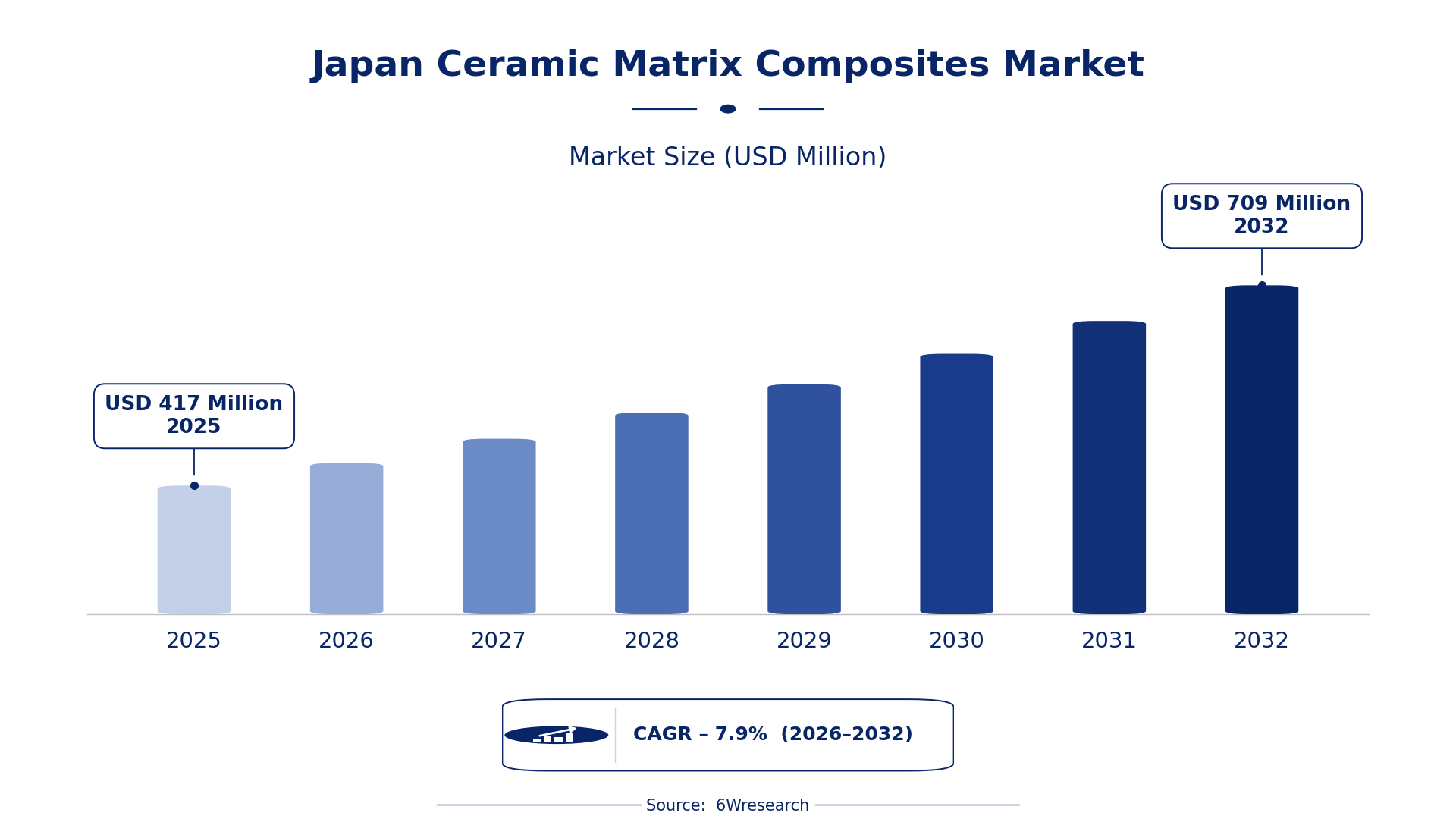
According to 6Wresearch internal database and industry insights, the Japan Ceramic Matrix Composites Market was valued at USD 417 Million in 2025 and is projected to reach USD 709 Million by 2032, growing at a CAGR of approximately 7.9% during 2026–2032.
Japan Ceramic Matrix Composites Market Highlights
| Report Metric | Details |
| Report Name | Japan Ceramic Matrix Composites Market (2026-2032) |
| Market Size 2025 | USD 417 Million |
| Market Size 2032 | USD 709 Million |
| Absolute Growth 2025–2032 | USD 292 Million |
| CAGR 2026–2032 | 7.9% |
| Peak Annual Growth | 8.9% in 2030 |
| Forecast Period | 2026–2032 |
| Historical Data | 2022–2025 |
| Base Year | 2025 |
| Leading Matrix Type, 2025 | C/C (53% share) |
| Leading Fiber Type, 2025 | Continuous (56% share) |
| Leading End Use Industry, 2025 | Aerospace & Defense (45% share) |
| Fastest-Growing Matrix Type | C/Sic (11.0% CAGR) |
| Fastest-Growing Fiber Type | Woven (10.4% CAGR) |
| Fastest-Growing End Use Industry | Automotive (10.3% CAGR) |
| Growing Sector | Aerospace & Defense |
| Key End Users | Aerospace manufacturers, automotive manufacturers, energy system developers, industrial manufacturers |
Japan Ceramic Matrix Composites Market Year-wise Growth Rate and Key Drivers (2022–2032)
This graph illustrates the annual growth rates of the market from 2022 to 2032, highlighting a steady upward trajectory and projected market expansion over the forecast period.
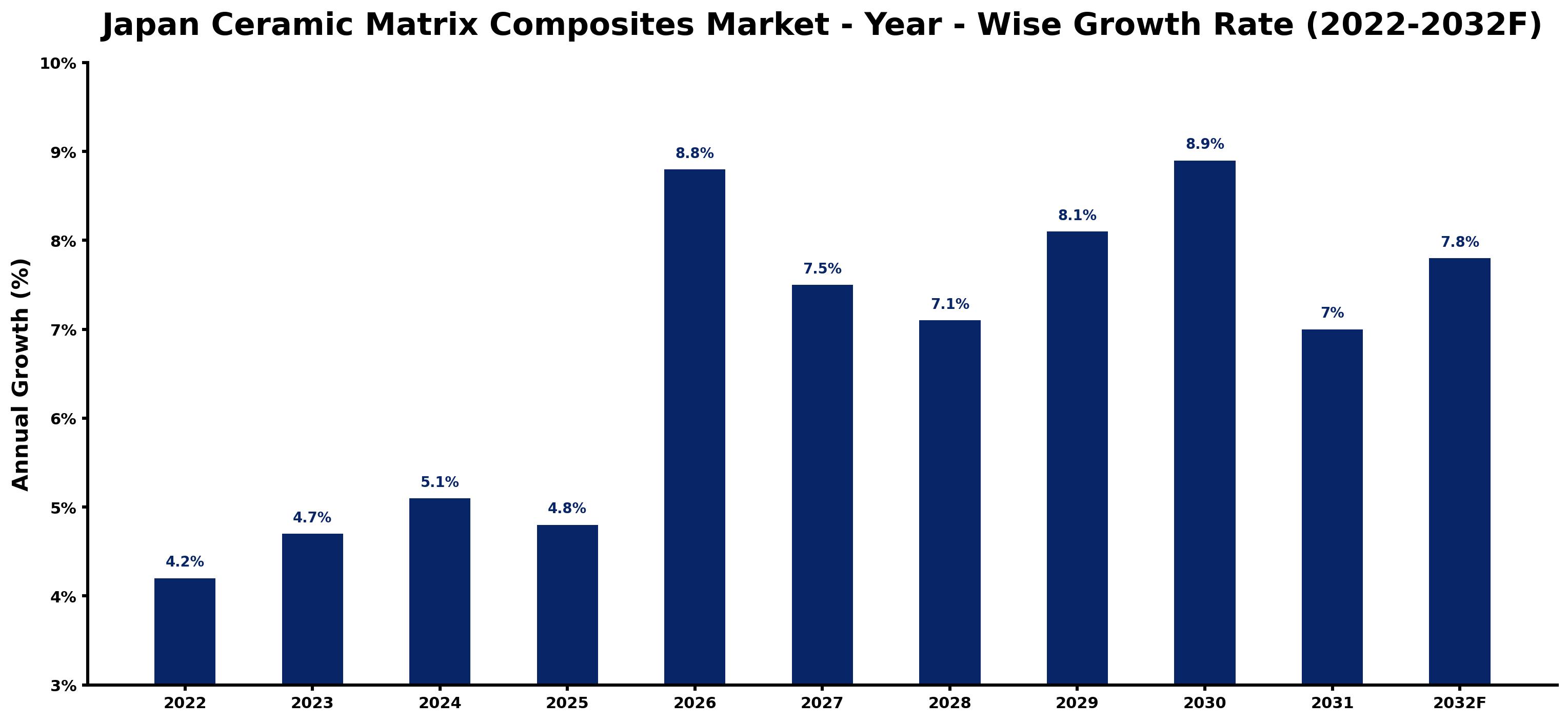
The yearly estimates that follow link every growth rate to its principal driver, so readers can see why the pace changed in each period.
| Year | Estimated Annual Growth (%) | Market Rationale |
| 2022 | 4.2 | The market experienced steady growth due to ongoing aerospace projects and demand for advanced materials. |
| 2023 | 4.7 | Growth accelerated as domestic manufacturers increased production of aerospace components using CMCs. |
| 2024 | 5.1 | Aerospace demand continued to rise, driven by new aircraft models requiring advanced materials. |
| 2025 | 4.8 | Growth slowed as manufacturers adjusted to supply chain changes and production capacities. |
| 2026 | 8.8 | Investment in lightweight materials surged, particularly in the automotive sector, boosting demand for CMCs. |
| 2027 | 7.5 | Demand growth moderated as the market stabilised following a period of rapid investment. |
| 2028 | 7.1 | The market continued to grow, supported by increasing adoption of CMCs in high-performance vehicles. |
| 2029 | 8.1 | Aerospace and automotive sectors drove renewed demand, leading to faster growth rates. |
| 2030 | 8.9 | Peak growth will be achieved as major aerospace projects reach critical phases, increasing CMC requirements. |
| 2031 | 7.0 | Growth will slow as the market begins to stabilise after a peak in demand. |
| 2032 | 7.8 | The market is expected to maintain strong growth as new applications for CMCs emerge. |
Note: Market size estimations and growth projections presented in this report are based on 6Wresearch's proprietary forecasting methodology, utilizing the latest available industry data, government publications, and primary research inputs.
Japan Ceramic Matrix Composites Market Synopsis
Ceramic Matrix Composites (CMCs) are advanced materials made from ceramic fibers embedded in a ceramic matrix, known for their high strength and thermal resistance. The Japan Ceramic Matrix Composites Market is expanding, driven by strong demand from the aerospace and defense sectors, projected to require over 1,000 tons of CMCs by 2025. The automotive industry is investing heavily in lightweight materials, with at least 20 new vehicle models set to adopt CMCs by 2026. Government support for advanced materials research is stimulating further growth in this market.
Market Dynamics Impact Analysis (2026–2032)
| Factor | Type | Impact | Primary Segment Affected |
| Increasing demand from aerospace manufacturers for lightweight materials | Driver | High | Aerospace & Defense |
| Growing investments in lightweight automotive components | Driver | High | Automotive |
| Expansion of aerospace manufacturing in the Tokyo region | Opportunity | High | Aerospace & Defense |
| Rising need for advanced materials in high-performance vehicles | Opportunity | High | Automotive |
| Regulatory compliance costs associated with advanced materials | Restraint | Medium | C/C |
| Limited applications of CMCs in energy systems | Restraint | Medium | Energy & Power |
| High production costs for advanced materials | Challenge | High | C/Sic |
| Capacity constraints in manufacturing facilities | Challenge | Medium | Continuous |
Evaluation of Drivers in Japan Ceramic Matrix Composites Market (2026–2032)
The factors lifting demand, and the evidence behind each, are summarised below.
| Drivers | Primary Segment Affected | Why It Matters (Evidence) |
| Demand from the aerospace sector for advanced materials | Aerospace & Defense | Japan's aerospace sector is projected to require over 1,000 tons of CMCs by 2025. |
| Investment in lightweight materials by automotive manufacturers | Automotive | The automotive industry is investing heavily in lightweight materials, including CMCs. |
| Research initiatives in advanced materials | C/Sic | A program to support advanced materials research was launched in 2023. |
| Increased adoption of CMCs in aerospace components | Continuous | The installed base of aerospace components using CMCs in Japan is estimated at over 500 units. |
| Growth in high-performance vehicle models | Automotive | The automotive sector is expected to adopt CMCs in at least 20 new vehicle models by 2026. |
Most of the extra volume comes from the aerospace sector, which is projected to require over 1,000 tons of CMCs by 2025. This demand arises from the need for lightweight, high-strength materials in aircraft manufacturing. The automotive sector is also investing heavily in lightweight materials, with plans for 20 new vehicle models to include CMCs by 2026. The installed base of aerospace components using CMCs indicates strong market penetration, while continuous fiber CMCs are increasingly used in jet engine components due to their superior thermal properties, improving performance in aerospace applications.
Evaluation of Restraints in Japan Ceramic Matrix Composites Market
The main factors holding the market back are set out below.
| Market Restraint | Primary Segment Affected | Why It Matters (Evidence) |
| High production costs for ceramic matrix composites | C/C | The cost of producing CMCs remains elevated, limiting widespread adoption in various sectors. |
| Limited applications of CMCs in energy systems | Energy & Power | The niche nature of energy applications restricts market growth for CMCs in this segment. |
| Regulatory compliance costs associated with advanced materials | C/Sic | Manufacturers incur costs to meet regulatory standards for new materials. |
| Capacity constraints in manufacturing facilities | Continuous | Current manufacturing capacities may not meet the rising demand for CMCs in aerospace. |
| Slow adoption rates in industrial applications | Industrial | Limited awareness and understanding of CMC benefits hinder growth in industrial uses. |
Japan Ceramic Matrix Composites Market Challenges
A shortage of skilled technicians in advanced materials hampers production in the Tokyo region, causing delays that increase costs for buyers. Stringent compliance with JIS R 1601 complicates the certification process, extending time-to-market for new products and reducing revenue for suppliers. Supply chain disruptions stem from reliance on a limited number of raw material suppliers, inflating input costs and impacting buyers' pricing strategies. Resistance to adopting new manufacturing technologies leads to inefficiencies, constraining producers' capacity to innovate and meet evolving market demands.
Trends in the Japan Ceramic Matrix Composites Market
The shifts below are changing how Japan Ceramic Matrix Composites Market products are bought and supplied.
- Shift from Traditional to Advanced Materials: Japan's aerospace sector is increasingly adopting advanced materials like CMCs, with over 1,000 tons expected by 2025. This shift improves performance and efficiency in aircraft design.
- Transition from Conventional to Lightweight Automotive Components: The automotive industry is moving towards lightweight materials, with at least 20 new vehicle models anticipated to adopt CMCs by 2026. This transition supports fuel efficiency and performance improvements.
- Emergence of Research Initiatives in Advanced Materials: A program launched in 2023 promotes advanced materials research, aiming to stimulate innovation and development in the CMC sector.
- Prioritisation of Aerospace Manufacturing in the Tokyo Region: The Tokyo region is becoming a major hub for aerospace manufacturing, hosting multiple key players and driving demand for CMCs, with significant investments in production capabilities.
Investment Opportunities in the Japan Ceramic Matrix Composites Market
Where to invest in the Japan Ceramic Matrix Composites Market: the main openings are set out below.
- Investment in Lightweight Automotive Components: With the automotive industry investing heavily in lightweight materials, suppliers can focus on providing CMCs for at least 20 new vehicle models expected by 2026, addressing a growing market need.
- Supply of Advanced Materials for Aerospace Applications: Japan's aerospace sector is projected to require over 1,000 tons of CMCs by 2025, presenting opportunities for manufacturers to meet this demand through partnerships with local firms.
- Collaboration with Research Institutions: Engaging with the Japan Society of Composite Materials can facilitate access to research and development funding, improving product offerings in CMC technologies.
- Expansion into Niche Energy Applications: With limited applications in energy systems, there is potential for suppliers to innovate and develop CMC solutions, tapping into a market that is currently underutilised.
Government Initiatives in the Japan Ceramic Matrix Composites Market
The Hydrogen Society Promotion Act, enacted in 2024, supplements existing laws by providing price-gap support for low-carbon hydrogen supply chains. This measure encourages investment in advanced materials that can improve energy efficiency in various applications, including CMCs.
The Ministry of Economy, Trade and Industry is responsible for approving funding for advanced materials research initiatives. With a budget of ¥10 billion for 2024, this agency supports projects that aim to advance the development and application of CMC technologies.
Future Insight of the Japan Ceramic Matrix Composites Market
New advanced materials research facilities will emerge by 2032, driven by government support for innovation. The aerospace sector's demand for over 500 units of CMCs will stimulate production capabilities. Adoption of CMCs in at least 20 new vehicle models by 2026 will bolster the automotive industry's growth. Increased focus on advanced materials in renewable energy systems will open new avenues for suppliers.
Market Segmentation Analysis
Japan Ceramic Matrix Composites Market report covers a detailed analysis of the following market segments:
By Matrix Type – C/C Leads, C/Sic Expected to Grow Fastest
According to Shubham Padhi, Research Analyst at 6Wresearch, C/C took 53% of matrix type revenue in 2025, more than any other category. C/C holds the largest share because it is essential for aerospace applications that demand high thermal resistance, particularly in jet engine components. The established installed base of over 500 aerospace components using CMCs in Japan highlights its critical importance in this market. Over 2026–2032, C/Sic is expected to post the fastest growth, at a CAGR of 11.0%. C/Sic is rapidly growing as it finds increasing use in high-performance automotive parts, reflecting the automotive industry's focus on lightweight materials. The anticipated adoption of CMCs in at least 20 new vehicle models by 2026 will further accelerate this segment's growth. Suppliers should concentrate on developing C/Sic products to meet the automotive sector's rising demand for lightweight materials.
By Fiber Type – Continuous Leads, Woven Expected to Grow Fastest
The largest fiber type category in 2025 was Continuous, at 56% of revenue. The Continuous fiber type leads the market as it is essential for structural applications in aerospace, where high strength and thermal resistance are paramount. This segment's dominance is reinforced by the ongoing demand from domestic aerospace manufacturers in Japan. Woven is projected to grow fastest, at a CAGR of 10.4% during 2026–2032. Woven fibers are growing rapidly due to their application in specialized automotive components, reflecting the automotive industry's increasing focus on performance. As manufacturers seek advanced materials for lightweight designs, this segment is likely to see continued expansion. Buyers in the automotive sector should consider sourcing woven fibers to meet the rising demand for high-performance components.
By End Use Industry – Aerospace & Defense Leads, Automotive Expected to Grow Fastest
With 45% of end use industry revenue in 2025, Aerospace & Defense was the largest category. Aerospace & Defense holds the largest share due to substantial demand from domestic aerospace manufacturers and the active defence sector. The installed base of aerospace components using CMCs in Japan is estimated at over 500 units, showcasing the segment's established presence. Automotive is set to record the highest CAGR in this split, 10.3% over 2026–2032. The Automotive sector is witnessing rapid growth as manufacturers adopt CMCs for high-performance vehicles, reflecting a shift towards lightweight materials. This segment is expected to see CMCs integrated into at least 20 new vehicle models by 2026, indicating strong future demand. This suggests that suppliers should prioritise partnerships with automotive manufacturers to leverage the increasing use of CMCs in upcoming vehicle models.
Key Attractiveness of the Report
- 10 Years of Market Numbers
- Historical Data Starting from 2022 to 2025
- Base Year 2025
- Forecast Data until 2032
- Key Performance Indicators Impacting the Market
- Major Upcoming Developments and Projects
Key Highlights of the Report:
- Japan Ceramic Matrix Composites Market Outlook
- Market Size of Japan Ceramic Matrix Composites Market, 2025
- Forecast of Japan Ceramic Matrix Composites Market, 2032
- Historical Data and Forecast of Japan Ceramic Matrix Composites Revenues & Volume for the Period 2022-2032
- Japan Ceramic Matrix Composites Market Trend Evolution
- Japan Ceramic Matrix Composites Market Drivers and Challenges
- Japan Ceramic Matrix Composites Price Trends
- Japan Ceramic Matrix Composites Porter's Five Forces
- Japan Ceramic Matrix Composites Industry Life Cycle
- Historical Data and Forecast of Japan Ceramic Matrix Composites Market Revenues & Volume By Matrix Type for the Period 2022-2032
- Historical Data and Forecast of Japan Ceramic Matrix Composites Market Revenues & Volume By C/C for the Period 2022-2032
- Historical Data and Forecast of Japan Ceramic Matrix Composites Market Revenues & Volume By C/Sic for the Period 2022-2032
- Historical Data and Forecast of Japan Ceramic Matrix Composites Market Revenues & Volume By Oxide/Oxide for the Period 2022-2032
- Historical Data and Forecast of Japan Ceramic Matrix Composites Market Revenues & Volume By Sic/Sic for the Period 2022-2032
- Historical Data and Forecast of Japan Ceramic Matrix Composites Market Revenues & Volume By Fiber Type for the Period 2022-2032
- Historical Data and Forecast of Japan Ceramic Matrix Composites Market Revenues & Volume By Continuous for the Period 2022-2032
- Historical Data and Forecast of Japan Ceramic Matrix Composites Market Revenues & Volume By Woven for the Period 2022-2032
- Historical Data and Forecast of Japan Ceramic Matrix Composites Market Revenues & Volume By End Use Industry for the Period 2022-2032
- Historical Data and Forecast of Japan Ceramic Matrix Composites Market Revenues & Volume By Aerospace & Defense for the Period 2022-2032
- Historical Data and Forecast of Japan Ceramic Matrix Composites Market Revenues & Volume By Automotive for the Period 2022-2032
- Historical Data and Forecast of Japan Ceramic Matrix Composites Market Revenues & Volume By Energy & Power for the Period 2022-2032
- Historical Data and Forecast of Japan Ceramic Matrix Composites Market Revenues & Volume By Industrial for the Period 2022-2032
- Japan Ceramic Matrix Composites Import Export Trade Statistics
- Market Opportunity Assessment By Matrix Type
- Market Opportunity Assessment By Fiber Type
- Market Opportunity Assessment By End Use Industry
- Japan Ceramic Matrix Composites Top Companies Market Share
- Japan Ceramic Matrix Composites Competitive Benchmarking By Technical and Operational Parameters
- Japan Ceramic Matrix Composites Company Profiles
- Japan Ceramic Matrix Composites Key Strategic Recommendations
Market Covered
This report examines the market across the segments below.
By Matrix Type
- C/C
- C/Sic
- Oxide/Oxide
- Sic/Sic
By Fiber Type
- Continuous
- Woven
By End Use Industry
- Aerospace & Defense
- Automotive
- Energy & Power
- Industrial































