Japan Chilled Uncooked Fish and Shellfish Market Size & Growth Rate
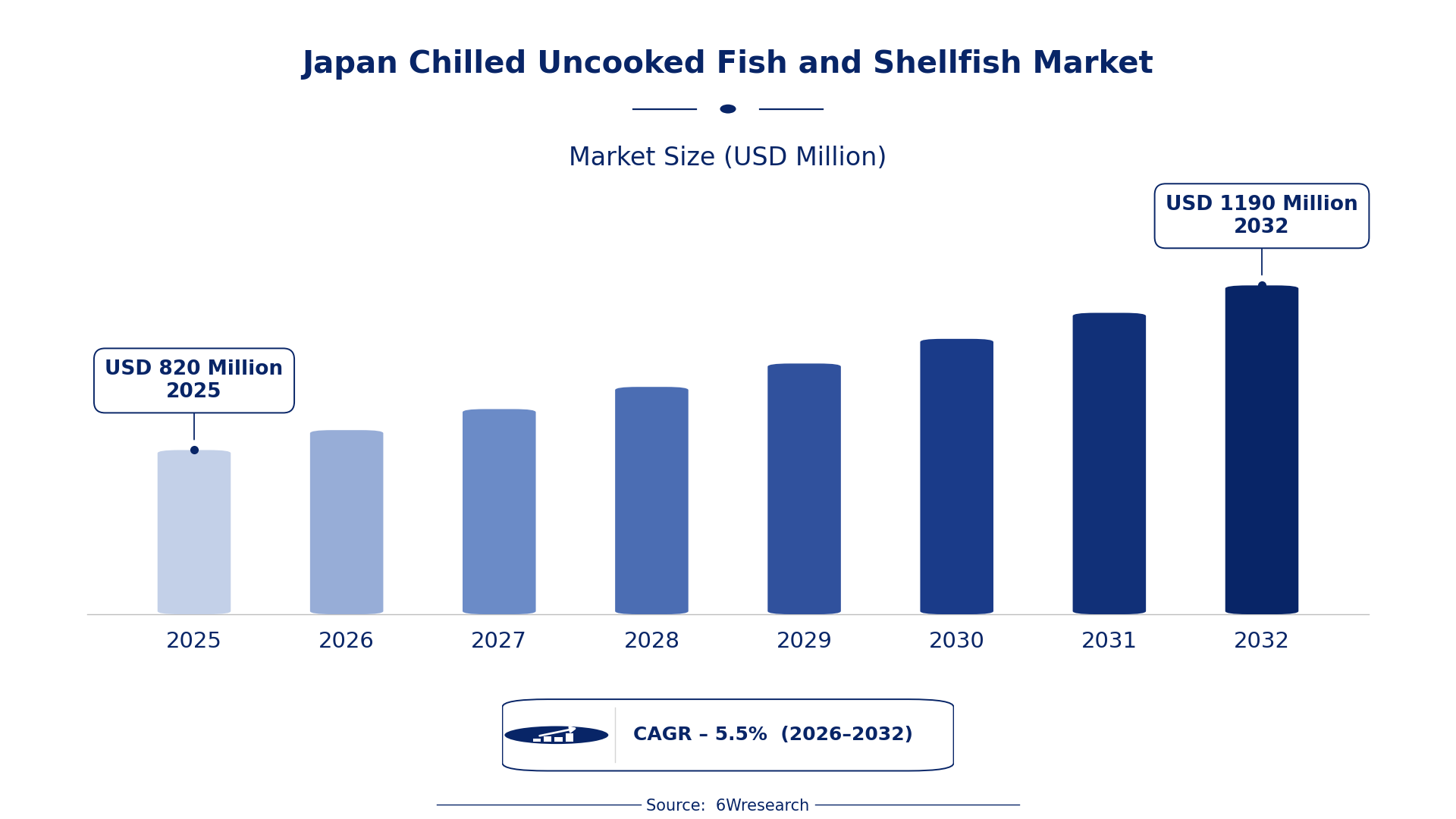
According to 6Wresearch internal database and industry insights, the Japan Chilled Uncooked Fish and Shellfish Market was valued at USD 820 Million in 2025 and is projected to reach USD 1,190 Million by 2032, growing at a CAGR of approximately 5.5% during 2026–2032.
Japan Chilled Uncooked Fish and Shellfish Market Highlights
| Report Metric | Details |
| Report Name | Japan Chilled Uncooked Fish and Shellfish Market (2026-2032) |
| Market Size 2025 | USD 820 Million |
| Market Size 2032 | USD 1,190 Million |
| Absolute Growth 2025–2032 | USD 370 Million |
| CAGR 2026–2032 | 5.5% |
| Peak Annual Growth | 6.5% in 2032 |
| Forecast Period | 2026–2032 |
| Historical Data | 2022–2025 |
| Base Year | 2025 |
| Leading Product Type, 2025 | Fish (59% share) |
| Leading End-user, 2025 | Food Processing Industry (37% share) |
| Leading Distribution Channel, 2025 | B2B (40% share) |
| Fastest-Growing Product Type | Shellfish (7.5% CAGR) |
| Fastest-Growing End-user | Food Service Provider (7.4% CAGR) |
| Fastest-Growing Distribution Channel | B2C (7.8% CAGR) |
| Growing Sector | Food Service Provider |
| Key End Users | Food Processing Industry, Food Service Provider, Retail/ Household |
Japan Chilled Uncooked Fish and Shellfish Market Year-wise Growth Rate and Key Drivers (2022–2032)
This graph illustrates the annual growth rates of the market from 2022 to 2032, highlighting a steady upward trajectory and projected market expansion over the forecast period.
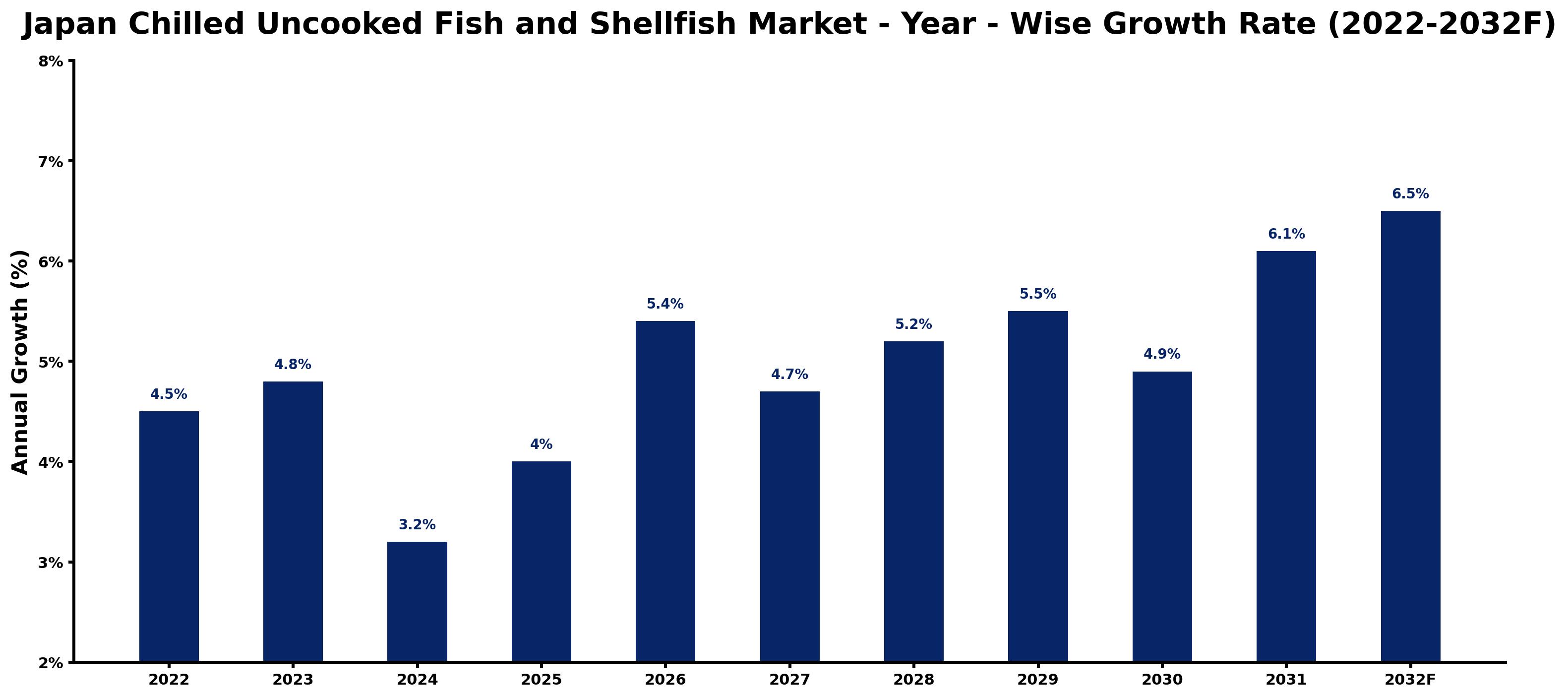
Each row of the following table gives one year's estimated growth and the event or demand shift that explains it.
| Year | Estimated Annual Growth (%) | Market Rationale |
| 2022 | 4.5 | The market showed steady growth, driven by increased seafood consumption in households. |
| 2023 | 4.8 | Growth was faster than the previous year, supported by rising demand from food service providers. |
| 2024 | 3.2 | Growth slowed as the market adjusted to supply chain challenges and fluctuating prices. |
| 2025 | 4.0 | The market experienced renewed growth, driven by increased retail demand for chilled seafood. |
| 2026 | 5.4 | Growth is expected to accelerate due to expanding online sales and consumer preference for fresh products. |
| 2027 | 4.7 | Growth is projected to slow as market saturation begins to affect purchasing patterns. |
| 2028 | 5.2 | The market is expected to rebound with faster growth, driven by new culinary trends and restaurant openings. |
| 2029 | 5.5 | Growth will continue to rise, supported by increased seafood consumption in urban areas. |
| 2030 | 4.9 | Growth is projected to slow as competition intensifies among suppliers in the chilled seafood segment. |
| 2031 | 6.1 | The market will see faster growth, driven by improved marketing strategies and product innovation. |
| 2032 | 6.5 | Growth is expected to peak as consumer preferences shift towards high-quality and sustainable seafood options. |
Note: Market size estimations and growth projections presented in this report are based on 6Wresearch's proprietary forecasting methodology, utilizing the latest available industry data, government publications, and primary research inputs.
Japan Chilled Uncooked Fish and Shellfish Market Synopsis
Chilled uncooked fish and shellfish are products maintained at low temperatures to ensure freshness. These items are widely consumed in households and restaurants, serving as key ingredients in various dishes. The Japan Chilled Uncooked Fish and Shellfish Market is growing due to rising consumption, particularly in urban areas, alongside increased demand from the food service sector. In 2022, Japan produced around 1.3 million tons of seafood, with a retail market valued at over 1 trillion JPY, revealing substantial opportunities for suppliers to capitalise on this growth.
Market Dynamics Impact Analysis (2026–2032)
| Factor | Type | Impact | Primary Segment Affected |
| Rising seafood consumption in urban areas | Driver | High | Retail/ Household |
| Growing demand from food service providers | Driver | High | Food Service Provider |
| Expansion of online seafood sales channels | Opportunity | High | B2C |
| Increased focus on sustainable seafood sourcing | Opportunity | High | Food Processing Industry |
| Strict regulations on seafood imports | Restraint | High | Fish |
| Challenges in maintaining seafood quality during transport | Restraint | Medium | Fish |
| High transportation costs affecting supply chain efficiency | Challenge | High | Fish |
| Intense competition among suppliers in the market | Challenge | Medium | Fish |
Evaluation of Drivers in Japan Chilled Uncooked Fish and Shellfish Market (2026–2032)
The following drivers explain most of the expected growth.
| Drivers | Primary Segment Affected | Why It Matters (Evidence) |
| Increased seafood consumption per capita | Retail/ Household | Japan's seafood consumption per capita is approximately 25 kg annually, driving demand for fresh products. |
| Rising number of restaurants and eateries | Food Service Provider | The Tokyo metropolitan area has the highest demand for chilled seafood products, increasing purchases from food service providers. |
| Growth of online retailing for seafood | B2C | Online seafood sales have surged by 15% in the last year, attracting more consumers to this channel. |
| Focus on sustainable fishing practices | Food Processing Industry | The promotion of sustainable fishing practices increases market appeal for seafood products. |
| Expansion of hypermarkets and supermarkets | Hypermarket/Supermarket | Hypermarkets account for a large share of the retail seafood market, boosting overall sales. |
Behind the steady rise in orders sits the increasing seafood consumption per capita, which is approximately 25 kg annually. Urban areas, particularly Tokyo, drive purchases from food service providers, reflecting a growing trend in dining out. Recent statistics show that online seafood sales surged by 15% last year, attracting more consumers to this channel. The focus on sustainable fishing practices is appealing to environmentally conscious buyers, while the expansion of hypermarkets has significantly increased the retail market's overall value, providing more access to consumers.
Evaluation of Restraints in Japan Chilled Uncooked Fish and Shellfish Market
The following restraints limit how fast demand can grow.
| Market Restraint | Primary Segment Affected | Why It Matters (Evidence) |
| Strict regulations on seafood imports | Fish | Japan has strict regulations to ensure quality and safety, limiting supply options for buyers. |
| Challenges in maintaining seafood quality during transport | Fish | Maintaining the quality of chilled seafood during transport is critical, often resulting in higher costs. |
| High transportation costs affecting supply chain efficiency | Fish | Transportation costs have risen sharply, impacting overall pricing strategies for suppliers. |
| Limited availability of certain seafood types | Fish | Seasonal fluctuations can lead to limited availability of specific seafood types, affecting supply consistency. |
| Intense competition among suppliers in the market | Fish | The competitive environment can lead to price wars, reducing profitability for suppliers. |
Japan Chilled Uncooked Fish and Shellfish Market Challenges
Japan experiences a shortage of skilled workers in the seafood sector due to low wages and challenging working conditions, which delays production and reduces output for producers. Many producers rely on outdated technology, as traditional methods persist, causing inefficiencies that inflate operational costs by approximately 20%. Rising raw material costs, influenced by strict environmental regulations, impose financial strain on buyers, potentially leading to price increases of up to 15%. Local producers face intense competition from imported seafood, forcing them to lower prices and jeopardising profit margins.
Trends in the Japan Chilled Uncooked Fish and Shellfish Market
The following changes are redrawing the Japan Chilled Uncooked Fish and Shellfish Market.
- Shift towards Online Seafood Sales: Tokyo is experiencing a notable shift towards online seafood sales, with a 15% increase in the last year. This trend reflects changing consumer preferences for convenience, prompting suppliers to strengthen their online presence.
- Rising Demand for Sustainable Seafood: The focus on sustainable seafood sourcing has gained traction, particularly in urban areas. Sustainable practices influence consumer choices and supplier strategies, aligning with market trends.
- Growing Popularity of Shellfish: Shellfish consumption is on the rise, accounting for about 20% of total seafood consumption in Japan. This trend is driven by culinary innovations and increased restaurant offerings featuring shellfish dishes.
- Expansion of Hypermarkets: The growth of hypermarkets in urban regions is reshaping seafood retail. These outlets are becoming major channels for seafood sales, contributing significantly to the retail market's overall value.
Investment Opportunities in the Japan Chilled Uncooked Fish and Shellfish Market
Where to invest in the Japan Chilled Uncooked Fish and Shellfish Market: the main openings are set out below.
- Investment in Online Retailing: The rise of online seafood sales, increasing by 15% last year, presents an opportunity for suppliers to invest in e-commerce platforms to reach more consumers effectively.
- Focus on Sustainable Seafood Products: With the promotion of sustainable fishing, suppliers can invest in eco-friendly seafood products to attract environmentally conscious consumers.
- Expansion into Hypermarkets: Hypermarkets are a growing channel for seafood sales, accounting for a large market share. Suppliers can partner with these retailers to improve visibility and sales.
- Development of New Culinary Products: The increasing popularity of shellfish offers opportunities for suppliers to develop new culinary products targeting restaurants and food service providers.
Government Initiatives in the Japan Chilled Uncooked Fish and Shellfish Market
The Food Recycling Law, enacted in 2000, mandates food businesses to reduce waste and recycle it into feed, fertiliser, and energy. This law, overseen by relevant ministries, encourages sustainable practices in the seafood industry, benefiting producers and suppliers of chilled uncooked fish and shellfish. The Food Sanitation Act amendment in 2018 introduced a system for ensuring safety standards in food packaging, which improves the quality of seafood products available in the market.
The food service sector benefits from the Food Sanitation Act amendment, which made hygiene management mandatory for food businesses. This regulation ensures that seafood served in restaurants meets high safety standards. The Digital Agency, established in September 2021, supports digital transformation in the food sector, streamlining processes for seafood suppliers and improving operational efficiency.
Future Insight of the Japan Chilled Uncooked Fish and Shellfish Market
By 2032, government initiatives will significantly transform the seafood market, particularly through enhanced aquaculture development, which will strengthen local production capabilities. Online seafood sales are expected to grow by 20% in the next five years, providing buyers with increased purchasing options. The implementation of stricter quality standards will elevate product safety, benefiting both buyers and suppliers. Technological advancements will streamline operations, allowing producers to improve product quality and meet evolving consumer preferences.
Market Segmentation Analysis
Japan Chilled Uncooked Fish and Shellfish Market report covers a detailed analysis of the following market segments:
By Product Type – Fish Leads, Shellfish Expected to Grow Fastest
According to Ravi Bhandari, Research Head at 6Wresearch, Fish took 59% of product type revenue in 2025, more than any other category. Fish holds the largest share because it is widely consumed in households and restaurants throughout Japan. The vibrant dining culture in the Tokyo metropolitan area significantly drives the demand for fish products. The quickest growth will come from Shellfish, forecast to expand at a CAGR of 7.5% between 2026 and 2032. Shellfish is experiencing rapid growth as it gains popularity in culinary dishes served at restaurants. The rising trend towards gourmet dining experiences has resulted in a marked increase in shellfish consumption. Suppliers should consider expanding their offerings of shellfish to align with the growing culinary demands.
By End-user – Food Processing Industry Leads, Food Service Provider Expected to Grow Fastest
Food Processing Industry accounted for 37% of the market by end-user in 2025. The food processing industry leads the market as it utilises chilled uncooked fish and shellfish as essential raw materials for various products. This sector's dependence on high-quality seafood is vital for maintaining product standards. Food Service Provider is set to record the highest CAGR in this split, 7.4% over 2026–2032. Food service providers are the fastest-growing segment, propelled by the increasing trend of dining out and catering services. The surge in the number of restaurants and catering events has significantly heightened the demand for chilled seafood. Suppliers must adapt their strategies to effectively meet the evolving needs of food service providers.
By Distribution Channel – B2B Leads, B2C Expected to Grow Fastest
The largest distribution channel category in 2025 was B2B, at 40% of revenue. B2B distribution dominates as it supplies chilled seafood directly to businesses like restaurants and hotels, which are key consumers in the market. The established relationships between suppliers and these businesses ensure a steady demand. Over 2026–2032, B2C is expected to post the fastest growth, at a CAGR of 7.8%. B2C is the fastest-growing channel, fuelled by the increasing trend of consumers purchasing seafood directly. The rise in online seafood sales, which increased by 15% last year, highlights the shift towards direct consumer engagement. Suppliers should invest in B2C channels to capitalise on the growing consumer preference for direct purchases.
Key Attractiveness of the Report
- 10 Years of Market Numbers
- Historical Data Starting from 2022 to 2025
- Base Year 2025
- Forecast Data until 2032
- Key Performance Indicators Impacting the Market
- Major Upcoming Developments and Projects
Key Highlights of the Report:
- Japan Chilled Uncooked Fish and Shellfish Market Outlook
- Market Size of Japan Chilled Uncooked Fish and Shellfish Market, 2025
- Forecast of Japan Chilled Uncooked Fish and Shellfish Market, 2032
- Historical Data and Forecast of Japan Chilled Uncooked Fish and Shellfish Revenues & Volume for the Period 2022-2032
- Japan Chilled Uncooked Fish and Shellfish Market Trend Evolution
- Japan Chilled Uncooked Fish and Shellfish Market Drivers and Challenges
- Japan Chilled Uncooked Fish and Shellfish Price Trends
- Japan Chilled Uncooked Fish and Shellfish Porter's Five Forces
- Japan Chilled Uncooked Fish and Shellfish Industry Life Cycle
- Historical Data and Forecast of Japan Chilled Uncooked Fish and Shellfish Market Revenues & Volume By Product Type for the Period 2022-2032
- Historical Data and Forecast of Japan Chilled Uncooked Fish and Shellfish Market Revenues & Volume By Fish for the Period 2022-2032
- Historical Data and Forecast of Japan Chilled Uncooked Fish and Shellfish Market Revenues & Volume By Shellfish for the Period 2022-2032
- Historical Data and Forecast of Japan Chilled Uncooked Fish and Shellfish Market Revenues & Volume By End-user for the Period 2022-2032
- Historical Data and Forecast of Japan Chilled Uncooked Fish and Shellfish Market Revenues & Volume By Food Processing Industry for the Period 2022-2032
- Historical Data and Forecast of Japan Chilled Uncooked Fish and Shellfish Market Revenues & Volume By Food Service Provider for the Period 2022-2032
- Historical Data and Forecast of Japan Chilled Uncooked Fish and Shellfish Market Revenues & Volume By Retail/ Household for the Period 2022-2032
- Historical Data and Forecast of Japan Chilled Uncooked Fish and Shellfish Market Revenues & Volume By Animal Feed and Pet Food? for the Period 2022-2032
- Historical Data and Forecast of Japan Chilled Uncooked Fish and Shellfish Market Revenues & Volume By Distribution Channel for the Period 2022-2032
- Historical Data and Forecast of Japan Chilled Uncooked Fish and Shellfish Market Revenues & Volume By B2B for the Period 2022-2032
- Historical Data and Forecast of Japan Chilled Uncooked Fish and Shellfish Market Revenues & Volume By B2C for the Period 2022-2032
- Historical Data and Forecast of Japan Chilled Uncooked Fish and Shellfish Market Revenues & Volume By Hypermarket/Supermarket? for the Period 2022-2032
- Historical Data and Forecast of Japan Chilled Uncooked Fish and Shellfish Market Revenues & Volume By Fish Mongers for the Period 2022-2032
- Historical Data and Forecast of Japan Chilled Uncooked Fish and Shellfish Market Revenues & Volume By Convenience Store? for the Period 2022-2032
- Historical Data and Forecast of Japan Chilled Uncooked Fish and Shellfish Market Revenues & Volume By Specialty Store? for the Period 2022-2032
- Historical Data and Forecast of Japan Chilled Uncooked Fish and Shellfish Market Revenues & Volume By Online Retailing? for the Period 2022-2032
- Historical Data and Forecast of Japan Chilled Uncooked Fish and Shellfish Market Revenues & Volume By Others? for the Period 2022-2032
- Japan Chilled Uncooked Fish and Shellfish Import Export Trade Statistics
- Market Opportunity Assessment By Product Type
- Market Opportunity Assessment By End-user
- Market Opportunity Assessment By Distribution Channel
- Japan Chilled Uncooked Fish and Shellfish Top Companies Market Share
- Japan Chilled Uncooked Fish and Shellfish Competitive Benchmarking By Technical and Operational Parameters
- Japan Chilled Uncooked Fish and Shellfish Company Profiles
- Japan Chilled Uncooked Fish and Shellfish Key Strategic Recommendations
Market Covered
The following segment groups are covered in the report.
By Product Type
- Fish
- Shellfish
By End-user
- Food Processing Industry
- Food Service Provider
- Retail/ Household
- Animal Feed and Pet Food
By Distribution Channel
- B2B
- B2C
- Hypermarket/Supermarket
- Fish Mongers
- Convenience Store
- Specialty Store
- Online Retailing
- Others































