Japan Clothes Iron Market Size & Growth Rate
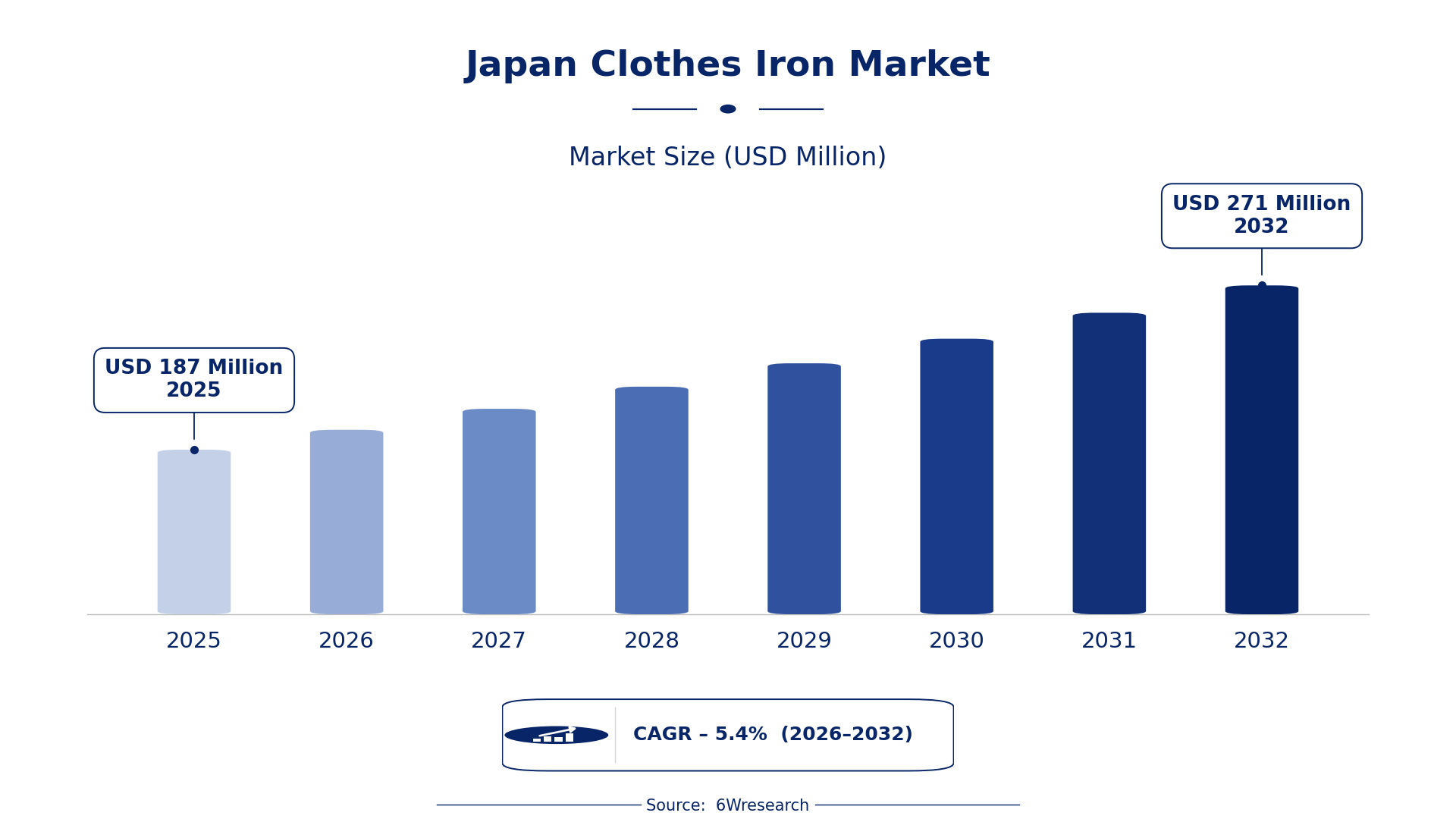
According to 6Wresearch internal database and industry insights, the Japan Clothes Iron Market was valued at USD 187 Million in 2025 and is projected to reach USD 271 Million by 2032, growing at a CAGR of approximately 5.4% during 2026–2032.
Japan Clothes Iron Market Highlights
| Report Metric | Details |
| Report Name | Japan Clothes Iron Market (2026-2032) |
| Market Size 2025 | USD 187 Million |
| Market Size 2032 | USD 271 Million |
| Absolute Growth 2025–2032 | USD 84 Million |
| CAGR 2026–2032 | 5.4% |
| Peak Annual Growth | 6.8% in 2032 |
| Forecast Period | 2026–2032 |
| Historical Data | 2022–2025 |
| Base Year | 2025 |
| Leading Product Type, 2025 | Normal Type (53% share) |
| Leading Price Point, 2025 | Premium (51% share) |
| Leading Application, 2025 | Household (46% share) |
| Leading Distribution Channel, 2025 | B2b (44% share) |
| Fastest-Growing Product Type | Thermostat Type (7.5% CAGR) |
| Fastest-Growing Price Point | Medium (7.2% CAGR) |
| Fastest-Growing Application | Commercial (7.1% CAGR) |
| Fastest-Growing Distribution Channel | B2C (7.9% CAGR) |
| Growing Sector | Commercial |
| Key End Users | Household, Commercial |
Japan Clothes Iron Market Year-wise Growth Rate and Key Drivers (2022–2032)
This graph illustrates the annual growth rates of the market from 2022 to 2032, highlighting a steady upward trajectory and projected market expansion over the forecast period.
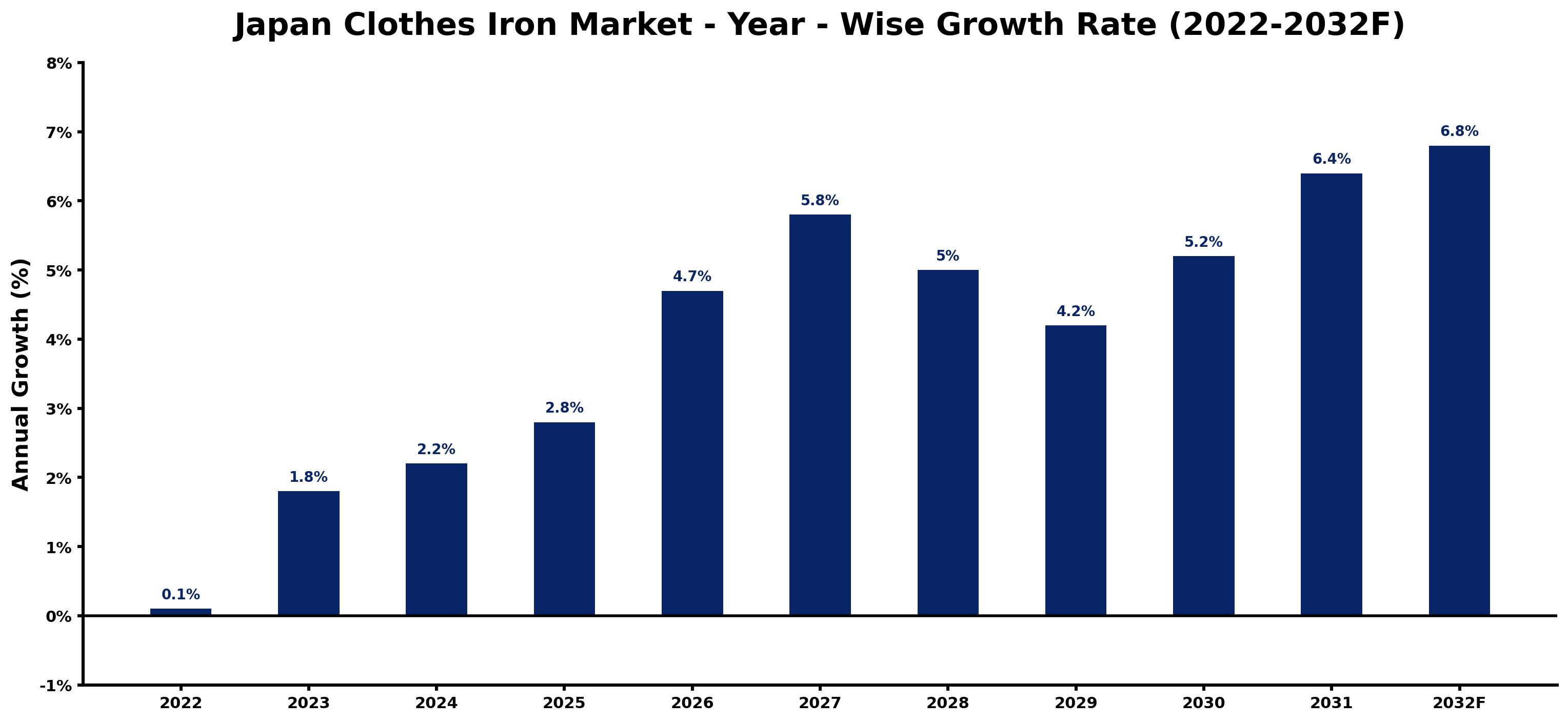
Year by year, the estimates below pair each growth rate with the development that shaped it.
| Year | Estimated Annual Growth (%) | Market Rationale |
| 2022 | 0.1 | The market showed minimal growth due to a stable demand environment. |
| 2023 | 1.8 | Growth accelerated as households increasingly sought efficient ironing solutions. |
| 2024 | 2.2 | Rising consumer interest in steam irons contributed to faster growth. |
| 2025 | 2.8 | Demand surged as the market reached its historical peak growth rate. |
| 2026 | 4.7 | Investment in energy-efficient appliances is expected to drive higher demand. |
| 2027 | 5.8 | Consumer preference will shift towards advanced thermostat models, boosting sales. |
| 2028 | 5.0 | Growth is projected to slow slightly as the market matures and competition intensifies. |
| 2029 | 4.2 | A further slowdown is expected as saturation in household ownership becomes apparent. |
| 2030 | 5.2 | Market conditions will improve with renewed interest in energy-saving technologies. |
| 2031 | 6.4 | Growth will pick up again as new product launches attract consumer attention. |
| 2032 | 6.8 | The market is projected to peak with increased investment in innovation. |
Note: Market size estimations and growth projections presented in this report are based on 6Wresearch's proprietary forecasting methodology, utilizing the latest available industry data, government publications, and primary research inputs.
Japan Clothes Iron Market Synopsis
Clothes irons are essential electrical appliances used to remove wrinkles from garments, primarily made of metal plates that heat up. The household sector is the primary user, with notable contributions from commercial applications in laundries and garment factories. The Japan Clothes Iron Market is experiencing growth driven by rising consumer demand for energy-efficient appliances, with online sales increasing by 25% in 2023, particularly in urban areas like Tokyo, where the market is concentrated.
Market Dynamics Impact Analysis (2026–2032)
| Factor | Type | Impact | Primary Segment Affected |
| Increasing demand for energy-efficient appliances | Driver | High | Steam Type |
| Rising online sales post-pandemic | Driver | High | B2C |
| Expansion of energy-saving campaigns | Opportunity | High | Household |
| Growth in urban population density | Opportunity | High | Commercial |
| High competition among brands leading to price wars | Restraint | Medium | Normal Type |
| Market saturation in household ownership of clothes irons | Restraint | Medium | Household |
| Challenges in meeting new energy efficiency standards | Challenge | High | Steam Type |
| Rising costs of raw materials affecting pricing | Challenge | Medium | Premium |
Evaluation of Drivers in Japan Clothes Iron Market (2026–2032)
Below are the drivers that matter most for revenue growth, with supporting evidence.
| Drivers | Primary Segment Affected | Why It Matters (Evidence) |
| Growing consumer preference for steam irons | Steam Type | Steam irons accounted for over 60% of household sales in 2023, driving demand for effective wrinkle removal. |
| Increased online shopping for home appliances | B2C | Online sales of clothes irons rose by 25% in 2023, reflecting a shift in consumer purchasing behaviour. |
| Investment in energy-efficient technologies | Household | The government allocated 2 billion yen in 2023 to promote energy-efficient home appliances, encouraging consumer purchases. |
| Urban population density in major cities | Commercial | The Kanto region's high urban density supports greater demand for clothes irons in laundries and textile production. |
| Rising average household expenditure on home appliances | Normal Type | The average household spent around 100,000 yen annually on home appliances, including clothes irons. |
Volumes grow on the back of increased consumer preference for steam irons, which accounted for over 60% of household sales in 2023. The shift towards online shopping has also driven demand, with online sales increasing by 25% last year. The rising average household expenditure on home appliances fuels the market for clothes irons, reflecting a growing willingness to invest in quality products.
Evaluation of Restraints in Japan Clothes Iron Market
These are the pressures that could keep growth below its potential.
| Market Restraint | Primary Segment Affected | Why It Matters (Evidence) |
| Intense competition leading to price wars | Normal Type | Intense competition has resulted in aggressive pricing strategies, which can reduce profit margins for manufacturers. |
| Market saturation in household ownership | Household | With the average household owning 1.5 irons, growth is constrained as fewer new purchases occur. |
| Challenges in meeting energy efficiency standards | Steam Type | New energy efficiency standards require manufacturers to invest heavily in technology to comply. |
| Rising raw material costs impacting pricing | Premium | Increased costs for materials used in high-end irons can lead to higher retail prices, affecting sales. |
| Limited commercial sales channels for bulk purchases | B2b | The B2b segment faces challenges due to fewer established distribution networks for bulk orders. |
Japan Clothes Iron Market Challenges
Producers of clothes irons are grappling with rising material costs stemming from fluctuations in metal prices, which have increased production expenses by up to 15% and led to higher retail prices for consumers. Buyers are facing delays in receiving new models due to supply chain disruptions, potentially resulting in a 10% loss in sales during peak seasons. Manufacturers are also struggling with slow technology adoption, which limits advancements in energy-efficient designs, deterring environmentally conscious consumers. Workforce skills shortages are impacting production efficiency, causing delays that can extend lead times by an average of three weeks for suppliers.
Trends in the Japan Clothes Iron Market
Four trends stand out in the Japan Clothes Iron Market.
- Launch of New Energy Efficiency Labeling System: In 2023, Japan implemented a new energy efficiency labeling system for home appliances. This initiative encourages consumers to select energy-saving products, aiming to reduce household energy consumption.
- Shift to Online Sales Channels: The trend towards online shopping for clothes irons has accelerated, with online sales increasing by 25% in 2023. This shift reflects evolving consumer preferences, particularly among younger demographics.
- Increased Popularity of Steam Irons: Steam irons have gained popularity, accounting for over 60% of household sales in 2023. Their effectiveness in wrinkle removal has made them the preferred choice among consumers.
- Focus on Urban Markets: The Kanto region has emerged as the largest market for clothes irons, driven by its high urban population density. This concentration of consumers presents opportunities for targeted marketing and sales strategies.
Investment Opportunities in the Japan Clothes Iron Market
The following opportunities in the Japan Clothes Iron Market pair current demand with a clear way in.
- Supply Energy-Efficient Clothes Irons: With the government's emphasis on energy-efficient appliances, there is a growing market for clothes irons that meet these standards. The 2 billion yen allocated for this initiative in 2023 offers a timely investment opportunity for manufacturers.
- Expand Online Sales Platforms: The shift to online shopping is creating a gap in the market, as online sales of clothes irons rose by 25% in 2023. Investing in e-commerce platforms can capture this expanding consumer base.
- Target Commercial Applications: The commercial sector, particularly laundries, is expanding due to urban density. Suppliers can focus on high-capacity steam irons to meet this demand, especially in metropolitan areas.
- Develop Premium Product Lines: As consumers seek high-quality appliances, there is an opportunity to develop premium clothes irons. The average household expenditure on home appliances is around 100,000 yen annually, indicating a readiness to invest.
Government Initiatives in the Japan Clothes Iron Market
The Act on Japanese Industrial Standards governs the safety and performance standards for clothes irons, ensuring that manufacturers comply with quality requirements. This law mandates that products meet specific criteria, helping buyers trust the safety and efficiency of their appliances. Compliance with JIS standards is crucial for producers, as it directly affects their marketability and consumer confidence, leading to improved sales outcomes in a competitive environment.
The Consumer Affairs Agency oversees the enforcement of the Act against Unjustifiable Premiums and Misleading Representations, which protects buyers from deceptive marketing practices. This agency ensures that all advertising for clothes irons is truthful, allowing consumers to make informed choices. In 2023, the agency increased its focus on monitoring compliance, benefiting consumers by ensuring they receive products that meet advertised claims.
Future Insight of the Japan Clothes Iron Market
Investment in energy-efficient technologies will drive the development of new clothes iron models by 2032, responding to consumer demand for sustainable options. New energy efficiency standards will encourage suppliers to innovate, aligning with government initiatives promoting energy-saving appliances. The average lifespan of clothes irons is expected to improve, with many models lasting up to 10 years, reducing replacement frequency and costs for households. Enhanced online sales channels will reflect a shift in consumer preference for convenience and accessibility.
Market Segmentation Analysis
Japan Clothes Iron Market report covers a detailed analysis of the following market segments:
By Product Type – Normal Type Leads, Thermostat Type Expected to Grow Fastest
According to Ravi Bhandari, Research Head at 6Wresearch, with 53% of product type revenue in 2025, Normal Type was the largest category. Normal Type holds the largest share as it is predominantly used in households, where the average consumer opts for this type for daily ironing tasks. Its established presence in residential settings makes it the preferred choice for many Japanese households. Thermostat Type is set to record the highest CAGR in this split, 7.5% over 2026–2032. Thermostat Type is witnessing rapid growth as consumers increasingly demand precise temperature control for various fabrics, indicating a shift towards more specialised ironing solutions. This segment's expansion is fuelled by the rising need for tailored ironing experiences in both household and commercial applications. Suppliers should focus on enhancing the features of thermostat irons to capture the growing consumer interest.
By Price Point – Premium Leads, Medium Expected to Grow Fastest
In 2025, Premium led the price point split with a 51% share. The Premium segment leads the market as it attracts consumers seeking high-quality features and durability, appealing to those willing to invest more for advanced technology. This trend is particularly strong among niche markets prioritising performance and longevity in their appliance choices. The quickest growth will come from Medium, forecast to expand at a CAGR of 7.2% between 2026 and 2032. The Medium price segment is growing quickly as it appeals to the average consumer looking for a balance between quality and affordability, especially in a competitive market. Increasing consumer awareness and demand for value-for-money appliances are driving this segment's growth. Suppliers should consider expanding their medium-range offerings to cater to the rising demand from budget-conscious consumers.
By Application – Household Leads, Commercial Expected to Grow Fastest
Household took 46% of application revenue in 2025, more than any other category. Household applications dominate the market as they represent the primary use case for clothes irons, driven by personal clothing care needs in Japanese homes. The high number of households in urban areas contributes significantly to the sustained demand for this segment. Over 2026–2032, Commercial is expected to post the fastest growth, at a CAGR of 7.1%. Commercial applications are rapidly growing due to the increasing reliance on professional ironing services in laundries and textile production, reflecting a trend towards outsourcing these tasks. The expansion of the textile industry in Japan is a key factor behind this growth. Suppliers should explore partnerships with commercial entities to tap into the expanding market for professional ironing solutions.
By Distribution Channel – B2b Leads, B2C Expected to Grow Fastest
B2b held 44% of the Japan Clothes Iron Market by distribution channel in 2025. The B2B channel leads as it caters to commercial buyers who purchase in bulk for professional use, ensuring steady demand from businesses such as laundries. This segment benefits from established relationships between suppliers and commercial clients, facilitating consistent sales. B2C is projected to grow fastest, at a CAGR of 7.9% during 2026–2032. The B2C channel is growing swiftly as more consumers turn to direct purchases for convenience and a wider selection of products, particularly through retail outlets. The increasing trend of direct shopping is also contributing to this channel's rapid expansion. Suppliers should enhance their B2C strategies to capitalise on the growing consumer preference for direct purchasing.
Key Attractiveness of the Report
- 10 Years of Market Numbers
- Historical Data Starting from 2022 to 2025
- Base Year 2025
- Forecast Data until 2032
- Key Performance Indicators Impacting the Market
- Major Upcoming Developments and Projects
Key Highlights of the Report:
- Japan Clothes Iron Market Outlook
- Market Size of Japan Clothes Iron Market, 2025
- Forecast of Japan Clothes Iron Market, 2032
- Historical Data and Forecast of Japan Clothes Iron Revenues & Volume for the Period 2022-2032
- Japan Clothes Iron Market Trend Evolution
- Japan Clothes Iron Market Drivers and Challenges
- Japan Clothes Iron Price Trends
- Japan Clothes Iron Porter's Five Forces
- Japan Clothes Iron Industry Life Cycle
- Historical Data and Forecast of Japan Clothes Iron Market Revenues & Volume By Product Type for the Period 2022-2032
- Historical Data and Forecast of Japan Clothes Iron Market Revenues & Volume By Normal Type for the Period 2022-2032
- Historical Data and Forecast of Japan Clothes Iron Market Revenues & Volume By Thermostat Type for the Period 2022-2032
- Historical Data and Forecast of Japan Clothes Iron Market Revenues & Volume By Steam Type for the Period 2022-2032
- Historical Data and Forecast of Japan Clothes Iron Market Revenues & Volume By Other for the Period 2022-2032
- Historical Data and Forecast of Japan Clothes Iron Market Revenues & Volume By Price Point for the Period 2022-2032
- Historical Data and Forecast of Japan Clothes Iron Market Revenues & Volume By Premium for the Period 2022-2032
- Historical Data and Forecast of Japan Clothes Iron Market Revenues & Volume By Medium for the Period 2022-2032
- Historical Data and Forecast of Japan Clothes Iron Market Revenues & Volume By Economy for the Period 2022-2032
- Historical Data and Forecast of Japan Clothes Iron Market Revenues & Volume By Application for the Period 2022-2032
- Historical Data and Forecast of Japan Clothes Iron Market Revenues & Volume By Household for the Period 2022-2032
- Historical Data and Forecast of Japan Clothes Iron Market Revenues & Volume By Commercial for the Period 2022-2032
- Historical Data and Forecast of Japan Clothes Iron Market Revenues & Volume By Other for the Period 2022-2032
- Historical Data and Forecast of Japan Clothes Iron Market Revenues & Volume By Distribution Channel for the Period 2022-2032
- Historical Data and Forecast of Japan Clothes Iron Market Revenues & Volume By B2b for the Period 2022-2032
- Historical Data and Forecast of Japan Clothes Iron Market Revenues & Volume By B2C for the Period 2022-2032
- Historical Data and Forecast of Japan Clothes Iron Market Revenues & Volume By Online for the Period 2022-2032
- Japan Clothes Iron Import Export Trade Statistics
- Market Opportunity Assessment By Product Type
- Market Opportunity Assessment By Price Point
- Market Opportunity Assessment By Application
- Market Opportunity Assessment By Distribution Channel
- Japan Clothes Iron Top Companies Market Share
- Japan Clothes Iron Competitive Benchmarking By Technical and Operational Parameters
- Japan Clothes Iron Company Profiles
- Japan Clothes Iron Key Strategic Recommendations
Market Covered
The report covers the following segments.
By Product Type
- Normal Type
- Thermostat Type
- Steam Type
- Other
By Price Point
- Premium
- Medium
- Economy
By Application
- Household
- Commercial
- Other
By Distribution Channel
- B2b
- B2C
- Online































