Japan Cold Storage Warehouse Market Size & Growth Rate
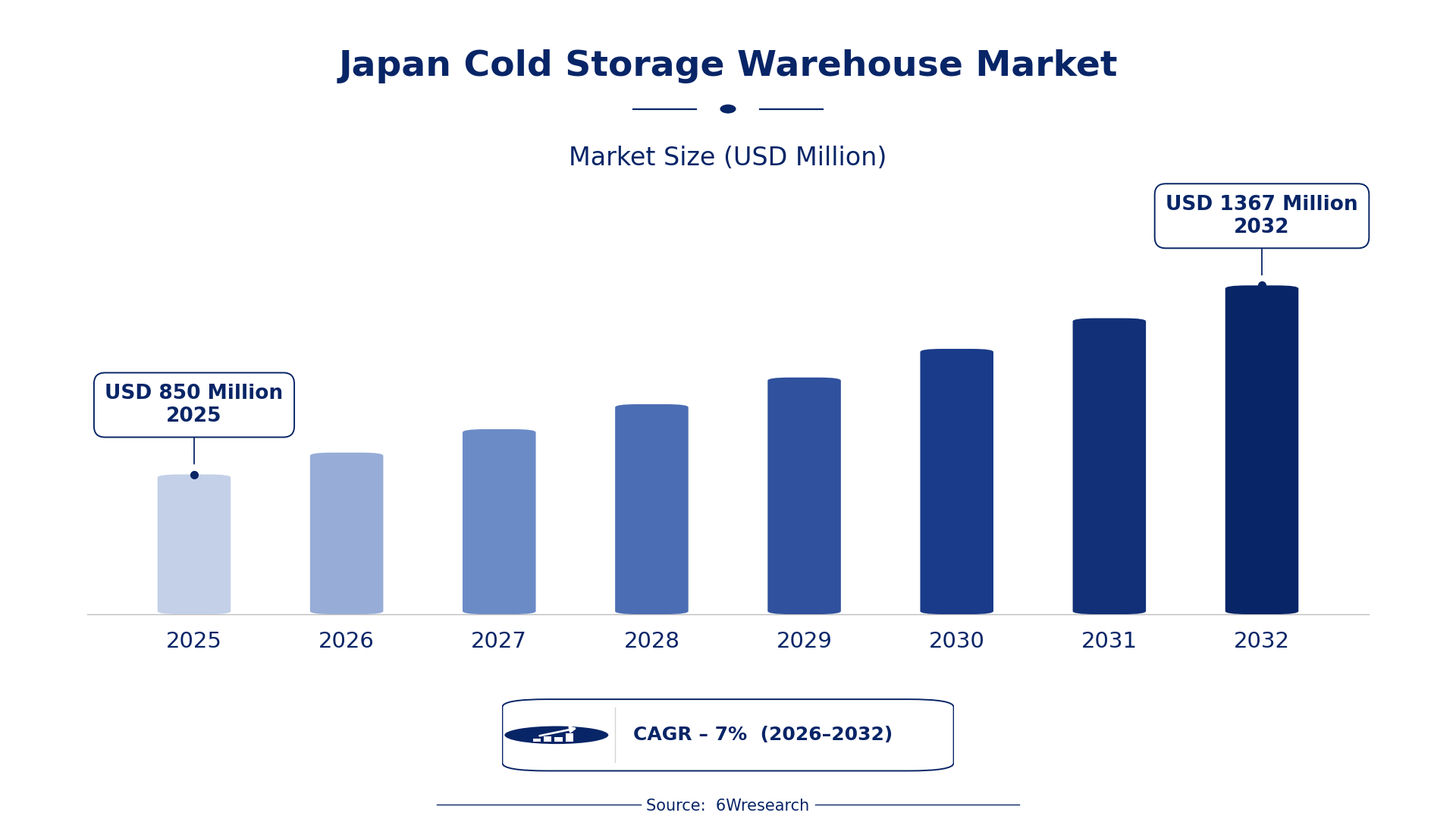
According to 6Wresearch internal database and industry insights, the Japan Cold Storage Warehouse Market was valued at USD 850 Million in 2025 and is projected to reach USD 1,367 Million by 2032, growing at a CAGR of approximately 7% during 2026–2032.
Japan Cold Storage Warehouse Market Highlights
| Report Metric | Details |
| Report Name | Japan Cold Storage Warehouse Market (2026-2032) |
| Market Size 2025 | USD 850 Million |
| Market Size 2032 | USD 1,367 Million |
| Absolute Growth 2025–2032 | USD 517 Million |
| CAGR 2026–2032 | 7% |
| Peak Annual Growth | 7.7% in 2026 |
| Forecast Period | 2026–2032 |
| Historical Data | 2022–2025 |
| Base Year | 2025 |
| Leading Type, 2025 | Refrigerated Containers (55% share) |
| Leading Temperature, 2025 | -30 to 0C (45% share) |
| Leading Application, 2025 | Food & Beverage (48% share) |
| Leading End-user, 2025 | Public Warehousing (59% share) |
| Fastest-Growing Temperature | Below -30C (8.6% CAGR) |
| Fastest-Growing Application | Biopharmaceuticals (9.7% CAGR) |
| Fastest-Growing End-user | Private Warehousing (8.4% CAGR) |
| Growing Sector | Food & Beverage |
| Key End Users | Food producers, Biopharmaceutical manufacturers, Logistics providers |
Japan Cold Storage Warehouse Market Year-wise Growth Rate and Key Drivers (2022–2032)
This graph illustrates the annual growth rates of the market from 2022 to 2032, highlighting a steady upward trajectory and projected market expansion over the forecast period.
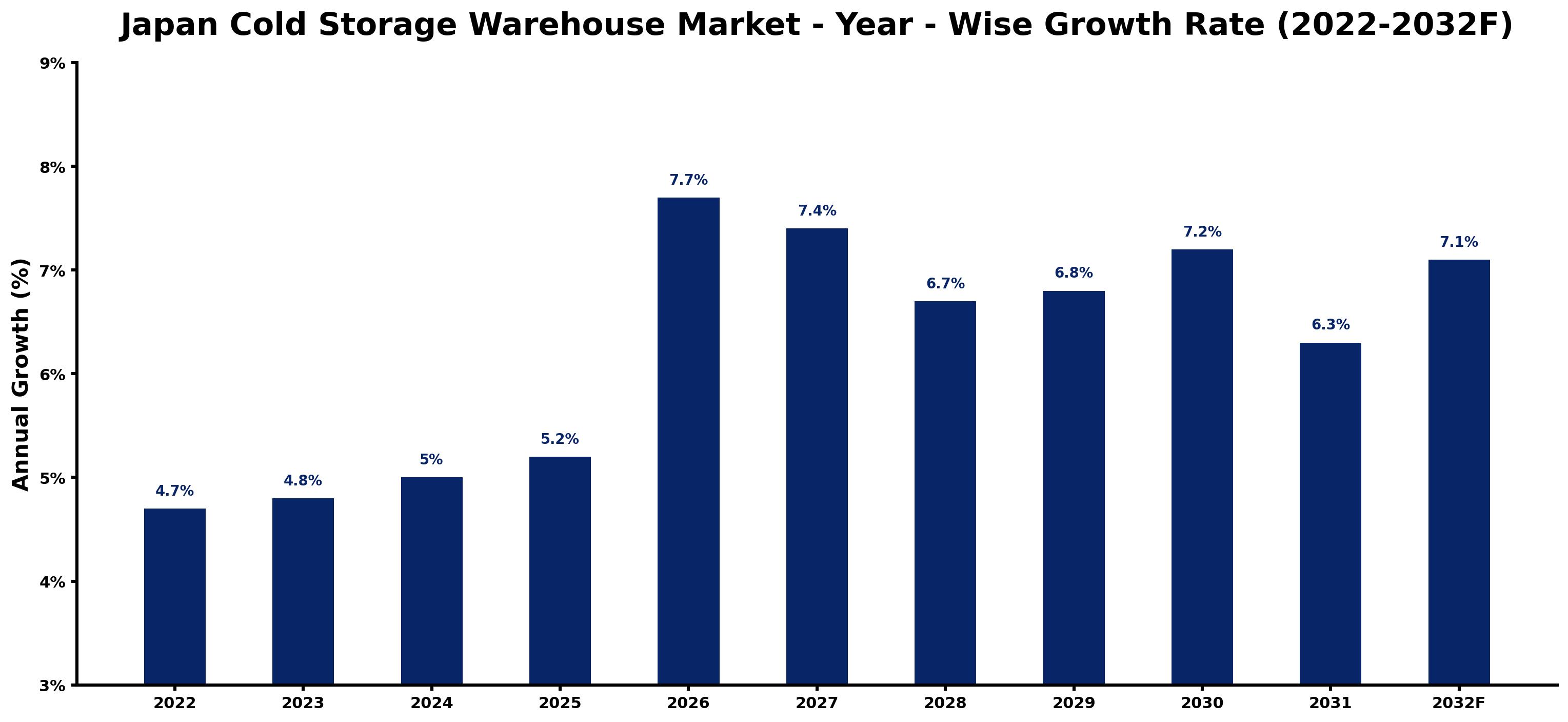
Below, each year's estimated growth is shown next to the factor that most influenced it.
| Year | Estimated Annual Growth (%) | Market Rationale |
| 2022 | 4.7 | The market experienced steady growth, driven by increasing demand for cold storage solutions. |
| 2023 | 4.8 | Demand continued to rise as the food and beverage sector expanded its cold storage needs. |
| 2024 | 5.0 | Growth accelerated with ongoing investments in cold storage technology and infrastructure. |
| 2025 | 5.2 | The market reached a peak growth rate, supported by heightened demand in urban areas. |
| 2026 | 7.7 | The market is expected to see strong growth as the biopharmaceutical sector increases cold storage requirements. |
| 2027 | 7.4 | Growth is projected to slow slightly due to market maturation and competition among providers. |
| 2028 | 6.7 | Demand will remain strong, though growth rates are expected to moderate from previous highs. |
| 2029 | 6.8 | The market is anticipated to rebound with renewed investments in cold storage facilities and technology. |
| 2030 | 7.2 | Growth is expected to pick up again as trade in refrigerated containers expands. |
| 2031 | 6.3 | The market will experience a slowdown as capacity constraints begin to emerge. |
| 2032 | 7.1 | Demand is projected to surge again, driven by new regulations and increased focus on food safety. |
Note: Market size estimations and growth projections presented in this report are based on 6Wresearch's proprietary forecasting methodology, utilizing the latest available industry data, government publications, and primary research inputs.
Japan Cold Storage Warehouse Market Synopsis
Cold storage warehouses are crucial for preserving perishable goods, built with advanced refrigeration systems. They support key sectors such as food products and biopharmaceuticals. The Japan Cold Storage Warehouse Market is growing due to increasing demand from the food and beverage sector, which represents 50% of capacity, alongside the biopharmaceutical industry, expected to see substantial growth by 2025. The Tokyo metropolitan area, accounting for 30% of demand, underscores urban requirements for efficient cold chain logistics.
Market Dynamics Impact Analysis (2026–2032)
| Factor | Type | Impact | Primary Segment Affected |
| Rising demand from the food and beverage sector | Driver | High | Food & Beverage |
| Increased biopharmaceutical sector growth | Driver | High | Biopharmaceuticals |
| Investment in cold storage technology | Opportunity | High | Refrigerated Containers |
| Expansion of trade in refrigerated containers | Opportunity | High | Refrigerated Containers |
| Capacity constraints in urban areas | Restraint | High | Public Warehousing |
| Strict hygiene and safety regulations | Restraint | Medium | Refrigerated Containers |
| Competition among cold storage providers | Challenge | Medium | Private Warehousing |
| Aging cold storage infrastructure | Challenge | Medium | Refrigerated Containers |
Evaluation of Drivers in Japan Cold Storage Warehouse Market (2026–2032)
Key forces behind demand, with the segment each one moves most, are listed below.
| Drivers | Primary Segment Affected | Why It Matters (Evidence) |
| Expansion of the food and beverage sector | Food & Beverage | The food and beverage sector, accounting for 50% of capacity, drives demand for cold storage to preserve perishable items, particularly in urban areas like Tokyo. |
| Growth in the biopharmaceutical industry | Biopharmaceuticals | The biopharmaceutical sector's expected growth increases the need for cold storage solutions, particularly for vaccines and sensitive medical products. |
| Investment in cold storage technology | Refrigerated Containers | Investment in cold storage technology has risen by 20% over the last five years, enhancing operational efficiency and increasing capacity. |
| Rising trade in refrigerated containers | Refrigerated Containers | Increased trade activities necessitate more refrigerated containers, expanding the market for temperature-sensitive goods across Japan. |
| Urbanisation and population growth | Public Warehousing | Urbanisation, particularly in metropolitan areas, raises demand for public warehousing solutions, which rely heavily on cold storage facilities. |
Orders keep climbing as the food and beverage sector expands, accounting for 50% of cold storage capacity. The biopharmaceutical industry is also growing, increasing the need for temperature-controlled storage solutions. Investments in cold storage technology have risen by 20% over the last five years, leading to improved operational capabilities. The logistics sector employs over 1 million people, many in cold storage roles, which supports the demand for efficient storage solutions. Overall, the market is adapting to meet the needs of various industries, including food and pharmaceuticals.
Evaluation of Restraints in Japan Cold Storage Warehouse Market
The table below lists the restraints and the evidence behind each.
| Market Restraint | Primary Segment Affected | Why It Matters (Evidence) |
| Strict hygiene and safety regulations | Refrigerated Containers | Compliance with hygiene regulations requires costly upgrades, increasing operational expenses by up to 15% for cold storage facilities. |
| Unpredictable demand in the food sector | Food & Beverage | Fluctuating demand in the food and beverage sector can lead to excess stock, causing financial losses for cold storage providers. |
| Intense competition among suppliers | Public Warehousing | Fierce competition in urban areas compresses profit margins, making it challenging for suppliers to maintain sustainable operations. |
| Shortage of skilled workers | Refrigerated Containers | A shortage of skilled workers in logistics leads to recruitment delays and increased training costs, affecting operational efficiency. |
| High operational costs | Refrigerated Containers | Rising energy costs and maintenance expenses strain the profitability of refrigerated container operations, impacting overall market growth. |
Japan Cold Storage Warehouse Market Challenges
Strict hygiene and safety regulations pose a considerable challenge for suppliers, as compliance necessitates costly upgrades to facilities, raising operational expenses by up to 15%. Buyers encounter unpredictable demand in the food and beverage sector, consuming 50% of cold storage capacity; this volatility can lead to excess stock and financial losses. In urban centres like Tokyo, intense competition among suppliers compresses profit margins, complicating operational sustainability. A shortage of skilled workers in logistics affects efficiency, with over 1 million employees in the sector, resulting in recruitment delays and increased training costs.
Trends in the Japan Cold Storage Warehouse Market
Four trends stand out in the Japan Cold Storage Warehouse Market.
- Launch of the Cold Chain Logistics Improvement Program: In 2023, the government initiated a program to improve cold chain logistics efficiency, aiming to reduce food waste by 20% by 2030. This initiative encourages investment in modern storage facilities.
- Shift towards Advanced Refrigeration Technologies: The cold storage market is increasingly adopting advanced refrigeration technologies to improve efficiency and reduce energy consumption. This shift is evident in facilities across Chiba, where energy-efficient systems are being implemented.
- Growing Demand for Biopharmaceutical Storage Solutions: The biopharmaceutical sector is experiencing a surge in demand for cold storage solutions, particularly for vaccines. This trend is reflected in the projected growth of the sector, expected to expand significantly by 2025.
- Increased Focus on Food Safety Standards: With the introduction of ISO 22000 standards, cold storage facilities are prioritising food safety management. Compliance with these standards is becoming essential for operators in the food and beverage sector.
Investment Opportunities in the Japan Cold Storage Warehouse Market
Below are the investment opportunities with the strongest case in the Japan Cold Storage Warehouse Market.
- Partnerships for Cold Storage Expansion: Now is a prime opportunity for partnerships to expand cold storage facilities, particularly in urban areas like Tokyo, where demand is increasing sharply. Collaborating with local logistics firms can ease market entry.
- Investment in Refrigerated Container Technology: With the refrigerated container market anticipated to grow, investing in advanced container technology is timely. Focusing on trade hubs such as Chiba can strengthen market presence.
- Development of Custom Cold Storage Solutions: The demand for tailored cold storage solutions is rising, especially in the biopharmaceutical sector. Concentrating on this niche can yield substantial returns for investors.
- Approval for Energy-Efficient Cold Storage Projects: Now is the ideal time to invest in energy-efficient cold storage projects, given government targets for reducing food waste. Engaging with the Ministry of Agriculture, Forestry and Fisheries can streamline approvals.
Government Initiatives in the Japan Cold Storage Warehouse Market
The PRTR Law, enacted in 1999, requires businesses to report chemical substance releases, ensuring safety in cold storage operations. Additionally, the Chemical Substances Control Law mandates evaluation and control of chemicals used in cold storage facilities, promoting safer practices. These regulations help ensure that cold storage facilities operate within safety standards, benefiting both producers and consumers.
In 2023, the government launched a programme to enhance cold chain logistics efficiency, overseen by the Ministry of Agriculture, Forestry and Fisheries. This initiative aims to improve cold storage capabilities and reduce food waste across the country, directly impacting the efficiency of cold storage operations.
Future Insight of the Japan Cold Storage Warehouse Market
A policy-driven shift towards improved cold chain logistics efficiency will transform the market by 2032. Investment in cold storage technology has risen significantly, with a 20% increase over the last five years, improving operational capabilities. Growth in the food and beverage sector will fuel demand for storage solutions that comply with evolving safety standards. Government initiatives aimed at reducing food waste will necessitate upgrades in storage practices, ensuring better preservation of perishable goods and minimising losses.
Market Segmentation Analysis
Japan Cold Storage Warehouse Market report covers a detailed analysis of the following market segments:
By Type – Refrigerated Containers Lead and Record the Fastest Growth
According to Sumit Sagar, AM at 6Wresearch, Refrigerated Containers took 55% of type revenue in 2025, more than any other category. Refrigerated containers dominate the market due to their vital role in transporting temperature-sensitive goods over long distances, especially for the food and beverage sector. With Japan's cold storage capacity reaching approximately 2 million tons, these containers are essential for maintaining product quality during distribution. Refrigerated Containers are also forecast to expand faster than any other category, at a CAGR of 8.9% over 2026–2032. The refrigerated container segment is poised for rapid growth, driven by a 20% increase in investments in cold storage technology over the last five years. This trend will likely widen the lead of refrigerated containers as they continue to meet logistics demands effectively. Suppliers should prioritise enhancing refrigerated container offerings to address the increasing market demands.
By Temperature – -30 to 0C Leads, Below -30C Expected to Grow Fastest
With 45% of temperature revenue in 2025, -30 to 0C was the largest category. The -30 to 0C temperature range is crucial for preserving frozen goods long-term, particularly within Japan's seafood industry, one of the largest globally. This segment's importance is underscored by the average temperature range for food storage being maintained within these limits. The quickest growth will come from Below -30C, forecast to expand at a CAGR of 8.6% between 2026 and 2032. The Below -30C segment is gaining traction due to the rising need for storing specific pharmaceuticals and biological materials that require stringent temperature controls. As the biopharmaceutical sector grows, this sub-segment will likely see accelerated demand. Buyers must ensure compliance with temperature standards to maintain product quality and adhere to industry regulations.
By Application – Food & Beverage Leads, Biopharmaceuticals Expected to Grow Fastest
In 2025, Food & Beverage led the application split with a 48% share. The food and beverage sector accounts for 50% of cold storage capacity, making it the largest user of these facilities in Japan. This high demand arises from the necessity to effectively preserve perishable food items, particularly in urban areas with significant consumption rates. Biopharmaceuticals are set to record the highest CAGR in this split, 9.7% over 2026–2032. Biopharmaceuticals are experiencing rapid growth as they are essential for storing vaccines and other sensitive medical products. This sector's expansion will further increase the need for specialised cold storage solutions to ensure product integrity. Suppliers must adapt their offerings to meet the growing biopharmaceutical market's specific storage requirements.
By End-user – Public Warehousing Leads, Private Warehousing Expected to Grow Fastest
Public Warehousing held 59% of the Japan Cold Storage Warehouse Market by end-user in 2025. Public warehousing provides essential storage services for various businesses, making it the leading end-user segment in Japan's cold storage market. The concentration of cold storage facilities in urban areas supports this demand, particularly in metropolitan regions like Tokyo. Over 2026–2032, Private Warehousing is expected to post the fastest growth, at a CAGR of 8.4%. Private warehousing is on the rise as companies increasingly seek to manage their own inventory more effectively, reflecting a shift towards customised storage solutions. This trend indicates a growing preference for in-house management of cold storage needs. Buyers should consider the benefits of private warehousing for greater control over inventory.
Key Attractiveness of the Report
- 10 Years of Market Numbers
- Historical Data Starting from 2022 to 2025
- Base Year 2025
- Forecast Data until 2032
- Key Performance Indicators Impacting the Market
- Major Upcoming Developments and Projects
Key Highlights of the Report:
- Japan Cold Storage Warehouse Market Outlook
- Market Size of Japan Cold Storage Warehouse Market, 2025
- Forecast of Japan Cold Storage Warehouse Market, 2032
- Historical Data and Forecast of Japan Cold Storage Warehouse Revenues & Volume for the Period 2022-2032
- Japan Cold Storage Warehouse Market Trend Evolution
- Japan Cold Storage Warehouse Market Drivers and Challenges
- Japan Cold Storage Warehouse Price Trends
- Japan Cold Storage Warehouse Porter's Five Forces
- Japan Cold Storage Warehouse Industry Life Cycle
- Historical Data and Forecast of Japan Cold Storage Warehouse Market Revenues & Volume By Type for the Period 2022-2032
- Historical Data and Forecast of Japan Cold Storage Warehouse Market Revenues & Volume By Blast Freezers & Chillers for the Period 2022-2032
- Historical Data and Forecast of Japan Cold Storage Warehouse Market Revenues & Volume By Refrigerated Containers for the Period 2022-2032
- Historical Data and Forecast of Japan Cold Storage Warehouse Market Revenues & Volume By Others (Cold Rooms, Custom Cold Storage, etc.) for the Period 2022-2032
- Historical Data and Forecast of Japan Cold Storage Warehouse Market Revenues & Volume By Temperature for the Period 2022-2032
- Historical Data and Forecast of Japan Cold Storage Warehouse Market Revenues & Volume By 0 to 10C for the Period 2022-2032
- Historical Data and Forecast of Japan Cold Storage Warehouse Market Revenues & Volume By -30 to 0C for the Period 2022-2032
- Historical Data and Forecast of Japan Cold Storage Warehouse Market Revenues & Volume By Below -30C for the Period 2022-2032
- Historical Data and Forecast of Japan Cold Storage Warehouse Market Revenues & Volume By Application for the Period 2022-2032
- Historical Data and Forecast of Japan Cold Storage Warehouse Market Revenues & Volume By Food & Beverage for the Period 2022-2032
- Historical Data and Forecast of Japan Cold Storage Warehouse Market Revenues & Volume By Retail Food Industry for the Period 2022-2032
- Historical Data and Forecast of Japan Cold Storage Warehouse Market Revenues & Volume By Biopharmaceuticals for the Period 2022-2032
- Historical Data and Forecast of Japan Cold Storage Warehouse Market Revenues & Volume By Others (Chemicals, Botanicals, etc.) for the Period 2022-2032
- Historical Data and Forecast of Japan Cold Storage Warehouse Market Revenues & Volume By End-user for the Period 2022-2032
- Historical Data and Forecast of Japan Cold Storage Warehouse Market Revenues & Volume By Public Warehousing for the Period 2022-2032
- Historical Data and Forecast of Japan Cold Storage Warehouse Market Revenues & Volume By Private Warehousing for the Period 2022-2032
- Japan Cold Storage Warehouse Import Export Trade Statistics
- Market Opportunity Assessment By Type
- Market Opportunity Assessment By Temperature
- Market Opportunity Assessment By Application
- Market Opportunity Assessment By End-user
- Japan Cold Storage Warehouse Top Companies Market Share
- Japan Cold Storage Warehouse Competitive Benchmarking By Technical and Operational Parameters
- Japan Cold Storage Warehouse Company Profiles
- Japan Cold Storage Warehouse Key Strategic Recommendations
Market Covered
Segments analysed in this report are listed below.
By Type
- Blast Freezers & Chillers
- Refrigerated Containers
- Others (Cold Rooms, Custom Cold Storage, etc.)
By Temperature
- 0 to 10C
- -30 to 0C
- Below -30C
By Application
- Food & Beverage
- Retail Food Industry
- Biopharmaceuticals
- Others (Chemicals, Botanicals, etc.)
By End-user
- Public Warehousing
- Private Warehousing































