Japan Composite Decking & Railing Market Size & Growth Rate
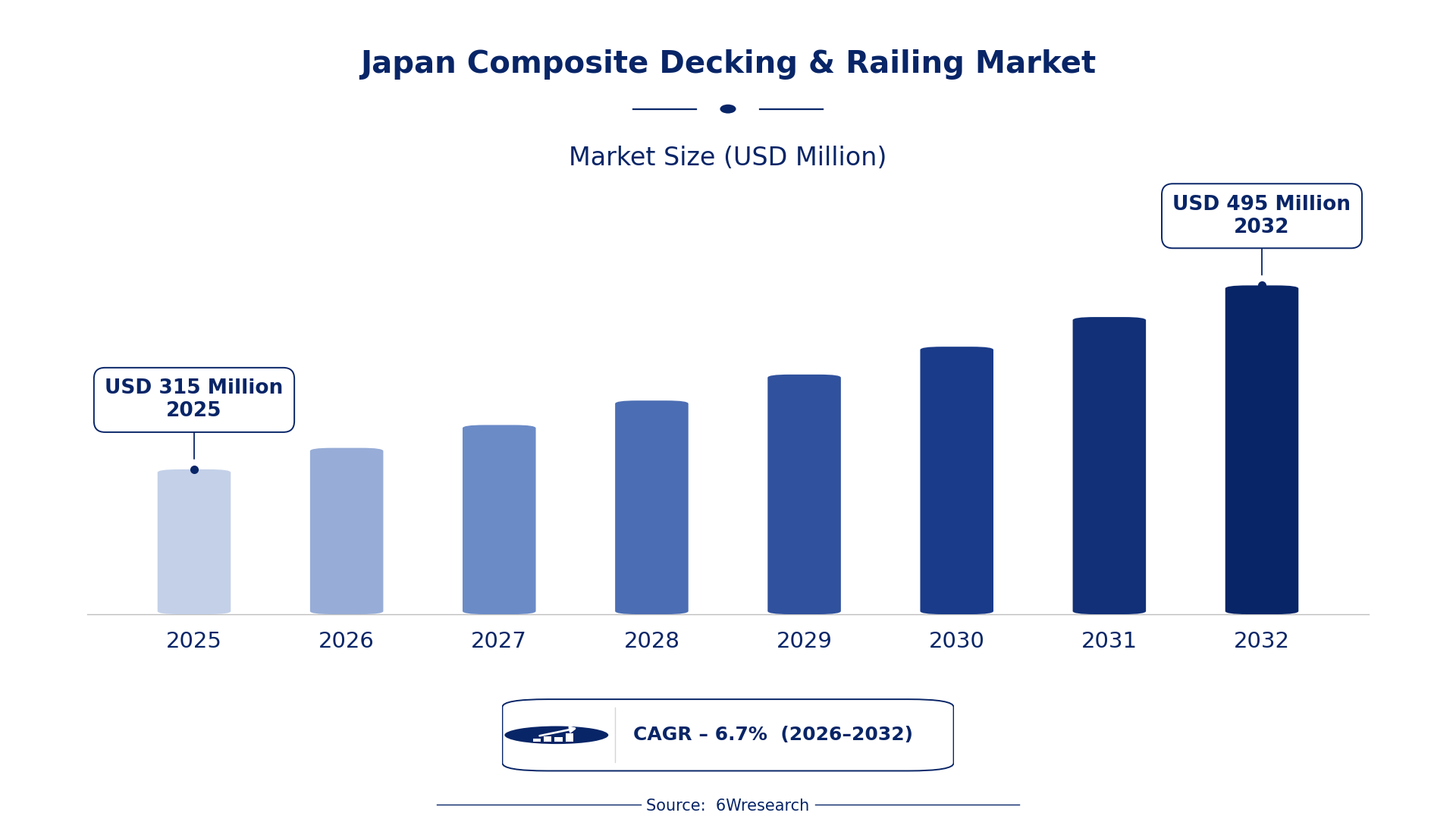
According to 6Wresearch internal database and industry insights, the Japan Composite Decking & Railing Market was valued at USD 315 Million in 2025 and is projected to reach USD 495 Million by 2032, growing at a CAGR of approximately 6.7% during 2026–2032.
Japan Composite Decking & Railing Market Highlights
| Report Metric | Details |
| Report Name | Japan Composite Decking & Railing Market (2026-2032) |
| Market Size 2025 | USD 315 Million |
| Market Size 2032 | USD 495 Million |
| Absolute Growth 2025–2032 | USD 180 Million |
| CAGR 2026–2032 | 6.7% |
| Peak Annual Growth | 7.2% in 2031 |
| Forecast Period | 2026–2032 |
| Historical Data | 2022–2025 |
| Base Year | 2025 |
| Leading Type, 2025 | Capped (55% share) |
| Leading Resin Type, 2025 | Polyethylene (52% share) |
| Leading Application, 2025 | Residential (58% share) |
| Fastest-Growing Resin Type | Polyvinylchloride (9.1% CAGR) |
| Fastest-Growing Application | Non-Residential (8.5% CAGR) |
| Growing Sector | Residential construction |
| Key End Users | Homeowners, builders, contractors, urban developers |
Japan Composite Decking & Railing Market Year-wise Growth Rate and Key Drivers (2022–2032)
This graph illustrates the annual growth rates of the market from 2022 to 2032, highlighting a steady upward trajectory and projected market expansion over the forecast period.
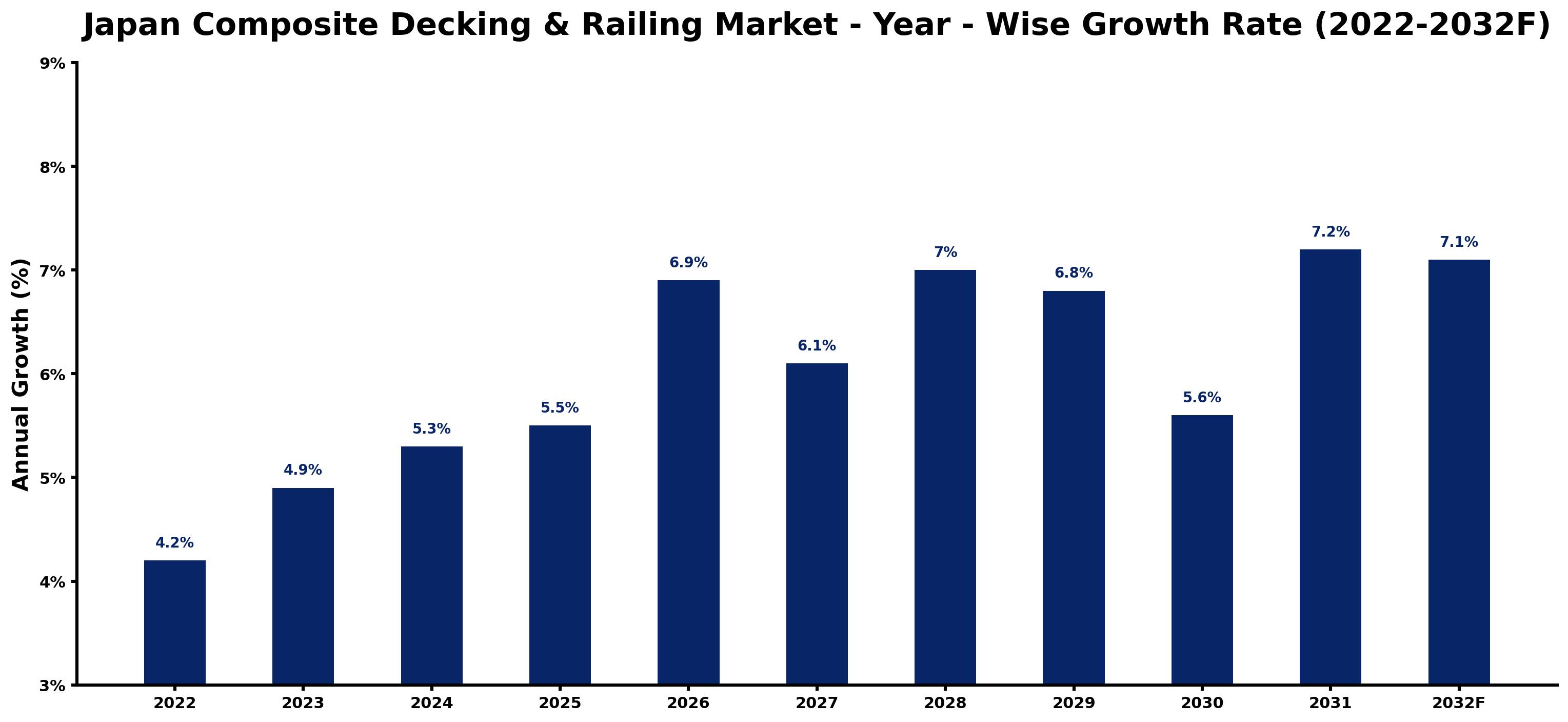
Below, each year's estimated growth is shown next to the factor that most influenced it.
| Year | Estimated Annual Growth (%) | Market Rationale |
| 2022 | 4.2 | The residential construction sector showed strong activity with over 800,000 housing starts. |
| 2023 | 4.9 | Growth accelerated as demand for low-maintenance outdoor solutions increased among urban homeowners. |
| 2024 | 5.3 | The market continued to expand due to rising interest in sustainable building materials. |
| 2025 | 5.5 | Demand peaked as the construction sector embraced composite decking for its durability. |
| 2026 | 6.9 | Growth strengthened as public projects began incorporating composite materials for eco-friendliness. |
| 2027 | 6.1 | A slowdown occurred as supply chain issues affected availability of raw materials. |
| 2028 | 7.0 | Demand rose again as urban areas sought to improve outdoor living spaces. |
| 2029 | 6.8 | Growth slowed slightly as competition among materials intensified in the market. |
| 2030 | 5.6 | The market maintained growth as awareness of composite benefits continued to spread. |
| 2031 | 7.2 | Demand surged as new public initiatives promoted eco-friendly building practices. |
| 2032 | 7.1 | Growth moderated slightly as market saturation began to take effect. |
Note: Market size estimations and growth projections presented in this report are based on 6Wresearch's proprietary forecasting methodology, utilizing the latest available industry data, government publications, and primary research inputs.
Japan Composite Decking & Railing Market Synopsis
Composite decking and railing are advanced materials made from wood fibres and plastic, offering durability and weather resistance. In Japan, over 800,000 new housing starts in 2022 and a preference for low-maintenance solutions drive demand. The Tokyo region accounts for around 30% of sales, supported by public initiatives that encourage eco-friendly materials.
Market Dynamics Impact Analysis (2026–2032)
| Factor | Type | Impact | Primary Segment Affected |
| Increasing residential construction activities | Driver | High | Residential |
| Rising preference for low-maintenance materials | Driver | High | Capped |
| Expansion of public projects promoting composite materials | Opportunity | High | Non-Residential |
| Growing urbanisation leading to demand for outdoor living spaces | Opportunity | High | Residential |
| Supply chain disruptions affecting raw material availability | Restraint | High | Capped |
| Competition from traditional materials limiting market share | Restraint | Medium | Capped |
| Rising costs for raw materials impacting pricing | Challenge | High | Capped |
| Regulatory compliance challenges for new entrants | Challenge | Medium | Capped |
Evaluation of Drivers in Japan Composite Decking & Railing Market (2026–2032)
The following drivers explain most of the expected growth.
| Drivers | Primary Segment Affected | Why It Matters (Evidence) |
| Rising number of housing starts | Residential | In 2022, over 800,000 new housing starts increased demand for durable outdoor solutions. |
| Preference for eco-friendly materials | Capped | Approximately 70% of urban homeowners prefer composite decking for its low maintenance and sustainability. |
| Public initiatives promoting composite materials | Non-Residential | The GX Basic Policy adopted in 2023 encourages the use of composite materials in public projects. |
| Increased urbanisation | Residential | Urban areas, particularly Tokyo, account for about 30% of composite decking sales, driving demand. |
| Long lifespan of composite products | Capped | With an average lifespan of 25 years, composite decking is preferred over traditional wood. |
The strongest pull on demand comes from the rising number of housing starts, with a high volume of new homes built in 2022. Urbanisation is driving sales, particularly in the Tokyo region, which accounts for a significant share of composite decking sales. A large percentage of homeowners in urban areas prefer composite decking for its low maintenance. The average lifespan of composite decking, estimated at 25 years, makes it a preferred choice over traditional wood materials.
Evaluation of Restraints in Japan Composite Decking & Railing Market
Below are the constraints most often cited by buyers and suppliers, with the segment each affects.
| Market Restraint | Primary Segment Affected | Why It Matters (Evidence) |
| Supply chain disruptions affecting raw material availability | Capped | Disruptions have led to delays in sourcing essential materials, impacting production timelines. |
| Competition from traditional materials limiting market share | Capped | Traditional wood products still dominate some segments, affecting the market penetration of composites. |
| Rising costs for raw materials impacting pricing | Capped | Increased costs for plastics and wood fibers have pressured profit margins for producers. |
| Regulatory compliance challenges for new entrants | Capped | New regulations require extensive testing and certification, complicating market entry for smaller firms. |
| Market saturation in urban areas | Capped | As the market matures, growth opportunities in urban areas may become limited. |
Japan Composite Decking & Railing Market Challenges
High demand for skilled labour in Japan's construction sector hampers the installation of composite decking, resulting in project delays for contractors and increasing labour costs by 15%. Rising raw material prices, exacerbated by global supply chain disruptions, inflate production costs for suppliers, leading to a 10% increase in final product prices for buyers. Compliance with stringent building regulations, such as JIS A 5371 standards, poses challenges for suppliers, often extending project timelines by up to three months. Rapid advancements in alternative materials compel traditional composite producers to innovate, risking market share loss for those unable to adapt.
Trends in the Japan Composite Decking & Railing Market
These developments are changing demand patterns in the Japan Composite Decking & Railing Market.
- Shift towards Sustainable Building Practices: In urban areas like Tokyo, the adoption of eco-friendly materials is increasing, driven by the GX Basic Policy initiated in 2023. Approximately 70% of homeowners now prefer composite decking for its sustainability.
- Transition from Traditional to Composite Materials: The construction sector is increasingly replacing traditional wood with composite materials, particularly in residential projects. In 2022, over 800,000 new housing starts highlighted this trend, as builders sought durable options.
- Emergence of Capped Composite Products: Capped composite decking is gaining popularity, especially in regions like Shikoku, known for high rainfall. This segment is expected to grow as it offers improved durability and weather resistance.
- Growing Demand for Non-Residential Applications: Non-residential projects are increasingly incorporating composite materials, particularly in urban centres like Osaka and Yokohama. The annual demand for composite railing systems is projected to exceed 1 million linear metres by 2025.
Investment Opportunities in the Japan Composite Decking & Railing Market
The openings below show where demand in the Japan Composite Decking & Railing Market is visible and how suppliers can enter.
- Partnerships with Local Builders: Now is an ideal time for partnerships with local builders in urban areas, where demand for composite decking is high. The Tokyo region, accounting for 30% of sales, presents substantial opportunities.
- Investment in Eco-Friendly Materials: With the GX Basic Policy promoting sustainable materials, there is a strong opportunity to supply composite products. Urban developers are increasingly seeking low-maintenance solutions.
- Expansion into Non-Residential Markets: The demand for composite materials in non-residential projects is growing, particularly in urban centres. Investing in marketing strategies targeting these sectors can yield high returns.
- Compliance with JIS Standards: Compliance with JIS A 5371 standards positions products favourably in the market. Engaging with the Japan Building Materials Association can facilitate market entry.
Government Initiatives in the Japan Composite Decking & Railing Market
The Act against Unjustifiable Premiums and Misleading Representations, enforced by the Consumer Affairs Agency, ensures that composite decking products are accurately labelled, protecting buyers from misleading claims. Compliance with the Industrial Standardization Act, which governs JIS standards, is essential for producers to maintain product quality and consumer trust.
In 2023, the Japanese government announced a JPY 150 trillion investment in decarbonisation initiatives, administered by the Government of Japan. This funding aims to support the adoption of eco-friendly materials, including composites, in construction projects.
Future Insight of the Japan Composite Decking & Railing Market
New public projects will increasingly utilise composite decking and railing systems, as urban centres prioritise sustainable building practices. By 2032, annual demand for composite railing systems will surpass 1 million linear metres, reflecting a shift towards low-maintenance solutions among homeowners. Enhanced production technologies will improve efficiency, allowing suppliers to respond effectively to rising market needs. Government initiatives will further promote the adoption of composite materials in construction, solidifying their role in future building standards.
Market Segmentation Analysis
Japan Composite Decking & Railing Market report covers a detailed analysis of the following market segments:
By Type – Capped Leads and Records the Fastest Growth
According to Vasudha, AM at 6Wresearch, Capped took 55% of type revenue in 2025, more than any other category. Capped composite decking commands the largest share due to its superior durability and weather resistance, making it ideal for outdoor settings, especially in regions like Shikoku with high rainfall. This segment thrives as it meets the needs of homeowners seeking reliable, long-lasting solutions for their outdoor spaces. Its lead should widen, with a projected CAGR of 8.9% during 2026–2032, the highest in this split. Capped composite decking is poised for continued growth, supported by the strong residential construction sector, which recorded over 800,000 new housing starts in 2022. Its established reputation for durability and low maintenance will likely keep driving demand among consumers looking for dependable outdoor materials. Suppliers should focus on capped composite products to capitalise on their rising popularity among homeowners.
By Resin Type – Polyethylene Leads, Polyvinylchloride Expected to Grow Fastest
In 2025, Polyethylene led the resin type split with a 52% share. Polyethylene composites dominate the market due to their moisture and chemical resistance, making them ideal for outdoor decking applications. This segment's strong performance is supported by the fact that they are used in over 60% of new residential decks, reflecting their widespread acceptance among builders and homeowners. Polyvinylchloride is set to record the highest CAGR in this split, 9.1% over 2026–2032. Polyvinylchloride is experiencing rapid growth because of its affordability and ease of maintenance, appealing to cost-conscious consumers. This segment is likely to expand as more homeowners seek budget-friendly options for their outdoor spaces, further diversifying the market. Manufacturers should consider expanding their offerings in polyvinylchloride to meet the rising demand for cost-effective decking solutions.
By Application – Residential Leads, Non-Residential Expected to Grow Fastest
The largest application category in 2025 was Residential, at 58% of revenue. Residential applications dominate the market as there is a substantial demand for outdoor living spaces, particularly in urban areas where homeowners prefer low-maintenance solutions. The preference for composite decking in residential projects is highlighted by approximately 70% of urban homeowners choosing these materials for their durability and aesthetic appeal. Non-Residential is projected to grow fastest, at a CAGR of 8.5% during 2026–2032. Non-residential applications are experiencing rapid growth, fuelled by urban development and public projects that incorporate composite materials. The government's initiatives to promote eco-friendly building practices will likely accelerate this growth, presenting new opportunities for suppliers in the non-residential sector. Suppliers should investigate opportunities in the non-residential market to benefit from the increasing demand for composite materials in public and commercial projects.
Key Attractiveness of the Report
- 10 Years of Market Numbers
- Historical Data Starting from 2022 to 2025
- Base Year 2025
- Forecast Data until 2032
- Key Performance Indicators Impacting the Market
- Major Upcoming Developments and Projects
Key Highlights of the Report:
- Japan Composite Decking & Railing Market Outlook
- Market Size of Japan Composite Decking & Railing Market, 2025
- Forecast of Japan Composite Decking & Railing Market, 2032
- Historical Data and Forecast of Japan Composite Decking & Railing Revenues & Volume for the Period 2022-2032
- Japan Composite Decking & Railing Market Trend Evolution
- Japan Composite Decking & Railing Market Drivers and Challenges
- Japan Composite Decking & Railing Price Trends
- Japan Composite Decking & Railing Porter's Five Forces
- Japan Composite Decking & Railing Industry Life Cycle
- Historical Data and Forecast of Japan Composite Decking & Railing Market Revenues & Volume By Type for the Period 2022-2032
- Historical Data and Forecast of Japan Composite Decking & Railing Market Revenues & Volume By Capped for the Period 2022-2032
- Historical Data and Forecast of Japan Composite Decking & Railing Market Revenues & Volume By Uncapped for the Period 2022-2032
- Historical Data and Forecast of Japan Composite Decking & Railing Market Revenues & Volume By Resin Type for the Period 2022-2032
- Historical Data and Forecast of Japan Composite Decking & Railing Market Revenues & Volume By Polyethylene for the Period 2022-2032
- Historical Data and Forecast of Japan Composite Decking & Railing Market Revenues & Volume By Polypropylene for the Period 2022-2032
- Historical Data and Forecast of Japan Composite Decking & Railing Market Revenues & Volume By Polyvinylchloride for the Period 2022-2032
- Historical Data and Forecast of Japan Composite Decking & Railing Market Revenues & Volume By Others for the Period 2022-2032
- Historical Data and Forecast of Japan Composite Decking & Railing Market Revenues & Volume By Application for the Period 2022-2032
- Historical Data and Forecast of Japan Composite Decking & Railing Market Revenues & Volume By Residential for the Period 2022-2032
- Historical Data and Forecast of Japan Composite Decking & Railing Market Revenues & Volume By Non-Residential for the Period 2022-2032
- Japan Composite Decking & Railing Import Export Trade Statistics
- Market Opportunity Assessment By Type
- Market Opportunity Assessment By Resin Type
- Market Opportunity Assessment By Application
- Japan Composite Decking & Railing Top Companies Market Share
- Japan Composite Decking & Railing Competitive Benchmarking By Technical and Operational Parameters
- Japan Composite Decking & Railing Company Profiles
- Japan Composite Decking & Railing Key Strategic Recommendations
Market Covered
This report examines the market across the segments below.
By Type
- Capped
- Uncapped
By Resin Type
- Polyethylene
- Polypropylene
- Polyvinylchloride
- Others
By Application
- Residential
- Non-Residential































