Japan Consignment Software Market Size & Growth Rate
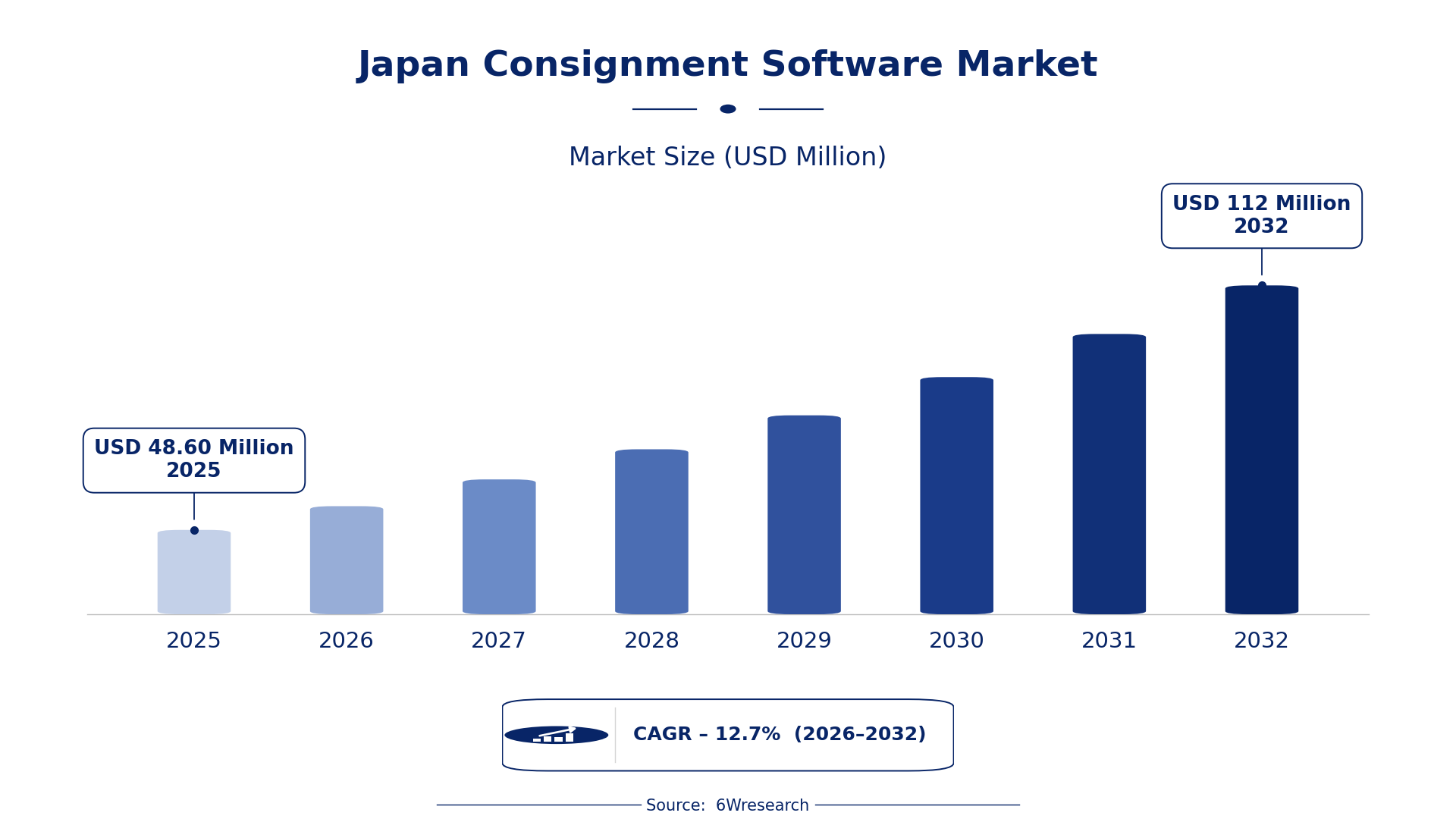
According to 6Wresearch internal database and industry insights, the Japan Consignment Software Market was valued at USD 48.60 Million in 2025 and is projected to reach USD 112 Million by 2032, growing at a CAGR of approximately 12.7% during 2026–2032.
Japan Consignment Software Market Highlights
| Report Metric | Details |
| Report Name | Japan Consignment Software Market (2026-2032) |
| Market Size 2025 | USD 48.60 Million |
| Market Size 2032 | USD 112 Million |
| Absolute Growth 2025–2032 | USD 63.40 Million |
| CAGR 2026–2032 | 12.7% |
| Peak Annual Growth | 14.9% in 2026 |
| Forecast Period | 2026–2032 |
| Historical Data | 2022–2025 |
| Base Year | 2025 |
| Leading Deployment Mode, 2025 | Cloud (69% share) |
| Leading Enterprise Size, 2025 | Large Enterprise (61% share) |
| Fastest-Growing Deployment Mode | On-premise (17.3% CAGR) |
| Fastest-Growing Enterprise Size | Small and Medium Enterprise (15.8% CAGR) |
| Growing Sector | Retail and Logistics |
| Key End Users | Retail businesses, logistics companies, small and medium enterprises, e-commerce platforms |
Japan Consignment Software Market Year-wise Growth Rate and Key Drivers (2022–2032)
This graph illustrates the annual growth rates of the market from 2022 to 2032, highlighting a steady upward trajectory and projected market expansion over the forecast period.
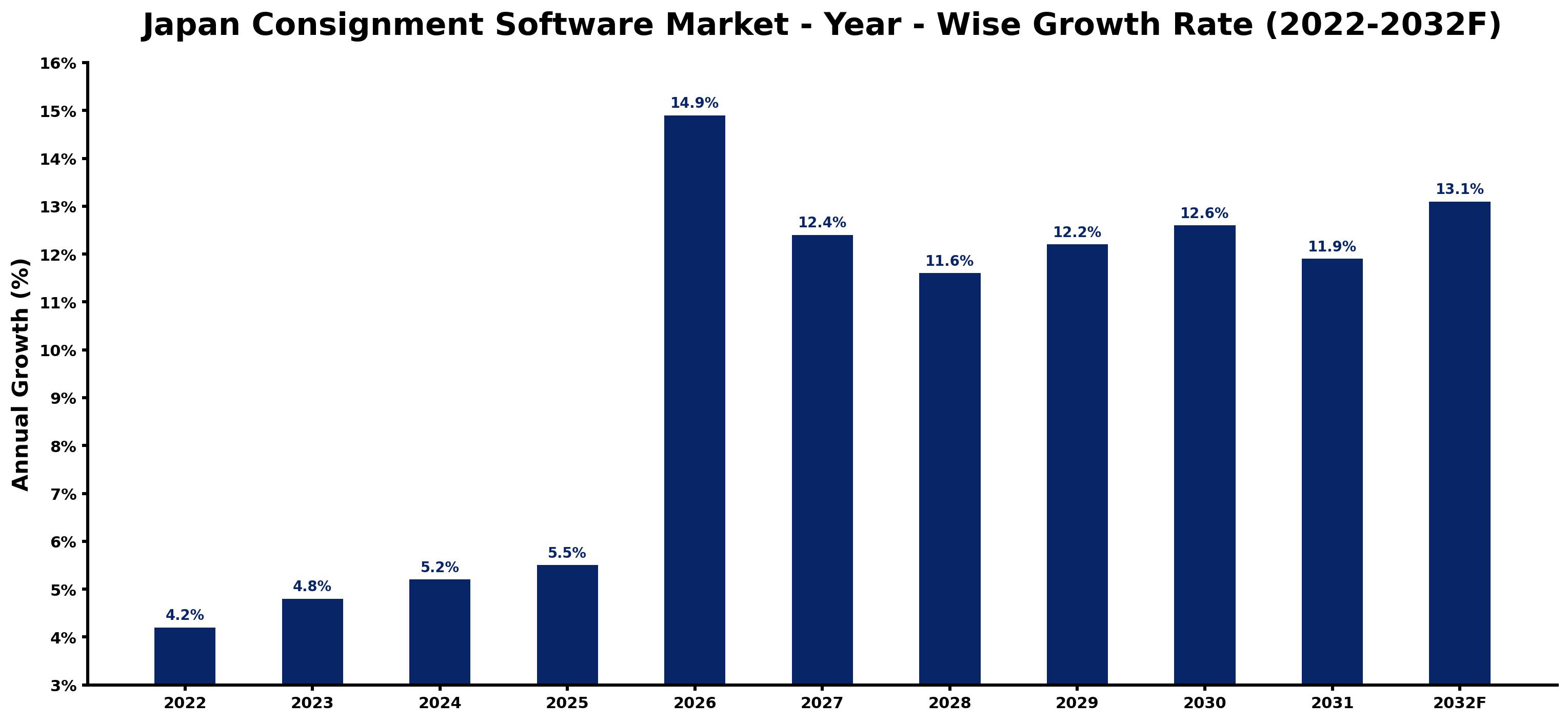
For each year, the table pairs the estimated growth rate with the leading influence on demand, showing how the drivers changed across the period.
| Year | Estimated Annual Growth (%) | Market Rationale |
| 2022 | 4.2 | The market experienced steady growth, reflecting ongoing adoption of technology in retail. |
| 2023 | 4.8 | Demand increased as more businesses recognised the benefits of consignment software. |
| 2024 | 5.2 | The rise in e-commerce prompted further investments in inventory management solutions. |
| 2025 | 5.5 | Growth accelerated due to a surge in retail businesses adopting digital solutions. |
| 2026 | 14.9 | The market is expected to peak as logistics investments surge, driving software purchases. |
| 2027 | 12.4 | Growth is projected to slow slightly as the market begins to stabilise after rapid expansion. |
| 2028 | 11.6 | The market will continue to grow, supported by ongoing digital transformation efforts. |
| 2029 | 12.2 | Demand is expected to increase again as businesses seek efficiency in inventory management. |
| 2030 | 12.6 | The market will maintain its momentum, driven by rising e-commerce activities. |
| 2031 | 11.9 | Growth is projected to decelerate as the market reaches a more mature phase. |
| 2032 | 13.1 | Demand is expected to rise as new technologies improve consignment processes. |
Note: Market size estimations and growth projections presented in this report are based on 6Wresearch's proprietary forecasting methodology, utilizing the latest available industry data, government publications, and primary research inputs.
Japan Consignment Software Market Synopsis
Consignment software is a technology solution that helps businesses manage inventory and sales on a consignment basis. The Japan Consignment Software Market is expanding, driven by over 12 million retail businesses and an e-commerce market reaching 20 trillion yen in 2022. Key drivers of this growth include the digital transformation initiative for SMEs launched in 2023, which encourages technology adoption and efficiency improvements.
Market Dynamics Impact Analysis (2026–2032)
| Factor | Type | Impact | Primary Segment Affected |
| Rising e-commerce activities drive demand for effective inventory management solutions. | Driver | High | Cloud |
| The growing number of retail businesses seeking efficient operations creates opportunities for software providers. | Driver | High | Large Enterprise |
| The shift towards cloud computing adoption opens new avenues for software solutions. | Opportunity | High | Cloud |
| Investments in logistics software solutions are increasing as companies modernise their operations. | Opportunity | High | Large Enterprise |
| Cost constraints limit the adoption of advanced software solutions among SMEs. | Restraint | Medium | Small and Medium Enterprise |
| Limited awareness of software benefits hinders market growth in certain sectors. | Restraint | Medium | On-premise |
| Compliance with software security standards can be a barrier for new entrants. | Challenge | High | Cloud |
| Capacity issues in meeting the growing demand may affect service delivery. | Challenge | Medium | Large Enterprise |
Evaluation of Drivers in Japan Consignment Software Market (2026–2032)
The main growth drivers and the segments they affect most are set out below.
| Drivers | Primary Segment Affected | Why It Matters (Evidence) |
| Increased e-commerce transactions require better inventory management. | Cloud | Japan's e-commerce market reached 20 trillion yen in 2022, prompting businesses to seek efficient solutions. |
| The high number of retail businesses drives demand for consignment software. | Large Enterprise | With over 12 million retail businesses, the need for effective inventory management is significant. |
| The digital transformation initiative for SMEs encourages technology adoption. | Small and Medium Enterprise | Launched in 2023, this initiative supports SMEs in enhancing operational efficiency. |
| The logistics sector's investment in software solutions boosts market growth. | Large Enterprise | Projected investments of 15 billion yen by 2025 highlight the sector's commitment to modernisation. |
| Cloud computing adoption is accelerating, enhancing software accessibility. | Cloud | The government's strategy to promote cloud adoption by 2025 is driving demand for cloud solutions. |
What keeps demand rising is the increasing number of e-commerce transactions, with Japan's e-commerce market reaching 20 trillion yen in 2022. This surge prompts retailers to seek effective inventory management solutions, particularly in sectors like fashion and electronics, which include over 12 million businesses. The logistics sector is projected to invest 15 billion yen in software solutions by 2025, reflecting a commitment to modernisation. The strategy promoting cloud computing adoption by 2025 also supports the rising demand for cloud-based consignment software, enabling more companies to access these solutions.
Evaluation of Restraints in Japan Consignment Software Market
Below are the constraints most often cited by buyers and suppliers, with the segment each affects.
| Market Restraint | Primary Segment Affected | Why It Matters (Evidence) |
| Cost constraints limit software adoption among small and medium enterprises. | Small and Medium Enterprise | Many SMEs face budget limitations, hindering their ability to invest in advanced solutions. |
| Limited awareness of software benefits hinders market growth in certain sectors. | On-premise | Some businesses remain unaware of the advantages of consignment software, delaying adoption. |
| Compliance with software security standards can be a barrier for new entrants. | Cloud | ISO/IEC 27001 compliance requirements can deter companies from entering the market. |
| Integration challenges with existing systems may slow down adoption rates. | Large Enterprise | Large enterprises often encounter difficulties integrating new software with legacy systems. |
| Market saturation in certain regions limits growth potential for new solutions. | Cloud | With many established players, new entrants may struggle to gain market share. |
Japan Consignment Software Market Challenges
Japan's minimum wage increase to JPY 1,055 per hour raises operational costs for consignment shops, squeezing their profit margins. A technology gap persists as over 3.8 million SMEs struggle to implement advanced consignment solutions, limiting their competitiveness in the market. Regulatory compliance with ISO/IEC 27001 standards imposes additional costs for software updates and security measures, burdening smaller businesses. Buyers face inefficiencies in inventory management, with an average turnover rate of only six times per year, resulting in excess stock and lost sales opportunities.
Trends in the Japan Consignment Software Market
These developments are changing demand patterns in the Japan Consignment Software Market.
- Shift from On-premise to Cloud Solutions: Businesses are increasingly adopting cloud-based consignment software as they seek scalability and accessibility. The government's strategy to promote cloud computing adoption by 2025 encourages this shift, with cloud solutions expected to capture a larger market share.
- Growing Focus on Digital Transformation: The digital transformation initiative for SMEs launched in 2023 is reshaping how businesses operate. This programme encourages small and medium enterprises to invest in technology, leading to increased demand for consignment software solutions.
- Increased Investment in Logistics Software: The logistics sector is experiencing a surge in investments, with projections of 15 billion yen allocated for software solutions by 2025. This trend indicates a strong commitment to modernising operations and improving efficiency in inventory management.
- Emphasis on Compliance with Security Standards: As businesses adopt consignment software, there is a growing emphasis on meeting security standards. Compliance with ISO/IEC 27001 is becoming essential for companies to ensure data protection and build trust with clients.
Investment Opportunities in the Japan Consignment Software Market
The following opportunities in the Japan Consignment Software Market pair current demand with a clear way in.
- Consignment Software Solutions for SMEs: There is an opportunity to supply cost-effective consignment software solutions tailored for SMEs. With approximately 3.8 million SMEs in Japan, the demand for affordable solutions is high, especially as digital transformation initiatives gain traction.
- Cloud Solutions for Retailers: Now is the time to invest in cloud-based consignment software, as businesses increasingly seek scalable solutions. The retail sector, with over 12 million businesses, presents a strong market for cloud software providers.
- Logistics Software Solutions: Investing in logistics software solutions is timely, given the projected 15 billion yen investment by 2025. Targeting logistics companies in major industrial regions like Tokyo and Osaka can yield substantial returns.
- Partnerships for Software Development: Forming joint ventures with local tech firms can facilitate entry into the Japanese market. Collaborating with established players can ease the approval process and improve market penetration.
Government Initiatives in the Japan Consignment Software Market
The Industrial Standardization Act, amended in 2019, governs product and test standards in Japan. This law ensures that consignment software meets specific quality and security benchmarks, benefiting both producers and buyers by establishing trust in software solutions. Additionally, the AI Promotion Act, established in 2025, sets a framework for AI research and development, promoting innovation in software applications.
The Digital Agency, established in September 2021, leads government digital transformation efforts. It funds various initiatives aimed at improving technology adoption, including support for software solutions in the consignment sector. This agency's initiatives are important for ensuring that businesses can access the latest technologies and standards.
Future Insight of the Japan Consignment Software Market
Retail businesses will increasingly adopt advanced software solutions, improving inventory management and operational efficiency. The digital transformation initiative for SMEs will drive technology uptake, enabling suppliers to offer more effective consignment solutions. By 2032, logistics sector investments of 15 billion yen in software will streamline operations for buyers. Growing e-commerce activity, which reached 20 trillion yen in 2022, will further boost demand for sophisticated consignment software, creating new opportunities for both buyers and suppliers.
Market Segmentation Analysis
Japan Consignment Software Market report covers a detailed analysis of the following market segments:
By Deployment Mode – Cloud Leads, On-premise Expected to Grow Fastest
According to Sumit Sagar, AM at 6Wresearch, Cloud took 69% of deployment mode revenue in 2025, more than any other category. Cloud deployment leads the market as it provides scalability and easy access for numerous retail businesses in Japan. This trend is particularly strong in industrial hubs like Tokyo and Osaka, where cloud solutions are preferred for managing inventory efficiently. On-premise is projected to grow fastest, at a CAGR of 17.3% during 2026–2032. On-premise solutions are gaining traction as some businesses prioritise data control and operational autonomy. This resurgence is influenced by rising concerns regarding data security and adherence to standards such as ISO/IEC 27001. Suppliers should offer diverse deployment options to accommodate different customer needs and preferences.
By Enterprise Size – Large Enterprise Leads, Small and Medium Enterprise Expected to Grow Fastest
In 2025, Large Enterprise led the enterprise size split with a 61% share. Large enterprises dominate the market as they necessitate comprehensive consignment software to manage complex inventory operations efficiently. Their extensive scale and established presence in sectors like retail require solutions that can handle high transaction volumes and diverse product lines. Small and Medium Enterprise is set to record the highest CAGR in this split, 15.8% over 2026–2032. The Small and Medium Enterprise segment is experiencing rapid growth as these businesses pursue cost-effective consignment solutions for effective inventory management. The government's digital transformation initiative for SMEs is a key factor driving this acceleration. Suppliers should tailor their offerings to meet the specific needs of SMEs to effectively tap into this growing segment.
Key Attractiveness of the Report
- 10 Years of Market Numbers
- Historical Data Starting from 2022 to 2025
- Base Year 2025
- Forecast Data until 2032
- Key Performance Indicators Impacting the Market
- Major Upcoming Developments and Projects
Key Highlights of the Report:
- Japan Consignment Software Market Outlook
- Market Size of Japan Consignment Software Market, 2025
- Forecast of Japan Consignment Software Market, 2032
- Historical Data and Forecast of Japan Consignment Software Revenues & Volume for the Period 2022-2032
- Japan Consignment Software Market Trend Evolution
- Japan Consignment Software Market Drivers and Challenges
- Japan Consignment Software Price Trends
- Japan Consignment Software Porter's Five Forces
- Japan Consignment Software Industry Life Cycle
- Historical Data and Forecast of Japan Consignment Software Market Revenues & Volume By Deployment Mode for the Period 2022-2032
- Historical Data and Forecast of Japan Consignment Software Market Revenues & Volume By Cloud for the Period 2022-2032
- Historical Data and Forecast of Japan Consignment Software Market Revenues & Volume By On-premise for the Period 2022-2032
- Historical Data and Forecast of Japan Consignment Software Market Revenues & Volume By Enterprise Size for the Period 2022-2032
- Historical Data and Forecast of Japan Consignment Software Market Revenues & Volume By Large Enterprise for the Period 2022-2032
- Historical Data and Forecast of Japan Consignment Software Market Revenues & Volume By Small and Medium Enterprise for the Period 2022-2032
- Japan Consignment Software Import Export Trade Statistics
- Market Opportunity Assessment By Deployment Mode
- Market Opportunity Assessment By Enterprise Size
- Japan Consignment Software Top Companies Market Share
- Japan Consignment Software Competitive Benchmarking By Technical and Operational Parameters
- Japan Consignment Software Company Profiles
- Japan Consignment Software Key Strategic Recommendations
Market Covered
The report covers the following segments.
By Deployment Mode
- Cloud
- On-premise
By Enterprise Size
- Large Enterprise
- Small and Medium Enterprise































