Japan Conveyor System Market Size & Growth Rate
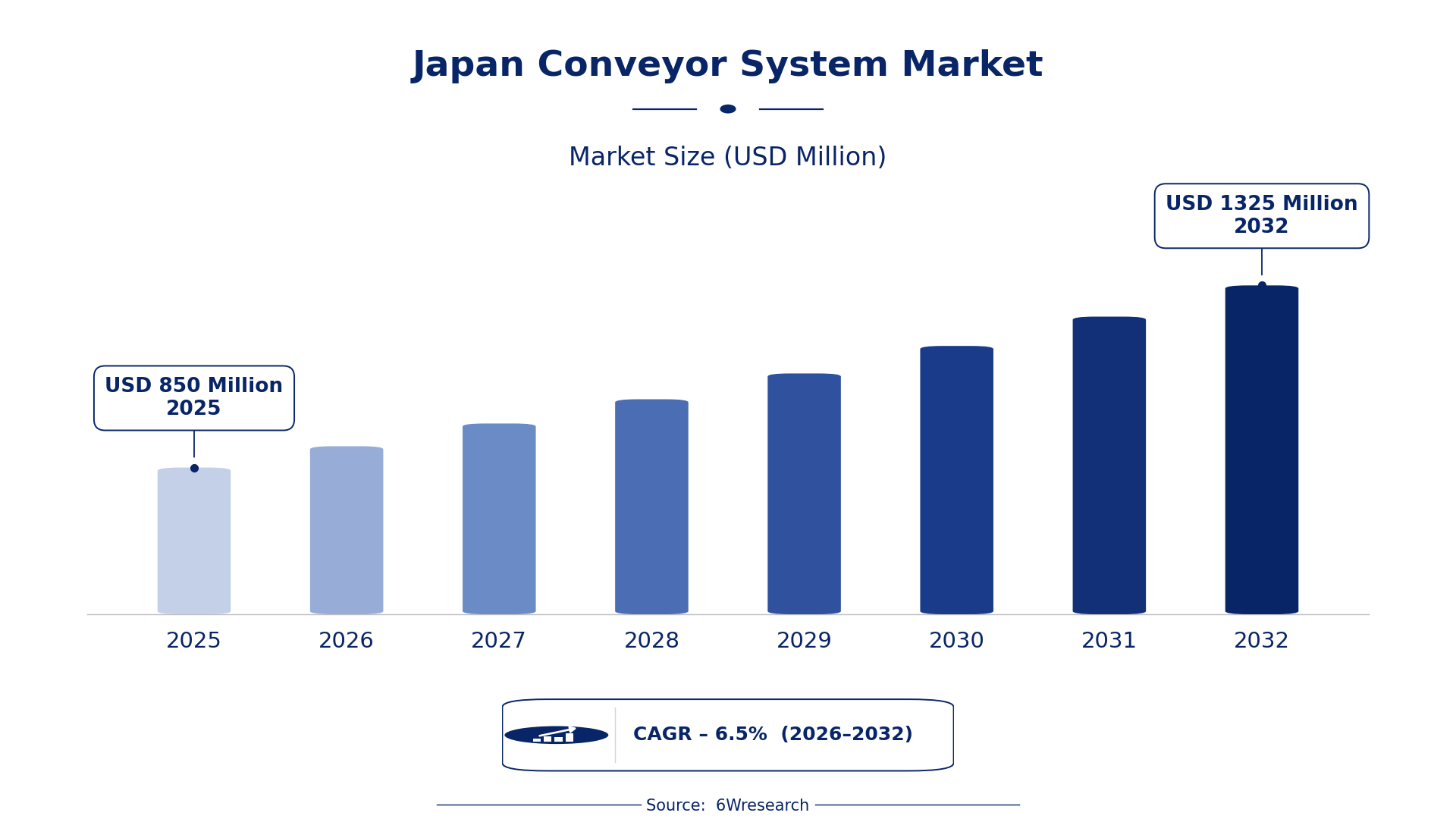
According to 6Wresearch internal database and industry insights, the Japan Conveyor System Market was valued at USD 850 Million in 2025 and is projected to reach USD 1,325 Million by 2032, growing at a CAGR of approximately 6.5% during 2026–2032.
Japan Conveyor System Market Highlights
| Report Metric | Details |
| Report Name | Japan Conveyor System Market (2026-2032) |
| Market Size 2025 | USD 850 Million |
| Market Size 2032 | USD 1,325 Million |
| Absolute Growth 2025–2032 | USD 475 Million |
| CAGR 2026–2032 | 6.5% |
| Peak Annual Growth | 7.2% in 2032 |
| Forecast Period | 2026–2032 |
| Historical Data | 2022–2025 |
| Base Year | 2025 |
| Leading Type, 2025 | Belt Conveyor (43% share) |
| Leading Operation Mode, 2025 | Automatic (52% share) |
| Leading Industry, 2025 | Manufacturing (39% share) |
| Leading End User, 2025 | Automotive (39% share) |
| Fastest-Growing Type | Roller Conveyor (9.0% CAGR) |
| Fastest-Growing Industry | Logistics (8.5% CAGR) |
| Fastest-Growing End User | Warehouses (8.3% CAGR) |
| Growing Sector | Logistics |
| Key End Users | Manufacturing, Logistics, Food & Beverage, Mining |
Japan Conveyor System Market Year-wise Growth Rate and Key Drivers (2022–2032)
This graph illustrates the annual growth rates of the market from 2022 to 2032, highlighting a steady upward trajectory and projected market expansion over the forecast period.
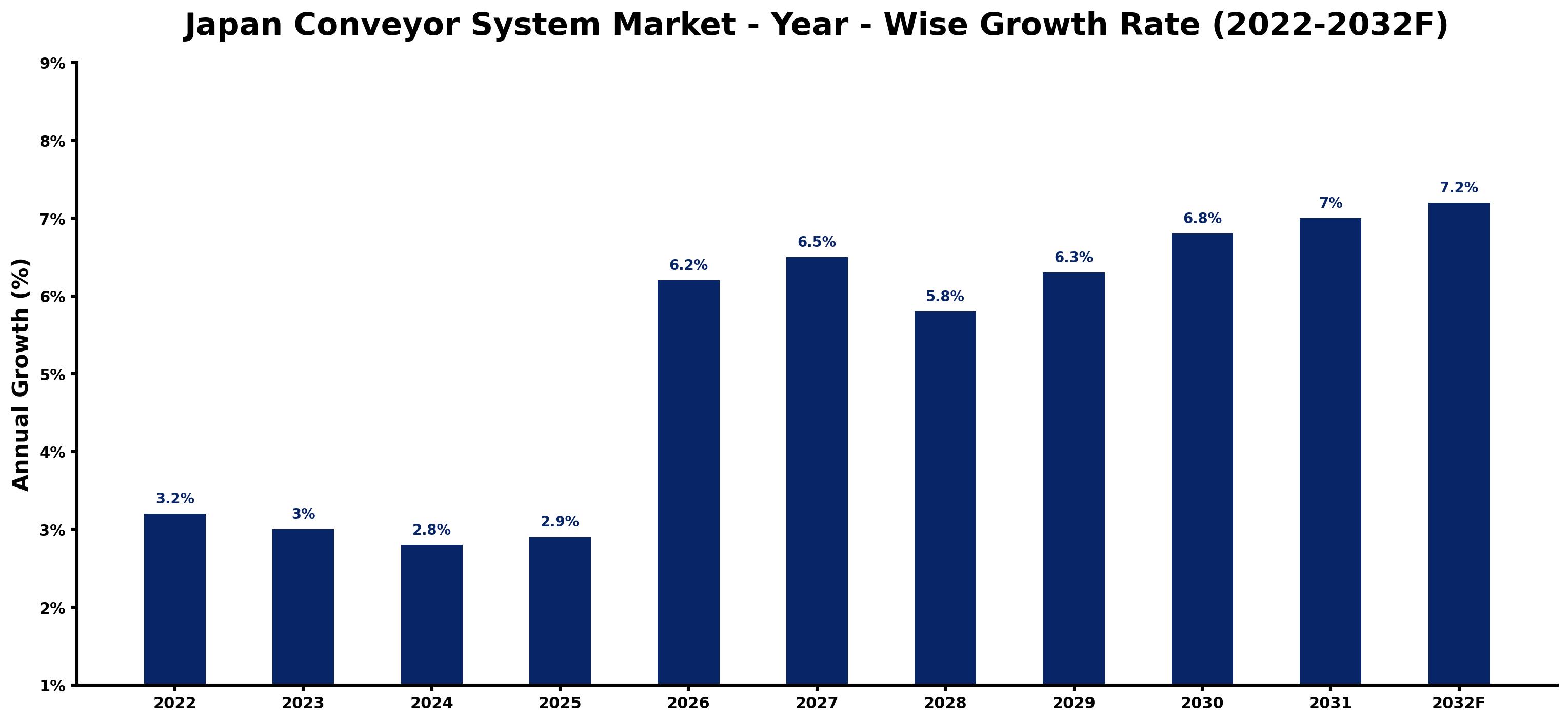
Below, each year's estimated growth is shown next to the factor that most influenced it.
| Year | Estimated Annual Growth (%) | Market Rationale |
| 2022 | 3.2 | Demand was stable, supported by ongoing investments in manufacturing automation. |
| 2023 | 3.0 | Growth slowed due to market saturation in certain sectors, yet demand remained positive. |
| 2024 | 2.8 | A further slowdown occurred as companies adjusted to previous expansions in capacity. |
| 2025 | 2.9 | Demand picked up as manufacturers sought efficiency improvements through automation. |
| 2026 | 6.2 | Growth accelerated with increased investments in logistics and supply chain optimisation. |
| 2027 | 6.5 | Demand continued to rise as automation became essential for competitive advantage. |
| 2028 | 5.8 | A slight slowdown occurred as market adjustments took place after rapid growth. |
| 2029 | 6.3 | Growth rebounded as new technologies in conveyor systems gained traction. |
| 2030 | 6.8 | Demand strengthened with rising automation needs in various industries. |
| 2031 | 7.0 | Continued growth was driven by increased production capacities and technological advancements. |
| 2032 | 7.2 | The market peaked as investments in advanced conveyor systems surged. |
Note: Market size estimations and growth projections presented in this report are based on 6Wresearch's proprietary forecasting methodology, utilizing the latest available industry data, government publications, and primary research inputs.
Japan Conveyor System Market Synopsis
Conveyor systems are integral to automating material handling in various industries, including manufacturing and logistics. These systems, which include belt, roller, and overhead types, improve efficiency and productivity. The Japan Conveyor System Market is expanding due to rising demand from the automotive and manufacturing sectors, with investments in automation technologies and logistics infrastructure driving purchases.
Market Dynamics Impact Analysis (2026–2032)
| Factor | Type | Impact | Primary Segment Affected |
| Increasing automation in manufacturing processes | Driver | High | Automatic |
| Rising demand for efficient logistics solutions | Driver | High | Logistics |
| Growing e-commerce sector requiring advanced logistics | Opportunity | High | Logistics |
| Expansion of manufacturing facilities in urban areas | Opportunity | High | Manufacturing |
| High initial investment costs for advanced systems | Restraint | Medium | Belt Conveyor |
| Limited awareness of newer technologies among smaller firms | Restraint | Medium | Roller Conveyor |
| Supply chain disruptions affecting component availability | Challenge | High | Chain Conveyor |
| Competition from alternative material handling solutions | Challenge | Medium | Overhead Conveyor |
Evaluation of Drivers in Japan Conveyor System Market (2026–2032)
The table below links each growth driver to the segment it affects and the evidence for it.
| Drivers | Primary Segment Affected | Why It Matters (Evidence) |
| Growing demand for automation in manufacturing | Automatic | This trend is driven by the need for efficiency, with the manufacturing sector expanding by 39% in recent years. |
| Expansion of e-commerce logistics | Logistics | The e-commerce sector's growth is increasing demand for conveyor systems, with logistics expected to expand at 8.5% CAGR. |
| Technological advancements in conveyor systems | Belt Conveyor | Innovations are improving system capabilities, leading to a strong market share of 43% in 2025. |
| Increased production capacities in the automotive sector | Automotive | The automotive industry is expected to maintain a strong share, driving demand for efficient conveyor systems. |
| Focus on supply chain optimisation | Roller Conveyor | As companies seek to streamline operations, the roller conveyor segment is projected to grow rapidly. |
A broader customer base accounts for much of the growth, as the demand for automation in manufacturing rises. The manufacturing sector is expanding, resulting in greater purchases of conveyor systems. The growth of e-commerce logistics is driving demand, requiring advanced material handling solutions. Developments in conveyor systems are boosting capabilities, leading to a strong market presence for belt conveyors. The automotive industry's emphasis on production efficiency is driving purchases, as companies refine their supply chains.
Evaluation of Restraints in Japan Conveyor System Market
The following restraints limit how fast demand can grow.
| Market Restraint | Primary Segment Affected | Why It Matters (Evidence) |
| High initial investment costs for advanced systems | Belt Conveyor | The upfront costs deter smaller manufacturers from adopting advanced conveyor solutions, impacting overall market growth. |
| Limited awareness of newer technologies among smaller firms | Roller Conveyor | Many smaller companies lack knowledge of the latest conveyor technologies, hindering their ability to invest in upgrades. |
| Supply chain disruptions affecting component availability | Chain Conveyor | Ongoing supply chain issues lead to delays in acquiring essential components, which can slow down project timelines. |
| Competition from alternative material handling solutions | Overhead Conveyor | The rise of robotics and automated guided vehicles presents competition, affecting the adoption of traditional conveyor systems. |
| Regulatory compliance costs for manufacturing standards | Automatic | Adhering to stringent manufacturing regulations incurs additional costs, which can limit investment in new conveyor systems. |
Japan Conveyor System Market Challenges
Regulatory complexities in Japan create compliance hurdles for buyers, often delaying project approvals by three months. Suppliers face challenges with outdated technology, which increases their operational costs by 15% and limits their competitiveness. Supply chain disruptions caused by natural disasters result in longer lead times, forcing buyers to hold 20% more inventory than necessary. Fluctuating buyer demand leads to more order cancellations, with a 25% increase affecting suppliers' revenue stability.
Trends in the Japan Conveyor System Market
The trends below show where the Japan Conveyor System Market is heading.
- Shift towards Automation in Manufacturing: The trend towards automation in manufacturing has accelerated since 2025, as facilities implement automatic conveyor systems to optimise operations, with a projected growth of 39% in this sector.
- Transition from Manual to Automatic Systems: Since 2026, there has been a clear transition from manual to automatic conveyor systems, particularly in the automotive sector, as manufacturers aim to boost productivity, with automatic systems anticipated to capture a 52% market share by 2025.
- Emergence of Advanced Logistics Solutions: Logistics operations are increasingly integrating advanced conveyor systems, especially in urban areas, with the logistics sector expected to grow at an 8.5% CAGR, reflecting the need for efficient material handling solutions.
- Prioritisation of Sustainability in Manufacturing: Since 2026, manufacturers have focused on sustainability, incorporating energy-efficient conveyor systems into their operations, in line with the growing commitment to reducing environmental impact.
Investment Opportunities in the Japan Conveyor System Market
Where to invest in the Japan Conveyor System Market: the main openings are set out below.
- Manufacturers seeking automation solutions: With the market projected to reach USD 1,325 million by 2032, manufacturers require advanced conveyor systems to improve productivity, particularly in the automotive sector. Collaborating with local suppliers can ease market entry.
- Logistics companies expanding operations: The logistics sector is set to grow at an 8.5% CAGR, generating demand for efficient conveyor systems. Companies can partner with local firms to effectively address this rising need.
- Automotive industry investments in efficiency: As the automotive sector continues to expand, the demand for advanced conveyor systems will rise. Forming joint ventures with local manufacturers can help satisfy this demand.
- Warehouse operators upgrading technology: With the growth of e-commerce, warehouse operators are seeking advanced conveyor solutions. Investing in automated systems now can secure a share of this expanding market.
Government Initiatives in the Japan Conveyor System Market
The PMD Act, established in 1960 and renamed in 2014, governs the approval, manufacture, and quality of pharmaceuticals and medical devices, affecting various sectors, including conveyor systems. The Clinical Trials Act, enacted in 2017, outlines conduct and disclosure rules for clinical research, ensuring compliance in related industries. These laws establish a framework that influences the standards for conveyor systems used in medical and manufacturing applications.
The PMDA, established in 2004, reviews pharmaceuticals and medical devices, ensuring their safety and efficacy. The AMED, launched in April 2015, funds medical research and development, supporting advancements in related fields. Both agencies play a crucial role in approving technologies that improve conveyor systems, ensuring they adhere to regulatory standards.
Future Insight of the Japan Conveyor System Market
New automated distribution centres will be operational by 2032, improving efficiency for suppliers. The integration of advanced robotics will streamline production processes, enabling quicker turnaround times. By then, at least 25% of facilities will adopt renewable energy solutions, significantly reducing operational costs. Enhanced data analytics will offer buyers real-time insights, aiding better inventory management and potentially decreasing excess stock by 30%.
Market Segmentation Analysis
Japan Conveyor System Market report covers a detailed analysis of the following market segments:
By Type – Belt Conveyor Leads, Roller Conveyor Expected to Grow Fastest
According to Bhawna Singh, Assistant Manager at 6Wresearch, the largest type category in 2025 was Belt Conveyor, at 43% of revenue. Belt conveyors dominate the market due to their widespread use in manufacturing and material handling applications. Their effectiveness in transporting bulk materials efficiently makes them essential for production processes in various industries. Roller Conveyor is set to record the highest CAGR in this split, 9.0% over 2026–2032. Roller conveyors are experiencing rapid growth, primarily driven by their rising adoption in logistics for efficient package handling. The growth of e-commerce has led to an increased need for streamlined operations in distribution centres, propelling this segment forward. Suppliers should focus on roller conveyor technologies to capitalise on the increasing demand in the logistics sector.
By Operation Mode – Automatic Leads and Records the Fastest Growth
Automatic accounted for 52% of the market by operation mode in 2025. Automatic systems hold the largest share as they streamline operations and reduce labour costs in various sectors. The increasing trend towards automation in manufacturing processes drives the demand for these systems. The same category is also set to grow fastest, at a CAGR of 8.6% during 2026–2032. The automatic operation mode is also the fastest-growing segment, as industries seek to improve efficiency and reduce human error. This trend is expected to widen the lead of automatic systems over time. Buyers should prioritise investing in automatic systems to stay competitive in the market.
By Industry – Manufacturing Leads, Logistics Expected to Grow Fastest
With 39% of industry revenue in 2025, Manufacturing was the largest category. The manufacturing sector leads the market due to its extensive use of conveyor systems for assembly and material handling. This sector's continuous growth and technological advancements ensure a steady demand for these systems. The quickest growth will come from Logistics, forecast to expand at a CAGR of 8.5% between 2026 and 2032. Logistics is the fastest-growing industry segment, driven by the increasing need for efficient supply chain management and the rise of online shopping. The expansion of logistics facilities is expected to further accelerate this growth. Suppliers must adapt their strategies to cater to the logistics industry's evolving requirements.
By End User – Automotive Leads, Warehouses Expected to Grow Fastest
Automotive took 39% of end user revenue in 2025, more than any other category. The automotive sector represents the largest share of end users, as conveyor systems are integral to assembly lines and production processes. The high volume of vehicle production in Japan sustains this demand. Over 2026–2032, Warehouses are expected to post the fastest growth, at a CAGR of 8.3%. Warehouses are the fastest-growing end user segment, spurred by the growth of e-commerce and the need for efficient storage solutions. This trend indicates a shift towards more automated and efficient warehouse operations. Suppliers should focus on developing tailored solutions for warehouse applications to meet increasing demand.
Key Attractiveness of the Report
- 10 Years of Market Numbers
- Historical Data Starting from 2022 to 2025
- Base Year 2025
- Forecast Data until 2032
- Key Performance Indicators Impacting the Market
- Major Upcoming Developments and Projects
Key Highlights of the Report:
- Japan Conveyor System Market Outlook
- Market Size of Japan Conveyor System Market,2025
- Forecast of Japan Conveyor System Market, 2032
- Historical Data and Forecast of Japan Conveyor System Revenues & Volume for the Period 2022-2032
- Japan Conveyor System Market Trend Evolution
- Japan Conveyor System Market Drivers and Challenges
- Japan Conveyor System Price Trends
- Japan Conveyor System Porter's Five Forces
- Japan Conveyor System Industry Life Cycle
- Historical Data and Forecast of Japan Conveyor System Market Revenues & Volume By Type for the Period 2022-2032
- Historical Data and Forecast of Japan Conveyor System Market Revenues & Volume By Belt Conveyor for the Period 2022-2032
- Historical Data and Forecast of Japan Conveyor System Market Revenues & Volume By Roller Conveyor for the Period 2022-2032
- Historical Data and Forecast of Japan Conveyor System Market Revenues & Volume By Overhead Conveyor for the Period 2022-2032
- Historical Data and Forecast of Japan Conveyor System Market Revenues & Volume By Chain Conveyor for the Period 2022-2032
- Historical Data and Forecast of Japan Conveyor System Market Revenues & Volume By Operation Mode for the Period 2022-2032
- Historical Data and Forecast of Japan Conveyor System Market Revenues & Volume By Automatic for the Period 2022-2032
- Historical Data and Forecast of Japan Conveyor System Market Revenues & Volume By Semi-Automatic for the Period 2022-2032
- Historical Data and Forecast of Japan Conveyor System Market Revenues & Volume By Manual for the Period 2022-2032
- Historical Data and Forecast of Japan Conveyor System Market Revenues & Volume By Industry for the Period 2022-2032
- Historical Data and Forecast of Japan Conveyor System Market Revenues & Volume By Manufacturing for the Period 2022-2032
- Historical Data and Forecast of Japan Conveyor System Market Revenues & Volume By Food & Beverage for the Period 2022-2032
- Historical Data and Forecast of Japan Conveyor System Market Revenues & Volume By Logistics for the Period 2022-2032
- Historical Data and Forecast of Japan Conveyor System Market Revenues & Volume By Mining for the Period 2022-2032
- Historical Data and Forecast of Japan Conveyor System Market Revenues & Volume By End User for the Period 2022-2032
- Historical Data and Forecast of Japan Conveyor System Market Revenues & Volume By Automotive for the Period 2022-2032
- Historical Data and Forecast of Japan Conveyor System Market Revenues & Volume By Retail for the Period 2022-2032
- Historical Data and Forecast of Japan Conveyor System Market Revenues & Volume By Healthcare for the Period 2022-2032
- Historical Data and Forecast of Japan Conveyor System Market Revenues & Volume By Warehouses for the Period 2022-2032
- Japan Conveyor System Import Export Trade Statistics
- Market Opportunity Assessment By Type
- Market Opportunity Assessment By Operation Mode
- Market Opportunity Assessment By Industry
- Market Opportunity Assessment By End User
- Japan Conveyor System Top Companies Market Share
- Japan Conveyor System Competitive Benchmarking By Technical and Operational Parameters
- Japan Conveyor System Company Profiles
- Japan Conveyor System Key Strategic Recommendations
Market Covered
Segments analysed in this report are listed below.
By Type
- Belt Conveyor
- Roller Conveyor
- Overhead Conveyor
- Chain Conveyor
By Operation Mode
- Automatic
- Semi-Automatic
- Manual
By Industry
- Manufacturing
- Food & Beverage
- Logistics
- Mining
By End User
- Automotive
- Retail
- Healthcare
- Warehouses































