Japan Conveyor Wire Belts Market Size & Growth Rate
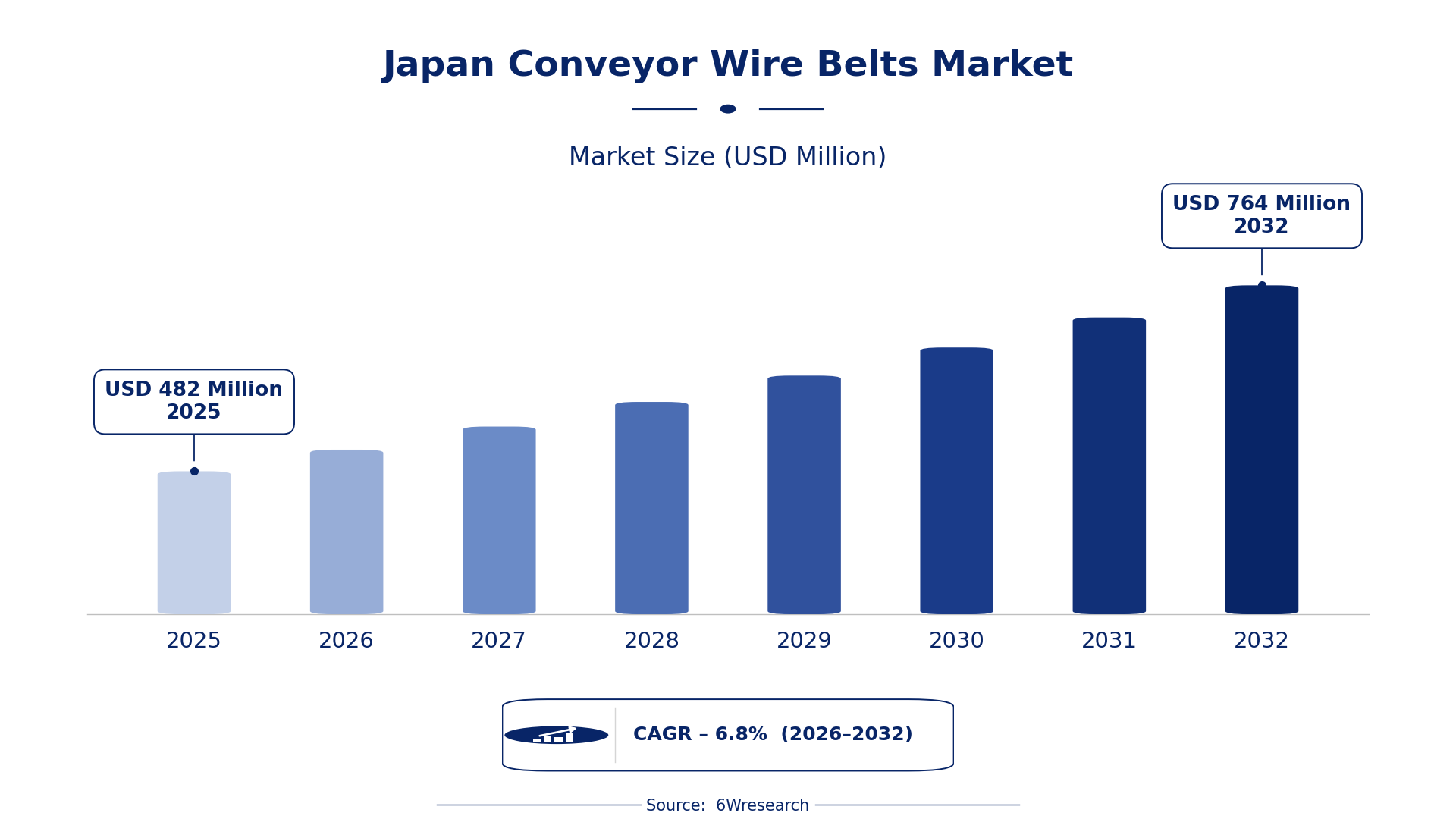
According to 6Wresearch internal database and industry insights, the Japan Conveyor Wire Belts Market was valued at USD 482 Million in 2025 and is projected to reach USD 764 Million by 2032, growing at a CAGR of approximately 6.8% during 2026–2032.
Japan Conveyor Wire Belts Market Highlights
| Report Metric | Details |
| Report Name | Japan Conveyor Wire Belts Market (2026-2032) |
| Market Size 2025 | USD 482 Million |
| Market Size 2032 | USD 764 Million |
| Absolute Growth 2025–2032 | USD 282 Million |
| CAGR 2026–2032 | 6.8% |
| Peak Annual Growth | 7.6% in 2027 |
| Forecast Period | 2026–2032 |
| Historical Data | 2022–2025 |
| Base Year | 2025 |
| Leading Type, 2025 | Metal Conveyor Belts (53% share) |
| Leading Application, 2025 | Mining (44% share) |
| Fastest-Growing Type | Aluminum Conveyor Belts (9.4% CAGR) |
| Fastest-Growing Application | Food Industry (9.9% CAGR) |
| Growing Sector | Food Industry |
| Key End Users | Manufacturers, Logistics Providers, Food Processors, Mining Companies |
Japan Conveyor Wire Belts Market Year-wise Growth Rate and Key Drivers (2022–2032)
This graph illustrates the annual growth rates of the market from 2022 to 2032, highlighting a steady upward trajectory and projected market expansion over the forecast period.
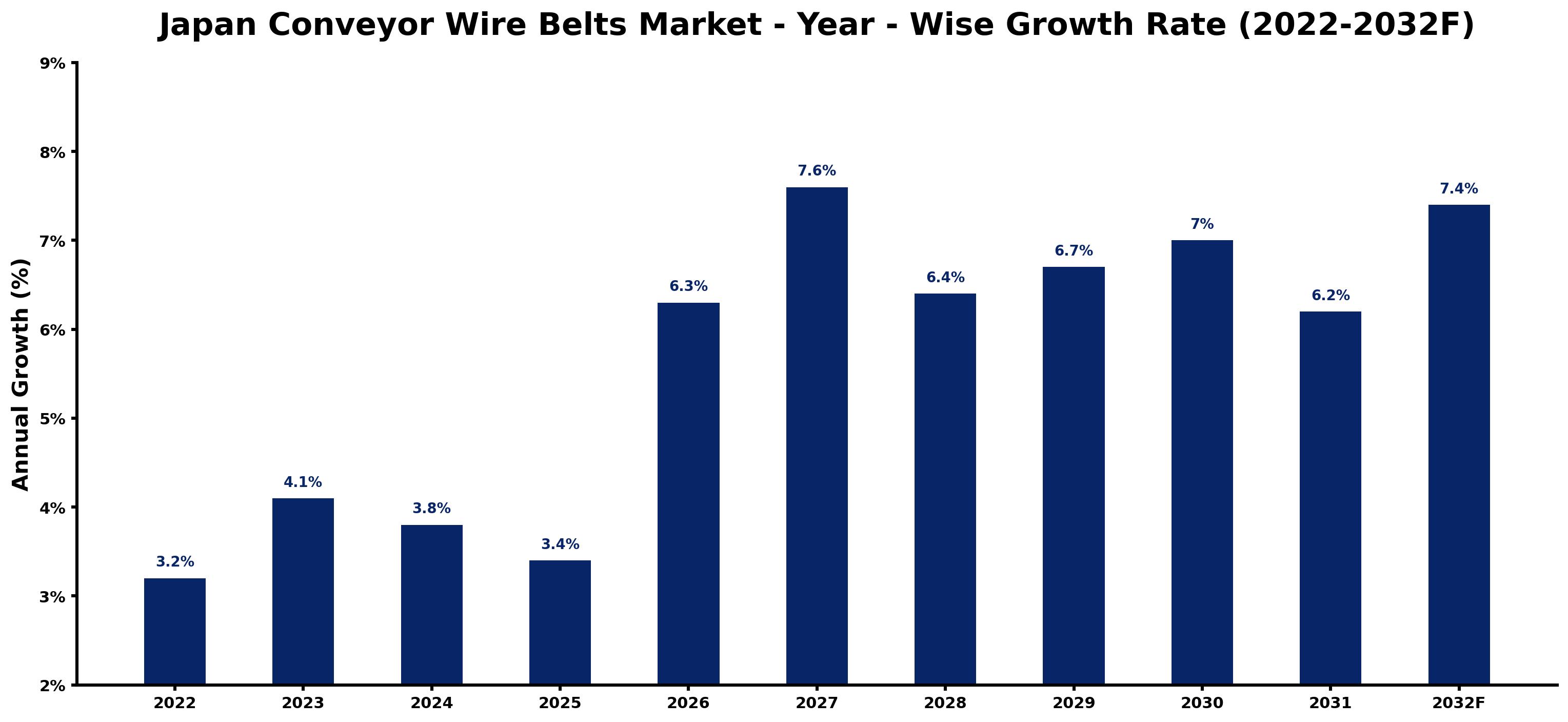
Each row of the following table gives one year's estimated growth and the event or demand shift that explains it.
| Year | Estimated Annual Growth (%) | Market Rationale |
| 2022 | 3.2 | The market experienced stable growth due to consistent demand from the manufacturing sector. |
| 2023 | 4.1 | Demand increased as the food industry expanded its operations and required more conveyor systems. |
| 2024 | 3.8 | Growth slowed as some sectors faced temporary setbacks in production capacity. |
| 2025 | 3.4 | Demand continued to grow, albeit at a slower pace, as automation trends began to take hold. |
| 2026 | 6.3 | The market is expected to rebound with increased investments in logistics and warehousing automation. |
| 2027 | 7.6 | A peak in growth is projected as the mining sector ramps up operations and requires more conveyor belts. |
| 2028 | 6.4 | Growth is anticipated to slow slightly as the market adjusts to the previous year's peak demand. |
| 2029 | 6.7 | Increased demand from the food industry is expected to drive growth as processing needs expand further. |
| 2030 | 7.0 | The market is projected to see a resurgence as investments in construction projects increase overall demand. |
| 2031 | 6.2 | Growth is expected to slow as the market stabilises after several years of rapid expansion. |
| 2032 | 7.4 | Demand is expected to rise again as new technologies in conveyor systems are adopted. |
Note: Market size estimations and growth projections presented in this report are based on 6Wresearch's proprietary forecasting methodology, utilizing the latest available industry data, government publications, and primary research inputs.
Japan Conveyor Wire Belts Market Synopsis
Conveyor wire belts are mechanical systems designed for transporting materials across various industries, constructed from durable metal wires woven together. The Japan Conveyor Wire Belts Market is valued at approximately 100 billion JPY, with the food industry accounting for about 40% of usage. Growth stems from increased automation in logistics and warehousing, investments in the mining sector, and sustained demand from the food processing industry, which drives higher investments in conveyor systems.
Market Dynamics Impact Analysis (2026–2032)
| Factor | Type | Impact | Primary Segment Affected |
| Increasing automation in logistics and warehousing | Driver | High | Logistics/Warehousing |
| Rising demand from the food processing sector | Driver | High | Food Industry |
| Expansion of mining operations requiring efficient material transport | Opportunity | High | Mining |
| Growing investments in construction projects boosting conveyor system needs | Opportunity | Medium | Construction |
| High production costs affecting profitability | Restraint | High | Metal Conveyor Belts |
| Limited availability of skilled workforce for installation and maintenance | Restraint | Medium | Metal Conveyor Belts |
| Compliance with safety regulations increasing operational costs | Challenge | High | Metal Conveyor Belts |
| Capacity constraints in manufacturing facilities delaying deliveries | Challenge | Medium | Metal Conveyor Belts |
Evaluation of Drivers in Japan Conveyor Wire Belts Market (2026–2032)
Demand rests on the following drivers, each shown with the segment it touches most.
| Drivers | Primary Segment Affected | Why It Matters (Evidence) |
| Increased automation in logistics and warehousing | Logistics/Warehousing | The rise in automation has led to a 40% increase in conveyor belt installations in warehouses, improving efficiency. |
| Growing food processing demands | Food Industry | The food sector's expansion has resulted in a 40% share of conveyor belt usage, prompting manufacturers to increase production. |
| Rising mining activities | Mining | With around 20,000 workers in the mining sector, demand for conveyor belts has surged to facilitate material transport. |
| Construction sector investments | Construction | Recent investments in construction projects have led to a 25% increase in conveyor belt requirements for material handling. |
| Adoption of ISO 9001 standards | Metal Conveyor Belts | Manufacturers adopting ISO 9001 have seen a 15% boost in production efficiency, leading to higher demand for conveyor belts. |
What keeps demand rising is the contrast between today and five years ago, with increased automation in logistics and warehousing leading to a 40% rise in conveyor belt installations. The food industry, which accounts for about 40% of usage, propels demand as processing operations expand. Mining activities have surged, with around 20,000 workers requiring conveyor belts for efficient material transport. Investments in construction projects have also boosted demand for conveyor systems, while manufacturers adopting ISO 9001 standards have improved production efficiency, stimulating the market further.
Evaluation of Restraints in Japan Conveyor Wire Belts Market
These restraints slow adoption and weigh on supplier margins.
| Market Restraint | Primary Segment Affected | Why It Matters (Evidence) |
| High production costs affecting profitability | Metal Conveyor Belts | Rising raw material prices have increased production costs, limiting profit margins for manufacturers. |
| Limited availability of skilled workforce | Metal Conveyor Belts | A shortage of skilled workers has delayed installation and maintenance, impacting operational efficiency. |
| Compliance with safety regulations | Metal Conveyor Belts | Adhering to safety regulations has raised operational costs, affecting overall profitability. |
| Supply chain disruptions | Metal Conveyor Belts | Recent global supply chain issues have led to delays in material availability, extending lead times. |
| Market saturation in certain segments | Metal Conveyor Belts | Increased competition has saturated the market, limiting price increases and affecting profit margins. |
Japan Conveyor Wire Belts Market Challenges
In the logistics sector, buyers often experience delays due to a shortage of specific conveyor wire belts, resulting in increased operational costs of up to 15%. Local suppliers face intense competition from imports, compelling them to lower prices, which can jeopardise product quality and reliability. Complying with standards such as ISO 9001 necessitates substantial investment, diverting funds from innovation and delaying new product introductions, which weakens suppliers' market position. A lack of skilled workers in advanced manufacturing techniques limits suppliers' capacity to meet rising demand, leading to lead times that can extend by several weeks for buyers.
Trends in the Japan Conveyor Wire Belts Market
These developments are changing demand patterns in the Japan Conveyor Wire Belts Market.
- Shift towards Automation in Warehousing: The trend towards automation in warehousing is reshaping the conveyor wire belts market, with a 30% increase in installations. This shift is illustrated by the growing use of automated guided vehicles (AGVs) in logistics.
- Transition from Metal to Aluminum Belts: Aluminum conveyor belts are increasingly preferred in automotive assembly lines, with a 25% rise in usage. This change reflects the need for lightweight solutions in manufacturing processes.
- Growing Demand from the Food Industry: The food industry is prioritising conveyor systems for processing, leading to a 40% share of market usage. This trend is driven by the need for efficient packaging and handling solutions.
- Increased Focus on Safety Standards: There is a growing emphasis on safety standards in conveyor belt manufacturing, with ISO 9001 adoption rising. This focus ensures compliance and bolsters product reliability.
Investment Opportunities in the Japan Conveyor Wire Belts Market
Investors looking at the Japan Conveyor Wire Belts Market should consider the following areas.
- Conveyor Systems for Mining: Investing in conveyor systems tailored for mining operations presents a significant opportunity, with the sector employing a large workforce. The current demand gap indicates a need for efficient transport solutions.
- Automation Solutions for Warehousing: The logistics sector is ripe for automation solutions, with a 30% rise in conveyor installations. Investing in automation technologies can enhance efficiency and reduce operational costs.
- Food Processing Conveyor Belts: With the food industry accounting for 40% of conveyor belt usage, there is a pressing need for advanced processing solutions. Suppliers can enter this market through partnerships with food manufacturers.
- Construction Industry Conveyor Systems: The construction sector is investing in conveyor systems for material transport, with a notable increase in demand. This presents an opportunity for suppliers to provide tailored solutions.
Government Initiatives in the Japan Conveyor Wire Belts Market
The Electrical Appliance and Material Safety Act (1961) has been updated to enforce stricter safety regulations for conveyor systems, requiring manufacturers to implement enhanced testing protocols. This update builds on previous laws by mandating compliance with international safety standards, ensuring higher product reliability and safety for users.
The PRTR Law (1999) requires businesses to report chemical substances, ensuring that food processing conveyor systems meet safety standards. This law allows manufacturers to confidently market their products, knowing they comply with necessary regulations.
Future Insight of the Japan Conveyor Wire Belts Market
By 2032, advancements in automation will reshape conveyor wire belt systems, enhancing efficiency across various sectors. Government initiatives will promote innovation, resulting in cutting-edge conveyor solutions that cater to specific industry needs. The logistics sector will adopt automated conveyor systems more widely, improving material handling and operational workflows. Japan's conveyor belt market is expected to exceed 100 billion JPY as smart technologies integrate into manufacturing and logistics, creating new opportunities for buyers and suppliers alike.
Market Segmentation Analysis
Japan Conveyor Wire Belts Market report covers a detailed analysis of the following market segments:
By Type – Metal Conveyor Belts Lead, Aluminum Conveyor Belts Expected to Grow Fastest
According to Ravi Bhandari, Research Head at 6Wresearch, Metal Conveyor Belts took 53% of type revenue in 2025, more than any other category. Metal conveyor belts hold the largest share due to their strength and durability, essential for heavy-duty applications in sectors like manufacturing and logistics. Their production in the Kanto region supports a strong installed base that caters to diverse industrial needs. Aluminum Conveyor Belts are projected to grow fastest, at a CAGR of 9.4% during 2026–2032. Aluminum conveyor belts are experiencing rapid growth as industries increasingly favour lightweight solutions, particularly in automotive assembly lines. This trend is evidenced by rising adoption rates driven by efficiency requirements in production. Suppliers must prioritise lightweight material offerings to capitalise on the increasing demand in the market.
By Application – Mining Leads, Food Industry Expected to Grow Fastest
In 2025, Mining led the application split with a 44% share. The mining sector holds a substantial share as conveyor belts are essential for efficiently transporting mined materials, which is critical for operational success. With approximately 20,000 workers in this sector relying on these systems, the demand remains strong. The quickest growth will come from Food Industry, forecast to expand at a CAGR of 9.9% between 2026 and 2032. The food industry is experiencing rapid growth due to the rising need for efficient processing and packaging solutions in food production. This sector's expansion is supported by increasing consumer demand for processed food products, driving the adoption of conveyor systems. Buyers in the food sector should consider investing in advanced conveyor systems to improve processing efficiency.
Key Attractiveness of the Report
- 10 Years of Market Numbers
- Historical Data Starting from 2022 to 2025
- Base Year 2025
- Forecast Data until 2032
- Key Performance Indicators Impacting the Market
- Major Upcoming Developments and Projects
Key Highlights of the Report:
- Japan Conveyor Wire Belts Market Outlook
- Market Size of Japan Conveyor Wire Belts Market, 2025
- Forecast of Japan Conveyor Wire Belts Market, 2032
- Historical Data and Forecast of Japan Conveyor Wire Belts Revenues & Volume for the Period 2022-2032
- Japan Conveyor Wire Belts Market Trend Evolution
- Japan Conveyor Wire Belts Market Drivers and Challenges
- Japan Conveyor Wire Belts Price Trends
- Japan Conveyor Wire Belts Porter's Five Forces
- Japan Conveyor Wire Belts Industry Life Cycle
- Historical Data and Forecast of Japan Conveyor Wire Belts Market Revenues & Volume By Type for the Period 2022-2032
- Historical Data and Forecast of Japan Conveyor Wire Belts Market Revenues & Volume By Metal Conveyor Belts for the Period 2022-2032
- Historical Data and Forecast of Japan Conveyor Wire Belts Market Revenues & Volume By Aluminum Conveyor Belts for the Period 2022-2032
- Historical Data and Forecast of Japan Conveyor Wire Belts Market Revenues & Volume By Wire Mesh Conveyor Belts for the Period 2022-2032
- Historical Data and Forecast of Japan Conveyor Wire Belts Market Revenues & Volume By Other for the Period 2022-2032
- Historical Data and Forecast of Japan Conveyor Wire Belts Market Revenues & Volume By Application for the Period 2022-2032
- Historical Data and Forecast of Japan Conveyor Wire Belts Market Revenues & Volume By Mining for the Period 2022-2032
- Historical Data and Forecast of Japan Conveyor Wire Belts Market Revenues & Volume By Food Industry for the Period 2022-2032
- Historical Data and Forecast of Japan Conveyor Wire Belts Market Revenues & Volume By Chemical Industry for the Period 2022-2032
- Historical Data and Forecast of Japan Conveyor Wire Belts Market Revenues & Volume By Logistics/Warehousing for the Period 2022-2032
- Historical Data and Forecast of Japan Conveyor Wire Belts Market Revenues & Volume By Construction for the Period 2022-2032
- Historical Data and Forecast of Japan Conveyor Wire Belts Market Revenues & Volume By Other for the Period 2022-2032
- Japan Conveyor Wire Belts Import Export Trade Statistics
- Market Opportunity Assessment By Type
- Market Opportunity Assessment By Application
- Japan Conveyor Wire Belts Top Companies Market Share
- Japan Conveyor Wire Belts Competitive Benchmarking By Technical and Operational Parameters
- Japan Conveyor Wire Belts Company Profiles
- Japan Conveyor Wire Belts Key Strategic Recommendations
Market Covered
This report examines the market across the segments below.
By Type
- Metal Conveyor Belts
- Aluminum Conveyor Belts
- Wire Mesh Conveyor Belts
- Other
By Application
- Mining
- Food Industry
- Chemical Industry
- Logistics/Warehousing
- Construction
- Other































