Japan Data Historian Market Size & Growth Rate (2026-2032)
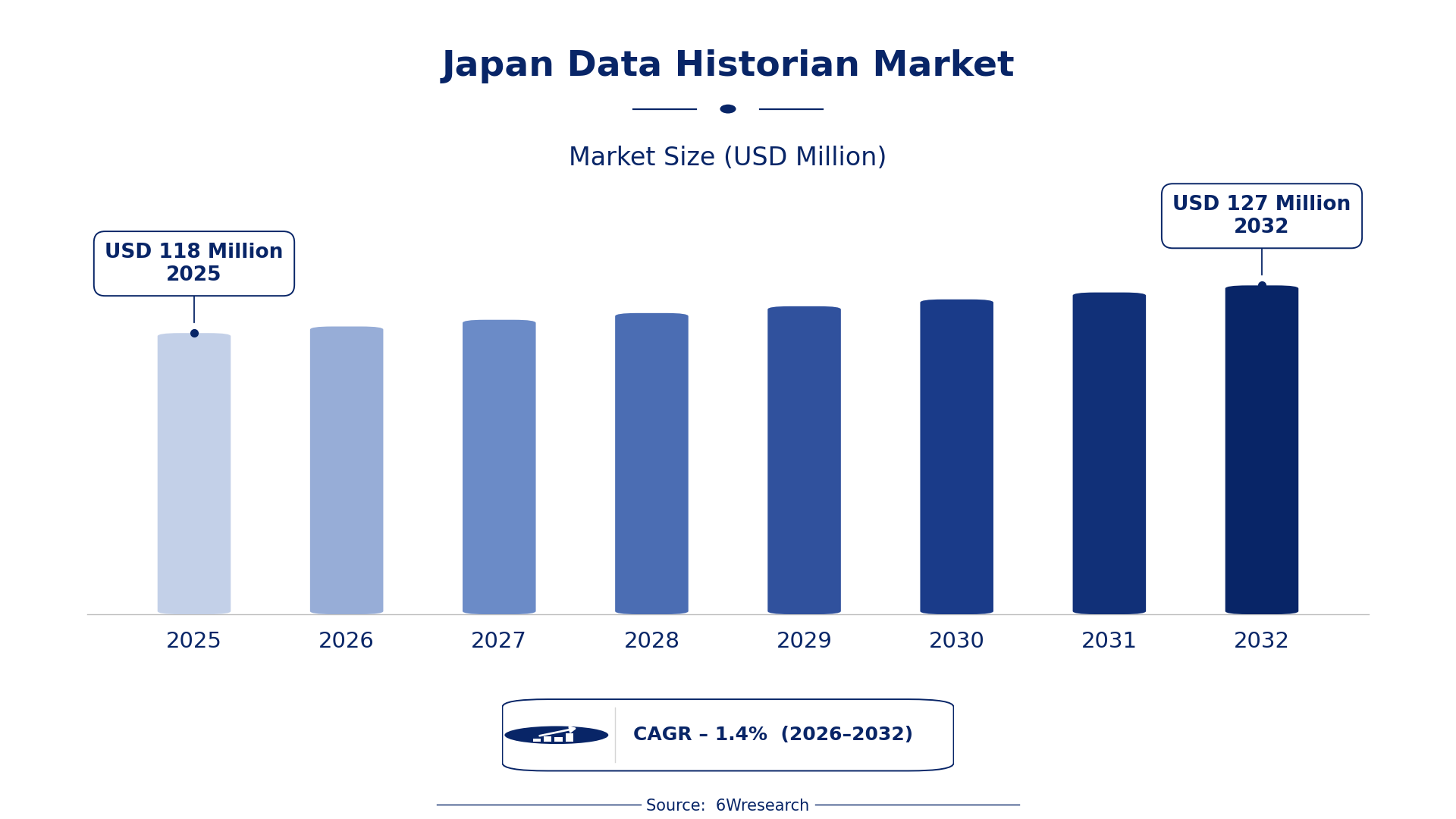
The Japan Data Historian Market was estimated at USD 118 Million in 2025 and is projected to reach USD 127 Million by 2032, growing at a CAGR of 1.4% from 2026 to 2032.
Japan Data Historian Market Synopsis
A major force driving the Japan Data Historian Market is the rapid adoption of Industrial Internet of Things (IIoT) technologies across various sectors. As industries increasingly seek to optimize their operations, the need for sophisticated data management tools has never been more critical.
Organizations are recognizing the value of real-time data analysis to enhance operational efficiency and support data-driven decision-making. This shift is further propelled by Japan's commitment to technological advancement and automation, making it a ripe environment for data historian solutions.
Japan Data Historian Market Year-wise Growth Rate and Key Drivers
This graph illustrates the annual growth rates of the Japan Data Historian Market from 2021 to 2032, highlighting a steady upward trajectory and projected expansion over the forecast period.
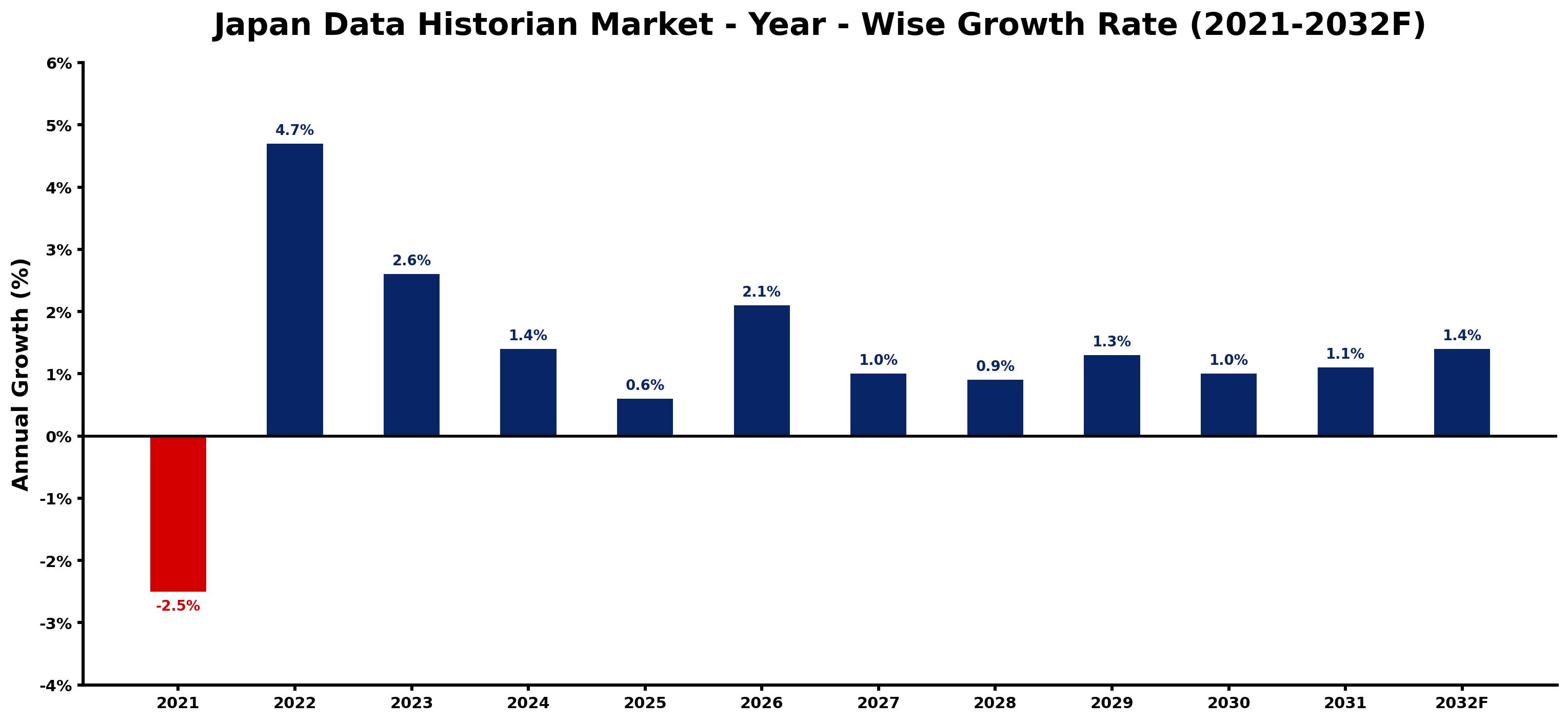
The table below presents the year‑wise growth rates along with the key drivers influencing the market
| Year | Growth Rate | Major Drivers |
| 2021 | -2.5% | Reduced government funding for digitization projects. |
| 2022 | 4.7% | Government push for Industry 4.0 adoption accelerates data utilization. |
| 2023 | 2.6% | Increased emphasis on data analytics in manufacturing sectors. |
| 2024 | 1.4% | Tokyo 2020 Olympics legacy promotes advanced data management. |
| 2025 | 0.6% | Surge in IoT device deployment necessitates data collection tools. |
| 2026 | 2.1% | Local tech firms enhancing real-time data processing capabilities. |
| 2027 | 1.0% | Growing need for compliance with data protection regulations. |
| 2028 | 0.9% | Investment in digital transformation by SMEs enhances market growth. |
| 2029 | 1.3% | Demographic shifts driving demand for elder healthcare data solutions. |
| 2030 | 1.0% | Rising focus on energy management boosts data historian usage. |
| 2031 | 1.1% | Adoption of AI in industrial applications requiring historical data. |
| 2032 | 1.4% | Emergence of 5G enabling faster data historian integration. |
Note: Market size estimations and growth projections presented in this report are based on 6Wresearch's proprietary forecasting methodology, utilizing the latest available industry data, government publications, and primary research inputs.
Japan Data Historian Market Key Takeaways
Below are some of the specific key takeaways from the market, including:
- Increased demand for cloud-based data historian solutions driven by operational efficiency needs.
- Growing integration of IIoT technologies with data historian systems to enable real-time monitoring.
- Investment opportunities emerging in software and consulting services for data management.
- Regulatory frameworks shaping data privacy and cybersecurity measures for data historians.
- The market is evolving towards advanced analytics capabilities and predictive maintenance tools.
Evaluation of Restraints in Japan Data Historian Market
The Japan Data Historian Market faces notable challenges that hinder broader adoption. High initial investments required for implementing data historian systems can be a significant barrier for smaller enterprises. These organizations often struggle to justify the expense against perceived benefits.
Additionally, the complexity of integrating new data historian solutions with existing infrastructure can deter companies from making the switch. Ensuring data security while complying with Japan's stringent data privacy laws adds another layer of difficulty, complicating the decision-making process for many potential users.
Japan Data Historian Market Trends
Current trends indicate a marked shift toward cloud-based data historian solutions. Companies are recognizing the advantages of scalable, flexible, and cost-effective data management systems. Enhanced analytics capabilities are also in demand as organizations seek to derive actionable insights from the vast amounts of data generated by industrial processes.
The integration of IIoT technologies into data historian systems is further driving demand. This interconnectivity allows for more sophisticated data collection and analysis, facilitating predictive maintenance and operational optimization.
Japan Data Historian Market Opportunities
Investors and companies looking to enter the Japan Data Historian Market have various avenues to explore. The increasing push for digital transformation within industries such as manufacturing, energy, and utilities creates a fertile ground for data historian solutions.
Specifically, opportunities lie in developing advanced software solutions that enhance data analysis capabilities and improve process optimization. Consulting and integration services also stand to gain traction as businesses seek expert guidance in leveraging their data effectively.
Government Initiatives in the Japan Data Historian Market
Government policy in Japan plays a crucial role in shaping the Data Historian Market. Recent initiatives emphasize data protection, cybersecurity, and the promotion of data-driven technologies. These policies create a supportive environment for businesses looking to adopt data historian solutions while ensuring compliance with regulatory standards.
- A regulatory framework introduced in 2025 mandating data privacy compliance for businesses handling sensitive information.
- An ongoing national digital infrastructure upgrade program focusing on enhancing data connectivity and security.
- A recent initiative promoting the integration of IIoT technologies into industrial processes to boost productivity.
- Upcoming policies aimed at incentivizing companies to adopt smart manufacturing practices through funding and resources.
Future Insights of the Japan Data Historian Market
The Japan Data Historian Market is set to grow steadily as industries continue to prioritize digitalization and automation. As businesses increasingly turn to data for insights, the demand for real-time monitoring and analytics will expand. This trend will be bolstered by government initiatives aimed at promoting Industry 4.0 practices, ensuring that data historian solutions remain integral to operational strategies.
With an emphasis on predictive maintenance and enhanced decision-making, the market is likely to evolve further, embracing advanced analytics and cloud-based solutions that meet the evolving needs of businesses across sectors.
Japan Data Historian Market Latest Developments
Recent activity in the Japan Data Historian Market reflects a robust push towards technological integration and advanced analytics. Over the past year, companies have made significant strides in enhancing their data management capabilities and aligning with government policies.
- A major technology vendor launched a new cloud-based data historian solution in Q1 2025, aiming to improve operational efficiency for manufacturers.
- A leading regional operator initiated a project to integrate IIoT sensors with existing data historian systems, which is currently underway and expected to complete by mid-2026.
- In early 2025, a consortium of businesses began a collaborative effort to develop standards for data privacy and cybersecurity in data historian applications.
- A planned public-private partnership is expected to kick off in late 2026 to enhance data infrastructure in the energy sector, focusing on data historian integration.
Japan Data Historian Market - Key Attractiveness of the Report
- 10 Years of Market Numbers
- Historical Data Starting from 2022 to 2025
- Base Year: 2025
- Forecast Data until 2032
- Key Performance Indicators Impacting the Market
- Major Upcoming Developments and Projects
Key Highlights of the Report:
- Japan Data Historian Market Outlook
- Market Size of Japan Data Historian Market, 2025
- Forecast of Japan Data Historian Market, 2032
- Historical Data and Forecast of Japan Data Historian Revenues & Volume for the Period 2022-2032F
- Japan Data Historian Market Trend Evolution
- Japan Data Historian Market Drivers and Challenges
- Japan Data Historian Price Trends
- Japan Data Historian Porter's Five Forces
- Japan Data Historian Industry Life Cycle
- Historical Data and Forecast of Japan Data Historian Market Revenues & Volume By Application for the Period 2022-2032F
- Historical Data and Forecast of Japan Data Historian Market Revenues & Volume By Production Tracking for the Period 2022-2032F
- Historical Data and Forecast of Japan Data Historian Market Revenues & Volume By Environmental Auditing for the Period 2022-2032F
- Historical Data and Forecast of Japan Data Historian Market Revenues & Volume By Asset Performance Management for the Period 2022-2032F
- Historical Data and Forecast of Japan Data Historian Market Revenues & Volume By GRC Management for the Period 2022-2032F
- Historical Data and Forecast of Japan Data Historian Market Revenues & Volume By Predictive Maintenance for the Period 2022-2032F
- Historical Data and Forecast of Japan Data Historian Market Revenues & Volume By Others (security and quality control management) for the Period 2022-2032F
- Historical Data and Forecast of Japan Data Historian Market Revenues & Volume By Deployment Mode for the Period 2022-2032F
- Historical Data and Forecast of Japan Data Historian Market Revenues & Volume By On-premises for the Period 2022-2032F
- Historical Data and Forecast of Japan Data Historian Market Revenues & Volume By Cloud for the Period 2022-2032F
- Historical Data and Forecast of Japan Data Historian Market Revenues & Volume By Organization Size for the Period 2022-2032F
- Historical Data and Forecast of Japan Data Historian Market Revenues & Volume By SMEs for the Period 2022-2032F
- Historical Data and Forecast of Japan Data Historian Market Revenues & Volume By Large Enterprises for the Period 2022-2032F
- Historical Data and Forecast of Japan Data Historian Market Revenues & Volume By End User for the Period 2022-2032F
- Historical Data and Forecast of Japan Data Historian Market Revenues & Volume By Oil and Gas for the Period 2022-2032F
- Historical Data and Forecast of Japan Data Historian Market Revenues & Volume By Marine for the Period 2022-2032F
- Historical Data and Forecast of Japan Data Historian Market Revenues & Volume By Chemicals and Petrochemicals for the Period 2022-2032F
- Historical Data and Forecast of Japan Data Historian Market Revenues & Volume By Paper and Pulp for the Period 2022-2032F
- Historical Data and Forecast of Japan Data Historian Market Revenues & Volume By Metal and Mining for the Period 2022-2032F
- Historical Data and Forecast of Japan Data Historian Market Revenues & Volume By Power and Utilities for the Period 2022-2032F
- Historical Data and Forecast of Japan Data Historian Market Revenues & Volume By Others for the Period 2022-2032F
- Historical Data and Forecast of Japan Data Historian Market Revenues & Volume By Component for the Period 2022-2032F
- Historical Data and Forecast of Japan Data Historian Market Revenues & Volume By Software/Tools for the Period 2022-2032F
- Historical Data and Forecast of Japan Data Historian Market Revenues & Volume By Services for the Period 2022-2032F
- Japan Data Historian Import Export Trade Statistics
- Market Opportunity Assessment By Application
- Market Opportunity Assessment By Deployment Mode
- Market Opportunity Assessment By Organization Size
- Market Opportunity Assessment By End User
- Market Opportunity Assessment By Component
- Japan Data Historian Top Companies Market Share
- Japan Data Historian Competitive Benchmarking By Technical and Operational Parameters
- Japan Data Historian Company Profiles
- Japan Data Historian Key Strategic Recommendations






































