Japan Dielectric Liquid Transformer Market Size & Growth Rate
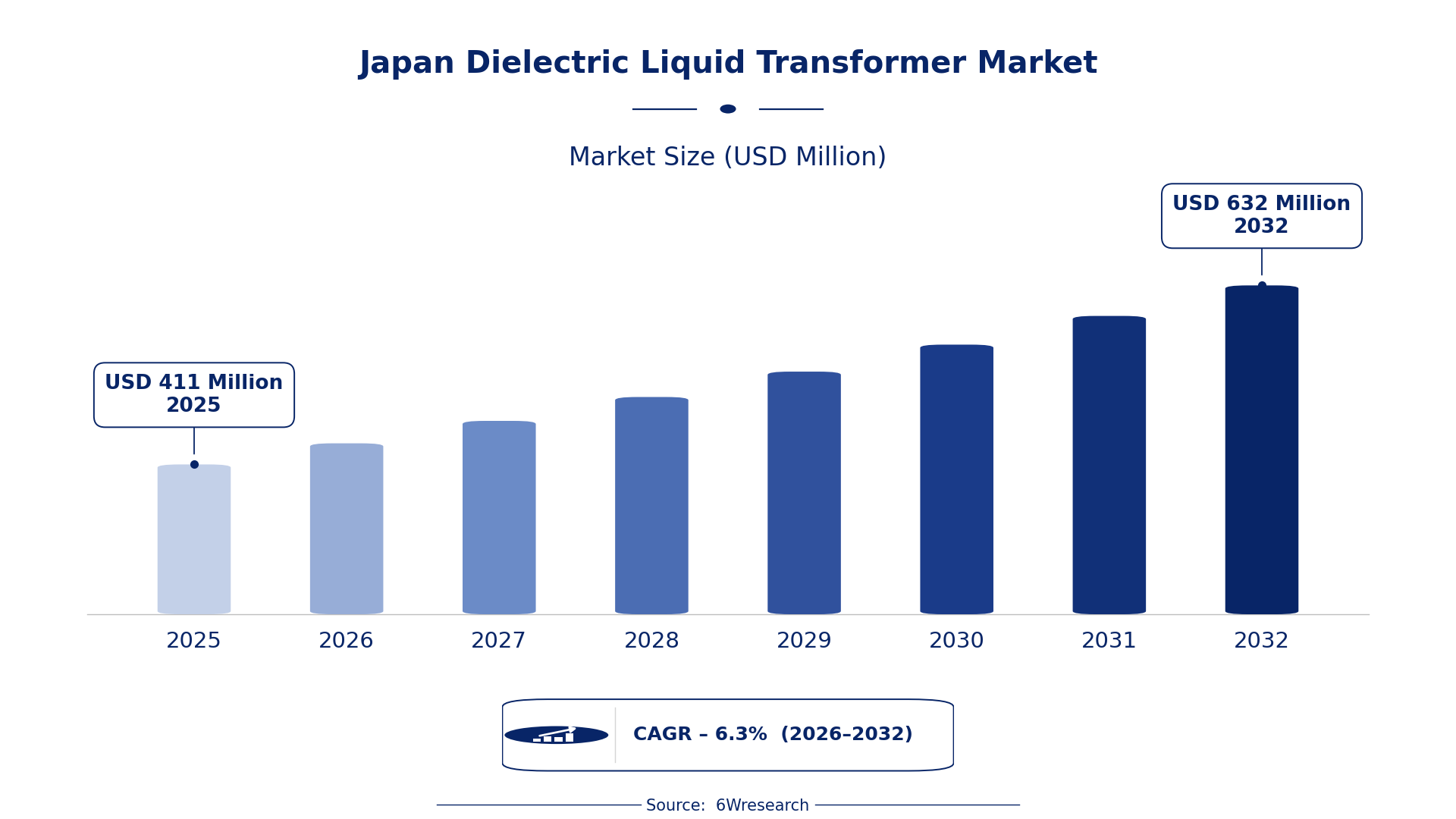
According to 6Wresearch internal database and industry insights, the Japan Dielectric Liquid Transformer Market was valued at USD 411 Million in 2025 and is projected to reach USD 632 Million by 2032, growing at a CAGR of approximately 6.3% during 2026–2032.
Japan Dielectric Liquid Transformer Market Highlights
| Report Metric | Details |
| Report Name | Japan Dielectric Liquid Transformer Market (2026-2032) |
| Market Size 2025 | USD 411 Million |
| Market Size 2032 | USD 632 Million |
| Absolute Growth 2025–2032 | USD 221 Million |
| CAGR 2026–2032 | 6.3% |
| Peak Annual Growth | 7.4% in 2028 |
| Forecast Period | 2026–2032 |
| Historical Data | 2022–2025 |
| Base Year | 2025 |
| Leading Product Types, 2025 | Hydrocarbon Oil Based (54% share) |
| Leading Applications, 2025 | Distribution Transformers (47% share) |
| Fastest-Growing Product Types | Water Based (8.7% CAGR) |
| Fastest-Growing Applications | Windmill Transformers (9.0% CAGR) |
| Growing Sector | Windmill Transformers |
| Key End Users | Distribution Transformers, Windmill Transformers, Traction Transformers, Off-Shore Transformers |
Japan Dielectric Liquid Transformer Market Year-wise Growth Rate and Key Drivers (2022–2032)
This graph illustrates the annual growth rates of the market from 2022 to 2032, highlighting a steady upward trajectory and projected market expansion over the forecast period.
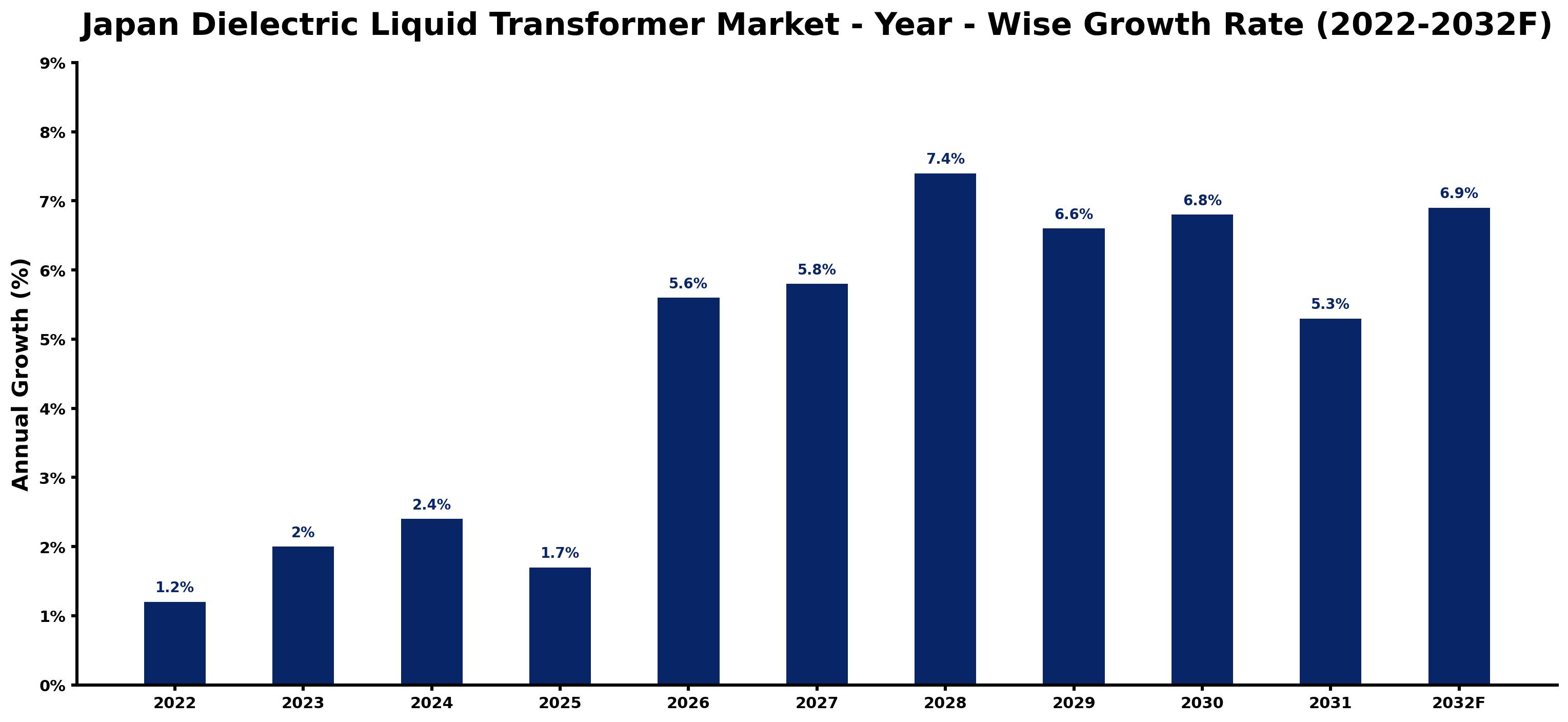
The following figures match every annual growth estimate with the main market development of that year, giving the reasoning behind each rise or slowdown.
| Year | Estimated Annual Growth (%) | Market Rationale |
| 2022 | 1.2 | The market experienced steady growth, reflecting increased demand for electrical infrastructure. |
| 2023 | 2.0 | Demand for dielectric liquid transformers grew faster due to rising installations in urban areas. |
| 2024 | 2.4 | The growth rate continued to rise as more transformers were installed across the country. |
| 2025 | 1.7 | Growth slowed as the market stabilised after rapid expansions in previous years. |
| 2026 | 5.6 | Purchasing surged as investments in renewable energy projects began to increase. |
| 2027 | 5.8 | Demand continued to rise, driven by the integration of new technologies in transformers. |
| 2028 | 7.4 | The market peaked with substantial growth from the expansion of offshore wind projects. |
| 2029 | 6.6 | Growth slowed as the market adjusted to the peak demand levels seen in the previous year. |
| 2030 | 6.8 | Demand increased again as new regulations supported renewable energy initiatives. |
| 2031 | 5.3 | The market experienced a slowdown as growth stabilised after the peak in 2028. |
| 2032 | 6.9 | Demand is expected to rise as the focus on energy transition continues to strengthen. |
Note: Market size estimations and growth projections presented in this report are based on 6Wresearch's proprietary forecasting methodology, utilizing the latest available industry data, government publications, and primary research inputs.
Japan Dielectric Liquid Transformer Market Synopsis
Dielectric liquid transformers utilise dielectric liquids for insulation and cooling, primarily made from hydrocarbon oils and synthetic esters. Their main applications include electrical insulation and heat dissipation in various transformer types. The Japan Dielectric Liquid Transformer Market is expanding due to increased demand from urban electrical infrastructure and renewable energy projects, particularly offshore wind farms. The installed base of distribution transformers is around 1.5 million units, driving further investments in this sector.
Market Dynamics Impact Analysis (2026–2032)
| Factor | Type | Impact | Primary Segment Affected |
| Growing demand for renewable energy integration | Driver | High | Windmill Transformers |
| Increased installations in urban areas | Driver | High | Distribution Transformers |
| Expansion of offshore wind energy projects | Opportunity | High | Off-Shore Transformers |
| Rising investments in electrical infrastructure | Opportunity | High | Distribution Transformers |
| Regulatory compliance costs for dielectric liquids | Restraint | Medium | Hydrocarbon Oil Based |
| Limited applications of water-based transformers | Restraint | Medium | Water Based |
| High costs associated with transformer upgrades | Challenge | High | Distribution Transformers |
| Capacity constraints in production facilities | Challenge | Medium | Hydrocarbon Oil Based |
Evaluation of Drivers in Japan Dielectric Liquid Transformer Market (2026–2032)
The following drivers explain most of the expected growth.
| Drivers | Primary Segment Affected | Why It Matters (Evidence) |
| Rising investments in renewable energy projects | Windmill Transformers | Increased focus on offshore wind farms, with over 300 installations boosting demand for windmill transformers. |
| Urban electrical infrastructure expansion | Distribution Transformers | Japan's population of approximately 126 million drives the need for improved electrical distribution systems. |
| Technological advancements in transformer efficiency | Hydrocarbon Oil Based | Improvements in insulation materials result in greater adoption of hydrocarbon oil-based transformers. |
| Government initiatives promoting renewable energy | Off-Shore Transformers | The 2023 programme supports the integration of renewable energy, stimulating demand for offshore transformers. |
| Increased demand for energy-efficient solutions | Distribution Transformers | The average lifespan of transformers is about 30 years, prompting upgrades for efficiency. |
Purchasing is picking up as urban electrical infrastructure expands, driven by Japan's population of approximately 126 million. With around 1.5 million distribution transformers in place, demand for efficient solutions is on the rise. Improvements in insulation materials result in greater adoption of hydrocarbon oil-based transformers. The focus on energy efficiency is prompting upgrades, as the average lifespan of transformers is about 30 years, encouraging investments in modern solutions.
Evaluation of Restraints in Japan Dielectric Liquid Transformer Market
The following restraints limit how fast demand can grow.
| Market Restraint | Primary Segment Affected | Why It Matters (Evidence) |
| Regulatory compliance costs for dielectric liquids | Hydrocarbon Oil Based | Producers face increased costs to meet the JIS C 4001 standard for transformer oil specifications. |
| Limited applications of water-based transformers | Water Based | Water-based dielectric liquids have restricted use in high voltage transformers, limiting market growth. |
| High costs associated with transformer upgrades | Distribution Transformers | Upgrading existing transformers to meet new standards incurs substantial expenses for buyers. |
| Capacity constraints in production facilities | Hydrocarbon Oil Based | Manufacturers are struggling to meet the growing demand due to limited production capabilities. |
| Market saturation in urban areas | Distribution Transformers | High penetration of transformers in urban regions is resulting in slower growth rates. |
Japan Dielectric Liquid Transformer Market Challenges
A shortage of skilled technicians in Japan hampers the production of dielectric liquid transformers, delaying project timelines for electrical infrastructure developers. Heightened competition from international markets pressures local producers to lower prices, which can diminish profit margins and restrict funding for quality improvements. Interruptions in the supply chain for hydrocarbon oils, which constitute 80% of dielectric liquids used, can inflate costs for manufacturers, resulting in increased prices for buyers. Rapid technological advancements in transformers demand substantial investments in new production machinery, which can extend lead times for suppliers.
Trends in the Japan Dielectric Liquid Transformer Market
These developments are changing demand patterns in the Japan Dielectric Liquid Transformer Market.
- Shift in Focus to Renewable Energy: Renewable energy solutions are becoming a priority, particularly offshore wind projects, with over 300 wind farms in Japan driving demand for windmill transformers.
- Transition to Advanced Dielectric Liquids: The introduction of advanced hydrocarbon oil-based dielectric liquids is changing the market, with 80% of transformers currently using this type, improving efficiency and safety.
- Growing Demand for Energy-Efficient Transformers: The emphasis on energy efficiency is reshaping buyer preferences, as the average lifespan of transformers is about 30 years, prompting upgrades to modern solutions.
- Increased Urban Infrastructure Development: Tokyo and Osaka are key regions for transformer installations, reflecting the ongoing urbanisation trend that drives demand for distribution transformers.
Investment Opportunities in the Japan Dielectric Liquid Transformer Market
The opportunities below stand out in the Japan Dielectric Liquid Transformer Market for new entrants and existing suppliers.
- Tokyo's Urban Electrical Infrastructure: Tokyo's ongoing urban development creates a need for new distribution transformers, with an installed base of around 1.5 million units, prompting investments in modern solutions.
- Renewable Energy Integration Initiatives: With Japan's energy transition strategy aiming to increase offshore wind capacity by 10 GW by 2030, there is a strong opportunity for suppliers of windmill transformers.
- Investment in Energy-Efficient Solutions: The push for energy-efficient transformers is clear, with buyers looking for upgrades to meet modern standards, creating opportunities for manufacturers.
- Support for Offshore Wind Projects: The 2023 programme promotes renewable energy, offering opportunities for suppliers in the offshore transformer market.
Government Initiatives in the Japan Dielectric Liquid Transformer Market
The Electrical Appliance and Material Safety Act (1961) regulates the safety of dielectric liquids used in transformers, ensuring that producers meet specific safety standards. Compliance with this law is essential for manufacturers to maintain market access and consumer trust.
In 2023, the Ministry of Economy, Trade and Industry launched a programme to promote renewable energy integration, with funding of approximately USD 50 million. This initiative supports the development of offshore wind energy projects, benefiting buyers and producers in the dielectric liquid transformer market.
Future Insight of the Japan Dielectric Liquid Transformer Market
Japan's energy transition strategy will drive a substantial shift in the electrical sector, significantly increasing the demand for dielectric liquid transformers. The integration of smart grid technologies will enhance efficiency and reliability, benefiting both suppliers and buyers. An increase of 10 GW in offshore wind capacity by 2030 will create a heightened need for specialised transformers. Stricter regulations for dielectric liquids will ensure improved safety and performance standards, fostering greater trust among end-users.
Market Segmentation Analysis
Japan Dielectric Liquid Transformer Market report covers a detailed analysis of the following market segments:
By Product Types – Hydrocarbon Oil Based Leads, Water Based Expected to Grow Fastest
According to Ravi Bhandari, Research Head at 6Wresearch, Hydrocarbon Oil Based accounted for 54% of the market by product types in 2025. Hydrocarbon oil-based dielectric liquids are predominant in Japan due to their critical role in insulation and cooling for a vast array of transformers. This type accounts for around 80% of the installed transformers, making it essential for reliable electrical performance. The quickest growth will come from Water Based, forecast to expand at a CAGR of 8.7% between 2026 and 2032. Water-based dielectric liquids are gaining traction as they cater to specific high voltage transformer applications, spurred by tightening environmental regulations. Their adoption is likely to increase as the industry shifts towards more sustainable solutions. Suppliers must prioritise the development of water-based dielectric liquids to align with the growing demand for eco-friendly transformer solutions.
By Applications – Distribution Transformers Lead, Windmill Transformers Expected to Grow Fastest
Distribution Transformers held 47% of the Japan Dielectric Liquid Transformer Market by applications in 2025. Distribution transformers hold the largest share due to their essential role in urban and rural electrical distribution networks. With around 1.5 million units installed, they ensure the reliability of Japan's extensive electrical infrastructure. Windmill Transformers are projected to grow fastest, at a CAGR of 9.0% during 2026–2032. Windmill transformers are experiencing rapid growth as a result of the increasing number of wind farms, which are crucial for meeting renewable energy targets. The initiative to boost offshore wind capacity by 10 GW by 2030 will further accelerate this segment's development. Suppliers should focus on windmill transformers to capitalise on the expanding renewable energy sector and align with government initiatives.
Key Attractiveness of the Report
- 10 Years of Market Numbers
- Historical Data Starting from 2022 to 2025
- Base Year 2025
- Forecast Data until 2032
- Key Performance Indicators Impacting the Market
- Major Upcoming Developments and Projects
Key Highlights of the Report:
- Japan Dielectric Liquid Transformer Market Outlook
- Market Size of Japan Dielectric Liquid Transformer Market, 2025
- Forecast of Japan Dielectric Liquid Transformer Market, 2032
- Historical Data and Forecast of Japan Dielectric Liquid Transformer Revenues & Volume for the Period 2022-2032F
- Japan Dielectric Liquid Transformer Market Trend Evolution
- Japan Dielectric Liquid Transformer Market Drivers and Challenges
- Japan Dielectric Liquid Transformer Price Trends
- Japan Dielectric Liquid Transformer Porter's Five Forces
- Japan Dielectric Liquid Transformer Industry Life Cycle
- Historical Data and Forecast of Japan Dielectric Liquid Transformer Market Revenues & Volume By Product Types for the Period 2022-2032F
- Historical Data and Forecast of Japan Dielectric Liquid Transformer Market Revenues & Volume By Water Based for the Period 2022-2032F
- Historical Data and Forecast of Japan Dielectric Liquid Transformer Market Revenues & Volume By Hydrocarbon Oil Based for the Period 2022-2032F
- Historical Data and Forecast of Japan Dielectric Liquid Transformer Market Revenues & Volume By Gas Based for the Period 2022-2032F
- Historical Data and Forecast of Japan Dielectric Liquid Transformer Market Revenues & Volume By Applications for the Period 2022-2032F
- Historical Data and Forecast of Japan Dielectric Liquid Transformer Market Revenues & Volume By Windmill Transformers for the Period 2022-2032F
- Historical Data and Forecast of Japan Dielectric Liquid Transformer Market Revenues & Volume By Traction Transformers for the Period 2022-2032F
- Historical Data and Forecast of Japan Dielectric Liquid Transformer Market Revenues & Volume By Electrical Discharge Machining (EDM) for the Period 2022-2032F
- Historical Data and Forecast of Japan Dielectric Liquid Transformer Market Revenues & Volume By Capacitors for the Period 2022-2032F
- Historical Data and Forecast of Japan Dielectric Liquid Transformer Market Revenues & Volume By Off-Shore Transformers for the Period 2022-2032F
- Historical Data and Forecast of Japan Dielectric Liquid Transformer Market Revenues & Volume By Distribution Transformers for the Period 2022-2032F
- Historical Data and Forecast of Japan Dielectric Liquid Transformer Market Revenues & Volume By Others for the Period 2022-2032F
- Japan Dielectric Liquid Transformer Import Export Trade Statistics
- Market Opportunity Assessment By Product Types
- Market Opportunity Assessment By Applications
- Japan Dielectric Liquid Transformer Top Companies Market Share
- Japan Dielectric Liquid Transformer Competitive Benchmarking By Technical and Operational Parameters
- Japan Dielectric Liquid Transformer Company Profiles
- Japan Dielectric Liquid Transformer Key Strategic Recommendations
Market Covered
The following segment groups are covered in the report.
By Product Types
- Water Based
- Hydrocarbon Oil Based
- Gas Based
By Applications
- Windmill Transformers
- Traction Transformers
- Electrical Discharge Machining (EDM)
- Capacitors
- Off-Shore Transformers
- Distribution Transformers
- Others































