Japan Digital Forensics Market Size & Growth Rate (2026-2032)
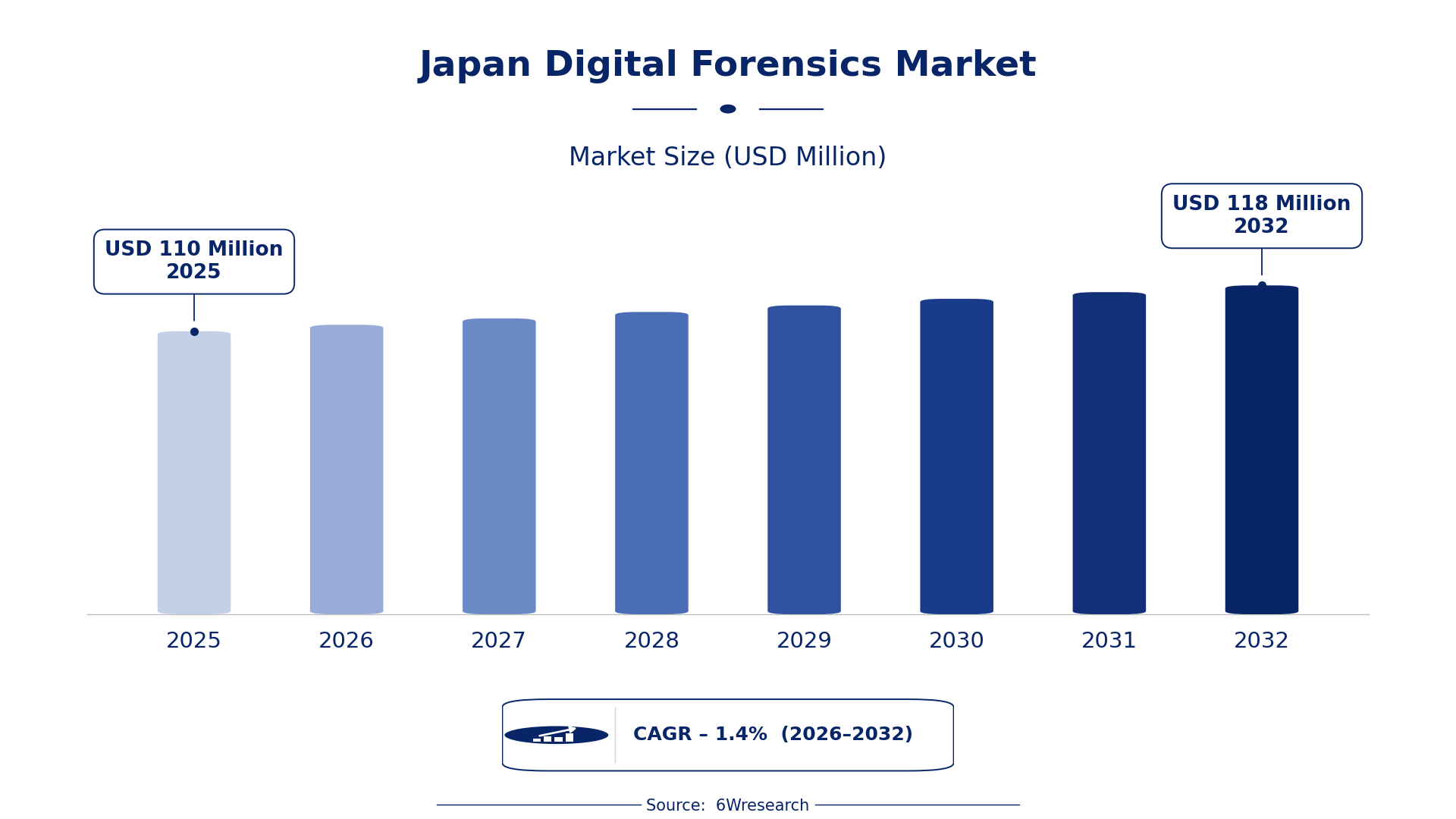
The Japan Digital Forensics Market was estimated at USD 110 Million in 2025 and is projected to reach USD 118 Million by 2032, growing at a CAGR of 1.4% from 2026 to 2032.
Japan Digital Forensics Market Synopsis
The Japan Digital Forensics Market has seen substantial momentum in recent years, fueled by increasing incidents of cyber threats and regulatory demands. As organizations across sectors recognize the importance of cybersecurity, there is a growing reliance on digital forensics to protect sensitive data and aid in legal investigations.
Looking ahead, the market is expected to evolve in response to technological advancements and the complexities of digital evidence. Companies are likely to invest in sophisticated forensic tools and expert services, focusing on compliance with new regulations while addressing the ever-changing landscape of cybercrime.
Japan Digital Forensics Market Year-wise Growth Rate and Key Drivers
This graph illustrates the annual growth rates of the Japan Digital Forensics Market from 2021 to 2032, highlighting a steady upward trajectory and projected expansion over the forecast period.
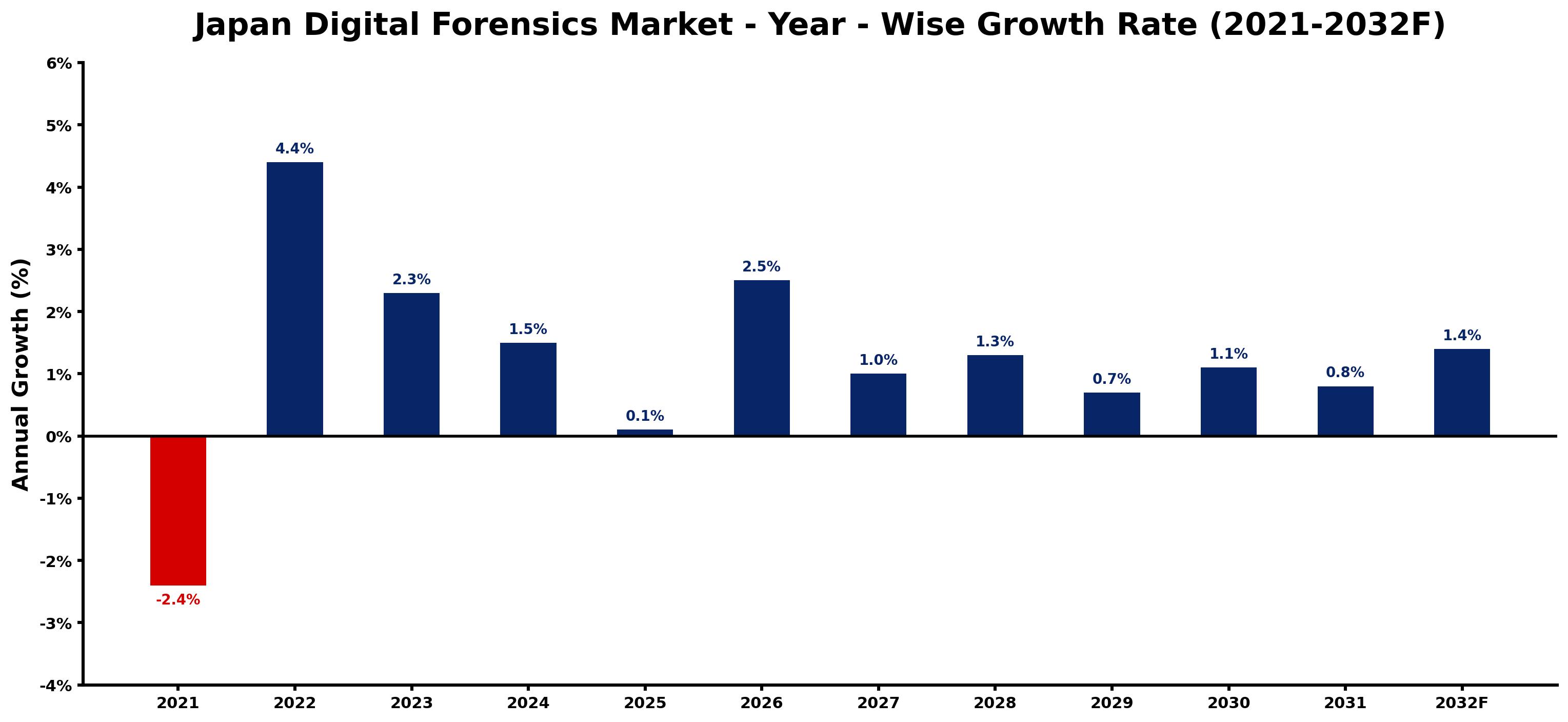
The table below presents the year‑wise growth rates along with the key drivers influencing the market
| Year | Growth Rate | Major Drivers |
| 2021 | -2.4% | Government budget cuts reduced digital forensic funding. |
| 2022 | 4.4% | Implementation of stricter data privacy laws by JPCERT |
| 2023 | 2.3% | Increased cybercrime incidents fueling digital forensic demand |
| 2024 | 1.5% | Growing adoption of blockchain technology in Japan |
| 2025 | 0.1% | Digital transformation initiatives within Japanese enterprises |
| 2026 | 2.5% | Proliferation of IoT devices necessitating forensic analysis |
| 2027 | 1.0% | Emergence of advanced threat detection tools in cybersecurity |
| 2028 | 1.3% | Rising investment in compliance and regulatory responses |
| 2029 | 0.7% | Boost in e-commerce leading to fraud investigations |
| 2030 | 1.1% | Enhancements in AI capabilities for data analysis |
| 2031 | 0.8% | Continued focus on protecting company intellectual property |
| 2032 | 1.4% | Increased collaboration among law enforcement agencies |
Note: Market size estimations and growth projections presented in this report are based on 6Wresearch's proprietary forecasting methodology, utilizing the latest available industry data, government publications, and primary research inputs.
Japan Digital Forensics Market Key Takeaways
Below are some of the specific key takeaways from the market, including:
- Increasing investment in digital forensics solutions is driven by the rise in cybercrime incidents.
- Government regulations are shaping the landscape of digital forensics, compelling organizations to enhance their cybersecurity frameworks.
- Emerging technologies like AI and machine learning are significantly influencing forensic analysis methodologies.
- Challenges include a shortage of skilled professionals, which impacts the efficiency of investigations.
- The market is evolving due to heightened awareness of data privacy and compliance with regulations such as PIPA.
Evaluation of Restraints in Japan Digital Forensics Market
One of the most pressing constraints in the Japan Digital Forensics Market is the rapidly evolving nature of cyber threats. As malicious actors continually develop new tactics, forensic experts must adapt quickly to effectively combat these challenges. A concerning aspect is the shortage of qualified digital forensic professionals; this scarcity hampers the ability of organizations to mount effective responses to cyber incidents. on top of that, the legal framework surrounding digital forensics is still maturing, leading to ambiguities that can complicate investigations and the presentation of evidence in court.
Japan Digital Forensics Market Trends
The ongoing rise in digital technology usage correlates directly with a surge in demand for digital forensics services. Organizations are increasingly investing in advanced forensic tools tailored to the unique challenges posed by cloud computing and IoT devices. Additionally, the introduction of stringent data privacy regulations, such as the Personal Information Protection Act, is compelling businesses to focus on compliance, thereby amplifying the demand for forensic services that ensure data protection.
Japan Digital Forensics Market Opportunities
The Japan Digital Forensics Market is ripe with investment opportunities, particularly as organizations prioritize cybersecurity in response to escalating threats. Key opportunities lie in developing cutting-edge forensic technologies, enhancing data encryption protocols, and leveraging cyber threat intelligence solutions. on top of that, there is a growing need for specialized training and consulting services, as businesses and government entities seek to improve their capabilities in digital investigations.
Government Initiatives in the Japan Digital Forensics Market
The Japanese government is actively promoting the growth of the digital forensics sector through various initiatives aimed at enhancing cybersecurity and ensuring regulatory compliance. This commitment to strengthening the nation’s digital infrastructure is crucial for fostering a secure environment where digital forensics can thrive.
- A recently completed national digital infrastructure upgrade programme aims to bolster cybersecurity readiness across critical sectors.
- Currently underway is a collaborative initiative involving law enforcement and private sector entities to develop standardized procedures for digital evidence collection.
- Upcoming policies include the planned introduction of a regulatory framework in 2026 to enhance data protection and define best practices for digital forensics.
- The government has allocated funding for research and development in cybersecurity technologies, directly benefiting the digital forensics market.
- Active training programs are being implemented to enhance the skills of digital forensic professionals, addressing the talent gap in this crucial area.
Future Insights of the Japan Digital Forensics Market
As we look toward 2026-2032, the Japan Digital Forensics Market is set for sustained growth, driven by escalating cyber threats and an increasing reliance on digital solutions. The integration of AI and machine learning technologies will likely enhance the capabilities of forensic tools, allowing for quicker and more comprehensive investigations. on top of that, with the ongoing emphasis on compliance and data protection, organizations will continuously seek reliable forensic services to safeguard their digital assets.
Japan Digital Forensics Market Latest Developments
In the past year, activity within the Japan Digital Forensics Market has intensified as companies adapt to the growing demand for security solutions. Notable developments indicate a shift towards innovative technologies and improved collaboration between public and private sectors.
- A major technology vendor announced the launch of an advanced forensic analysis tool in Q1 2025, aimed at streamlining investigations.
- An ongoing partnership between law enforcement agencies and cybersecurity firms began in mid-2025 to improve incident response strategies.
- A regional digital forensics conference held in early 2025 brought together industry leaders to discuss the future of forensic technologies and practices.
- A planned initiative, expected to roll out in late 2026, will focus on providing resources for small and medium enterprises to enhance their digital forensic capabilities.
- A technology upgrade project is currently underway to incorporate AI into existing forensic tools, with completion anticipated by early 2026.
Japan Digital Forensics Market - Key Attractiveness of the Report
- 10 Years of Market Numbers
- Historical Data Starting from 2022 to 2025
- Base Year: 2025
- Forecast Data until 2032
- Key Performance Indicators Impacting the Market
- Major Upcoming Developments and Projects
Key Highlights of the Report:
- Japan Digital Forensics Market Outlook
- Market Size of Japan Digital Forensics Market, 2025
- Forecast of Japan Digital Forensics Market, 2032
- Historical Data and Forecast of Japan Digital Forensics Revenues & Volume for the Period 2022-2032F
- Japan Digital Forensics Market Trend Evolution
- Japan Digital Forensics Market Drivers and Challenges
- Japan Digital Forensics Price Trends
- Japan Digital Forensics Porter's Five Forces
- Japan Digital Forensics Industry Life Cycle
- Historical Data and Forecast of Japan Digital Forensics Market Revenues & Volume By Component for the Period 2022-2032F
- Historical Data and Forecast of Japan Digital Forensics Market Revenues & Volume By Hardware for the Period 2022-2032F
- Historical Data and Forecast of Japan Digital Forensics Market Revenues & Volume By Software for the Period 2022-2032F
- Historical Data and Forecast of Japan Digital Forensics Market Revenues & Volume By Services for the Period 2022-2032F
- Historical Data and Forecast of Japan Digital Forensics Market Revenues & Volume By Type for the Period 2022-2032F
- Historical Data and Forecast of Japan Digital Forensics Market Revenues & Volume By Computer Forensics for the Period 2022-2032F
- Historical Data and Forecast of Japan Digital Forensics Market Revenues & Volume By Network Forensics for the Period 2022-2032F
- Historical Data and Forecast of Japan Digital Forensics Market Revenues & Volume By Mobile Device Forensics for the Period 2022-2032F
- Historical Data and Forecast of Japan Digital Forensics Market Revenues & Volume By Cloud Forensics for the Period 2022-2032F
- Historical Data and Forecast of Japan Digital Forensics Market Revenues & Volume By Tool for the Period 2022-2032F
- Historical Data and Forecast of Japan Digital Forensics Market Revenues & Volume By Vertical for the Period 2022-2032F
- Japan Digital Forensics Import Export Trade Statistics
- Market Opportunity Assessment By Component
- Market Opportunity Assessment By Type
- Market Opportunity Assessment By Tool
- Market Opportunity Assessment By Vertical
- Japan Digital Forensics Top Companies Market Share
- Japan Digital Forensics Competitive Benchmarking By Technical and Operational Parameters
- Japan Digital Forensics Company Profiles
- Japan Digital Forensics Key Strategic Recommendations






































