Japan Digital Printing on Wood Market Size & Growth Rate
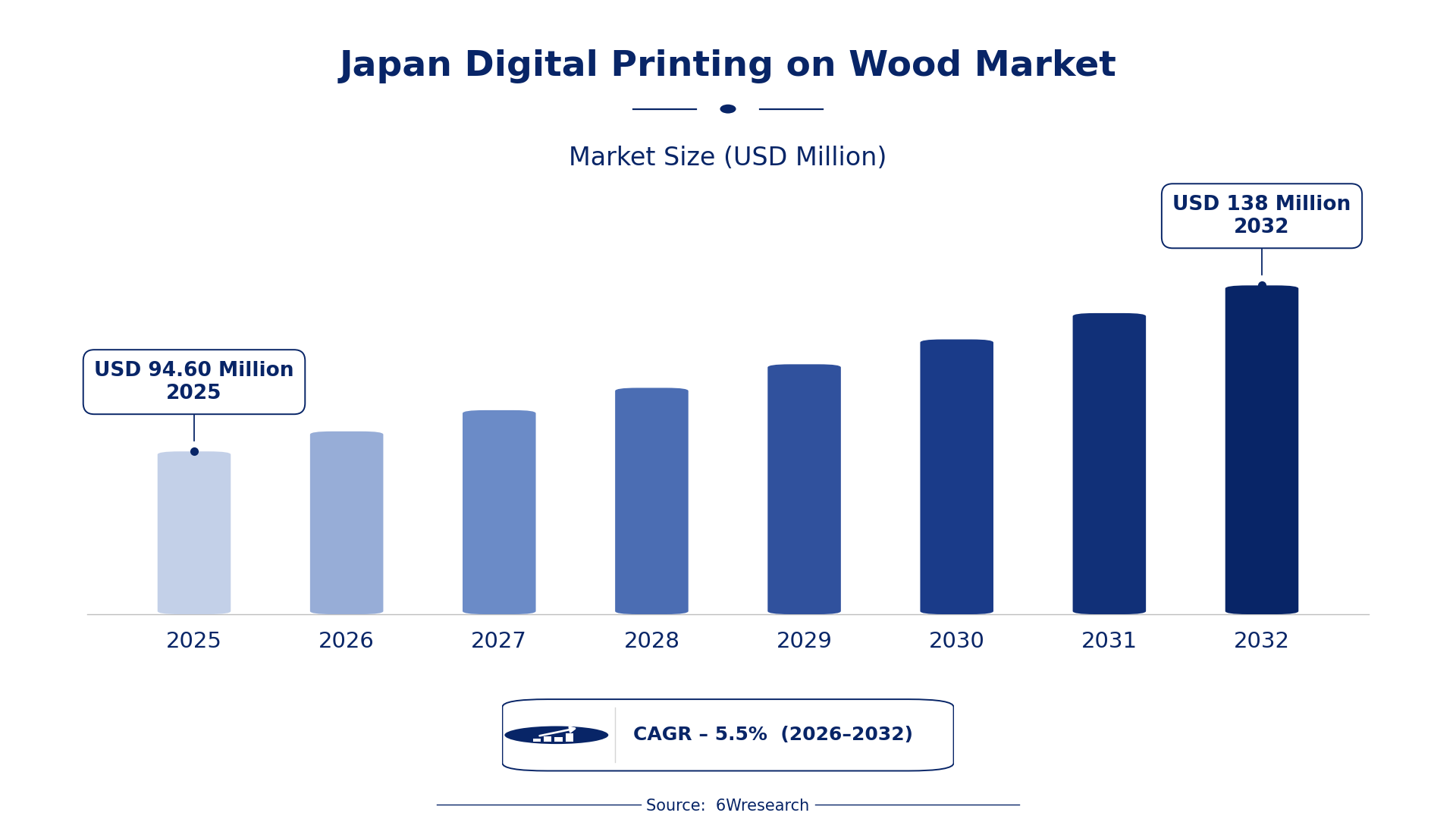
According to 6Wresearch internal database and industry insights, the Japan Digital Printing on Wood Market was valued at USD 94.60 Million in 2025 and is projected to reach USD 138 Million by 2032, growing at a CAGR of approximately 5.5% during 2026–2032.
Japan Digital Printing on Wood Market Highlights
| Report Metric | Details |
| Report Name | Japan Digital Printing on Wood Market (2026-2032) |
| Market Size 2025 | USD 94.60 Million |
| Market Size 2032 | USD 138 Million |
| Absolute Growth 2025–2032 | USD 43.40 Million |
| CAGR 2026–2032 | 5.5% |
| Peak Annual Growth | 7.0% in 2026 |
| Forecast Period | 2026–2032 |
| Historical Data | 2022–2025 |
| Base Year | 2025 |
| Leading Type, 2025 | Plywood (37% share) |
| Leading End use, 2025 | Vertical application (37% share) |
| Leading Application, 2025 | Boxes (45% share) |
| Fastest-Growing Type | Particleboard (7.4% CAGR) |
| Fastest-Growing End use | Fire retardant applications (7.1% CAGR) |
| Fastest-Growing Application | Cans (6.9% CAGR) |
| Growing Sector | Furniture |
| Key End Users | Furniture manufacturers, interior designers, wood processing companies |
Japan Digital Printing on Wood Market Year-wise Growth Rate and Key Drivers (2022–2032)
This graph illustrates the annual growth rates of the market from 2022 to 2032, highlighting a steady upward trajectory and projected market expansion over the forecast period.
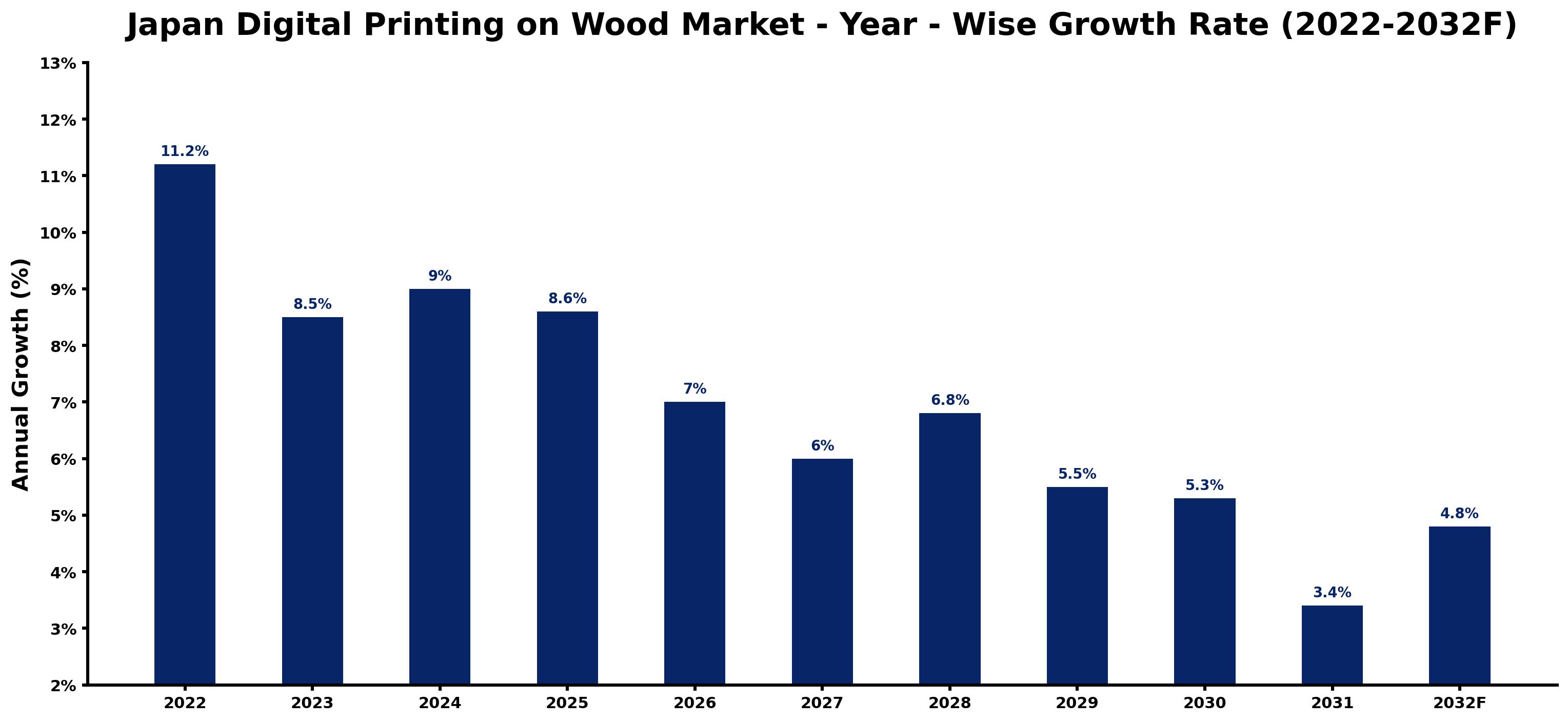
Below, each year's estimated growth is shown next to the factor that most influenced it.
| Year | Estimated Annual Growth (%) | Market Rationale |
| 2022 | 11.2 | The market experienced strong demand from the furniture sector and decorative applications. |
| 2023 | 8.5 | Growth slowed due to market saturation in some decorative segments. |
| 2024 | 9.0 | Increased investment in new printing technologies boosted demand. |
| 2025 | 8.6 | Demand from the furniture market remained steady, supporting growth. |
| 2026 | 7.0 | The market is expected to face a slowdown as competition intensifies among suppliers. |
| 2027 | 6.0 | Growth is projected to slow as buyers become more price-sensitive due to market conditions. |
| 2028 | 6.8 | Demand is expected to pick up again, driven by new applications in wall decor. |
| 2029 | 5.5 | A slowdown is projected as the market matures and innovation slows. |
| 2030 | 5.3 | Growth is expected to continue slowing as buyers focus on cost-effective solutions. |
| 2031 | 3.4 | The market will see further deceleration as demand stabilises. |
| 2032 | 4.8 | Growth is expected to rise again with new product developments. |
Note: Market size estimations and growth projections presented in this report are based on 6Wresearch's proprietary forecasting methodology, utilizing the latest available industry data, government publications, and primary research inputs.
Japan Digital Printing on Wood Market Synopsis
Digital Printing on Wood involves applying ink directly to wooden surfaces using advanced technology. In Japan, this process is widely used for decorative applications, furniture manufacturing, and customised wood products. The Japan Digital Printing on Wood Market is growing due to rising domestic demand, particularly from the furniture sector valued at around 1 trillion yen. Recent government initiatives to support wood innovation technologies are expected to stimulate investment and development in this sector, improving production capabilities and product quality.
Market Dynamics Impact Analysis (2026–2032)
| Factor | Type | Impact | Primary Segment Affected |
| Growing demand from the furniture sector drives the need for customized wood products. | Driver | High | Furniture |
| Investment in new printing technologies presents new opportunities for suppliers. | Opportunity | High | Vertical application |
| Limited availability of high-quality wood affects production capacity. | Restraint | Medium | Plywood |
| High competition among suppliers leads to price pressures. | Restraint | Medium | Particleboard |
| Emerging trends in sustainable materials create new market avenues. | Opportunity | High | Medium-Density Fibreboard (MDF) |
| Economic fluctuations may impact consumer spending on furniture. | Challenge | High | Furniture |
| Technological advancements require constant investment from suppliers. | Challenge | Medium | Plywood |
| Slow adoption of new technologies may hinder market expansion. | Restraint | Medium | Vertical application |
Evaluation of Drivers in Japan Digital Printing on Wood Market (2026–2032)
The following drivers explain most of the expected growth.
| Drivers | Primary Segment Affected | Why It Matters (Evidence) |
| Increased household spending on furniture drives demand for customized wood products. | Furniture | The average household in Japan spends about 300,000 yen on furniture annually. |
| The popularity of decorative applications in interior design boosts market demand. | Vertical application | Japan's wood processing industry supports this trend with diverse offerings. |
| Growing emphasis on sustainability encourages the use of eco-friendly materials. | Plywood | Fire retardant MDF is increasingly used in commercial buildings. |
| Investment in new printing technologies improves production capabilities. | Particleboard | Investment in new printing technologies is on the rise. |
| The expansion of the recreational vehicle market increases demand for custom interiors. | Recreational vehicles | The recreational vehicle market in Japan is growing, focusing on custom finishes. |
A wider customer base explains much of the growth, as increased household spending on furniture fuels demand for customized wood products. The average household in Japan spends about 300,000 yen annually on furniture, driving interest in decorative applications in interior design. The growing emphasis on sustainability encourages the use of eco-friendly materials, with fire retardant MDF increasingly used in commercial buildings. The expansion of the recreational vehicle market further increases demand for custom interiors, showcasing the diverse applications of digital printing on wood.
Evaluation of Restraints in Japan Digital Printing on Wood Market
Below are the constraints most often cited by buyers and suppliers, with the segment each affects.
| Market Restraint | Primary Segment Affected | Why It Matters (Evidence) |
| Limited availability of high-quality wood affects production capacity. | Plywood | Japan produced approximately 1.2 million cubic meters of plywood in 2022. |
| High competition among suppliers leads to price pressures. | Particleboard | The furniture market in Japan is valued at around 1 trillion yen. |
| Changing consumer preferences towards eco-friendly products can limit market growth. | Plywood | The ISO 9001 certification is commonly sought by wood processing companies. |
| Slow adoption of new technologies may hinder market expansion. | Vertical application | The JIS A 5908 standard governs plywood quality in Japan. |
| Economic fluctuations may impact consumer spending on furniture. | Furniture | Japan's population is approximately 125 million, influencing domestic wood demand. |
Japan Digital Printing on Wood Market Challenges
Producers in the furniture market face high costs due to limited access to quality plywood from the Tohoku region, which can delay projects and increase expenses by 10%. Suppliers encounter technological challenges, as many wood processing companies have not upgraded their printing equipment, leading to inefficiencies that inflate production costs by 15%. Buyers experience price volatility for raw materials, with costs rising by 10% during peak seasons, complicating budgeting and pricing strategies. The lack of skilled workers in advanced printing techniques hampers production efficiency, affecting output for suppliers and delaying delivery times.
Trends in the Japan Digital Printing on Wood Market
Buyers and suppliers in the Japan Digital Printing on Wood Market are adjusting to the following trends.
- Shift towards Eco-Friendly Materials: Furniture manufacturers are increasingly adopting eco-friendly materials in their products, driven by consumer demand for sustainability. In 2022, approximately 30% of new furniture lines incorporated sustainable wood sources, reflecting a market shift.
- Growing Demand for Customisation: Interior designers are prioritising customised wood products to meet unique client needs. In 2023, the market for bespoke wood items grew by 15%, showcasing the increasing trend towards personalisation.
- Expansion of Digital Printing Applications: The use of digital printing technology is broadening beyond traditional furniture applications. In 2023, decorative wall panels using digital printing saw a 20% increase in adoption, highlighting new market opportunities.
- Increase in Online Furniture Sales: Online platforms are becoming a primary sales channel for furniture, with a 25% rise in e-commerce transactions in 2023. This trend is reshaping how consumers purchase wood products.
Investment Opportunities in the Japan Digital Printing on Wood Market
The following areas offer the clearest openings for investors and suppliers in the Japan Digital Printing on Wood Market.
- Tohoku Region as a Hub for Innovation: The Tohoku region is emerging as a centre for wood innovation technologies, with government support. In 2023, funding for innovative wood projects increased by 20%, presenting opportunities for suppliers.
- Investment in Sustainable Wood Products: With a growing emphasis on sustainability, there is a notable gap in the market for eco-friendly wood products. The furniture sector is seeking suppliers who can provide certified sustainable materials.
- Custom Packaging Solutions for Boxes: The demand for custom packaging solutions is rising, with the boxes segment expected to grow. In 2023, the market for custom boxes expanded by 18%, indicating strong investment potential.
- Focus on Fire Retardant Applications: With rising safety standards, there is an opportunity to supply fire retardant MDF products. The commercial building sector is increasingly adopting these materials, creating a niche market.
Government Initiatives in the Japan Digital Printing on Wood Market
The wood innovation technologies programme launched in 2023 adds support to existing laws promoting sustainable forestry practices. This programme encourages producers to adopt new techniques, improving product quality and environmental sustainability. In 2023, the government allocated 500 million yen to support these initiatives.
The Digital Agency oversees government digital transformation and approves projects that improve wood processing capabilities. This agency's initiatives aim to streamline production processes and improve the quality of wood products, benefiting buyers and suppliers alike.
Future Insight of the Japan Digital Printing on Wood Market
The introduction of advanced wood processing facilities will improve production capabilities by 2032, enabling suppliers to adopt cutting-edge printing technologies. This transition will allow buyers to obtain higher-quality products with improved turnaround times. The implementation of the ISO 9001 certification will ensure consistent quality standards across the industry, benefiting buyers seeking reliability. Growing interest in custom wood products will drive innovation, prompting suppliers to expand their offerings and meet diverse market demands.
Market Segmentation Analysis
Japan Digital Printing on Wood Market report covers a detailed analysis of the following market segments:
By Type – Plywood Leads, Particleboard Expected to Grow Fastest
According to Sachin Kumar Rai, Senior Research Analyst at 6Wresearch, the largest type category in 2025 was Plywood, at 37% of revenue. Plywood holds the largest share due to its extensive use in furniture and flooring applications across Japan. The strong demand is bolstered by the concentration of the wood processing industry in the Tohoku region, which is known for its quality production. Over 2026–2032, Particleboard is expected to post the fastest growth, at a CAGR of 7.4%. Particleboard is witnessing rapid growth as it becomes increasingly popular for furniture and cabinetry, appealing to budget-conscious consumers. The government's recent programme to support wood innovation technologies is expected to further accelerate this segment's expansion. Suppliers should focus on enhancing their particleboard offerings to capitalise on the rising market demand.
By End use – Vertical application Leads, Fire retardant applications Expected to Grow Fastest
Vertical application accounted for 37% of the market by end use in 2025. Vertical application dominates the market as it is widely used for wall decor and signage, appealing to both residential and commercial sectors. This segment benefits from the trend towards personalised interior designs in Japan. Fire retardant applications are set to record the highest CAGR in this split, 7.1% over 2026–2032. Fire retardant applications are growing quickly due to rising safety regulations in specific industries, leading to increased demand for compliant materials. As awareness of fire safety continues to rise, this segment is expected to expand further. Buyers in industries requiring fire safety compliance should prioritise sourcing materials that meet these standards.
By Application – Boxes Lead, Cans Expected to Grow Fastest
With 45% of application revenue in 2025, Boxes was the largest category. Boxes lead the application segment as they are essential for custom packaging solutions across various industries, highlighting Japan's commitment to quality packaging. The demand for tailored packaging is particularly strong among local manufacturers seeking to differentiate their products. The quickest growth will come from Cans, forecast to expand at a CAGR of 6.9% between 2026 and 2032. Cans are experiencing the fastest growth, albeit from a smaller base, as they find new applications in decorative designs for niche markets. This trend may prompt suppliers to diversify their product lines to capture this emerging demand. Suppliers should explore opportunities in the can segment to meet the increasing interest in unique packaging solutions.
Key Attractiveness of the Report
- 10 Years of Market Numbers
- Historical Data Starting from 2022 to 2025
- Base Year 2025
- Forecast Data until 2032
- Key Performance Indicators Impacting the Market
- Major Upcoming Developments and Projects
Key Highlights of the Report:
- Japan Digital Printing on Wood Market Outlook
- Market Size of Japan Digital Printing on Wood Market, 2025
- Forecast of Japan Digital Printing on Wood Market, 2032
- Historical Data and Forecast of Japan Digital Printing on Wood Revenues & Volume for the Period 2022-2032
- Japan Digital Printing on Wood Market Trend Evolution
- Japan Digital Printing on Wood Market Drivers and Challenges
- Japan Digital Printing on Wood Price Trends
- Japan Digital Printing on Wood Porter's Five Forces
- Japan Digital Printing on Wood Industry Life Cycle
- Historical Data and Forecast of Japan Digital Printing on Wood Market Revenues & Volume By Type for the Period 2022-2032
- Historical Data and Forecast of Japan Digital Printing on Wood Market Revenues & Volume By Plywood for the Period 2022-2032
- Historical Data and Forecast of Japan Digital Printing on Wood Market Revenues & Volume By Particleboard for the Period 2022-2032
- Historical Data and Forecast of Japan Digital Printing on Wood Market Revenues & Volume By Oriented Strand Board (OSB) for the Period 2022-2032
- Historical Data and Forecast of Japan Digital Printing on Wood Market Revenues & Volume By Medium-Density Fibreboard (MDF) for the Period 2022-2032
- Historical Data and Forecast of Japan Digital Printing on Wood Market Revenues & Volume By End use for the Period 2022-2032
- Historical Data and Forecast of Japan Digital Printing on Wood Market Revenues & Volume By Vertical application for the Period 2022-2032
- Historical Data and Forecast of Japan Digital Printing on Wood Market Revenues & Volume By Fire retardant applications for the Period 2022-2032
- Historical Data and Forecast of Japan Digital Printing on Wood Market Revenues & Volume By Furniture for the Period 2022-2032
- Historical Data and Forecast of Japan Digital Printing on Wood Market Revenues & Volume By Flooring for the Period 2022-2032
- Historical Data and Forecast of Japan Digital Printing on Wood Market Revenues & Volume By Roofing for the Period 2022-2032
- Historical Data and Forecast of Japan Digital Printing on Wood Market Revenues & Volume By Yachts for the Period 2022-2032
- Historical Data and Forecast of Japan Digital Printing on Wood Market Revenues & Volume By Recreational vehicles for the Period 2022-2032
- Historical Data and Forecast of Japan Digital Printing on Wood Market Revenues & Volume By Application for the Period 2022-2032
- Historical Data and Forecast of Japan Digital Printing on Wood Market Revenues & Volume By Boxes for the Period 2022-2032
- Historical Data and Forecast of Japan Digital Printing on Wood Market Revenues & Volume By Cans for the Period 2022-2032
- Historical Data and Forecast of Japan Digital Printing on Wood Market Revenues & Volume By Bottles for the Period 2022-2032
- Japan Digital Printing on Wood Import Export Trade Statistics
- Market Opportunity Assessment By Type
- Market Opportunity Assessment By End use
- Market Opportunity Assessment By Application
- Japan Digital Printing on Wood Top Companies Market Share
- Japan Digital Printing on Wood Competitive Benchmarking By Technical and Operational Parameters
- Japan Digital Printing on Wood Company Profiles
- Japan Digital Printing on Wood Key Strategic Recommendations
Market Covered
The report covers the following segments.
By Type
- Plywood
- Particleboard
- Oriented Strand Board (OSB)
- Medium-Density Fibreboard (MDF)
By End use
- Vertical application
- Fire retardant applications
- Furniture
- Flooring
- Roofing
- Yachts
- Recreational vehicles
By Application
- Boxes
- Cans
- Bottles































