Japan Digital Transformation in Retail Market Size & Growth Rate
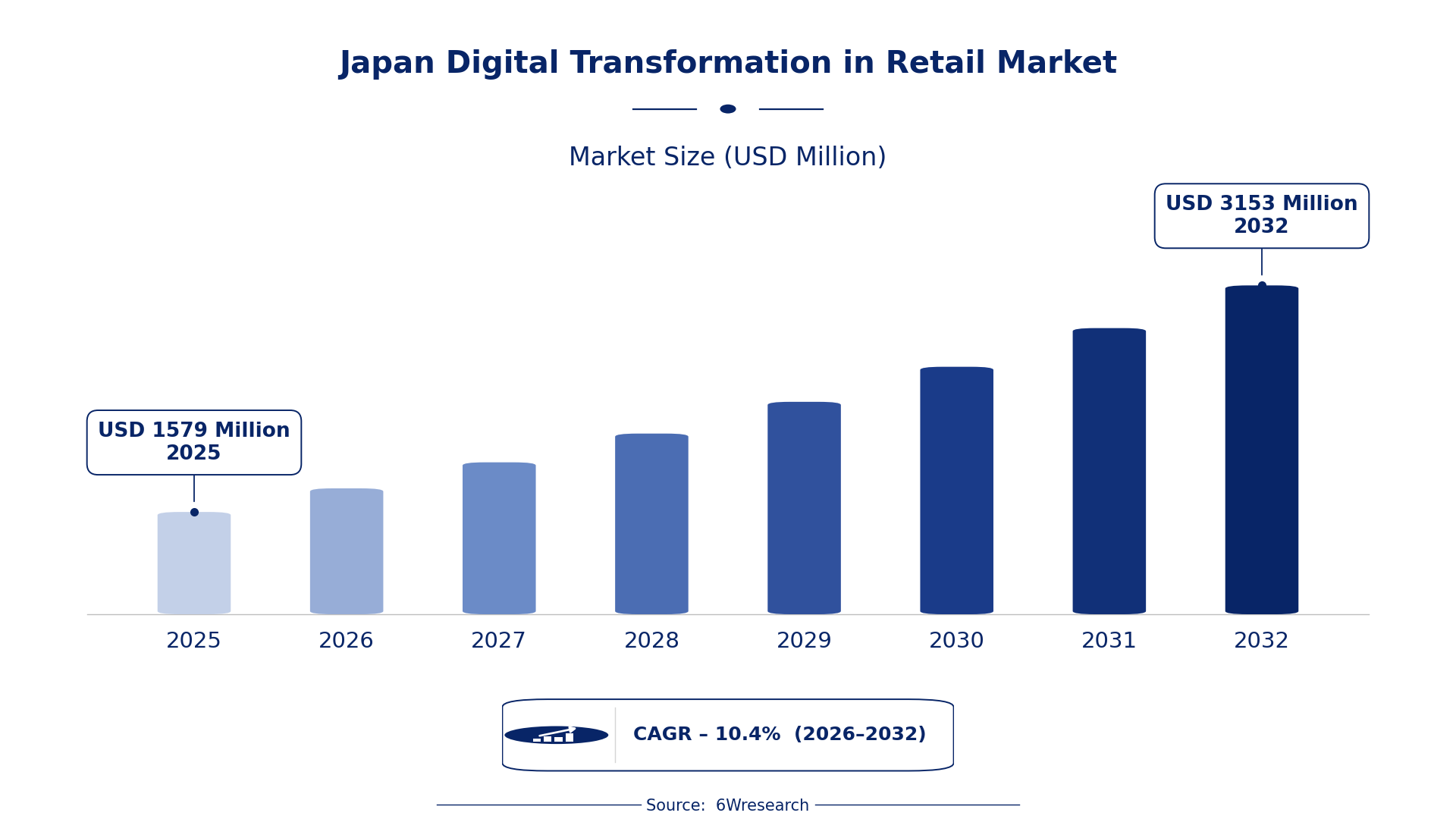
According to 6Wresearch internal database and industry insights, the Japan Digital Transformation in Retail Market was valued at USD 1,579 Million in 2025 and is projected to reach USD 3,153 Million by 2032, growing at a CAGR of approximately 10.4% during 2026–2032.
Japan Digital Transformation in Retail Market Highlights
| Report Metric | Details |
| Report Name | Japan Digital Transformation in Retail Market (2026-2032) |
| Market Size 2025 | USD 1,579 Million |
| Market Size 2032 | USD 3,153 Million |
| Absolute Growth 2025–2032 | USD 1,574 Million |
| CAGR 2026–2032 | 10.4% |
| Peak Annual Growth | 11.2% in 2031 |
| Forecast Period | 2026–2032 |
| Historical Data | 2022–2025 |
| Base Year | 2025 |
| Leading Accesibility, 2025 | Mobile Application (67% share) |
| Leading Product, 2025 | Consumer Electronics (42% share) |
| Leading Technology, 2025 | Cloud computing (46% share) |
| Fastest-Growing Accesibility | Website (13.5% CAGR) |
| Fastest-Growing Product | Media and Entertainment (15.3% CAGR) |
| Fastest-Growing Technology | Big data (15.4% CAGR) |
| Growing Sector | Retail e-commerce |
| Key End Users | Retailers, technology providers, consumers |
Japan Digital Transformation in Retail Market Year-wise Growth Rate and Key Drivers (2022–2032)
This graph illustrates the annual growth rates of the market from 2022 to 2032, highlighting a steady upward trajectory and projected market expansion over the forecast period.
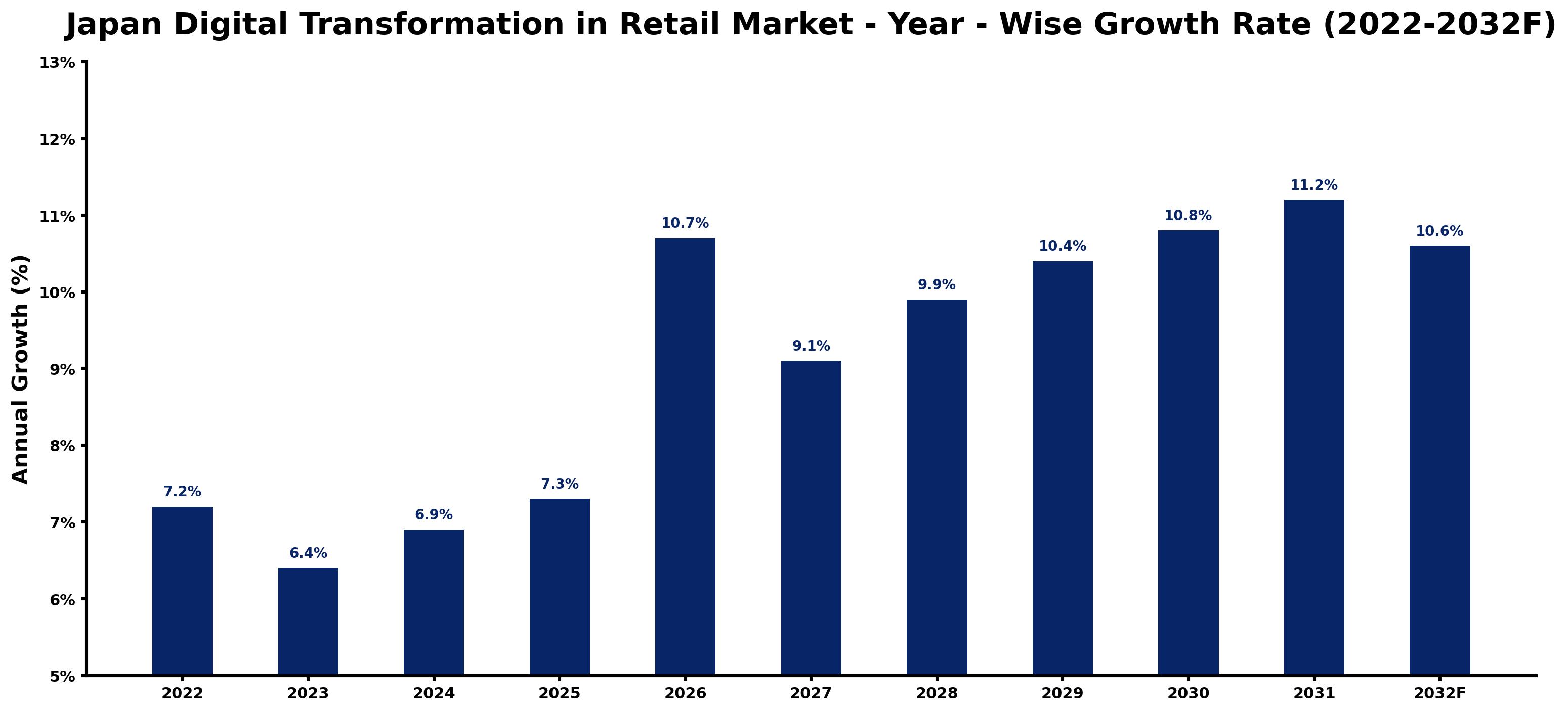
For each year, the table pairs the estimated growth rate with the leading influence on demand, showing how the drivers changed across the period.
| Year | Estimated Annual Growth (%) | Market Rationale |
| 2022 | 7.2 | The market showed steady growth as digital tools gained traction among retailers. |
| 2023 | 6.4 | Growth slowed due to market saturation in certain digital solutions. |
| 2024 | 6.9 | Increased adoption of AI technologies spurred faster growth compared to the previous year. |
| 2025 | 7.3 | Retailers invested heavily in cloud services, driving growth. |
| 2026 | 10.7 | Demand surged as digital literacy initiatives began to take effect across the sector. |
| 2027 | 9.1 | Growth slowed as the market adjusted to high levels of digital integration. |
| 2028 | 9.9 | The introduction of new big data applications accelerated growth once again. |
| 2029 | 10.4 | Investment in IoT solutions revitalised market momentum. |
| 2030 | 10.8 | The rise of AR technology in retail contributed to continued growth. |
| 2031 | 11.2 | Peak growth was driven by widespread AI adoption across retail operations. |
| 2032 | 10.6 | Growth slowed as the market stabilised after reaching high adoption rates. |
Note: Market size estimations and growth projections presented in this report are based on 6Wresearch's proprietary forecasting methodology, utilizing the latest available industry data, government publications, and primary research inputs.
Japan Digital Transformation in Retail Market Synopsis
Digital transformation in retail involves integrating digital technology into all retail operations, improving customer experiences and operational efficiency. The Japan Digital Transformation in Retail Market is growing due to rising e-commerce sales, with retail e-commerce reaching ¥19.5 trillion in 2022. Demand arises from technological advancements, particularly in cloud computing and AI, which facilitate better customer engagement and streamlined supply chains. Government initiatives to promote digital literacy further support this growth, creating opportunities for various buyer groups in the sector.
Market Dynamics Impact Analysis (2026–2032)
| Factor | Type | Impact | Primary Segment Affected |
| Growing e-commerce sales drive demand for digital solutions. | Driver | High | Mobile Application |
| Investment in cloud computing enhances operational efficiency. | Driver | High | Cloud computing |
| Increased consumer preference for online shopping creates demand for digital tools. | Opportunity | High | Website |
| Emerging technologies like AI and IoT present new market opportunities. | Opportunity | Medium | AI |
| High initial investment costs can deter smaller retailers from adopting digital solutions. | Restraint | High | Consumer Electronics |
| Limited digital literacy among some retailers restricts effective implementation. | Restraint | Medium | Food and Beverage |
| Challenges in cybersecurity compliance can delay digital transformation efforts. | Challenge | High | Apparel |
| The fast pace of technology evolution can overwhelm retailers' adaptation capabilities. | Challenge | Medium | Beauty and Personal Care |
Evaluation of Drivers in Japan Digital Transformation in Retail Market (2026–2032)
The following drivers explain most of the expected growth.
| Drivers | Primary Segment Affected | Why It Matters (Evidence) |
| Rising e-commerce sales increase the need for mobile applications. | Mobile Application | Retail e-commerce sales reached ¥19.5 trillion in 2022, prompting retailers to improve mobile engagement. |
| Investment in cloud computing improves data management. | Cloud computing | Cloud computing services are projected to grow by 20% annually, reflecting the need for efficient data handling in retail. |
| AI adoption facilitates customer personalisation. | AI | AI adoption in retail is expected to rise to 40% by 2025, driving demand for tailored shopping experiences. |
| IoT technology streamlines supply chains. | IoT | The IoT market in retail is valued at ¥1 trillion as of 2023, indicating significant investment in operational efficiency. |
| Big data analytics provide insights into consumer behaviour. | Big data | The growing importance of data-driven decision-making is evident as retailers seek competitive advantages. |
Much of the new demand traces back to the increasing reliance on digital tools in retail operations. The IoT market in retail is valued at ¥1 trillion, driving investments in supply chain efficiency. AI adoption is expected to rise, allowing for greater personalisation of shopping experiences. Cloud computing services are anticipated to grow by 20% annually, facilitating better data management and operational efficiency. Retailers are increasingly investing in these technologies to strengthen their competitive edge and meet evolving consumer expectations.
Evaluation of Restraints in Japan Digital Transformation in Retail Market
These are the pressures that could keep growth below its potential.
| Market Restraint | Primary Segment Affected | Why It Matters (Evidence) |
| High initial costs for digital transformation deter small retailers. | Consumer Electronics | Investment in digital infrastructure by retailers is estimated at ¥500 billion in 2023, which can be prohibitive. |
| Limited digital literacy hampers effective implementation of technologies. | Food and Beverage | The government aims for 80% of retailers to adopt digital tools by 2025, highlighting existing gaps. |
| Challenges in cybersecurity compliance can delay implementation. | Apparel | Industry standards for cybersecurity in retail are being updated, creating compliance hurdles. |
| Rapid technological changes can overwhelm retailers' adaptation capabilities. | Beauty and Personal Care | The fast pace of technology evolution can lead to implementation delays and increased costs. |
| Market saturation in certain digital solutions limits growth potential. | Website | As the number of e-commerce platforms increased by 30% since 2020, competition has intensified. |
Japan Digital Transformation in Retail Market Challenges
Producers face regulatory hurdles with accessibility standards like JIS X 8341-3, which increase compliance costs, particularly affecting smaller retailers who struggle to meet these requirements. Skills shortages in digital literacy hinder the workforce's ability to implement necessary technologies, delaying transformation efforts and limiting engagement for 70 million mobile app users. Buyers encounter inconsistent digital experiences across platforms, which frustrates customers and can reduce average online shopping cart values by ¥7,500. Technology adoption, particularly in cloud services, remains slow, with a projected growth rate of 20% annually, creating inefficiencies in supply chains for retailers.
Trends in the Japan Digital Transformation in Retail Market
The trends below show where the Japan Digital Transformation in Retail Market is heading.
- Transition from Traditional to Digital Platforms: Retailers are increasingly moving from traditional storefronts to digital platforms, with Tokyo emerging as a major hub for digital retail innovation, reflecting a shift in consumer behaviour and preferences.
- Growing Use of AI for Personalisation: Retailers are adopting AI technologies for personalisation, with AI adoption expected to rise to 40% by 2025, improving customer engagement and satisfaction across various retail sectors.
- Increased Investment in Cloud Computing: Cloud computing is becoming essential for retail operations, with services projected to grow by 20% annually, enabling retailers to manage data more efficiently and effectively.
- Expansion of E-commerce Platforms: The number of e-commerce platforms in Japan has increased by 30% since 2020, indicating a shift towards online shopping and creating more competition in the market.
Investment Opportunities in the Japan Digital Transformation in Retail Market
Below are the investment opportunities with the strongest case in the Japan Digital Transformation in Retail Market.
- Digital Tools for Customer Engagement: Investment in mobile applications is vital as the number of mobile app users in retail reached 70 million in Japan, creating a substantial market gap to fill for developers.
- Cloud Computing Services for Operational Efficiency: With cloud computing services projected to grow by 20% annually, partnerships with tech firms can enhance service offerings for retailers looking to improve operational efficiency.
- AI Solutions for Personalisation: The anticipated rise of AI adoption to 40% by 2025 presents an opportunity for technology providers to supply tailored solutions to retailers aiming for better customer experiences.
- IoT Solutions for Supply Chain Management: The valuation of the IoT market in retail at ¥1 trillion indicates a ripe opportunity for suppliers to offer innovative solutions that streamline operations and enhance efficiency.
Government Initiatives in the Japan Digital Transformation in Retail Market
The Digital Transformation Promotion Act, enacted in 2021, supports businesses by providing a framework for digital integration, building on previous laws aimed at improving retail efficiency. This act encourages retailers to adopt digital tools and technologies, aligning with the government's goal of increasing digital literacy in the sector.
The Digital Agency's initiatives promote digital literacy through funding and support programs. These efforts aim to help retailers implement digital solutions effectively, ensuring they remain competitive in a rapidly evolving market.
Future Insight of the Japan Digital Transformation in Retail Market
By 2032, AI adoption in retail is expected to reach 40%, enabling suppliers to make more informed, data-driven decisions. The Digital Agency's initiatives will enhance digital literacy, allowing retailers to effectively utilise new technologies. Updated cybersecurity standards will protect consumer data, building trust in online transactions. With the government aiming for 80% digital tool adoption by 2025, buyers will benefit from more personalised services and streamlined shopping experiences.
Market Segmentation Analysis
Japan Digital Transformation in Retail Market report covers a detailed analysis of the following market segments:
By Accesibility – Mobile Application Leads, Website Expected to Grow Fastest
According to Sumit Sagar, AM at 6Wresearch, Mobile Application accounted for 67% of the market by accesibility in 2025. Mobile applications are essential for customer engagement and transactions, making them a preferred choice among retailers in Japan. With 70 million mobile app users in the retail sector, this sub-segment effectively addresses the demand for convenient shopping experiences. The quickest growth will come from Website, forecast to expand at a CAGR of 13.5% between 2026 and 2032. Websites are experiencing rapid growth as they serve as the primary platform for e-commerce and information dissemination. The 30% increase in e-commerce platforms since 2020 indicates a strong shift towards online retailing, driving this growth. Suppliers should focus on enhancing website functionalities to meet the evolving needs of online shoppers.
By Product – Consumer Electronics Leads, Media and Entertainment Expected to Grow Fastest
Consumer Electronics held 42% of the Japan Digital Transformation in Retail Market by product in 2025. Consumer electronics hold a significant share as they support various retail operations, appealing to tech-savvy consumers. The 15% increase in online sales within this sector in 2023 underscores its ongoing importance in the retail landscape. Media and Entertainment is set to record the highest CAGR in this split, 15.3% over 2026–2032. Media and entertainment are becoming increasingly important as they are used for marketing, improving brand visibility. The rising focus on digital content in retail strategies reflects a shift towards integrating media into shopping experiences. Retailers must leverage media and entertainment effectively to attract and engage customers.
By Technology – Cloud computing Leads, Big data Expected to Grow Fastest
With 46% of technology revenue in 2025, Cloud computing was the largest category. Cloud computing is essential for data management and operational efficiency, establishing it as the leading technology in the retail sector. Its projected annual growth rate of 20% underscores its critical role in enabling digital transformation initiatives. Over 2026–2032, Big data is expected to post the fastest growth, at a CAGR of 15.4%. Big data is becoming increasingly important for acquiring customer insights and analytics, leading to its swift adoption among retailers. As data-driven decision-making gains prominence, the demand for big data solutions will continue to grow. Investments in big data analytics will be vital for retailers seeking to improve customer understanding and operational efficiency.
Key Attractiveness of the Report
- 10 Years of Market Numbers
- Historical Data Starting from 2022 to 2025
- Base Year 2025
- Forecast Data until 2032
- Key Performance Indicators Impacting the Market
- Major Upcoming Developments and Projects
Key Highlights of the Report:
- Japan Digital Transformation in Retail Market Outlook
- Market Size of Japan Digital Transformation in Retail Market, 2025
- Forecast of Japan Digital Transformation in Retail Market, 2032
- Historical Data and Forecast of Japan Digital Transformation in Retail Revenues & Volume for the Period 2022-2032
- Japan Digital Transformation in Retail Market Trend Evolution
- Japan Digital Transformation in Retail Market Drivers and Challenges
- Japan Digital Transformation in Retail Price Trends
- Japan Digital Transformation in Retail Porter's Five Forces
- Japan Digital Transformation in Retail Industry Life Cycle
- Historical Data and Forecast of Japan Digital Transformation in Retail Market Revenues & Volume By Accesibility for the Period 2022-2032
- Historical Data and Forecast of Japan Digital Transformation in Retail Market Revenues & Volume By Mobile Application for the Period 2022-2032
- Historical Data and Forecast of Japan Digital Transformation in Retail Market Revenues & Volume By Website for the Period 2022-2032
- Historical Data and Forecast of Japan Digital Transformation in Retail Market Revenues & Volume By Product for the Period 2022-2032
- Historical Data and Forecast of Japan Digital Transformation in Retail Market Revenues & Volume By Consumer Electronics for the Period 2022-2032
- Historical Data and Forecast of Japan Digital Transformation in Retail Market Revenues & Volume By Media and Entertainment for the Period 2022-2032
- Historical Data and Forecast of Japan Digital Transformation in Retail Market Revenues & Volume By Apparel for the Period 2022-2032
- Historical Data and Forecast of Japan Digital Transformation in Retail Market Revenues & Volume By Food and Beverage for the Period 2022-2032
- Historical Data and Forecast of Japan Digital Transformation in Retail Market Revenues & Volume By Furniture and Home Decor for the Period 2022-2032
- Historical Data and Forecast of Japan Digital Transformation in Retail Market Revenues & Volume By Beauty and Personal Care for the Period 2022-2032
- Historical Data and Forecast of Japan Digital Transformation in Retail Market Revenues & Volume By Other Products for the Period 2022-2032
- Historical Data and Forecast of Japan Digital Transformation in Retail Market Revenues & Volume By Technology for the Period 2022-2032
- Historical Data and Forecast of Japan Digital Transformation in Retail Market Revenues & Volume By Cloud computing for the Period 2022-2032
- Historical Data and Forecast of Japan Digital Transformation in Retail Market Revenues & Volume By Big data for the Period 2022-2032
- Historical Data and Forecast of Japan Digital Transformation in Retail Market Revenues & Volume By AI for the Period 2022-2032
- Historical Data and Forecast of Japan Digital Transformation in Retail Market Revenues & Volume By IoT for the Period 2022-2032
- Historical Data and Forecast of Japan Digital Transformation in Retail Market Revenues & Volume By AR/VR for the Period 2022-2032
- Japan Digital Transformation in Retail Import Export Trade Statistics
- Market Opportunity Assessment By Accesibility
- Market Opportunity Assessment By Product
- Market Opportunity Assessment By Technology
- Japan Digital Transformation in Retail Top Companies Market Share
- Japan Digital Transformation in Retail Competitive Benchmarking By Technical and Operational Parameters
- Japan Digital Transformation in Retail Company Profiles
- Japan Digital Transformation in Retail Key Strategic Recommendations
Market Covered
Segments analysed in this report are listed below.
By Accesibility
- Mobile Application
- Website
By Product
- Consumer Electronics
- Media and Entertainment
- Apparel
- Food and Beverage
- Furniture and Home Decor
- Beauty and Personal Care
- Other Products
By Technology
- Cloud computing
- Big data
- AI
- IoT
- AR/VR































