Japan Digital Transmission Driving the Geospatial Services Market Size & Growth Rate
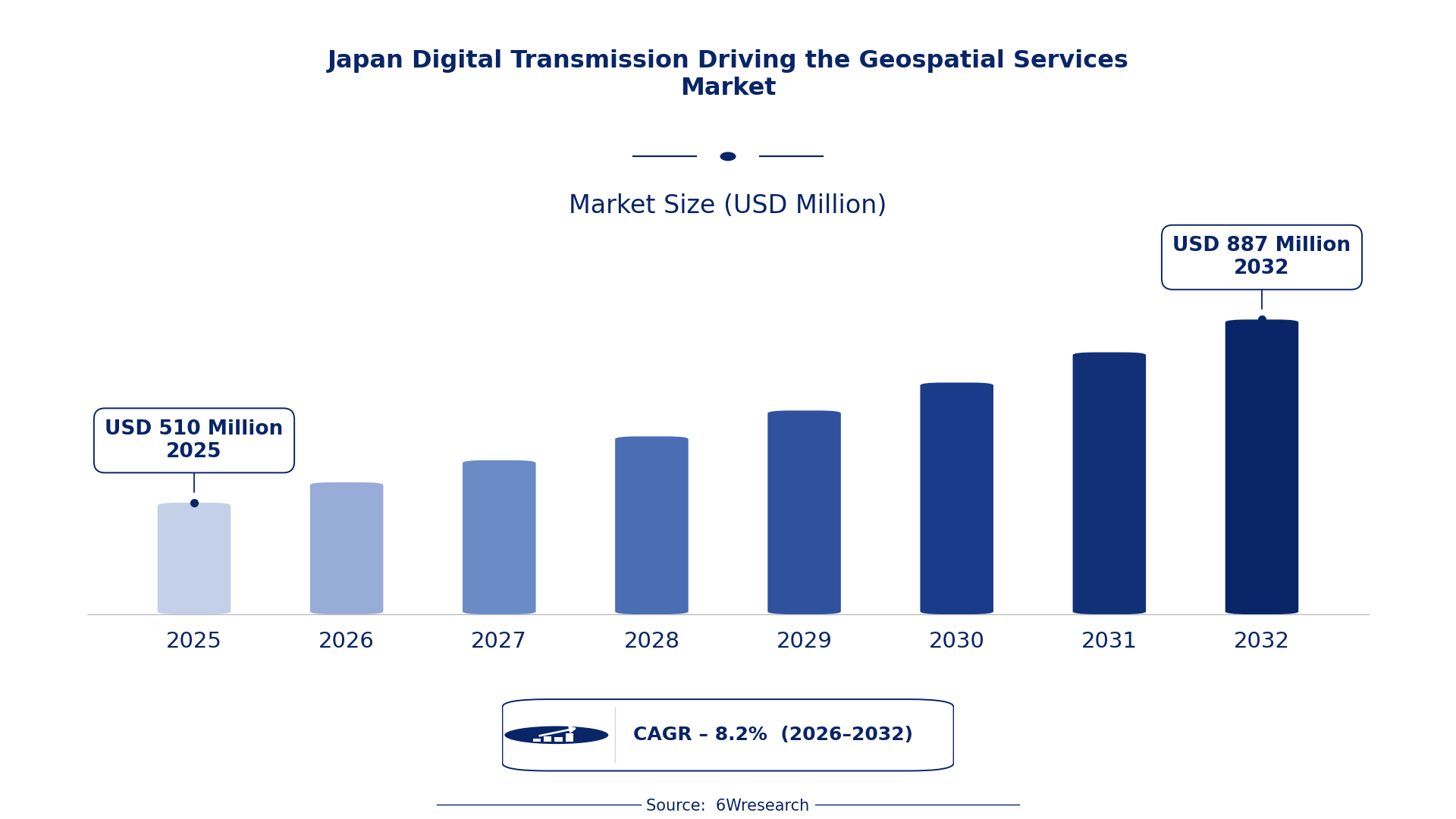
According to 6Wresearch internal database and industry insights, the Japan Digital Transmission Driving the Geospatial Services Market was valued at USD 510 Million in 2025 and is projected to reach USD 887 Million by 2032, growing at a CAGR of approximately 8.2% during 2026–2032.
Japan Digital Transmission Driving the Geospatial Services Market Highlights
| Report Metric | Details |
| Report Name | Japan Digital Transmission Driving the Geospatial Services Market (2026-2032) |
| Market Size 2025 | USD 510 Million |
| Market Size 2032 | USD 887 Million |
| Absolute Growth 2025–2032 | USD 377 Million |
| CAGR 2026–2032 | 8.2% |
| Peak Annual Growth | 9.7% in 2026 |
| Forecast Period | 2026–2032 |
| Historical Data | 2022–2025 |
| Base Year | 2025 |
| Leading Type, 2025 | Network & Location Analytics (35% share) |
| Leading Technology, 2025 | Geographic Information System (GIS) (45% share) |
| Leading Application, 2025 | Disaster Risk & Reduction Management (41% share) |
| Leading Industry Vertical, 2025 | Healthcare & Life Sciences (33% share) |
| Fastest-Growing Type | Surface & Field Analytics (11.4% CAGR) |
| Fastest-Growing Technology | Remote Sensing (11.0% CAGR) |
| Fastest-Growing Application | Climate Change Adaptation (11.1% CAGR) |
| Fastest-Growing Industry Vertical | Energy (10.9% CAGR) |
| Growing Sector | Urban Planning |
| Key End Users | Government agencies, agricultural producers, environmental organisations, urban planners |
Japan Digital Transmission Driving the Geospatial Services Market Year-wise Growth Rate and Key Drivers (2022–2032)
This graph illustrates the annual growth rates of the market from 2022 to 2032, highlighting a steady upward trajectory and projected market expansion over the forecast period.
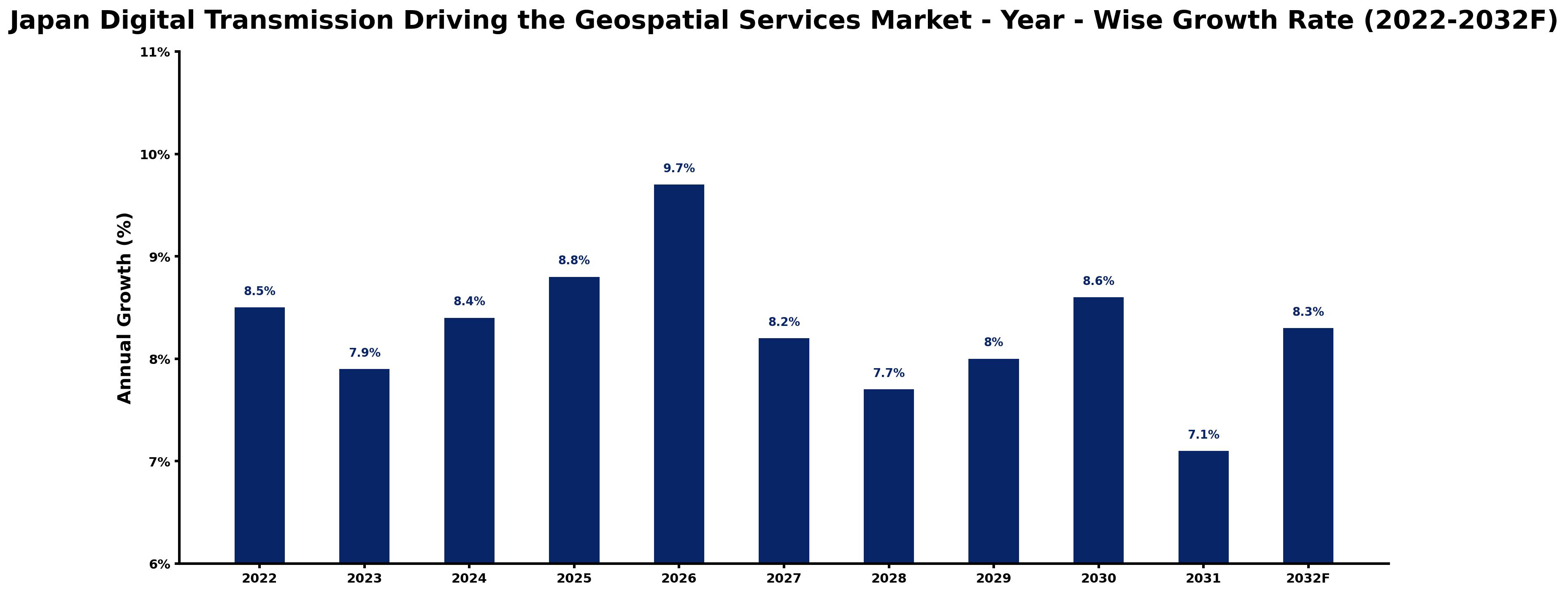
The table below sets out the estimated growth rate for each year and the main factor behind it.
| Year | Estimated Annual Growth (%) | Market Rationale |
| 2022 | 8.5 | The market experienced steady growth, driven by increasing urbanisation and demand for geospatial services. |
| 2023 | 7.9 | Growth slowed slightly due to market saturation in some urban areas, yet demand remained strong. |
| 2024 | 8.4 | An uptick in investment in disaster management technologies boosted growth rates. |
| 2025 | 8.8 | Demand surged as urban planning initiatives expanded, leading to increased geospatial service utilisation. |
| 2026 | 9.7 | The market is expected to peak with heightened investments in infrastructure projects and disaster risk management. |
| 2027 | 8.2 | Growth is projected to slow as the market begins to stabilise after the peak in 2026. |
| 2028 | 7.7 | A continued focus on environmental monitoring will contribute to a further slowdown in growth. |
| 2029 | 8.0 | Investment in urban development projects will increase demand for geospatial services, driving growth. |
| 2030 | 8.6 | Growth will accelerate again as new technologies in remote sensing gain traction. |
| 2031 | 7.1 | The market is expected to experience a slowdown as growth stabilises following a period of rapid expansion. |
| 2032 | 8.3 | A resurgence in demand for disaster risk reduction initiatives will spur growth in geospatial services. |
Note: Market size estimations and growth projections presented in this report are based on 6Wresearch's proprietary forecasting methodology, utilizing the latest available industry data, government publications, and primary research inputs.
Japan Digital Transmission Driving the Geospatial Services Market Synopsis
Digital transmission driving the geospatial services market employs advanced technologies to collect and analyse geographic data, essential for urban planning, environmental monitoring, and disaster management. The demand is further supported by a growing population and an increasing number of certified GIS professionals, creating opportunities for investment and innovation in the sector.
Market Dynamics Impact Analysis (2026–2032)
| Factor | Type | Impact | Primary Segment Affected |
| Increasing urbanisation drives demand for geospatial services in urban planning. | Driver | High | Geographic Information System (GIS) |
| Government investment in disaster risk reduction initiatives enhances market growth. | Driver | High | Disaster Risk & Reduction Management |
| Growing need for precision agriculture creates opportunities for remote sensing technologies. | Opportunity | High | Remote Sensing |
| Rising environmental concerns prompt investment in climate change adaptation projects. | Opportunity | Medium | Climate Change Adaptation |
| Limited awareness of geospatial technologies restricts market growth in rural areas. | Restraint | Medium | Surface & Field Analytics |
| High initial investment costs for advanced geospatial systems may deter new users. | Restraint | High | Geovisualisation |
| Competition from international firms may limit local market share for domestic providers. | Challenge | High | Network & Location Analytics |
| Rapid technological advancements can outpace local adoption rates, creating gaps. | Challenge | Medium | Remote Sensing |
Evaluation of Drivers in Japan Digital Transmission Driving the Geospatial Services Market (2026–2032)
The main growth drivers and the segments they affect most are set out below.
| Drivers | Primary Segment Affected | Why It Matters (Evidence) |
| Urbanisation increases the need for efficient urban planning solutions. | Geographic Information System (GIS) | The Japanese population of approximately 125 million drives demand for urban planning solutions. |
| Government funding supports disaster management initiatives. | Disaster Risk & Reduction Management | In 2023, ¥5 billion was allocated for disaster risk reduction using geospatial technologies. |
| Rising agricultural demands lead to increased use of remote sensing technologies. | Remote Sensing | Over 30% of farmers in Japan are now utilising remote sensing for crop management. |
| Growing interest in climate change adaptation stimulates investment in geospatial data analysis. | Climate Change Adaptation | Numerous projects focused on climate resilience are supported by the Ministry of the Environment. |
| Technological advancements in GIS improve data analysis capabilities. | Geographic Information System (GIS) | The presence of over 1,000 certified GIS professionals in Japan supports market growth. |
A wider customer base explains much of the growth, as Tokyo showcases the rising demand for geospatial services with numerous tech firms specialising in GIS. The population of approximately 125 million creates a strong need for urban planning solutions, driving investments in Geographic Information Systems. More than 30% of farmers are utilising remote sensing technologies, reflecting increased agricultural demands. Projects focused on climate resilience also boost investment in geospatial data analysis, driving overall market demand.
Evaluation of Restraints in Japan Digital Transmission Driving the Geospatial Services Market
The main factors holding the market back are set out below.
| Market Restraint | Primary Segment Affected | Why It Matters (Evidence) |
| Limited awareness of geospatial technologies in rural areas restricts market penetration. | Surface & Field Analytics | Many rural users remain uninformed about the benefits of advanced geospatial solutions. |
| High initial costs for advanced geospatial systems may deter potential users. | Geovisualisation | The financial barrier limits adoption among smaller firms and local governments. |
| Slow adoption of new technologies can hinder competitive advantage. | Remote Sensing | Technological advancements may outpace the ability of some users to integrate them. |
| Competition from international firms can limit market share for local providers. | Network & Location Analytics | International companies often have more resources and established reputations. |
| Regulatory hurdles can slow down project approvals for geospatial initiatives. | Disaster Risk & Reduction Management | Complex approval processes can delay the implementation of critical projects. |
Japan Digital Transmission Driving the Geospatial Services Market Challenges
Sourcing advanced digital transmission technologies presents a major supply issue, causing delays in urban planning and disaster management projects for producers. Limited availability of certified GIS professionals restricts importers' ability to meet the increasing demand from buyers in urban areas, resulting in project backlogs. Rising costs linked to the ¥5 billion allocated for disaster risk reduction initiatives strain budgets for buyers, forcing them to prioritise essential projects. Regulatory compliance with ISO 19101 standards creates hurdles, leading to additional time and resource constraints for healthcare facilities integrating GIS into patient management.
Trends in the Japan Digital Transmission Driving the Geospatial Services Market
Buyers and suppliers in the Japan Digital Transmission Driving the Geospatial Services Market are adjusting to the following trends.
- Shift towards Enhanced Remote Sensing Applications: Annual conferences by the Japan Remote Sensing Society showcase advancements in remote sensing, with over 30% of farmers adopting these technologies. This trend indicates a growing reliance on data-driven agricultural practices, improving productivity.
- Transition to Integrated Urban Planning Solutions: Tokyo's urban planning initiatives increasingly incorporate GIS technologies, reflecting a broader trend towards integrated solutions. The city's population of approximately 14 million drives demand for efficient urban management.
- Emergence of Climate Change Adaptation Strategies: The Ministry of the Environment has prioritised climate change adaptation projects, with geospatial data analysis playing a significant role. This shift is important for improving resilience against environmental challenges.
- Growing Focus on Disaster Risk Management: The government's allocation of ¥5 billion for disaster risk reduction initiatives highlights a shift towards proactive disaster management strategies, ensuring better preparedness and response capabilities.
Investment Opportunities in the Japan Digital Transmission Driving the Geospatial Services Market
Below are the investment opportunities with the strongest case in the Japan Digital Transmission Driving the Geospatial Services Market.
- Increasing Demand for Precision Agriculture Solutions: With over 30% of farmers using remote sensing technologies, there is an opportunity for investment in precision agriculture solutions, particularly in rural regions.
- Expansion of Climate Change Adaptation Projects: The focus on climate change adaptation presents an opportunity for geospatial service providers. In 2023, Japan allocated funds to support these initiatives, creating a market gap.
- Growth in Urban Planning Initiatives: As urban areas expand, the demand for geospatial services in urban planning is increasing. Tokyo's initiatives illustrate this trend, with significant investments being made.
- Investment in Disaster Risk Reduction Technologies: The ¥5 billion allocated for disaster risk reduction in 2023 indicates a growing market for geospatial technologies in this area. Companies can supply innovative solutions to meet this demand.
Government Initiatives in the Japan Digital Transmission Driving the Geospatial Services Market
The Semiconductor and Digital Industry Strategy, established by METI in June 2021, has set measures to secure domestic semiconductor manufacturing, impacting the digital transmission sector. This initiative aims to strengthen the technological capabilities of geospatial services by ensuring a steady supply of essential components. The Next-Generation Medical Infrastructure Act, enacted in 2017, allows certified bodies to anonymise medical data for research and product development, facilitating advancements in geospatial applications in healthcare.
The Digital Agency, established in September 2021, leads government digital transformation efforts, including the establishment of common system standards. This agency's initiatives support buyers in accessing reliable geospatial data and technologies, improving overall service delivery.
Future Insight of the Japan Digital Transmission Driving the Geospatial Services Market
A shift towards developing national geospatial data infrastructure will drive advancements in digital transmission technologies. By 2032, urban areas will increasingly integrate these services in disaster management, thanks to initiatives from the Ministry of Land, Infrastructure, Transport and Tourism. The expected increase in certified GIS professionals will streamline project execution for both buyers and suppliers. Collaboration among technology firms in Tokyo will spur innovation and improve service delivery in geospatial applications.
Market Segmentation Analysis
Japan Digital Transmission Driving the Geospatial Services Market report covers a detailed analysis of the following market segments:
By Type – Network & Location Analytics Leads, Surface & Field Analytics Expected to Grow Fastest
According to Ravi Bhandari, Research Head at 6Wresearch, the largest type category in 2025 was Network & Location Analytics, at 35% of revenue. Network & Location Analytics holds the largest share as it is essential for optimising location-based services and logistics, especially in urban areas. The reliance of numerous tech firms in Tokyo on these analytics illustrates their critical role in improving operational efficiency. Over 2026–2032, Surface & Field Analytics is expected to post the fastest growth, at a CAGR of 11.4%. Surface & Field Analytics is experiencing rapid growth as over 30% of farmers are adopting remote sensing technologies to enhance agricultural practices. This trend indicates a growing awareness of the benefits that data-driven methods can bring to farming. Suppliers should focus on developing solutions that cater to the increasing demand for analytics in agriculture.
By Technology – Geographic Information System (GIS) Leads, Remote Sensing Expected to Grow Fastest
Geographic Information System (GIS) accounted for 45% of the market by technology in 2025. Geographic Information System (GIS) dominates the market due to its widespread application in mapping and spatial analysis across various sectors. Its integration into government initiatives, such as the national geospatial data infrastructure programme, solidifies its leading status. Remote Sensing is set to record the highest CAGR in this split, 11.0% over 2026–2032. Remote Sensing is the fastest-growing segment, driven by its vital role in environmental monitoring and land use planning. The allocation of ¥5 billion for disaster risk reduction initiatives highlights its significance in national strategies. Buyers ought to invest in advanced remote sensing technologies to strengthen their capabilities in environmental management.
By Application – Disaster Risk & Reduction Management Leads, Climate Change Adaptation Expected to Grow Fastest
Disaster Risk & Reduction Management took 41% of application revenue in 2025, more than any other category. Disaster Risk & Reduction Management leads the application segment as it is critical for preparedness and response strategies, particularly in a disaster-prone country like Japan. The government's allocation of ¥5 billion for related initiatives underscores its significance. The quickest growth will come from Climate Change Adaptation, forecast to expand at a CAGR of 11.1% between 2026 and 2032. Climate Change Adaptation is growing rapidly as it becomes increasingly important for planning and mitigation strategies in response to environmental changes. The support from the Ministry of the Environment for related projects indicates a strong future demand. Suppliers should develop solutions that align with climate adaptation efforts to capture emerging opportunities.
By Industry Vertical – Healthcare & Life Sciences Lead, Energy Expected to Grow Fastest
In 2025, Healthcare & Life Sciences led the industry vertical split with a 33% share. Healthcare & Life Sciences is the leading vertical as it supports research and resource allocation in patient management, reflecting the sector's growing reliance on geospatial technologies. The increasing use of GIS in healthcare facilities illustrates this trend. Energy is projected to grow fastest, at a CAGR of 10.9% during 2026–2032. Energy is the fastest-growing vertical, as it utilises geospatial technologies for resource management, driven by the need for efficient energy distribution. The rising focus on sustainable energy practices is likely to fuel further growth. Buyers in the energy sector must adopt geospatial solutions to optimise resource management.
Key Attractiveness of the Report
- 10 Years of Market Numbers
- Historical Data Starting from 2022 to 2025
- Base Year 2025
- Forecast Data until 2032
- Key Performance Indicators Impacting the Market
- Major Upcoming Developments and Projects
Key Highlights of the Report:
- Japan Digital Transmission Driving the Geospatial Services Market Outlook
- Market Size of Japan Digital Transmission Driving the Geospatial Services Market, 2025
- Forecast of Japan Digital Transmission Driving the Geospatial Services Market, 2032
- Historical Data and Forecast of Japan Digital Transmission Driving the Geospatial Services Revenues & Volume for the Period 2022-2032
- Japan Digital Transmission Driving the Geospatial Services Market Trend Evolution
- Japan Digital Transmission Driving the Geospatial Services Market Drivers and Challenges
- Japan Digital Transmission Driving the Geospatial Services Price Trends
- Japan Digital Transmission Driving the Geospatial Services Porter's Five Forces
- Japan Digital Transmission Driving the Geospatial Services Industry Life Cycle
- Historical Data and Forecast of Japan Digital Transmission Driving the Geospatial Services Market Revenues & Volume By Type for the Period 2022-2032
- Historical Data and Forecast of Japan Digital Transmission Driving the Geospatial Services Market Revenues & Volume By Network & Location Analytics for the Period 2022-2032
- Historical Data and Forecast of Japan Digital Transmission Driving the Geospatial Services Market Revenues & Volume By Surface & Field Analytics for the Period 2022-2032
- Historical Data and Forecast of Japan Digital Transmission Driving the Geospatial Services Market Revenues & Volume By Geovisualisation for the Period 2022-2032
- Historical Data and Forecast of Japan Digital Transmission Driving the Geospatial Services Market Revenues & Volume By Others for the Period 2022-2032
- Historical Data and Forecast of Japan Digital Transmission Driving the Geospatial Services Market Revenues & Volume By Technology for the Period 2022-2032
- Historical Data and Forecast of Japan Digital Transmission Driving the Geospatial Services Market Revenues & Volume By Geographic Information System (GIS) for the Period 2022-2032
- Historical Data and Forecast of Japan Digital Transmission Driving the Geospatial Services Market Revenues & Volume By Remote Sensing for the Period 2022-2032
- Historical Data and Forecast of Japan Digital Transmission Driving the Geospatial Services Market Revenues & Volume By Internet Mapping Technologies for the Period 2022-2032
- Historical Data and Forecast of Japan Digital Transmission Driving the Geospatial Services Market Revenues & Volume By Application for the Period 2022-2032
- Historical Data and Forecast of Japan Digital Transmission Driving the Geospatial Services Market Revenues & Volume By Medicine & Public Safety for the Period 2022-2032
- Historical Data and Forecast of Japan Digital Transmission Driving the Geospatial Services Market Revenues & Volume By Surveying for the Period 2022-2032
- Historical Data and Forecast of Japan Digital Transmission Driving the Geospatial Services Market Revenues & Volume By Climate Change Adaptation for the Period 2022-2032
- Historical Data and Forecast of Japan Digital Transmission Driving the Geospatial Services Market Revenues & Volume By Disaster Risk & Reduction Management for the Period 2022-2032
- Historical Data and Forecast of Japan Digital Transmission Driving the Geospatial Services Market Revenues & Volume By Others for the Period 2022-2032
- Historical Data and Forecast of Japan Digital Transmission Driving the Geospatial Services Market Revenues & Volume By Industry Vertical for the Period 2022-2032
- Historical Data and Forecast of Japan Digital Transmission Driving the Geospatial Services Market Revenues & Volume By Healthcare & Life Sciences for the Period 2022-2032
- Historical Data and Forecast of Japan Digital Transmission Driving the Geospatial Services Market Revenues & Volume By Energy, Utility & Natural Resources for the Period 2022-2032
- Historical Data and Forecast of Japan Digital Transmission Driving the Geospatial Services Market Revenues & Volume By Defense & Security for the Period 2022-2032
- Historical Data and Forecast of Japan Digital Transmission Driving the Geospatial Services Market Revenues & Volume By Engineering & Construction for the Period 2022-2032
- Historical Data and Forecast of Japan Digital Transmission Driving the Geospatial Services Market Revenues & Volume By Mining & Manufacturing for the Period 2022-2032
- Historical Data and Forecast of Japan Digital Transmission Driving the Geospatial Services Market Revenues & Volume By Insurance for the Period 2022-2032
- Historical Data and Forecast of Japan Digital Transmission Driving the Geospatial Services Market Revenues & Volume By Agriculture for the Period 2022-2032
- Historical Data and Forecast of Japan Digital Transmission Driving the Geospatial Services Market Revenues & Volume By Others for the Period 2022-2032
- Japan Digital Transmission Driving the Geospatial Services Import Export Trade Statistics
- Market Opportunity Assessment By Type
- Market Opportunity Assessment By Technology
- Market Opportunity Assessment By Application
- Market Opportunity Assessment By Industry Vertical
- Japan Digital Transmission Driving the Geospatial Services Top Companies Market Share
- Japan Digital Transmission Driving the Geospatial Services Competitive Benchmarking By Technical and Operational Parameters
- Japan Digital Transmission Driving the Geospatial Services Company Profiles
- Japan Digital Transmission Driving the Geospatial Services Key Strategic Recommendations
Market Covered
The study includes the following segmentation.
By Type
- Network & Location Analytics
- Surface & Field Analytics
- Geovisualisation
- Others
By Technology
- Geographic Information System (GIS)
- Remote Sensing
- Internet Mapping Technologies
By Application
- Medicine & Public Safety
- Surveying
- Climate Change Adaptation
- Disaster Risk & Reduction Management
- Others
By Industry Vertical
- Healthcare & Life Sciences
- Energy
- Utility & Natural Resources
- Defense & Security
- Engineering & Construction
- Mining & Manufacturing
- Insurance
- Agriculture
- Others































