Japan Direct to Consumer Ecommerce Market Size & Growth Rate
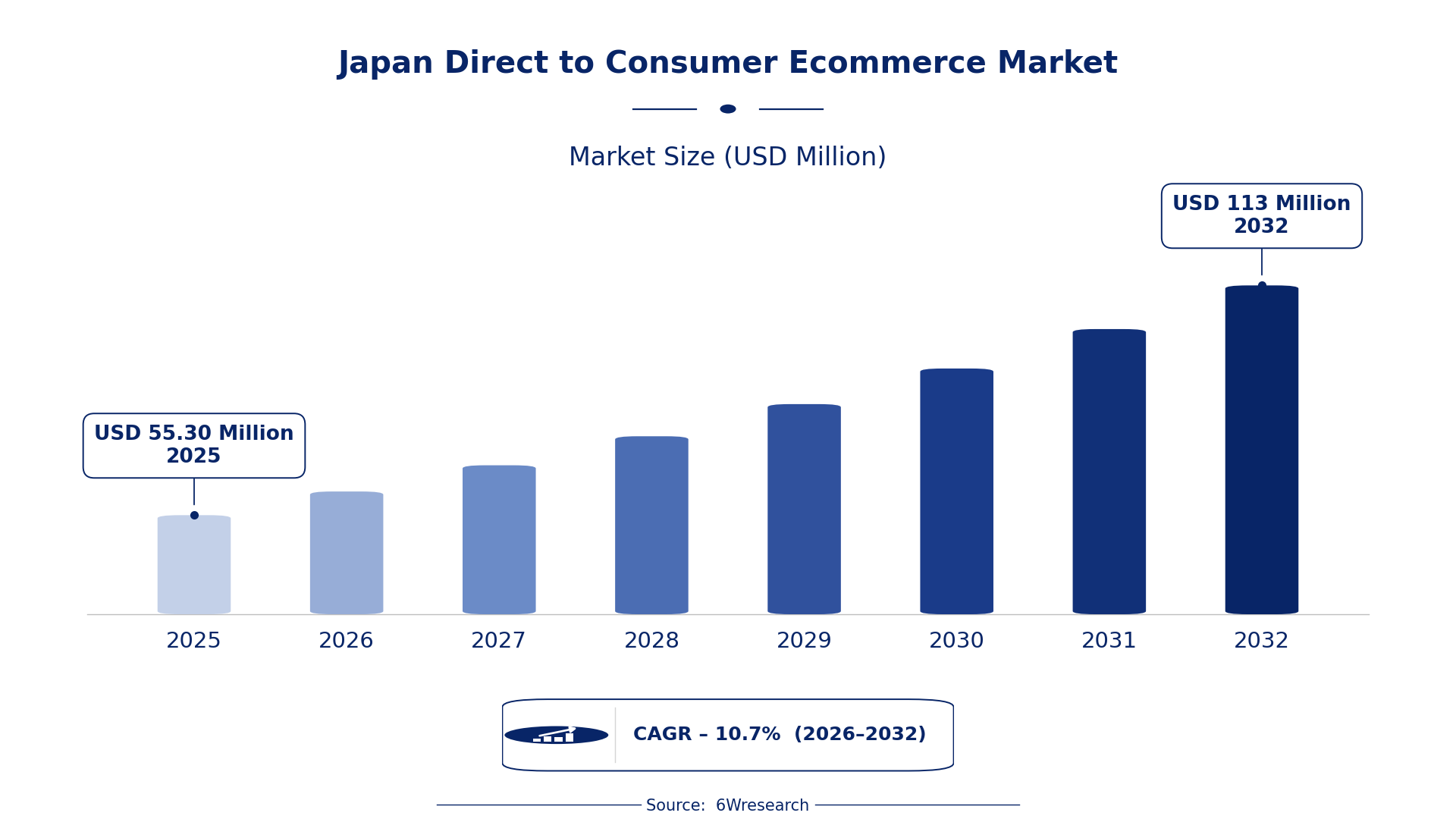
According to 6Wresearch internal database and industry insights, the Japan Direct to Consumer Ecommerce Market was valued at USD 55.30 Million in 2025 and is projected to reach USD 113 Million by 2032, growing at a CAGR of approximately 10.7% during 2026–2032.
Japan Direct to Consumer Ecommerce Market Highlights
| Report Metric | Details |
| Report Name | Japan Direct to Consumer Ecommerce Market (2026-2032) |
| Market Size 2025 | USD 55.30 Million |
| Market Size 2032 | USD 113 Million |
| Absolute Growth 2025–2032 | USD 57.70 Million |
| CAGR 2026–2032 | 10.7% |
| Peak Annual Growth | 14.9% in 2026 |
| Forecast Period | 2026–2032 |
| Historical Data | 2022–2025 |
| Base Year | 2025 |
| Leading End-User Vertical, 2025 | Apparel and Footwear (44% share) |
| Fastest-Growing End-User Vertical | Grocery and Gourmet (14.1% CAGR) |
| Growing Sector | Grocery and Gourmet |
| Key End Users | apparel manufacturers, grocery retailers, personal care brands, household goods suppliers |
Japan Direct to Consumer Ecommerce Market Year-wise Growth Rate and Key Drivers (2022–2032)
This graph illustrates the annual growth rates of the market from 2022 to 2032, highlighting a steady upward trajectory and projected market expansion over the forecast period.
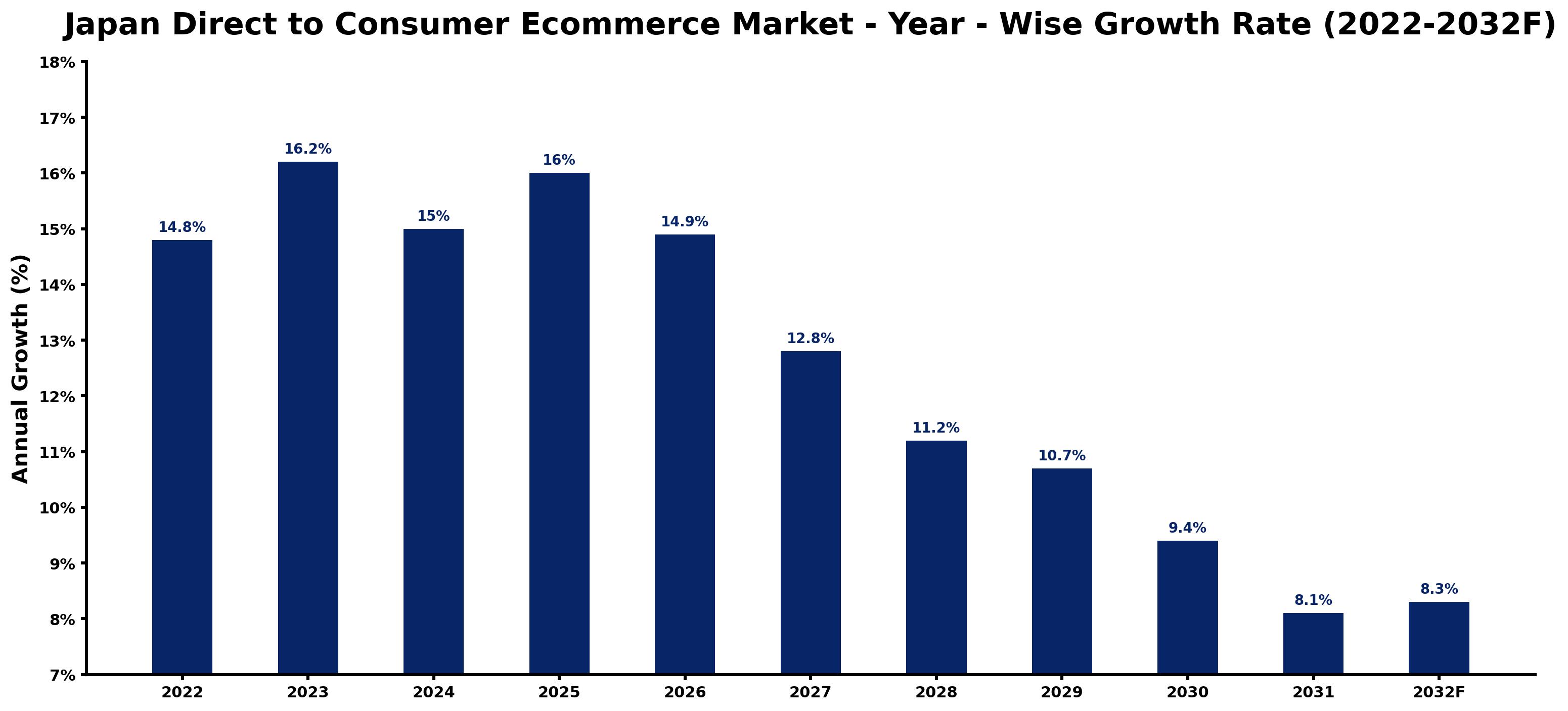
Each row of the following table gives one year's estimated growth and the event or demand shift that explains it.
| Year | Estimated Annual Growth (%) | Market Rationale |
| 2022 | 14.8 | The market was characterised by strong online shopping habits among consumers. |
| 2023 | 16.2 | Growth was driven by increased consumer adoption of direct purchasing methods. |
| 2024 | 15.0 | The market experienced a slowdown as growth rates moderated from the previous year. |
| 2025 | 16.0 | Consumer interest surged again, leading to faster growth in online purchases. |
| 2026 | 14.9 | Growth is expected to slow slightly, reflecting a stabilisation in the market's expansion. |
| 2027 | 12.8 | The market will continue to grow, but at a slower pace than in previous years. |
| 2028 | 11.2 | A further slowdown is projected as the market begins to mature. |
| 2029 | 10.7 | Growth is expected to remain steady, indicating a stabilisation in consumer behaviour. |
| 2030 | 9.4 | The market will continue to grow, although at a diminishing rate compared to earlier years. |
| 2031 | 8.1 | Growth is projected to slow further, reflecting a more saturated market environment. |
| 2032 | 8.3 | An uptick in growth is expected, driven by renewed interest in online shopping. |
Note: Market size estimations and growth projections presented in this report are based on 6Wresearch's proprietary forecasting methodology, utilizing the latest available industry data, government publications, and primary research inputs.
Japan Direct to Consumer Ecommerce Market Synopsis
Direct to Consumer Ecommerce in Japan allows brands to sell directly to consumers through digital platforms, improving convenience and accessibility. The Japan Direct to Consumer Ecommerce Market, valued at approximately 3 trillion yen in 2022, is driven by a strong online presence in the apparel and footwear segment, which accounts for about 30% of total DTC sales. The growing preference for online shopping among consumers, particularly in Tokyo, along with increased investments in logistics and delivery services, are key factors propelling market growth.
Market Dynamics Impact Analysis (2026–2032)
| Factor | Type | Impact | Primary Segment Affected |
| Increasing consumer preference for online shopping | Driver | High | Apparel and Footwear |
| Growth in logistics and delivery services | Driver | High | Grocery and Gourmet |
| Expansion of small DTC businesses | Opportunity | Medium | Personal Care |
| Rising demand for online grocery shopping | Opportunity | High | Grocery and Gourmet |
| Market saturation in certain segments | Restraint | Medium | Household Supplies |
| Regulatory challenges in online sales | Restraint | High | Healthcare |
| High competition among DTC brands | Challenge | High | Apparel and Footwear |
| Technological advancements required for operations | Challenge | Medium | Personal Care |
Evaluation of Drivers in Japan Direct to Consumer Ecommerce Market (2026–2032)
Demand rests on the following drivers, each shown with the segment it touches most.
| Drivers | Primary Segment Affected | Why It Matters (Evidence) |
| High online consumer engagement | Apparel and Footwear | Over 70% of Japanese consumers have shopped online at least once, increasing demand for apparel. |
| Investment in logistics infrastructure | Grocery and Gourmet | The government allocated 1 billion yen to support digital transformation in retail, improving delivery services. |
| Growth of mobile shopping platforms | Household Supplies | The average Japanese consumer spends about 100,000 yen annually on online purchases, boosting demand. |
| Rising consumer spending on online purchases | Personal Care | The personal care segment saw a 15% increase in online sales in 2023, due to mobile accessibility. |
| Support from industry associations | Grocery and Gourmet | The Japan Direct Marketing Association promotes best practices, encouraging consumer trust in online shopping. |
What keeps demand rising is the surge in online shopping, particularly in urban areas like Tokyo, where over 70% of consumers have engaged in online purchases. The average annual spending on online shopping is around 100,000 yen per consumer, indicating a strong market. The grocery sector has seen a notable increase in online sales, reflecting the convenience of mobile platforms. Investments in logistics are improving delivery services, encouraging more consumers to shop online. Technology adoption is making online purchasing more accessible, particularly in the grocery sector.
Evaluation of Restraints in Japan Direct to Consumer Ecommerce Market
The following restraints limit how fast demand can grow.
| Market Restraint | Primary Segment Affected | Why It Matters (Evidence) |
| Market saturation in the apparel segment | Apparel and Footwear | The apparel segment holds a 30% share of DTC sales, leading to intense competition. |
| Regulatory hurdles in online sales | Healthcare | Strict regulations limit the types of healthcare products that can be sold online. |
| Limited consumer trust in new brands | Personal Care | Many consumers prefer established brands, hindering new entrants in the market. |
| High operational costs for logistics | Household Supplies | Rising logistics costs affect the pricing strategies of online retailers. |
| Technological barriers for small businesses | Grocery and Gourmet | Small DTC businesses may struggle to adopt necessary technology for online sales. |
Japan Direct to Consumer Ecommerce Market Challenges
High recruitment costs for skilled workers in the DTC ecommerce sector can reach 20% of annual salaries, placing a burden on producers who struggle to find qualified staff. Limited technological infrastructure hampers efficiency, causing delays of up to two weeks for online retailers in fulfilling orders. Intense competition among DTC brands leads to aggressive pricing strategies, which can erode profit margins by as much as 15%, affecting both suppliers and producers. Compliance with standards like ISO 9001 incurs additional costs, averaging 5 million yen annually for small businesses, restricting their growth potential.
Trends in the Japan Direct to Consumer Ecommerce Market
These developments are changing demand patterns in the Japan Direct to Consumer Ecommerce Market.
- Shift in Consumer Preference to Online Grocery Shopping: Urban consumers are increasingly opting for online grocery shopping, particularly in Tokyo, where convenience is paramount. In 2023, online grocery sales saw a notable increase, reflecting changing shopping habits.
- Growth of Mobile Shopping Platforms: Mobile shopping platforms have gained traction, especially among younger consumers, with over 70% of online shoppers using mobile devices. This shift is reshaping ecommerce in Japan.
- Increasing Investment in Logistics Services: The government’s investment of 1 billion yen in 2023 to support digital transformation in retail is driving improvements in logistics services, benefiting DTC ecommerce operations across the country.
- Rising Popularity of Personal Care Products Online: The personal care segment has seen a 15% increase in online sales in 2023, driven by consumer demand for convenience and accessibility in purchasing everyday items.
Investment Opportunities in the Japan Direct to Consumer Ecommerce Market
The following opportunities in the Japan Direct to Consumer Ecommerce Market pair current demand with a clear way in.
- Partnership Opportunities for Small DTC Brands: Small DTC brands can partner with logistics firms to improve delivery capabilities, especially in urban areas like Tokyo, where demand is high. This is timely as the market continues to grow.
- Investing in Mobile Shopping Technologies: With over 70% of consumers shopping online, investing in mobile shopping technologies is essential for brands targeting younger demographics, particularly in metropolitan regions.
- Expansion of Online Grocery Services: The increasing preference for online grocery shopping presents opportunities for brands to expand their offerings, particularly in urban centres where convenience is key.
- Collaboration with Industry Associations for Growth: Brands can collaborate with the Japan Direct Marketing Association to adopt best practices and build consumer trust, particularly in the personal care segment.
Government Initiatives in the Japan Direct to Consumer Ecommerce Market
The Medical Care Act of 1948 sets standards for healthcare facilities, influencing how healthcare products are marketed online. This law ensures that products sold meet specific safety and efficacy standards, impacting consumer trust and brand reputation. Additionally, the Long-Term Care Insurance Act, in force since 2000, funds services that support older adults, indirectly affecting DTC ecommerce by increasing demand for accessible products.
The Ministry of Economy, Trade and Industry is responsible for approving funding for digital transformation initiatives in retail, including the 1 billion yen allocated in 2023 to support small DTC businesses. This funding helps improve the technological capabilities of DTC brands, facilitating their growth in the ecommerce market.
Future Insight of the Japan Direct to Consumer Ecommerce Market
The establishment of new logistics hubs will enhance delivery processes for buyers and suppliers. By 2032, digital transformation initiatives will lead to a 30% increase in online sales across various segments. Technology adoption will enable real-time inventory management, improving stock availability for consumers. Government support for small DTC businesses will drive innovation, allowing new entrants to compete effectively in the market.
Market Segmentation Analysis
Japan Direct to Consumer Ecommerce Market report covers a detailed analysis of the following market segments:
By End-User Vertical – Apparel and Footwear Leads, Grocery and Gourmet Expected to Grow Fastest
According to Vasudha, AM at 6Wresearch, Apparel and Footwear held 44% of the Japan Direct to Consumer Ecommerce Market by end-user vertical in 2025. The apparel and footwear segment holds the largest share due to its strong online presence and high consumer interest, making up approximately 30% of total DTC sales in Japan. Urban consumers, particularly in Tokyo, are significant buyers, frequently engaging in online shopping for these products. Grocery and Gourmet is projected to grow fastest, at a CAGR of 14.1% during 2026–2032. The grocery and gourmet segment is experiencing rapid growth as more consumers choose online grocery shopping for its convenience, with a notable increase in sales in 2023. This trend reflects a broader shift towards digital purchasing for everyday essentials, which is likely to continue. This indicates that suppliers should focus on enhancing their digital offerings to capture the growing demand in the grocery segment.
Key Attractiveness of the Report
- 10 Years of Market Numbers
- Historical Data Starting from 2022 to 2025
- Base Year 2025
- Forecast Data until 2032
- Key Performance Indicators Impacting the Market
- Major Upcoming Developments and Projects
Key Highlights of the Report:
- Japan Direct to Consumer Ecommerce Market Outlook
- Market Size of Japan Direct to Consumer Ecommerce Market, 2025
- Forecast of Japan Direct to Consumer Ecommerce Market, 2032
- Historical Data and Forecast of Japan Direct to Consumer Ecommerce Revenues & Volume for the Period 2022-2032
- Japan Direct to Consumer Ecommerce Market Trend Evolution
- Japan Direct to Consumer Ecommerce Market Drivers and Challenges
- Japan Direct to Consumer Ecommerce Price Trends
- Japan Direct to Consumer Ecommerce Porter's Five Forces
- Japan Direct to Consumer Ecommerce Industry Life Cycle
- Historical Data and Forecast of Japan Direct to Consumer Ecommerce Market Revenues & Volume By End-User Vertical for the Period 2022-2032
- Historical Data and Forecast of Japan Direct to Consumer Ecommerce Market Revenues & Volume By Apparel and Footwear for the Period 2022-2032
- Historical Data and Forecast of Japan Direct to Consumer Ecommerce Market Revenues & Volume By Grocery and Gourmet for the Period 2022-2032
- Historical Data and Forecast of Japan Direct to Consumer Ecommerce Market Revenues & Volume By Personal Care for the Period 2022-2032
- Historical Data and Forecast of Japan Direct to Consumer Ecommerce Market Revenues & Volume By Home Decor for the Period 2022-2032
- Historical Data and Forecast of Japan Direct to Consumer Ecommerce Market Revenues & Volume By Household Supplies for the Period 2022-2032
- Historical Data and Forecast of Japan Direct to Consumer Ecommerce Market Revenues & Volume By Healthcare for the Period 2022-2032
- Historical Data and Forecast of Japan Direct to Consumer Ecommerce Market Revenues & Volume By Jewellery for the Period 2022-2032
- Japan Direct to Consumer Ecommerce Import Export Trade Statistics
- Market Opportunity Assessment By End-User Vertical
- Japan Direct to Consumer Ecommerce Top Companies Market Share
- Japan Direct to Consumer Ecommerce Competitive Benchmarking By Technical and Operational Parameters
- Japan Direct to Consumer Ecommerce Company Profiles
- Japan Direct to Consumer Ecommerce Key Strategic Recommendations
Market Covered
The report covers the following segments.
By End-User Vertical
- Apparel and Footwear
- Grocery and Gourmet
- Personal Care
- Home Decor
- Household Supplies
- Healthcare
- Jewellery































