Japan DNA Damage Response Drugs Market Size & Growth Rate
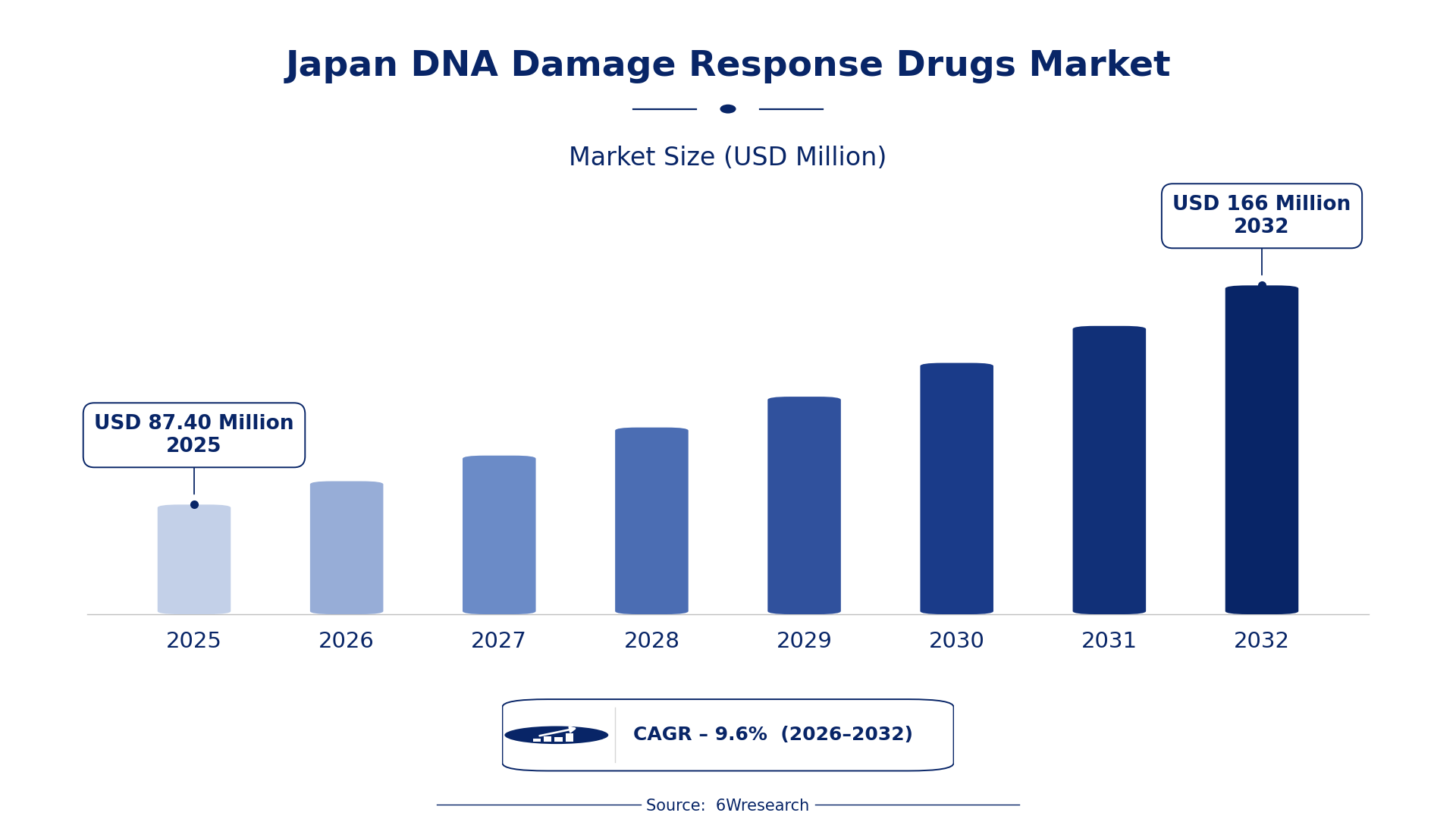
According to 6Wresearch internal database and industry insights, the Japan DNA Damage Response Drugs Market was valued at USD 87.40 Million in 2025 and is projected to reach USD 166 Million by 2032, growing at a CAGR of approximately 9.6% during 2026–2032.
Japan DNA Damage Response Drugs Market Highlights
| Report Metric | Details |
| Report Name | Japan DNA Damage Response Drugs Market (2026-2032) |
| Market Size 2025 | USD 87.40 Million |
| Market Size 2032 | USD 166 Million |
| Absolute Growth 2025–2032 | USD 78.60 Million |
| CAGR 2026–2032 | 9.6% |
| Peak Annual Growth | 10.5% in 2027 |
| Forecast Period | 2026–2032 |
| Historical Data | 2022–2025 |
| Base Year | 2025 |
| Leading Type, 2025 | PARP (56% share) |
| Leading Applications, 2025 | Oncology (46% share) |
| Fastest-Growing Type | Inhibitors (13.0% CAGR) |
| Fastest-Growing Applications | Stroke (13.2% CAGR) |
| Growing Sector | Oncology |
| Key End Users | hospitals, research institutions, healthcare providers |
Japan DNA Damage Response Drugs Market Year-wise Growth Rate and Key Drivers (2022–2032)
This graph illustrates the annual growth rates of the market from 2022 to 2032, highlighting a steady upward trajectory and projected market expansion over the forecast period.
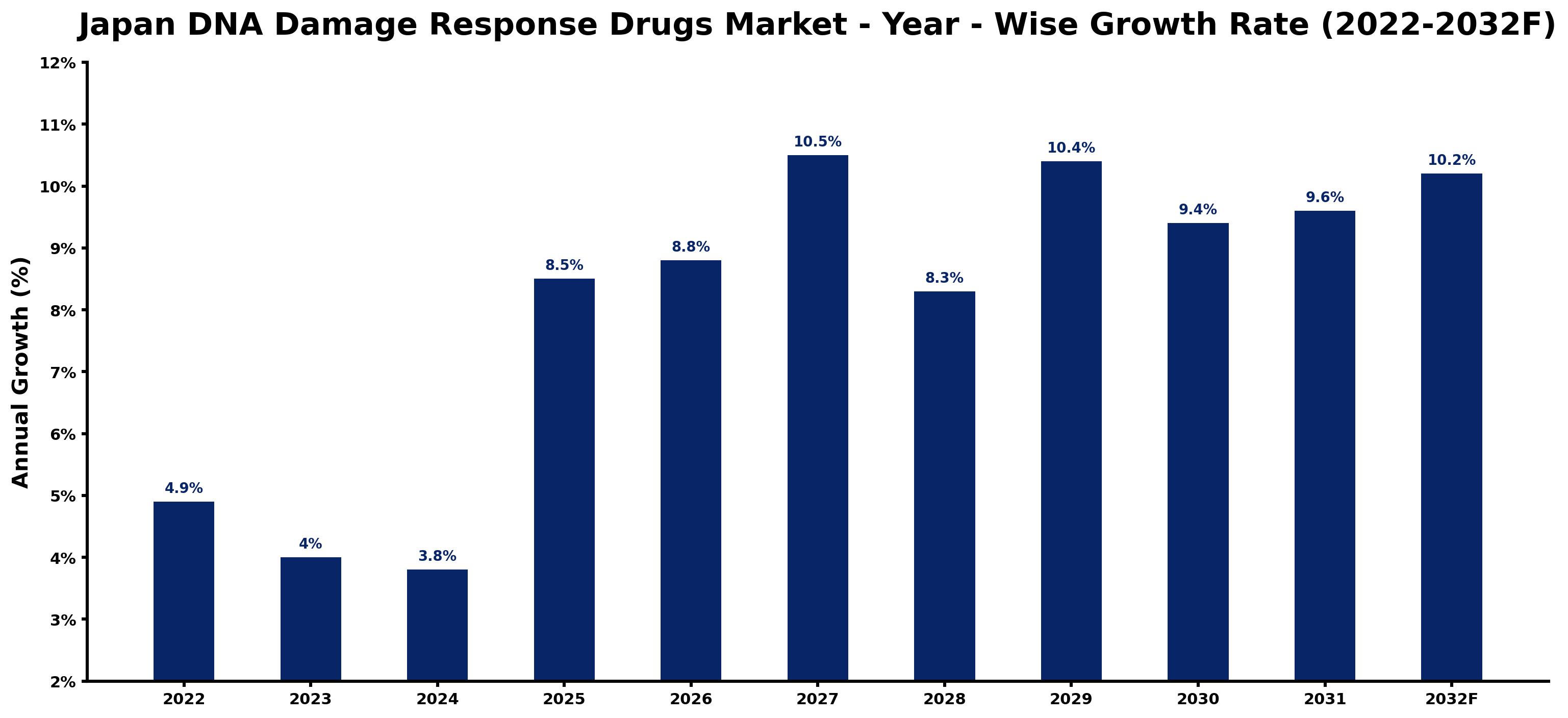
The following figures match every annual growth estimate with the main market development of that year, giving the reasoning behind each rise or slowdown.
| Year | Estimated Annual Growth (%) | Market Rationale |
| 2022 | 4.9 | The market showed steady growth due to increasing cancer diagnoses and treatment advancements. |
| 2023 | 4.0 | Growth slowed as the market adjusted to new treatment protocols and emerging therapies. |
| 2024 | 3.8 | Demand continued to rise but at a slower pace, reflecting market maturation and competition. |
| 2025 | 8.5 | The introduction of new PARP inhibitors boosted growth as they became standard treatments. |
| 2026 | 8.8 | Investment in clinical trials and research is expected to lead to a surge in drug approvals and usage. |
| 2027 | 10.5 | The peak growth year will see heightened demand driven by successful treatment outcomes and awareness. |
| 2028 | 8.3 | Growth is projected to slow as market saturation begins to set in with established therapies dominating. |
| 2029 | 10.4 | A resurgence in growth is expected as new treatments gain traction among healthcare providers. |
| 2030 | 9.4 | Market expansion will continue but at a reduced rate as competition intensifies among existing drugs. |
| 2031 | 9.6 | Growth is projected to pick up again due to increased funding for cancer research and new drug developments. |
| 2032 | 10.2 | The market is expected to maintain strong growth as new therapies enter the market. |
Note: Market size estimations and growth projections presented in this report are based on 6Wresearch's proprietary forecasting methodology, utilizing the latest available industry data, government publications, and primary research inputs.
Japan DNA Damage Response Drugs Market Synopsis
DNA Damage Response Drugs target DNA repair mechanisms in cancer cells and are primarily synthesized through chemical processes. These pharmaceuticals are mainly used in oncology to treat cancers with DNA repair deficiencies. The Japan DNA Damage Response Drugs Market is expanding due to a growing elderly population, rising cancer incidence, and ongoing research efforts. In 2023, Japan reported over 1 million new cancer cases annually, driving demand for effective treatments such as PARP inhibitors, which are recognised as standard therapies for specific cancers.
Market Dynamics Impact Analysis (2026–2032)
| Factor | Type | Impact | Primary Segment Affected |
| Increasing cancer incidence and treatment advancements drive demand for DNA damage response drugs. | Driver | High | PARP |
| Ongoing clinical trials and research funding create opportunities for new drug development. | Opportunity | High | Inhibitors |
| Regulatory hurdles and lengthy approval processes can delay drug availability. | Restraint | High | Others |
| Competition from alternative therapies can limit market share for existing drugs. | Challenge | Medium | PARP |
| Rising healthcare expenditure supports the adoption of innovative cancer treatments. | Driver | High | Oncology |
| Growing awareness and education among healthcare providers enhance treatment adoption. | Opportunity | Medium | Oncology |
| Limited patient access to cutting-edge therapies can hinder market growth. | Restraint | Medium | Inhibitors |
| Market saturation with established therapies poses challenges for new entrants. | Challenge | Medium | Others |
Evaluation of Drivers in Japan DNA Damage Response Drugs Market (2026–2032)
These are the developments adding the most demand over the forecast period.
| Drivers | Primary Segment Affected | Why It Matters (Evidence) |
| Increasing elderly population leads to higher cancer incidence, driving demand for DNA damage response drugs. | Oncology | In 2023, Japan's population is approximately 125 million, with a growing elderly demographic increasing cancer incidence. |
| Funding for cancer research programs boosts development of new therapies. | PARP | The Japanese government allocated ¥50 billion for cancer research programs in 2023. |
| Established guidelines for DNA damage response drugs improve treatment protocols. | Inhibitors | Guidelines for the use of DNA damage response drugs have been established by medical societies. |
| Ongoing clinical trials expand the range of available treatments for cancer patients. | Others | Clinical trials for new DNA damage response drugs are ongoing in various prefectures. |
| Increased awareness of cancer treatment options drives demand for effective therapies. | Oncology | Awareness initiatives promote research funding for cancer treatment. |
Behind the steady rise in orders sits the increasing elderly population, contributing to a higher cancer incidence, with over 1 million new cases diagnosed annually in Japan. Guidelines for DNA damage response drugs by medical societies promote their integration into treatment protocols. Clinical trials in various prefectures are expanding the available treatments, while awareness efforts further drive demand for effective therapies.
Evaluation of Restraints in Japan DNA Damage Response Drugs Market
Several factors work against faster growth; the main ones are summarised below.
| Market Restraint | Primary Segment Affected | Why It Matters (Evidence) |
| Regulatory hurdles can delay the approval of new DNA damage response drugs. | PARP | The Pharmaceuticals and Medical Devices Agency oversees the approval process, which can be lengthy and complex. |
| Limited patient access to new therapies hinders market growth. | Inhibitors | Access to advanced treatments is often restricted by healthcare infrastructure and costs. |
| High costs associated with R&D can limit the number of new entrants in the market. | PARP | The financial burden of developing new drugs can deter investment in new therapies. |
| Market saturation with established therapies can restrict growth opportunities for new drugs. | Inhibitors | As more drugs become available, differentiation becomes challenging for new entrants. |
| Competition from alternative therapies can impact market share for existing drugs. | Others | As new therapies emerge, established drugs may struggle to maintain their market position. |
Japan DNA Damage Response Drugs Market Challenges
Buyers face high costs due to intense competition among pharmaceutical firms, which drives down prices and reduces the availability of new drugs. This situation forces producers to invest heavily in R&D, delaying the introduction of vital treatments for hospitals that require timely access to therapies. Many manufacturers struggle with outdated technology, leading to inefficient production processes that result in longer wait times for clinics needing essential medications. Regulatory hurdles imposed by the Pharmaceuticals and Medical Devices Agency can prolong approval times, costing suppliers valuable market opportunities and restricting patient access to critical therapies.
Trends in the Japan DNA Damage Response Drugs Market
Buyers and suppliers in the Japan DNA Damage Response Drugs Market are adjusting to the following trends.
- Shift from Traditional to Targeted Cancer Therapies: The trend towards targeted cancer therapies is changing in Japan, where PARP inhibitors are becoming standard treatments for BRCA-mutated cancers. In 2023, these therapies accounted for a significant share of oncology treatments, reflecting a shift in treatment paradigms.
- Increasing Focus on Clinical Trials: Tokyo has become a hub for clinical trials, with numerous studies ongoing to evaluate new DNA damage response drugs. In 2023, over 100 clinical trials were registered, highlighting the growing emphasis on new cancer therapies.
- Emergence of Personalized Medicine: Personalized medicine is gaining traction in Japan, particularly in oncology. The National Cancer Center Japan leads initiatives to tailor treatments based on genetic profiles, enhancing treatment efficacy for patients.
- Growing Awareness of Cancer Treatment Options: Healthcare providers in Japan are increasingly aware of the benefits of DNA damage response drugs. In 2023, educational programs funded by medical societies reached thousands of practitioners, promoting new treatment options.
Investment Opportunities in the Japan DNA Damage Response Drugs Market
Where to invest in the Japan DNA Damage Response Drugs Market: the main openings are set out below.
- ¥50 Billion Funding for Cancer Research: The Japanese government allocated ¥50 billion for cancer research in 2023, creating an opportunity for investment in new therapies. This funding supports research institutions and healthcare providers focused on developing new treatments.
- Rising Demand for Effective Cancer Treatments: The increasing cancer incidence presents a timely opportunity for suppliers of DNA damage response drugs. Healthcare facilities across Japan are seeking effective therapies to meet the needs of patients, particularly in oncology.
- Expansion of Clinical Trials: The ongoing clinical trials in regions like Tokyo present an opportunity for pharmaceutical companies to introduce new drugs. Collaborating with local research institutions can facilitate entry into the market.
- Growing Market for Personalized Medicine: The shift towards personalized medicine creates opportunities for suppliers of targeted therapies. Engaging with healthcare providers and research institutions can improve market penetration.
Government Initiatives in the Japan DNA Damage Response Drugs Market
The NHI drug price standard, revised regularly, sets reimbursement prices for DNA damage response drugs, ensuring affordability for patients and encouraging their use in clinical settings. The PMD Act, which regulates the approval and quality of pharmaceuticals, mandates rigorous testing and compliance, building trust in the safety of these drugs. This framework supports ongoing research and development, enabling the introduction of new therapies to meet the rising demand for cancer treatments in Japan.
Healthcare providers benefit from the funding allocated by AMED, which supports medical research and development initiatives. This funding facilitates clinical trials for DNA damage response drugs, allowing hospitals to access cutting-edge therapies. The Pharmaceuticals and Medical Devices Agency oversees these trials, ensuring compliance with safety standards, which ultimately improves patient care and treatment outcomes in oncology.
Future Insight of the Japan DNA Damage Response Drugs Market
Investment in cancer research programs will exceed ¥60 billion by 2024, creating a robust pipeline for DNA damage response drugs. This influx of funding will stimulate the development of new therapies, expanding treatment options for patients. Clinical trials in Tokyo and Osaka will accelerate the introduction of new drugs, catering to the rising cancer incidence among the elderly. By 2032, the implementation of advanced manufacturing standards will improve drug quality, ensuring that suppliers deliver safer and more effective treatments to buyers.
Market Segmentation Analysis
Japan DNA Damage Response Drugs Market report covers a detailed analysis of the following market segments:
By Type – PARP Leads, Inhibitors Expected to Grow Fastest
According to Ravi Bhandari, Research Head at 6Wresearch, the largest type category in 2025 was PARP, at 56% of revenue. PARP inhibitors hold the largest share as they are specifically designed to target cancer cells with DNA repair deficiencies. Their established role as a standard treatment for BRCA-mutated breast and ovarian cancers in Japan reinforces their leading position. Inhibitors are set to record the highest CAGR in this split, 13.0% over 2026–2032. The inhibitors segment is experiencing rapid growth due to their critical role in directly impacting tumor growth and survival. Ongoing clinical trials in major prefectures such as Tokyo and Osaka are accelerating their adoption in cancer therapies. This suggests that suppliers should focus on enhancing their offerings of PARP inhibitors to meet the rising demand in oncology.
By Applications – Oncology Leads, Stroke Expected to Grow Fastest
With 46% of applications revenue in 2025, Oncology was the largest category. Oncology dominates the applications segment as it is the primary focus for DNA damage response drugs aimed at treating various cancers. The increasing number of new cancer cases diagnosed annually in Japan, exceeding 1 million, underscores the importance of this application area. Over 2026–2032, Stroke is expected to post the fastest growth, at a CAGR of 13.2%. The stroke application segment is growing due to emerging research indicating potential benefits of certain drugs in stroke recovery. This growth is further encouraged by the Japanese Society of Clinical Oncology's guidelines, which may expand treatment protocols. Buyers should consider diversifying their treatment options to include drugs with potential applications beyond oncology.
Key Attractiveness of the Report
- 10 Years of Market Numbers
- Historical Data Starting from 2022 to 2025
- Base Year 2025
- Forecast Data until 2032
- Key Performance Indicators Impacting the Market
- Major Upcoming Developments and Projects
Key Highlights of the Report:
- Japan DNA Damage Response Drugs Market Outlook
- Market Size of Japan DNA Damage Response Drugs Market, 2025
- Forecast of Japan DNA Damage Response Drugs Market, 2032
- Historical Data and Forecast of Japan DNA Damage Response Drugs Revenues & Volume for the Period 2022-2032
- Japan DNA Damage Response Drugs Market Trend Evolution
- Japan DNA Damage Response Drugs Market Drivers and Challenges
- Japan DNA Damage Response Drugs Price Trends
- Japan DNA Damage Response Drugs Porter's Five Forces
- Japan DNA Damage Response Drugs Industry Life Cycle
- Historical Data and Forecast of Japan DNA Damage Response Drugs Market Revenues & Volume By Type for the Period 2022-2032
- Historical Data and Forecast of Japan DNA Damage Response Drugs Market Revenues & Volume By PARP for the Period 2022-2032
- Historical Data and Forecast of Japan DNA Damage Response Drugs Market Revenues & Volume By Inhibitors for the Period 2022-2032
- Historical Data and Forecast of Japan DNA Damage Response Drugs Market Revenues & Volume By Others for the Period 2022-2032
- Historical Data and Forecast of Japan DNA Damage Response Drugs Market Revenues & Volume By Applications for the Period 2022-2032
- Historical Data and Forecast of Japan DNA Damage Response Drugs Market Revenues & Volume By Oncology for the Period 2022-2032
- Historical Data and Forecast of Japan DNA Damage Response Drugs Market Revenues & Volume By Stroke for the Period 2022-2032
- Historical Data and Forecast of Japan DNA Damage Response Drugs Market Revenues & Volume By Radiotherapy for the Period 2022-2032
- Japan DNA Damage Response Drugs Import Export Trade Statistics
- Market Opportunity Assessment By Type
- Market Opportunity Assessment By Applications
- Japan DNA Damage Response Drugs Top Companies Market Share
- Japan DNA Damage Response Drugs Competitive Benchmarking By Technical and Operational Parameters
- Japan DNA Damage Response Drugs Company Profiles
- Japan DNA Damage Response Drugs Key Strategic Recommendations
Market Covered
Coverage by segment is as follows.
By Type
- PARP
- Inhibitors
- Others
By Applications
- Oncology
- Stroke
- Radiotherapy































