Japan Dried Spices Market Size & Growth Rate
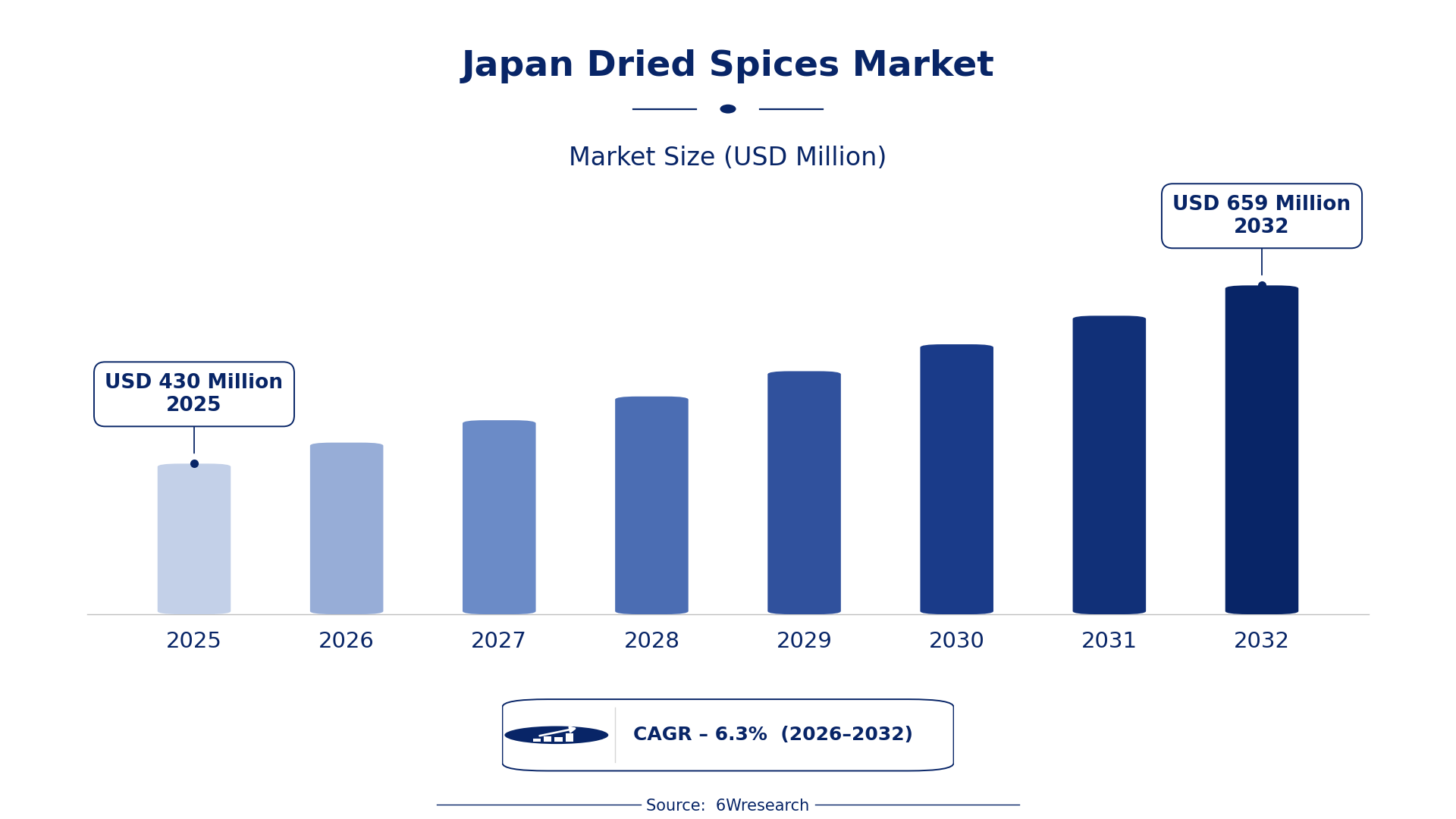
According to 6Wresearch internal database and industry insights, the Japan Dried Spices Market was valued at USD 430 Million in 2025 and is projected to reach USD 659 Million by 2032, growing at a CAGR of approximately 6.3% during 2026–2032.
Japan Dried Spices Market Highlights
| Report Metric | Details |
| Report Name | Japan Dried Spices Market (2026-2032) |
| Market Size 2025 | USD 430 Million |
| Market Size 2032 | USD 659 Million |
| Absolute Growth 2025–2032 | USD 229 Million |
| CAGR 2026–2032 | 6.3% |
| Peak Annual Growth | 6.9% in 2027 |
| Forecast Period | 2026–2032 |
| Historical Data | 2022–2025 |
| Base Year | 2025 |
| Leading Product Type, 2025 | Dried Pepper (40% share) |
| Leading Functionality, 2025 | Flavoring (55% share) |
| Leading Application Area, 2025 | Food Processing (43% share) |
| Leading Distribution Channel, 2025 | Retail Chains (42% share) |
| Leading End User, 2025 | Consumers (50% share) |
| Fastest-Growing Product Type | Dried Turmeric (8.6% CAGR) |
| Fastest-Growing Functionality | Aroma (8.1% CAGR) |
| Fastest-Growing Application Area | Spice Blends (7.4% CAGR) |
| Fastest-Growing Distribution Channel | Online Platforms (8.2% CAGR) |
| Fastest-Growing End User | Food Manufacturers (7.9% CAGR) |
| Growing Sector | Spice Blends |
| Key End Users | Food Processing, Culinary, Spice Blends, Beverages |
Japan Dried Spices Market Year-wise Growth Rate and Key Drivers (2022–2032)
This graph illustrates the annual growth rates of the market from 2022 to 2032, highlighting a steady upward trajectory and projected market expansion over the forecast period.
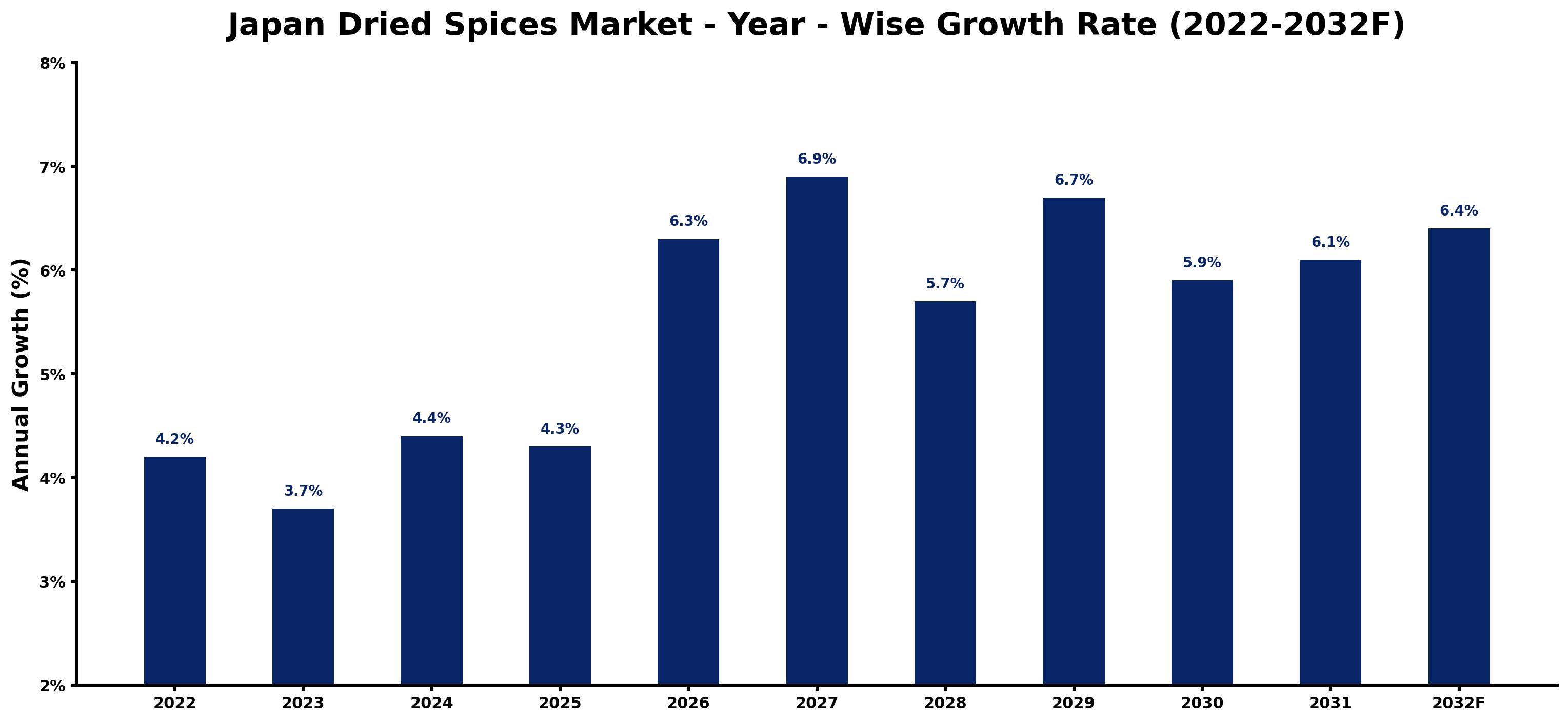
Annual growth estimates for each year appear below with the principal reason behind them, explaining the shifts that set the pace of the market.
| Year | Estimated Annual Growth (%) | Market Rationale |
| 2022 | 4.2 | The market experienced stable growth, driven by consistent culinary practices. |
| 2023 | 3.7 | Growth slowed due to supply chain challenges impacting spice availability. |
| 2024 | 4.4 | Demand increased as interest in diverse cuisines and flavours rose. |
| 2025 | 4.3 | Growth moderated as market adjustments followed previous peaks. |
| 2026 | 6.3 | The market is set to expand as health trends boost spice consumption. |
| 2027 | 6.9 | Demand is expected to surge with increased awareness of health benefits. |
| 2028 | 5.7 | Growth will slow as the market stabilises after rapid expansion. |
| 2029 | 6.7 | Demand will rise again as culinary innovation drives spice usage. |
| 2030 | 5.9 | Growth will moderate as market saturation begins to take effect. |
| 2031 | 6.1 | Demand is anticipated to increase as new culinary trends emerge. |
| 2032 | 6.4 | The market will continue to grow as consumer preferences evolve. |
Note: Market size estimations and growth projections presented in this report are based on 6Wresearch's proprietary forecasting methodology, utilizing the latest available industry data, government publications, and primary research inputs.
Japan Dried Spices Market Synopsis
Dried spices are dehydrated plant-derived products used primarily for flavouring food, adding colour, and providing aroma in culinary applications. The Japan Dried Spices Market is expanding, driven by the food processing sector valued at over 10 trillion JPY. The average household consumes approximately 3 kg of spices annually, with increasing interest in traditional and modern cuisine fuelling demand. Tokyo serves as a major hub for spice distribution, further supporting market growth.
Market Dynamics Impact Analysis (2026–2032)
| Factor | Type | Impact | Primary Segment Affected |
| Rising health consciousness among consumers | Driver | High | Dried Turmeric |
| Growing culinary diversity and experimentation | Driver | High | Dried Pepper |
| Increased demand for organic and locally sourced spices | Opportunity | High | Dried Cinnamon |
| Expansion of online retail channels for spice sales | Opportunity | Medium | Dried Cardamom |
| Supply chain disruptions affecting spice imports | Restraint | High | Dried Turmeric |
| Limited awareness of spice benefits among new consumers | Restraint | Medium | Dried Pepper |
| Intense competition from alternative flavouring agents | Challenge | High | Dried Cinnamon |
| Rising costs of raw materials impacting pricing | Challenge | Medium | Dried Cardamom |
Evaluation of Drivers in Japan Dried Spices Market (2026–2032)
Below are the drivers that matter most for revenue growth, with supporting evidence.
| Drivers | Primary Segment Affected | Why It Matters (Evidence) |
| Increased health benefits associated with turmeric | Dried Turmeric | The rising popularity of turmeric for its anti-inflammatory properties has led to higher purchases from health-conscious consumers. |
| Growing interest in spicy flavours and cuisines | Dried Pepper | As culinary trends shift towards spicier dishes, demand for dried pepper varieties has surged, particularly in urban areas. |
| Rising demand for natural colourants in food products | Dried Cinnamon | Food manufacturers are increasingly seeking natural colourants, boosting the use of dried cinnamon in various applications. |
| Expansion of culinary schools emphasizing spice use | Dried Cardamom | Culinary institutions are integrating spice education into their curricula, leading to increased demand from aspiring chefs. |
| Increased online shopping for convenience | Dried Turmeric | The rise of e-commerce platforms has made spices more accessible, resulting in a 25% increase in online sales over the past year. |
Orders keep climbing as health awareness rises, particularly for dried turmeric, which has seen a notable increase in demand due to its anti-inflammatory properties. Urban consumers are increasingly interested in spicy flavours, driving higher purchases of dried pepper varieties. The food processing sector seeks natural colourants, leading to more use of dried cinnamon. Culinary schools are focusing on spice education, increasing demand for dried cardamom among aspiring chefs. Online shopping convenience has boosted sales, with a reported 25% increase in online purchases over the past year.
Evaluation of Restraints in Japan Dried Spices Market
The main factors holding the market back are set out below.
| Market Restraint | Primary Segment Affected | Why It Matters (Evidence) |
| Supply chain disruptions affecting spice imports | Dried Turmeric | Recent global supply chain issues have limited the availability of imported spices, impacting overall market growth. |
| Limited awareness of spice benefits among new consumers | Dried Pepper | Many new consumers lack knowledge about the culinary and health benefits of dried spices, restricting market expansion. |
| Intense competition from alternative flavouring agents | Dried Cinnamon | The rise of synthetic flavouring agents poses a challenge to the market share of traditional dried spices. |
| Rising costs of raw materials impacting pricing | Dried Cardamom | Fluctuating prices of raw materials have led to increased costs for dried cardamom, affecting consumer purchasing decisions. |
| Regulatory compliance requirements for food safety | Dried Turmeric | Stricter food safety regulations require producers to invest in compliance, limiting operational flexibility. |
Japan Dried Spices Market Challenges
High production costs burden producers due to expensive agricultural inputs and limited local cultivation. This situation results in a 15% increase in retail prices for buyers, making dried spices less accessible. Importers face fierce competition from international suppliers, which pressures margins and leads to delays in stock replenishment. Buyers encounter fluctuating availability, as local spice varieties struggle to compete with cheaper imports, causing a 20% increase in procurement times. Technological advancements in processing are slow to adopt, leaving producers behind and hampering their ability to meet market demands, which costs them market share.
Trends in the Japan Dried Spices Market
Buyers and suppliers in the Japan Dried Spices Market are adjusting to the following trends.
- Health-Conscious Spice Consumption Gaining Traction: In 2023, the trend towards health-conscious eating began to reshape spice preferences, particularly for turmeric, which gained popularity due to its health benefits. This shift has led to a notable increase in consumer demand.
- Modern Culinary Practices on the Rise: Since 2022, culinary schools in Tokyo have increasingly integrated modern cooking techniques, boosting the use of spices in traditional dishes. This change has resulted in a 20% rise in spice usage among students.
- Growth of Online Sales Channels: Online platforms have become a significant sales channel for spices, with a 25% increase in online purchases reported in the past year. This trend is reshaping how consumers access and purchase dried spices.
- Surge in Demand for Organic Spices: The past year has seen a growing preference for organic dried spices, driven by health-conscious consumers. This trend has led to increased production and marketing efforts in organic spice varieties.
Investment Opportunities in the Japan Dried Spices Market
Investors looking at the Japan Dried Spices Market should consider the following areas.
- Current Demand for Health-Focused Products: With health awareness on the rise, there is a growing opportunity to supply health-focused dried spices, particularly turmeric. Food manufacturers are actively seeking these products to cater to health-conscious consumers, especially in urban areas.
- Increasing Online Sales Potential: The surge in online shopping presents an opportunity for suppliers to enhance their digital presence. Retailers in Tokyo are investing in e-commerce platforms to reach a broader consumer base, capitalising on the 25% increase in online spice sales.
- Expansion in Culinary Education: Culinary schools are increasingly focusing on spice education, creating a demand for suppliers to provide high-quality dried spices. Collaborating with these institutions can facilitate access to a new generation of chefs who value spice diversity.
- Growing Interest in Organic Offerings: The rising preference for organic spices presents an opportunity for suppliers to expand their product lines. Food manufacturers are keen to source organic options to meet consumer demand, particularly in metropolitan areas.
Government Initiatives in the Japan Dried Spices Market
The Food Sanitation Act amendment (2018) introduced a positive list system for synthetic resins used in food utensils, containers, and packaging, which is now in force. This regulation ensures that food safety standards are upheld, requiring producers to comply with stringent hygiene practices, thereby increasing consumer confidence in dried spices.
The Ministry of Agriculture's spice cultivation program supports local farmers in improving production methods and increasing yield. This initiative is expected to benefit food manufacturers by ensuring a steady supply of high-quality spices, which can reduce dependency on imports.
Future Insight of the Japan Dried Spices Market
A new spice cultivation programme launched by the Ministry of Agriculture will increase local production capabilities by 30% by 2032, allowing suppliers to provide fresher products. Improved distribution facilities in Tokyo will reduce delivery times for buyers, making spices more readily available. The adoption of ISO 22000 standards will strengthen food safety practices, reassuring buyers about product quality. As dried turmeric gains popularity for its health benefits, suppliers will likely diversify their offerings to cater to health-conscious cooking.
Market Segmentation Analysis
Japan Dried Spices Market report covers a detailed analysis of the following market segments:
By Product Type – Dried Pepper Leads, Dried Turmeric Expected to Grow Fastest
According to Ayushi Shukla, Senior Research Analyst at 6Wresearch, the largest product type category in 2025 was Dried Pepper, at 40% of revenue. Dried pepper holds the largest share due to its essential role in flavouring a wide range of dishes in Japanese cuisine. Its popularity is particularly pronounced in urban areas like Tokyo, where it is a staple in many households. The quickest growth will come from Dried Turmeric, forecast to expand at a CAGR of 8.6% between 2026 and 2032. Dried turmeric is experiencing rapid growth, largely attributed to increasing consumer awareness of its health benefits. The rising incorporation of turmeric in various culinary applications, such as traditional dishes, is a clear indicator of this trend. Suppliers should focus on health-oriented products to capitalise on the growing interest in turmeric.
By Functionality – Flavoring Leads, Aroma Expected to Grow Fastest
Flavoring took 55% of functionality revenue in 2025, more than any other category. The flavouring functionality dominates the market as it is vital for enhancing the taste of food products. This is especially evident in the food processing sector, where flavouring is a fundamental requirement for product development. Aroma is projected to grow fastest, at a CAGR of 8.1% during 2026–2032. Aroma is the fastest-growing functionality, driven by the increasing consumer desire for rich sensory experiences in cooking. The emphasis on aroma in culinary education further stimulates growth in this segment. Suppliers must prioritise aroma in product development to align with changing consumer preferences.
By Application Area – Food Processing Leads, Spice Blends Expected to Grow Fastest
With 43% of application area revenue in 2025, Food Processing was the largest category. Food processing is the leading application area, crucial for the mass production of flavoured products consumed daily. The sector's substantial valuation of over 10 trillion JPY underscores its significance in the market. Over 2026–2032, Spice Blends are expected to post the fastest growth, at a CAGR of 7.4%. Spice blends are rapidly expanding, propelled by the demand for diverse and complex flavours in cooking. The trend towards convenience in meal preparation significantly contributes to the growth of this segment. Suppliers should explore opportunities in spice blends to meet consumer preferences for convenience and variety.
By Distribution Channel – Retail Chains Lead, Online Platforms Expected to Grow Fastest
Retail Chains held 42% of the Japan Dried Spices Market by distribution channel in 2025. Retail chains are the primary distribution channel, providing essential access for consumers purchasing dried spices. Their extensive network across Japan ensures a reliable supply of products to satisfy consumer demand. Online Platforms are set to record the highest CAGR in this split, 8.2% over 2026–2032. Online platforms are the fastest-growing channel, with a notable 25% increase in sales over the past year. This growth reflects the changing shopping habits of consumers who seek convenience and variety online. Suppliers must enhance their online presence to take advantage of the increasing trend of online spice purchases.
By End User – Consumers Lead, Food Manufacturers Expected to Grow Fastest
In 2025, Consumers led the end user split with a 50% share. Consumers represent the largest end user group, being the main purchasers of dried spices for home cooking. The average household consumption of approximately 3 kg annually highlights their significant impact on the market. The quickest growth will come from Food Manufacturers, forecast to expand at a CAGR of 7.9% between 2026 and 2032. Food manufacturers are the fastest-growing end user segment, driven by rising demand for flavoured products in mass production. Their need for consistent quality and supply of spices is crucial for their operations. Suppliers should strengthen partnerships with food manufacturers to secure long-term contracts and stable demand.
Key Attractiveness of the Report
- 10 Years of Market Numbers
- Historical Data Starting from 2022 to 2025
- Base Year 2025
- Forecast Data until 2032
- Key Performance Indicators Impacting the Market
- Major Upcoming Developments and Projects
Key Highlights of the Report:
- Japan Dried Spices Market Outlook
- Market Size of Japan Dried Spices Market, 2025
- Forecast of Japan Dried Spices Market, 2032
- Historical Data and Forecast of Japan Dried Spices Market Revenues & Volume for the Period 2022-2032F
- Japan Dried Spices Market Trend Evolution
- Japan Dried Spices Market Drivers and Challenges
- Japan Dried Spices Market Price Trends
- Japan Dried Spices Market Porter's Five Forces
- Japan Dried Spices Market Industry Life Cycle
- Historical Data and Forecast of Japan Dried Spices Market Revenues & Volume By Product Type for the Period 2022-2032F
- Historical Data and Forecast of Japan Dried Spices Market Revenues & Volume By Dried Pepper for the Period 2022-2032F
- Historical Data and Forecast of Japan Dried Spices Market Revenues & Volume By Dried Turmeric for the Period 2022-2032F
- Historical Data and Forecast of Japan Dried Spices Market Revenues & Volume By Dried Cinnamon for the Period 2022-2032F
- Historical Data and Forecast of Japan Dried Spices Market Revenues & Volume By Dried Cardamom for the Period 2022-2032F
- Historical Data and Forecast of Japan Dried Spices Market Revenues & Volume By Functionality for the Period 2022-2032F
- Historical Data and Forecast of Japan Dried Spices Market Revenues & Volume By Flavoring for the Period 2022-2032F
- Historical Data and Forecast of Japan Dried Spices Market Revenues & Volume By Color & Flavor for the Period 2022-2032F
- Historical Data and Forecast of Japan Dried Spices Market Revenues & Volume By Aroma for the Period 2022-2032F
- Historical Data and Forecast of Japan Dried Spices Market Revenues & Volume By Flavoring for the Period 2022-2032F
- Historical Data and Forecast of Japan Dried Spices Market Revenues & Volume By Application Area for the Period 2022-2032F
- Historical Data and Forecast of Japan Dried Spices Market Revenues & Volume By Food Processing for the Period 2022-2032F
- Historical Data and Forecast of Japan Dried Spices Market Revenues & Volume By Culinary for the Period 2022-2032F
- Historical Data and Forecast of Japan Dried Spices Market Revenues & Volume By Spice Blends for the Period 2022-2032F
- Historical Data and Forecast of Japan Dried Spices Market Revenues & Volume By Beverages for the Period 2022-2032F
- Historical Data and Forecast of Japan Dried Spices Market Revenues & Volume By Distribution Channel for the Period 2022-2032F
- Historical Data and Forecast of Japan Dried Spices Market Revenues & Volume By Retail Chains for the Period 2022-2032F
- Historical Data and Forecast of Japan Dried Spices Market Revenues & Volume By Online Platforms for the Period 2022-2032F
- Historical Data and Forecast of Japan Dried Spices Market Revenues & Volume By Direct Sales for the Period 2022-2032F
- Historical Data and Forecast of Japan Dried Spices Market Revenues & Volume By Specialty Distributors for the Period 2022-2032F
- Historical Data and Forecast of Japan Dried Spices Market Revenues & Volume By End User for the Period 2022-2032F
- Historical Data and Forecast of Japan Dried Spices Market Revenues & Volume By Consumers for the Period 2022-2032F
- Historical Data and Forecast of Japan Dried Spices Market Revenues & Volume By Food Manufacturers for the Period 2022-2032F
- Historical Data and Forecast of Japan Dried Spices Market Revenues & Volume By Restaurants for the Period 2022-2032F
- Historical Data and Forecast of Japan Dried Spices Market Revenues & Volume By Hospitality Industry for the Period 2022-2032F
- Japan Dried Spices Market Import Export Trade Statistics
- Market Opportunity Assessment By Product Type
- Market Opportunity Assessment By Functionality
- Market Opportunity Assessment By Application Area
- Market Opportunity Assessment By Distribution Channel
- Market Opportunity Assessment By End User
- Japan Dried Spices Market Top Companies Market Share
- Japan Dried Spices Market Competitive Benchmarking By Technical and Operational Parameters
- Japan Dried Spices Market Company Profiles
- Japan Dried Spices Market Key Strategic Recommendations
Market Covered
The study includes the following segmentation.
By Product Type
- Dried Pepper
- Dried Turmeric
- Dried Cinnamon
- Dried Cardamom
By Functionality
- Flavoring
- Color & Flavor
- Aroma
By Application Area
- Food Processing
- Culinary
- Spice Blends
- Beverages
By Distribution Channel
- Retail Chains
- Online Platforms
- Direct Sales
- Specialty Distributors
By End User
- Consumers
- Food Manufacturers
- Restaurants
- Hospitality Industry































