Japan E-commerce Logistics Market Size & Growth Rate
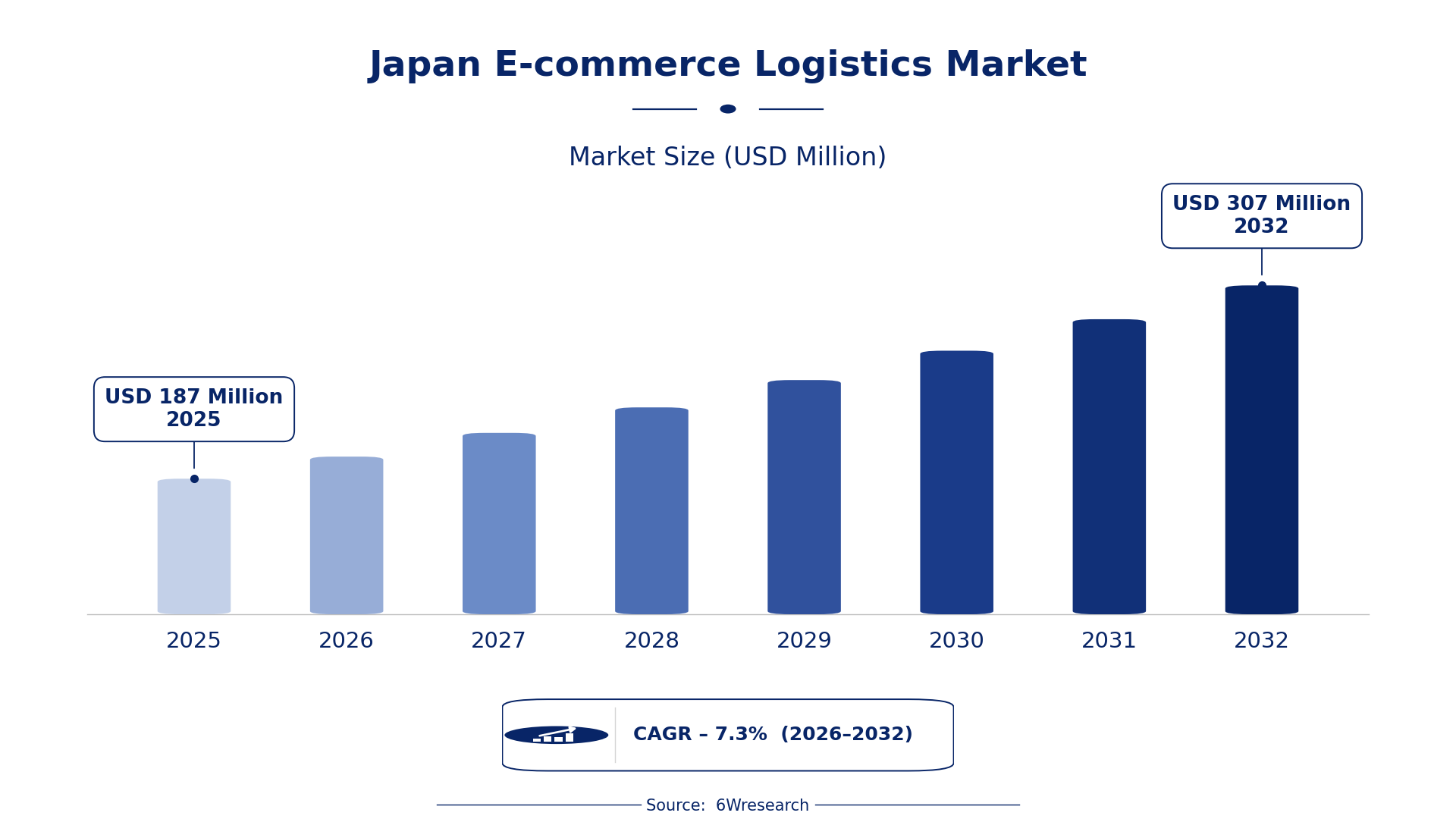
According to 6Wresearch internal database and industry insights, the Japan E-commerce Logistics Market was valued at USD 187 Million in 2025 and is projected to reach USD 307 Million by 2032, growing at a CAGR of approximately 7.3% during 2026–2032.
Japan E-commerce Logistics Market Highlights
| Report Metric | Details |
| Report Name | Japan E-commerce Logistics Market (2026-2032) |
| Market Size 2025 | USD 187 Million |
| Market Size 2032 | USD 307 Million |
| Absolute Growth 2025–2032 | USD 120 Million |
| CAGR 2026–2032 | 7.3% |
| Peak Annual Growth | 8.3% in 2028 |
| Forecast Period | 2026–2032 |
| Historical Data | 2022–2025 |
| Base Year | 2025 |
| Leading Service, 2025 | Transportation (43% share) |
| Leading Business, 2025 | B2B (63% share) |
| Leading Destination, 2025 | Domestic (56% share) |
| Leading Product, 2025 | Fashion and pparel (43% share) |
| Fastest-Growing Service | Warehousing and Inventory Management (9.7% CAGR) |
| Fastest-Growing Business | B2C (8.8% CAGR) |
| Fastest-Growing Destination | International/Cross Border (8.9% CAGR) |
| Fastest-Growing Product | Consumer electronics (10.5% CAGR) |
| Growing Sector | E-commerce |
| Key End Users | Online retailers, wholesalers, cross-border traders, logistics service providers |
Japan E-commerce Logistics Market Year-wise Growth Rate and Key Drivers (2022–2032)
This graph illustrates the annual growth rates of the market from 2022 to 2032, highlighting a steady upward trajectory and projected market expansion over the forecast period.
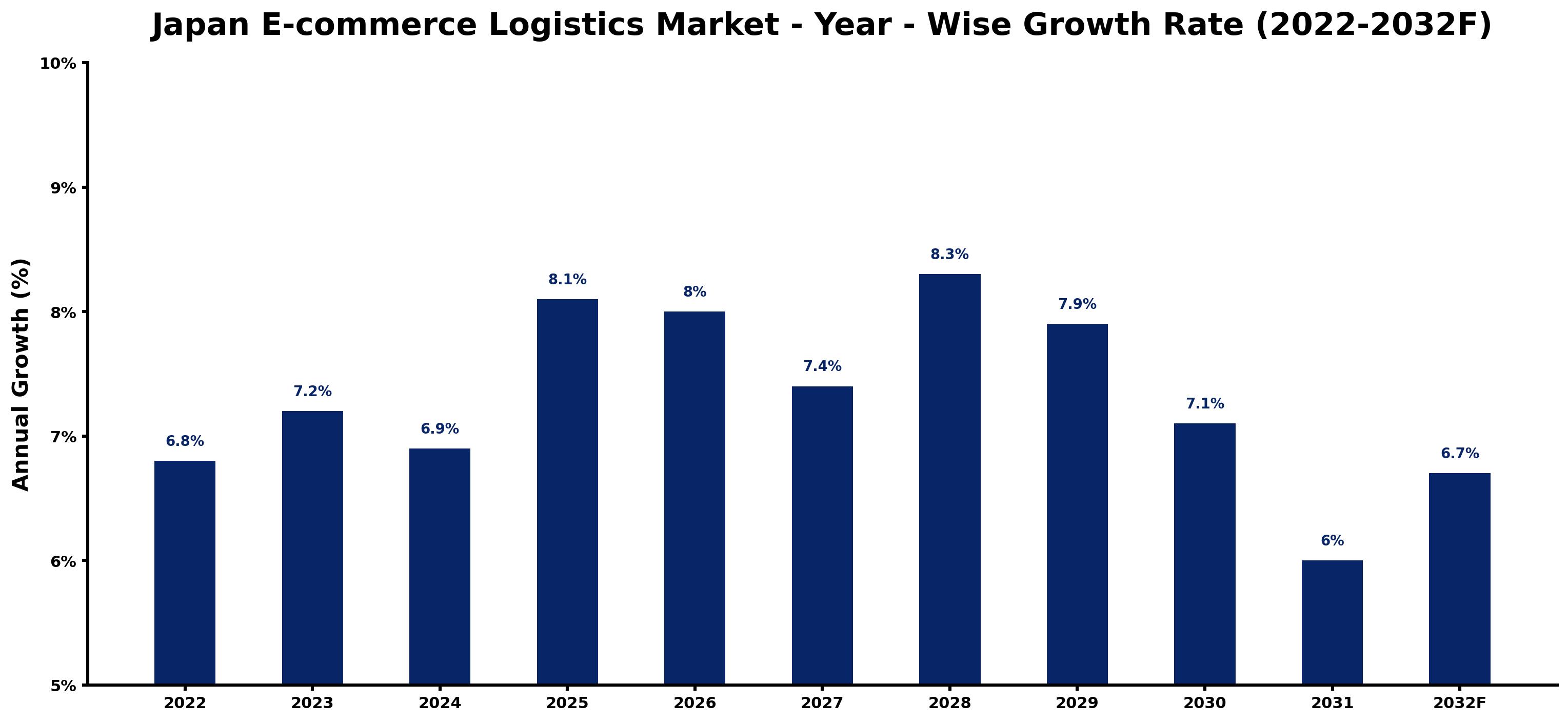
Below, each year's estimated growth is shown next to the factor that most influenced it.
| Year | Estimated Annual Growth (%) | Market Rationale |
| 2022 | 6.8 | The market experienced steady growth due to increased online shopping activity. |
| 2023 | 7.2 | Growth accelerated as more consumers turned to e-commerce for convenience. |
| 2024 | 6.9 | The market saw a slowdown in growth as competition intensified among logistics providers. |
| 2025 | 8.1 | Demand surged with the introduction of new logistics efficiency programs. |
| 2026 | 8.0 | Growth is expected to slow slightly as the market adjusts to operational standards. |
| 2027 | 7.4 | The market will continue to grow, driven by rising e-commerce penetration rates. |
| 2028 | 8.3 | A peak in growth is projected as automation investments begin to take effect. |
| 2029 | 7.9 | Growth will slow as market saturation in certain segments becomes apparent. |
| 2030 | 7.1 | The market is expected to maintain growth, supported by ongoing consumer demand for online shopping. |
| 2031 | 6.0 | Growth will slow as logistics costs remain a concern for many businesses. |
| 2032 | 6.7 | The market is projected to rebound with new innovations and efficiency measures implemented. |
Note: Market size estimations and growth projections presented in this report are based on 6Wresearch's proprietary forecasting methodology, utilizing the latest available industry data, government publications, and primary research inputs.
Japan E-commerce Logistics Market Synopsis
E-commerce logistics involves the transportation, warehousing, and management of goods sold online, using advanced technology for efficient order fulfillment and inventory management. The Japan E-commerce Logistics Market is growing due to a high online shopping rate, with around 126 million people engaging in e-commerce. A projected investment of 500 billion JPY in automation by 2025 and the rising trend in cross-border e-commerce are driving new demand. The logistics sector is set for substantial growth as consumer preferences shift towards faster delivery options.
Market Dynamics Impact Analysis (2026–2032)
| Factor | Type | Impact | Primary Segment Affected |
| Growing demand for efficient order fulfillment due to high e-commerce penetration | Driver | High | B2C |
| Investment in automation technologies to enhance logistics efficiency | Driver | High | Transportation |
| Expansion of cross-border e-commerce creating new logistics opportunities | Opportunity | High | International/Cross Border |
| Rising consumer expectations for faster delivery services | Opportunity | High | B2C |
| Increasing logistics costs driven by rising minimum wage | Restraint | High | Transportation |
| Shortage of skilled workers affecting operational efficiency | Restraint | Medium | Warehousing and Inventory Management |
| Intense competition among e-commerce businesses leading to price wars | Challenge | High | B2B |
| Slow technology adoption hindering logistics providers' efficiency | Challenge | Medium | Transportation |
Evaluation of Drivers in Japan E-commerce Logistics Market (2026–2032)
These are the developments adding the most demand over the forecast period.
| Drivers | Primary Segment Affected | Why It Matters (Evidence) |
| High e-commerce penetration rate | B2C | The e-commerce penetration rate reached 9.5% in 2022, driving demand for logistics services. |
| Investment in automation | Warehousing and Inventory Management | The logistics industry is set to invest 500 billion JPY in automation by 2025, improving efficiency. |
| Rising consumer preference for online shopping | B2B | With over 200,000 e-commerce businesses in Japan, B2B transactions are increasing. |
| Expansion of cross-border e-commerce | International/Cross Border | The growing trend in global trade boosts demand for international logistics services. |
| Technological advancements in logistics | Value-added services (labeling, packaging, etc.) | ISO 9001 certification adoption among providers ensures quality, improving service offerings. |
Orders keep climbing as Japan's e-commerce penetration rate reached 9.5% in 2022, increasing demand for logistics services. The logistics industry is set to invest 500 billion JPY in automation by 2025, improving efficiency for providers. The expansion of cross-border e-commerce is also creating new opportunities for logistics services. The adoption of ISO 9001 certification among logistics providers ensures quality, attracting more clients. With over 200,000 e-commerce businesses registered, B2B transactions are on the rise, further driving demand.
Evaluation of Restraints in Japan E-commerce Logistics Market
The table below lists the restraints and the evidence behind each.
| Market Restraint | Primary Segment Affected | Why It Matters (Evidence) |
| Intense competition among logistics providers | Transportation | With many players in the market, pricing pressure can limit profitability for service providers. |
| High operational costs | Warehousing and Inventory Management | Rising costs associated with labor and technology can hinder logistics providers' profitability. |
| Consumer expectations for fast delivery | B2C | Increasing demands for quicker delivery times challenge logistics efficiency and capacity. |
| Technological investments required | Value-added services (labeling, packaging, etc.) | Continuous advancements in technology require substantial investments from logistics firms. |
| Regulatory compliance costs | International/Cross Border | Navigating international regulations can add complexity and costs for logistics providers. |
Japan E-commerce Logistics Market Challenges
Japan's e-commerce logistics market faces a JPY 500 billion investment gap in automation by 2025, stemming from slow technology adoption among providers, which hampers operational efficiency for over 1 million workers. Intense competition among 200,000 registered e-commerce businesses compresses profit margins, forcing suppliers to reduce costs and affecting service quality. Rising logistics costs impact buyers as Japan's minimum wage increased to JPY 1,055 per hour, prompting retailers to raise prices. A shortage of skilled workers in the logistics sector obstructs effective order fulfillment, leading to delays that frustrate consumers and lower overall satisfaction.
Trends in the Japan E-commerce Logistics Market
These developments are changing demand patterns in the Japan E-commerce Logistics Market.
- Shift towards Automation in Logistics: Japan is experiencing a shift towards automation in logistics operations, driven by the need for efficiency. The logistics industry plans to invest 500 billion JPY in automation by 2025, improving service delivery.
- Growing Demand for Cross-Border E-commerce: Cross-border e-commerce is expanding rapidly, especially in regions like Tokyo and Osaka. This segment is projected to grow at a rate of 8.9% until 2032, reflecting increased global trade.
- Increased Focus on Sustainability: There is a rising emphasis on sustainable logistics practices in Japan. The Food Recycling Law encourages waste reduction and recycling, prompting logistics providers to adopt greener practices.
- Expansion of Value-Added Services: Logistics providers are increasingly offering value-added services such as packaging and labeling. This trend is driven by consumer demand for improved product presentation and compliance with regulations.
Investment Opportunities in the Japan E-commerce Logistics Market
Several openings in the Japan E-commerce Logistics Market merit attention from investors.
- Supply Chain Automation Solutions: The demand for automation solutions is surging, with logistics providers seeking partners to improve efficiency. The logistics sector's planned investment of 500 billion JPY by 2025 highlights the need for effective solutions.
- Expansion into Cross-Border Logistics: With cross-border e-commerce growing, logistics firms can enter this market by forming joint ventures with local partners. This segment is expected to see substantial growth due to rising international trade.
- Sustainable Logistics Services: There is a significant opportunity for logistics providers to offer sustainable services. The Food Recycling Law encourages practices that reduce waste, appealing to environmentally conscious consumers.
- Investment in Last-Mile Delivery Solutions: The need for efficient last-mile delivery solutions is critical as e-commerce grows. Investing in technology and partnerships can help logistics firms meet consumer expectations for speed.
Government Initiatives in the Japan E-commerce Logistics Market
The Food Recycling Law, enacted in 2000, mandates food businesses to reduce waste and recycle it into feed, fertiliser, and energy. This law has important implications for logistics providers handling food products, as they must ensure compliance with recycling standards. The Building Energy Efficiency Act, amended in 2022, requires new buildings to meet energy efficiency standards, impacting logistics facilities by necessitating upgrades to comply with these regulations.
The Ministry of Economy, Trade and Industry launched a program in 2023 to enhance logistics efficiency, aiming to reduce logistics costs by 10% by 2025. This initiative is supported by the Japan E-commerce Association, which promotes best practices in logistics. The program's funding is directed towards improving technology adoption and infrastructure development, benefiting logistics providers and enhancing service quality for e-commerce businesses.
Future Insight of the Japan E-commerce Logistics Market
A policy-driven shift will prompt suppliers to adopt advanced technologies, aiming to reduce logistics costs by 10% by 2025. Increased e-commerce demand will drive a surge in automation investments, with projections reaching JPY 500 billion by 2025. New efficiency standards will improve service quality for buyers. As technology integration progresses, order fulfillment speeds will increase, benefiting consumers and retailers alike.
Market Segmentation Analysis
Japan E-commerce Logistics Market report covers a detailed analysis of the following market segments:
By Service – Transportation Leads, Warehousing and Inventory Management Expected to Grow Fastest
According to Vasudha, AM at 6Wresearch, in 2025, Transportation led the service split with a 43% share. Transportation holds the largest share as it is crucial for delivering goods to consumers and businesses across Japan's urban centres. The extensive transport networks in Tokyo and Osaka are indispensable for fulfilling e-commerce logistics requirements. Warehousing and Inventory Management is projected to grow fastest, at a CAGR of 9.7% during 2026–2032. Warehousing and inventory management is rapidly expanding as companies invest in automation to enhance operational efficiency. The logistics sector's planned investment of 500 billion JPY in automation by 2025 will further streamline processes. Suppliers should focus on integrating advanced technologies to cater to the growing demand for efficient logistics services.
By Business – B2B Leads, B2C Expected to Grow Fastest
B2B accounted for 63% of the market by business in 2025. The B2B segment leads the market because it supports substantial wholesale transactions and bulk orders that are essential for many enterprises in Japan. The existence of over 200,000 e-commerce businesses underscores the importance of reliable logistics in their operations. The quickest growth will come from B2C, forecast to expand at a CAGR of 8.8% between 2026 and 2032. B2C is experiencing the fastest growth, driven by the increasing trend of direct-to-consumer sales. The e-commerce penetration rate of 9.5% in 2022 reflects a shift towards logistics solutions that prioritise consumer needs. Buyers can anticipate more customised logistics solutions as the B2C segment continues to expand.
By Destination – Domestic Leads, International/Cross Border Expected to Grow Fastest
Domestic took 56% of destination revenue in 2025, more than any other category. The domestic segment dominates the market as it caters to the strong demand for local deliveries within Japan's population of approximately 126 million. This focus on local logistics is vital for ensuring customer satisfaction in e-commerce operations. International/Cross Border is set to record the highest CAGR in this split, 8.9% over 2026–2032. International and cross-border logistics are growing rapidly due to the rise in global trade and online shopping among Japanese consumers. Government initiatives aimed at reducing logistics costs by 10% by 2025 are expected to bolster this growth. Suppliers must adjust their strategies to accommodate the increasing demand for international shipping solutions.
By Product – Fashion and pparel Leads, Consumer electronics Expected to Grow Fastest
The largest product category in 2025 was Fashion and pparel, at 43% of revenue. Fashion and apparel lead the market due to their high volume of online sales, reflecting consumer preferences for trendy clothing. This category thrives on Japan's significant online shopping rate, which drives the need for effective logistics. Over 2026–2032, Consumer electronics is expected to post the fastest growth, at a CAGR of 10.5%. Consumer electronics are the fastest-growing segment, propelled by the strong demand for timely delivery of technology products. The rising reliance on online platforms for purchasing electronics further intensifies this demand. Suppliers should enhance their logistics capabilities to specifically address the fast-paced consumer electronics market.
Key Attractiveness of the Report
- 10 Years of Market Numbers
- Historical Data Starting from 2022 to 2025
- Base Year 2025
- Forecast Data until 2032
- Key Performance Indicators Impacting the Market
- Major Upcoming Developments and Projects
Key Highlights of the Report:
- Japan E-commerce Logistics Market Outlook
- Market Size of Japan E-commerce Logistics Market, 2025
- Forecast of Japan E-commerce Logistics Market, 2032
- Historical Data and Forecast of Japan E-commerce Logistics Revenues & Volume for the Period 2022-2032
- Japan E-commerce Logistics Market Trend Evolution
- Japan E-commerce Logistics Market Drivers and Challenges
- Japan E-commerce Logistics Price Trends
- Japan E-commerce Logistics Porter's Five Forces
- Japan E-commerce Logistics Industry Life Cycle
- Historical Data and Forecast of Japan E-commerce Logistics Market Revenues & Volume By Service for the Period 2022-2032
- Historical Data and Forecast of Japan E-commerce Logistics Market Revenues & Volume By Transportation for the Period 2022-2032
- Historical Data and Forecast of Japan E-commerce Logistics Market Revenues & Volume By Warehousing and Inventory Management for the Period 2022-2032
- Historical Data and Forecast of Japan E-commerce Logistics Market Revenues & Volume By Value-added services (labeling, packaging, etc.) for the Period 2022-2032
- Historical Data and Forecast of Japan E-commerce Logistics Market Revenues & Volume By Business for the Period 2022-2032
- Historical Data and Forecast of Japan E-commerce Logistics Market Revenues & Volume By B2B for the Period 2022-2032
- Historical Data and Forecast of Japan E-commerce Logistics Market Revenues & Volume By B2C for the Period 2022-2032
- Historical Data and Forecast of Japan E-commerce Logistics Market Revenues & Volume By Destination for the Period 2022-2032
- Historical Data and Forecast of Japan E-commerce Logistics Market Revenues & Volume By Domestic for the Period 2022-2032
- Historical Data and Forecast of Japan E-commerce Logistics Market Revenues & Volume By International/Cross Border for the Period 2022-2032
- Historical Data and Forecast of Japan E-commerce Logistics Market Revenues & Volume By Product for the Period 2022-2032
- Historical Data and Forecast of Japan E-commerce Logistics Market Revenues & Volume By Fashion and pparel for the Period 2022-2032
- Historical Data and Forecast of Japan E-commerce Logistics Market Revenues & Volume By Consumer electronics for the Period 2022-2032
- Historical Data and Forecast of Japan E-commerce Logistics Market Revenues & Volume By Home Appliances for the Period 2022-2032
- Historical Data and Forecast of Japan E-commerce Logistics Market Revenues & Volume By Furniture for the Period 2022-2032
- Historical Data and Forecast of Japan E-commerce Logistics Market Revenues & Volume By Beauty and Personal care for the Period 2022-2032
- Historical Data and Forecast of Japan E-commerce Logistics Market Revenues & Volume By Other products (Toys, Food Products, etc.) for the Period 2022-2032
- Japan E-commerce Logistics Import Export Trade Statistics
- Market Opportunity Assessment By Service
- Market Opportunity Assessment By Business
- Market Opportunity Assessment By Destination
- Market Opportunity Assessment By Product
- Japan E-commerce Logistics Top Companies Market Share
- Japan E-commerce Logistics Competitive Benchmarking By Technical and Operational Parameters
- Japan E-commerce Logistics Company Profiles
- Japan E-commerce Logistics Key Strategic Recommendations
Market Covered
This report examines the market across the segments below.
By Service
- Transportation
- Warehousing and Inventory Management
- Value-added services (labeling, packaging, etc.)
By Business
- B2B
- B2C
By Destination
- Domestic
- International/Cross Border
By Product
- Fashion and pparel
- Consumer electronics
- Home Appliances
- Furniture
- Beauty and Personal care
- Other products (Toys, Food Products, etc.)






































