Japan Edge Computing Market Size & Growth Rate (2026-2032)
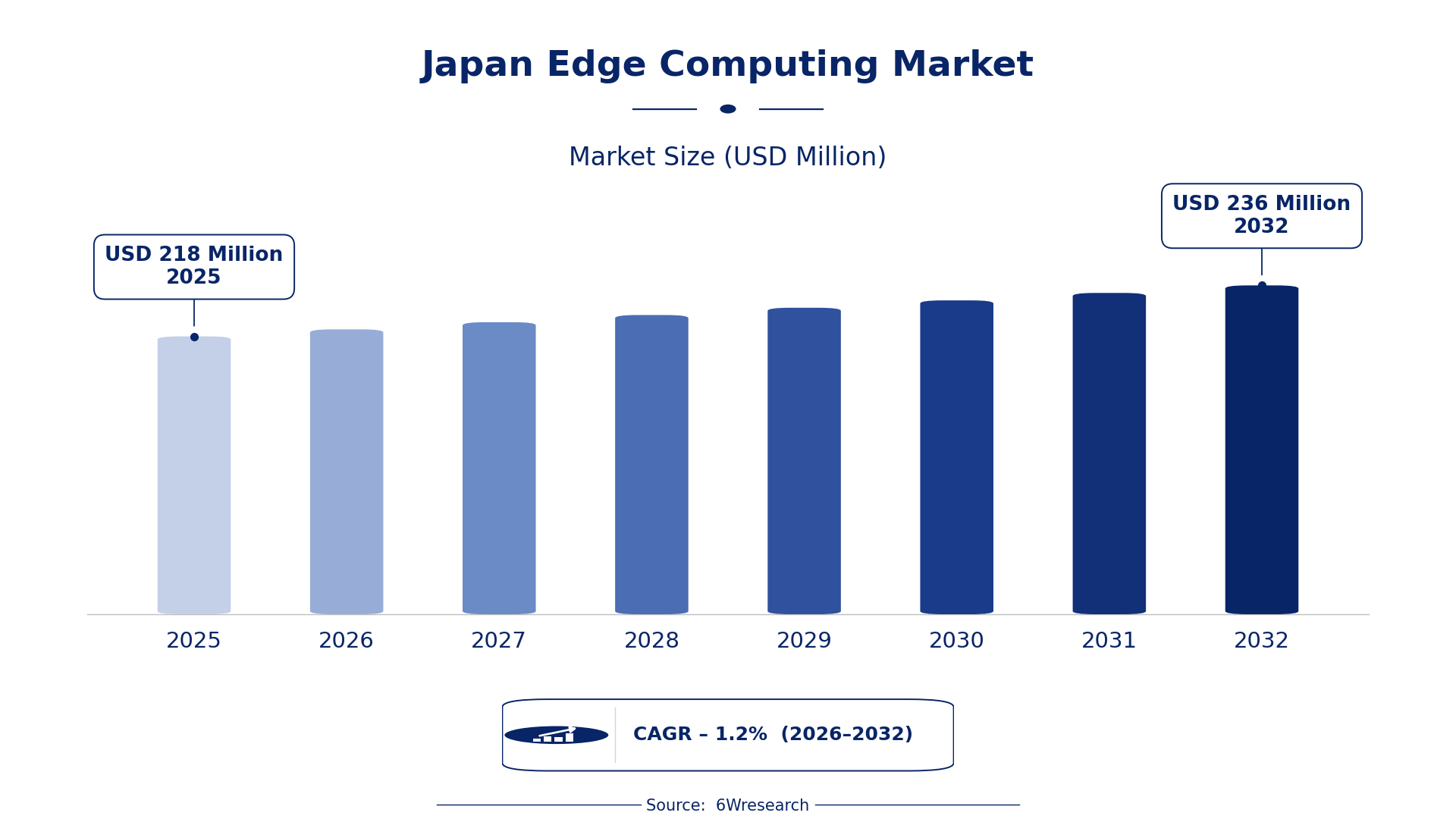
The Japan Edge Computing Market was estimated at USD 218 Million in 2025 and is projected to reach USD 236 Million by 2032, growing at a CAGR of 1.2% from 2026 to 2032.
Japan Edge Computing Market Synopsis
The Japan Edge Computing Market is rapidly advancing, driven by the proliferation of Internet of Things (IoT) devices and the growing demand for real-time data processing. Industries such as smart manufacturing, healthcare, and transportation are increasingly integrating edge computing solutions to enhance operational efficiency and reduce latency.
With major investments from both private sectors and government initiatives aimed at digital transformation, the market is witnessing a shift towards decentralized computing. This shift not only improves data handling but also enables organizations to respond swiftly to real-time insights and operational needs.
Japan Edge Computing Market Year-wise Growth Rate and Key Drivers
This graph illustrates the annual growth rates of the Japan Edge Computing Market from 2021 to 2032, highlighting a steady upward trajectory and projected expansion over the forecast period.
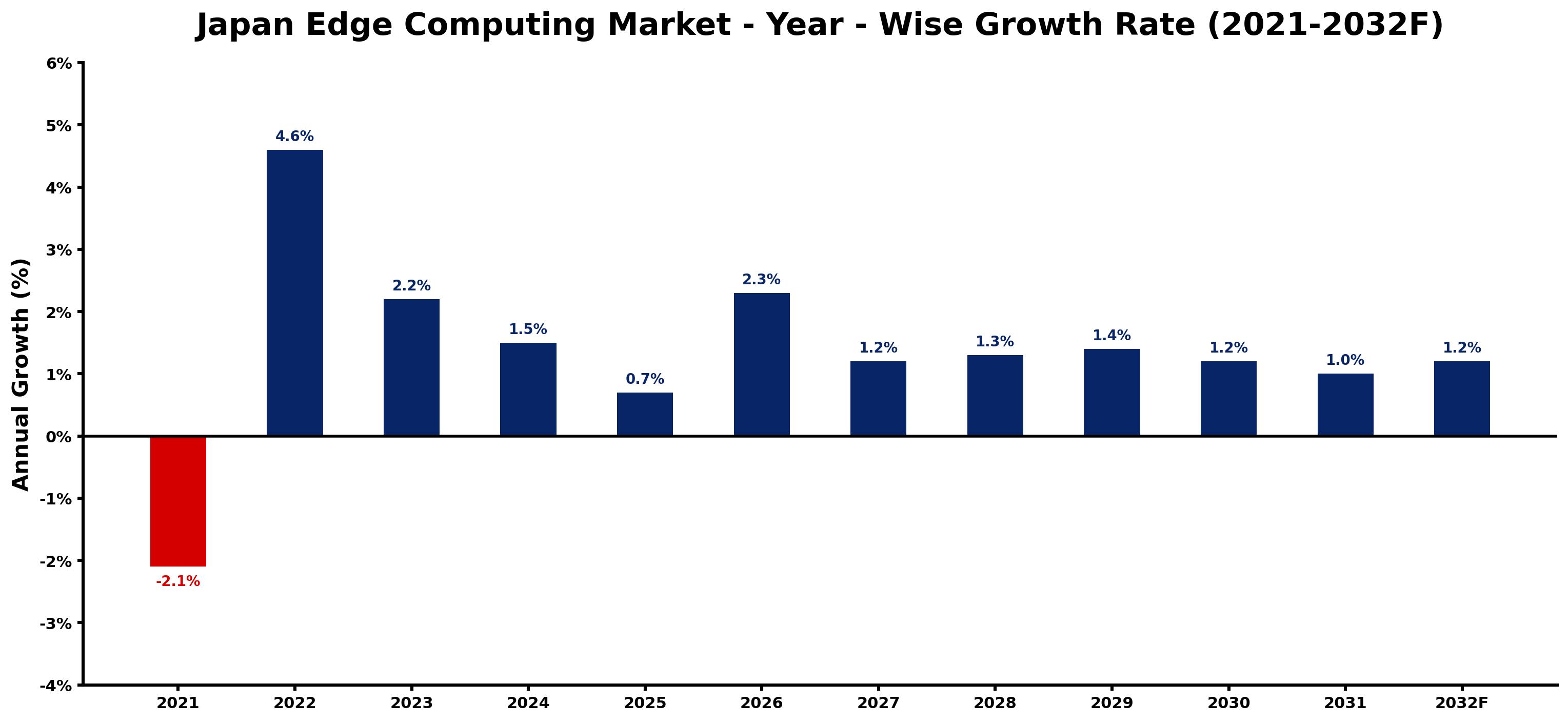
The table below presents the year‑wise growth rates along with the key drivers influencing the market
| Year | Growth Rate | Major Drivers |
| 2021 | -2.1% | Delays in cloud adoption by Japanese enterprises. |
| 2022 | 4.6% | Japan's 5G rollout accelerating edge computing applications. |
| 2023 | 2.2% | Increased IoT adoption in smart manufacturing sectors. |
| 2024 | 1.5% | Government initiatives supporting AI-driven data analysis. |
| 2025 | 0.7% | Rising need for low-latency solutions in finance. |
| 2026 | 2.3% | Surge in healthcare telemedicine requiring edge solutions. |
| 2027 | 1.2% | Corporate strategies targeting enhanced cybersecurity measures. |
| 2028 | 1.3% | Growth in localized content delivery networks deployment. |
| 2029 | 1.4% | Interest in regional data centers boosting edge capabilities. |
| 2030 | 1.2% | Collaboration between tech firms on edge innovations. |
| 2031 | 1.0% | Demand for smart cities pushing edge infrastructure. |
| 2032 | 1.2% | Focus on disaster recovery solutions benefiting edge computing. |
Note: Market size estimations and growth projections presented in this report are based on 6Wresearch's proprietary forecasting methodology, utilizing the latest available industry data, government publications, and primary research inputs.
Japan Edge Computing Market Key Takeaways
Below are some of the specific key takeaways from the market, including:
- Increasing adoption of IoT devices is driving demand for edge computing solutions across various sectors.
- Real-time data processing capabilities are becoming crucial for operational efficiency and decision-making.
- Heightened focus on security and data privacy is shaping edge computing implementations.
- Investment opportunities are emerging in edge infrastructure and software solutions.
- Government policies are aligning to promote innovation and support the digital economy.
Evaluation of Restraints in Japan Edge Computing Market
Despite the promising growth trajectory, the Japan Edge Computing Market faces several restraints. Infrastructure development is lagging behind demand, making it challenging for organizations to implement effective edge computing solutions. The shortage of skilled professionals with expertise in edge technologies further complicates the landscape, limiting the speed of adoption. on top of that, concerns regarding data security and regulatory compliance create additional hurdles for businesses seeking to capitalize on edge computing's advantages.
Japan Edge Computing Market Trends
Current trends indicate a significant shift towards decentralized computing as organizations prioritize real-time data analytics. The rise of smart manufacturing and autonomous vehicles is propelling this trend, necessitating faster processing capabilities. Additionally, edge security is gaining attention, with companies investing in solutions that ensure data protection while maintaining efficiency. These trends highlight the increasing recognition of edge computing as a vital component for modern digital transformation.
Japan Edge Computing Market Opportunities
The market presents numerous investment opportunities, particularly in sectors that are rapidly adopting IoT technologies. Companies focusing on healthcare and smart transportation stand to gain significantly from edge computing solutions. Investment in edge data centers and partnerships with local technology firms are strategic avenues for growth. As the demand for real-time data processing escalates, innovative edge computing technologies will become pivotal for businesses looking to enhance their operational efficiency.
Government Initiatives in the Japan Edge Computing Market
The Japanese government is actively fostering an environment conducive to the growth of edge computing technologies. With initiatives aimed at digital transformation, policymakers are prioritizing the integration of edge computing to enhance various sectors, including healthcare and smart cities. A supportive regulatory framework is being established to address data privacy and security, making it easier for organizations to innovate in this space.
- A national digital infrastructure upgrade program was launched in early 2023 to enhance connectivity and support edge computing development.
- Currently, a regulatory framework focusing on data privacy and security standards is under review, aiming to streamline compliance for businesses.
- A public-private partnership initiative focused on expanding edge computing capabilities in urban areas is underway, expected to complete by late 2025.
- Planned investments in research and development for edge technologies are scheduled for 2026, targeting innovations in smart city applications.
- A new digital skills training program is set to launch in 2025 to address the skills gap in edge computing technologies.
Future Insights of the Japan Edge Computing Market
Looking ahead to 2026-2032, the Japan Edge Computing Market is likely to continue its upward trajectory. The increasing integration of AI and 5G technologies will further drive the need for efficient data processing at the edge. As organizations seek to optimize their operations, the demand for edge solutions will expand across various industries. Companies that invest in advanced edge technologies will be well-positioned to capture market share in this dynamic environment.
Japan Edge Computing Market Latest Developments
Recent activity in the Japan Edge Computing Market indicates a strong push towards innovation and expansion. Companies are focused on enhancing their edge capabilities to meet the growing demand for real-time data processing. Collaborative efforts between industry players and government agencies are fostering an environment ripe for technological advancements.
- A leading regional operator announced the rollout of a new edge computing service in Q2 2023, aimed at improving data processing for local businesses.
- A major technology vendor launched an advanced edge computing platform in early 2024, featuring enhanced security measures to protect sensitive data.
- An initiative that began in mid-2023 focused on establishing edge data centers in urban areas is currently underway and progressing well.
- A planned partnership between multiple stakeholders is expected to be finalized by late 2025, aimed at boosting edge computing infrastructure in rural areas.
- A pilot program for integrating edge computing in healthcare applications is slated to begin in early 2026, targeting improvements in patient data management.
Japan Edge Computing Market - Key Attractiveness of the Report
- 10 Years of Market Numbers
- Historical Data Starting from 2022 to 2025
- Base Year: 2025
- Forecast Data until 2032
- Key Performance Indicators Impacting the Market
- Major Upcoming Developments and Projects
Key Highlights of the Report:
- Japan Edge Computing Market Outlook
- Market Size of Japan Edge Computing Market, 2025
- Forecast of Japan Edge Computing Market, 2032
- Historical Data and Forecast of Japan Edge Computing Revenues & Volume for the Period 2022-2032F
- Japan Edge Computing Market Trend Evolution
- Japan Edge Computing Market Drivers and Challenges
- Japan Edge Computing Price Trends
- Japan Edge Computing Porter's Five Forces
- Japan Edge Computing Industry Life Cycle
- Historical Data and Forecast of Japan Edge Computing Market Revenues & Volume By Component for the Period 2022-2032F
- Historical Data and Forecast of Japan Edge Computing Market Revenues & Volume By Hardware for the Period 2022-2032F
- Historical Data and Forecast of Japan Edge Computing Market Revenues & Volume By Software for the Period 2022-2032F
- Historical Data and Forecast of Japan Edge Computing Market Revenues & Volume By Services for the Period 2022-2032F
- Historical Data and Forecast of Japan Edge Computing Market Revenues & Volume By Organization Size for the Period 2022-2032F
- Historical Data and Forecast of Japan Edge Computing Market Revenues & Volume By Large Enterprises for the Period 2022-2032F
- Historical Data and Forecast of Japan Edge Computing Market Revenues & Volume By SMEs for the Period 2022-2032F
- Historical Data and Forecast of Japan Edge Computing Market Revenues & Volume By Application for the Period 2022-2032F
- Historical Data and Forecast of Japan Edge Computing Market Revenues & Volume By Smart Cities for the Period 2022-2032F
- Historical Data and Forecast of Japan Edge Computing Market Revenues & Volume By Industrial Internet of Things (IIoT) for the Period 2022-2032F
- Historical Data and Forecast of Japan Edge Computing Market Revenues & Volume By Remote Monitoring for the Period 2022-2032F
- Historical Data and Forecast of Japan Edge Computing Market Revenues & Volume By Content Delivery for the Period 2022-2032F
- Historical Data and Forecast of Japan Edge Computing Market Revenues & Volume By Augmented Reality (AR) and Virtual Reality (VR) for the Period 2022-2032F
- Historical Data and Forecast of Japan Edge Computing Market Revenues & Volume By Others (Autonomous Vehicles, Drones, And Gaming) for the Period 2022-2032F
- Historical Data and Forecast of Japan Edge Computing Market Revenues & Volume By Vertical for the Period 2022-2032F
- Historical Data and Forecast of Japan Edge Computing Market Revenues & Volume By Manufacturing for the Period 2022-2032F
- Historical Data and Forecast of Japan Edge Computing Market Revenues & Volume By Energy and Utilities for the Period 2022-2032F
- Historical Data and Forecast of Japan Edge Computing Market Revenues & Volume By Government and Defense for the Period 2022-2032F
- Historical Data and Forecast of Japan Edge Computing Market Revenues & Volume By Telecommunications for the Period 2022-2032F
- Historical Data and Forecast of Japan Edge Computing Market Revenues & Volume By Media and Entertainment for the Period 2022-2032F
- Historical Data and Forecast of Japan Edge Computing Market Revenues & Volume By Retail and Consumer Goods for the Period 2022-2032F
- Historical Data and Forecast of Japan Edge Computing Market Revenues & Volume By Transportation and Logistics for the Period 2022-2032F
- Historical Data and Forecast of Japan Edge Computing Market Revenues & Volume By Healthcare and Life Sciences for the Period 2022-2032F
- Japan Edge Computing Import Export Trade Statistics
- Market Opportunity Assessment By Component
- Market Opportunity Assessment By Organization Size
- Market Opportunity Assessment By Application
- Market Opportunity Assessment By Vertical
- Japan Edge Computing Top Companies Market Share
- Japan Edge Computing Competitive Benchmarking By Technical and Operational Parameters
- Japan Edge Computing Company Profiles
- Japan Edge Computing Key Strategic Recommendations






































