Japan Edible Pigment Market Size & Growth Rate
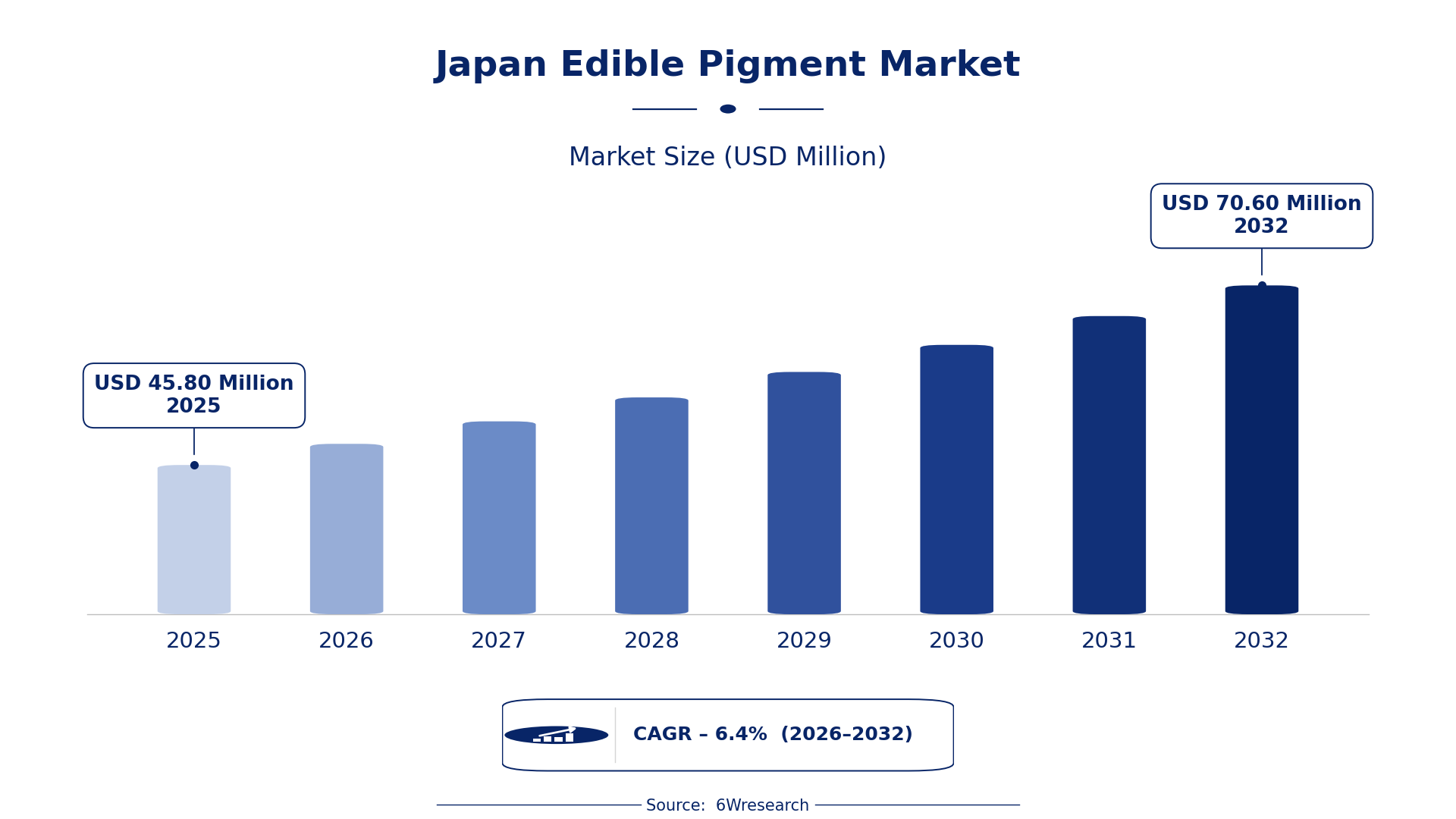
According to 6Wresearch internal database and industry insights, the Japan Edible Pigment Market was valued at USD 45.80 Million in 2025 and is projected to reach USD 70.60 Million by 2032, growing at a CAGR of approximately 6.4% during 2026–2032.
Japan Edible Pigment Market Highlights
| Report Metric | Details |
| Report Name | Japan Edible Pigment Market (2026-2032) |
| Market Size 2025 | USD 45.80 Million |
| Market Size 2032 | USD 70.60 Million |
| Absolute Growth 2025–2032 | USD 24.80 Million |
| CAGR 2026–2032 | 6.4% |
| Peak Annual Growth | 7.6% in 2032 |
| Forecast Period | 2026–2032 |
| Historical Data | 2022–2025 |
| Base Year | 2025 |
| Leading Product Type, 2025 | Natural Pigments (39% share) |
| Leading Functionality, 2025 | Coloring (55% share) |
| Leading Application Area, 2025 | Bakery (40% share) |
| Leading Distribution Channel, 2025 | Retail Chains (35% share) |
| Leading End User, 2025 | Food Producers (43% share) |
| Fastest-Growing Product Type | Plant-based Pigments (9.4% CAGR) |
| Fastest-Growing Functionality | Food Decoration (8.4% CAGR) |
| Fastest-Growing Application Area | Confectionery (7.8% CAGR) |
| Fastest-Growing Distribution Channel | Online Platforms (8.6% CAGR) |
| Fastest-Growing End User | Food Manufacturers (8.3% CAGR) |
| Growing Sector | Food Production |
| Key End Users | Food Producers, Food Manufacturers, Bakeries, Confectioneries |
Japan Edible Pigment Market Year-wise Growth Rate and Key Drivers (2022–2032)
This graph illustrates the annual growth rates of the market from 2022 to 2032, highlighting a steady upward trajectory and projected market expansion over the forecast period.
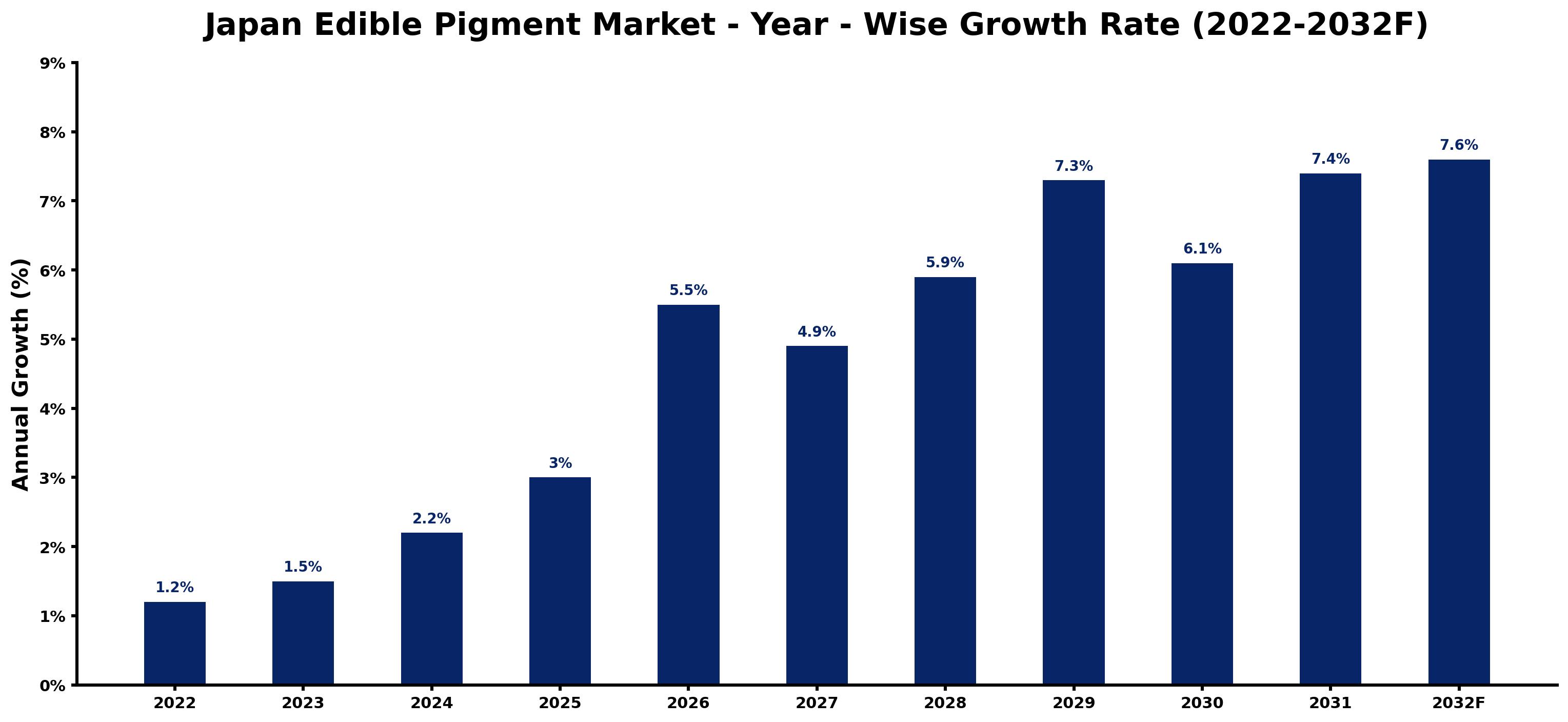
Annual growth estimates for each year appear below with the principal reason behind them, explaining the shifts that set the pace of the market.
| Year | Estimated Annual Growth (%) | Market Rationale |
| 2022 | 1.2 | The market exhibited steady growth due to consistent demand from food producers. |
| 2023 | 1.5 | Growth accelerated as the food industry expanded, boosting pigment usage. |
| 2024 | 2.2 | The rise in health-conscious consumers increased demand for natural pigments. |
| 2025 | 3.0 | Market growth peaked as bakeries and confectioneries sought vibrant colors. |
| 2026 | 5.5 | Investment in plant-based pigments surged, driving further demand. |
| 2027 | 4.9 | Growth slowed slightly as market saturation began to set in. |
| 2028 | 5.9 | Demand for new food products spurred a resurgence in growth. |
| 2029 | 7.3 | The market experienced an uptick as consumer preferences evolved. |
| 2030 | 6.1 | Growth decelerated as competition intensified among suppliers. |
| 2031 | 7.4 | The market rebounded with renewed interest in natural ingredients. |
| 2032 | 7.6 | Peak growth was achieved as plant-based pigments gained widespread acceptance. |
Note: Market size estimations and growth projections presented in this report are based on 6Wresearch's proprietary forecasting methodology, utilizing the latest available industry data, government publications, and primary research inputs.
Japan Edible Pigment Market Synopsis
Edible pigments are substances that impart colour to food products, derived from natural or synthetic sources. Their primary applications include improving the visual appeal of food items and ensuring colour consistency in processed foods. The Japan Edible Pigment Market is expanding due to rising consumer demand for natural ingredients, with the food industry valued at approximately 50 trillion yen in 2023. The increasing preference for plant-based pigments, driven by health trends, is creating new opportunities for producers and suppliers, particularly in the Tokyo region.
Market Dynamics Impact Analysis (2026–2032)
| Factor | Type | Impact | Primary Segment Affected |
| Rising consumer preference for natural ingredients | Driver | High | Natural Pigments |
| Growth in the food industry, particularly in confectionery | Driver | High | Confectionery |
| Increasing demand for vibrant colours in gourmet food | Opportunity | High | Food Decoration |
| Expansion of online sales channels for niche products | Opportunity | Medium | Online Platforms |
| Regulatory scrutiny on food additives and safety standards | Restraint | High | Synthetic Pigments |
| Limited consumer awareness of synthetic options | Restraint | Medium | Synthetic Pigments |
| High costs associated with natural pigment production | Challenge | High | Natural Pigments |
| Competition from alternative food colourants | Challenge | Medium | Plant-based Pigments |
Evaluation of Drivers in Japan Edible Pigment Market (2026–2032)
The table below links each growth driver to the segment it affects and the evidence for it.
| Drivers | Primary Segment Affected | Why It Matters (Evidence) |
| Increased investment in plant-based pigment production | Plant-based Pigments | This investment is linked to rising veganism, leading to a 15% increase in online sales of food ingredients in 2023. |
| Expansion of the confectionery sector | Confectionery | As the sector grows, demand for vibrant colours in candies and chocolates increases, reflecting changing consumer preferences. |
| Health trends favouring natural ingredients | Natural Pigments | The preference for health-conscious options has led to a shift towards natural pigments in food applications. |
| Support for natural ingredient development | Natural Pigments | Government subsidies for innovation in natural ingredients are driving growth in this segment. |
| Rising demand from bakeries for aesthetic appeal | Bakery | Bakeries are increasingly using pigments to enhance the visual appeal of bread and pastries, driving sales. |
Much of the new demand traces back to increased investment in plant-based pigment production, which rose by 15% in online sales of food ingredients in 2023. The expansion of the confectionery sector is notable, as vibrant colours in candies and chocolates are increasingly sought after. Health trends favouring natural ingredients have shifted consumer preferences towards these pigments, aligning with market demands.
Evaluation of Restraints in Japan Edible Pigment Market
These restraints slow adoption and weigh on supplier margins.
| Market Restraint | Primary Segment Affected | Why It Matters (Evidence) |
| Regulatory scrutiny on food additives and safety standards | Synthetic Pigments | The stringent regulations, such as the Food Sanitation Act, impose compliance costs on producers, limiting market entry. |
| Limited consumer awareness of synthetic options | Synthetic Pigments | Many consumers prefer natural pigments, reducing the market size for synthetic alternatives. |
| High costs associated with natural pigment production | Natural Pigments | Production costs for natural pigments are higher, impacting pricing strategies for producers. |
| Competition from alternative food colourants | Plant-based Pigments | Emerging alternatives are drawing attention away from traditional edible pigments, affecting market share. |
| Fluctuating raw material prices for pigments | Natural Pigments | Volatility in raw material prices can disrupt production schedules and profit margins. |
Japan Edible Pigment Market Challenges
Producers in Japan face intense competition from both local and international players, which can erode profit margins by up to 15%. Many still use outdated technology, leading to production inefficiencies that may delay output by 20%. A lack of skilled workers in advanced food processing limits innovation, extending product development timelines by six months for numerous companies. Supply chain disruptions occur due to reliance on imported raw materials, impacting production schedules for over 30% of producers, which ultimately affects their ability to meet market demand.
Trends in the Japan Edible Pigment Market
These developments are changing demand patterns in the Japan Edible Pigment Market.
- Shift towards Plant-based Pigments: The Tokyo region is experiencing a shift towards plant-based pigments as health trends gain traction. In 2023, the demand for these pigments rose by 15%, reflecting consumer preferences for natural ingredients.
- Transition from Synthetic to Natural Ingredients: Consumer preferences are transitioning from synthetic to natural ingredients, particularly in the food industry. The Food Sanitation Act's regulations have encouraged this change, resulting in a notable increase in natural pigment usage.
- Emergence of Online Sales Channels: Online platforms are becoming increasingly important for the distribution of edible pigments. In 2023, online sales grew by 15%, indicating a shift in purchasing behaviour among consumers.
- Prioritisation of Aesthetic Appeal in Food Products: Food producers are prioritising aesthetic appeal, leading to increased demand for vibrant colours. The bakery sector, accounting for 40% of the market, exemplifies this trend.
Investment Opportunities in the Japan Edible Pigment Market
Below are the investment opportunities with the strongest case in the Japan Edible Pigment Market.
- Tokyo's Food Innovation Hubs: Tokyo is a major hub for food innovation, with a growing demand for natural pigments. The market gap for plant-based options is notable, with a projected increase in sales of 20% by 2025.
- Investment in Natural Ingredient Development: With the Japanese government supporting food innovation through subsidies, there is an opportunity to invest in natural ingredient development. Food manufacturers are increasingly seeking these products, with a projected growth of 25% in demand.
- Growing Vegan Population: The rising vegan population in Japan presents an opportunity for suppliers of plant-based pigments. This demographic shift is driving demand for natural colourants in food products, with an increase of 30% expected by 2025.
- Expansion of Online Retail Channels: The growing trend towards online shopping provides a timely opportunity for suppliers. Retail chains are increasingly using online platforms to reach consumers seeking niche products, with online sales expected to rise by 20%.
Government Initiatives in the Japan Edible Pigment Market
The Economic Security Promotion Act of 2022 supports supply-chain resilience for critical products, including edible pigments. This measure strengthens existing regulations by ensuring that producers can maintain consistent quality and availability of pigments in the market. The act aims to improve the reliability of supply chains, which is vital for the food industry, with a focus on enhancing local production capabilities and reducing dependency on imports.
The Food Sanitation Act mandates safety standards for food additives. The Japan Food Additives Association oversees compliance, ensuring that producers adhere to safety protocols while using edible pigments. This oversight helps maintain consumer trust and product safety, benefiting over 30,000 registered food manufacturers in Japan.
Future Insight of the Japan Edible Pigment Market
Investment in natural ingredient development will rise, generating demand for plant-based solutions by 2032. The increasing consumer preference for healthier options will drive suppliers to seek alternatives to synthetic pigments. Online sales of food ingredients are expected to grow by 15%, reflecting shifts in consumer purchasing behaviour. New safety standards will be enforced, ensuring compliance for all edible pigments, which will enhance product credibility and create new opportunities for both buyers and suppliers.
Market Segmentation Analysis
Japan Edible Pigment Market report covers a detailed analysis of the following market segments:
By Product Type – Natural Pigments Lead, Plant-based Pigments Expected to Grow Fastest
According to Ayushi Shukla, Senior Research Analyst at 6Wresearch, Natural Pigments took 39% of product type revenue in 2025, more than any other category. Natural pigments dominate due to their widespread application in food coloring and decoration, appealing to health-conscious consumers. The Japanese Agricultural Standards endorse these pigments, ensuring safety and quality, which boosts their adoption among food producers. Plant-based Pigments are projected to grow fastest, at a CAGR of 9.4% during 2026–2032. The surge in demand for plant-based pigments is fuelled by a growing trend towards veganism, with consumers increasingly seeking natural ingredients. This shift is evidenced by a notable increase in plant-based product launches in the food sector. Suppliers should focus on expanding their range of natural and plant-based pigments to meet evolving consumer preferences.
By Functionality – Coloring Leads, Food Decoration Expected to Grow Fastest
Coloring accounted for 55% of the market by functionality in 2025. Coloring is essential for food aesthetics and marketing, making it the primary functionality in Japan's edible pigment market. Many food producers rely on pigments to enhance the visual appeal of their products, particularly in the thriving Tokyo region. Over 2026–2032, Food Decoration is expected to post the fastest growth, at a CAGR of 8.4%. Food decoration is experiencing rapid growth as gourmet food trends gain traction, with manufacturers eager to create visually striking offerings. The increasing use of decorative pigments in high-end culinary creations exemplifies this shift. Suppliers must prioritise the development of decorative pigment solutions to cater to the growing demand for aesthetically pleasing food products.
By Application Area – Bakery Leads, Confectionery Expected to Grow Fastest
Bakery held 40% of the Japan Edible Pigment Market by application area in 2025. Bakery is the leading application area for edible pigments, as they are widely used for colouring bread and pastries. The robust bakery sector in Japan, supported by over 30,000 registered food manufacturers, significantly contributes to this demand. The quickest growth will come from Confectionery, forecast to expand at a CAGR of 7.8% between 2026 and 2032. Confectionery is growing quickly due to the rising demand for vibrant colours in candies and chocolates, appealing to various consumer preferences. This growth is further driven by increased confectionery production and ongoing product innovation. Suppliers should focus on the confectionery segment with tailored pigment solutions to capitalise on its expanding opportunities.
By Distribution Channel – Retail Chains Lead, Online Platforms Expected to Grow Fastest
The largest distribution channel category in 2025 was Retail Chains, at 35% of revenue. Retail chains are the primary distribution channel for edible pigments, ensuring broad access for consumers and food producers. Their established networks facilitate efficient distribution throughout Japan, making pigments readily available. Online Platforms are set to record the highest CAGR in this split, 8.6% over 2026–2032. Online platforms are quickly becoming a preferred channel, with a 15% rise in online sales of food ingredients in 2023. This trend is influenced by consumer convenience and the increasing demand for niche products not typically found in traditional retail. Suppliers must strengthen their online strategies to capture the expanding market of consumers purchasing pigments through digital platforms.
By End User – Food Producers Lead, Food Manufacturers Expected to Grow Fastest
In 2025, Food Producers led the end user split with a 43% share. Food producers represent the largest end user group for edible pigments, as they require these products for various food applications. Their substantial scale and continuous innovation in food products drive the demand for pigments. Food Manufacturers are projected to grow fastest, at a CAGR of 8.3% during 2026–2032. Food manufacturers are experiencing the fastest growth in demand for edible pigments, as they seek to meet consumer preferences for visually appealing and safe food products. This trend is supported by the increasing emphasis on product differentiation in the competitive food market. Suppliers should focus on building relationships with food manufacturers to secure long-term contracts and partnerships.
Key Attractiveness of the Report
- 10 Years of Market Numbers
- Historical Data Starting from 2022 to 2025
- Base Year 2025
- Forecast Data until 2032
- Key Performance Indicators Impacting the Market
- Major Upcoming Developments and Projects
Key Highlights of the Report:
- Japan Edible Pigment Market Outlook
- Market Size of Japan Edible Pigment Market, 2025
- Forecast of Japan Edible Pigment Market, 2032
- Historical Data and Forecast of Japan Edible Pigment Market Revenues & Volume for the Period 2022-2032F
- Japan Edible Pigment Market Trend Evolution
- Japan Edible Pigment Market Drivers and Challenges
- Japan Edible Pigment Market Price Trends
- Japan Edible Pigment Market Porter's Five Forces
- Japan Edible Pigment Market Industry Life Cycle
- Historical Data and Forecast of Japan Edible Pigment Market Revenues & Volume By Product Type for the Period 2022-2032F
- Historical Data and Forecast of Japan Edible Pigment Market Revenues & Volume By Natural Pigments for the Period 2022-2032F
- Historical Data and Forecast of Japan Edible Pigment Market Revenues & Volume By Synthetic Pigments for the Period 2022-2032F
- Historical Data and Forecast of Japan Edible Pigment Market Revenues & Volume By Plant-based Pigments for the Period 2022-2032F
- Historical Data and Forecast of Japan Edible Pigment Market Revenues & Volume By Mineral-based Pigments for the Period 2022-2032F
- Historical Data and Forecast of Japan Edible Pigment Market Revenues & Volume By Functionality for the Period 2022-2032F
- Historical Data and Forecast of Japan Edible Pigment Market Revenues & Volume By Coloring for the Period 2022-2032F
- Historical Data and Forecast of Japan Edible Pigment Market Revenues & Volume By Food Decoration for the Period 2022-2032F
- Historical Data and Forecast of Japan Edible Pigment Market Revenues & Volume By Coloring for the Period 2022-2032F
- Historical Data and Forecast of Japan Edible Pigment Market Revenues & Volume By Coloring for the Period 2022-2032F
- Historical Data and Forecast of Japan Edible Pigment Market Revenues & Volume By Application Area for the Period 2022-2032F
- Historical Data and Forecast of Japan Edible Pigment Market Revenues & Volume By Bakery for the Period 2022-2032F
- Historical Data and Forecast of Japan Edible Pigment Market Revenues & Volume By Confectionery for the Period 2022-2032F
- Historical Data and Forecast of Japan Edible Pigment Market Revenues & Volume By Beverages for the Period 2022-2032F
- Historical Data and Forecast of Japan Edible Pigment Market Revenues & Volume By Dairy Products for the Period 2022-2032F
- Historical Data and Forecast of Japan Edible Pigment Market Revenues & Volume By Distribution Channel for the Period 2022-2032F
- Historical Data and Forecast of Japan Edible Pigment Market Revenues & Volume By Retail Chains for the Period 2022-2032F
- Historical Data and Forecast of Japan Edible Pigment Market Revenues & Volume By Online Platforms for the Period 2022-2032F
- Historical Data and Forecast of Japan Edible Pigment Market Revenues & Volume By Direct Sales for the Period 2022-2032F
- Historical Data and Forecast of Japan Edible Pigment Market Revenues & Volume By Specialty Distributors for the Period 2022-2032F
- Historical Data and Forecast of Japan Edible Pigment Market Revenues & Volume By End User for the Period 2022-2032F
- Historical Data and Forecast of Japan Edible Pigment Market Revenues & Volume By Food Producers for the Period 2022-2032F
- Historical Data and Forecast of Japan Edible Pigment Market Revenues & Volume By Food Manufacturers for the Period 2022-2032F
- Historical Data and Forecast of Japan Edible Pigment Market Revenues & Volume By Restaurants for the Period 2022-2032F
- Historical Data and Forecast of Japan Edible Pigment Market Revenues & Volume By Dairy Industry for the Period 2022-2032F
- Japan Edible Pigment Market Import Export Trade Statistics
- Market Opportunity Assessment By Product Type
- Market Opportunity Assessment By Functionality
- Market Opportunity Assessment By Application Area
- Market Opportunity Assessment By Distribution Channel
- Market Opportunity Assessment By End User
- Japan Edible Pigment Market Top Companies Market Share
- Japan Edible Pigment Market Competitive Benchmarking By Technical and Operational Parameters
- Japan Edible Pigment Market Company Profiles
- Japan Edible Pigment Market Key Strategic Recommendations
Market Covered
Segments analysed in this report are listed below.
By Product Type
- Natural Pigments
- Synthetic Pigments
- Plant-based Pigments
- Mineral-based Pigments
By Functionality
- Coloring
- Food Decoration
By Application Area
- Bakery
- Confectionery
- Beverages
- Dairy Products
By Distribution Channel
- Retail Chains
- Online Platforms
- Direct Sales
- Specialty Distributors
By End User
- Food Producers
- Food Manufacturers
- Restaurants
- Dairy Industry































