Japan Electrolytic Iron Market Size & Growth Rate
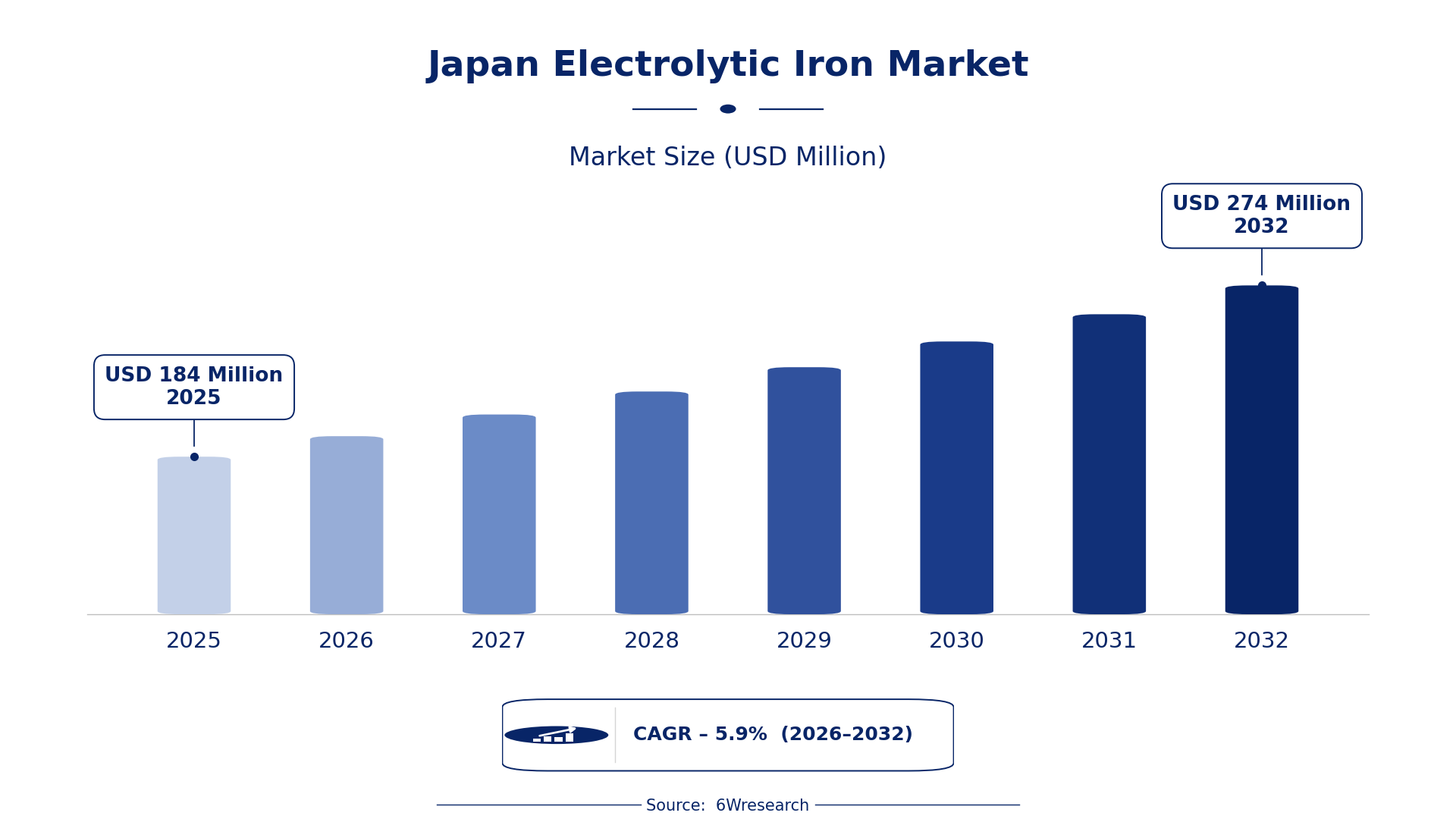
According to 6Wresearch internal database and industry insights, the Japan Electrolytic Iron Market was valued at USD 184 Million in 2025 and is projected to reach USD 274 Million by 2032, growing at a CAGR of approximately 5.9% during 2026–2032.
Japan Electrolytic Iron Market Highlights
| Report Metric | Details |
| Report Name | Japan Electrolytic Iron Market (2026-2032) |
| Market Size 2025 | USD 184 Million |
| Market Size 2032 | USD 274 Million |
| Absolute Growth 2025–2032 | USD 90 Million |
| CAGR 2026–2032 | 5.9% |
| Peak Annual Growth | 6.5% in 2032 |
| Forecast Period | 2026–2032 |
| Historical Data | 2022–2025 |
| Base Year | 2025 |
| Leading Type, 2025 | High Purity (56% share) |
| Leading Application, 2025 | Electronic Components (48% share) |
| Fastest-Growing Type | Low Purity (8.0% CAGR) |
| Fastest-Growing Application | Special Alloys (7.8% CAGR) |
| Growing Sector | Electronic Components |
| Key End Users | Manufacturers of electronic components, aerospace sector, research institutions |
Japan Electrolytic Iron Market Year-wise Growth Rate and Key Drivers (2022–2032)
This graph illustrates the annual growth rates of the market from 2022 to 2032, highlighting a steady upward trajectory and projected market expansion over the forecast period.
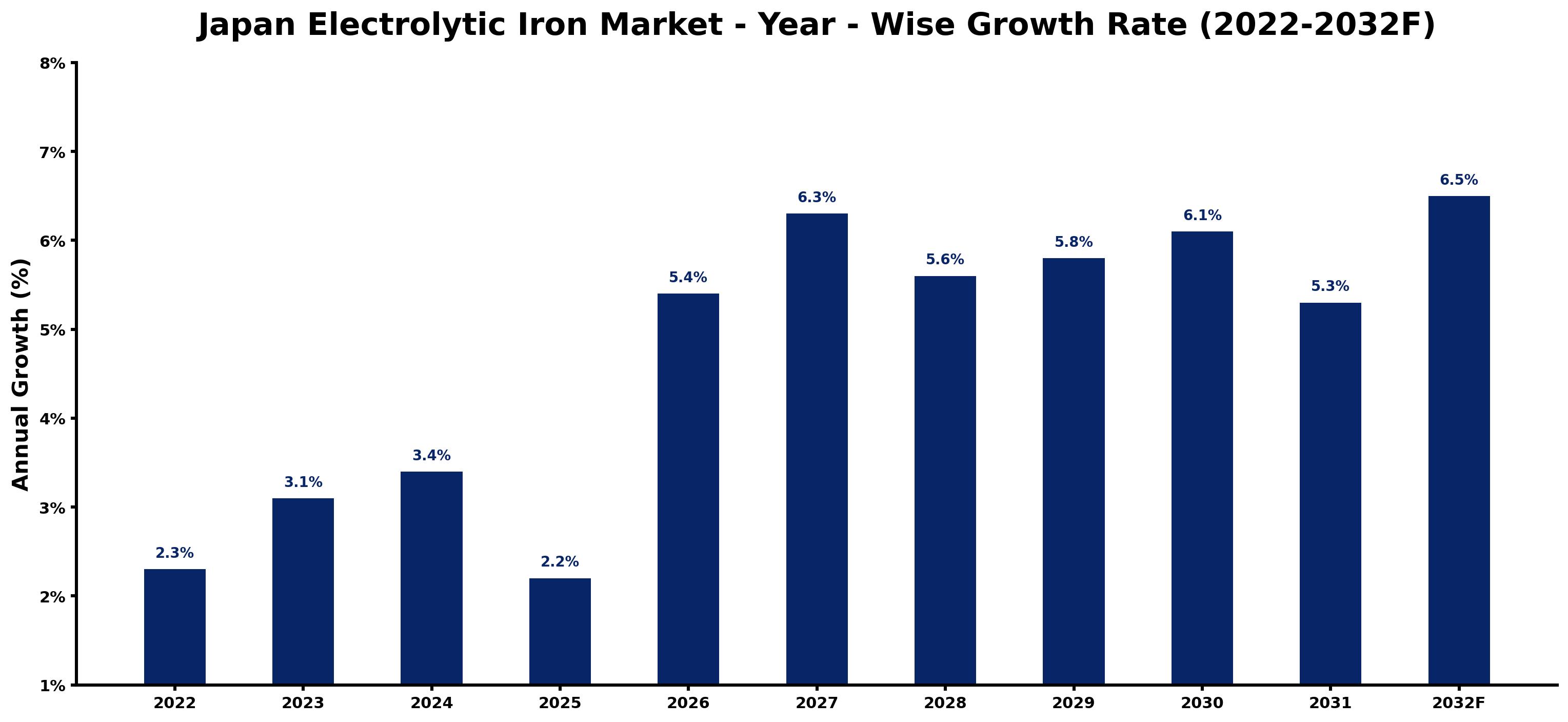
Annual growth estimates for each year appear below with the principal reason behind them, explaining the shifts that set the pace of the market.
| Year | Estimated Annual Growth (%) | Market Rationale |
| 2022 | 2.3 | The market showed stable growth, reflecting ongoing demand from electronic components manufacturers. |
| 2023 | 3.1 | Growth accelerated due to increased investments in high-tech manufacturing sectors. |
| 2024 | 3.4 | Demand continued to rise as production of electronic components expanded further. |
| 2025 | 2.2 | Growth slowed as market conditions stabilised after rapid previous increases. |
| 2026 | 5.4 | Investment in advanced materials technology is projected to boost demand. |
| 2027 | 6.3 | Demand is expected to rise as manufacturers adopt new production techniques. |
| 2028 | 5.6 | Growth is anticipated to normalise as the market adjusts to previous peaks. |
| 2029 | 5.8 | Investment in specialty alloys is likely to drive demand upwards again. |
| 2030 | 6.1 | Demand is projected to increase as new applications for electrolytic iron emerge. |
| 2031 | 5.3 | Growth is expected to slow as the market stabilises after several years of expansion. |
| 2032 | 6.5 | The peak growth year will see heightened demand for high-purity electrolytic iron. |
Note: Market size estimations and growth projections presented in this report are based on 6Wresearch's proprietary forecasting methodology, utilizing the latest available industry data, government publications, and primary research inputs.
Japan Electrolytic Iron Market Synopsis
Electrolytic iron is a high-purity iron product produced through an electrolytic process, primarily used in specialized alloys and electronic components. In Japan, 80% of electrolytic iron is utilized in electronic components manufacturing, driven by the country's advanced technology sector. The Japan Electrolytic Iron Market is growing due to increased domestic demand from manufacturers and investments in advanced material technologies, with government initiatives supporting production capabilities.
Market Dynamics Impact Analysis (2026–2032)
| Factor | Type | Impact | Primary Segment Affected |
| Increased investment in advanced materials technology | Driver | High | High Purity |
| Growing demand for high-performance electronic components | Driver | High | Electronic Components |
| Expansion of specialty alloys production | Opportunity | Medium | Special Alloys |
| Rising need for high-purity iron in aerospace applications | Opportunity | Medium | Special Alloys |
| Limited domestic production capacity for electrolytic iron | Restraint | High | High Purity |
| Dependence on specific applications for low purity electrolytic iron | Restraint | Medium | Low Purity |
| Challenges in meeting international quality standards | Challenge | High | High Purity |
| Competition from alternative materials in electronic components | Challenge | Medium | Electronic Components |
Evaluation of Drivers in Japan Electrolytic Iron Market (2026–2032)
Below are the drivers that matter most for revenue growth, with supporting evidence.
| Drivers | Primary Segment Affected | Why It Matters (Evidence) |
| Increased investment in advanced materials technology | High Purity | This investment is projected to enhance production capabilities, leading to a rise in demand for high-purity electrolytic iron. |
| Growing demand for high-performance electronic components | Electronic Components | As Japan's electronics sector expands, manufacturers are purchasing more electrolytic iron to meet their production needs. |
| Rising production of specialty alloys | Special Alloys | The aerospace sector's growth is driving demand for electrolytic iron in high-performance alloys, which are crucial for aerospace applications. |
| Technological advancements in manufacturing processes | High Purity | New techniques are improving efficiency and quality, encouraging manufacturers to purchase more electrolytic iron. |
| Increased research activities in material sciences | Research | Research institutions are utilizing electrolytic iron for advanced studies, further boosting its demand. |
In 2022, Japan produced 5,000 tons of electrolytic iron, primarily for electronic components manufacturing, which accounted for 80% of the usage. The Tokyo region is a major hub for this production, further driving demand. The aerospace sector's growth is increasing the need for specialty alloys, which rely heavily on electrolytic iron. Research institutions are utilising this material for advanced studies, further boosting demand.
Evaluation of Restraints in Japan Electrolytic Iron Market
Several factors work against faster growth; the main ones are summarised below.
| Market Restraint | Primary Segment Affected | Why It Matters (Evidence) |
| Limited domestic production capacity | High Purity | Japan's electrolytic iron output only met 80% of domestic demand in 2022, leading to reliance on imports. |
| Stringent compliance costs | Electronic Components | ISO 9001 standards increase operational expenses for manufacturers, limiting their ability to invest in technology upgrades. |
| Price competition from imports | Special Alloys | Local producers face pressure from foreign suppliers offering lower prices, which can erode profit margins. |
| Regulatory compliance changes | Research | Changes from the Ministry of Economy, Trade and Industry can introduce new costs, impacting pricing strategies. |
| Market saturation | Others | Niche applications for electrolytic iron have limited demand, restricting growth opportunities. |
Japan Electrolytic Iron Market Challenges
Producers of electronic components face rising costs due to Japan's electrolytic iron output only meeting 80% of their requirements in 2022, compelling them to import materials or maintain excessive stock. Stringent ISO 9001 compliance requirements hinder technology upgrades, resulting in increased operational expenses for manufacturers. Local producers encounter fierce competition from foreign suppliers who can offer lower prices, diminishing profit margins and risking market share erosion. Regulatory changes from the Ministry of Economy, Trade and Industry can introduce additional compliance costs, impacting pricing strategies for local buyers.
Trends in the Japan Electrolytic Iron Market
The trends below show where the Japan Electrolytic Iron Market is heading.
- Shift towards Advanced Material Technologies: In 2023, the government launched a program to promote advanced material technologies, aiming to improve production efficiency. This initiative is likely to increase the adoption of electrolytic iron in high-tech applications.
- Rising Demand for Specialty Alloys: The aerospace sector is increasingly utilising specialty alloys made from electrolytic iron, with over 60% of production relying on this material. This trend is expected to continue as aerospace applications expand.
- Growing Use in Research Applications: Research institutions in Japan are increasingly using electrolytic iron for advanced material studies. This trend is supported by ongoing research funding, which is projected to increase significantly.
- Expansion of Electronic Components Manufacturing: The Tokyo region remains a major hub for electronic component production, with 80% of electrolytic iron used in this sector. This concentration is driving demand as manufacturers ramp up production.
Investment Opportunities in the Japan Electrolytic Iron Market
The following areas offer the clearest openings for investors and suppliers in the Japan Electrolytic Iron Market.
- Partner with Local Manufacturers: Investing in partnerships with local manufacturers in the Tokyo region can facilitate market entry. With 80% of electrolytic iron used in electronic components, collaboration is essential.
- Timing for Investment in Specialty Alloys: Now is an opportune time to invest in specialty alloys production, as demand is rising. The aerospace sector is a key buyer group driving this trend.
- Supply High-Purity Electrolytic Iron: There is a strong need for high-purity electrolytic iron in Japan's electronics sector. Entering the market through local partnerships can facilitate access to this growing demand.
- Approval Pathways for Advanced Materials: Investing in advanced materials technology is essential, particularly with government support for related initiatives. Engaging with research institutions can provide valuable insights.
Government Initiatives in the Japan Electrolytic Iron Market
The Industrial Standardization Act, amended in 2019, governs product and test standards for electrolytic iron, ensuring quality and safety. The Semiconductor and Digital Industry Strategy, launched in June 2021, aims to secure domestic semiconductor manufacturing, which relies heavily on high-purity electrolytic iron.
The Ministry of Economy, Trade and Industry oversees funding for advanced materials development, supporting projects that improve production capabilities. The GX Basic Policy, adopted in 2023, aims for JPY 150 trillion of public-private investment in decarbonisation, impacting the electrolytic iron sector.
Future Insight of the Japan Electrolytic Iron Market
Advanced material technologies will reshape demand for electrolytic iron by 2032, driven by government initiatives promoting innovation. The introduction of new manufacturing processes will improve the efficiency of specialty alloy production, which currently relies on electrolytic iron for over 60% of its output. Research institutions will explore novel applications in aerospace, increasing the material's significance. The Kanagawa Prefecture will remain a hub for high-tech manufacturing, attracting investments that will strengthen the local market.
Market Segmentation Analysis
Japan Electrolytic Iron Market report covers a detailed analysis of the following market segments:
By Type – High Purity Leads, Low Purity Expected to Grow Fastest
According to Ravi Bhandari, Research Head at 6Wresearch, High Purity accounted for 56% of the market by type in 2025. The high purity segment holds the largest share as it is essential for high-performance applications, particularly in electronic components manufacturing, which utilises 80% of this product. Its established role in advanced technology sectors ensures a consistent demand and a robust installed base. Low Purity is projected to grow fastest, at a CAGR of 8.0% during 2026–2032. The low purity segment is experiencing rapid growth as manufacturers increasingly opt for cost-effective alternatives in less critical applications, reflecting a broader trend towards production efficiency. This shift is particularly evident in sectors where budget constraints are becoming more pronounced. Suppliers should consider expanding their low purity product lines to meet the rising demand in cost-sensitive applications.
By Application – Electronic Components Lead, Special Alloys Expected to Grow Fastest
Electronic Components held 48% of the Japan Electrolytic Iron Market by application in 2025. The electronic components segment leads the market due to its critical role in producing high-tech devices, supported by Japan's thriving electronics industry. The concentration of manufacturers in the Tokyo region further solidifies this segment's dominant position. Special Alloys are set to record the highest CAGR in this split, 7.8% over 2026–2032. The special alloys segment is witnessing swift growth driven by rising demand in aerospace applications, where high-performance materials are essential. This trend is further encouraged by government initiatives that promote advanced material technologies in Japan. Buyers should focus on sourcing electrolytic iron for special alloys to capitalise on the expanding aerospace market.
Key Attractiveness of the Report
- 10 Years of Market Numbers
- Historical Data Starting from 2022 to 2025
- Base Year 2025
- Forecast Data until 2032
- Key Performance Indicators Impacting the Market
- Major Upcoming Developments and Projects
Key Highlights of the Report:
- Japan Electrolytic Iron Market Outlook
- Market Size of Japan Electrolytic Iron Market, 2025
- Forecast of Japan Electrolytic Iron Market, 2032
- Historical Data and Forecast of Japan Electrolytic Iron Revenues & Volume for the Period 2022-2032
- Japan Electrolytic Iron Market Trend Evolution
- Japan Electrolytic Iron Market Drivers and Challenges
- Japan Electrolytic Iron Price Trends
- Japan Electrolytic Iron Porter's Five Forces
- Japan Electrolytic Iron Industry Life Cycle
- Historical Data and Forecast of Japan Electrolytic Iron Market Revenues & Volume By Type for the Period 2022-2032
- Historical Data and Forecast of Japan Electrolytic Iron Market Revenues & Volume By High Purity for the Period 2022-2032
- Historical Data and Forecast of Japan Electrolytic Iron Market Revenues & Volume By Low Purity for the Period 2022-2032
- Historical Data and Forecast of Japan Electrolytic Iron Market Revenues & Volume By Application for the Period 2022-2032
- Historical Data and Forecast of Japan Electrolytic Iron Market Revenues & Volume By Electronic Components for the Period 2022-2032
- Historical Data and Forecast of Japan Electrolytic Iron Market Revenues & Volume By Research for the Period 2022-2032
- Historical Data and Forecast of Japan Electrolytic Iron Market Revenues & Volume By Special Alloys for the Period 2022-2032
- Historical Data and Forecast of Japan Electrolytic Iron Market Revenues & Volume By Others for the Period 2022-2032
- Japan Electrolytic Iron Import Export Trade Statistics
- Market Opportunity Assessment By Type
- Market Opportunity Assessment By Application
- Japan Electrolytic Iron Top Companies Market Share
- Japan Electrolytic Iron Competitive Benchmarking By Technical and Operational Parameters
- Japan Electrolytic Iron Company Profiles
- Japan Electrolytic Iron Key Strategic Recommendations
Market Covered
Segments analysed in this report are listed below.
By Type
- High Purity
- Low Purity
By Application
- Electronic Components
- Research
- Special Alloys
- Others































