Japan Electronic-invoicing (e-invoicing) Market Size & Growth Rate
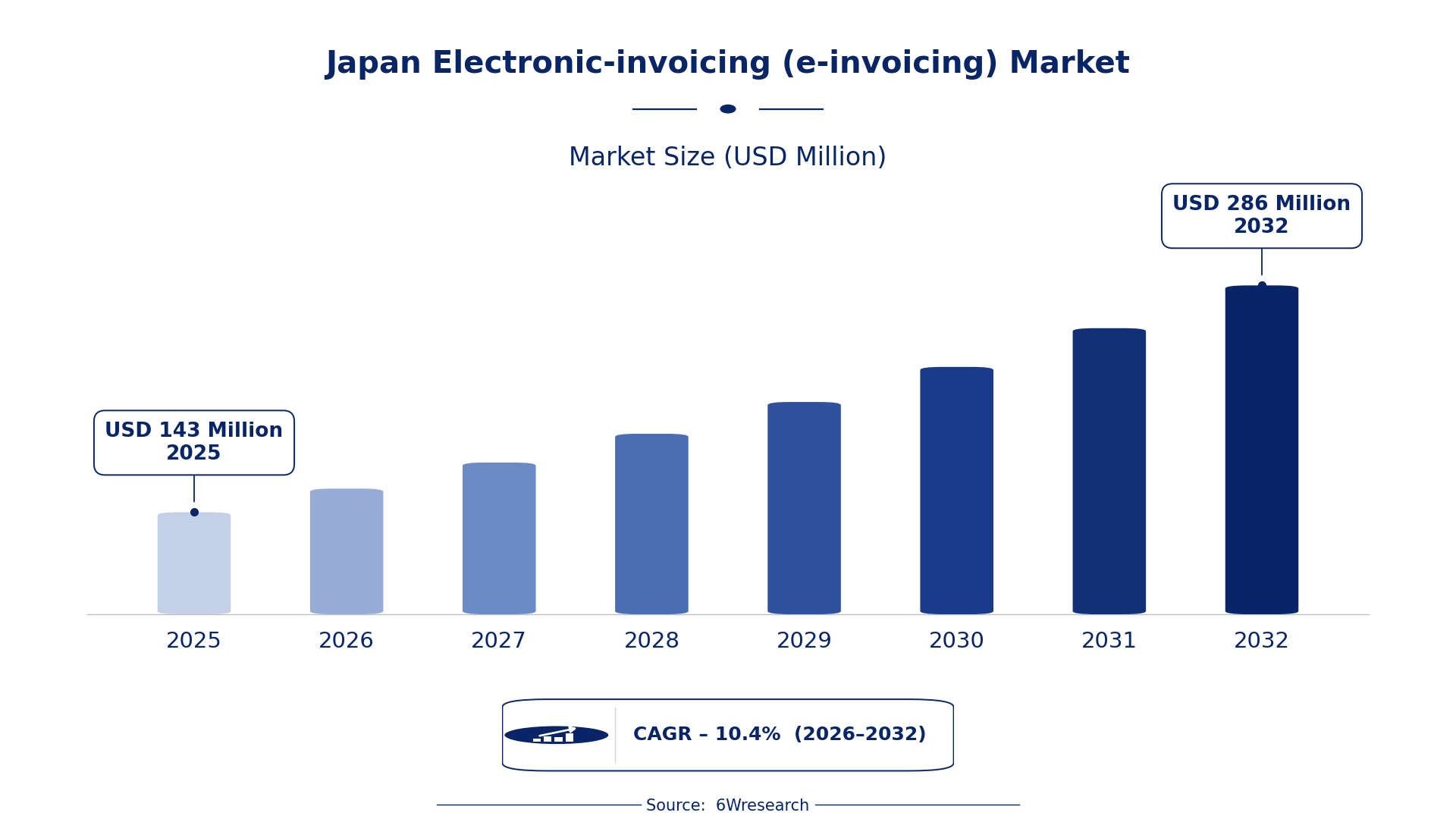
According to 6Wresearch internal database and industry insights, the Japan Electronic-invoicing (e-invoicing) Market was valued at USD 143 Million in 2025 and is projected to reach USD 286 Million by 2032, growing at a CAGR of approximately 10.4% during 2026–2032.
Japan Electronic-invoicing (e-invoicing) Market Highlights
| Report Metric | Details |
| Report Name | Japan Electronic-invoicing (e-invoicing) Market (2026-2032) |
| Market Size 2025 | USD 143 Million |
| Market Size 2032 | USD 286 Million |
| Absolute Growth 2025–2032 | USD 143 Million |
| CAGR 2026–2032 | 10.4% |
| Peak Annual Growth | 11.6% in 2028 |
| Forecast Period | 2026–2032 |
| Historical Data | 2022–2025 |
| Base Year | 2025 |
| Leading Type, 2025 | Cloud (57% share) |
| Leading End User, 2025 | Business-To-Business (46% share) |
| Leading Application, 2025 | E-Commerce (32% share) |
| Fastest-Growing End User | Business-To-Consumer (12.4% CAGR) |
| Fastest-Growing Application | Banking (14.3% CAGR) |
| Growing Sector | Business-To-Consumer |
| Key End Users | Business-To-Business, Business-To-Consumer |
Japan Electronic-invoicing (e-invoicing) Market Year-wise Growth Rate and Key Drivers (2022–2032)
This graph illustrates the annual growth rates of the market from 2022 to 2032, highlighting a steady upward trajectory and projected market expansion over the forecast period.
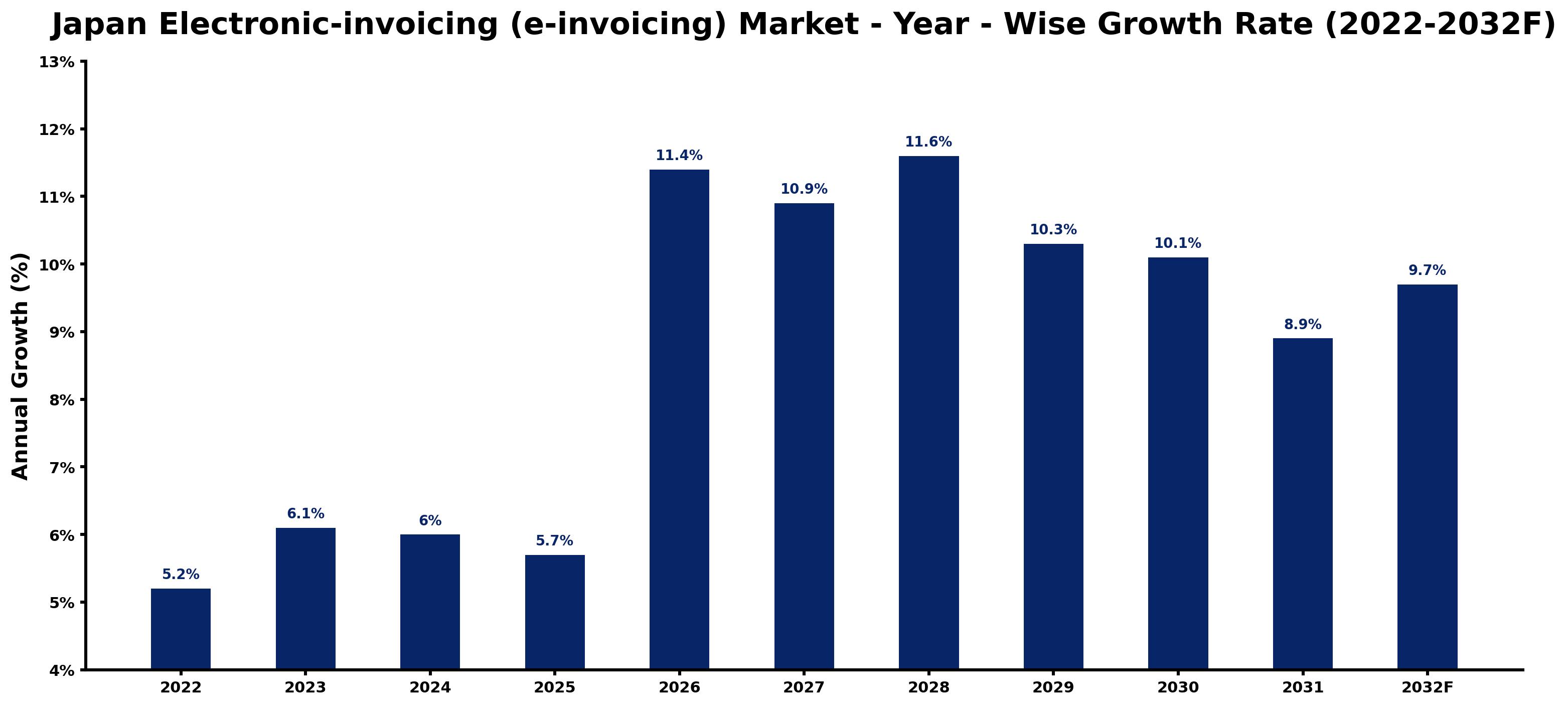
Year by year, the estimates below pair each growth rate with the development that shaped it.
| Year | Estimated Annual Growth (%) | Market Rationale |
| 2022 | 5.2 | The market exhibited steady growth as businesses began adopting digital invoicing solutions. |
| 2023 | 6.1 | Demand accelerated as large enterprises integrated e-invoicing into operations, exceeding 80% adoption. |
| 2024 | 6.0 | Growth slowed slightly as some businesses faced challenges in full implementation of e-invoicing. |
| 2025 | 5.7 | The market continued to expand, driven by ongoing initiatives promoting digital transformation. |
| 2026 | 11.4 | Growth is expected to surge as businesses increasingly recognise the efficiency benefits of e-invoicing solutions. |
| 2027 | 10.9 | Demand is projected to moderate as the market stabilises after rapid adoption phases. |
| 2028 | 11.6 | The market is expected to peak in growth as the government pushes for full adoption by 2025. |
| 2029 | 10.3 | Growth will slow as market saturation begins to affect new adoption rates. |
| 2030 | 10.1 | Demand will continue to moderate as businesses focus on optimising existing e-invoicing systems. |
| 2031 | 8.9 | The market is projected to experience a further slowdown as growth stabilises in a mature phase. |
| 2032 | 9.7 | Demand is expected to rise again as new technologies improve e-invoicing capabilities. |
Note: Market size estimations and growth projections presented in this report are based on 6Wresearch's proprietary forecasting methodology, utilizing the latest available industry data, government publications, and primary research inputs.
Japan Electronic-invoicing (e-invoicing) Market Synopsis
Electronic invoicing (e-invoicing) is a method for generating, sending, and receiving invoices electronically, streamlining billing processes and improving cash flow management. The Japan Electronic-invoicing (e-invoicing) Market is expanding, driven by over 80% adoption among large enterprises and government initiatives promoting digital transformation. The Digital Agency's goal of achieving 100% e-invoicing adoption by 2025 and the rapid integration of e-invoicing with ERP systems are key factors contributing to this growth. This shift is crucial for improving operational efficiency and compliance in various sectors.
Market Dynamics Impact Analysis (2026–2032)
| Factor | Type | Impact | Primary Segment Affected |
| High adoption rates among large enterprises | Driver | High | Business-To-Business |
| Government initiatives promoting digital transformation | Driver | High | E-Commerce |
| Increased demand for compliance with tax regulations | Opportunity | High | Cloud |
| Growing need for efficiency in billing processes | Opportunity | High | Banking |
| Challenges in integrating e-invoicing with existing systems | Restraint | Medium | On-Premise |
| Limited awareness among smaller businesses | Restraint | Medium | Business-To-Consumer |
| Competition from alternative invoicing solutions | Challenge | Medium | Others |
| Technological barriers in adoption for some sectors | Challenge | Medium | Energy And Utilities |
Evaluation of Drivers in Japan Electronic-invoicing (e-invoicing) Market (2026–2032)
The main growth drivers and the segments they affect most are set out below.
| Drivers | Primary Segment Affected | Why It Matters (Evidence) |
| High adoption rates among large enterprises | Business-To-Business | Over 80% of large enterprises have adopted e-invoicing, driving demand for inter-company transactions. |
| Government initiatives promoting digital transformation | E-Commerce | The government aims for 100% e-invoicing adoption by 2025, encouraging businesses to comply with standards. |
| Integration with ERP systems | Cloud | As e-invoicing integrates with ERP systems, businesses streamline operations, leading to increased purchases of solutions. |
| Need for compliance with tax regulations | Banking | Financial institutions require e-invoicing for transaction documentation, boosting demand for compliant solutions. |
| Rapid growth in the e-commerce sector | E-Commerce | The e-commerce sector is one of the fastest adopters, necessitating efficient invoicing for online transactions. |
Purchasing is picking up as businesses increasingly adopt electronic invoicing solutions, with over 80% of large enterprises implementing them. The e-commerce sector, a major adopter, is projected to see a rise in online transactions, necessitating efficient invoicing processes. Integration with ERP systems streamlines operations, leading to increased purchases.
Evaluation of Restraints in Japan Electronic-invoicing (e-invoicing) Market
The key brakes on demand, and where they bite hardest, are shown below.
| Market Restraint | Primary Segment Affected | Why It Matters (Evidence) |
| Complex compliance requirements | Business-To-Business | Navigating guidelines set by the Financial Services Agency can delay implementation for many companies. |
| Integration challenges with existing systems | E-Commerce | Buyers often struggle with integrating e-invoicing into current systems, risking cash flow disruptions. |
| Limited availability of skilled professionals | Cloud | Supply chain disruptions occur due to a shortage of skilled workers managing e-invoicing solutions. |
| Rapid technological evolution | Banking | Keeping up with standards like ISO 20022 is challenging, risking non-compliance and penalties. |
| Market saturation effects | Energy And Utilities | As the market matures, new adoption rates may decline, impacting growth opportunities. |
Japan Electronic-invoicing (e-invoicing) Market Challenges
Navigating e-invoicing regulations poses a major obstacle, as businesses must adhere to guidelines from the Financial Services Agency, which can delay implementation by up to six months for many firms. Buyers often struggle to integrate e-invoicing with legacy systems, leading to cash flow disruptions that can impact small enterprises, causing delays in payments of around ¥1 million monthly. Limited availability of skilled professionals to manage e-invoicing solutions results in project delays, increasing operational costs by 15% for companies. Rapid technological advancements pressure firms to adapt to standards like JIS X 0127, risking non-compliance and potential penalties for users.
Trends in the Japan Electronic-invoicing (e-invoicing) Market
The following changes are redrawing the Japan Electronic-invoicing (e-invoicing) Market.
- Shift from Paper to Digital Invoicing: Japan is transitioning from traditional paper invoicing to electronic methods, driven by efficiency demands. This change began in 2021 with the establishment of the Digital Agency, which promotes digital transformation across sectors.
- Increased Integration with ERP Systems: Since 2022, businesses have increasingly integrated e-invoicing with ERP systems, streamlining processes. This trend is particularly evident in Tokyo, where a high concentration of businesses supports this shift.
- E-Commerce Adoption Surge: The e-commerce sector has rapidly adopted e-invoicing since 2022, with a projected growth rate of 14.3%. This shift is essential for facilitating efficient online transactions and record-keeping.
- Focus on Compliance Standards: Since 2023, there has been a heightened focus on compliance with standards like ISO 20022. This trend is driven by financial institutions requiring adherence for transaction documentation.
Investment Opportunities in the Japan Electronic-invoicing (e-invoicing) Market
The openings below show where demand in the Japan Electronic-invoicing (e-invoicing) Market is visible and how suppliers can enter.
- E-Commerce Sector Demand: E-commerce businesses are increasingly seeking efficient invoicing solutions, with a growth rate of 14.3%. Investing in tailored e-invoicing systems for this sector in Tokyo can yield substantial returns.
- Government Support for Digital Transformation: With the government aiming for 100% e-invoicing adoption by 2025, there is a pressing need for solutions. Collaborating with local businesses in urban areas can facilitate market entry.
- Cloud Solutions for Flexibility: Cloud-based e-invoicing solutions are in demand due to their flexibility and scalability. Targeting large enterprises in Tokyo can provide lucrative opportunities for suppliers.
- Investment in Digital Infrastructure: The ¥10 billion allocated for digital infrastructure improvements highlights a gap in e-invoicing solutions. Suppliers can engage with government initiatives to enhance service offerings.
Government Initiatives in the Japan Electronic-invoicing (e-invoicing) Market
The Digital Agency's establishment in 2021 plays a crucial role in shaping the e-invoicing market for buyers in Japan. This agency is responsible for overseeing the implementation of digital initiatives, including the push for 100% e-invoicing adoption by 2025. Compliance with e-invoicing standards, such as JIS X 0127, is mandated, ensuring that businesses adhere to regulatory requirements. The agency's efforts are vital for facilitating a seamless transition to digital invoicing, improving operational efficiency and compliance across sectors.
In 2023, the government allocated ¥10 billion to improve digital infrastructure, including e-invoicing systems, managed by the Ministry of Economy, Trade and Industry (METI). This funding supports the development of technologies that facilitate e-invoicing adoption, benefiting businesses across various sectors. METI's initiatives aim to streamline invoicing processes and ensure compliance with tax regulations, ultimately driving the growth of the e-invoicing market in Japan.
Future Insight of the Japan Electronic-invoicing (e-invoicing) Market
The integration of advanced automation technologies will reshape e-invoicing demand by 2032, streamlining processes for users. The government's initiative for 100% e-invoicing adoption by 2025 will drive widespread digital transformation, providing benefits to both buyers and suppliers. With substantial investments in digital infrastructure, businesses will gain access to improved invoicing solutions. By 2025, the e-commerce sector is expected to lead in e-invoicing adoption, significantly improving operational efficiency across various industries.
Market Segmentation Analysis
Japan Electronic-invoicing (e-invoicing) Market report covers a detailed analysis of the following market segments:
By Type – Cloud Leads and Records the Fastest Growth
According to Vasudha, AM at 6Wresearch, Cloud accounted for 57% of the market by type in 2025. Cloud solutions dominate Japan's e-invoicing market because they offer flexibility and scalability, appealing to a broad spectrum of businesses. The widespread adoption among over 80% of large enterprises illustrates a strong preference for cloud-based systems. Cloud is also forecast to expand faster than any other category, at a CAGR of 11.8% over 2026–2032. The cloud segment will continue to grow rapidly as businesses pursue more efficient invoicing processes and align with government digital transformation goals. The government's target for 100% e-invoicing adoption by 2025 will further strengthen the cloud's market position. Suppliers should prioritise cloud solutions to cater to the increasing demand from businesses.
By End User – Business-To-Business Leads, Business-To-Consumer Expected to Grow Fastest
Business-To-Business took 46% of end user revenue in 2025, more than any other category. Business-To-Business transactions are the largest segment in the e-invoicing market, crucial for inter-company transactions and enhancing operational efficiency. The significant adoption rates among large enterprises in Japan highlight the critical role of this segment. Business-To-Consumer is projected to grow fastest, at a CAGR of 12.4% during 2026–2032. The Business-To-Consumer segment is growing quickly, driven by specific sectors adopting e-invoicing to streamline their billing processes. This trend suggests a potential expansion of direct consumer invoicing practices as digital transformation continues. Buyers in the B2C sector must prepare for enhanced e-invoicing capabilities to improve customer interactions.
By Application – E-Commerce Leads, Banking Expected to Grow Fastest
E-Commerce held 32% of the Japan Electronic-invoicing (e-invoicing) Market by application in 2025. E-Commerce is the leading application for e-invoicing, vital for online transactions and maintaining accurate records. The surge in online businesses in Japan has significantly bolstered this segment's prominence. Banking is set to record the highest CAGR in this split, 14.3% over 2026–2032. Banking is experiencing the fastest growth due to rising demands for transaction documentation and compliance audits. The financial sector's commitment to digital transformation will likely accelerate the adoption of e-invoicing solutions. Suppliers should focus on the banking sector to leverage its increasing need for efficient invoicing solutions.
Key Attractiveness of the Report
- 10 Years of Market Numbers
- Historical Data Starting from 2022 to 2025
- Base Year 2025
- Forecast Data until 2032
- Key Performance Indicators Impacting the Market
- Major Upcoming Developments and Projects
Key Highlights of the Report:
- Japan Electronic-invoicing (e-invoicing) Market Outlook
- Market Size of Japan Electronic-invoicing (e-invoicing) Market, 2025
- Forecast of Japan Electronic-invoicing (e-invoicing) Market, 2032
- Historical Data and Forecast of Japan Electronic-invoicing (e-invoicing) Revenues & Volume for the Period 2022-2032
- Japan Electronic-invoicing (e-invoicing) Market Trend Evolution
- Japan Electronic-invoicing (e-invoicing) Market Drivers and Challenges
- Japan Electronic-invoicing (e-invoicing) Price Trends
- Japan Electronic-invoicing (e-invoicing) Porter's Five Forces
- Japan Electronic-invoicing (e-invoicing) Industry Life Cycle
- Historical Data and Forecast of Japan Electronic-invoicing (e-invoicing) Market Revenues & Volume By Type for the Period 2022-2032
- Historical Data and Forecast of Japan Electronic-invoicing (e-invoicing) Market Revenues & Volume By Cloud for the Period 2022-2032
- Historical Data and Forecast of Japan Electronic-invoicing (e-invoicing) Market Revenues & Volume By On-Premise for the Period 2022-2032
- Historical Data and Forecast of Japan Electronic-invoicing (e-invoicing) Market Revenues & Volume By End User for the Period 2022-2032
- Historical Data and Forecast of Japan Electronic-invoicing (e-invoicing) Market Revenues & Volume By Business-To-Business for the Period 2022-2032
- Historical Data and Forecast of Japan Electronic-invoicing (e-invoicing) Market Revenues & Volume By Business-To-Consumer for the Period 2022-2032
- Historical Data and Forecast of Japan Electronic-invoicing (e-invoicing) Market Revenues & Volume By Others for the Period 2022-2032
- Historical Data and Forecast of Japan Electronic-invoicing (e-invoicing) Market Revenues & Volume By Application for the Period 2022-2032
- Historical Data and Forecast of Japan Electronic-invoicing (e-invoicing) Market Revenues & Volume By Energy And Utilities for the Period 2022-2032
- Historical Data and Forecast of Japan Electronic-invoicing (e-invoicing) Market Revenues & Volume By Fast-Moving Consumer Goods for the Period 2022-2032
- Historical Data and Forecast of Japan Electronic-invoicing (e-invoicing) Market Revenues & Volume By E-Commerce for the Period 2022-2032
- Historical Data and Forecast of Japan Electronic-invoicing (e-invoicing) Market Revenues & Volume By Banking for the Period 2022-2032
- Historical Data and Forecast of Japan Electronic-invoicing (e-invoicing) Market Revenues & Volume By Financal Services for the Period 2022-2032
- Historical Data and Forecast of Japan Electronic-invoicing (e-invoicing) Market Revenues & Volume By Insuarance for the Period 2022-2032
- Historical Data and Forecast of Japan Electronic-invoicing (e-invoicing) Market Revenues & Volume By Government for the Period 2022-2032
- Historical Data and Forecast of Japan Electronic-invoicing (e-invoicing) Market Revenues & Volume By Others for the Period 2022-2032
- Japan Electronic-invoicing (e-invoicing) Import Export Trade Statistics
- Market Opportunity Assessment By Type
- Market Opportunity Assessment By End User
- Market Opportunity Assessment By Application
- Japan Electronic-invoicing (e-invoicing) Top Companies Market Share
- Japan Electronic-invoicing (e-invoicing) Competitive Benchmarking By Technical and Operational Parameters
- Japan Electronic-invoicing (e-invoicing) Company Profiles
- Japan Electronic-invoicing (e-invoicing) Key Strategic Recommendations
Market Covered
The study includes the following segmentation.
By Type
- Cloud
- On-Premise
By End User
- Business-To-Business
- Business-To-Consumer
- Others
By Application
- Energy And Utilities
- Fast-Moving Consumer Goods
- E-Commerce
- Banking
- Financal Services
- Insuarance
- Government
- Others






































