Japan Electronic Wet Chemicals Market Size & Growth Rate
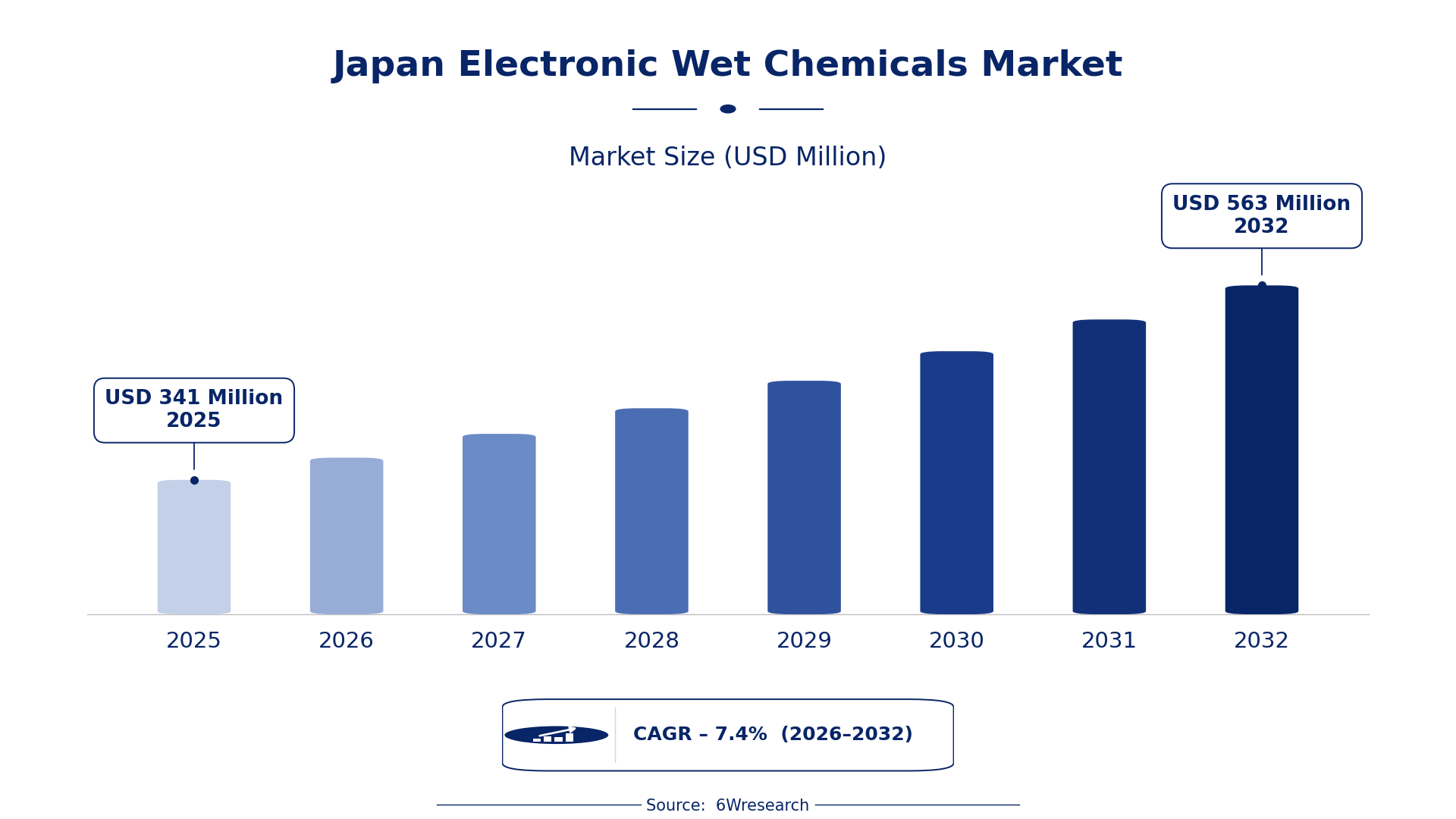
According to 6Wresearch internal database and industry insights, the Japan Electronic Wet Chemicals Market was valued at USD 341 Million in 2025 and is projected to reach USD 563 Million by 2032, growing at a CAGR of approximately 7.4% during 2026–2032.
Japan Electronic Wet Chemicals Market Highlights
| Report Metric | Details |
| Report Name | Japan Electronic Wet Chemicals Market (2026-2032) |
| Market Size 2025 | USD 341 Million |
| Market Size 2032 | USD 563 Million |
| Absolute Growth 2025–2032 | USD 222 Million |
| CAGR 2026–2032 | 7.4% |
| Peak Annual Growth | 8.9% in 2028 |
| Forecast Period | 2026–2032 |
| Historical Data | 2022–2025 |
| Base Year | 2025 |
| Leading Form, 2025 | Solid Liquid (60% share) |
| Leading Application, 2025 | Semiconductor (57% share) |
| Leading End Use Industry, 2025 | Consumer Goods (37% share) |
| Fastest-Growing Form | Gas (10.0% CAGR) |
| Fastest-Growing Application | IC Packaging (10.5% CAGR) |
| Fastest-Growing End Use Industry | Automotive (9.7% CAGR) |
| Growing Sector | IC Packaging |
| Key End Users | Semiconductor, IC Packaging, PCB |
Japan Electronic Wet Chemicals Market Year-wise Growth Rate and Key Drivers (2022–2032)
This graph illustrates the annual growth rates of the market from 2022 to 2032, highlighting a steady upward trajectory and projected market expansion over the forecast period.
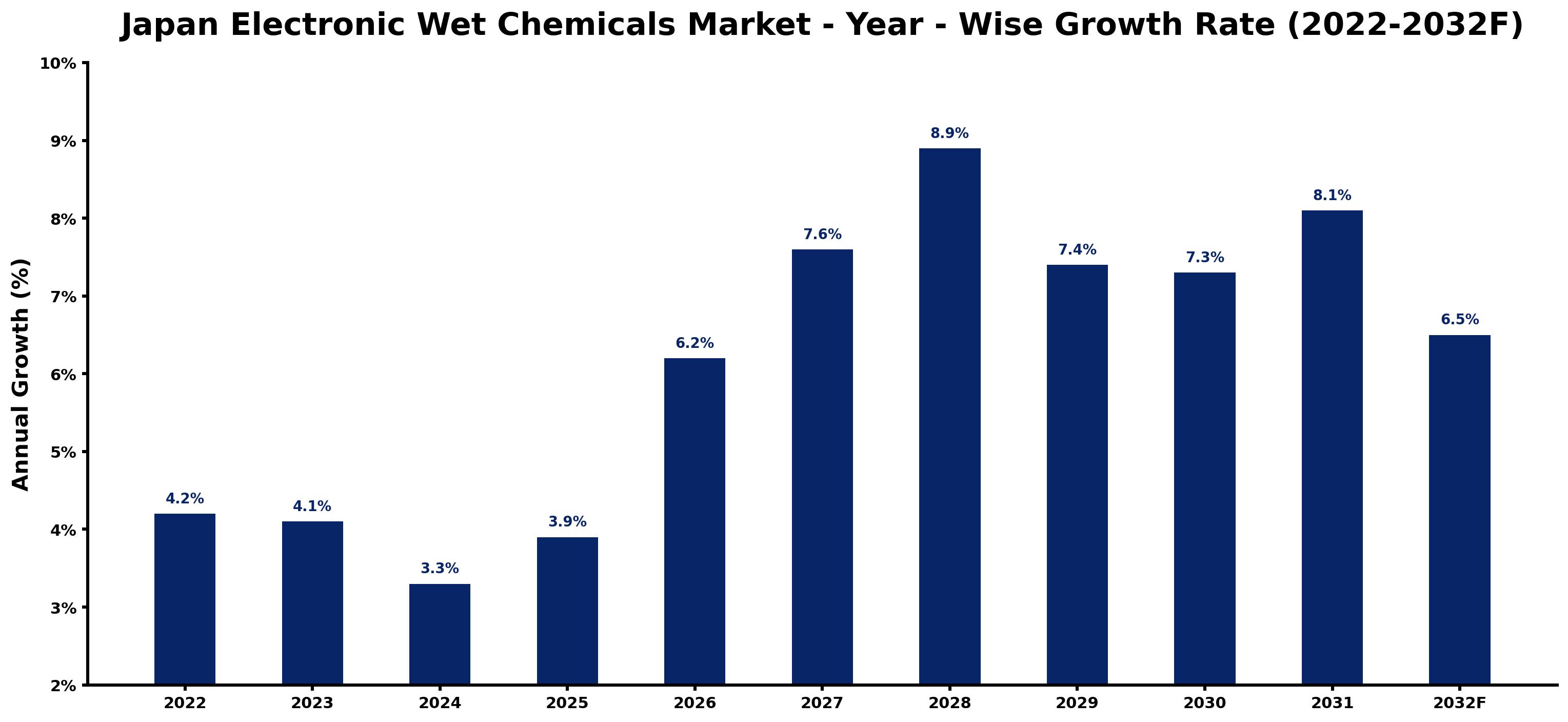
The following figures match every annual growth estimate with the main market development of that year, giving the reasoning behind each rise or slowdown.
| Year | Estimated Annual Growth (%) | Market Rationale |
| 2022 | 4.2 | The market demonstrated solid growth due to strong semiconductor demand from domestic manufacturers. |
| 2023 | 4.1 | Growth slowed slightly as manufacturers adjusted to supply chain challenges and market conditions. |
| 2024 | 3.3 | Continued supply chain issues led to further deceleration in growth, despite ongoing demand. |
| 2025 | 3.9 | Growth accelerated as investments in semiconductor technology began to yield results for manufacturers. |
| 2026 | 6.2 | Demand is expected to surge as new semiconductor fabrication plants come online, driving higher chemical usage. |
| 2027 | 7.6 | Increased production capacity and technological advancements will contribute to a rise in demand. |
| 2028 | 8.9 | Peak growth is projected as investments in semiconductor innovation reach fruition. |
| 2029 | 7.4 | Growth will slow as the market stabilises after the peak, but demand will remain strong. |
| 2030 | 7.3 | A slight slowdown in growth is expected as the market adjusts to new production levels. |
| 2031 | 8.1 | Demand will increase again as new technologies and applications emerge in the semiconductor sector. |
| 2032 | 6.5 | Growth will moderate as the market matures, but opportunities in automotive and consumer electronics will remain. |
Note: Market size estimations and growth projections presented in this report are based on 6Wresearch's proprietary forecasting methodology, utilizing the latest available industry data, government publications, and primary research inputs.
Japan Electronic Wet Chemicals Market Synopsis
Electronic Wet Chemicals are essential chemical solutions used in the manufacturing of electronic components, particularly in cleaning, etching, and developing processes for semiconductors and printed circuit boards. The Japan Electronic Wet Chemicals Market is experiencing growth driven by substantial investments in semiconductor manufacturing, with the market valued at approximately 4 trillion JPY in 2022. Key drivers include the ongoing expansion of semiconductor fabrication facilities in regions like Tokyo and Osaka, which are critical for domestic production, and the increasing demand for high purity standards in electronics.
Market Dynamics Impact Analysis (2026–2032)
| Factor | Type | Impact | Primary Segment Affected |
| Growing investments in semiconductor manufacturing | Driver | High | Semiconductor |
| Increasing demand for high-purity chemicals | Driver | High | IC Packaging |
| Expansion of semiconductor fabrication plants | Opportunity | High | Semiconductor |
| Rising demand for electronic components in automotive | Opportunity | Medium | Automotive |
| Supply chain disruptions affecting chemical availability | Restraint | High | PCB |
| Environmental regulations impacting production processes | Restraint | Medium | Consumer Goods |
| Competition from alternative materials | Challenge | High | Gas |
| Technological advancements requiring new formulations | Challenge | Medium | Solid Liquid |
Evaluation of Drivers in Japan Electronic Wet Chemicals Market (2026–2032)
The following drivers explain most of the expected growth.
| Drivers | Primary Segment Affected | Why It Matters (Evidence) |
| Investments in semiconductor technology | Semiconductor | Japan's semiconductor market was valued at approximately 4 trillion JPY in 2022, driving demand for electronic wet chemicals. |
| Increased production capacity in semiconductor fabrication plants | IC Packaging | The installed base of semiconductor fabrication plants in Japan exceeds 100, leading to higher chemical consumption. |
| Rising standards for electronic component purity | PCB | The adoption of the ISO 9001 standard ensures high purity in electronic wet chemicals, boosting demand. |
| Growth in the automotive sector's electronic systems | Automotive | The automotive industry is integrating electronic components, driving demand for related chemicals. |
| Technological advancements in semiconductor manufacturing | Gas | New processes in semiconductor production create demand for specialized gas chemicals. |
Much of the new demand traces back to the ongoing expansion of semiconductor fabrication facilities in Japan, which are essential for producing high-quality electronic components. In 2022, Japan's semiconductor market was valued at approximately 4 trillion JPY, prompting manufacturers to increase their usage of electronic wet chemicals. The adoption of the ISO 9001 standard ensures that these chemicals meet high purity requirements, further driving demand. The automotive sector is increasingly integrating electronic systems, which boosts the need for these specialized chemicals. As a result, suppliers are seeing a rise in orders for cleaning and etching solutions used in semiconductor manufacturing processes.
Evaluation of Restraints in Japan Electronic Wet Chemicals Market
These are the pressures that could keep growth below its potential.
| Market Restraint | Primary Segment Affected | Why It Matters (Evidence) |
| Supply chain disruptions due to reliance on imported raw materials | Semiconductor | Delays in production timelines can extend by up to three months, impacting overall output. |
| Cost pressures from Japan's decarbonisation targets | IC Packaging | Operational expenses for manufacturers could increase by approximately 15%, affecting pricing strategies. |
| Compliance with strict standards like ISO 9001 | PCB | This leads to slower innovation cycles that can extend project timelines by 20%. |
| Skills shortages in the semiconductor sector | Automotive | This could result in a 10% reduction in output capacity by 2032, affecting competitiveness. |
| Limited domestic production of raw materials | Gas | This creates dependency on imports, which can lead to price volatility and supply issues. |
Japan Electronic Wet Chemicals Market Challenges
Producers in the electronics sector face supply chain disruptions due to reliance on imported raw materials, causing production delays of up to three months. Cost pressures arise from Japan's ambitious decarbonisation targets, potentially increasing operational expenses for manufacturers by approximately 15%. Technology adoption struggles stem from strict compliance with standards like JIS Z 2801, resulting in slower innovation cycles that can extend project timelines by 20%. Skills shortages in the electronics workforce hinder development, which could lead to a 10% reduction in output capacity by 2032, impacting overall market competitiveness.
Trends in the Japan Electronic Wet Chemicals Market
The shifts below are changing how Japan Electronic Wet Chemicals Market products are bought and supplied.
- Shift in Semiconductor Manufacturing Techniques: The automotive sector has seen a marked shift towards electronic systems since 2023, increasing the demand for electronic wet chemicals. This trend is reflected in the growing integration of electronics in vehicle manufacturing, with a projected rise in electronic component usage.
- Increased Focus on High Purity Standards: The trend towards higher purity standards has gained momentum since 2022, impacting all sectors of electronics manufacturing. The implementation of the ISO 9001 standard is a key driver, ensuring quality in chemical solutions, with significant adoption rates across the industry.
- Expansion of Automotive Electronics: The automotive sector is increasingly integrating electronic systems, a trend that began in 2023. This shift has led to a notable rise in the demand for electronic wet chemicals, with a projected increase in their use in vehicle production.
- Growth in Recycling Initiatives: Japan is enhancing its recycling initiatives for electronic waste, a movement that started in 2023. This shift is expected to reshape chemical usage, promoting sustainability in the electronics sector, with a focus on eco-friendly practices.
Investment Opportunities in the Japan Electronic Wet Chemicals Market
Where to invest in the Japan Electronic Wet Chemicals Market: the main openings are set out below.
- Investment in Semiconductor Facilities: With Japan's semiconductor market valued at 4 trillion JPY, there is an urgent need for high-quality electronic wet chemicals. Suppliers can enter this market by partnering with local manufacturers in Tokyo and Osaka, which are key regions for semiconductor production.
- Expansion into Automotive Sector: As the automotive industry incorporates more electronic systems, there is a growing demand for specialised chemicals. Suppliers should focus on establishing joint ventures with automotive manufacturers to meet this need, particularly in regions with a high concentration of automotive production.
- Development of High-Purity Chemical Solutions: The increasing adoption of high purity standards presents an opportunity for suppliers to develop specialised products. Collaborating with certification bodies can assist in gaining market access, especially as demand for high-quality chemicals rises.
- Enhancing Recycling Capabilities: The push for improved recycling initiatives opens avenues for suppliers of eco-friendly electronic wet chemicals. Engaging with local recycling facilities can facilitate entry into this emerging market, aligning with Japan's sustainability goals.
Government Initiatives in the Japan Electronic Wet Chemicals Market
The Semiconductor and Digital Industry Strategy, initiated by METI in June 2021, aims to secure domestic semiconductor manufacturing. This strategy includes measures to promote investment and innovation in the semiconductor sector, which directly impacts the demand for electronic wet chemicals. The programme targets approximately JPY 150 trillion of public and private decarbonisation investment over 10 years, enhancing the overall semiconductor environment in Japan.
In 2023, Japan launched a 500 billion JPY programme to boost semiconductor innovation, administered by METI. This funding is directed towards advancing technology development and increasing the production capacity of semiconductor facilities, which will further drive the demand for electronic wet chemicals.
Future Insight of the Japan Electronic Wet Chemicals Market
Investment in decarbonisation initiatives will drive demand for electronic wet chemicals, creating opportunities for suppliers. The government's 150 trillion JPY programme will support technology development, pushing manufacturers towards higher purity standards. By 2032, the installed base of semiconductor fabrication plants is projected to support over 1 million jobs, creating a greater need for specialised chemical solutions. Recycling initiatives will reshape chemical usage, promoting sustainability and efficiency in the electronics sector.
Market Segmentation Analysis
Japan Electronic Wet Chemicals Market report covers a detailed analysis of the following market segments:
By Form – Solid Liquid Leads, Gas Expected to Grow Fastest
According to Ravi Bhandari, Research Head at 6Wresearch, Solid Liquid accounted for 60% of the market by form in 2025. The Solid Liquid segment holds the largest share due to its extensive use in cleaning and etching processes essential for semiconductor fabrication. This segment benefits from the installed base of over 100 semiconductor fabrication plants in Japan, which rely heavily on these solutions. Gas are projected to grow fastest, at a CAGR of 10.0% during 2026–2032. The Gas segment is experiencing rapid growth as it finds niche applications in specific processes, such as precision cleaning. This growth is supported by the increasing demand for high-purity chemicals in advanced manufacturing techniques. Suppliers should focus on developing tailored solutions for the growing Gas segment to capture emerging opportunities.
By Application – Semiconductor Leads, IC Packaging Expected to Grow Fastest
With 57% of application revenue in 2025, Semiconductor was the largest category. The Semiconductor application holds the largest share as it is crucial for device fabrication, which underpins the entire electronics sector. With over 100 semiconductor fabrication plants operating in Japan, this segment is vital for sustaining production capabilities. The quickest growth will come from IC Packaging, forecast to expand at a CAGR of 10.5% between 2026 and 2032. IC Packaging is witnessing the fastest growth due to the rising complexity of electronic devices that necessitate advanced packaging solutions. This expansion is fuelled by the increasing demand for high-performance electronics across various industries, ensuring continued market vitality. Suppliers must adapt their offerings to align with the rigorous standards required in the IC Packaging segment.
By End Use Industry – Consumer Goods Lead, Automotive Expected to Grow Fastest
In 2025, Consumer Goods led the end use industry split with a 37% share. The Consumer Goods sector is the predominant end-use industry as it incorporates electronic components into a wide range of products, ensuring consistent demand for electronic wet chemicals. The large population of approximately 125 million in Japan significantly drives the consumption of these goods. Automotive is set to record the highest CAGR in this split, 9.7% over 2026–2032. The Automotive sector is set for rapid growth as vehicles are progressively equipped with sophisticated electronic systems. This shift is influenced by the industry's move towards electrification and the adoption of smart technologies, indicating a notable change in market dynamics. Buyers in the Automotive sector should prioritise suppliers who can deliver customised chemical solutions tailored to their electronic system requirements.
Key Attractiveness of the Report
- 10 Years of Market Numbers
- Historical Data Starting from 2022 to 2025
- Base Year 2025
- Forecast Data until 2032
- Key Performance Indicators Impacting the Market
- Major Upcoming Developments and Projects
Key Highlights of the Report:
- Japan Electronic Wet Chemicals Market Outlook
- Market Size of Japan Electronic Wet Chemicals Market, 2025
- Forecast of Japan Electronic Wet Chemicals Market, 2032
- Historical Data and Forecast of Japan Electronic Wet Chemicals Revenues & Volume for the Period 2022-2032
- Japan Electronic Wet Chemicals Market Trend Evolution
- Japan Electronic Wet Chemicals Market Drivers and Challenges
- Japan Electronic Wet Chemicals Price Trends
- Japan Electronic Wet Chemicals Porter's Five Forces
- Japan Electronic Wet Chemicals Industry Life Cycle
- Historical Data and Forecast of Japan Electronic Wet Chemicals Market Revenues & Volume By Form for the Period 2022-2032
- Historical Data and Forecast of Japan Electronic Wet Chemicals Market Revenues & Volume By Solid Liquid for the Period 2022-2032
- Historical Data and Forecast of Japan Electronic Wet Chemicals Market Revenues & Volume By Gas for the Period 2022-2032
- Historical Data and Forecast of Japan Electronic Wet Chemicals Market Revenues & Volume By Application for the Period 2022-2032
- Historical Data and Forecast of Japan Electronic Wet Chemicals Market Revenues & Volume By Semiconductor for the Period 2022-2032
- Historical Data and Forecast of Japan Electronic Wet Chemicals Market Revenues & Volume By IC Packaging for the Period 2022-2032
- Historical Data and Forecast of Japan Electronic Wet Chemicals Market Revenues & Volume By PCB for the Period 2022-2032
- Historical Data and Forecast of Japan Electronic Wet Chemicals Market Revenues & Volume By End Use Industry for the Period 2022-2032
- Historical Data and Forecast of Japan Electronic Wet Chemicals Market Revenues & Volume By Consumer Goods for the Period 2022-2032
- Historical Data and Forecast of Japan Electronic Wet Chemicals Market Revenues & Volume By Automotive for the Period 2022-2032
- Historical Data and Forecast of Japan Electronic Wet Chemicals Market Revenues & Volume By Aerospace & Defence for the Period 2022-2032
- Historical Data and Forecast of Japan Electronic Wet Chemicals Market Revenues & Volume By Medical for the Period 2022-2032
- Japan Electronic Wet Chemicals Import Export Trade Statistics
- Market Opportunity Assessment By Form
- Market Opportunity Assessment By Application
- Market Opportunity Assessment By End Use Industry
- Japan Electronic Wet Chemicals Top Companies Market Share
- Japan Electronic Wet Chemicals Competitive Benchmarking By Technical and Operational Parameters
- Japan Electronic Wet Chemicals Company Profiles
- Japan Electronic Wet Chemicals Key Strategic Recommendations
Market Covered
Coverage by segment is as follows.
By Form
- Solid Liquid
- Gas
By Application
- Semiconductor
- IC Packaging
- PCB
By End Use Industry
- Consumer Goods
- Automotive
- Aerospace & Defence
- Medical































