Japan Electronics Housings Market Size & Growth Rate
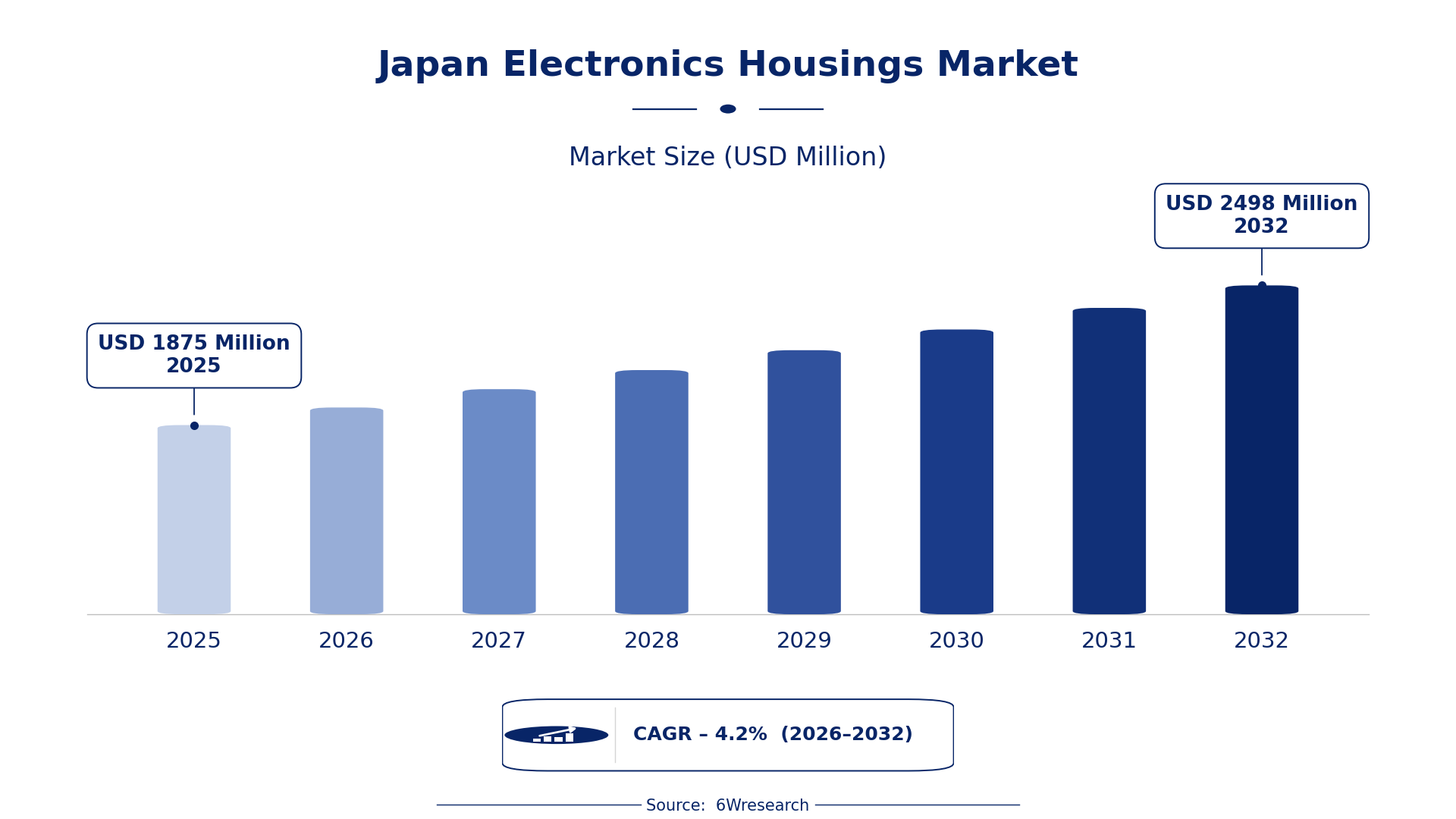
According to 6Wresearch internal database and industry insights, the Japan Electronics Housings Market was valued at USD 1,875 Million in 2025 and is projected to reach USD 2,498 Million by 2032, growing at a CAGR of approximately 4.2% during 2026–2032.
Japan Electronics Housings Market Highlights
| Report Metric | Details |
| Report Name | Japan Electronics Housings Market (2026-2032) |
| Market Size 2025 | USD 1,875 Million |
| Market Size 2032 | USD 2,498 Million |
| Absolute Growth 2025–2032 | USD 623 Million |
| CAGR 2026–2032 | 4.2% |
| Peak Annual Growth | 6.3% in 2026 |
| Forecast Period | 2026–2032 |
| Historical Data | 2022–2025 |
| Base Year | 2025 |
| Leading Housing Type, 2025 | Plastic Enclosure (32% share) |
| Leading Material Used, 2025 | ABS (46% share) |
| Leading Protection Level, 2025 | IP65 (42% share) |
| Leading End User, 2025 | Electronics OEM (39% share) |
| Fastest-Growing Housing Type | Metal Case (5.8% CAGR) |
| Fastest-Growing Material Used | Aluminum (5.6% CAGR) |
| Fastest-Growing Protection Level | EMI Shielded (5.2% CAGR) |
| Fastest-Growing End User | Telecom Firms (5.3% CAGR) |
| Growing Sector | Consumer Electronics |
| Key End Users | Electronics OEM, Telecom Firms, Industrial Control, Consumer Electronics |
Japan Electronics Housings Market Year-wise Growth Rate and Key Drivers (2022–2032)
This graph illustrates the annual growth rates of the market from 2022 to 2032, highlighting a steady upward trajectory and projected market expansion over the forecast period.
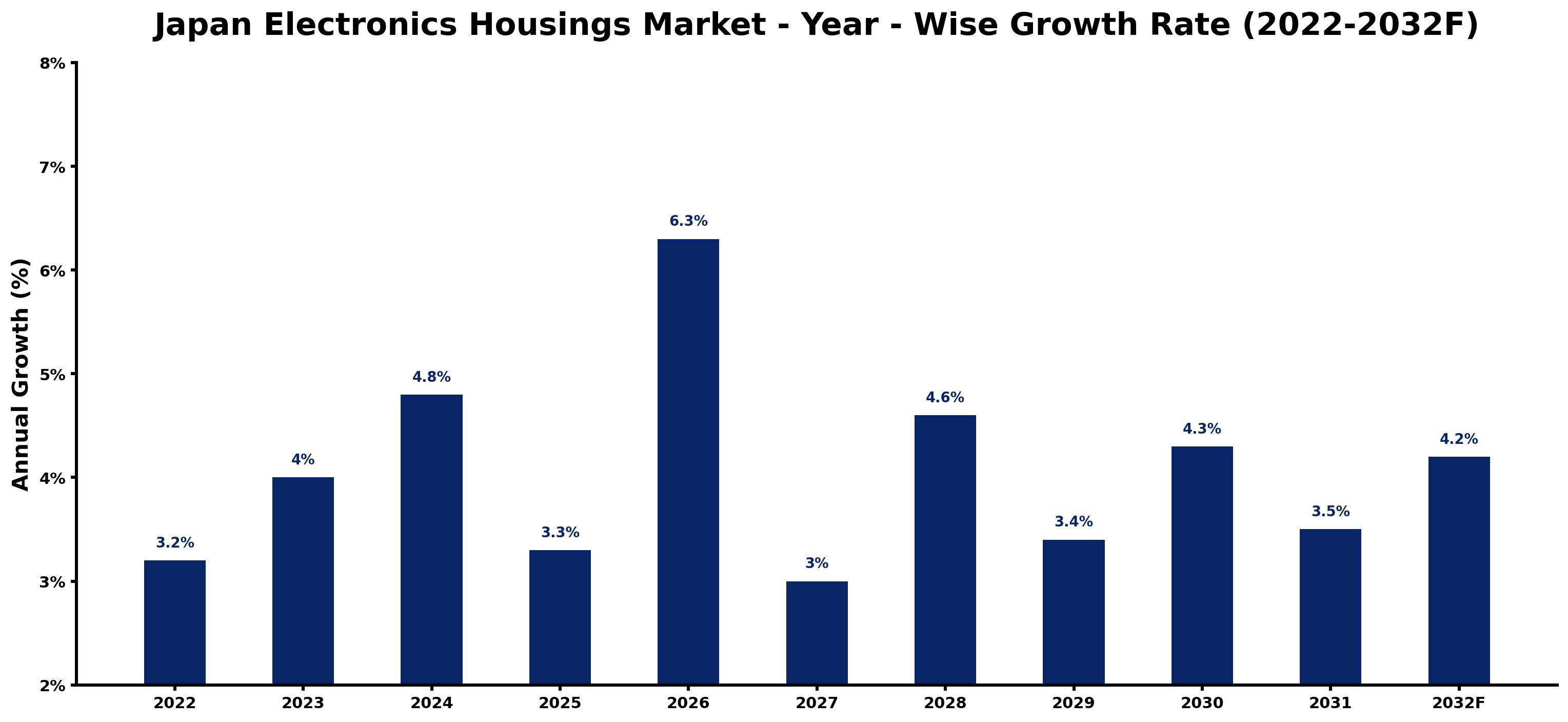
The table below sets out the estimated growth rate for each year and the main factor behind it.
| Year | Estimated Annual Growth (%) | Market Rationale |
| 2022 | 3.2 | The market experienced stable demand from the electronics manufacturing sector. |
| 2023 | 4.0 | Growth was supported by increased production in consumer electronics and telecommunications. |
| 2024 | 4.8 | Demand rose as manufacturers adopted advanced technologies in electronics housing. |
| 2025 | 3.3 | The growth rate slowed due to market saturation in certain segments. |
| 2026 | 6.3 | A surge in infrastructure investment is expected to boost demand for electronics housings. |
| 2027 | 3.0 | The market growth rate will slow as competition intensifies among manufacturers. |
| 2028 | 4.6 | Increased adoption of EMI Shielded housings will drive demand in sensitive applications. |
| 2029 | 3.4 | A slowdown will occur as the market adjusts to previous high growth rates. |
| 2030 | 4.3 | Demand will increase with new product launches in the consumer electronics sector. |
| 2031 | 3.5 | The growth rate will slow as the market stabilises after rapid expansion. |
| 2032 | 4.2 | The market is expected to grow steadily as new technologies emerge. |
Note: Market size estimations and growth projections presented in this report are based on 6Wresearch's proprietary forecasting methodology, utilizing the latest available industry data, government publications, and primary research inputs.
Japan Electronics Housings Market Synopsis
Electronics housings serve as protective enclosures for electronic devices, made primarily from plastic and metal. The Japan Electronics Housings Market is growing due to rising demand from consumer electronics and telecommunications sectors, alongside substantial investments in infrastructure. Annual demand for electronics housings is estimated at 200 million units, with a strong emphasis on IP65 rated housings, which are standard in many applications. This expansion is further propelled by advancements in manufacturing technologies and a skilled workforce in the electronics industry.
Market Dynamics Impact Analysis (2026–2032)
| Factor | Type | Impact | Primary Segment Affected |
| Rising production of consumer electronics | Driver | High | Plastic Enclosure |
| Increased investment in telecommunications infrastructure | Driver | High | Metal Case |
| Growing demand for EMI Shielded housings in sensitive applications | Opportunity | High | EMI Shielded |
| Expansion of the automotive electronics sector requiring hybrid housings | Opportunity | Medium | Hybrid Housing |
| Market saturation in certain segments leading to slower growth | Restraint | High | Plastic Enclosure |
| Competition among manufacturers affecting pricing strategies | Restraint | Medium | Metal Case |
| High production costs impacting profit margins for manufacturers | Challenge | High | Aluminum |
| Technological advancements requiring continuous investment | Challenge | Medium | Polycarbonate |
Evaluation of Drivers in Japan Electronics Housings Market (2026–2032)
The following drivers explain most of the expected growth.
| Drivers | Primary Segment Affected | Why It Matters (Evidence) |
| Increased production of electronic devices | Plastic Enclosure | Japan produced approximately 1.5 billion electronic devices in 2022, which increased demand for lightweight housings. |
| Investment in telecommunications infrastructure | Metal Case | Telecom firms in Japan invested over $5 billion in infrastructure in 2023, driving demand for durable housings. |
| Adoption of advanced manufacturing technologies | Hybrid Housing | The promotion of advanced manufacturing technologies is boosting the use of hybrid housings. |
| Growth of the consumer electronics market | Consumer Electronics | Consumer electronics accounted for 40% of the total electronics market in Japan, creating demand for various housings. |
| Focus on environmental standards | IP65 | IP65 rated housings are standard in many consumer electronics, ensuring protection against dust and water. |
Most of the extra volume comes from the production of approximately 1.5 billion electronic devices in 2022, which increased demand for lightweight plastic enclosures. The investment of over $5 billion in telecommunications infrastructure in 2023 has driven the need for durable metal cases. The promotion of advanced manufacturing technologies is encouraging the adoption of hybrid housings. The consumer electronics sector continues to spur demand for various housings, accounting for 40% of the total electronics market. The standardisation of IP65 rated housings in consumer electronics ensures that manufacturers purchase more to meet environmental protection requirements.
Evaluation of Restraints in Japan Electronics Housings Market
These restraints slow adoption and weigh on supplier margins.
| Market Restraint | Primary Segment Affected | Why It Matters (Evidence) |
| Market saturation in the plastic enclosure segment | Plastic Enclosure | With a 32% share in 2025, saturation limits growth opportunities for new entrants. |
| Intense competition affecting pricing strategies | Metal Case | The presence of multiple manufacturers drives down prices, impacting profit margins. |
| High production costs for aluminum housings | Aluminum | Rising raw material prices have increased production costs, limiting profitability. |
| Investment in new technology is essential for competitiveness | Polycarbonate | Manufacturers must invest in new technologies to remain competitive, straining budgets. |
| Regulatory compliance costs for housing standards | EMI Shielded | Compliance with JIS standards adds to operational costs for manufacturers. |
Japan Electronics Housings Market Challenges
Producers in Japan face a skills shortage, as the electronics industry employs over 800,000 people but struggles to attract new talent, delaying production timelines for manufacturers. Technology adoption is slow, with many firms relying on traditional methods, which raises costs for buyers seeking competitive pricing. Supply chain disruptions frequently affect materials like polycarbonate, causing delays in delivering the estimated 200 million annual units needed by end users. Compliance with the JIS standard can lead to increased costs and longer lead times for product launches, impacting producers' ability to meet market demand.
Trends in the Japan Electronics Housings Market
Below are the shifts with the largest effect on the Japan Electronics Housings Market.
- Shift towards EMI Shielded housings: The demand for EMI Shielded housings is increasing as electronic devices become more sensitive to interference. In 2022, the market for EMI Shielded housings grew by 5.2%, reflecting the need for protection in critical applications.
- Transition to advanced composites for housings: Manufacturers are increasingly using advanced composites for electronics housings, driven by the need for lightweight and durable solutions. The adoption of these materials is expected to rise as manufacturers seek to improve product performance.
- Emergence of hybrid housings in automotive applications: Hybrid housings are gaining traction in automotive electronics, with a notable increase in demand due to their versatility. This segment is projected to grow as automotive technology evolves, particularly in electric vehicles.
- Telecom firms prioritising durable housings: Telecom firms are focusing on durable housings to protect equipment from environmental factors. In 2023, investments in these housings are expected to rise as firms expand infrastructure.
Investment Opportunities in the Japan Electronics Housings Market
Below are the investment opportunities with the strongest case in the Japan Electronics Housings Market.
- Gap in lightweight housing solutions: With an annual demand of 200 million units, there is a notable gap for lightweight housing solutions. Electronics OEMs are seeking new materials to improve product performance, presenting an opportunity for new suppliers.
- Telecom firms needing durable housings: Telecom firms are increasingly requiring durable housings for their equipment, driven by infrastructure expansion. Suppliers can enter this market through partnerships with local manufacturers.
- Investment in advanced manufacturing technologies: Support for advanced manufacturing technologies creates opportunities for suppliers of new materials. Entering through joint ventures can facilitate access to this growing market.
- Focus on waterproof housing solutions: With waterproof housings critical for outdoor devices, there is a growing demand for these products. Suppliers can target the consumer electronics sector to meet this need effectively.
Government Initiatives in the Japan Electronics Housings Market
The Industrial Standardization Act (1949; amended and renamed the Act on Japanese Industrial Standards in 2019) governs product and test standards for electronics housings. Compliance with JIS standards ensures that manufacturers meet quality and safety requirements, building consumer confidence. The Building Energy Efficiency Act (2015, amended 2022) sets energy standards for new buildings, indirectly influencing the demand for energy-efficient electronics housings in construction applications.
Telecom firms benefit from the Semiconductor and Digital Industry Strategy (METI, June 2021), which secures domestic semiconductor manufacturing. This strategy supports the production of high-quality electronics housings, ensuring that firms can source reliable components. The Japan Electronics Packaging Association also plays a role in promoting industry standards, providing guidance to manufacturers on best practices and compliance.
Future Insight of the Japan Electronics Housings Market
By 2032, a shift towards advanced manufacturing technologies will transform Japan's electronics sector, driven by government initiatives that support innovation. Increased investment in infrastructure will stimulate demand for new housing designs, particularly as the adoption of hybrid housings in automotive electronics rises. The Tokyo Metropolitan Government's backing of automated processes will improve production efficiency, benefiting both buyers and suppliers. The annual production of electronic devices is projected to remain steady, with approximately 1.5 billion units produced, ensuring a consistent need for electronics housings.
Market Segmentation Analysis
Japan Electronics Housings Market report covers a detailed analysis of the following market segments:
By Housing Type – Plastic Enclosure Leads, Metal Case Expected to Grow Fastest
According to Saurav Kr Singh, Senior Research Analyst at 6Wresearch, the largest housing type category in 2025 was Plastic Enclosure, at 32% of revenue. Plastic enclosures dominate the market due to their lightweight and versatile characteristics, making them ideal for a wide range of electronic devices. Their extensive use in consumer electronics, which represents 40% of Japan's total electronics market, solidifies their leading position. Over 2026–2032, Metal Case is expected to post the fastest growth, at a CAGR of 5.8%. The metal case segment is witnessing rapid growth as industries increasingly require durable solutions for their applications. This trend is particularly evident in industrial control systems, where the demand for robust housings is on the rise. Suppliers should focus on enhancing their metal case offerings to cater to the growing industrial demand.
By Material Used – ABS Leads, Aluminum Expected to Grow Fastest
ABS accounted for 46% of the market by material used in 2025. ABS is the leading material for electronics housings, valued for its strength and affordability. Its broad applicability across various housing types ensures a consistent demand from manufacturers in the electronics sector. Aluminum is set to record the highest CAGR in this split, 5.6% over 2026–2032. Aluminum is experiencing the fastest growth due to its lightweight and strong properties, making it a preferred choice for numerous applications. The emphasis on efficiency in manufacturing processes is a critical factor contributing to this trend. Buyers may find advantages in exploring aluminium options to enhance product performance and maintain competitiveness.
By Protection Level – IP65 Leads, EMI Shielded Expected to Grow Fastest
With 42% of protection level revenue in 2025, IP65 was the largest category. IP65 rated housings lead the market as they provide vital protection against dust and water, essential for many electronic devices. Their standardisation across various sectors guarantees a stable demand for these housings. EMI Shielded is projected to grow fastest, at a CAGR of 5.2% during 2026–2032. The EMI shielded segment is growing quickly as more sensitive electronic devices require protection from electromagnetic interference. The increasing adoption of advanced electronic applications is driving this demand forward. Suppliers should consider expanding their portfolio to include EMI shielded housings to meet the rising needs of modern electronics.
By End User – Electronics OEM Leads, Telecom Firms Expected to Grow Fastest
Electronics OEM held 39% of the Japan Electronics Housings Market by end user in 2025. Electronics OEMs are the largest user group for electronics housings, requiring diverse solutions for their product lines. Their significant presence in the market ensures a steady demand for various types of housings. The quickest growth will come from Telecom Firms, forecast to expand at a CAGR of 5.3% between 2026 and 2032. Telecom firms are the fastest-growing segment as they invest substantially in robust housings for their equipment. The notable $5 billion investment in infrastructure by telecom firms in 2023 highlights this increasing trend. Suppliers should target telecom firms to align with their growing requirements for durable housing solutions.
Key Attractiveness of the Report
- 10 Years of Market Numbers
- Historical Data Starting from 2022 to 2025
- Base Year 2025
- Forecast Data until 2032
- Key Performance Indicators Impacting the Market
- Major Upcoming Developments and Projects
Key Highlights of the Report:
- Japan Electronics Housings Market Outlook
- Market Size of Japan Electronics Housings Market, 2025
- Forecast of Japan Electronics Housings Market, 2032
- Historical Data and Forecast of Japan Electronics Housings Revenues & Volume for the Period 2022-2032F
- Japan Electronics Housings Market Trend Evolution
- Japan Electronics Housings Market Drivers and Challenges
- Japan Electronics Housings Price Trends
- Japan Electronics Housings Porter's Five Forces
- Japan Electronics Housings Industry Life Cycle
- Historical Data and Forecast of Japan Electronics Housings Market Revenues & Volume By Housing Type for the Period 2022-2032F
- Historical Data and Forecast of Japan Electronics Housings Market Revenues & Volume By Plastic Enclosure for the Period 2022-2032F
- Historical Data and Forecast of Japan Electronics Housings Market Revenues & Volume By Metal Case for the Period 2022-2032F
- Historical Data and Forecast of Japan Electronics Housings Market Revenues & Volume By Hybrid Housing for the Period 2022-2032F
- Historical Data and Forecast of Japan Electronics Housings Market Revenues & Volume By Transparent Cover for the Period 2022-2032F
- Historical Data and Forecast of Japan Electronics Housings Market Revenues & Volume By Material Used for the Period 2022-2032F
- Historical Data and Forecast of Japan Electronics Housings Market Revenues & Volume By ABS for the Period 2022-2032F
- Historical Data and Forecast of Japan Electronics Housings Market Revenues & Volume By Aluminum for the Period 2022-2032F
- Historical Data and Forecast of Japan Electronics Housings Market Revenues & Volume By PC + Steel for the Period 2022-2032F
- Historical Data and Forecast of Japan Electronics Housings Market Revenues & Volume By Polycarbonate for the Period 2022-2032F
- Historical Data and Forecast of Japan Electronics Housings Market Revenues & Volume By Protection Level for the Period 2022-2032F
- Historical Data and Forecast of Japan Electronics Housings Market Revenues & Volume By IP65 for the Period 2022-2032F
- Historical Data and Forecast of Japan Electronics Housings Market Revenues & Volume By EMI Shielded for the Period 2022-2032F
- Historical Data and Forecast of Japan Electronics Housings Market Revenues & Volume By Waterproof for the Period 2022-2032F
- Historical Data and Forecast of Japan Electronics Housings Market Revenues & Volume By Dustproof for the Period 2022-2032F
- Historical Data and Forecast of Japan Electronics Housings Market Revenues & Volume By End User for the Period 2022-2032F
- Historical Data and Forecast of Japan Electronics Housings Market Revenues & Volume By Electronics OEM for the Period 2022-2032F
- Historical Data and Forecast of Japan Electronics Housings Market Revenues & Volume By Telecom Firms for the Period 2022-2032F
- Historical Data and Forecast of Japan Electronics Housings Market Revenues & Volume By Industrial Control for the Period 2022-2032F
- Historical Data and Forecast of Japan Electronics Housings Market Revenues & Volume By Consumer Electronics for the Period 2022-2032F
- Japan Electronics Housings Import Export Trade Statistics
- Market Opportunity Assessment By Housing Type
- Market Opportunity Assessment By Material Used
- Market Opportunity Assessment By Protection Level
- Market Opportunity Assessment By End User
- Japan Electronics Housings Top Companies Market Share
- Japan Electronics Housings Competitive Benchmarking By Technical and Operational Parameters
- Japan Electronics Housings Company Profiles
- Japan Electronics Housings Key Strategic Recommendations
Market Covered
The following segment groups are covered in the report.
By Housing Type
- Plastic Enclosure
- Metal Case
- Hybrid Housing
- Transparent Cover
By Material Used
- ABS
- Aluminum
- PC + Steel
- Polycarbonate
By Protection Level
- IP65
- EMI Shielded
- Waterproof
- Dustproof
By End User
- Electronics OEM
- Telecom Firms
- Industrial Control
- Consumer Electronics































