Japan Embedded Audio Processing Market Size & Growth Rate
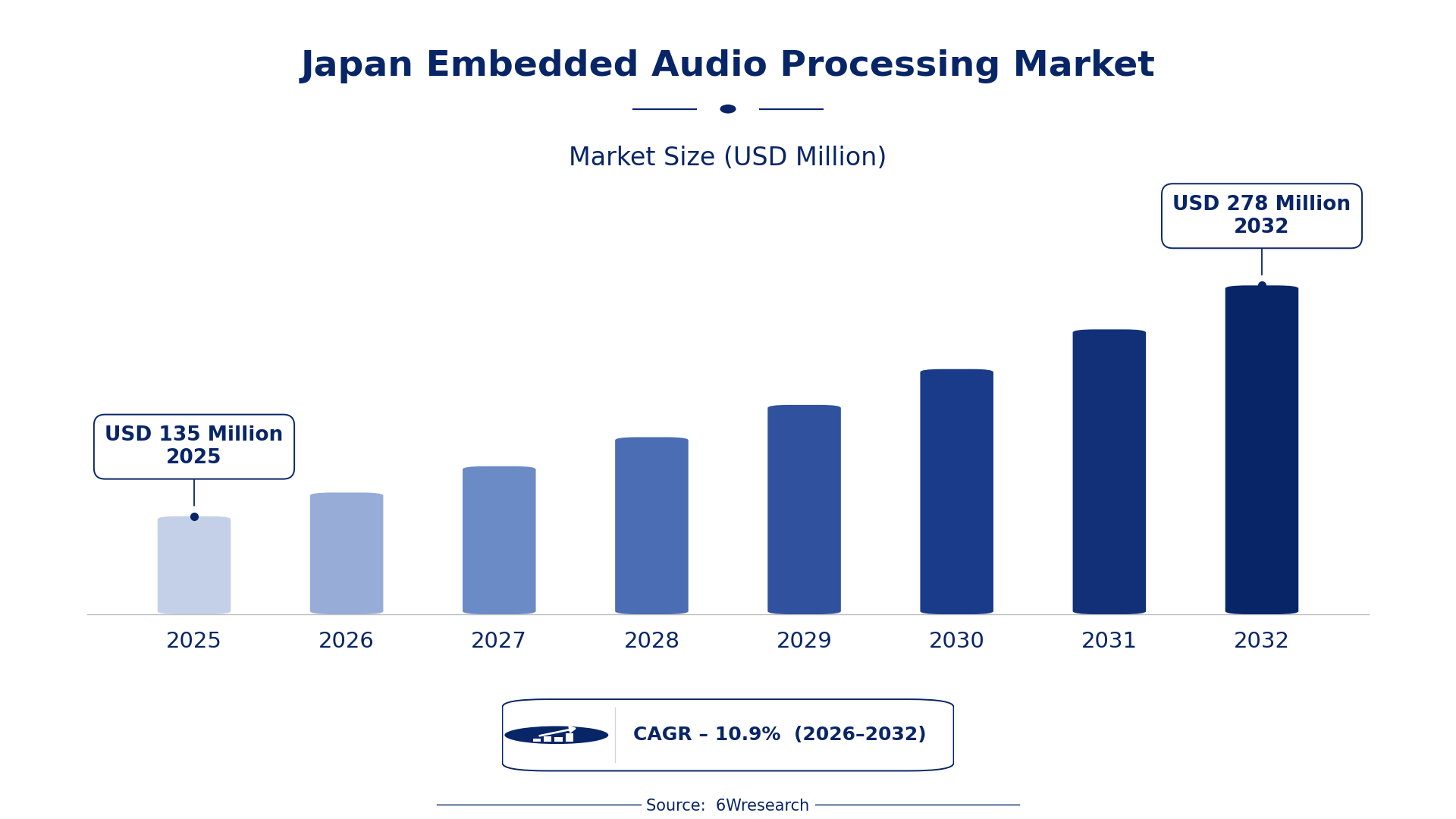
According to 6Wresearch internal database and industry insights, the Japan Embedded Audio Processing Market was valued at USD 135 Million in 2025 and is projected to reach USD 278 Million by 2032, growing at a CAGR of approximately 10.9% during 2026–2032.
Japan Embedded Audio Processing Market Highlights
| Report Metric | Details |
| Report Name | Japan Embedded Audio Processing Market (2026-2032) |
| Market Size 2025 | USD 135 Million |
| Market Size 2032 | USD 278 Million |
| Absolute Growth 2025–2032 | USD 143 Million |
| CAGR 2026–2032 | 10.9% |
| Peak Annual Growth | 11.6% in 2027 |
| Forecast Period | 2026–2032 |
| Historical Data | 2022–2025 |
| Base Year | 2025 |
| Leading Audio Function, 2025 | Echo Cancellation (38% share) |
| Leading Processor Type, 2025 | DSP Core (47% share) |
| Leading Application Area, 2025 | Smart Speakers (37% share) |
| Leading End User, 2025 | IoT Device Makers (46% share) |
| Fastest-Growing Audio Function | Noise Reduction (14.1% CAGR) |
| Fastest-Growing Processor Type | ARM Cortex-M (15.2% CAGR) |
| Fastest-Growing Application Area | Automotive Audio (13.8% CAGR) |
| Fastest-Growing End User | Car OEMs (14.2% CAGR) |
| Growing Sector | Consumer Electronics |
| Key End Users | IoT Device Makers, Automotive Manufacturers, Electronics Firms, Audio Device Brands |
Japan Embedded Audio Processing Market Year-wise Growth Rate and Key Drivers (2022–2032)
This graph illustrates the annual growth rates of the market from 2022 to 2032, highlighting a steady upward trajectory and projected market expansion over the forecast period.
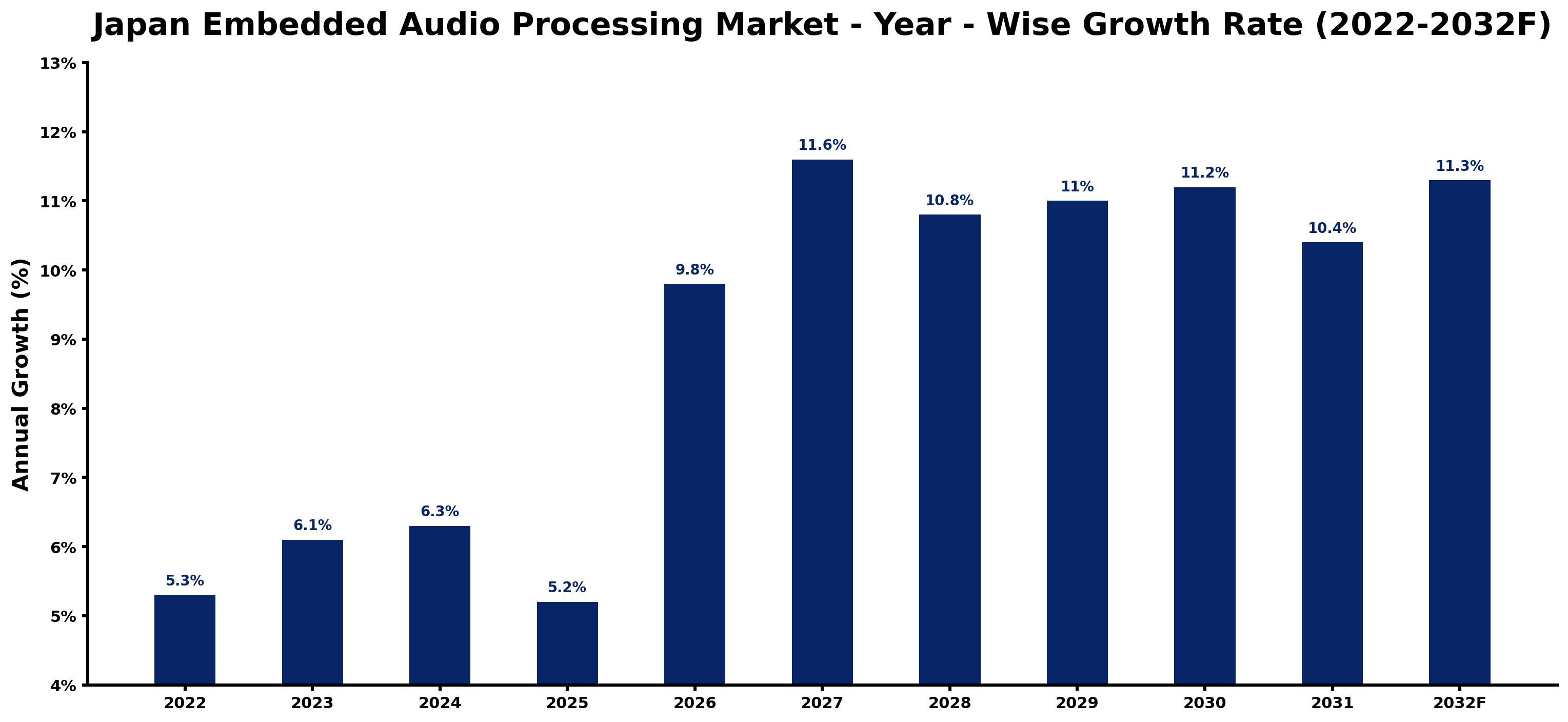
Each row of the following table gives one year's estimated growth and the event or demand shift that explains it.
| Year | Estimated Annual Growth (%) | Market Rationale |
| 2022 | 5.3 | The market experienced steady growth due to strong consumer electronics demand. |
| 2023 | 6.1 | Increased adoption of smart devices contributed to faster growth compared to the previous year. |
| 2024 | 6.3 | The rise in automotive audio applications further accelerated market expansion. |
| 2025 | 5.2 | Growth slowed as the market adjusted to previous high rates of expansion. |
| 2026 | 9.8 | The introduction of new technologies is expected to spur a resurgence in demand. |
| 2027 | 11.6 | Peak growth will be driven by a surge in smart speaker adoption and automotive audio improvements. |
| 2028 | 10.8 | Growth is projected to moderate as the market stabilises after rapid expansion in previous years. |
| 2029 | 11.0 | Demand will accelerate again, driven by advancements in voice recognition technology. |
| 2030 | 11.2 | Continued growth is expected to be supported by increasing smartphone penetration and IoT applications. |
| 2031 | 10.4 | A slight slowdown will occur as the market begins to mature, yet growth will remain strong. |
| 2032 | 11.3 | Demand will surge again, driven by innovations in automotive audio systems and smart devices. |
Note: Market size estimations and growth projections presented in this report are based on 6Wresearch's proprietary forecasting methodology, utilizing the latest available industry data, government publications, and primary research inputs.
Japan Embedded Audio Processing Market Synopsis
Embedded audio processing technology encompasses systems that facilitate efficient audio signal processing in devices through specialised chips and algorithms. In Japan, the smart speaker market was valued at 1.2 million units in 2022, demonstrating strong consumer interest. The Japan Embedded Audio Processing Market is expanding due to increasing demand from IoT device manufacturers and automotive audio applications, supported by substantial investments in technology and innovation.
Market Dynamics Impact Analysis (2026–2032)
| Factor | Type | Impact | Primary Segment Affected |
| Increasing adoption of smart speakers drives demand for embedded audio processing technology. | Driver | High | Smart Speakers |
| The automotive audio market's projected growth fuels demand for advanced audio processing solutions. | Driver | High | Automotive Audio |
| The demand for noise reduction technology presents opportunities for innovation in automotive systems. | Opportunity | High | Noise Reduction |
| The rise of IoT applications creates a growing need for embedded audio processing solutions. | Opportunity | High | Voice Recognition |
| High competition in the consumer electronics sector may limit profit margins for producers. | Restraint | Medium | Audio Playback |
| Rapid technological changes can lead to obsolescence of existing products. | Restraint | Medium | DSP Core |
| Supply chain disruptions can delay product availability for manufacturers. | Challenge | High | IoT Device Makers |
| The need for continuous R&D investment can strain financial resources for smaller firms. | Challenge | High | Electronics Firms |
Evaluation of Drivers in Japan Embedded Audio Processing Market (2026–2032)
The following drivers explain most of the expected growth.
| Drivers | Primary Segment Affected | Why It Matters (Evidence) |
| Rising smart speaker adoption | Smart Speakers | The smart speaker market was valued at 1.2 million units in 2022, driving demand for advanced audio processing. |
| Growth in automotive audio applications | Automotive Audio | The automotive audio market is projected to reach 3.5 billion USD by 2025, increasing the need for embedded audio solutions. |
| Increased demand for voice recognition | Voice Recognition | The demand for voice recognition technology in smart devices has increased by 30% over the last two years. |
| Expansion of IoT applications | IoT Device Makers | With over 100 million smartphones in use, the demand for embedded audio processing in IoT devices is surging. |
| Technological advancements in audio processing | DSP Core | DSP cores are essential in over 60% of audio processing applications, driving innovation in the sector. |
The primary driver of demand is the growing adoption of smart speakers, with the market valued at 1.2 million units in 2022. The automotive audio sector is also experiencing notable growth, projected to reach 3.5 billion USD by 2025. The demand for voice recognition technology has surged by 30% in the past two years, further propelling market expansion. Additionally, the presence of over 100 million smartphones in Japan increases the need for embedded audio processing in IoT devices. Technological advancements ensure that DSP cores remain crucial in over 60% of audio processing applications, driving demand and innovation.
Evaluation of Restraints in Japan Embedded Audio Processing Market
The following restraints limit how fast demand can grow.
| Market Restraint | Primary Segment Affected | Why It Matters (Evidence) |
| High competition in the consumer electronics sector | Audio Playback | Intense competition may limit profit margins, impacting manufacturers' ability to invest in new technologies. |
| Rapid technological changes | DSP Core | Frequent advancements can render existing products obsolete, affecting sales and market share for producers. |
| Supply chain disruptions | IoT Device Makers | Delays in component availability can hinder production schedules, affecting product launches and revenue. |
| Need for continuous R&D investment | Electronics Firms | Smaller firms may struggle to allocate sufficient resources for R&D, limiting their competitiveness. |
| Market saturation in consumer electronics | Smart Speakers | As the market matures, growth rates may decline, affecting long-term profitability for producers. |
Japan Embedded Audio Processing Market Challenges
High costs for embedded audio processing arise from the reliance on advanced DSP cores, which are essential in over 60% of applications. This dependence increases production expenses for producers, leading to higher prices for buyers. Regulatory standards like the JIS X 8341 impose additional compliance costs on manufacturers, resulting in delays for product launches.
Trends in the Japan Embedded Audio Processing Market
Several trends are reshaping the Japan Embedded Audio Processing Market; the most important are set out below.
- Shift towards Smart Speakers: Smart speakers are increasingly favoured by consumers for home automation, with the Tokyo region at the forefront of this trend. In 2023, Japan's smart speaker market is anticipated to reach 1.2 million units, reflecting strong consumer interest.
- Transition to Automotive Audio Enhancements: The automotive audio market is transforming with an emphasis on enhancing in-car entertainment systems. By 2025, this market is expected to reach 3.5 billion USD, indicating substantial investments in audio technology.
- Emergence of Voice Recognition Technology: Voice recognition technology has become crucial for user interaction in smart devices. Demand has surged by 30% in the last two years, underscoring the shift towards hands-free operation.
- Growing Importance of Noise Reduction: Noise reduction technology is increasingly important, particularly in Japan's automotive sector for electric vehicles. This trend is driven by consumer demand for quieter driving experiences.
Investment Opportunities in the Japan Embedded Audio Processing Market
The opportunities below stand out in the Japan Embedded Audio Processing Market for new entrants and existing suppliers.
- Partnering with IoT Device Makers: Now is an opportune moment to pursue partnerships with IoT device manufacturers, as demand for embedded audio processing solutions is rising. The Japanese government initiated a programme in 2023 to support IoT device innovation.
- Investing in Automotive Audio Solutions: With the automotive audio market projected to reach 3.5 billion USD by 2025, suppliers should concentrate on developing advanced audio processing solutions for vehicles. Collaborating with car OEMs can facilitate market entry.
- Expanding into Smart Speaker Development: The growth of the smart speaker market offers an opportunity for investment in audio processing technology. Engaging with electronics firms in the Tokyo region can help capture this demand.
- Focusing on Noise Reduction Technologies: The rising significance of noise reduction in automotive applications presents a gap for suppliers. Investing in effective solutions can address the evolving needs of the automotive industry.
Government Initiatives in the Japan Embedded Audio Processing Market
The Semiconductor and Digital Industry Strategy, established by METI in June 2021, aims to secure domestic semiconductor manufacturing, directly benefiting embedded audio processing producers. This strategy encourages investment in R&D and production capabilities, improving competitiveness in the market.
In 2023, the Japanese government launched a program to support IoT device innovation, administered by the Ministry of Internal Affairs and Communications. This initiative funds projects aimed at advancing audio technologies, promoting growth in the embedded audio processing sector.
Future Insight of the Japan Embedded Audio Processing Market
The launch of government-supported IoT device innovation programmes will drive advancements in embedded audio processing technologies. By 2032, the automotive audio market will generate substantial revenue, prompting suppliers to enhance their product offerings. Adoption of the JIS X 8341 standard will improve accessibility in audio devices, benefiting users across various sectors. As consumer electronics demand rises, producers will focus on developing more efficient audio processing solutions to meet the needs of Japan's population of approximately 125 million.
Market Segmentation Analysis
Japan Embedded Audio Processing Market report covers a detailed analysis of the following market segments:
By Audio Function – Echo Cancellation Leads, Noise Reduction Expected to Grow Fastest
According to Saurav Kr Singh, Senior Research Analyst at 6Wresearch, Echo Cancellation held 38% of the Japan Embedded Audio Processing Market by audio function in 2025. Echo cancellation technology is essential for clear communication in devices, particularly in sectors like telecommunications and conferencing. Its extensive application in smart speakers and communication devices ensures a robust user base in Japan. Noise Reduction is set to record the highest CAGR in this split, 14.1% over 2026–2032. The increasing demand for noise reduction technology is particularly evident in the automotive industry, where it is crucial for enhancing audio quality in electric vehicles. With the automotive audio market projected to reach 3.5 billion USD by 2025, this segment is set for rapid growth. Suppliers should prioritise advancements in noise reduction technology to meet the rising demands of the automotive sector.
By Processor Type – DSP Core Leads, ARM Cortex-M Expected to Grow Fastest
DSP Core took 47% of processor type revenue in 2025, more than any other category. DSP cores are integral for efficient audio signal processing, serving as a fundamental component across numerous audio applications. Their presence in over 60% of audio processing applications underscores their significance in the Japanese market. The quickest growth will come from ARM Cortex-M, forecast to expand at a CAGR of 15.2% between 2026 and 2032. The ARM Cortex-M processor type is gaining popularity for its suitability in low-power audio processing applications, particularly within IoT devices. With government backing for IoT device innovation, this segment is set for notable expansion. Buyers should evaluate the benefits of ARM Cortex-M for energy-efficient audio processing in new IoT applications.
By Application Area – Smart Speakers Lead, Automotive Audio Expected to Grow Fastest
The largest application area category in 2025 was Smart Speakers, at 37% of revenue. Smart speakers represent a rapidly expanding market segment for home automation, driven by the growing adoption of smart home technologies in Japan. Their widespread appeal is reflected in the high volume of units sold, solidifying their leading market position. Automotive Audio is projected to grow fastest, at a CAGR of 13.8% during 2026–2032. Automotive audio is vital for improving in-car entertainment systems, especially as consumer preferences shift towards integrated audio solutions. This segment's growth is supported by rising demand for advanced audio features in vehicles. Suppliers should focus on automotive audio solutions to capitalise on the increasing demand for enhanced in-car entertainment.
By End User – IoT Device Makers Lead, Car OEMs Expected to Grow Fastest
In 2025, IoT Device Makers led the end user split with a 46% share. IoT device makers are key players in the embedded audio processing market, leveraging audio technology to enhance device functionality. Their significant presence is driven by the growing number of connected devices in Japan. Over 2026–2032, Car OEMs are expected to post the fastest growth, at a CAGR of 14.2%. Car OEMs are major users of audio processing technology, particularly as they incorporate advanced audio features into their vehicles. This trend is likely to accelerate as the automotive industry embraces more sophisticated audio systems. Suppliers must align their products with the needs of car OEMs to seize opportunities in the evolving automotive market.
Key Attractiveness of the Report
- 10 Years of Market Numbers
- Historical Data Starting from 2022 to 2025
- Base Year 2025
- Forecast Data until 2032
- Key Performance Indicators Impacting the Market
- Major Upcoming Developments and Projects
Key Highlights of the Report:
- Japan Embedded Audio Processing Market Outlook
- Market Size of Japan Embedded Audio Processing Market, 2025
- Forecast of Japan Embedded Audio Processing Market, 2032
- Historical Data and Forecast of Japan Embedded Audio Processing Revenues & Volume for the Period 2022-2032F
- Japan Embedded Audio Processing Market Trend Evolution
- Japan Embedded Audio Processing Market Drivers and Challenges
- Japan Embedded Audio Processing Price Trends
- Japan Embedded Audio Processing Porter's Five Forces
- Japan Embedded Audio Processing Industry Life Cycle
- Historical Data and Forecast of Japan Embedded Audio Processing Market Revenues & Volume By Audio Function for the Period 2022-2032F
- Historical Data and Forecast of Japan Embedded Audio Processing Market Revenues & Volume By Echo Cancellation for the Period 2022-2032F
- Historical Data and Forecast of Japan Embedded Audio Processing Market Revenues & Volume By Noise Reduction for the Period 2022-2032F
- Historical Data and Forecast of Japan Embedded Audio Processing Market Revenues & Volume By Voice Recognition for the Period 2022-2032F
- Historical Data and Forecast of Japan Embedded Audio Processing Market Revenues & Volume By Audio Playback for the Period 2022-2032F
- Historical Data and Forecast of Japan Embedded Audio Processing Market Revenues & Volume By Processor Type for the Period 2022-2032F
- Historical Data and Forecast of Japan Embedded Audio Processing Market Revenues & Volume By DSP Core for the Period 2022-2032F
- Historical Data and Forecast of Japan Embedded Audio Processing Market Revenues & Volume By ARM Cortex-M for the Period 2022-2032F
- Historical Data and Forecast of Japan Embedded Audio Processing Market Revenues & Volume By FPGA Embedded for the Period 2022-2032F
- Historical Data and Forecast of Japan Embedded Audio Processing Market Revenues & Volume By ASIC for the Period 2022-2032F
- Historical Data and Forecast of Japan Embedded Audio Processing Market Revenues & Volume By Application Area for the Period 2022-2032F
- Historical Data and Forecast of Japan Embedded Audio Processing Market Revenues & Volume By Smart Speakers for the Period 2022-2032F
- Historical Data and Forecast of Japan Embedded Audio Processing Market Revenues & Volume By Automotive Audio for the Period 2022-2032F
- Historical Data and Forecast of Japan Embedded Audio Processing Market Revenues & Volume By Headphones for the Period 2022-2032F
- Historical Data and Forecast of Japan Embedded Audio Processing Market Revenues & Volume By Smartphones for the Period 2022-2032F
- Historical Data and Forecast of Japan Embedded Audio Processing Market Revenues & Volume By End User for the Period 2022-2032F
- Historical Data and Forecast of Japan Embedded Audio Processing Market Revenues & Volume By IoT Device Makers for the Period 2022-2032F
- Historical Data and Forecast of Japan Embedded Audio Processing Market Revenues & Volume By Car OEMs for the Period 2022-2032F
- Historical Data and Forecast of Japan Embedded Audio Processing Market Revenues & Volume By Audio Device Brands for the Period 2022-2032F
- Historical Data and Forecast of Japan Embedded Audio Processing Market Revenues & Volume By Electronics Firms for the Period 2022-2032F
- Japan Embedded Audio Processing Import Export Trade Statistics
- Market Opportunity Assessment By Audio Function
- Market Opportunity Assessment By Processor Type
- Market Opportunity Assessment By Application Area
- Market Opportunity Assessment By End User
- Japan Embedded Audio Processing Top Companies Market Share
- Japan Embedded Audio Processing Competitive Benchmarking By Technical and Operational Parameters
- Japan Embedded Audio Processing Company Profiles
- Japan Embedded Audio Processing Key Strategic Recommendations
Market Covered
The report covers the following segments.
By Audio Function
- Echo Cancellation
- Noise Reduction
- Voice Recognition
- Audio Playback
By Processor Type
- DSP Core
- ARM Cortex-M
- FPGA Embedded
- ASIC
By Application Area
- Smart Speakers
- Automotive Audio
- Headphones
- Smartphones
By End User
- IoT Device Makers
- Car OEMs
- Audio Device Brands
- Electronics Firms































