Japan Embedded IC Market Size & Growth Rate
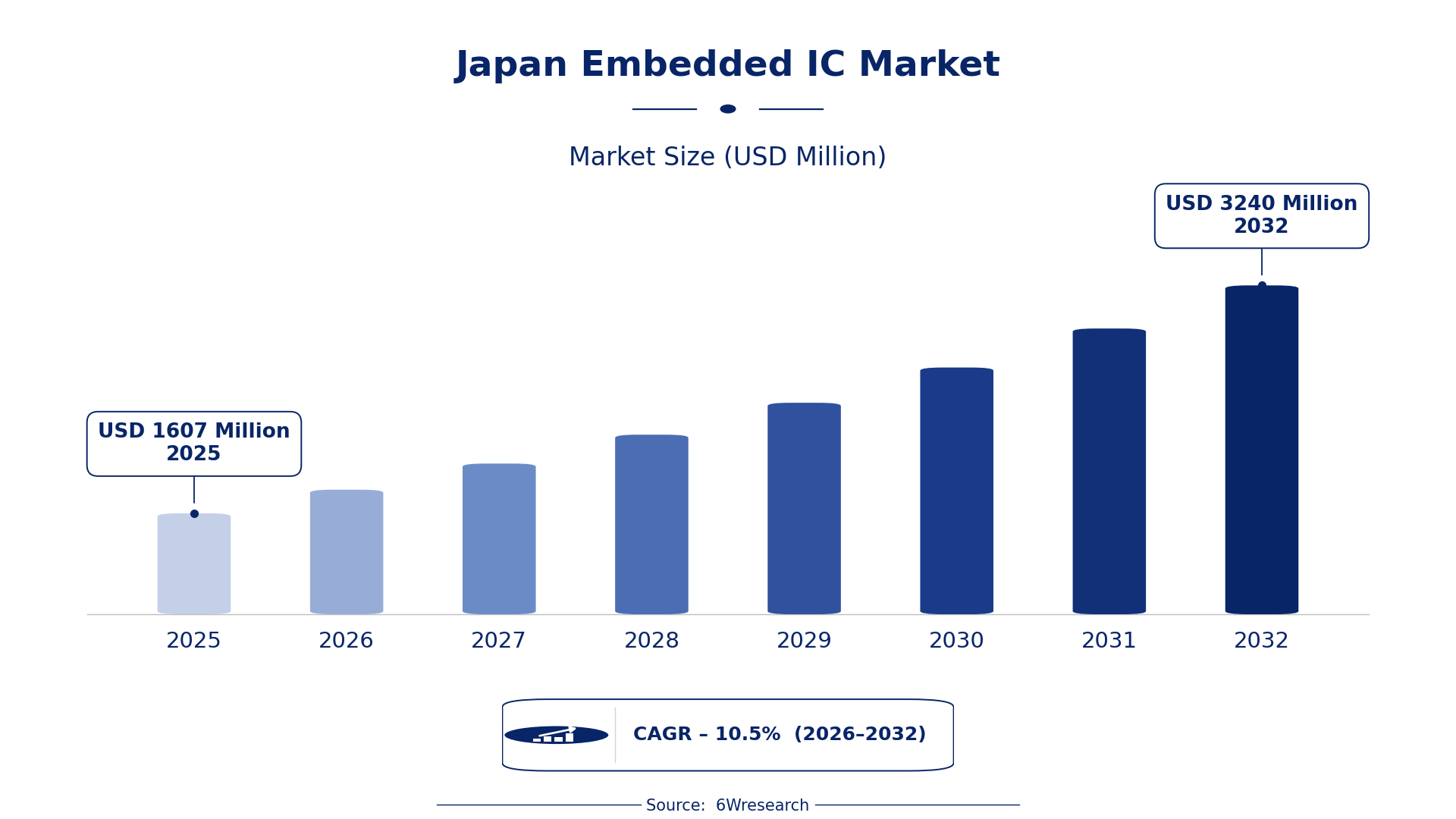
According to 6Wresearch internal database and industry insights, the Japan Embedded IC Market was valued at USD 1,607 Million in 2025 and is projected to reach USD 3,240 Million by 2032, growing at a CAGR of approximately 10.5% during 2026–2032.
Japan Embedded IC Market Highlights
| Report Metric | Details |
| Report Name | Japan Embedded IC Market (2026-2032) |
| Market Size 2025 | USD 1,607 Million |
| Market Size 2032 | USD 3,240 Million |
| Absolute Growth 2025–2032 | USD 1,633 Million |
| CAGR 2026–2032 | 10.5% |
| Peak Annual Growth | 12.0% in 2032 |
| Forecast Period | 2026–2032 |
| Historical Data | 2022–2025 |
| Base Year | 2025 |
| Leading IC Type, 2025 | SoC (52% share) |
| Leading Integration Level, 2025 | Very High (42% share) |
| Leading Function Area, 2025 | Processing (50% share) |
| Leading End User, 2025 | Chip Manufacturers (36% share) |
| Fastest-Growing IC Type | Microcontroller (14.8% CAGR) |
| Fastest-Growing Integration Level | Medium (13.8% CAGR) |
| Fastest-Growing Function Area | Control (12.7% CAGR) |
| Fastest-Growing End User | IoT Developers (14.1% CAGR) |
| Growing Sector | automotive systems |
| Key End Users | automotive manufacturers, electronics OEMs, IoT developers, chip manufacturers |
Japan Embedded IC Market Year-wise Growth Rate and Key Drivers (2022–2032)
This graph illustrates the annual growth rates of the market from 2022 to 2032, highlighting a steady upward trajectory and projected market expansion over the forecast period.
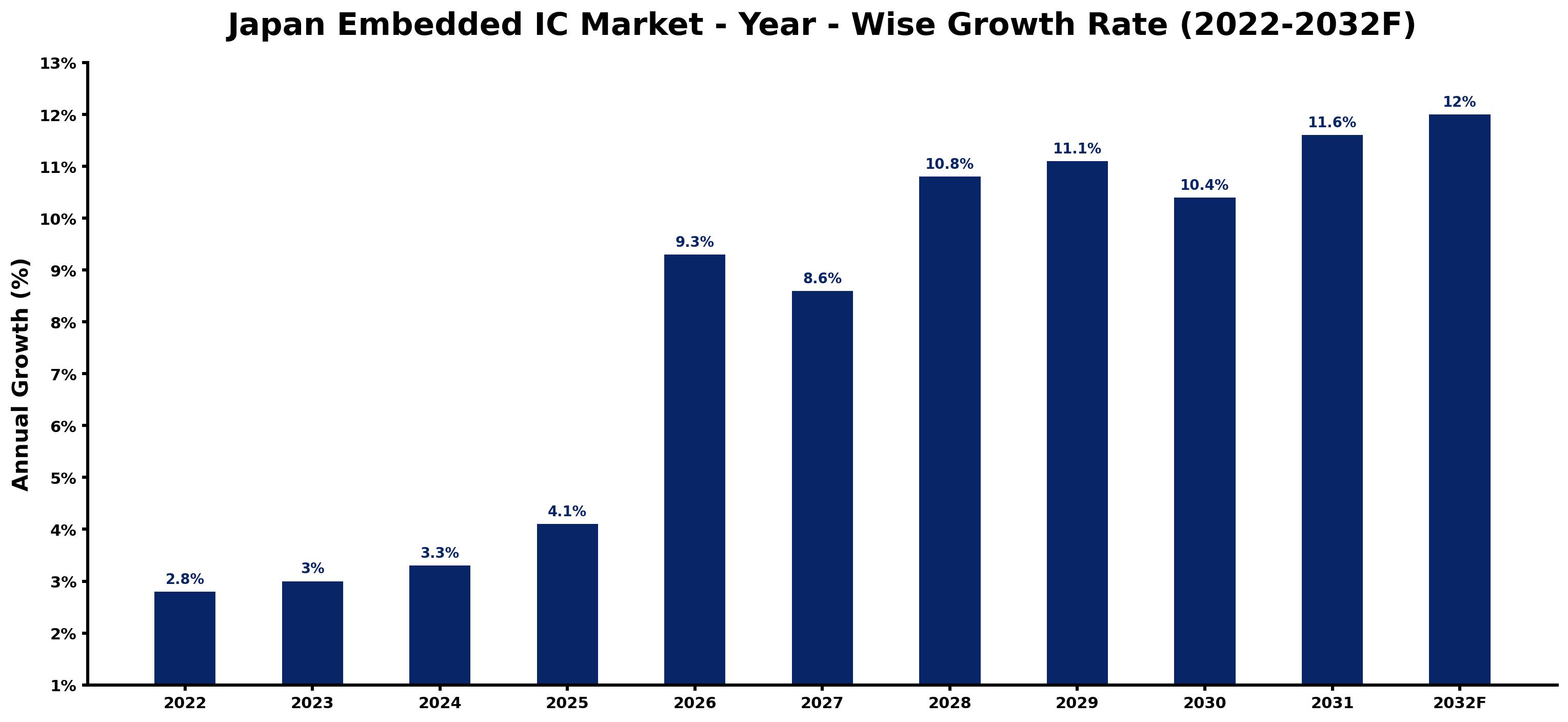
The following figures match every annual growth estimate with the main market development of that year, giving the reasoning behind each rise or slowdown.
| Year | Estimated Annual Growth (%) | Market Rationale |
| 2022 | 2.8 | The market experienced steady growth, driven by increasing consumer electronics demand. |
| 2023 | 3.0 | Growth accelerated due to rising automotive sector needs for embedded ICs. |
| 2024 | 3.3 | Demand continued to rise as IoT applications expanded in various industries. |
| 2025 | 4.1 | The automotive sector's consumption of embedded ICs boosted growth further. |
| 2026 | 9.3 | Investment in semiconductor capabilities is expected to improve production capacity. |
| 2027 | 8.6 | Growth is expected to slow slightly as the market stabilises after rapid expansion in previous years. |
| 2028 | 10.8 | Increased adoption of embedded ICs in IoT devices will drive renewed growth. |
| 2029 | 11.1 | Demand is projected to rise as more connected devices are integrated into daily life. |
| 2030 | 10.4 | Growth is anticipated to moderate as the market adjusts to previous high rates of expansion. |
| 2031 | 11.6 | A surge in automotive applications will lead to increased demand for embedded ICs. |
| 2032 | 12.0 | The market is expected to peak as advanced technologies in automotive and IoT drive purchases. |
Note: Market size estimations and growth projections presented in this report are based on 6Wresearch's proprietary forecasting methodology, utilizing the latest available industry data, government publications, and primary research inputs.
Japan Embedded IC Market Synopsis
Embedded ICs are integrated circuits tailored for specific functions within larger systems, produced through semiconductor fabrication processes. The Japan Embedded IC Market is expanding due to growing needs in consumer electronics, automotive systems, and IoT devices, with the automotive sector accounting for approximately 30% of embedded IC usage. Driven by a projected 1.5 billion connected devices by 2025 and increased investments in semiconductor manufacturing capabilities, the market is poised for growth.
Market Dynamics Impact Analysis (2026–2032)
| Factor | Type | Impact | Primary Segment Affected |
| Rising automotive sector demand for embedded ICs | Driver | High | Microcontroller |
| Increasing IoT applications driving embedded IC usage | Driver | High | SoC |
| Growing investment in semiconductor manufacturing capabilities | Opportunity | High | ASIC |
| Expansion of consumer electronics market requiring embedded ICs | Opportunity | Medium | FPGA |
| Challenges in meeting safety regulations for embedded ICs | Restraint | High | Microcontroller |
| Dependence on imported materials for semiconductor production | Restraint | Medium | SoC |
| High costs associated with R&D in semiconductor technologies | Challenge | High | ASIC |
| Limited capacity for scaling production to meet rising demand | Challenge | Medium | FPGA |
Evaluation of Drivers in Japan Embedded IC Market (2026–2032)
These are the developments adding the most demand over the forecast period.
| Drivers | Primary Segment Affected | Why It Matters (Evidence) |
| Increased automotive applications for embedded ICs | Microcontroller | The automotive sector accounts for approximately 30% of embedded IC usage, driving demand for advanced control systems. |
| Expansion of IoT devices requiring embedded ICs | SoC | The IoT market is expected to reach 1.5 billion connected devices by 2025, increasing demand for embedded solutions. |
| Government support for semiconductor manufacturing | ASIC | The Semiconductor and Digital Industry Strategy aims to secure domestic production capabilities, bolstering local supply. |
| Rising consumer electronics adoption of embedded ICs | FPGA | The average adoption rate of embedded ICs in consumer electronics is around 75%, driving further integration. |
| Growing R&D investments in semiconductor technologies | Microcontroller | A 20% increase in R&D investments in 2023 supports innovation in embedded systems. |
The strongest pull on demand comes from the automotive sector, which accounts for approximately 30% of embedded IC usage, leading to increased purchases of microcontrollers for advanced control systems. The IoT market is expected to reach 1.5 billion connected devices by 2025, driving demand for SoCs that facilitate connectivity. Consumer electronics show a high adoption rate of embedded ICs, increasing the need for FPGAs in various applications. A rise in R&D investments in 2023 supports innovation, ensuring a steady supply of advanced embedded technologies to meet market needs.
Evaluation of Restraints in Japan Embedded IC Market
Several factors work against faster growth; the main ones are summarised below.
| Market Restraint | Primary Segment Affected | Why It Matters (Evidence) |
| Compliance with stringent safety regulations | Microcontroller | The Electrical Appliance and Material Safety Act requires thorough testing, increasing costs for manufacturers. |
| Reliance on imported semiconductor materials | SoC | Dependence on imports can lead to supply chain vulnerabilities, impacting production timelines. |
| High R&D costs for developing new technologies | ASIC | Investment is needed to innovate, which can limit smaller players' market entry. |
| Limited production capacity for scaling operations | FPGA | Manufacturers may struggle to meet rising demand due to existing capacity constraints. |
| Market fluctuations affecting pricing stability | Microcontroller | Volatility in semiconductor prices can disrupt budgeting for projects requiring embedded ICs. |
Japan Embedded IC Market Challenges
Producers in the automotive sector face losses of approximately 10% annually due to lengthy approval processes linked to stringent regulations. These regulations inflate operational costs by up to 15% for manufacturers, which directly impacts their profit margins. Buyers encounter delays as supply chain disruptions from reliance on imported materials extend lead times by an average of four weeks, affecting electronics manufacturers' production schedules. Rising raw material costs have surged by 25% over the past year, compelling buyers to adjust pricing strategies and ultimately reducing consumer affordability.
Trends in the Japan Embedded IC Market
Buyers and suppliers in the Japan Embedded IC Market are adjusting to the following trends.
- Shift towards Advanced Automotive Systems: In Japan, over 90% of modern automotive systems now use embedded ICs, reflecting a shift towards advanced technologies. This trend is driven by the need for improved vehicle functionalities and safety features.
- Growth of IoT Device Integration: The integration of embedded ICs in IoT devices is accelerating, with projections of 1.5 billion connected devices by 2025. This trend is reshaping consumer electronics, pushing manufacturers to innovate rapidly.
- Increased Focus on Semiconductor R&D: Japan's semiconductor industry reported a 20% increase in R&D investments in 2023, highlighting a trend towards innovation in embedded technologies. This focus is essential for maintaining competitive advantages.
- Expansion of Consumer Electronics Market: The consumer electronics sector is experiencing growth, with an adoption rate of around 75% for embedded ICs. This trend is prompting manufacturers to improve product integration and functionality.
Investment Opportunities in the Japan Embedded IC Market
Where to invest in the Japan Embedded IC Market: the main openings are set out below.
- Partnerships for Semiconductor Production: Now is an ideal time for joint ventures in semiconductor manufacturing, given the government's push for local capabilities. Collaborating with regional electronics OEMs can facilitate market entry.
- Investment in IoT Device Development: With the IoT market projected to reach 1.5 billion devices by 2025, investing in IoT-focused embedded IC solutions presents a promising opportunity for suppliers.
- Expansion in Automotive Embedded Systems: The automotive sector's reliance on embedded ICs offers opportunities for suppliers to develop advanced control systems. Focusing on partnerships with automotive Tier 1 suppliers can strengthen market presence.
- Certification for Advanced Embedded Technologies: Obtaining ISO/IEC 30170 certification can open doors for manufacturers in the embedded IC market, particularly in sectors requiring compliance with international standards.
Government Initiatives in the Japan Embedded IC Market
The Electrical Appliance and Material Safety Act regulates the safety of electrical appliances and materials in Japan, ensuring that embedded ICs meet safety standards. Compliance with this act is essential for manufacturers to maintain market access and consumer trust.
In 2023, an investment of USD 500 million was allocated to strengthen semiconductor manufacturing capabilities, supporting domestic production. The Ministry of Economy, Trade and Industry oversees this initiative, which will enhance the local semiconductor industry and ensure supply chain resilience.
Future Insight of the Japan Embedded IC Market
Investment in semiconductor manufacturing will expand, creating demand for embedded ICs across various sectors. By 2032, R&D investments in Japan's semiconductor industry are projected to increase by 20%, driving advancements in production processes. The adoption of ISO/IEC 30170 standards will streamline operations, improving collaboration between buyers and suppliers. The automotive sector will experience a surge in embedded IC applications, with over 90% of modern systems integrating these technologies.
Market Segmentation Analysis
Japan Embedded IC Market report covers a detailed analysis of the following market segments:
By IC Type – SoC Leads, Microcontroller Expected to Grow Fastest
According to Saurav Kr Singh, Senior Research Analyst at 6Wresearch, SoC took 52% of ic type revenue in 2025, more than any other category. The System on Chip (SoC) segment holds the largest share due to its critical role in smartphones and tablets, essential for everyday communication. This segment benefits from a robust installed base in consumer electronics, ensuring sustained demand for processing capabilities. Over 2026–2032, Microcontroller is expected to post the fastest growth, at a CAGR of 14.8%. The Microcontroller segment is experiencing rapid growth as it is crucial for controlling devices in the automotive and IoT sectors, both of which are witnessing significant expansion. With the IoT market projected to reach 1.5 billion connected devices by 2025, Microcontrollers will see increased demand. Suppliers should focus on enhancing Microcontroller capabilities to take advantage of the growing IoT market.
By Integration Level – Very High Leads, Medium Expected to Grow Fastest
Very High held 42% of the Japan Embedded IC Market by integration level in 2025. Very High integration levels dominate the market due to their importance in high-performance computing and advanced applications, especially in the automotive sector. This integration level enables compact designs and improved efficiency, appealing to major manufacturers. Medium is projected to grow fastest, at a CAGR of 13.8% during 2026–2032. The Medium integration level is the fastest growing segment as it addresses less demanding applications that are becoming more popular among consumers. As the market for simpler electronic devices grows, demand for Medium integration solutions is expected to rise. Buyers may encounter a wider range of Medium integration options as manufacturers respond to changing market needs.
By Function Area – Processing Leads, Control Expected to Grow Fastest
Processing accounted for 50% of the market by function area in 2025. Processing functions dominate the market as they are essential for data handling in various electronic devices, including smartphones and automotive systems. The high adoption rate of embedded ICs in consumer electronics highlights the critical role of Processing capabilities in modern technology. The quickest growth will come from Control, forecast to expand at a CAGR of 12.7% between 2026 and 2032. Control functions are experiencing rapid growth as they are vital for device management and operation, especially in the context of IoT applications. The rising number of connected devices necessitates effective control solutions, further driving demand in this segment. Suppliers should prioritise the development of Control function solutions to address the needs of the expanding IoT market.
By End User – Chip Manufacturers Lead, IoT Developers Expected to Grow Fastest
In 2025, Chip Manufacturers led the end user split with a 36% share. Chip Manufacturers represent the largest share as they are the primary users of embedded ICs for production, serving a wide array of applications across industries. Their established relationships with semiconductor fabrication processes ensure a steady demand for embedded ICs. IoT Developers are set to record the highest CAGR in this split, 14.1% over 2026–2032. IoT Developers are the fastest-growing segment as they rely heavily on embedded ICs for the functionality of smart devices, which are rapidly proliferating. The anticipated growth in the IoT market will further accelerate their demand for embedded solutions. Suppliers should engage with IoT Developers to align their product offerings with the needs of the burgeoning smart device market.
Key Attractiveness of the Report
- 10 Years of Market Numbers
- Historical Data Starting from 2022 to 2025
- Base Year 2025
- Forecast Data until 2032
- Key Performance Indicators Impacting the Market
- Major Upcoming Developments and Projects
Key Highlights of the Report:
- Japan Embedded IC Market Outlook
- Market Size of Japan Embedded IC Market, 2025
- Forecast of Japan Embedded IC Market, 2032
- Historical Data and Forecast of Japan Embedded IC Revenues & Volume for the Period 2022-2032F
- Japan Embedded IC Market Trend Evolution
- Japan Embedded IC Market Drivers and Challenges
- Japan Embedded IC Price Trends
- Japan Embedded IC Porter's Five Forces
- Japan Embedded IC Industry Life Cycle
- Historical Data and Forecast of Japan Embedded IC Market Revenues & Volume By IC Type for the Period 2022-2032F
- Historical Data and Forecast of Japan Embedded IC Market Revenues & Volume By SoC for the Period 2022-2032F
- Historical Data and Forecast of Japan Embedded IC Market Revenues & Volume By Microcontroller for the Period 2022-2032F
- Historical Data and Forecast of Japan Embedded IC Market Revenues & Volume By ASIC for the Period 2022-2032F
- Historical Data and Forecast of Japan Embedded IC Market Revenues & Volume By FPGA for the Period 2022-2032F
- Historical Data and Forecast of Japan Embedded IC Market Revenues & Volume By Integration Level for the Period 2022-2032F
- Historical Data and Forecast of Japan Embedded IC Market Revenues & Volume By Very High for the Period 2022-2032F
- Historical Data and Forecast of Japan Embedded IC Market Revenues & Volume By Medium for the Period 2022-2032F
- Historical Data and Forecast of Japan Embedded IC Market Revenues & Volume By High for the Period 2022-2032F
- Historical Data and Forecast of Japan Embedded IC Market Revenues & Volume By Configurable for the Period 2022-2032F
- Historical Data and Forecast of Japan Embedded IC Market Revenues & Volume By Function Area for the Period 2022-2032F
- Historical Data and Forecast of Japan Embedded IC Market Revenues & Volume By Processing for the Period 2022-2032F
- Historical Data and Forecast of Japan Embedded IC Market Revenues & Volume By Control for the Period 2022-2032F
- Historical Data and Forecast of Japan Embedded IC Market Revenues & Volume By Custom Functions for the Period 2022-2032F
- Historical Data and Forecast of Japan Embedded IC Market Revenues & Volume By Signal Processing for the Period 2022-2032F
- Historical Data and Forecast of Japan Embedded IC Market Revenues & Volume By End User for the Period 2022-2032F
- Historical Data and Forecast of Japan Embedded IC Market Revenues & Volume By Chip Manufacturers for the Period 2022-2032F
- Historical Data and Forecast of Japan Embedded IC Market Revenues & Volume By IoT Developers for the Period 2022-2032F
- Historical Data and Forecast of Japan Embedded IC Market Revenues & Volume By Automotive Tier 1 for the Period 2022-2032F
- Historical Data and Forecast of Japan Embedded IC Market Revenues & Volume By Electronics OEMs for the Period 2022-2032F
- Japan Embedded IC Import Export Trade Statistics
- Market Opportunity Assessment By IC Type
- Market Opportunity Assessment By Integration Level
- Market Opportunity Assessment By Function Area
- Market Opportunity Assessment By End User
- Japan Embedded IC Top Companies Market Share
- Japan Embedded IC Competitive Benchmarking By Technical and Operational Parameters
- Japan Embedded IC Company Profiles
- Japan Embedded IC Key Strategic Recommendations
Market Covered
This report examines the market across the segments below.
By IC Type
- SoC
- Microcontroller
- ASIC
- FPGA
By Integration Level
- Very High
- Medium
- High
- Configurable
By Function Area
- Processing
- Control
- Custom Functions
- Signal Processing
By End User
- Chip Manufacturers
- IoT Developers
- Automotive Tier 1
- Electronics OEMs































