Japan Emergency Response Market Size & Growth Rate
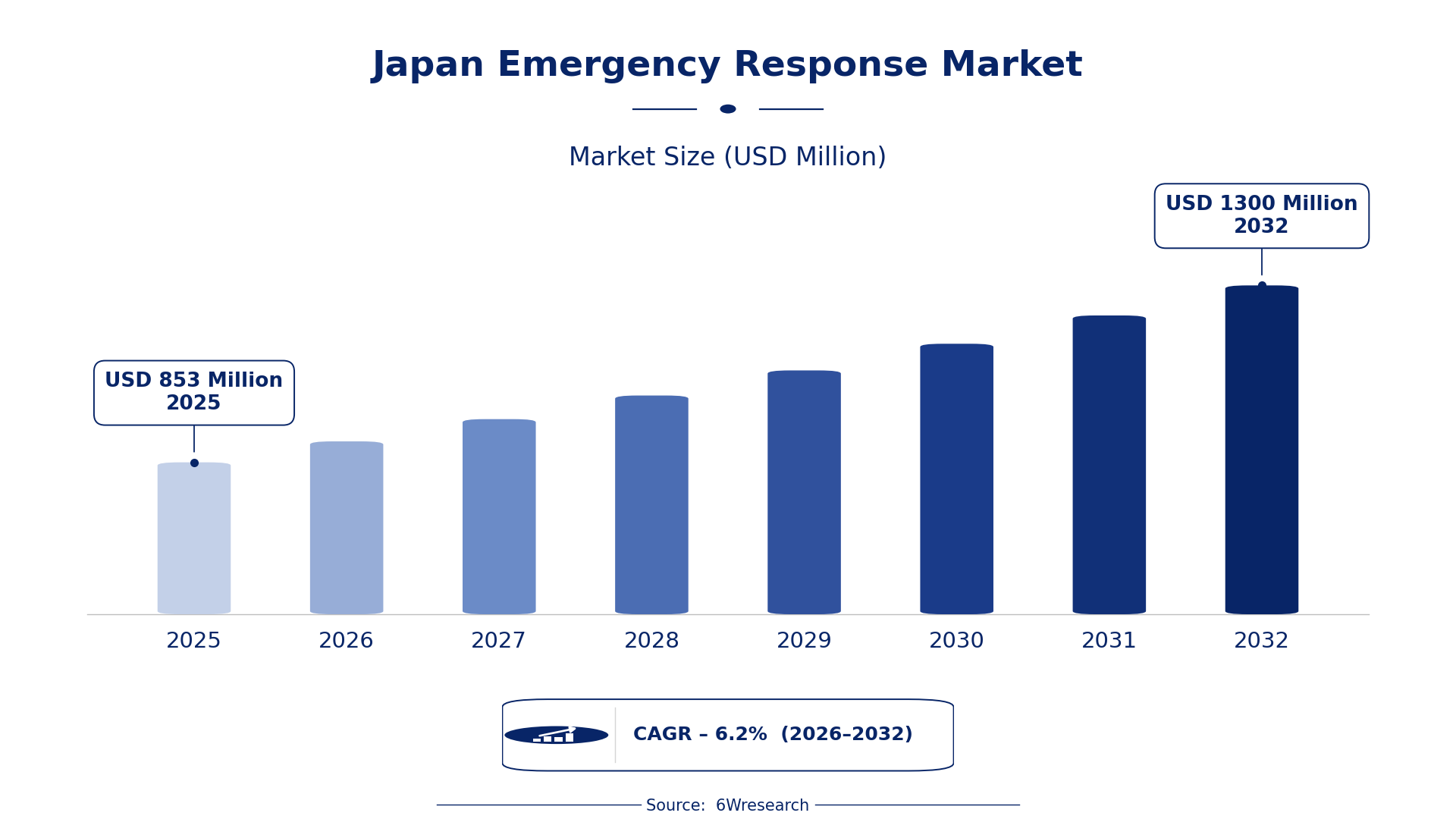
According to 6Wresearch internal database and industry insights, the Japan Emergency Response Market was valued at USD 853 Million in 2025 and is projected to reach USD 1,300 Million by 2032, growing at a CAGR of approximately 6.2% during 2026–2032.
Japan Emergency Response Market Highlights
| Report Metric | Details |
| Report Name | Japan Emergency Response Market (2026-2032) |
| Market Size 2025 | USD 853 Million |
| Market Size 2032 | USD 1,300 Million |
| Absolute Growth 2025–2032 | USD 447 Million |
| CAGR 2026–2032 | 6.2% |
| Peak Annual Growth | 7.3% in 2028 |
| Forecast Period | 2026–2032 |
| Historical Data | 2022–2025 |
| Base Year | 2025 |
| Leading Response Type, 2025 | Fire Response (47% share) |
| Leading Incident Type, 2025 | Earthquake/Flood (53% share) |
| Leading Distribution Channel, 2025 | Government Contracts (41% share) |
| Leading End User, 2025 | Fire Departments (41% share) |
| Fastest-Growing Response Type | Medical Response (8.5% CAGR) |
| Fastest-Growing Distribution Channel | Emergency Tenders (7.6% CAGR) |
| Fastest-Growing End User | Disaster Teams (7.8% CAGR) |
| Growing Sector | Emergency Services |
| Key End Users | Fire Departments, Paramedic Units, Disaster Teams |
Japan Emergency Response Market Year-wise Growth Rate and Key Drivers (2022–2032)
This graph illustrates the annual growth rates of the market from 2022 to 2032, highlighting a steady upward trajectory and projected market expansion over the forecast period.
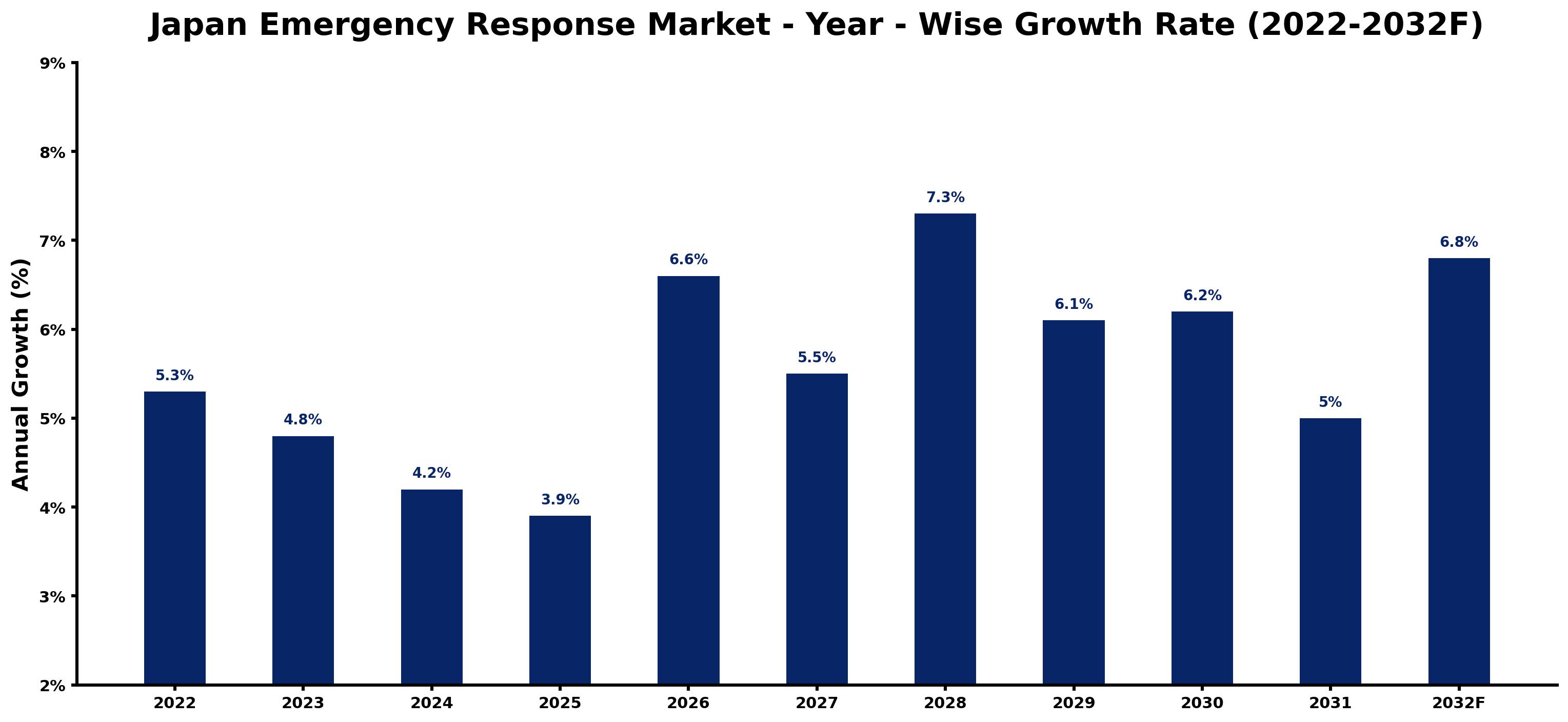
Each row of the following table gives one year's estimated growth and the event or demand shift that explains it.
| Year | Estimated Annual Growth (%) | Market Rationale |
| 2022 | 5.3 | The market experienced steady demand due to ongoing emergency preparedness initiatives. |
| 2023 | 4.8 | Growth slowed as emergency response budgets faced tighter scrutiny amid economic pressures. |
| 2024 | 4.2 | Demand continued to grow, supported by increased earthquake preparedness drills across local municipalities. |
| 2025 | 3.9 | Market growth slowed further as funding for new equipment faced delays in approval processes. |
| 2026 | 6.6 | Purchasing is expected to pick up as local governments invest more in emergency response capabilities. |
| 2027 | 5.5 | Demand rises as urban areas prioritise fire response services amid increasing building density. |
| 2028 | 7.3 | Growth accelerates with the introduction of advanced training programs for emergency responders. |
| 2029 | 6.1 | Demand slows slightly as budget reallocations affect funding for emergency services. |
| 2030 | 6.2 | Purchasing is expected to pick up as local governments expand disaster response training initiatives. |
| 2031 | 5.0 | Growth slows as the market stabilises after a period of rapid investment. |
| 2032 | 6.8 | Demand rises again as new disaster response technologies are adopted widely. |
Note: Market size estimations and growth projections presented in this report are based on 6Wresearch's proprietary forecasting methodology, utilizing the latest available industry data, government publications, and primary research inputs.
Japan Emergency Response Market Synopsis
Emergency response encompasses services for managing fire, medical, and rescue operations, coordinated by government agencies and local municipalities. The Japan Emergency Response Market is growing, driven by the need for effective disaster management, particularly in earthquake-prone regions. In 2023, ¥10 billion was allocated for disaster preparedness initiatives, reflecting the government's commitment to improving these critical services. Increasing urbanisation and a rising population also contribute to heightened demand for emergency response capabilities.
Market Dynamics Impact Analysis (2026–2032)
| Factor | Type | Impact | Primary Segment Affected |
| Growing frequency of natural disasters | Driver | High | Earthquake/Flood |
| Increased government funding for emergency preparedness | Driver | High | Government Contracts |
| Rising urbanisation leading to higher demand for fire services | Opportunity | High | Fire Response |
| Expansion of emergency training programs for responders | Opportunity | Medium | Medical Response |
| Budget constraints affecting local government spending | Restraint | High | Government Contracts |
| Delays in equipment procurement processes | Restraint | Medium | Fire Response |
| Competition for funding among various emergency services | Challenge | High | Rescue Operations |
| Need for advanced technology integration in response operations | Challenge | Medium | Medical Response |
Evaluation of Drivers in Japan Emergency Response Market (2026–2032)
Below are the drivers that matter most for revenue growth, with supporting evidence.
| Drivers | Primary Segment Affected | Why It Matters (Evidence) |
| Increased earthquake frequency | Earthquake/Flood | Japan experienced over 1,000 earthquakes in 2022, necessitating more emergency responses. |
| Government funding for disaster preparedness | Government Contracts | In 2023, Japan allocated ¥10 billion for disaster preparedness initiatives, boosting service demand. |
| Urbanisation and building density | Fire Response | High building density in urban areas increases the need for effective fire response services. |
| Training mandates for emergency personnel | Medical Response | Emergency response training is mandated for all local government officials, improving service quality. |
| Public awareness of disaster risks | Rescue Operations | Local governments conduct annual disaster drills involving millions, increasing public readiness and demand. |
Purchasing is picking up as Japan experienced over 1,000 earthquakes in 2022, driving demand for effective emergency responses. Urbanisation has intensified the need for fire response services, especially in densely populated areas. Training for local officials is mandated, ensuring improved service delivery. Public awareness campaigns and annual disaster drills involving millions of participants further increase preparedness and demand for emergency services.
Evaluation of Restraints in Japan Emergency Response Market
Below are the constraints most often cited by buyers and suppliers, with the segment each affects.
| Market Restraint | Primary Segment Affected | Why It Matters (Evidence) |
| Budget constraints limiting local government spending | Government Contracts | Local governments face tighter budgets, impacting their ability to fund emergency services adequately. |
| Delays in procurement processes for emergency equipment | Fire Response | Approval delays for new equipment purchases hinder timely upgrades to emergency response capabilities. |
| Competition for funding among various emergency services | Rescue Operations | Different emergency services vie for limited funding, affecting resource allocation for rescue operations. |
| Inadequate infrastructure in rural areas | Medical Response | Rural regions often lack the infrastructure needed for effective medical emergency responses. |
| Limited public awareness of emergency response options | Crisis Management | Insufficient public knowledge about available emergency services can reduce utilisation during crises. |
Japan Emergency Response Market Challenges
Emergency response buyers face fierce competition among over 1,000 fire departments, which can lead to inconsistent service quality and delayed responses during critical incidents. Regulatory frameworks impose compliance costs on local municipalities, diverting funds from essential training and equipment upgrades, which can postpone vital emergency preparedness. Supply chain disruptions for specialised equipment, particularly following over 1,000 earthquakes in 2022, can extend response times, risking lives in urgent situations. Skills shortages among trained personnel hinder effective emergency management, as local governments are mandated to provide training yet face budget constraints, impacting their operational readiness.
Trends in the Japan Emergency Response Market
These developments are changing demand patterns in the Japan Emergency Response Market.
- Shift from Traditional to Advanced Training: In 2023, local governments began adopting advanced training programs for emergency responders, improving service efficacy. This shift is expected to enhance overall emergency response capabilities across Japan.
- Transition to Integrated Emergency Management Systems: Japan is implementing integrated emergency management systems, particularly in urban areas, to streamline response efforts. This approach is reflected in the adoption of the ISO 22320 standard for emergency management practices.
- Emergence of Community-Based Disaster Preparedness: Community groups are increasingly involved in disaster preparedness initiatives, improving local resilience. In 2022, millions participated in annual disaster drills, cultivating a culture of readiness.
- Prioritisation of Fire Safety in Urban Planning: Since 2022, urban planning in Japan has increasingly prioritised fire safety measures, particularly in high-density areas. This trend is seen in new building regulations aimed at improving fire response capabilities.
Investment Opportunities in the Japan Emergency Response Market
The following areas offer the clearest openings for investors and suppliers in the Japan Emergency Response Market.
- Fire Departments seeking advanced equipment: Fire Departments are currently looking to upgrade their equipment, with local governments allocating funds for this purpose. In 2023, ¥10 billion was set aside for disaster preparedness initiatives.
- Increased demand for medical response services: The need for medical response services is rising due to an ageing population. Local health authorities are investing in advanced medical response units to address this demand.
- Emergency Tenders gaining traction: Emergency Tenders are becoming a preferred method for acquiring emergency services, with local governments increasingly utilising this approach. This shift is evident in recent procurement trends.
- Disaster Teams expanding capabilities: Disaster Teams are expanding their capabilities to manage mass casualty events more effectively. In 2022, local governments conducted drills involving millions to improve preparedness.
Government Initiatives in the Japan Emergency Response Market
The Disaster Countermeasures Basic Act, established in 1961, provides a framework for disaster response in Japan. This law mandates that local governments develop disaster response plans and conduct regular drills, ensuring preparedness for emergencies. The Building Energy Efficiency Act, amended in 2022, also plays a role by requiring new buildings to meet energy standards, indirectly supporting emergency response through improved infrastructure.
The Disaster Countermeasures Basic Act oversees the implementation of various health and safety regulations, ensuring facilities are equipped to handle emergencies. In 2023, funding was approved for training programs aimed at improving emergency response capabilities across local municipalities.
Future Insight of the Japan Emergency Response Market
New emergency management facilities will emerge by 2032, supported by the ISO 22320 standard to improve coordination during crises. Japan's ongoing investment of ¥10 billion for disaster preparedness initiatives will strengthen infrastructure and response capabilities. Annual disaster drills involving millions will cultivate a more prepared populace, ensuring quicker reactions to emergencies. Technological advancements in communication systems will streamline coordination between agencies, ultimately benefiting both buyers and suppliers in the emergency response sector.
Market Segmentation Analysis
Japan Emergency Response Market report covers a detailed analysis of the following market segments:
By Response Type – Fire Response Leads, Medical Response Expected to Grow Fastest
According to Saurav Kr Singh, Senior Research Analyst at 6Wresearch, Fire Response held 47% of the Japan Emergency Response Market by response type in 2025. Fire response services play a crucial role in managing fire incidents, especially in urban areas characterised by high building density. The extensive network of over 1,000 fire departments across Japan ensures a robust capability to address fire emergencies effectively. Medical Response is projected to grow fastest, at a CAGR of 8.5% during 2026–2032. The medical response segment is experiencing rapid growth due to a notable increase in medical emergencies, particularly in densely populated regions. The rising number of medical incidents in urban centres highlights the urgent need for enhanced medical response capabilities. This indicates that suppliers should prioritise the development of advanced medical response solutions to meet the growing demand.
By Incident Type – Earthquake/Flood Leads and Records the Fastest Growth
In 2025, Earthquake/Flood led the incident type split with a 53% share. Earthquake and flood incidents are prevalent in Japan, necessitating strong emergency response capabilities. The country's geographical characteristics and historical data on natural disasters reinforce the leadership of this segment in the market. Earthquake/Flood is also forecast to expand faster than any other category, at a CAGR of 8.6% over 2026–2032. The earthquake and flood segment's growth is propelled by Japan's ongoing vulnerability to natural disasters, with over 1,000 earthquakes recorded in 2022. This persistent threat ensures that resources and training for emergency services remain a priority. Suppliers must focus on solutions specifically designed for earthquake and flood scenarios to maintain competitiveness in this market.
By Distribution Channel – Government Contracts Lead, Emergency Tenders Expected to Grow Fastest
With 41% of distribution channel revenue in 2025, Government Contracts was the largest category. Government contracts serve as the primary funding source for emergency services, ensuring consistent financial support for operations. These contracts facilitate the procurement of essential equipment and training for responders across Japan. Emergency Tenders are set to record the highest CAGR in this split, 7.6% over 2026–2032. Emergency tenders are gaining traction as they streamline the acquisition of emergency services, reflecting the urgent need for rapid response capabilities. The increasing frequency of emergencies has led to a rise in tender opportunities for suppliers. This trend suggests that suppliers should actively engage in tender processes to capture new business opportunities.
By End User – Fire Departments Lead, Disaster Teams Expected to Grow Fastest
Fire Departments took 41% of end user revenue in 2025, more than any other category. Fire departments are the primary responders to fire incidents, making them a vital part of the emergency response system. Their established operational readiness and extensive training significantly enhance their market share. Over 2026–2032, Disaster Teams are expected to post the fastest growth, at a CAGR of 7.8%. Disaster teams are expanding rapidly due to the increasing need for specialised units capable of managing large-scale incidents effectively. As Japan continues to face natural disasters, the demand for these teams will likely rise, further propelling growth. This suggests to suppliers the necessity of equipping disaster teams with advanced tools and training.
Key Attractiveness of the Report
- 10 Years of Market Numbers
- Historical Data Starting from 2022 to 2025
- Base Year 2025
- Forecast Data until 2032
- Key Performance Indicators Impacting the Market
- Major Upcoming Developments and Projects
Key Highlights of the Report:
- Japan Emergency Response Market Outlook
- Market Size of Japan Emergency Response Market, 2025
- Forecast of Japan Emergency Response Market, 2032
- Historical Data and Forecast of Japan Emergency Response Revenues & Volume for the Period 2022-2032F
- Japan Emergency Response Market Trend Evolution
- Japan Emergency Response Market Drivers and Challenges
- Japan Emergency Response Price Trends
- Japan Emergency Response Porter's Five Forces
- Japan Emergency Response Industry Life Cycle
- Historical Data and Forecast of Japan Emergency Response Market Revenues & Volume By Response Type for the Period 2022-2032F
- Historical Data and Forecast of Japan Emergency Response Market Revenues & Volume By Fire Response for the Period 2022-2032F
- Historical Data and Forecast of Japan Emergency Response Market Revenues & Volume By Medical Response for the Period 2022-2032F
- Historical Data and Forecast of Japan Emergency Response Market Revenues & Volume By Rescue Operations for the Period 2022-2032F
- Historical Data and Forecast of Japan Emergency Response Market Revenues & Volume By Crisis Management for the Period 2022-2032F
- Historical Data and Forecast of Japan Emergency Response Market Revenues & Volume By Incident Type for the Period 2022-2032F
- Historical Data and Forecast of Japan Emergency Response Market Revenues & Volume By Building Fires for the Period 2022-2032F
- Historical Data and Forecast of Japan Emergency Response Market Revenues & Volume By Mass Casualty Events for the Period 2022-2032F
- Historical Data and Forecast of Japan Emergency Response Market Revenues & Volume By Earthquake/Flood for the Period 2022-2032F
- Historical Data and Forecast of Japan Emergency Response Market Revenues & Volume By Terror Attacks for the Period 2022-2032F
- Historical Data and Forecast of Japan Emergency Response Market Revenues & Volume By Distribution Channel for the Period 2022-2032F
- Historical Data and Forecast of Japan Emergency Response Market Revenues & Volume By Government Contracts for the Period 2022-2032F
- Historical Data and Forecast of Japan Emergency Response Market Revenues & Volume By Emergency Tenders for the Period 2022-2032F
- Historical Data and Forecast of Japan Emergency Response Market Revenues & Volume By Direct Services for the Period 2022-2032F
- Historical Data and Forecast of Japan Emergency Response Market Revenues & Volume By NGO Contracts for the Period 2022-2032F
- Historical Data and Forecast of Japan Emergency Response Market Revenues & Volume By End User for the Period 2022-2032F
- Historical Data and Forecast of Japan Emergency Response Market Revenues & Volume By Fire Departments for the Period 2022-2032F
- Historical Data and Forecast of Japan Emergency Response Market Revenues & Volume By Paramedic Units for the Period 2022-2032F
- Historical Data and Forecast of Japan Emergency Response Market Revenues & Volume By Disaster Teams for the Period 2022-2032F
- Historical Data and Forecast of Japan Emergency Response Market Revenues & Volume By Relief Agencies for the Period 2022-2032F
- Japan Emergency Response Import Export Trade Statistics
- Market Opportunity Assessment By Response Type
- Market Opportunity Assessment By Incident Type
- Market Opportunity Assessment By Distribution Channel
- Market Opportunity Assessment By End User
- Japan Emergency Response Top Companies Market Share
- Japan Emergency Response Competitive Benchmarking By Technical and Operational Parameters
- Japan Emergency Response Company Profiles
- Japan Emergency Response Key Strategic Recommendations
Market Covered
Coverage by segment is as follows.
By Response Type
- Fire Response
- Medical Response
- Rescue Operations
- Crisis Management
By Incident Type
- Building Fires
- Mass Casualty Events
- Earthquake/Flood
- Terror Attacks
By Distribution Channel
- Government Contracts
- Emergency Tenders
- Direct Services
- NGO Contracts
By End User
- Fire Departments
- Paramedic Units
- Disaster Teams
- Relief Agencies































