Japan Emerging Memory Technologies Market Size & Growth Rate
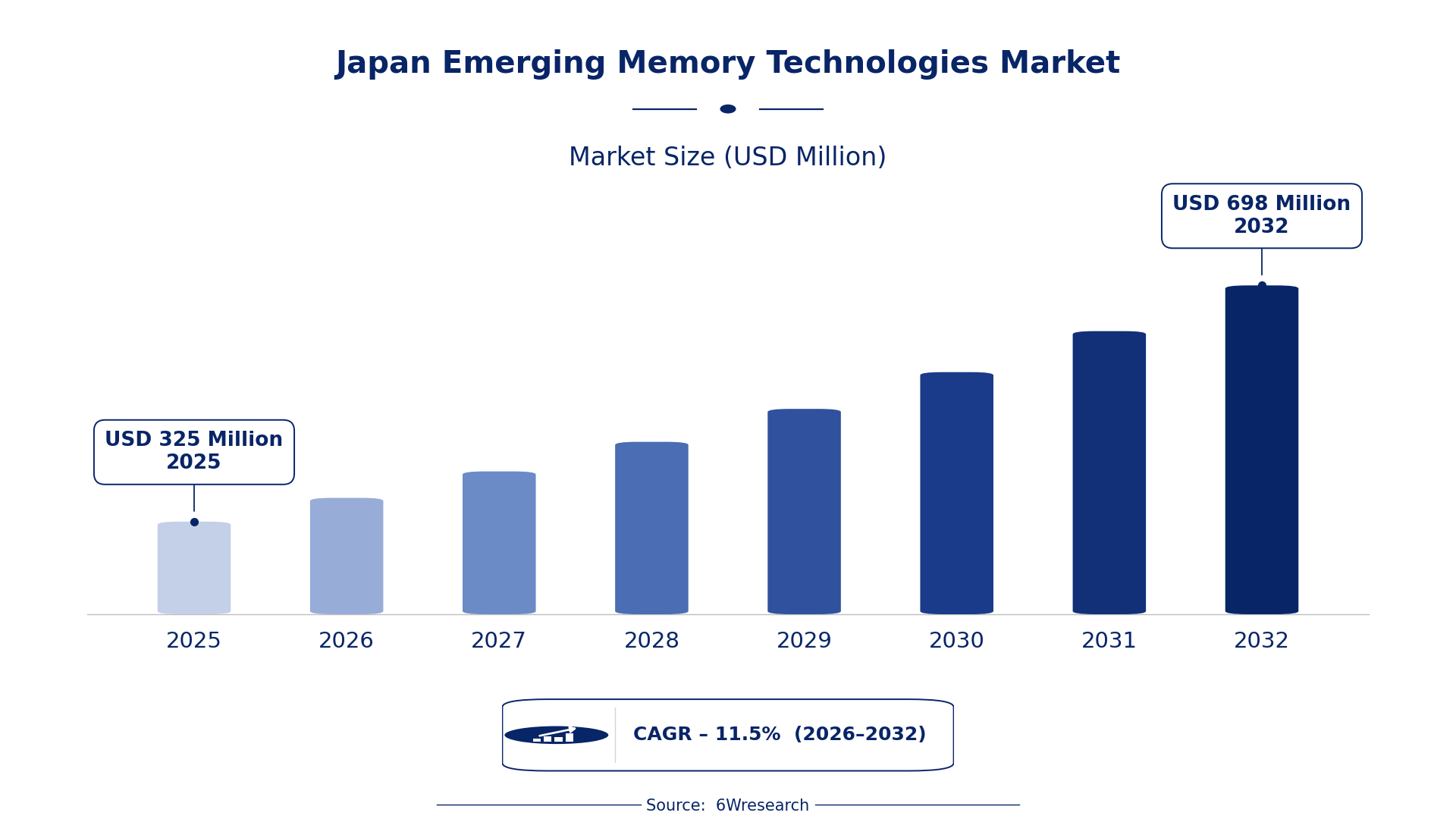
According to 6Wresearch internal database and industry insights, the Japan Emerging Memory Technologies Market was valued at USD 325 Million in 2025 and is projected to reach USD 698 Million by 2032, growing at a CAGR of approximately 11.5% during 2026–2032.
Japan Emerging Memory Technologies Market Highlights
| Report Metric | Details |
| Report Name | Japan Emerging Memory Technologies Market (2026-2032) |
| Market Size 2025 | USD 325 Million |
| Market Size 2032 | USD 698 Million |
| Absolute Growth 2025–2032 | USD 373 Million |
| CAGR 2026–2032 | 11.5% |
| Peak Annual Growth | 14.9% in 2026 |
| Forecast Period | 2026–2032 |
| Historical Data | 2022–2025 |
| Base Year | 2025 |
| Leading Memory Type, 2025 | MRAM (44% share) |
| Leading Application Area, 2025 | Embedded Systems (53% share) |
| Leading Distribution Channel, 2025 | Component Distributors (47% share) |
| Leading End User, 2025 | Electronics Manufacturers (43% share) |
| Fastest-Growing Memory Type | ReRAM (15.4% CAGR) |
| Fastest-Growing Application Area | Data Centers (13.9% CAGR) |
| Fastest-Growing Distribution Channel | OEMs (14.4% CAGR) |
| Fastest-Growing End User | Cloud Companies (14.6% CAGR) |
| Growing Sector | automotive electronics |
| Key End Users | electronics manufacturers, automotive OEMs, cloud companies, device integrators |
Japan Emerging Memory Technologies Market Year-wise Growth Rate and Key Drivers (2022–2032)
This graph illustrates the annual growth rates of the market from 2022 to 2032, highlighting a steady upward trajectory and projected market expansion over the forecast period.
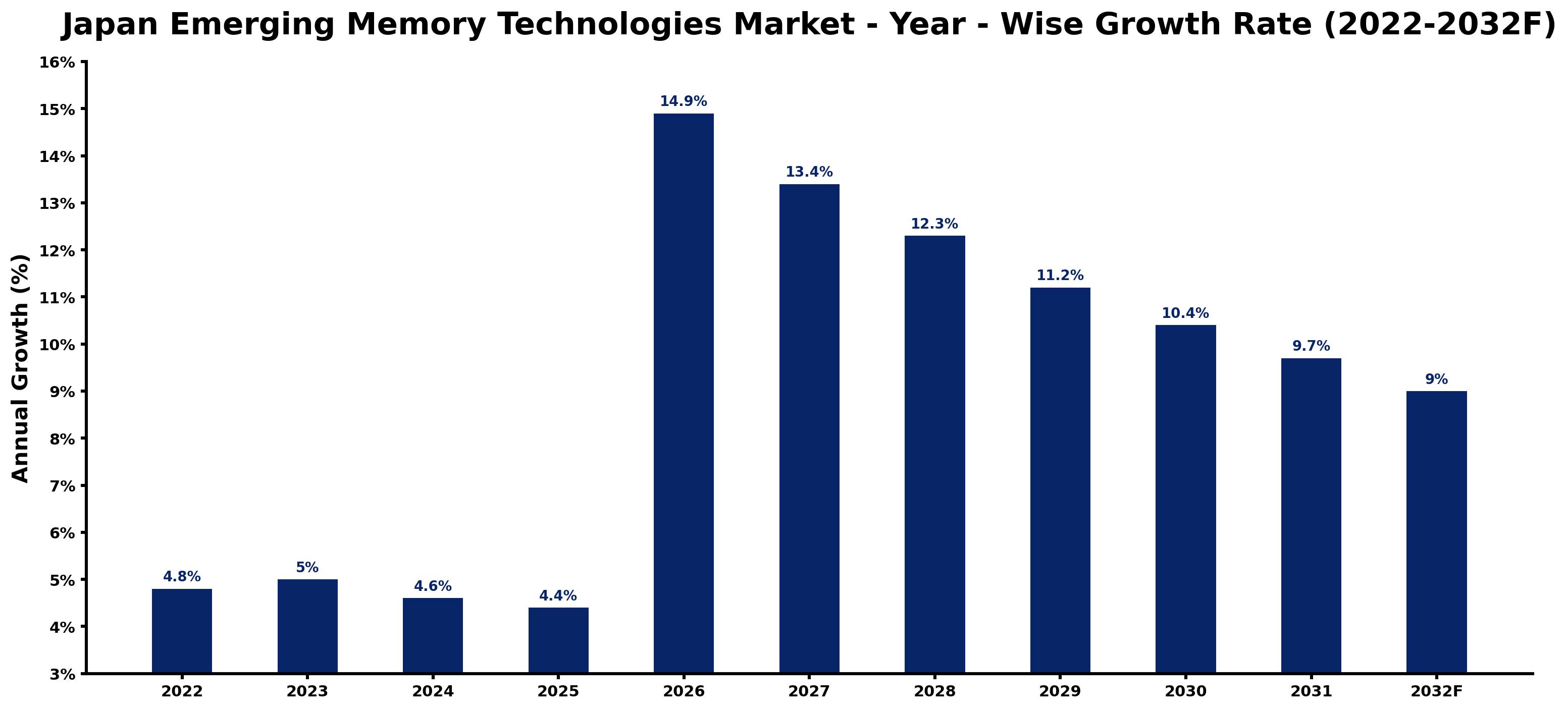
Each row of the following table gives one year's estimated growth and the event or demand shift that explains it.
| Year | Estimated Annual Growth (%) | Market Rationale |
| 2022 | 4.8 | The market experienced steady growth due to strong demand from electronics manufacturers. |
| 2023 | 5.0 | Growth accelerated as the automotive sector began adopting advanced memory technologies. |
| 2024 | 4.6 | A slight slowdown occurred as demand stabilised after rapid increases in previous years. |
| 2025 | 4.4 | Continued slow growth reflected ongoing investments in embedded systems and IoT devices. |
| 2026 | 14.9 | A surge in demand is anticipated as new technologies gain traction in various sectors. |
| 2027 | 13.4 | Growth will slow but remain strong as the market matures and stabilises. |
| 2028 | 12.3 | Demand will continue to rise, driven by advancements in data processing capabilities. |
| 2029 | 11.2 | A further slowdown is expected as the market reaches a more sustainable growth pace. |
| 2030 | 10.4 | Growth will remain steady, supported by ongoing investments in memory technology R&D. |
| 2031 | 9.7 | The market will continue to grow, driven by increasing demand for IoT applications. |
| 2032 | 9.0 | A gradual slowdown is anticipated as the market approaches maturity. |
Note: Market size estimations and growth projections presented in this report are based on 6Wresearch's proprietary forecasting methodology, utilizing the latest available industry data, government publications, and primary research inputs.
Japan Emerging Memory Technologies Market Synopsis
Emerging Memory Technologies encompass advanced storage solutions like MRAM, ReRAM, PCM, and FeRAM, produced through sophisticated fabrication techniques. The Japan Emerging Memory Technologies Market is expanding due to heightened demand from electronics manufacturers and the automotive sector, which is set to adopt 20% more advanced memory technologies by 2025. The need for faster, more efficient memory solutions in high-performance computing, automotive electronics, and IoT applications is propelling this growth.
Market Dynamics Impact Analysis (2026–2032)
| Factor | Type | Impact | Primary Segment Affected |
| Rising demand for high-performance computing solutions | Driver | High | MRAM |
| Increased adoption of IoT devices | Driver | High | ReRAM |
| Growing investment in semiconductor innovation | Opportunity | High | Data Centers |
| Expansion of automotive electronics applications | Opportunity | Medium | Automotive Electronics |
| High costs associated with R&D in memory technologies | Restraint | High | FeRAM |
| Limited awareness of emerging memory technologies among end users | Restraint | Medium | Embedded Systems |
| Competition from alternative memory technologies | Challenge | High | PCM |
| Supply chain disruptions affecting component availability | Challenge | Medium | ReRAM |
Evaluation of Drivers in Japan Emerging Memory Technologies Market (2026–2032)
The table below links each growth driver to the segment it affects and the evidence for it.
| Drivers | Primary Segment Affected | Why It Matters (Evidence) |
| Increased demand for non-volatile memory in high-speed applications | MRAM | Japan produced 1.3 billion semiconductor units in 2022, driving demand for MRAM in sectors like automotive electronics. |
| Growing need for low-power, high-density storage solutions | ReRAM | The IoT market in Japan is expected to reach $10 billion by 2025, increasing ReRAM adoption in smart home devices. |
| Rising capacity needs in data centers | PCM | Data centers in Japan are anticipated to grow by 15% in capacity by 2025, boosting PCM demand for fast write speeds. |
| Demand for advanced driver-assistance systems | FeRAM | The automotive electronics market in Japan is valued at $30 billion as of 2023, necessitating FeRAM for data storage. |
| Integration of memory technologies in consumer electronics | Embedded Systems | Embedded systems accounted for 35% of memory technology demand in 2022, highlighting their importance in electronics manufacturing. |
Orders keep climbing as the demand for non-volatile memory in high-speed applications rises, with Japan producing 1.3 billion semiconductor units in 2022. The IoT market is set to grow significantly, driving the need for low-power, high-density storage solutions like ReRAM. Data centers are expected to expand by 15% in capacity by 2025, increasing the demand for PCM technology. The automotive electronics sector, valued at $30 billion, requires FeRAM for advanced driver-assistance systems. Embedded systems accounted for 35% of memory technology demand in 2022, underpinning the integration of these technologies in consumer electronics.
Evaluation of Restraints in Japan Emerging Memory Technologies Market
The key brakes on demand, and where they bite hardest, are shown below.
| Market Restraint | Primary Segment Affected | Why It Matters (Evidence) |
| High R&D costs limit investment in new memory technologies | FeRAM | The average annual investment in memory technology R&D in Japan is around $1 billion, constraining innovation. |
| Limited awareness of emerging memory technologies among end users | Embedded Systems | Many electronics manufacturers lack knowledge about the benefits of advanced memory solutions, hindering adoption. |
| Competition from alternative memory technologies affects market share | PCM | Emerging technologies may divert attention from established solutions like PCM, impacting sales. |
| Supply chain disruptions affect component availability | ReRAM | Recent global supply chain issues have led to shortages, delaying production timelines for manufacturers. |
| Regulatory hurdles slow down product approvals | MRAM | Complex approval processes can delay the introduction of new MRAM products to the market. |
Japan Emerging Memory Technologies Market Challenges
Buyers in the automotive sector face rising costs as advanced memory technologies gain traction, with potential price increases of up to 20% by 2025. Competition intensifies as local manufacturers struggle to innovate quickly enough, resulting in product launch delays of up to six months for producers. Supply chain issues arise from reliance on specific semiconductor components, causing production delays that can extend lead times by three months for manufacturers. Buyers in the IoT market encounter sourcing difficulties for efficient memory solutions, hindering their ability to meet growing consumer demand as the market nears $10 billion by 2025.
Trends in the Japan Emerging Memory Technologies Market
Several trends are reshaping the Japan Emerging Memory Technologies Market; the most important are set out below.
- Shift from Traditional to Advanced Memory Solutions: Since 2023, the automotive sector has shifted towards adopting advanced memory technologies, with a projected 20% increase in adoption by 2025. This trend indicates a growing reliance on sophisticated memory solutions for improved vehicle performance.
- Transition from Centralised to Distributed Data Processing: The Tokyo region is experiencing a transition towards distributed data processing in data centers, with capacity expected to grow by 15% by 2025. This shift supports the need for advanced memory technologies to manage increased data loads.
- Emergence of Smart Home Devices: The adoption of ReRAM technology in smart home devices began in 2023, reflecting a growing market for efficient memory solutions. This trend is anticipated to improve device performance and user experience.
- Prioritisation of Medical Applications for FeRAM: FeRAM is increasingly being used in medical devices for data storage, with applications expanding since 2022. This trend highlights the technology's significance in ensuring reliable data management in healthcare.
Investment Opportunities in the Japan Emerging Memory Technologies Market
Investors looking at the Japan Emerging Memory Technologies Market should consider the following areas.
- Investment in Automotive Electronics: The automotive sector is projected to adopt 20% more advanced memory technologies by 2025, creating investment opportunities for suppliers. This demand arises from the need for enhanced driver-assistance systems.
- Support for Semiconductor Innovation: The Ministry of Economy, Trade and Industry launched a program in 2023 to support semiconductor innovation, allocating substantial funding to boost R&D efforts. This initiative presents opportunities for collaboration and growth in the memory technology sector.
- Growing Demand for IoT Devices: With Japan's population of approximately 125 million, the demand for IoT devices is anticipated to rise significantly. Suppliers can capitalise on this trend by offering advanced memory solutions tailored to IoT applications.
- Expansion of Data Center Capacity: Data centers in Japan are expected to grow by 15% in capacity by 2025, creating a need for efficient memory technologies. Suppliers should focus on providing solutions that enhance data processing capabilities.
Government Initiatives in the Japan Emerging Memory Technologies Market
The Semiconductor and Digital Industry Strategy, established by the Ministry of Economy, Trade and Industry in June 2021, aims to secure domestic semiconductor manufacturing through various measures. This strategy includes funding for R&D and support for technology development, which directly impacts the production of emerging memory technologies in Japan. The Next-Generation Medical Infrastructure Act, enacted in 2017, allows for the anonymisation of medical data for research, facilitating the integration of memory technologies in medical devices.
The Japan Electronics and Information Technology Industries Association promotes advancements in memory technology, benefiting buyers in the electronics manufacturing sector. The association collaborates with over 100 universities conducting research in semiconductor technologies, ensuring that manufacturers have access to the latest innovations and standards. This collaboration strengthens the competitiveness of Japanese electronics manufacturers in the global market.
Future Insight of the Japan Emerging Memory Technologies Market
A new government initiative will stimulate semiconductor innovation, prompting a shift in technology adoption by 2032. As the automotive sector embraces advanced memory technologies, suppliers will develop tailored solutions to meet emerging applications. The implementation of ISO/IEC 30170:2019 will establish essential standards, ensuring quality across memory technologies. Collaboration among universities and industry players will drive advancements in applications, positioning Japan as a leader in memory technology development.
Market Segmentation Analysis
Japan Emerging Memory Technologies Market report covers a detailed analysis of the following market segments:
By Memory Type – MRAM Leads, ReRAM Expected to Grow Fastest
According to Saurav Kr Singh, Senior Research Analyst at 6Wresearch, the largest memory type category in 2025 was MRAM, at 44% of revenue. MRAM holds the largest share due to its application in high-speed systems requiring non-volatility, making it a preferred choice among manufacturers. Its significant use in sectors such as telecommunications further solidifies its market dominance. ReRAM is set to record the highest CAGR in this split, 15.4% over 2026–2032. ReRAM is experiencing rapid growth as it caters to the increasing need for low-power, high-density storage solutions, particularly in smart home applications. This demand is expected to accelerate as consumer electronics evolve towards more efficient technologies. Suppliers should enhance their MRAM offerings while also exploring opportunities in ReRAM to align with market demands.
By Application Area – Embedded Systems Lead, Data Centers Expected to Grow Fastest
With 53% of application area revenue in 2025, Embedded Systems was the largest category. Embedded Systems dominate the market as they are vital for performance in integrated systems, accounting for 35% of memory technology demand in 2022. Their essential role in various applications reinforces their leading position in the market. The quickest growth will come from Data Centers, forecast to expand at a CAGR of 13.9% between 2026 and 2032. Data Centers are set for the fastest growth due to the rising need for high-speed data processing, with a projected capacity increase of 15% by 2025. This growth is largely driven by the expansion of cloud services and the increasing volume of data generated. Buyers in the data center sector should prioritise advanced memory technologies to ensure efficient data handling and processing capabilities.
By Distribution Channel – Component Distributors Lead, OEMs Expected to Grow Fastest
Component Distributors accounted for 47% of the market by distribution channel in 2025. Component Distributors lead the distribution channel as they facilitate the supply of memory technologies across various sectors, playing a crucial role in market access. Their established networks and relationships with manufacturers enhance their effectiveness in the market. Over 2026–2032, OEMs are expected to post the fastest growth, at a CAGR of 14.4%. OEMs are the fastest-growing channel as they directly integrate advanced memory technologies into their products, responding to the increasing demand for efficiency and performance. This trend is expected to continue as manufacturers seek to improve their product offerings. Suppliers must strengthen partnerships with OEMs to ensure their technologies are effectively integrated into new products.
By End User – Electronics Manufacturers Lead, Cloud Companies Expected to Grow Fastest
In 2025, Electronics Manufacturers led the end user split with a 43% share. Electronics Manufacturers represent the largest end user group as they are the primary consumers of memory technologies, utilising them in a wide array of devices. Their ongoing innovation in product development drives consistent demand in the market. Cloud Companies are projected to grow fastest, at a CAGR of 14.6% during 2026–2032. Cloud Companies are the fastest-growing end user segment, as they require advanced memory solutions for effective data management and storage. The rapid growth of cloud services is anticipated to further elevate their demand for emerging memory technologies. Suppliers should tailor their solutions to meet the specific needs of cloud companies to capitalise on this growth opportunity.
Key Attractiveness of the Report
- 10 Years of Market Numbers
- Historical Data Starting from 2022 to 2025
- Base Year 2025
- Forecast Data until 2032
- Key Performance Indicators Impacting the Market
- Major Upcoming Developments and Projects
Key Highlights of the Report:
- Japan Emerging Memory Technologies Market Outlook
- Market Size of Japan Emerging Memory Technologies Market, 2025
- Forecast of Japan Emerging Memory Technologies Market, 2032
- Historical Data and Forecast of Japan Emerging Memory Technologies Revenues & Volume for the Period 2022-2032F
- Japan Emerging Memory Technologies Market Trend Evolution
- Japan Emerging Memory Technologies Market Drivers and Challenges
- Japan Emerging Memory Technologies Price Trends
- Japan Emerging Memory Technologies Porter's Five Forces
- Japan Emerging Memory Technologies Industry Life Cycle
- Historical Data and Forecast of Japan Emerging Memory Technologies Market Revenues & Volume By Memory Type for the Period 2022-2032F
- Historical Data and Forecast of Japan Emerging Memory Technologies Market Revenues & Volume By MRAM for the Period 2022-2032F
- Historical Data and Forecast of Japan Emerging Memory Technologies Market Revenues & Volume By ReRAM for the Period 2022-2032F
- Historical Data and Forecast of Japan Emerging Memory Technologies Market Revenues & Volume By PCM for the Period 2022-2032F
- Historical Data and Forecast of Japan Emerging Memory Technologies Market Revenues & Volume By FeRAM for the Period 2022-2032F
- Historical Data and Forecast of Japan Emerging Memory Technologies Market Revenues & Volume By Application Area for the Period 2022-2032F
- Historical Data and Forecast of Japan Emerging Memory Technologies Market Revenues & Volume By Embedded Systems for the Period 2022-2032F
- Historical Data and Forecast of Japan Emerging Memory Technologies Market Revenues & Volume By Data Centers for the Period 2022-2032F
- Historical Data and Forecast of Japan Emerging Memory Technologies Market Revenues & Volume By Automotive Electronics for the Period 2022-2032F
- Historical Data and Forecast of Japan Emerging Memory Technologies Market Revenues & Volume By IoT Devices for the Period 2022-2032F
- Historical Data and Forecast of Japan Emerging Memory Technologies Market Revenues & Volume By Distribution Channel for the Period 2022-2032F
- Historical Data and Forecast of Japan Emerging Memory Technologies Market Revenues & Volume By Component Distributors for the Period 2022-2032F
- Historical Data and Forecast of Japan Emerging Memory Technologies Market Revenues & Volume By OEMs for the Period 2022-2032F
- Historical Data and Forecast of Japan Emerging Memory Technologies Market Revenues & Volume By Online B2B Platforms for the Period 2022-2032F
- Historical Data and Forecast of Japan Emerging Memory Technologies Market Revenues & Volume By Direct Sales for the Period 2022-2032F
- Historical Data and Forecast of Japan Emerging Memory Technologies Market Revenues & Volume By End User for the Period 2022-2032F
- Historical Data and Forecast of Japan Emerging Memory Technologies Market Revenues & Volume By Electronics Manufacturers for the Period 2022-2032F
- Historical Data and Forecast of Japan Emerging Memory Technologies Market Revenues & Volume By Cloud Companies for the Period 2022-2032F
- Historical Data and Forecast of Japan Emerging Memory Technologies Market Revenues & Volume By Auto OEMs for the Period 2022-2032F
- Historical Data and Forecast of Japan Emerging Memory Technologies Market Revenues & Volume By Device Integrators for the Period 2022-2032F
- Japan Emerging Memory Technologies Import Export Trade Statistics
- Market Opportunity Assessment By Memory Type
- Market Opportunity Assessment By Application Area
- Market Opportunity Assessment By Distribution Channel
- Market Opportunity Assessment By End User
- Japan Emerging Memory Technologies Top Companies Market Share
- Japan Emerging Memory Technologies Competitive Benchmarking By Technical and Operational Parameters
- Japan Emerging Memory Technologies Company Profiles
- Japan Emerging Memory Technologies Key Strategic Recommendations
Market Covered
Segments analysed in this report are listed below.
By Memory Type
- MRAM
- ReRAM
- PCM
- FeRAM
By Application Area
- Embedded Systems
- Data Centers
- Automotive Electronics
- IoT Devices
By Distribution Channel
- Component Distributors
- OEMs
- Online B2B Platforms
- Direct Sales
By End User
- Electronics Manufacturers
- Cloud Companies
- Auto OEMs
- Device Integrators































