Japan Energy Harvesting Sensor Market Size & Growth Rate
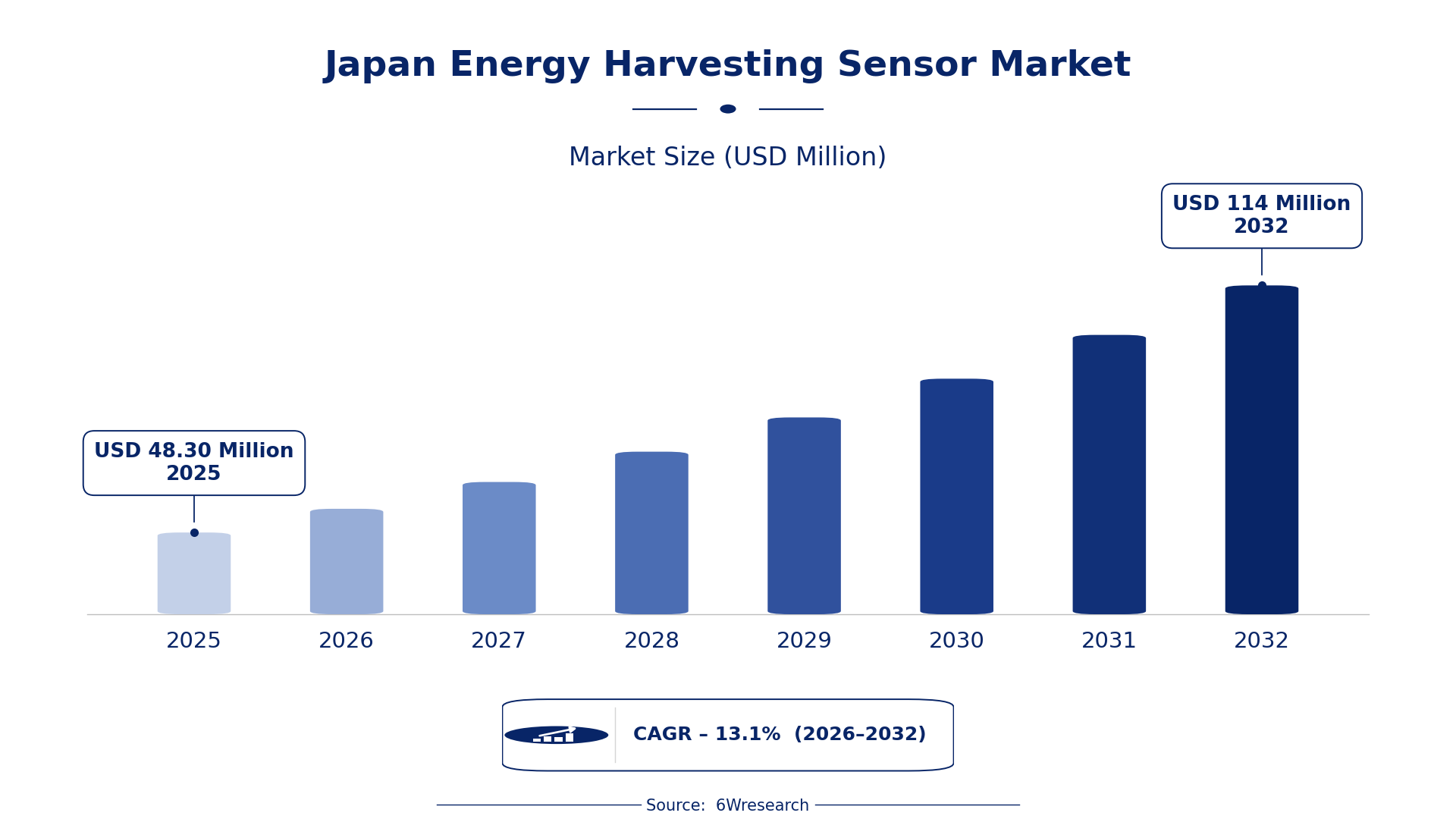
According to 6Wresearch internal database and industry insights, the Japan Energy Harvesting Sensor Market was valued at USD 48.30 Million in 2025 and is projected to reach USD 114 Million by 2032, growing at a CAGR of approximately 13.1% during 2026–2032.
Japan Energy Harvesting Sensor Market Highlights
| Report Metric | Details |
| Report Name | Japan Energy Harvesting Sensor Market (2026-2032) |
| Market Size 2025 | USD 48.30 Million |
| Market Size 2032 | USD 114 Million |
| Absolute Growth 2025–2032 | USD 65.70 Million |
| CAGR 2026–2032 | 13.1% |
| Peak Annual Growth | 14.6% in 2030 |
| Forecast Period | 2026–2032 |
| Historical Data | 2022–2025 |
| Base Year | 2025 |
| Leading Sensor Type, 2025 | Piezoelectric Sensor (39% share) |
| Leading Energy Source, 2025 | Vibration (44% share) |
| Leading Communication Tech, 2025 | Bluetooth Low Energy (48% share) |
| Leading End User, 2025 | Smart Factories (40% share) |
| Fastest-Growing Sensor Type | Thermoelectric Sensor (14.6% CAGR) |
| Fastest-Growing Energy Source | Heat (18.2% CAGR) |
| Fastest-Growing Communication Tech | Zigbee (16.9% CAGR) |
| Fastest-Growing End User | Industrial IoT (18.4% CAGR) |
| Growing Sector | smart factories |
| Key End Users | manufacturers, agricultural producers, IoT solution providers, industrial automation firms |
Japan Energy Harvesting Sensor Market Year-wise Growth Rate and Key Drivers (2022–2032)
This graph illustrates the annual growth rates of the market from 2022 to 2032, highlighting a steady upward trajectory and projected market expansion over the forecast period.
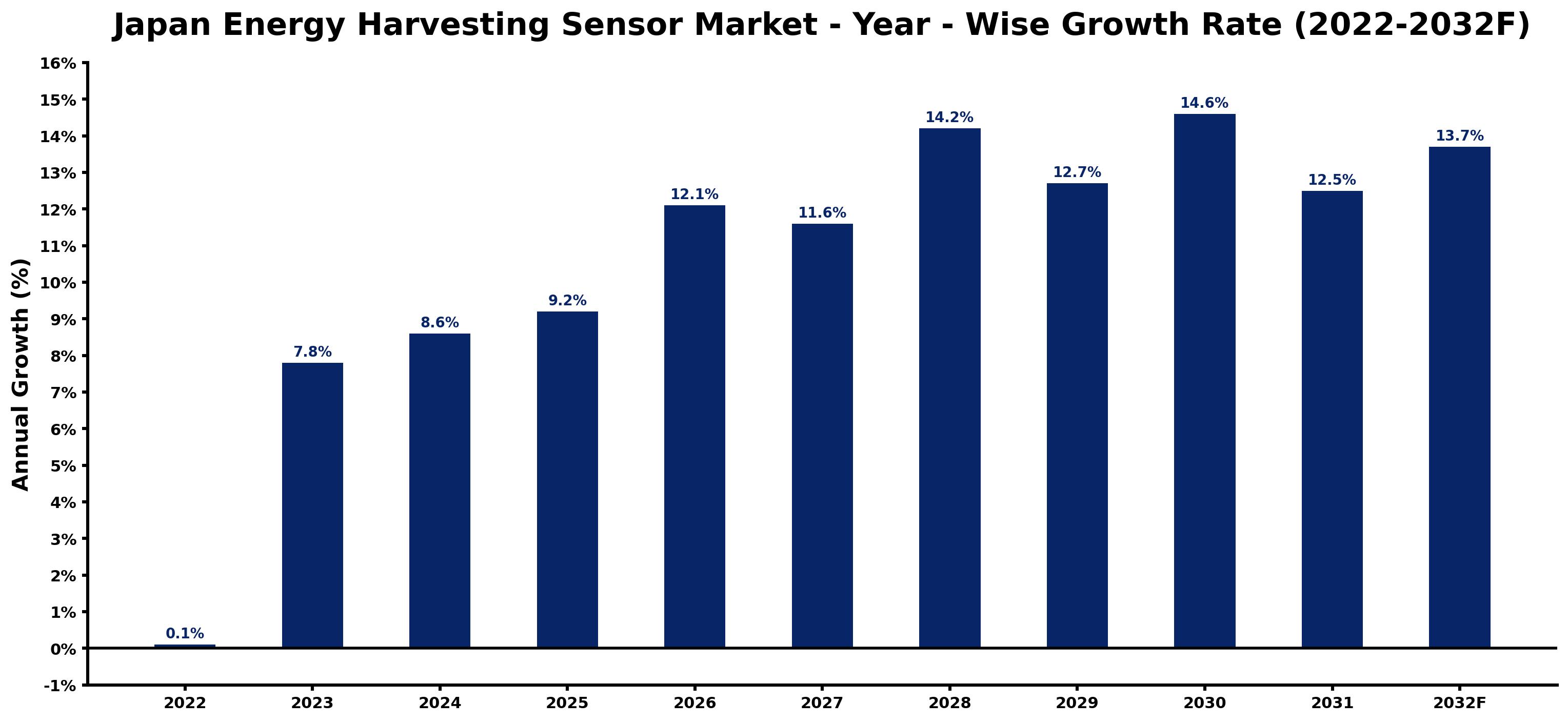
Each row of the following table gives one year's estimated growth and the event or demand shift that explains it.
| Year | Estimated Annual Growth (%) | Market Rationale |
| 2022 | 0.1 | The market showed minimal growth as initial adoption of energy harvesting sensors began. |
| 2023 | 7.8 | Demand rose due to increased interest in energy-efficient technologies among manufacturers. |
| 2024 | 8.6 | Growth continued as more smart factories integrated energy harvesting solutions into operations. |
| 2025 | 9.2 | The market peaked historically as awareness of sustainability drove sensor adoption. |
| 2026 | 12.1 | Growth is expected to accelerate with new investments in industrial IoT technologies. |
| 2027 | 11.6 | A slight slowdown is projected as the market adjusts to previous high growth rates. |
| 2028 | 14.2 | Demand is expected to surge again as energy efficiency initiatives gain traction across multiple sectors. |
| 2029 | 12.7 | Growth is projected to slow slightly as the market stabilises after rapid expansion in prior years. |
| 2030 | 14.6 | The market is expected to reach its peak growth rate as energy harvesting technology becomes mainstream. |
| 2031 | 12.5 | A slowdown is projected as market growth begins to normalise after peak levels. |
| 2032 | 13.7 | Growth is expected to resume as new applications for energy harvesting sensors emerge in various sectors. |
Note: Market size estimations and growth projections presented in this report are based on 6Wresearch's proprietary forecasting methodology, utilizing the latest available industry data, government publications, and primary research inputs.
Japan Energy Harvesting Sensor Market Synopsis
Energy harvesting sensors convert ambient energy into electrical energy, primarily using piezoelectric or thermoelectric materials. These devices power wireless systems and monitor operations across sectors such as industrial automation and smart agriculture. The Japan Energy Harvesting Sensor Market is experiencing rapid growth, driven by the implementation of these technologies in over 100 smart factories and a projected JPY 150 trillion investment in decarbonisation by 2033, reflecting a strong demand for efficient solutions.
Market Dynamics Impact Analysis (2026–2032)
| Factor | Type | Impact | Primary Segment Affected |
| Increased investment in smart factories | Driver | High | Smart Factories |
| Growing emphasis on energy efficiency in manufacturing | Driver | High | Industrial IoT |
| Rising demand for renewable energy solutions | Opportunity | High | Smart Agriculture |
| Expansion of wireless sensor networks in various applications | Opportunity | Medium | Wireless Sensor Nets |
| High initial costs of energy harvesting sensor technologies | Restraint | High | Piezoelectric Sensor |
| Limited awareness among potential users about energy harvesting benefits | Restraint | Medium | Thermoelectric Sensor |
| Compliance with strict energy standards and regulations | Challenge | High | RF Energy Sensor |
| Capacity constraints in production and supply chains | Challenge | Medium | Solar-Powered Sensor |
Evaluation of Drivers in Japan Energy Harvesting Sensor Market (2026–2032)
The factors lifting demand, and the evidence behind each, are summarised below.
| Drivers | Primary Segment Affected | Why It Matters (Evidence) |
| Investment in smart factories | Smart Factories | Over 100 smart factories in Japan are adopting energy harvesting technologies to improve operational efficiency. |
| Focus on energy efficiency | Industrial IoT | Japan's national initiatives aim for a 46% reduction in greenhouse gas emissions by 2030. |
| Adoption of renewable energy sources | Smart Agriculture | The government allocated ¥10 billion for smart agriculture initiatives in 2023, boosting sensor demand. |
| Integration of wireless sensor networks | Wireless Sensor Nets | The adoption rate of wireless sensor networks in Japan is around 30%, driving more purchases. |
| Technological advancements in sensor materials | Thermoelectric Sensor | Innovations in thermoelectric materials improve sensor efficiency, attracting more industrial applications. |
Behind the steady rise in orders sits the growing focus on energy efficiency in manufacturing, with Japan targeting a 46% reduction in greenhouse gas emissions by 2030. More than 100 smart factories are implementing these technologies, contributing to a projected 15% decrease in energy consumption by 2025. The adoption of wireless sensor networks is around 30%, indicating a strong market for integrated solutions. Innovations in thermoelectric materials are also improving sensor efficiency, further boosting demand in industrial applications.
Evaluation of Restraints in Japan Energy Harvesting Sensor Market
The table below lists the restraints and the evidence behind each.
| Market Restraint | Primary Segment Affected | Why It Matters (Evidence) |
| High initial costs of energy harvesting technologies | Piezoelectric Sensor | The high cost of implementation can deter manufacturers from adopting these sensors, limiting market growth. |
| Limited awareness of energy harvesting benefits | Thermoelectric Sensor | Many potential users remain unaware of the advantages, hindering wider adoption of these technologies. |
| Compliance with energy standards | RF Energy Sensor | Strict regulations require compliance with JIS standards, complicating market entry for new products. |
| Supply chain capacity constraints | Solar-Powered Sensor | Production limitations can delay the availability of sensors, affecting timely project implementation. |
| Technological integration challenges | Vibration | Integrating energy harvesting sensors with existing systems can be complex, slowing down adoption rates. |
Japan Energy Harvesting Sensor Market Challenges
In 2022, Japan's adoption rate of wireless sensor networks was around 30%, limiting access to advanced monitoring systems and delaying efficiency improvements for industrial users. Rapid technological advancements create integration challenges for suppliers, leading to product availability delays that disrupt manufacturers' production schedules. A shortage of skilled technicians hampers the deployment of energy harvesting sensors, causing implementation delays for producers. Rising material costs, driven by increased demand for renewable energy sources, inflate prices for buyers, impacting project budgets by up to 20%.
Trends in the Japan Energy Harvesting Sensor Market
Several trends are reshaping the Japan Energy Harvesting Sensor Market; the most important are set out below.
- Shift towards Smart Factories: Smart factories are increasingly adopting energy harvesting sensors to improve operational efficiency, with over 100 facilities implementing these technologies. This trend is expected to persist as manufacturers pursue sustainable solutions.
- Rise of Industrial IoT: The Tokyo metropolitan area is emerging as a hub for industrial IoT development, with a projected 15% reduction in energy consumption by 2025 due to sensor integration. This shift points to a growing market for energy harvesting sensors.
- Adoption of Energy Management Standards: ISO 50001 standards for energy management systems are gaining traction, promoting the use of energy harvesting sensors in various industries. This trend is set to drive demand for efficient energy solutions.
- Expansion of Wireless Sensor Networks: The adoption rate of wireless sensor networks in Japan is around 30%, signalling a growing trend towards integrated monitoring solutions. This expansion is likely to boost demand for energy harvesting sensors.
Investment Opportunities in the Japan Energy Harvesting Sensor Market
The openings below show where demand in the Japan Energy Harvesting Sensor Market is visible and how suppliers can enter.
- Investment in Smart Factories: The Tokyo metropolitan area is a key region for smart factory investments, with a projected increase in sensor adoption. Companies can enter this market through local partnerships to supply energy harvesting technologies.
- Focus on Smart Agriculture: With the government's ¥10 billion allocation for smart agriculture initiatives, there is a strong opportunity for suppliers of energy harvesting sensors. Collaborating with agricultural associations can facilitate market entry.
- Growth in Industrial IoT: The increasing integration of IoT solutions in industries presents a gap for energy harvesting sensor suppliers. Targeting industrial sectors in Japan can lead to valuable partnerships and contracts.
- Development of Renewable Energy Solutions: Japan's commitment to renewable energy sources creates a demand for energy harvesting sensors. Suppliers should consider entering through joint ventures with local firms to enhance market presence.
Government Initiatives in the Japan Energy Harvesting Sensor Market
The Hydrogen Society Promotion Act, enacted in 2024, supports low-carbon hydrogen supply chains, which can benefit energy harvesting sensor producers by creating a market for sustainable technologies. Additionally, the GX Promotion Act of 2023 establishes a framework for decarbonisation, encouraging investments in energy-efficient solutions.
The Ministry of Economy, Trade and Industry (METI) oversees the implementation of the GX Promotion Act, which funds projects aimed at improving energy efficiency in manufacturing. This support allows manufacturers to adopt energy harvesting sensors, improving their sustainability practices.
Future Insight of the Japan Energy Harvesting Sensor Market
The government’s commitment to a net zero target by 2050 will drive a policy shift towards energy harvesting sensors, prompting suppliers to innovate. By 2032, advancements in sensor technologies will lead to a projected 15% reduction in energy consumption in smart factories. The ¥150 trillion investment in decarbonisation over the next decade will stimulate demand for these sensors across various sectors. As ISO 50001 standards gain traction, buyers will benefit from enhanced energy management systems, ensuring greater efficiency and reliability.
Market Segmentation Analysis
Japan Energy Harvesting Sensor Market report covers a detailed analysis of the following market segments:
By Sensor Type – Piezoelectric Sensor Leads, Thermoelectric Sensor Expected to Grow Fastest
According to Saurav Kr Singh, Senior Research Analyst at 6Wresearch, with 39% of sensor type revenue in 2025, Piezoelectric Sensor was the largest category. The piezoelectric sensor segment leads the market as it is widely utilised in smart factories for converting mechanical energy into electrical energy, crucial for automation. With over 100 smart factories in Japan employing these sensors, their role in enhancing operational efficiency is vital. Over 2026–2032, Thermoelectric Sensor is expected to post the fastest growth, at a CAGR of 14.6%. Thermoelectric sensors are experiencing rapid growth due to a surge in demand for solutions that convert temperature differences into energy. This growth is further supported by government initiatives aimed at improving energy efficiency in manufacturing, which prioritise the use of these sensors. Suppliers must invest in thermoelectric sensor development to capitalise on the increasing adoption in various industrial applications.
By Energy Source – Vibration Leads, Heat Expected to Grow Fastest
Vibration took 44% of energy source revenue in 2025, more than any other category. Vibration leads the energy source segment, particularly in smart factories where mechanical vibrations are abundant. This energy source is vital for powering various monitoring systems and automation processes, ensuring uninterrupted operations. Heat is projected to grow fastest, at a CAGR of 18.2% during 2026–2032. Heat is the fastest-growing energy source, spurred by the pressing need for energy efficiency in industrial settings. The government's commitment to promoting decarbonisation investments further accelerates the adoption of heat-utilising technologies. Buyers should explore the integration of heat-based energy harvesting solutions to improve operational efficiency and sustainability.
By Communication Tech – Bluetooth Low Energy Leads, Zigbee Expected to Grow Fastest
Bluetooth Low Energy accounted for 48% of the market by communication tech in 2025. Bluetooth Low Energy is the leading communication technology due to its low power consumption, making it ideal for wireless sensor networks in industrial applications. Its adoption is supported by the increasing demand for energy-efficient communication solutions. The quickest growth will come from Zigbee, forecast to expand at a CAGR of 16.9% between 2026 and 2032. Zigbee is the fastest-growing communication technology as industries seek more reliable and low-power protocols for sensor networks. The integration of Zigbee in industrial IoT applications is expected to drive its rapid uptake. Suppliers must invest in Zigbee technology to meet the increasing demand for efficient communication in sensor networks.
By End User – Smart Factories Lead, Industrial IoT Expected to Grow Fastest
Smart Factories held 40% of the Japan Energy Harvesting Sensor Market by end user in 2025. Smart factories represent the largest end-user segment, leveraging energy harvesting sensors for automation and monitoring purposes. Their integration into manufacturing processes significantly improves operational efficiency, highlighting their critical role in this sector. Industrial IoT is set to record the highest CAGR in this split, 18.4% over 2026–2032. Industrial IoT is the fastest-growing end-user segment, with a notable increase in the adoption of sensor technologies for enhanced data collection and analysis. The ongoing expansion of smart factories is driving this growth, creating more opportunities for sensor utilisation. Suppliers should concentrate on the industrial IoT market to align with the growing trend of data-centric manufacturing.
Key Attractiveness of the Report
- 10 Years of Market Numbers
- Historical Data Starting from 2022 to 2025
- Base Year 2025
- Forecast Data until 2032
- Key Performance Indicators Impacting the Market
- Major Upcoming Developments and Projects
Key Highlights of the Report:
- Japan Energy Harvesting Sensor Market Outlook
- Market Size of Japan Energy Harvesting Sensor Market, 2025
- Forecast of Japan Energy Harvesting Sensor Market, 2032
- Historical Data and Forecast of Japan Energy Harvesting Sensor Revenues & Volume for the Period 2022-2032F
- Japan Energy Harvesting Sensor Market Trend Evolution
- Japan Energy Harvesting Sensor Market Drivers and Challenges
- Japan Energy Harvesting Sensor Price Trends
- Japan Energy Harvesting Sensor Porter's Five Forces
- Japan Energy Harvesting Sensor Industry Life Cycle
- Historical Data and Forecast of Japan Energy Harvesting Sensor Market Revenues & Volume By Sensor Type for the Period 2022-2032F
- Historical Data and Forecast of Japan Energy Harvesting Sensor Market Revenues & Volume By Piezoelectric Sensor for the Period 2022-2032F
- Historical Data and Forecast of Japan Energy Harvesting Sensor Market Revenues & Volume By Thermoelectric Sensor for the Period 2022-2032F
- Historical Data and Forecast of Japan Energy Harvesting Sensor Market Revenues & Volume By RF Energy Sensor for the Period 2022-2032F
- Historical Data and Forecast of Japan Energy Harvesting Sensor Market Revenues & Volume By Solar-Powered Sensor for the Period 2022-2032F
- Historical Data and Forecast of Japan Energy Harvesting Sensor Market Revenues & Volume By Energy Source for the Period 2022-2032F
- Historical Data and Forecast of Japan Energy Harvesting Sensor Market Revenues & Volume By Vibration for the Period 2022-2032F
- Historical Data and Forecast of Japan Energy Harvesting Sensor Market Revenues & Volume By Heat for the Period 2022-2032F
- Historical Data and Forecast of Japan Energy Harvesting Sensor Market Revenues & Volume By RF Signal for the Period 2022-2032F
- Historical Data and Forecast of Japan Energy Harvesting Sensor Market Revenues & Volume By Light for the Period 2022-2032F
- Historical Data and Forecast of Japan Energy Harvesting Sensor Market Revenues & Volume By Communication Tech for the Period 2022-2032F
- Historical Data and Forecast of Japan Energy Harvesting Sensor Market Revenues & Volume By Bluetooth Low Energy for the Period 2022-2032F
- Historical Data and Forecast of Japan Energy Harvesting Sensor Market Revenues & Volume By Zigbee for the Period 2022-2032F
- Historical Data and Forecast of Japan Energy Harvesting Sensor Market Revenues & Volume By WiFi for the Period 2022-2032F
- Historical Data and Forecast of Japan Energy Harvesting Sensor Market Revenues & Volume By LoRa for the Period 2022-2032F
- Historical Data and Forecast of Japan Energy Harvesting Sensor Market Revenues & Volume By End User for the Period 2022-2032F
- Historical Data and Forecast of Japan Energy Harvesting Sensor Market Revenues & Volume By Smart Factories for the Period 2022-2032F
- Historical Data and Forecast of Japan Energy Harvesting Sensor Market Revenues & Volume By Industrial IoT for the Period 2022-2032F
- Historical Data and Forecast of Japan Energy Harvesting Sensor Market Revenues & Volume By Wireless Sensor Nets for the Period 2022-2032F
- Historical Data and Forecast of Japan Energy Harvesting Sensor Market Revenues & Volume By Smart Agriculture for the Period 2022-2032F
- Japan Energy Harvesting Sensor Import Export Trade Statistics
- Market Opportunity Assessment By Sensor Type
- Market Opportunity Assessment By Energy Source
- Market Opportunity Assessment By Communication Tech
- Market Opportunity Assessment By End User
- Japan Energy Harvesting Sensor Top Companies Market Share
- Japan Energy Harvesting Sensor Competitive Benchmarking By Technical and Operational Parameters
- Japan Energy Harvesting Sensor Company Profiles
- Japan Energy Harvesting Sensor Key Strategic Recommendations
Market Covered
Segments analysed in this report are listed below.
By Sensor Type
- Piezoelectric Sensor
- Thermoelectric Sensor
- RF Energy Sensor
- Solar-Powered Sensor
By Energy Source
- Vibration
- Heat
- RF Signal
- Light
By Communication Tech
- Bluetooth Low Energy
- Zigbee
- WiFi
- LoRa
By End User
- Smart Factories
- Industrial IoT
- Wireless Sensor Nets
- Smart Agriculture































