Japan Energy Management IC Market Size & Growth Rate
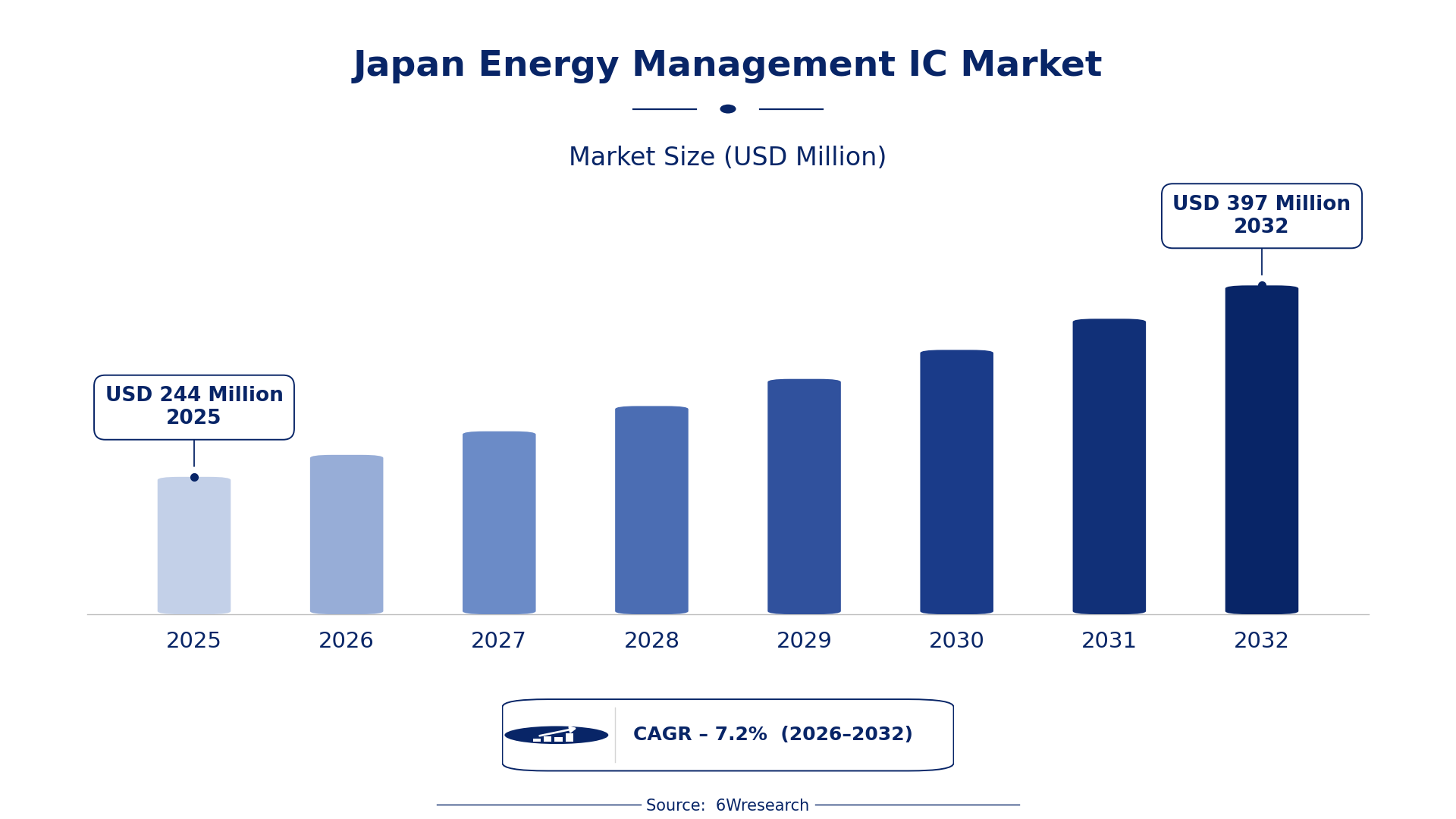
According to 6Wresearch internal database and industry insights, the Japan Energy Management IC Market was valued at USD 244 Million in 2025 and is projected to reach USD 397 Million by 2032, growing at a CAGR of approximately 7.2% during 2026–2032.
Japan Energy Management IC Market Highlights
| Report Metric | Details |
| Report Name | Japan Energy Management IC Market (2026-2032) |
| Market Size 2025 | USD 244 Million |
| Market Size 2032 | USD 397 Million |
| Absolute Growth 2025–2032 | USD 153 Million |
| CAGR 2026–2032 | 7.2% |
| Peak Annual Growth | 8.0% in 2026 |
| Forecast Period | 2026–2032 |
| Historical Data | 2022–2025 |
| Base Year | 2025 |
| Leading IC Type, 2025 | Power Management IC (44% share) |
| Leading Function, 2025 | Voltage Regulation (40% share) |
| Leading Application Area, 2025 | EV Batteries (35% share) |
| Leading End User, 2025 | OEMs (45% share) |
| Fastest-Growing IC Type | Battery Management IC (9.9% CAGR) |
| Fastest-Growing Function | Cell Balancing (9.2% CAGR) |
| Fastest-Growing Application Area | Smart Lighting (9.0% CAGR) |
| Fastest-Growing End User | EV Manufacturers (9.6% CAGR) |
| Growing Sector | Electric Vehicles |
| Key End Users | OEMs, EV Manufacturers, Lighting OEMs, Consumer Electronics |
Japan Energy Management IC Market Year-wise Growth Rate and Key Drivers (2022–2032)
This graph illustrates the annual growth rates of the market from 2022 to 2032, highlighting a steady upward trajectory and projected market expansion over the forecast period.
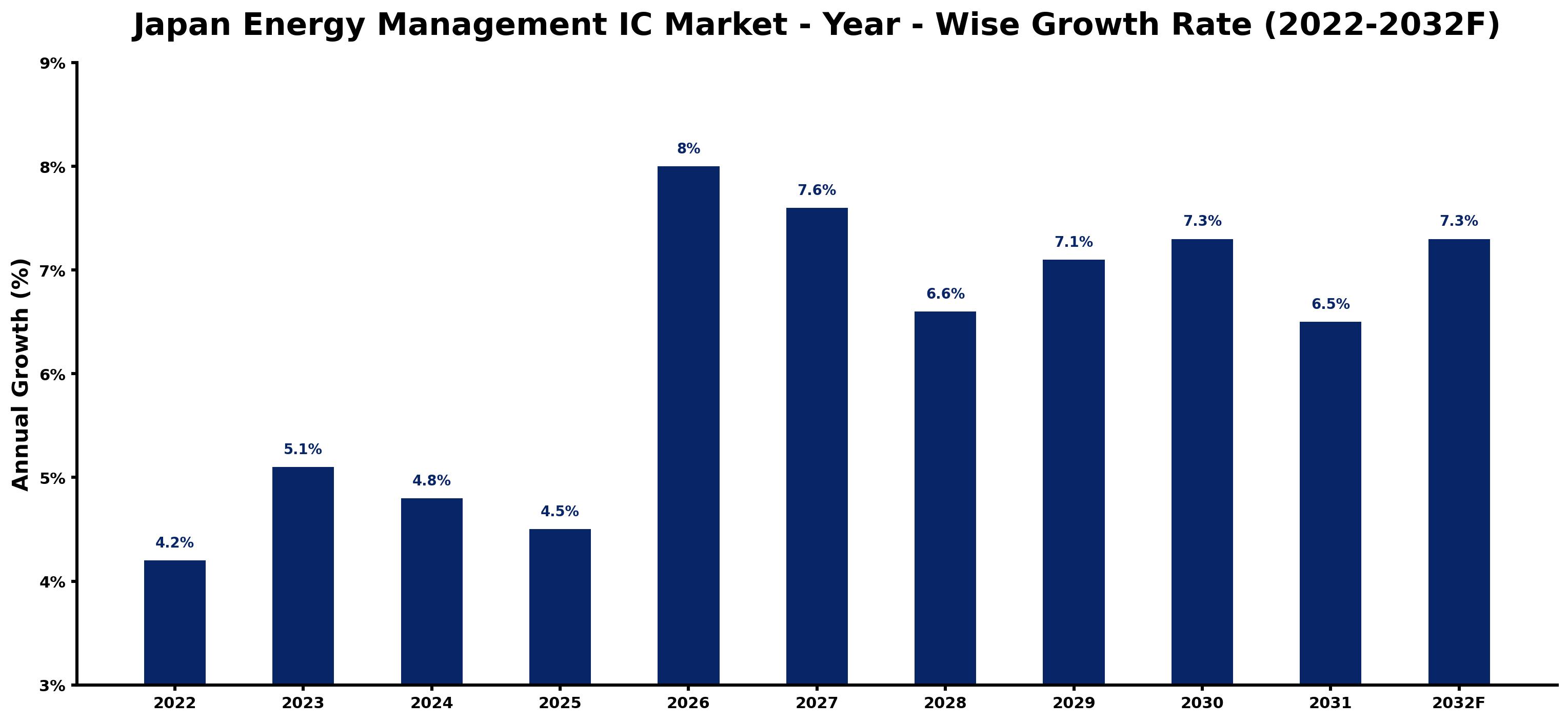
Annual growth estimates for each year appear below with the principal reason behind them, explaining the shifts that set the pace of the market.
| Year | Estimated Annual Growth (%) | Market Rationale |
| 2022 | 4.2 | The market showed steady growth as demand for energy-efficient technologies increased. |
| 2023 | 5.1 | Growth accelerated due to heightened interest in electric vehicles and energy management solutions. |
| 2024 | 4.8 | The market experienced a slowdown as competition intensified among semiconductor manufacturers. |
| 2025 | 4.5 | Demand continued to grow, although at a slower pace, influenced by market saturation. |
| 2026 | 8.0 | A surge in electric vehicle production and smart city initiatives is expected to drive growth. |
| 2027 | 7.6 | The market growth rate is projected to slow as the focus shifts towards product differentiation. |
| 2028 | 6.6 | Demand is expected to remain strong, but growth will decelerate due to increased competition and pricing pressures. |
| 2029 | 7.1 | Renewed interest in smart lighting systems is projected to boost market performance, leading to a growth rebound. |
| 2030 | 7.3 | The government’s push for electric vehicles will further stimulate demand for related ICs. |
| 2031 | 6.5 | Market growth is anticipated to slow as manufacturers face challenges in supply chain management. |
| 2032 | 7.3 | Increased adoption of energy-efficient technologies is expected to drive renewed growth. |
Note: Market size estimations and growth projections presented in this report are based on 6Wresearch's proprietary forecasting methodology, utilizing the latest available industry data, government publications, and primary research inputs.
Japan Energy Management IC Market Synopsis
Energy Management ICs are semiconductor devices that optimise energy usage in electronic systems, manufactured through silicon wafer processes and various fabrication techniques. The Japan Energy Management IC Market is experiencing growth, driven by the electric vehicle sector, which is projected to expand substantially. The government aims to have 1 million electric vehicles on the road by 2030, which will increase demand for battery management ICs. The Smart City initiative promotes energy-efficient solutions in urban areas, stimulating overall market growth.
Market Dynamics Impact Analysis (2026–2032)
| Factor | Type | Impact | Primary Segment Affected |
| Growing electric vehicle market driving demand for battery management ICs | Driver | High | Battery Management IC |
| Increased focus on energy-efficient technologies in urban areas | Driver | High | Power Management IC |
| Rising demand for smart lighting solutions in urban settings | Opportunity | Medium | LED Driver IC |
| Expansion of electric vehicle production capacity in Japan | Opportunity | Medium | Battery Management IC |
| Intense competition among semiconductor manufacturers | Restraint | High | Power Management IC |
| Challenges in supply chain management affecting production timelines | Restraint | Medium | Battery Management IC |
| High production costs impacting profit margins for manufacturers | Challenge | High | Power Management IC |
| Technological advancements requiring continuous investment in R&D | Challenge | Medium | LED Driver IC |
Evaluation of Drivers in Japan Energy Management IC Market (2026–2032)
The following drivers explain most of the expected growth.
| Drivers | Primary Segment Affected | Why It Matters (Evidence) |
| Increased electric vehicle production | Battery Management IC | Japan aims for 1 million electric vehicles on the road by 2030, boosting demand for battery management solutions. |
| Government initiatives promoting energy-efficient technologies | Power Management IC | The Smart City initiative drives demand for energy management ICs across urban developments. |
| Rising adoption of smart lighting systems | LED Driver IC | Smart lighting installations in Japan are projected to reach 10 million units by 2025, increasing IC usage. |
| Growing consumer electronics market | Power Management IC | Japan's population of approximately 126 million drives demand for energy-efficient technologies in devices. |
| Investment in renewable energy solutions | Battery Management IC | Japan's target for 100% renewable energy by 2050 increases the need for efficient energy storage systems. |
Most of the extra volume comes from increased electric vehicle production, with Japan targeting 1 million EVs by 2030, which will substantially raise demand for battery management ICs. The urban focus on sustainability is propelling the adoption of energy-efficient technologies across various sectors. With a population of about 126 million, there is a strong push for energy-efficient solutions in consumer electronics. Smart lighting installations are expected to reach 10 million units by 2025, further driving demand for LED driver ICs. Japan's commitment to achieving 100% renewable energy by 2050 will stimulate the battery management IC segment.
Evaluation of Restraints in Japan Energy Management IC Market
The main factors holding the market back are set out below.
| Market Restraint | Primary Segment Affected | Why It Matters (Evidence) |
| High production costs affecting profit margins | Power Management IC | Production costs are rising due to increased material prices, impacting profitability for manufacturers. |
| Supply chain disruptions delaying production timelines | Battery Management IC | Global supply chain issues have led to delays in semiconductor manufacturing, affecting timely delivery. |
| Intense competition leading to price wars | LED Driver IC | Competition among manufacturers is driving prices down, squeezing margins and profitability. |
| Regulatory compliance costs for energy efficiency standards | Power Management IC | Compliance with energy efficiency regulations increases operational costs for manufacturers. |
| Technological advancements requiring continuous investment | Battery Management IC | Rapid technological changes necessitate ongoing R&D investment, straining financial resources. |
Japan Energy Management IC Market Challenges
In Japan, buyers face rising costs for energy management ICs, inflating overall product prices by up to 10%. Producers encounter skills shortages in semiconductor manufacturing, which delay product launches and weaken their competitive edge. Technology gaps in energy management systems lead to inefficiencies, increasing operational costs for buyers by as much as 15%. Supply chain disruptions for semiconductor materials can cause delays of up to six months for importers, complicating their ability to meet market demand.
Trends in the Japan Energy Management IC Market
The following changes are redrawing the Japan Energy Management IC Market.
- Shift in Focus to Smart Lighting Solutions: Lighting OEMs are increasingly adopting smart lighting systems, driven by urban demand for energy efficiency. By 2025, smart lighting installations in Japan are expected to reach 10 million units, boosting the market for LED driver ICs.
- Transition from Conventional to Electric Vehicles: The electric vehicle market in Japan is expanding rapidly, with a target of 1 million EVs by 2030. This shift is increasing demand for battery management ICs, crucial for EV performance.
- Emergence of Energy Management Standards: The adoption of ISO 50001 by many Japanese companies is promoting energy management systems. This standardisation is driving demand for energy management ICs across various sectors, supporting overall market growth.
- Growing Investment in Decarbonisation: Japan's GX Basic Policy targets JPY 150 trillion in decarbonisation investment over 10 years. This commitment will boost demand for energy-efficient technologies and related ICs.
Investment Opportunities in the Japan Energy Management IC Market
Where to invest in the Japan Energy Management IC Market: the main openings are set out below.
- Tokyo as a Semiconductor Manufacturing Hub: Tokyo's semiconductor manufacturing capabilities present an opportunity for investment in energy management IC production. The region's expertise can support the growing demand for power management ICs.
- Current Demand for EV Battery Solutions: With Japan aiming for 1 million electric vehicles by 2030, there is a pressing need for advanced battery management ICs. Collaborating with EV manufacturers can facilitate entry into this expanding market.
- Need for Energy-Efficient Solutions in Urban Areas: As urban areas focus on sustainability, the demand for energy-efficient technologies is rising. Engaging with local governments in the Smart City initiative can open doors for suppliers.
- Gap in Smart Lighting Technologies: With smart lighting installations expected to reach 10 million units by 2025, there is a gap in supply for LED driver ICs. Suppliers can enter this market by partnering with lighting OEMs.
Government Initiatives in the Japan Energy Management IC Market
The Hydrogen Society Promotion Act, introduced in 2024, supports low-carbon hydrogen and ammonia supply chains with price-gap support. This act builds on the Energy Conservation Law, which obliges large energy users to improve energy efficiency and report energy use, strengthening the regulatory framework for energy management technologies.
The Ministry of Economy, Trade and Industry (METI) is responsible for approving and funding projects related to energy management technologies. METI's initiatives include the Battery Industry Strategy, which aims to increase domestic battery manufacturing capacity to 150 GWh by 2030, supporting the growth of energy management ICs.
Future Insight of the Japan Energy Management IC Market
The introduction of smart grid initiatives will accelerate the shift towards energy-efficient technologies, driving interest in energy management ICs. By 2032, Japan's public and private decarbonisation investments are projected to total JPY 150 trillion, enhancing the development of advanced semiconductor solutions. The adoption of ISO 50001 will streamline energy management practices, benefiting both suppliers and buyers. With the government targeting 1 million electric vehicles on the road by 2030, the demand for related ICs will expand significantly.
Market Segmentation Analysis
Japan Energy Management IC Market report covers a detailed analysis of the following market segments:
By IC Type – Power Management IC Leads, Battery Management IC Expected to Grow Fastest
According to Saurav Kr Singh, Senior Research Analyst at 6Wresearch, Power Management IC took 44% of ic type revenue in 2025, more than any other category. Power Management ICs hold the largest share due to their critical role in efficient power distribution across various electronic devices, especially in consumer electronics. The robust semiconductor manufacturing ecosystem in the Tokyo region ensures a solid installed base for these ICs. Over 2026–2032, Battery Management IC is expected to post the fastest growth, at a CAGR of 9.9%. Battery Management ICs are experiencing rapid growth as the electric vehicle market expands, with projections indicating a need for advanced systems to support 1 million electric vehicles by 2030. This growth will further solidify the dominance of Power Management ICs, as they are essential for overall energy management. Suppliers should focus on enhancing their Power Management IC offerings to cater to the increasing demand across diverse sectors.
By Function – Voltage Regulation Leads, Cell Balancing Expected to Grow Fastest
In 2025, Voltage Regulation led the function split with a 40% share. Voltage Regulation is the leading function as it is vital for maintaining stable voltage levels in electronic systems, ensuring optimal performance across various applications. Its widespread adoption in industries such as automotive and consumer electronics drives its market share. Cell Balancing is projected to grow fastest, at a CAGR of 9.2% during 2026–2032. Cell Balancing is growing rapidly due to the increasing complexity of battery systems in electric vehicles, where optimal performance is critical for efficiency and longevity. As demand for electric vehicles rises, the need for effective Cell Balancing solutions will also increase. Buyers should prioritise suppliers that provide advanced Voltage Regulation solutions to ensure reliable performance.
By Application Area – EV Batteries Lead, Smart Lighting Expected to Grow Fastest
EV Batteries held 35% of the Japan Energy Management IC Market by application area in 2025. EV Batteries lead the application area as they are vital for managing power systems in electric vehicles, which are becoming increasingly common in Japan. The government's goal of having 1 million electric vehicles on the road by 2030 drives strong demand for these ICs. Smart Lighting is set to record the highest CAGR in this split, 9.0% over 2026–2032. Smart Lighting is the fastest-growing application area, propelled by the Smart City initiative that advocates for energy-efficient solutions in urban settings. The expected installation of 10 million smart lighting units by 2025 will significantly boost demand for associated ICs. Suppliers should consider diversifying their product lines to address the rising needs in Smart Lighting applications.
By End User – OEMs Lead, EV Manufacturers Expected to Grow Fastest
With 45% of end user revenue in 2025, OEMs was the largest category. OEMs represent the largest end-user group as they are the primary consumers of energy management solutions across various sectors, including automotive and consumer electronics. Their high production volumes create a consistent demand for these technologies. The quickest growth will come from EV Manufacturers, forecast to expand at a CAGR of 9.6% between 2026 and 2032. EV Manufacturers are the fastest-growing end-user segment, driven by the rising production of electric vehicles and the increasing necessity for advanced battery management technologies. This trend will further enhance the demand for OEMs as they adapt to the changing market landscape. Buyers should align their procurement strategies with the increasing requirements of EV Manufacturers to maintain a competitive edge.
Key Attractiveness of the Report
- 10 Years of Market Numbers
- Historical Data Starting from 2022 to 2025
- Base Year 2025
- Forecast Data until 2032
- Key Performance Indicators Impacting the Market
- Major Upcoming Developments and Projects
Key Highlights of the Report:
- Japan Energy Management IC Market Outlook
- Market Size of Japan Energy Management IC Market, 2025
- Forecast of Japan Energy Management IC Market, 2032
- Historical Data and Forecast of Japan Energy Management IC Revenues & Volume for the Period 2022-2032F
- Japan Energy Management IC Market Trend Evolution
- Japan Energy Management IC Market Drivers and Challenges
- Japan Energy Management IC Price Trends
- Japan Energy Management IC Porter's Five Forces
- Japan Energy Management IC Industry Life Cycle
- Historical Data and Forecast of Japan Energy Management IC Market Revenues & Volume By IC Type for the Period 2022-2032F
- Historical Data and Forecast of Japan Energy Management IC Market Revenues & Volume By Power Management IC for the Period 2022-2032F
- Historical Data and Forecast of Japan Energy Management IC Market Revenues & Volume By Battery Management IC for the Period 2022-2032F
- Historical Data and Forecast of Japan Energy Management IC Market Revenues & Volume By LED Driver IC for the Period 2022-2032F
- Historical Data and Forecast of Japan Energy Management IC Market Revenues & Volume By Energy Harvesting IC for the Period 2022-2032F
- Historical Data and Forecast of Japan Energy Management IC Market Revenues & Volume By Function for the Period 2022-2032F
- Historical Data and Forecast of Japan Energy Management IC Market Revenues & Volume By Voltage Regulation for the Period 2022-2032F
- Historical Data and Forecast of Japan Energy Management IC Market Revenues & Volume By Cell Balancing for the Period 2022-2032F
- Historical Data and Forecast of Japan Energy Management IC Market Revenues & Volume By Dimming Control for the Period 2022-2032F
- Historical Data and Forecast of Japan Energy Management IC Market Revenues & Volume By Micro-Conversion for the Period 2022-2032F
- Historical Data and Forecast of Japan Energy Management IC Market Revenues & Volume By Application Area for the Period 2022-2032F
- Historical Data and Forecast of Japan Energy Management IC Market Revenues & Volume By Smartphones for the Period 2022-2032F
- Historical Data and Forecast of Japan Energy Management IC Market Revenues & Volume By EV Batteries for the Period 2022-2032F
- Historical Data and Forecast of Japan Energy Management IC Market Revenues & Volume By Smart Lighting for the Period 2022-2032F
- Historical Data and Forecast of Japan Energy Management IC Market Revenues & Volume By IoT Devices for the Period 2022-2032F
- Historical Data and Forecast of Japan Energy Management IC Market Revenues & Volume By End User for the Period 2022-2032F
- Historical Data and Forecast of Japan Energy Management IC Market Revenues & Volume By OEMs for the Period 2022-2032F
- Historical Data and Forecast of Japan Energy Management IC Market Revenues & Volume By EV Manufacturers for the Period 2022-2032F
- Historical Data and Forecast of Japan Energy Management IC Market Revenues & Volume By Lighting OEMs for the Period 2022-2032F
- Historical Data and Forecast of Japan Energy Management IC Market Revenues & Volume By Sensor Makers for the Period 2022-2032F
- Japan Energy Management IC Import Export Trade Statistics
- Market Opportunity Assessment By IC Type
- Market Opportunity Assessment By Function
- Market Opportunity Assessment By Application Area
- Market Opportunity Assessment By End User
- Japan Energy Management IC Top Companies Market Share
- Japan Energy Management IC Competitive Benchmarking By Technical and Operational Parameters
- Japan Energy Management IC Company Profiles
- Japan Energy Management IC Key Strategic Recommendations
Market Covered
Coverage by segment is as follows.
By IC Type
- Power Management IC
- Battery Management IC
- LED Driver IC
- Energy Harvesting IC
By Function
- Voltage Regulation
- Cell Balancing
- Dimming Control
- Micro-Conversion
By Application Area
- Smartphones
- EV Batteries
- Smart Lighting
- IoT Devices
By End User
- OEMs
- EV Manufacturers
- Lighting OEMs
- Sensor Makers































