Japan Energy Scavenging Technology Market Size & Growth Rate
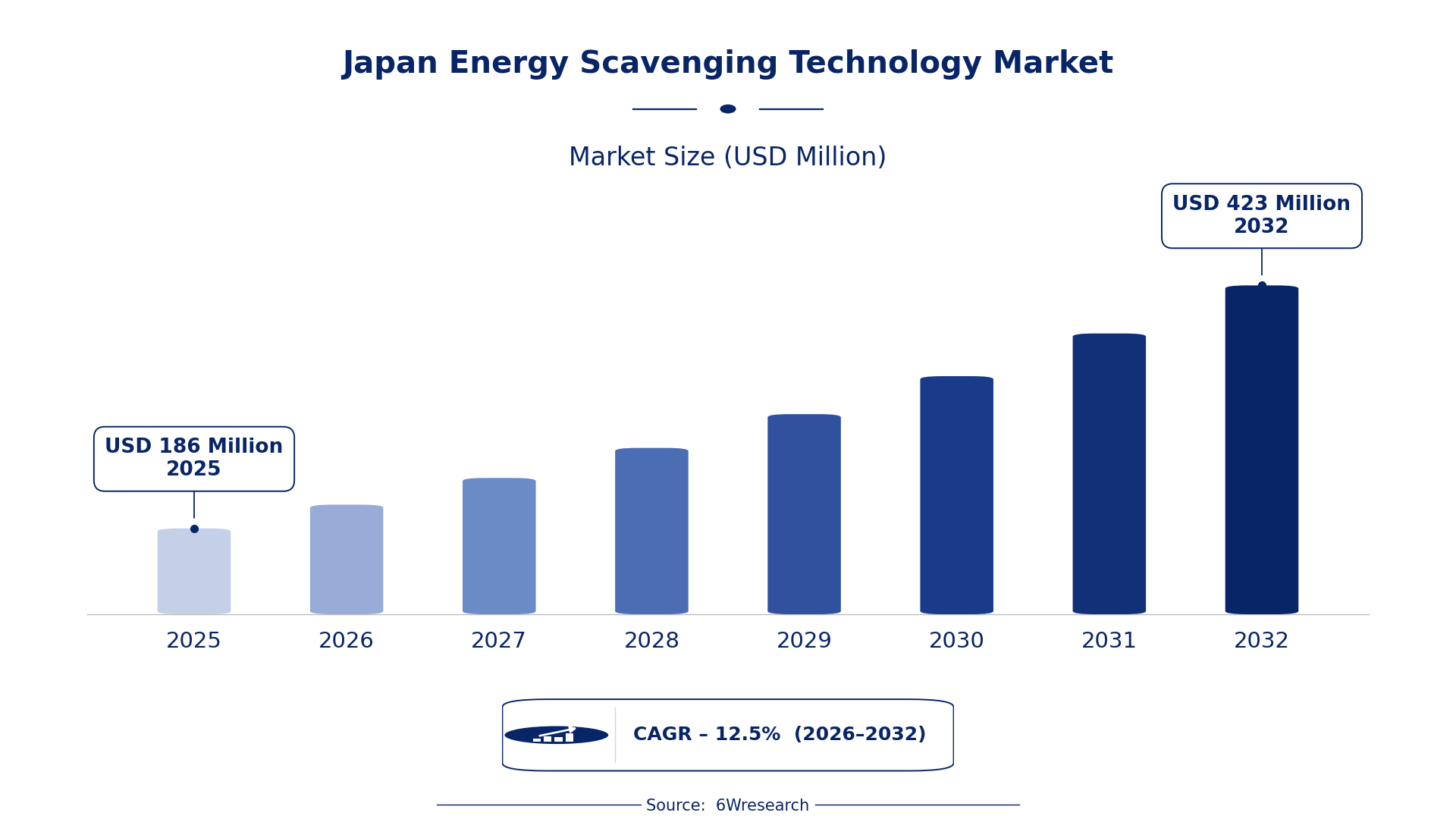
According to 6Wresearch internal database and industry insights, the Japan Energy Scavenging Technology Market was valued at USD 186 Million in 2025 and is projected to reach USD 423 Million by 2032, growing at a CAGR of approximately 12.5% during 2026–2032.
Japan Energy Scavenging Technology Market Highlights
| Report Metric | Details |
| Report Name | Japan Energy Scavenging Technology Market (2026-2032) |
| Market Size 2025 | USD 186 Million |
| Market Size 2032 | USD 423 Million |
| Absolute Growth 2025–2032 | USD 237 Million |
| CAGR 2026–2032 | 12.5% |
| Peak Annual Growth | 13.2% in 2028 |
| Forecast Period | 2026–2032 |
| Historical Data | 2022–2025 |
| Base Year | 2025 |
| Leading Technology Type, 2025 | Thermoelectric Generator (42% share) |
| Leading Energy Source, 2025 | Heat (45% share) |
| Leading Conversion Method, 2025 | Seebeck Effect (43% share) |
| Leading End User, 2025 | Wearable Electronics (40% share) |
| Fastest-Growing Technology Type | Piezoelectric System (18.4% CAGR) |
| Fastest-Growing Energy Source | Motion (17.3% CAGR) |
| Fastest-Growing Conversion Method | Charge Accumulation (18.1% CAGR) |
| Fastest-Growing End User | Structural Monitoring (16.8% CAGR) |
| Growing Sector | Wearable Electronics |
| Key End Users | Technology developers, automotive manufacturers, infrastructure monitoring firms, IoT solution providers |
Japan Energy Scavenging Technology Market Year-wise Growth Rate and Key Drivers (2022–2032)
This graph illustrates the annual growth rates of the market from 2022 to 2032, highlighting a steady upward trajectory and projected market expansion over the forecast period.
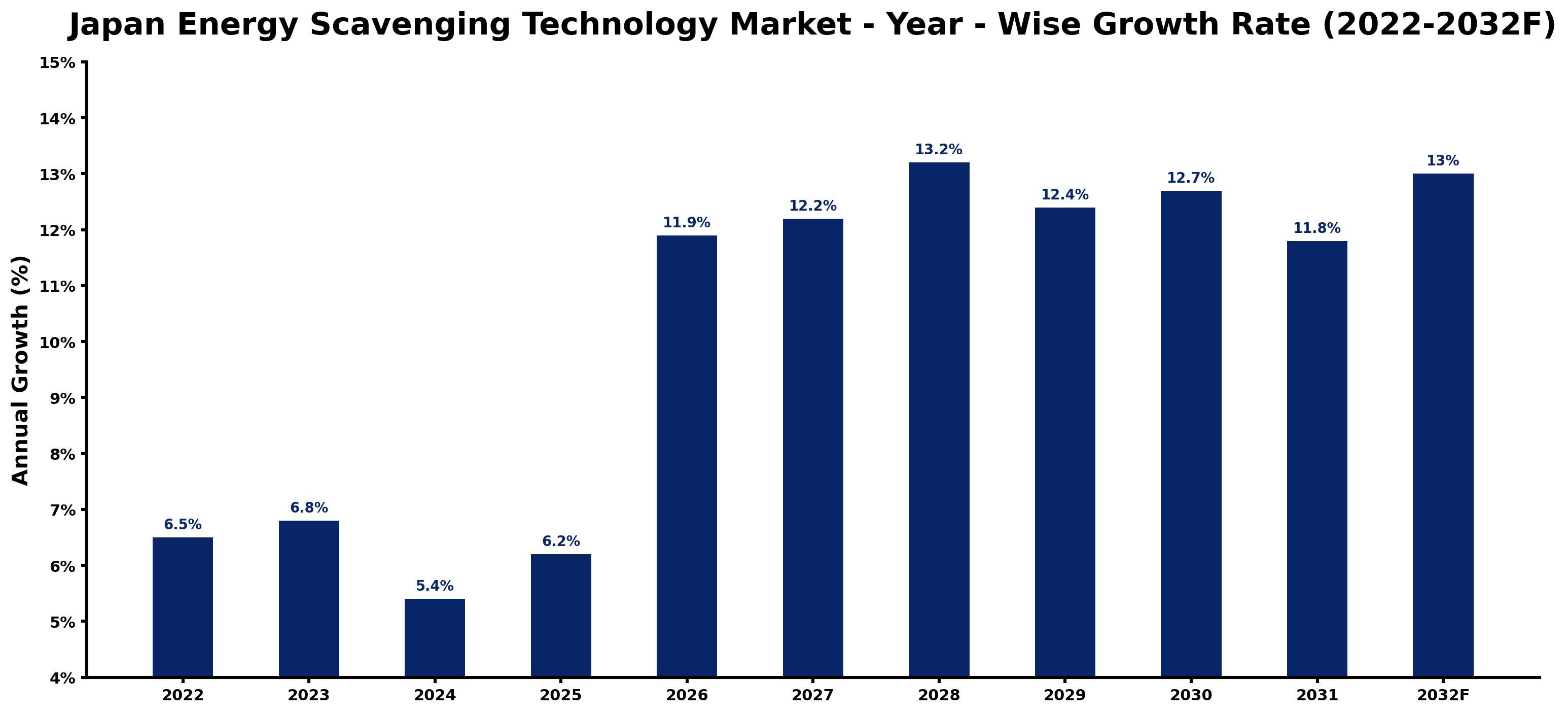
For each year, the table pairs the estimated growth rate with the leading influence on demand, showing how the drivers changed across the period.
| Year | Estimated Annual Growth (%) | Market Rationale |
| 2022 | 6.5 | The market showed steady growth due to increased interest in energy efficiency technologies. |
| 2023 | 6.8 | Growth accelerated as more technology developers adopted energy scavenging solutions. |
| 2024 | 5.4 | The market experienced a slowdown as demand stabilised after rapid expansion. |
| 2025 | 6.2 | Growth resumed as new applications in wearable electronics gained traction. |
| 2026 | 11.9 | Demand is expected to surge with rising investments in decarbonisation and sustainable technologies. |
| 2027 | 12.2 | Continued innovation in energy harvesting technologies is projected to drive further growth. |
| 2028 | 13.2 | The peak growth rate is anticipated as major projects are launched. |
| 2029 | 12.4 | Growth is expected to slow slightly as the market begins to mature and stabilise. |
| 2030 | 12.7 | Demand will increase again due to heightened awareness of sustainability initiatives. |
| 2031 | 11.8 | The market is projected to continue growing, albeit at a slower pace as competition intensifies. |
| 2032 | 13.0 | Growth is expected to remain strong as new applications emerge in structural monitoring. |
Note: Market size estimations and growth projections presented in this report are based on 6Wresearch's proprietary forecasting methodology, utilizing the latest available industry data, government publications, and primary research inputs.
Japan Energy Scavenging Technology Market Synopsis
Energy scavenging technology converts ambient energy into usable electrical energy through methods like thermoelectric, piezoelectric, and photovoltaic processes. It powers small electronic devices, particularly in sectors like wearable electronics and structural monitoring. The Japan Energy Scavenging Technology Market is expanding due to increasing investments in decarbonisation, with public and private funding projected to reach JPY 150 trillion over ten years. The Tokyo metropolitan area is a key hub for development, driving demand from technology developers and innovators.
Market Dynamics Impact Analysis (2026–2032)
| Factor | Type | Impact | Primary Segment Affected |
| Growing investment in decarbonisation technologies | Driver | High | Thermoelectric Generator |
| Rising demand for energy-efficient solutions in consumer electronics | Driver | High | Piezoelectric System |
| Emerging applications in structural monitoring | Opportunity | Medium | Structural Monitoring |
| Increased focus on IoT applications for energy harvesting | Opportunity | Medium | Sensor Nodes |
| High initial costs of technology adoption | Restraint | High | Photovoltaic Micro Cell |
| Limited awareness among potential users | Restraint | Medium | RF Energy Collector |
| Competition from alternative energy solutions | Challenge | High | Thermoelectric Generator |
| Technological complexities in integration | Challenge | Medium | Thermoelectric Generator |
Evaluation of Drivers in Japan Energy Scavenging Technology Market (2026–2032)
Key forces behind demand, with the segment each one moves most, are listed below.
| Drivers | Primary Segment Affected | Why It Matters (Evidence) |
| Increased investments in decarbonisation initiatives | Thermoelectric Generator | Japan's GX Basic Policy targets JPY 150 trillion in investments over ten years, boosting demand for energy scavenging technologies. |
| Growing adoption of wearable devices | Piezoelectric System | The population of Japan, approximately 125 million, drives demand for energy-efficient wearable electronics. |
| Expansion of IoT applications | Sensor Nodes | The total installed base of sensor nodes in Japan is estimated at 1.2 million units, driving demand for energy harvesting solutions. |
| Rising focus on sustainability | Photovoltaic Micro Cell | Japan's strict energy efficiency standards encourage the adoption of renewable energy technologies. |
| Technological advancements in energy harvesting | RF Energy Collector | The RF energy collector technology is primarily used in telecommunications, increasing its market presence. |
Most of the extra volume comes from heightened investments in sustainable technologies, with Japan targeting a 46% cut in greenhouse-gas emissions by 2030. The total installed base of sensor nodes is estimated at 1.2 million units, indicating strong demand for energy scavenging solutions in IoT applications. The growing population of approximately 125 million drives the need for energy-efficient wearable devices. The introduction of a budget of ¥5 billion in 2023 further supports technology adoption, while the emphasis on decarbonisation fuels the market for thermoelectric generators and piezoelectric systems.
Evaluation of Restraints in Japan Energy Scavenging Technology Market
The following restraints limit how fast demand can grow.
| Market Restraint | Primary Segment Affected | Why It Matters (Evidence) |
| High initial costs of technology implementation | Photovoltaic Micro Cell | The average cost of implementing energy scavenging systems can exceed JPY 1 million, deterring some buyers. |
| Limited awareness among potential users | RF Energy Collector | Many potential users are unaware of the benefits of RF energy harvesting, limiting market growth. |
| Competition from alternative energy solutions | Thermoelectric Generator | Alternative renewable energy sources may offer lower costs, affecting the adoption of energy scavenging technologies. |
| Technological complexities in integration | Thermoelectric Generator | Integrating energy scavenging technology into existing systems can be technically challenging and costly. |
| Regulatory hurdles for new technologies | Thermoelectric Generator | Stricter regulations on energy efficiency can complicate the approval process for new products. |
Japan Energy Scavenging Technology Market Challenges
Buyers face increased costs as Japan's strict energy efficiency standards raise production expenses for energy scavenging devices by 20%. Skills shortages in advanced manufacturing techniques lead to delays, extending product development timelines by an average of six months for producers. Competition among producers intensifies, resulting in price wars that can erode profit margins by 15%. Importers encounter disruptions in supply chains, causing delays in the delivery of critical components that can extend lead times by three weeks for buyers.
Trends in the Japan Energy Scavenging Technology Market
Buyers and suppliers in the Japan Energy Scavenging Technology Market are adjusting to the following trends.
- Shift from Conventional to Energy Scavenging Solutions: Since 2023, the Tokyo metropolitan area has seen a notable shift towards energy scavenging solutions in urban infrastructure, with over 1,000 participants attending the annual energy scavenging technology conference.
- Transition from Passive to Active Energy Harvesting: Beginning in 2023, there has been a clear transition in Japan towards active energy harvesting methods, such as piezoelectric systems, driven by increased demand in automotive applications.
- Emergence of Smart Wearable Devices: In 2023, the wearable electronics market expanded, with energy scavenging technology powering a growing number of devices, estimated to reach a significant market size by 2025.
- Prioritisation of Sustainable Energy Solutions: Since the introduction of the GX Promotion Act in 2023, Japan has prioritised sustainable energy solutions, with a projected investment of JPY 150 trillion over the next decade.
Investment Opportunities in the Japan Energy Scavenging Technology Market
The following areas offer the clearest openings for investors and suppliers in the Japan Energy Scavenging Technology Market.
- Timing for Investment in Wearable Electronics: With the wearable electronics market projected to grow, suppliers should focus on piezoelectric systems to meet increasing demand, supported by Japan's population of 125 million.
- Gap in Structural Monitoring Technologies: The structural monitoring sector is expanding, with a growing need for energy harvesting solutions, especially in urban areas like Tokyo, where infrastructure monitoring is critical.
- Demand for Energy-Efficient Solutions in IoT: The introduction of a ¥5 billion subsidy program in 2023 creates an opportunity for suppliers to enter the renewable energy market, particularly those focused on energy scavenging.
- Investment in Decarbonisation Technologies: With Japan's commitment to a 46% reduction in greenhouse-gas emissions by 2030, there is a strong demand for energy solutions, particularly in urban infrastructure.
Government Initiatives in the Japan Energy Scavenging Technology Market
The Hydrogen Society Promotion Act, enacted in 2024, supports the development of low-carbon hydrogen supply chains, providing price-gap support to producers. This law encourages the adoption of energy scavenging technologies as part of broader decarbonisation efforts. Additionally, the GX Promotion Act, introduced in 2023, serves as the legal basis for Japan's Green Growth Strategy, promoting investments in sustainable technologies.
The Ministry of the Environment plays a key role in promoting energy harvesting solutions, approving projects that align with sustainability goals. In 2023, the ministry allocated a budget of ¥5 billion to support initiatives aimed at advancing energy scavenging technologies, ensuring that producers meet safety and efficiency standards.
Future Insight of the Japan Energy Scavenging Technology Market
Investment in decarbonisation is expected to reach JPY 150 trillion by 2033, generating substantial demand for energy scavenging technologies. This influx will encourage suppliers to innovate in areas such as automotive applications and telecommunications. The government's subsidy program for renewable technologies will promote market growth, enabling buyers to access more cost-effective solutions. By 2032, the total installed base of sensor nodes is estimated to increase to 1.5 million units, improving the integration of energy harvesting solutions across various sectors.
Market Segmentation Analysis
Japan Energy Scavenging Technology Market report covers a detailed analysis of the following market segments:
By Technology Type – Thermoelectric Generator Leads, Piezoelectric System Expected to Grow Fastest
According to Saurav Kr Singh, Senior Research Analyst at 6Wresearch, Thermoelectric Generator held 42% of the Japan Energy Scavenging Technology Market by technology type in 2025. The thermoelectric generator segment leads the market due to its widespread application in converting heat into electricity, particularly in industrial processes. For instance, the Seebeck effect is employed in over 30% of thermoelectric generators in Japan, showcasing its strong foothold in the industry. Over 2026–2032, Piezoelectric System is expected to post the fastest growth, at a CAGR of 18.4%. The piezoelectric system is experiencing rapid growth, primarily due to increasing demand in automotive applications for sensors that convert mechanical stress into electrical energy. This segment's growth is further supported by a government initiative promoting energy harvesting technologies with a budget of ¥5 billion. Suppliers should focus on advancing piezoelectric technologies to meet the rising demand in automotive and other sectors.
By Energy Source – Heat Leads, Motion Expected to Grow Fastest
With 45% of energy source revenue in 2025, Heat was the largest category. Heat is the dominant energy source in the market, primarily because it is the main driver for thermoelectric generators used in various applications. This reliance on heat aligns with Japan's strict energy efficiency standards, which favour technologies that optimise thermal energy conversion. Motion is projected to grow fastest, at a CAGR of 17.3% during 2026–2032. Motion is emerging as the fastest-growing energy source, particularly in wearable devices that harness kinetic energy for powering sensors. The increasing interest in sustainable technologies among Japan's population supports this trend. Buyers should consider integrating motion-based energy solutions into their products to align with market trends.
By Conversion Method – Seebeck Effect Leads, Charge Accumulation Expected to Grow Fastest
In 2025, Seebeck Effect led the conversion method split with a 43% share. The Seebeck effect is the leading conversion method due to its fundamental role in thermoelectric generators, which are widely adopted across multiple sectors. This method's established efficiency and reliability make it a preferred choice for energy conversion in Japan. The quickest growth will come from Charge Accumulation, forecast to expand at a CAGR of 18.1% between 2026 and 2032. Charge accumulation is growing rapidly as a conversion method, albeit less commonly used, as it provides an alternative for energy storage in specific applications. The push for more efficient energy solutions is driving interest in this method. Suppliers may explore developing charge accumulation technologies to meet emerging market needs.
By End User – Wearable Electronics Leads, Structural Monitoring Expected to Grow Fastest
Wearable Electronics took 40% of end user revenue in 2025, more than any other category. Wearable electronics represent the largest share as they significantly utilise energy scavenging technology for powering devices in personal health monitoring. The increasing interest in sustainable technologies among Japan's population of approximately 125 million reinforces the importance of this segment. Structural Monitoring is set to record the highest CAGR in this split, 16.8% over 2026–2032. Structural monitoring is the fastest-growing end-user category, driven by the urgent need to power sensors for infrastructure monitoring. This growth aligns with government initiatives aimed at enhancing safety and efficiency through updated JIS standards. Buyers in the structural monitoring sector should adopt energy scavenging solutions to improve operational efficiency.
Key Attractiveness of the Report
- 10 Years of Market Numbers
- Historical Data Starting from 2022 to 2025
- Base Year 2025
- Forecast Data until 2032
- Key Performance Indicators Impacting the Market
- Major Upcoming Developments and Projects
Key Highlights of the Report:
- Japan Energy Scavenging Technology Market Outlook
- Market Size of Japan Energy Scavenging Technology Market, 2025
- Forecast of Japan Energy Scavenging Technology Market, 2032
- Historical Data and Forecast of Japan Energy Scavenging Technology Revenues & Volume for the Period 2022-2032F
- Japan Energy Scavenging Technology Market Trend Evolution
- Japan Energy Scavenging Technology Market Drivers and Challenges
- Japan Energy Scavenging Technology Price Trends
- Japan Energy Scavenging Technology Porter's Five Forces
- Japan Energy Scavenging Technology Industry Life Cycle
- Historical Data and Forecast of Japan Energy Scavenging Technology Market Revenues & Volume By Technology Type for the Period 2022-2032F
- Historical Data and Forecast of Japan Energy Scavenging Technology Market Revenues & Volume By Thermoelectric Generator for the Period 2022-2032F
- Historical Data and Forecast of Japan Energy Scavenging Technology Market Revenues & Volume By Piezoelectric System for the Period 2022-2032F
- Historical Data and Forecast of Japan Energy Scavenging Technology Market Revenues & Volume By RF Energy Collector for the Period 2022-2032F
- Historical Data and Forecast of Japan Energy Scavenging Technology Market Revenues & Volume By Photovoltaic Micro Cell for the Period 2022-2032F
- Historical Data and Forecast of Japan Energy Scavenging Technology Market Revenues & Volume By Energy Source for the Period 2022-2032F
- Historical Data and Forecast of Japan Energy Scavenging Technology Market Revenues & Volume By Heat for the Period 2022-2032F
- Historical Data and Forecast of Japan Energy Scavenging Technology Market Revenues & Volume By Motion for the Period 2022-2032F
- Historical Data and Forecast of Japan Energy Scavenging Technology Market Revenues & Volume By Ambient RF for the Period 2022-2032F
- Historical Data and Forecast of Japan Energy Scavenging Technology Market Revenues & Volume By Light for the Period 2022-2032F
- Historical Data and Forecast of Japan Energy Scavenging Technology Market Revenues & Volume By Conversion Method for the Period 2022-2032F
- Historical Data and Forecast of Japan Energy Scavenging Technology Market Revenues & Volume By Seebeck Effect for the Period 2022-2032F
- Historical Data and Forecast of Japan Energy Scavenging Technology Market Revenues & Volume By Charge Accumulation for the Period 2022-2032F
- Historical Data and Forecast of Japan Energy Scavenging Technology Market Revenues & Volume By Antenna-Based for the Period 2022-2032F
- Historical Data and Forecast of Japan Energy Scavenging Technology Market Revenues & Volume By Solar Panel Chip for the Period 2022-2032F
- Historical Data and Forecast of Japan Energy Scavenging Technology Market Revenues & Volume By End User for the Period 2022-2032F
- Historical Data and Forecast of Japan Energy Scavenging Technology Market Revenues & Volume By Wearable Electronics for the Period 2022-2032F
- Historical Data and Forecast of Japan Energy Scavenging Technology Market Revenues & Volume By Structural Monitoring for the Period 2022-2032F
- Historical Data and Forecast of Japan Energy Scavenging Technology Market Revenues & Volume By Sensor Nodes for the Period 2022-2032F
- Historical Data and Forecast of Japan Energy Scavenging Technology Market Revenues & Volume By Smart Tags for the Period 2022-2032F
- Japan Energy Scavenging Technology Import Export Trade Statistics
- Market Opportunity Assessment By Technology Type
- Market Opportunity Assessment By Energy Source
- Market Opportunity Assessment By Conversion Method
- Market Opportunity Assessment By End User
- Japan Energy Scavenging Technology Top Companies Market Share
- Japan Energy Scavenging Technology Competitive Benchmarking By Technical and Operational Parameters
- Japan Energy Scavenging Technology Company Profiles
- Japan Energy Scavenging Technology Key Strategic Recommendations
Market Covered
The study includes the following segmentation.
By Technology Type
- Thermoelectric Generator
- Piezoelectric System
- RF Energy Collector
- Photovoltaic Micro Cell
By Energy Source
- Heat
- Motion
- Ambient RF
- Light
By Conversion Method
- Seebeck Effect
- Charge Accumulation
- Antenna-Based
- Solar Panel Chip
By End User
- Wearable Electronics
- Structural Monitoring
- Sensor Nodes
- Smart Tags































