Japan Energy Storage Cells Market Size & Growth Rate
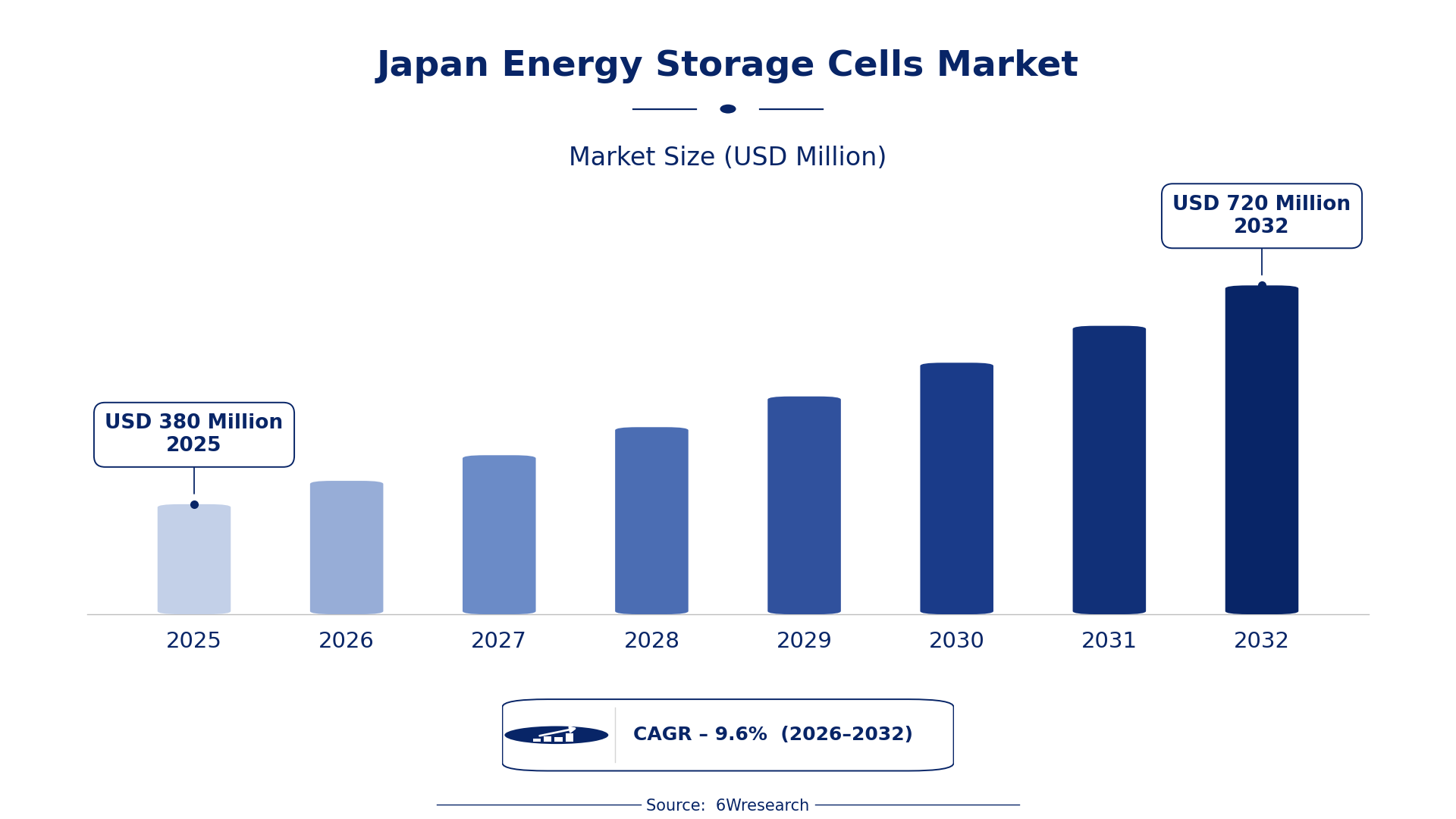
According to 6Wresearch internal database and industry insights, the Japan Energy Storage Cells Market was valued at USD 380 Million in 2025 and is projected to reach USD 720 Million by 2032, growing at a CAGR of approximately 9.6% during 2026–2032.
Japan Energy Storage Cells Market Highlights
| Report Metric | Details |
| Report Name | Japan Energy Storage Cells Market (2026-2032) |
| Market Size 2025 | USD 380 Million |
| Market Size 2032 | USD 720 Million |
| Absolute Growth 2025–2032 | USD 340 Million |
| CAGR 2026–2032 | 9.6% |
| Peak Annual Growth | 10.5% in 2028 |
| Forecast Period | 2026–2032 |
| Historical Data | 2022–2025 |
| Base Year | 2025 |
| Leading Cell Format, 2025 | Cylindrical Cell (42% share) |
| Leading Cell Chemistry, 2025 | Li-Ion (43% share) |
| Leading Voltage Output, 2025 | 3.6V (39% share) |
| Leading End User, 2025 | EV Battery Makers (39% share) |
| Fastest-Growing Cell Format | Pouch Cell (12.9% CAGR) |
| Fastest-Growing Cell Chemistry | Solid-State (12.6% CAGR) |
| Fastest-Growing Voltage Output | Variable (11.9% CAGR) |
| Fastest-Growing End User | Wearable OEMs (12.5% CAGR) |
| Growing Sector | Wearable OEMs |
| Key End Users | EV Battery Makers, Wearable OEMs, Solar Grid Providers, IoT Device Makers |
Japan Energy Storage Cells Market Year-wise Growth Rate and Key Drivers (2022–2032)
This graph illustrates the annual growth rates of the market from 2022 to 2032, highlighting a steady upward trajectory and projected market expansion over the forecast period.
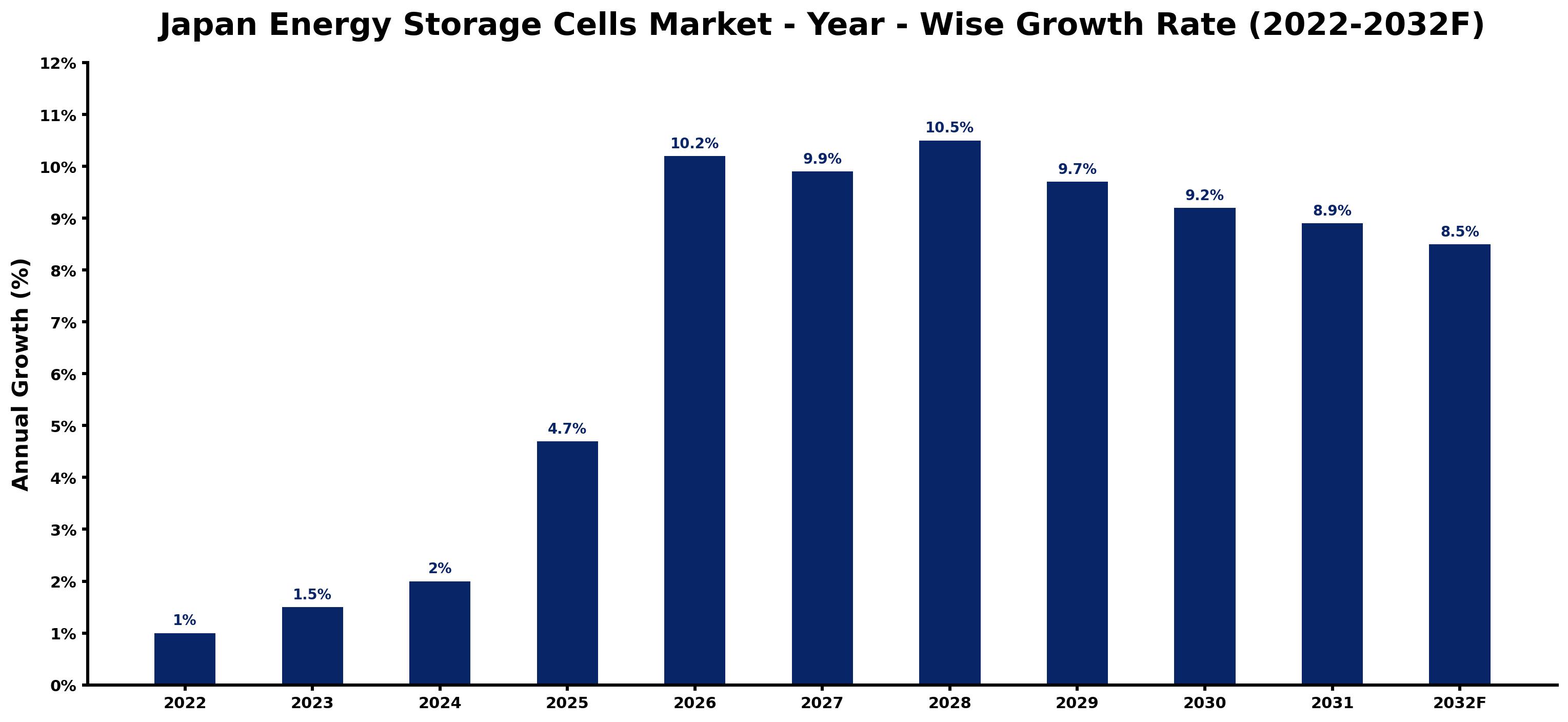
The table below sets out the estimated growth rate for each year and the main factor behind it.
| Year | Estimated Annual Growth (%) | Market Rationale |
| 2022 | 1.0 | The market showed modest growth with increasing energy needs driving demand. |
| 2023 | 1.5 | Growth accelerated as electric vehicle adoption gained momentum among consumers. |
| 2024 | 2.0 | Continued investment in renewable energy systems supported further market expansion. |
| 2025 | 4.7 | A surge in electric vehicle production led to strong demand for energy storage. |
| 2026 | 10.2 | Growth surged as the government will target substantial decarbonisation investments. |
| 2027 | 9.9 | The market continued to grow, though at a slower pace due to maturing demand. |
| 2028 | 10.5 | Strong growth was driven by rising electric vehicle sales and renewable integration. |
| 2029 | 9.7 | A slight slowdown occurred as the market began to stabilise after rapid expansion. |
| 2030 | 9.2 | Growth moderated as the market adjusted to increased production capacities. |
| 2031 | 8.9 | A further slowdown was observed as the market began to reach saturation. |
| 2032 | 8.5 | The market is expected to continue growing, albeit at a more stable rate. |
Note: Market size estimations and growth projections presented in this report are based on 6Wresearch's proprietary forecasting methodology, utilizing the latest available industry data, government publications, and primary research inputs.
Japan Energy Storage Cells Market Synopsis
Energy storage cells are electrochemical devices that store energy for later use, primarily made from lithium-ion, solid-state, or organic chemistry. The Japan Energy Storage Cells Market is driven by electric vehicle manufacturers and renewable energy sectors, with a target for 30% of vehicles to be electric by 2030. Public and private investments aim for JPY 150 trillion in decarbonisation over the next decade, creating strong demand for energy storage solutions. The installed base of electric vehicles surpassed 1 million units in 2023, further propelling market growth.
Market Dynamics Impact Analysis (2026–2032)
| Factor | Type | Impact | Primary Segment Affected |
| Rising electric vehicle adoption drives demand for energy storage cells. | Driver | High | EV Battery Makers |
| Increasing renewable energy capacity necessitates efficient energy storage solutions. | Driver | High | Solar Grid Providers |
| The shift towards renewable energy integration presents a growing market opportunity. | Opportunity | High | Solar Grid Providers |
| Emerging technologies in energy storage offer new avenues for investment. | Opportunity | Medium | Li-Ion |
| High production costs can limit the affordability of energy storage solutions. | Restraint | High | Cylindrical Cell |
| Competition from alternative energy storage technologies may hinder market growth. | Restraint | Medium | Solid-State |
| Supply chain disruptions can delay production timelines for manufacturers. | Challenge | High | Prismatic Cell |
| Technological advancements require continuous investment, straining smaller producers. | Challenge | Medium | Pouch Cell |
Evaluation of Drivers in Japan Energy Storage Cells Market (2026–2032)
The table below links each growth driver to the segment it affects and the evidence for it.
| Drivers | Primary Segment Affected | Why It Matters (Evidence) |
| Electric vehicle production increases demand for energy storage cells. | EV Battery Makers | In 2023, the installed base of electric vehicles surpassed 1 million units, driving higher purchases of energy storage cells. |
| Growing renewable energy capacity boosts energy storage needs. | Solar Grid Providers | Japan's renewable energy capacity is projected to reach 50 GW by 2025, necessitating more energy storage solutions. |
| Government decarbonisation targets encourage investment in energy storage. | Solar Grid Providers | The GX Basic Policy aims for JPY 150 trillion in decarbonisation investment over ten years, enhancing energy storage demand. |
| Technological advancements in battery chemistry improve performance. | Li-Ion | ISO 9001 standards are widely adopted in manufacturing, ensuring high-quality energy storage cells. |
| Public-private partnerships enhance energy storage project funding. | Solar Grid Providers | The government allocated ¥10 billion for energy storage research in 2023, stimulating market growth. |
A wider customer base explains much of the growth, as Tokyo serves as a hub for energy storage innovation and investment. Japan's energy storage capacity reached 5.4 GWh in 2022, while the installed base of electric vehicles surpassed 1 million units in 2023, driving demand for energy storage cells. As renewable energy capacity is expected to reach 50 GW by 2025, demand for efficient energy storage options will continue to rise. Public-private partnerships are increasing funding for energy storage projects, further stimulating market growth.
Evaluation of Restraints in Japan Energy Storage Cells Market
Several factors work against faster growth; the main ones are summarised below.
| Market Restraint | Primary Segment Affected | Why It Matters (Evidence) |
| High production costs limit the affordability of energy storage solutions. | Cylindrical Cell | Production costs have risen by 15% in the last year, affecting pricing strategies for manufacturers. |
| Competition from alternative energy storage technologies may hinder market growth. | Solid-State | Emerging solid-state technologies are attracting investment, diverting attention from traditional energy storage cells. |
| Supply chain disruptions can delay production timelines for manufacturers. | Prismatic Cell | Recent global supply chain issues have extended lead times by 20%, impacting delivery schedules. |
| Limited consumer awareness of energy storage benefits restricts market expansion. | Pouch Cell | Consumer education efforts are still developing, with only 30% of potential buyers informed about energy storage advantages. |
| Regulatory hurdles can slow down the approval process for new technologies. | Li-Ion | Compliance with JIS standards can add several months to the product launch timeline. |
Japan Energy Storage Cells Market Challenges
Producers face high technology costs due to the need for advanced manufacturing techniques, which can raise production expenses by 15% annually for manufacturers. Skills shortages in the workforce lead to delays in project timelines, extending development periods by up to six months for producers. Supply chain disruptions for raw materials, particularly lithium, can result in a 20% increase in input costs, forcing buyers to reconsider sourcing strategies. Compliance with ISO 9001 and JIS standards adds an additional 10% to operational expenses for suppliers, complicating pricing strategies and reducing competitiveness.
Trends in the Japan Energy Storage Cells Market
The shifts below are changing how Japan Energy Storage Cells Market products are bought and supplied.
- Shift towards Renewable Energy Integration: The Tokyo Metropolitan Government is promoting energy resilience through storage, targeting 30% of vehicles to be electric by 2030. This shift is driving demand for efficient energy storage solutions, with the market responding accordingly.
- Emergence of Solid-State Batteries: Solid-state battery technology is gaining traction, with a CAGR of 12.6% from 2026 to 2032. This innovation is appealing to manufacturers and consumers alike, improving safety and efficiency in energy storage applications.
- Transition from Traditional to Advanced Energy Storage Solutions: The Japan Battery Association is advocating for advancements in battery technology, pushing for new standards. This transition aligns with the country's decarbonisation goals, which will drive further investments.
- Growing Demand for LFP Batteries: The LFP battery market is projected to grow significantly, driven by safety and efficiency. This trend is evident as EV Battery Makers increasingly adopt LFP technology, positively impacting overall market dynamics.
Investment Opportunities in the Japan Energy Storage Cells Market
Below are the investment opportunities with the strongest case in the Japan Energy Storage Cells Market.
- Partnerships with Local Producers: Now is an opportune time to invest in energy storage technologies, as the government allocated ¥10 billion for research in 2023. Collaborating with local producers can facilitate market entry and improve product offerings.
- Investment in Renewable Energy Storage: With Japan's renewable energy capacity expected to reach 50 GW by 2025, a notable investment gap exists. Targeting Solar Grid Providers can yield fruitful opportunities for energy storage solutions.
- Expansion into Electric Vehicle Market: The target for 30% of vehicles to be electric by 2030 creates a demand for energy storage cells. Engaging with EV Battery Makers can provide a strategic entry point into this growing market.
- Focus on Advanced Battery Technologies: The emergence of solid-state batteries presents an investment opportunity. Engaging with research institutions in Tokyo can facilitate access to new developments.
Government Initiatives in the Japan Energy Storage Cells Market
The Hydrogen Society Promotion Act, enacted in 2024, supports low-carbon hydrogen and ammonia supply chains, improving energy storage production capabilities. This complements the Battery Industry Strategy, which aims to boost domestic battery manufacturing capacity by 2030, ensuring a solid regulatory framework for energy storage producers.
In 2023, the government allocated ¥10 billion for energy storage research, administered by the Ministry of the Environment. This funding aims to promote advancements in energy storage technologies, benefiting both producers and consumers by improving product quality and availability.
Future Insight of the Japan Energy Storage Cells Market
Electric vehicle manufacturers will adapt as the government targets 30% of vehicles to be electric by 2030, driving demand for energy storage solutions. The ¥10 billion allocated for energy storage research in 2023 will stimulate technological advancements, benefiting both buyers and suppliers. Japan's energy storage capacity reached 5.4 GWh in 2022, indicating a growing infrastructure for energy solutions. Public-private partnerships will enhance collaboration in energy storage projects, fostering innovation and efficiency across the sector.
Market Segmentation Analysis
Japan Energy Storage Cells Market report covers a detailed analysis of the following market segments:
By Cell Format – Cylindrical Cell Leads, Pouch Cell Expected to Grow Fastest
According to Saurav Kr Singh, Senior Research Analyst at 6Wresearch, with 42% of cell format revenue in 2025, Cylindrical Cell was the largest category. Cylindrical cells hold the largest share in Japan's market because they are extensively used in electric vehicles and consumer electronics, supported by a robust installed base. The electric vehicle sector, which has surpassed 1 million units, significantly drives the demand for this cell format. Pouch Cell is set to record the highest CAGR in this split, 12.9% over 2026–2032. The pouch cell segment is experiencing rapid growth, primarily due to the increasing demand for portable devices that require lightweight and flexible energy solutions. This trend is evident as manufacturers focus on enhancing the efficiency of portable electronics, propelling the pouch cell market forward. Suppliers should prioritise the development of cylindrical and pouch cells to meet the rising demands of the electric vehicle and portable device markets.
By Cell Chemistry – Li-Ion Leads, Solid-State Expected to Grow Fastest
Li-Ion took 43% of cell chemistry revenue in 2025, more than any other category. Li-ion chemistry commands the largest market share as it is the dominant technology in energy storage solutions, particularly for electric vehicles and consumer electronics. Its well-established manufacturing processes and widespread acceptance among manufacturers in Japan reinforce its leading position. The quickest growth will come from Solid-State, forecast to expand at a CAGR of 12.6% between 2026 and 2032. Solid-state technology is emerging swiftly due to its potential for higher energy density and improved safety, attracting significant investments and research aimed at commercialisation. As advancements continue, this chemistry is likely to shape the future direction of the market. Buyers should consider the long-term benefits of investing in solid-state technology, as it may offer superior performance and safety in future applications.
By Voltage Output – 3.6V Leads, Variable Expected to Grow Fastest
The largest voltage output category in 2025 was 3.6V, at 39% of revenue. The 3.6V output is the standard for many applications, making it the most widely adopted voltage level in energy storage cells. Its compatibility with a range of devices ensures a consistent demand across various sectors. Variable is projected to grow fastest, at a CAGR of 11.9% during 2026–2032. Variable voltage output is rapidly growing as it caters to specialised applications requiring tailored energy solutions, reflecting the increasing diversification of energy storage needs. This adaptability positions it well for future growth. Suppliers must be prepared to offer flexible voltage solutions to accommodate the evolving requirements of specialised applications.
By End User – EV Battery Makers Lead, Wearable OEMs Expected to Grow Fastest
EV Battery Makers accounted for 39% of the market by end user in 2025. EV battery makers represent the largest consumer group for energy storage cells, driven by the substantial growth in electric vehicle adoption in Japan. Their demand is further supported by government initiatives promoting electric vehicle usage. Over 2026–2032, Wearable OEMs are expected to post the fastest growth, at a CAGR of 12.5%. Wearable OEMs are experiencing the fastest growth due to the rising popularity of portable devices that require compact and efficient energy solutions. This trend indicates a shift towards more personal technology. Manufacturers should focus on developing energy storage solutions tailored for wearable technology to capitalise on this burgeoning market.
Key Attractiveness of the Report
- 10 Years of Market Numbers
- Historical Data Starting from 2022 to 2025
- Base Year 2025
- Forecast Data until 2032
- Key Performance Indicators Impacting the Market
- Major Upcoming Developments and Projects
Key Highlights of the Report:
- Japan Energy Storage Cells Market Outlook
- Market Size of Japan Energy Storage Cells Market, 2025
- Forecast of Japan Energy Storage Cells Market, 2032
- Historical Data and Forecast of Japan Energy Storage Cells Revenues & Volume for the Period 2022-2032F
- Japan Energy Storage Cells Market Trend Evolution
- Japan Energy Storage Cells Market Drivers and Challenges
- Japan Energy Storage Cells Price Trends
- Japan Energy Storage Cells Porter's Five Forces
- Japan Energy Storage Cells Industry Life Cycle
- Historical Data and Forecast of Japan Energy Storage Cells Market Revenues & Volume By Cell Format for the Period 2022-2032F
- Historical Data and Forecast of Japan Energy Storage Cells Market Revenues & Volume By Cylindrical Cell for the Period 2022-2032F
- Historical Data and Forecast of Japan Energy Storage Cells Market Revenues & Volume By Pouch Cell for the Period 2022-2032F
- Historical Data and Forecast of Japan Energy Storage Cells Market Revenues & Volume By Prismatic Cell for the Period 2022-2032F
- Historical Data and Forecast of Japan Energy Storage Cells Market Revenues & Volume By Thin-Film Cell for the Period 2022-2032F
- Historical Data and Forecast of Japan Energy Storage Cells Market Revenues & Volume By Cell Chemistry for the Period 2022-2032F
- Historical Data and Forecast of Japan Energy Storage Cells Market Revenues & Volume By Li-Ion for the Period 2022-2032F
- Historical Data and Forecast of Japan Energy Storage Cells Market Revenues & Volume By Solid-State for the Period 2022-2032F
- Historical Data and Forecast of Japan Energy Storage Cells Market Revenues & Volume By LFP for the Period 2022-2032F
- Historical Data and Forecast of Japan Energy Storage Cells Market Revenues & Volume By Organic for the Period 2022-2032F
- Historical Data and Forecast of Japan Energy Storage Cells Market Revenues & Volume By Voltage Output for the Period 2022-2032F
- Historical Data and Forecast of Japan Energy Storage Cells Market Revenues & Volume By 3.6V for the Period 2022-2032F
- Historical Data and Forecast of Japan Energy Storage Cells Market Revenues & Volume By Variable for the Period 2022-2032F
- Historical Data and Forecast of Japan Energy Storage Cells Market Revenues & Volume By 3.2V for the Period 2022-2032F
- Historical Data and Forecast of Japan Energy Storage Cells Market Revenues & Volume By <1V for the Period 2022-2032F
- Historical Data and Forecast of Japan Energy Storage Cells Market Revenues & Volume By End User for the Period 2022-2032F
- Historical Data and Forecast of Japan Energy Storage Cells Market Revenues & Volume By EV Battery Makers for the Period 2022-2032F
- Historical Data and Forecast of Japan Energy Storage Cells Market Revenues & Volume By Wearable OEMs for the Period 2022-2032F
- Historical Data and Forecast of Japan Energy Storage Cells Market Revenues & Volume By Solar Grid Providers for the Period 2022-2032F
- Historical Data and Forecast of Japan Energy Storage Cells Market Revenues & Volume By IoT Device Makers for the Period 2022-2032F
- Japan Energy Storage Cells Import Export Trade Statistics
- Market Opportunity Assessment By Cell Format
- Market Opportunity Assessment By Cell Chemistry
- Market Opportunity Assessment By Voltage Output
- Market Opportunity Assessment By End User
- Japan Energy Storage Cells Top Companies Market Share
- Japan Energy Storage Cells Competitive Benchmarking By Technical and Operational Parameters
- Japan Energy Storage Cells Company Profiles
- Japan Energy Storage Cells Key Strategic Recommendations
Market Covered
Coverage by segment is as follows.
By Cell Format
- Cylindrical Cell
- Pouch Cell
- Prismatic Cell
- Thin-Film Cell
By Cell Chemistry
- Li-Ion
- Solid-State
- LFP
- Organic
By Voltage Output
- 3.6V
- Variable
- 3.2V
- <1V
By End User
- EV Battery Makers
- Wearable OEMs
- Solar Grid Providers
- IoT Device Makers































