Japan Enterprise Automation Consulting Market Size & Growth Rate
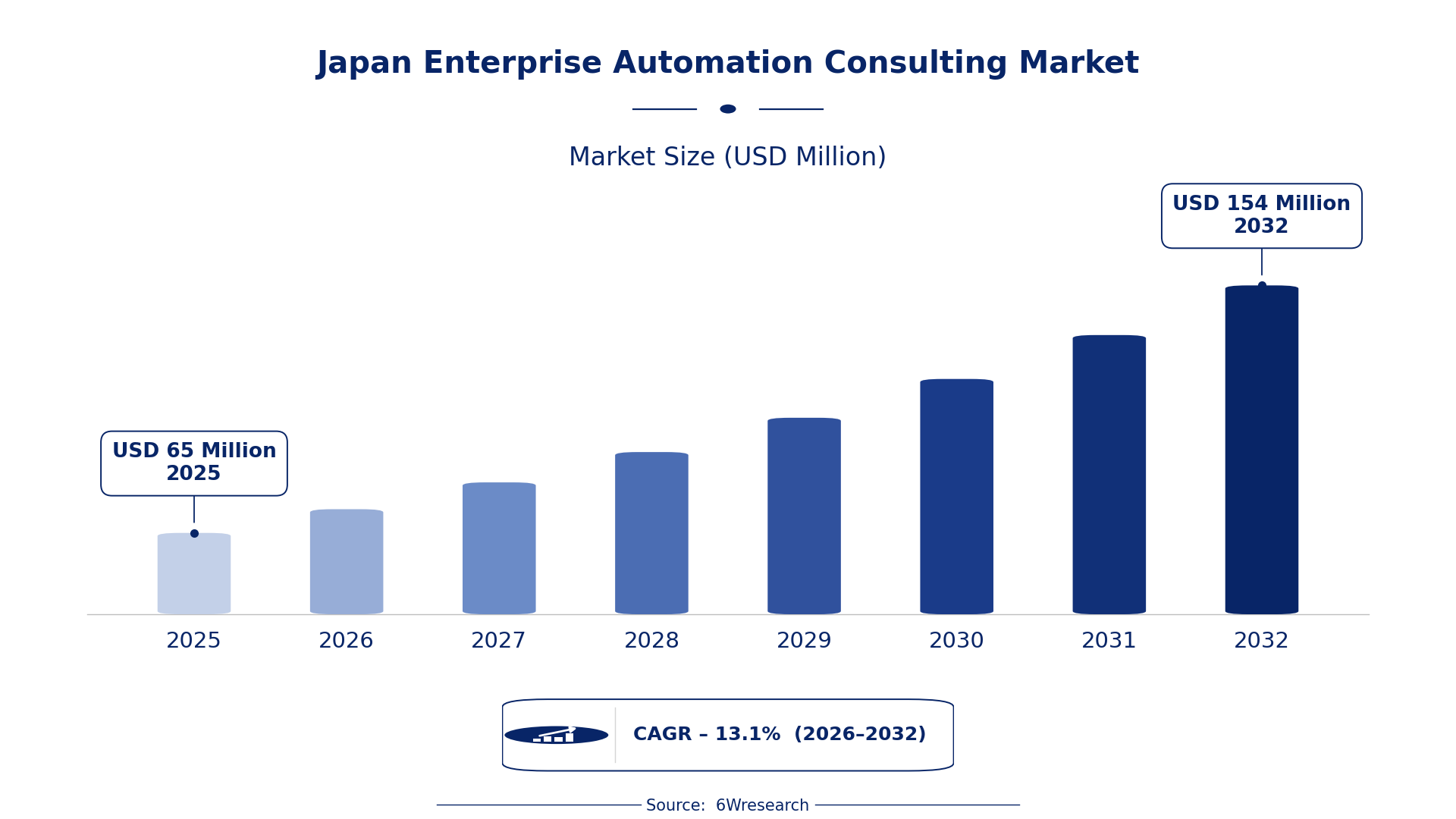
According to 6Wresearch internal database and industry insights, the Japan Enterprise Automation Consulting Market was valued at USD 65 Million in 2025 and is projected to reach USD 154 Million by 2032, growing at a CAGR of approximately 13.1% during 2026–2032.
Japan Enterprise Automation Consulting Market Highlights
| Report Metric | Details |
| Report Name | Japan Enterprise Automation Consulting Market (2026-2032) |
| Market Size 2025 | USD 65 Million |
| Market Size 2032 | USD 154 Million |
| Absolute Growth 2025–2032 | USD 89 Million |
| CAGR 2026–2032 | 13.1% |
| Peak Annual Growth | 15.7% in 2032 |
| Forecast Period | 2026–2032 |
| Historical Data | 2022–2025 |
| Base Year | 2025 |
| Leading Service Type, 2025 | AI Enablement (34% share) |
| Leading Delivery Model, 2025 | On-Site (43% share) |
| Leading Focus Area, 2025 | Factory Automation (41% share) |
| Leading Client Type, 2025 | Automotive Plants (36% share) |
| Fastest-Growing Delivery Model | Hybrid (17.9% CAGR) |
| Fastest-Growing Focus Area | Predictive Systems (16.2% CAGR) |
| Fastest-Growing Client Type | Electronics Firms (18.5% CAGR) |
| Growing Sector | automotive sector |
| Key End Users | automotive plants, electronics firms, textile units, steel plants |
Japan Enterprise Automation Consulting Market Year-wise Growth Rate and Key Drivers (2022–2032)
This graph illustrates the annual growth rates of the market from 2022 to 2032, highlighting a steady upward trajectory and projected market expansion over the forecast period.
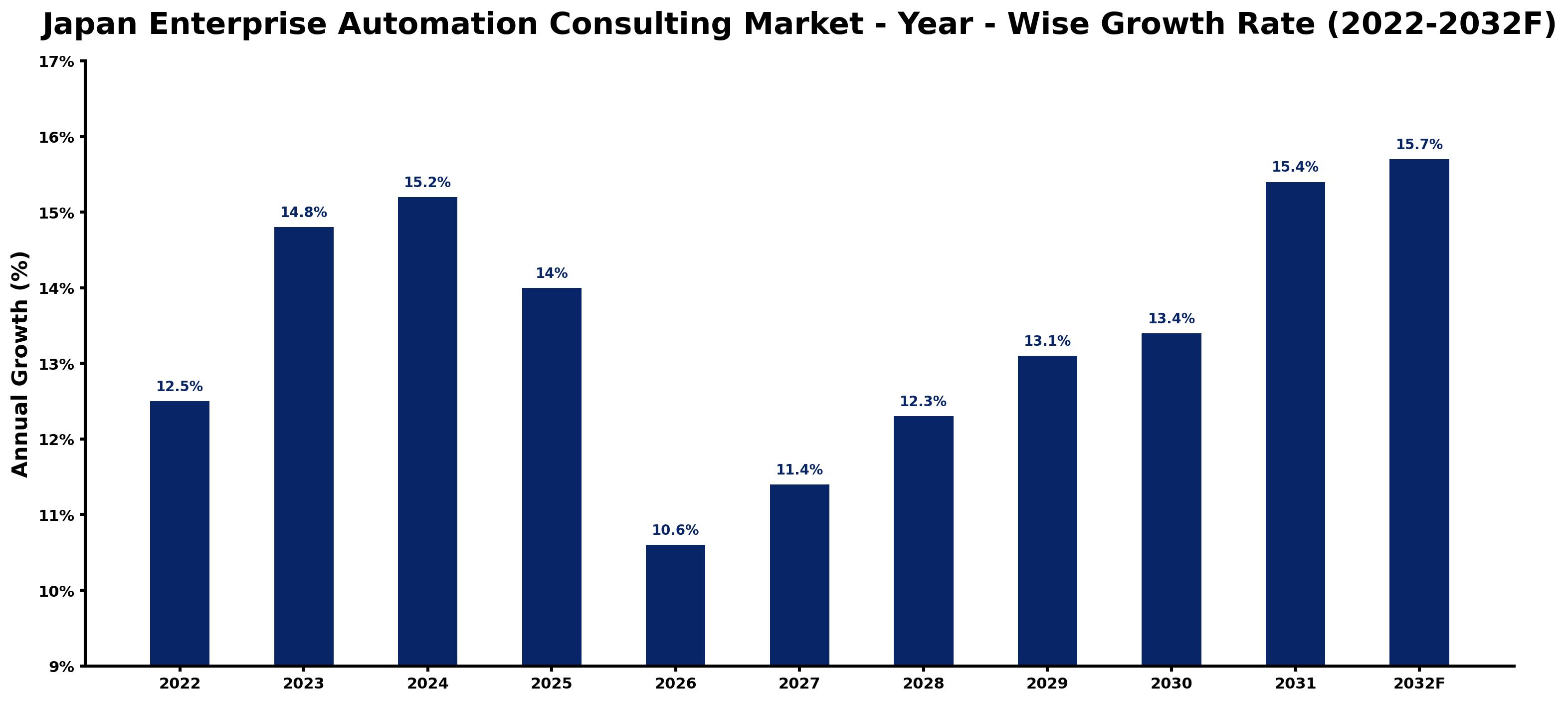
Year by year, the estimates below pair each growth rate with the development that shaped it.
| Year | Estimated Annual Growth (%) | Market Rationale |
| 2022 | 12.5 | The market experienced strong demand from the automotive sector, driving consulting engagements. |
| 2023 | 14.8 | Increased investment in digital transformation initiatives accelerated the growth of automation consulting services. |
| 2024 | 15.2 | Demand surged as companies sought to improve productivity through automation solutions. |
| 2025 | 14.0 | Growth slowed slightly as firms adjusted to rapid changes in technology adoption. |
| 2026 | 10.6 | A slowdown in growth is expected as businesses focus on consolidating automation efforts and improving efficiency. |
| 2027 | 11.4 | Investment in AI technologies is projected to rise, boosting demand for consulting services. |
| 2028 | 12.3 | Growing interest in predictive systems will drive further expansion in consulting engagements. |
| 2029 | 13.1 | The market is expected to pick up as more companies recognise the benefits of automation in operations. |
| 2030 | 13.4 | Increased factory automation initiatives will contribute to a rise in consulting demand. |
| 2031 | 15.4 | Demand is projected to strengthen as firms seek to optimise processes and reduce costs through automation. |
| 2032 | 15.7 | The market is expected to peak as businesses fully embrace automation to improve competitiveness. |
Note: Market size estimations and growth projections presented in this report are based on 6Wresearch's proprietary forecasting methodology, utilizing the latest available industry data, government publications, and primary research inputs.
Japan Enterprise Automation Consulting Market Synopsis
Enterprise Automation Consulting focuses on optimising business processes through technology integration and strategic planning. The Japan Enterprise Automation Consulting Market is projected to grow, driven by Japan's automotive sector employing over 5 million people and the electronics industry valued at approximately 10 trillion JPY. Factors such as the government's Industry 4.0 initiative aiming for a 30% increase in factory automation by 2025 and ongoing technological advancements are propelling this growth.
Market Dynamics Impact Analysis (2026–2032)
| Factor | Type | Impact | Primary Segment Affected |
| Rising investment in digital transformation initiatives | Driver | High | AI Enablement |
| Demand for efficiency improvements in manufacturing | Driver | High | Factory Automation |
| Growing need for automation solutions in automotive plants | Opportunity | High | Automotive Plants |
| Increasing focus on predictive systems for data-driven decisions | Opportunity | Medium | Predictive Systems |
| Challenges in integrating new technologies into existing workflows | Restraint | High | RPA Integration |
| Limited awareness of automation benefits among SMEs | Restraint | Medium | Performance Audits |
| High costs associated with implementing automation solutions | Challenge | High | Workflow Mapping |
| Shortage of skilled professionals in automation consulting | Challenge | Medium | AI Enablement |
Evaluation of Drivers in Japan Enterprise Automation Consulting Market (2026–2032)
The following drivers explain most of the expected growth.
| Drivers | Primary Segment Affected | Why It Matters (Evidence) |
| Increased investment in digital transformation initiatives | AI Enablement | Japan's GX Basic Policy targets JPY 150 trillion in decarbonisation investment, encouraging firms to adopt AI solutions. |
| Demand for efficiency improvements in manufacturing sectors | Factory Automation | The automotive sector employs over 5 million people, driving the need for enhanced productivity through automation. |
| Focus on reducing operational costs through automation | RPA Integration | The average cost savings from automation consulting in manufacturing is estimated at 15% annually, prompting more firms to invest. |
| Growing emphasis on data-driven decision making | Predictive Systems | The Japanese government aims to increase factory automation by 30% by 2025, boosting demand for predictive analytics. |
| Rising demand for performance evaluation services | Performance Audits | ISO 9001 is frequently adopted in automation projects, increasing the need for thorough performance assessments. |
Volumes grow on the back of increased investment in digital transformation, with Japan targeting JPY 150 trillion in decarbonisation over the next decade. The automotive sector, employing over 5 million people, drives demand for efficiency improvements through consulting. As firms seek to reduce operational costs, the average savings from consulting is estimated at 15% annually. The goal of a 30% increase in factory automation by 2025 boosts the need for predictive systems, while the adoption of ISO 9001 standards increases demand for performance audits.
Evaluation of Restraints in Japan Enterprise Automation Consulting Market
Several factors work against faster growth; the main ones are summarised below.
| Market Restraint | Primary Segment Affected | Why It Matters (Evidence) |
| High costs associated with implementing automation solutions | Workflow Mapping | The average cost of automation consulting can be substantial, deterring some firms from adopting solutions. |
| Limited awareness of automation benefits among SMEs | Performance Audits | Many small and medium enterprises lack understanding of how automation can improve efficiency and reduce costs. |
| Challenges in integrating new technologies into existing workflows | RPA Integration | Firms often face difficulties in aligning new automation tools with established processes, leading to inefficiencies. |
| Shortage of skilled professionals in automation consulting | AI Enablement | The demand for skilled consultants exceeds supply, making it difficult for firms to implement automation strategies. |
| Resistance to change within organizations | Factory Automation | Cultural barriers in traditional industries can hinder the adoption of automation solutions, slowing market growth. |
Japan Enterprise Automation Consulting Market Challenges
Automotive producers face unrealised savings of 15% from automation consulting, which raises operational costs. Electronics suppliers struggle with fluctuating demand, as the industry, valued at approximately 10 trillion JPY, requires swift adjustments to meet market needs. Shortages of skilled workers in automation technologies delay project timelines for clinics and plants, often extending implementation by several months. Hesitance to adopt new technologies due to perceived investment risks results in missed efficiency opportunities across various sectors, impacting both buyers and suppliers.
Trends in the Japan Enterprise Automation Consulting Market
The shifts below are changing how Japan Enterprise Automation Consulting Market products are bought and supplied.
- Shift from Traditional to Automated Processes: Since 2023, many automotive plants in Japan have begun transitioning from traditional manufacturing methods to automated processes. This shift is driven by the need for efficiency, with the government aiming for a 30% increase in factory automation by 2025.
- Emergence of Predictive Systems in Manufacturing: Starting in 2026, predictive systems are gaining traction among electronics firms, improving data-driven decision making. With the electronics industry valued at approximately 10 trillion JPY, this trend is expected to improve operational efficiency.
- Increased Focus on AI Technologies: In 2023, the Japanese government launched a program to support SMEs in adopting AI technologies. This initiative aims to boost productivity and competitiveness, with an allocation of 50 billion JPY for digital transformation.
- Rise of Hybrid Delivery Models: Beginning in 2026, hybrid delivery models for consulting services are gaining popularity, particularly among automotive plants. This model combines on-site and remote consultations, catering to diverse client needs.
Investment Opportunities in the Japan Enterprise Automation Consulting Market
Where to invest in the Japan Enterprise Automation Consulting Market: the main openings are set out below.
- Growing Demand for Automation in Automotive Sector: With over 5 million people employed in Japan's automotive sector, there is a pressing need for consulting services. The market gap is substantial, with potential savings of 15% annually from automation solutions.
- Investment in Predictive Systems: The increasing focus on data-driven decision making presents an opportunity for consulting firms. Electronics firms are particularly interested, as the sector is valued at approximately 10 trillion JPY.
- Support for SMEs in AI Adoption: The government’s 2023 initiative to support SMEs in adopting AI technologies opens new avenues for consulting services. Firms can enter this market through partnerships with local organisations.
- Expansion of Factory Automation Initiatives: The target of a 30% increase in factory automation by 2025 creates a strong demand for consulting services. Automotive plants are key buyers, necessitating collaboration with local experts.
Government Initiatives in the Japan Enterprise Automation Consulting Market
The GX Promotion Act of 2023 establishes a framework for decarbonisation efforts, enhancing previous laws by providing specific targets and funding mechanisms. This act aims to support automation consulting by promoting technology integration and efficiency improvements across industries.
The Ministry of Economy, Trade and Industry administers various funding programs to support automation initiatives. In 2023, the government allocated 50 billion JPY for digital transformation, enabling firms to access financial resources for implementing automation solutions.
Future Insight of the Japan Enterprise Automation Consulting Market
Investment in decarbonisation initiatives will create a robust demand for automation consulting services, with public and private funding exceeding JPY 150 trillion over the next decade. By 2032, factory automation will increase by 30% under the Industry 4.0 initiative, necessitating advanced consulting solutions. The government's 50 billion JPY allocation for digital transformation will drive innovation across multiple sectors. As firms embrace new standards like ISO 9001, buyers will benefit from enhanced operational efficiency while suppliers must evolve to stay competitive.
Market Segmentation Analysis
Japan Enterprise Automation Consulting Market report covers a detailed analysis of the following market segments:
By Service Type – AI Enablement Leads and Records the Fastest Growth
According to Saurav Kr Singh, Senior Research Analyst at 6Wresearch, with 34% of service type revenue in 2025, AI Enablement was the largest category. AI Enablement holds the largest share as it is crucial for optimising decision-making processes across various sectors. Its significance is highlighted by the automotive industry, which employs over 5 million people and relies heavily on these capabilities. AI Enablement is also forecast to expand faster than any other category, at a CAGR of 15.8% over 2026–2032. The growth of AI Enablement is propelled by the increasing necessity for advanced decision-making in automation projects. The Japanese government's allocation of 50 billion JPY for digital transformation initiatives in 2023 ensures sustained investment in this area, further solidifying its lead. Suppliers should focus on enhancing capabilities in AI Enablement to meet the rising demand from various sectors.
By Delivery Model – On-Site Leads, Hybrid Expected to Grow Fastest
The largest delivery model category in 2025 was On-Site, at 43% of revenue. On-Site delivery is preferred for its effectiveness in hands-on implementation, allowing consultants to engage directly with client operations. This model thrives particularly in regions like Tokyo and Aichi, where enterprise automation consulting is advancing rapidly. The quickest growth will come from Hybrid, forecast to expand at a CAGR of 17.9% between 2026 and 2032. The Hybrid model is gaining traction as it combines the advantages of both on-site and remote services, catering to diverse client needs. This flexibility is increasingly appealing amid Japan's ongoing digital transformation initiatives. Providers must adapt their offerings to align with the growing preference for Hybrid delivery models in the market.
By Focus Area – Factory Automation Leads, Predictive Systems Expected to Grow Fastest
Factory Automation accounted for 41% of the market by focus area in 2025. Factory Automation is the leading focus area for improving manufacturing efficiency, making it vital in the current market context. The substantial workforce in the automotive sector highlights the ongoing need for advancements in this domain to remain competitive. Predictive Systems are projected to grow fastest, at a CAGR of 16.2% during 2026–2032. Predictive Systems are emerging as a key growth area due to the rising demand for data-driven decision-making in automation projects. This trend is supported by the government's aim to increase factory automation by 30% by 2025 under the Industry 4.0 initiative. Consultants should invest in developing expertise in predictive systems to capitalise on this increasing demand.
By Client Type – Automotive Plants Lead, Electronics Firms Expected to Grow Fastest
Automotive Plants held 36% of the Japan Enterprise Automation Consulting Market by client type in 2025. Automotive Plants represent the largest client segment seeking automation solutions, driven by the need for improved efficiency and productivity. The extensive employment within this sector indicates a robust market for consulting services tailored to their needs. Electronics Firms are set to record the highest CAGR in this split, 18.5% over 2026–2032. Electronics Firms are experiencing a surge in demand for process improvement, spurred by the industry's significant valuation of approximately 10 trillion JPY. This trend is expected to continue as these firms strive to enhance operational efficiency. Consultants should target electronics firms to leverage the growing demand for automation consulting services.
Key Attractiveness of the Report
- 10 Years of Market Numbers
- Historical Data Starting from 2022 to 2025
- Base Year 2025
- Forecast Data until 2032
- Key Performance Indicators Impacting the Market
- Major Upcoming Developments and Projects
Key Highlights of the Report:
- Japan Enterprise Automation Consulting Market Outlook
- Market Size of Japan Enterprise Automation Consulting Market, 2025
- Forecast of Japan Enterprise Automation Consulting Market, 2032
- Historical Data and Forecast of Japan Enterprise Automation Consulting Revenues & Volume for the Period 2022-2032F
- Japan Enterprise Automation Consulting Market Trend Evolution
- Japan Enterprise Automation Consulting Market Drivers and Challenges
- Japan Enterprise Automation Consulting Price Trends
- Japan Enterprise Automation Consulting Porter's Five Forces
- Japan Enterprise Automation Consulting Industry Life Cycle
- Historical Data and Forecast of Japan Enterprise Automation Consulting Market Revenues & Volume By Service Type for the Period 2022-2032F
- Historical Data and Forecast of Japan Enterprise Automation Consulting Market Revenues & Volume By Workflow Mapping for the Period 2022-2032F
- Historical Data and Forecast of Japan Enterprise Automation Consulting Market Revenues & Volume By RPA Integration for the Period 2022-2032F
- Historical Data and Forecast of Japan Enterprise Automation Consulting Market Revenues & Volume By AI Enablement for the Period 2022-2032F
- Historical Data and Forecast of Japan Enterprise Automation Consulting Market Revenues & Volume By Performance Audits for the Period 2022-2032F
- Historical Data and Forecast of Japan Enterprise Automation Consulting Market Revenues & Volume By Delivery Model for the Period 2022-2032F
- Historical Data and Forecast of Japan Enterprise Automation Consulting Market Revenues & Volume By On-Site for the Period 2022-2032F
- Historical Data and Forecast of Japan Enterprise Automation Consulting Market Revenues & Volume By Remote for the Period 2022-2032F
- Historical Data and Forecast of Japan Enterprise Automation Consulting Market Revenues & Volume By Hybrid for the Period 2022-2032F
- Historical Data and Forecast of Japan Enterprise Automation Consulting Market Revenues & Volume By Virtual for the Period 2022-2032F
- Historical Data and Forecast of Japan Enterprise Automation Consulting Market Revenues & Volume By Focus Area for the Period 2022-2032F
- Historical Data and Forecast of Japan Enterprise Automation Consulting Market Revenues & Volume By Factory Automation for the Period 2022-2032F
- Historical Data and Forecast of Japan Enterprise Automation Consulting Market Revenues & Volume By Back Office Ops for the Period 2022-2032F
- Historical Data and Forecast of Japan Enterprise Automation Consulting Market Revenues & Volume By Predictive Systems for the Period 2022-2032F
- Historical Data and Forecast of Japan Enterprise Automation Consulting Market Revenues & Volume By Efficiency Tuning for the Period 2022-2032F
- Historical Data and Forecast of Japan Enterprise Automation Consulting Market Revenues & Volume By Client Type for the Period 2022-2032F
- Historical Data and Forecast of Japan Enterprise Automation Consulting Market Revenues & Volume By Automotive Plants for the Period 2022-2032F
- Historical Data and Forecast of Japan Enterprise Automation Consulting Market Revenues & Volume By Electronics Firms for the Period 2022-2032F
- Historical Data and Forecast of Japan Enterprise Automation Consulting Market Revenues & Volume By Textile Units for the Period 2022-2032F
- Historical Data and Forecast of Japan Enterprise Automation Consulting Market Revenues & Volume By Steel Plants for the Period 2022-2032F
- Japan Enterprise Automation Consulting Import Export Trade Statistics
- Market Opportunity Assessment By Service Type
- Market Opportunity Assessment By Delivery Model
- Market Opportunity Assessment By Focus Area
- Market Opportunity Assessment By Client Type
- Japan Enterprise Automation Consulting Top Companies Market Share
- Japan Enterprise Automation Consulting Competitive Benchmarking By Technical and Operational Parameters
- Japan Enterprise Automation Consulting Company Profiles
- Japan Enterprise Automation Consulting Key Strategic Recommendations
Market Covered
Segments analysed in this report are listed below.
By Service Type
- Workflow Mapping
- RPA Integration
- AI Enablement
- Performance Audits
By Delivery Model
- On-Site
- Remote
- Hybrid
- Virtual
By Focus Area
- Factory Automation
- Back Office Ops
- Predictive Systems
- Efficiency Tuning
By Client Type
- Automotive Plants
- Electronics Firms
- Textile Units
- Steel Plants































