Japan Enterprise Machine Learning Market Size & Growth Rate
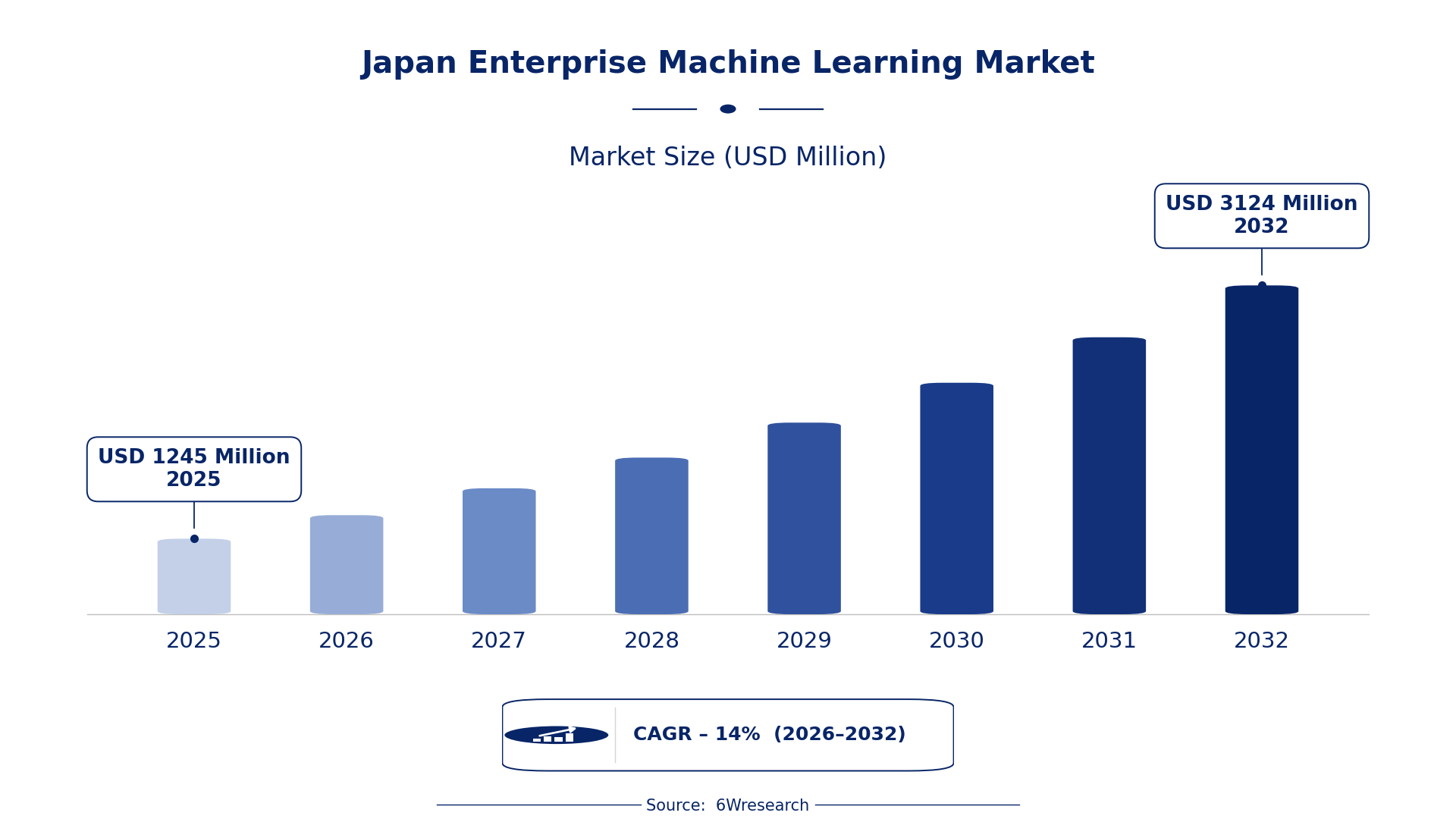
According to 6Wresearch internal database and industry insights, the Japan Enterprise Machine Learning Market was valued at USD 1,245 Million in 2025 and is projected to reach USD 3,124 Million by 2032, growing at a CAGR of approximately 14% during 2026–2032.
Japan Enterprise Machine Learning Market Highlights
| Report Metric | Details |
| Report Name | Japan Enterprise Machine Learning Market (2026-2032) |
| Market Size 2025 | USD 1,245 Million |
| Market Size 2032 | USD 3,124 Million |
| Absolute Growth 2025–2032 | USD 1,879 Million |
| CAGR 2026–2032 | 14% |
| Peak Annual Growth | 16.4% in 2032 |
| Forecast Period | 2026–2032 |
| Historical Data | 2022–2025 |
| Base Year | 2025 |
| Leading ML Type, 2025 | Deep Learning (46% share) |
| Leading Platform Type, 2025 | Cloud ML Suite (53% share) |
| Leading Integration Level, 2025 | Native Integration (39% share) |
| Leading End Use Case, 2025 | Demand Forecasting (42% share) |
| Fastest-Growing ML Type | Unsupervised (19.8% CAGR) |
| Fastest-Growing Platform Type | AI Sandbox (20.8% CAGR) |
| Fastest-Growing Integration Level | API Plug-in (20.3% CAGR) |
| Fastest-Growing End Use Case | Voice Recognition (18.2% CAGR) |
| Growing Sector | Voice Recognition |
| Key End Users | Demand Forecasting, Voice Recognition, Pattern Detection, Adaptive Controls |
Japan Enterprise Machine Learning Market Year-wise Growth Rate and Key Drivers (2022–2032)
This graph illustrates the annual growth rates of the market from 2022 to 2032, highlighting a steady upward trajectory and projected market expansion over the forecast period.
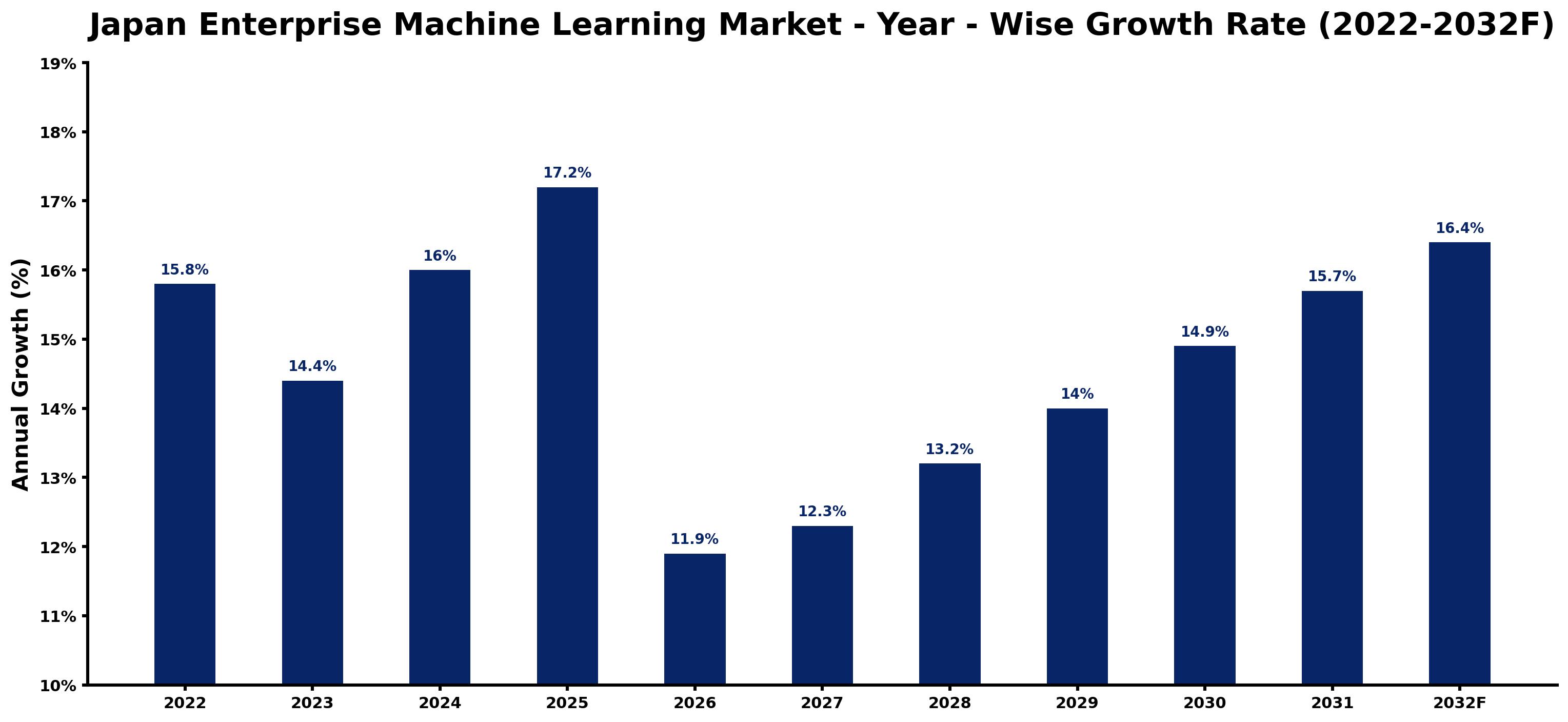
Below, each year's estimated growth is shown next to the factor that most influenced it.
| Year | Estimated Annual Growth (%) | Market Rationale |
| 2022 | 15.8 | The market experienced strong demand from various sectors, particularly technology and finance. |
| 2023 | 14.4 | Growth slowed as buyers adjusted to previous investments and market saturation began to emerge. |
| 2024 | 16.0 | Increased adoption of AI solutions in healthcare boosted demand for enterprise machine learning applications. |
| 2025 | 17.2 | Rapid advancements in machine learning technologies drove investments across multiple industries. |
| 2026 | 11.9 | Growth is expected to slow as the market stabilises after a period of rapid expansion. |
| 2027 | 12.3 | Demand from the manufacturing sector will increase, leading to a slight rise in growth rates. |
| 2028 | 13.2 | A growing focus on data analytics in business operations will contribute to renewed interest. |
| 2029 | 14.0 | Increased investments in AI talent and training programmes will further support market growth. |
| 2030 | 14.9 | The expansion of AI applications in logistics and supply chain management will spur demand. |
| 2031 | 15.7 | A rise in the number of AI research papers published will indicate a thriving innovation environment. |
| 2032 | 16.4 | The forecast peak is driven by anticipated growth in AI-driven decision-making processes. |
Note: Market size estimations and growth projections presented in this report are based on 6Wresearch's proprietary forecasting methodology, utilizing the latest available industry data, government publications, and primary research inputs.
Japan Enterprise Machine Learning Market Synopsis
Enterprise Machine Learning involves applying machine learning technologies in business settings to automate processes and analyse data. The Japan Enterprise Machine Learning Market is driven by the thriving technology sector, particularly in finance and manufacturing. The AI Strategy 2021 aims to increase AI usage, while a budget of ¥10 billion for 2023 promotes adoption. With an installed base of 1.2 million AI solutions, the market is set to expand as businesses increasingly rely on data-driven insights for strategic decision-making.
Market Dynamics Impact Analysis (2026–2032)
| Factor | Type | Impact | Primary Segment Affected |
| Growing demand for data-driven insights in business operations | Driver | High | Deep Learning |
| Increasing investments in AI talent and training | Driver | High | Cloud ML Suite |
| Expansion of AI applications in healthcare | Opportunity | High | Demand Forecasting |
| Rising interest in AI-driven automation in manufacturing | Opportunity | High | Pattern Detection |
| Challenges in data privacy compliance | Restraint | High | AI Sandbox |
| Limited understanding of machine learning capabilities among SMEs | Restraint | Medium | ML Toolkit |
| High costs associated with AI implementation | Challenge | High | SaaS Stack |
| Shortage of skilled professionals in AI and machine learning | Challenge | Medium | Native Integration |
Evaluation of Drivers in Japan Enterprise Machine Learning Market (2026–2032)
Below are the drivers that matter most for revenue growth, with supporting evidence.
| Drivers | Primary Segment Affected | Why It Matters (Evidence) |
| Increased demand for data analytics solutions | Deep Learning | The healthcare sector's adoption of AI for diagnostics has risen, leading to more purchases of deep learning technologies. |
| Growing investments in AI talent development | Cloud ML Suite | The government aims to train 1 million AI professionals by 2030, increasing demand for cloud-based machine learning offerings. |
| Rising need for predictive analytics in supply chain management | Demand Forecasting | The large population in Japan drives businesses to seek effective inventory management solutions. |
| Expansion of AI research initiatives | Pattern Detection | The increase in AI research papers published indicates a thriving innovation environment. |
| Adoption of AI standards for data protection | AI Sandbox | The JIS Q 15001 standard ensures compliance, encouraging more businesses to invest in AI technologies. |
Most of the extra volume comes from the growing need for data analytics, particularly in healthcare, where AI is being adopted for diagnostics. Companies are focusing on predictive analytics for effective inventory management, reflecting their need for efficiency. The rise in AI research papers published indicates a thriving innovation environment. Compliance with AI standards for data protection encourages more businesses to invest in AI technologies, boosting overall market activity.
Evaluation of Restraints in Japan Enterprise Machine Learning Market
Several factors work against faster growth; the main ones are summarised below.
| Market Restraint | Primary Segment Affected | Why It Matters (Evidence) |
| Challenges in ensuring data privacy compliance | AI Sandbox | The JIS Q 15001 standard requires businesses to meet strict data protection regulations, complicating AI implementation. |
| Limited understanding of machine learning capabilities among SMEs | ML Toolkit | Many small and medium enterprises lack the expertise to effectively implement machine learning solutions. |
| High costs associated with AI implementation | SaaS Stack | The initial investment for AI technologies can be prohibitive for many businesses, limiting adoption. |
| Slow integration of AI into existing systems | Native Integration | Legacy systems often hinder integration of new AI technologies, causing delays. |
| Insufficient data quality for effective machine learning | Deep Learning | Poor data quality can lead to inaccurate predictions, discouraging businesses from investing in deep learning. |
Japan Enterprise Machine Learning Market Challenges
Buyers in the enterprise machine learning market encounter growing regulatory challenges, as the JIS Q 15001 standard enforces strict personal information protection, complicating compliance efforts. This regulation arises from heightened data privacy concerns in Japan, costing buyers considerable time and resources to adjust their systems. Rising operational costs affect buyers as Japan's minimum wage reaches JPY 1,055 per hour, increasing expenses for implementing machine learning solutions. Competition intensifies with over 1.2 million AI solutions installed, leading to price wars that squeeze margins for producers and restrict innovation for buyers.
Trends in the Japan Enterprise Machine Learning Market
The trends below show where the Japan Enterprise Machine Learning Market is heading.
- Shift towards AI-driven healthcare solutions: The healthcare sector is increasingly adopting AI technologies for diagnostics and patient management. In 2023, AI solutions in healthcare experienced a notable rise, reflecting a growing trend towards data-driven decision-making.
- Transition from traditional analytics to machine learning: The demand for machine learning solutions is surpassing traditional analytics methods as businesses seek more accurate insights. The AI Strategy 2021 has resulted in a notable increase in AI research papers published in Japan.
- Emergence of AI standards for data protection: New regulations are influencing the AI sector, with the JIS Q 15001 standard governing data protection. This standard has prompted businesses to invest in compliant AI solutions, ensuring consumer trust.
- Growth in AI talent development initiatives: The government aims to train 1 million AI professionals by 2030, addressing the skills gap in the industry. This initiative is expected to elevate demand for AI solutions across various sectors.
Investment Opportunities in the Japan Enterprise Machine Learning Market
Where to invest in the Japan Enterprise Machine Learning Market: the main openings are set out below.
- Rising demand for AI solutions in healthcare: With the healthcare sector increasingly adopting AI technologies, there is a gap for suppliers to provide tailored solutions. Collaborating with healthcare facilities will facilitate market entry.
- Investment in AI talent development: The government’s initiative to train 1 million AI professionals creates opportunities for educational institutions to partner with tech firms. Establishing joint ventures can strengthen training programmes.
- Expansion of AI applications in logistics: The logistics sector is set for growth, with businesses seeking AI solutions for efficiency. Suppliers can enter this market by forming partnerships with logistics firms.
- Growing interest in predictive analytics: As businesses focus on predictive analytics, there is a demand for advanced machine learning technologies. Suppliers can target manufacturing firms to provide these capabilities.
Government Initiatives in the Japan Enterprise Machine Learning Market
The Industrial Safety and Health Act (1972) establishes employer responsibilities for hazardous substances and machinery, ensuring workplace safety in AI applications. Additionally, the Act on the Rational Use of Energy (1979) requires large energy users to improve energy efficiency, indirectly influencing AI implementation in energy-intensive industries. These regulations create a framework that encourages responsible AI deployment across sectors.
With a budget of ¥10 billion for 2023, the Ministry of Economy, Trade and Industry (METI) promotes AI adoption, supporting various initiatives. The Japan Artificial Intelligence Association facilitates collaboration among stakeholders, advancing the development and implementation of AI technologies. These efforts aim to strengthen Japan's position in the global AI market.
Future Insight of the Japan Enterprise Machine Learning Market
Investment in AI technology will expand significantly, driven by Japan's AI Strategy 2021 and a dedicated budget from METI for AI adoption. This growth will generate increased demand for machine learning solutions, particularly in sectors like healthcare and finance. The government’s initiative to train a large workforce of AI professionals will strengthen the talent pool, enabling suppliers to innovate and better serve buyer needs. The number of AI research papers published in Japan increased by 20% in 2023, indicating a vibrant research environment that will support future advancements.
Market Segmentation Analysis
Japan Enterprise Machine Learning Market report covers a detailed analysis of the following market segments:
By ML Type – Deep Learning Leads, Unsupervised Expected to Grow Fastest
According to Saurav Kr Singh, Senior Research Analyst at 6Wresearch, Deep Learning held 46% of the Japan Enterprise Machine Learning Market by ml type in 2025. Deep Learning holds the largest share due to its crucial role in analysing complex data and recognising patterns, particularly in the finance sector. The extensive installed base of 1.2 million AI solutions across various industries underscores its widespread acceptance. The quickest growth will come from Unsupervised, forecast to expand at a CAGR of 19.8% between 2026 and 2032. Unsupervised learning is experiencing rapid growth as it effectively identifies hidden patterns in data, which is increasingly beneficial in sectors like healthcare. This method's capacity to derive insights from unstructured data is accelerating its adoption. Suppliers should prioritise the development of deep learning technologies to align with the growing market demand.
By Platform Type – Cloud ML Suite Leads, AI Sandbox Expected to Grow Fastest
Cloud ML Suite accounted for 53% of the market by platform type in 2025. Cloud ML Suite leads the market as it is widely adopted for scalable machine learning solutions, allowing businesses to efficiently manage large datasets. Its integration across various sectors, particularly finance and manufacturing, highlights its critical role in operational efficiency. Over 2026–2032, AI Sandbox is expected to post the fastest growth, at a CAGR of 20.8%. AI Sandbox is witnessing rapid growth because it provides a platform for experimentation, enabling organisations to test machine learning models with minimal upfront costs. This flexibility is appealing to both startups and established enterprises. Buyers should explore cloud-based solutions for their scalability and adaptability in machine learning applications.
By Integration Level – Native Integration Leads, API Plug-in Expected to Grow Fastest
In 2025, Native Integration led the integration level split with a 39% share. Native Integration is the market leader as it seamlessly fits into existing systems, making it a preferred option for companies aiming to improve operations without extensive infrastructure changes. This compatibility is vital for industries that depend on legacy systems. API Plug-in is set to record the highest CAGR in this split, 20.3% over 2026–2032. API Plug-in is growing the fastest as it facilitates connectivity with other software applications, allowing for smoother integration of machine learning capabilities. This flexibility is attractive to businesses enhancing their digital frameworks. Suppliers must ensure their offerings accommodate various integration methods to meet diverse client requirements.
By End Use Case – Demand Forecasting Leads, Voice Recognition Expected to Grow Fastest
Demand Forecasting took 42% of end use case revenue in 2025, more than any other category. Demand Forecasting dominates the market because it is essential for managing inventory and supply chains, enabling businesses to optimise operations and minimise costs. Its significance is particularly evident in retail and manufacturing, where accurate predictions are crucial. Voice Recognition is projected to grow fastest, at a CAGR of 18.2% during 2026–2032. Voice Recognition is rapidly increasing in popularity due to its expanding application in customer service interactions, reflecting a trend towards more engaging and user-friendly interfaces. The growth of virtual assistants across industries is propelling this trend. Buyers should invest in technologies that enhance both demand forecasting and voice recognition to boost operational effectiveness.
Key Attractiveness of the Report
- 10 Years of Market Numbers
- Historical Data Starting from 2022 to 2025
- Base Year 2025
- Forecast Data until 2032
- Key Performance Indicators Impacting the Market
- Major Upcoming Developments and Projects
Key Highlights of the Report:
- Japan Enterprise Machine Learning Market Outlook
- Market Size of Japan Enterprise Machine Learning Market, 2025
- Forecast of Japan Enterprise Machine Learning Market, 2032
- Historical Data and Forecast of Japan Enterprise Machine Learning Revenues & Volume for the Period 2022-2032F
- Japan Enterprise Machine Learning Market Trend Evolution
- Japan Enterprise Machine Learning Market Drivers and Challenges
- Japan Enterprise Machine Learning Price Trends
- Japan Enterprise Machine Learning Porter's Five Forces
- Japan Enterprise Machine Learning Industry Life Cycle
- Historical Data and Forecast of Japan Enterprise Machine Learning Market Revenues & Volume By ML Type for the Period 2022-2032F
- Historical Data and Forecast of Japan Enterprise Machine Learning Market Revenues & Volume By Supervised for the Period 2022-2032F
- Historical Data and Forecast of Japan Enterprise Machine Learning Market Revenues & Volume By Unsupervised for the Period 2022-2032F
- Historical Data and Forecast of Japan Enterprise Machine Learning Market Revenues & Volume By Reinforcement for the Period 2022-2032F
- Historical Data and Forecast of Japan Enterprise Machine Learning Market Revenues & Volume By Deep Learning for the Period 2022-2032F
- Historical Data and Forecast of Japan Enterprise Machine Learning Market Revenues & Volume By Platform Type for the Period 2022-2032F
- Historical Data and Forecast of Japan Enterprise Machine Learning Market Revenues & Volume By Cloud ML Suite for the Period 2022-2032F
- Historical Data and Forecast of Japan Enterprise Machine Learning Market Revenues & Volume By ML Toolkit for the Period 2022-2032F
- Historical Data and Forecast of Japan Enterprise Machine Learning Market Revenues & Volume By AI Sandbox for the Period 2022-2032F
- Historical Data and Forecast of Japan Enterprise Machine Learning Market Revenues & Volume By SaaS Stack for the Period 2022-2032F
- Historical Data and Forecast of Japan Enterprise Machine Learning Market Revenues & Volume By Integration Level for the Period 2022-2032F
- Historical Data and Forecast of Japan Enterprise Machine Learning Market Revenues & Volume By Native Integration for the Period 2022-2032F
- Historical Data and Forecast of Japan Enterprise Machine Learning Market Revenues & Volume By API Plug-in for the Period 2022-2032F
- Historical Data and Forecast of Japan Enterprise Machine Learning Market Revenues & Volume By Edge Deployment for the Period 2022-2032F
- Historical Data and Forecast of Japan Enterprise Machine Learning Market Revenues & Volume By Cloud-Connected for the Period 2022-2032F
- Historical Data and Forecast of Japan Enterprise Machine Learning Market Revenues & Volume By End Use Case for the Period 2022-2032F
- Historical Data and Forecast of Japan Enterprise Machine Learning Market Revenues & Volume By Demand Forecasting for the Period 2022-2032F
- Historical Data and Forecast of Japan Enterprise Machine Learning Market Revenues & Volume By Pattern Detection for the Period 2022-2032F
- Historical Data and Forecast of Japan Enterprise Machine Learning Market Revenues & Volume By Adaptive Controls for the Period 2022-2032F
- Historical Data and Forecast of Japan Enterprise Machine Learning Market Revenues & Volume By Voice Recognition for the Period 2022-2032F
- Japan Enterprise Machine Learning Import Export Trade Statistics
- Market Opportunity Assessment By ML Type
- Market Opportunity Assessment By Platform Type
- Market Opportunity Assessment By Integration Level
- Market Opportunity Assessment By End Use Case
- Japan Enterprise Machine Learning Top Companies Market Share
- Japan Enterprise Machine Learning Competitive Benchmarking By Technical and Operational Parameters
- Japan Enterprise Machine Learning Company Profiles
- Japan Enterprise Machine Learning Key Strategic Recommendations
Market Covered
Segments analysed in this report are listed below.
By ML Type
- Supervised
- Unsupervised
- Reinforcement
- Deep Learning
By Platform Type
- Cloud ML Suite
- ML Toolkit
- AI Sandbox
- SaaS Stack
By Integration Level
- Native Integration
- API Plug-in
- Edge Deployment
- Cloud-Connected
By End Use Case
- Demand Forecasting
- Pattern Detection
- Adaptive Controls
- Voice Recognition































