Japan Environmental Detection Sensor Market Size & Growth Rate
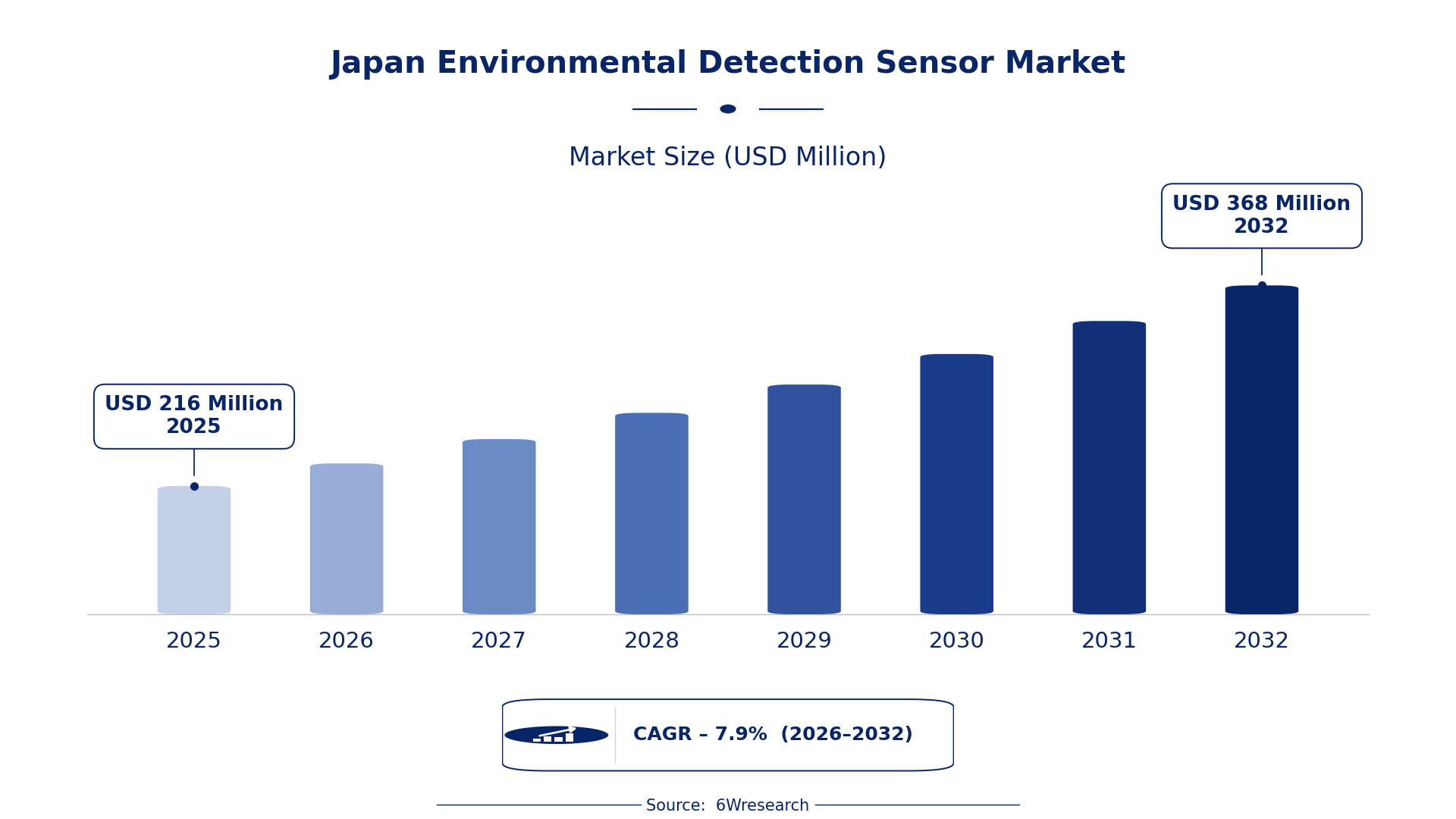
According to 6Wresearch internal database and industry insights, the Japan Environmental Detection Sensor Market was valued at USD 216 Million in 2025 and is projected to reach USD 368 Million by 2032, growing at a CAGR of approximately 7.9% during 2026–2032.
Japan Environmental Detection Sensor Market Highlights
| Report Metric | Details |
| Report Name | Japan Environmental Detection Sensor Market (2026-2032) |
| Market Size 2025 | USD 216 Million |
| Market Size 2032 | USD 368 Million |
| Absolute Growth 2025–2032 | USD 152 Million |
| CAGR 2026–2032 | 7.9% |
| Peak Annual Growth | 8.9% in 2026 |
| Forecast Period | 2026–2032 |
| Historical Data | 2022–2025 |
| Base Year | 2025 |
| Leading Sensor Type, 2025 | Gas Sensors (38% share) |
| Leading Detected Element, 2025 | CO2 (44% share) |
| Leading Distribution Channel, 2025 | Online Stores (36% share) |
| Leading End User, 2025 | IoT Device Manufacturers (40% share) |
| Fastest-Growing Sensor Type | Radiation Sensors (11.4% CAGR) |
| Fastest-Growing Detected Element | NOx (10.8% CAGR) |
| Fastest-Growing Distribution Channel | Sensor Suppliers (10.0% CAGR) |
| Fastest-Growing End User | Nuclear Facilities (10.2% CAGR) |
| Growing Sector | Nuclear Facilities |
| Key End Users | IoT Device Manufacturers, Nuclear Facilities, HVAC OEMs, Air Monitoring Units |
Japan Environmental Detection Sensor Market Year-wise Growth Rate and Key Drivers (2022–2032)
This graph illustrates the annual growth rates of the market from 2022 to 2032, highlighting a steady upward trajectory and projected market expansion over the forecast period.
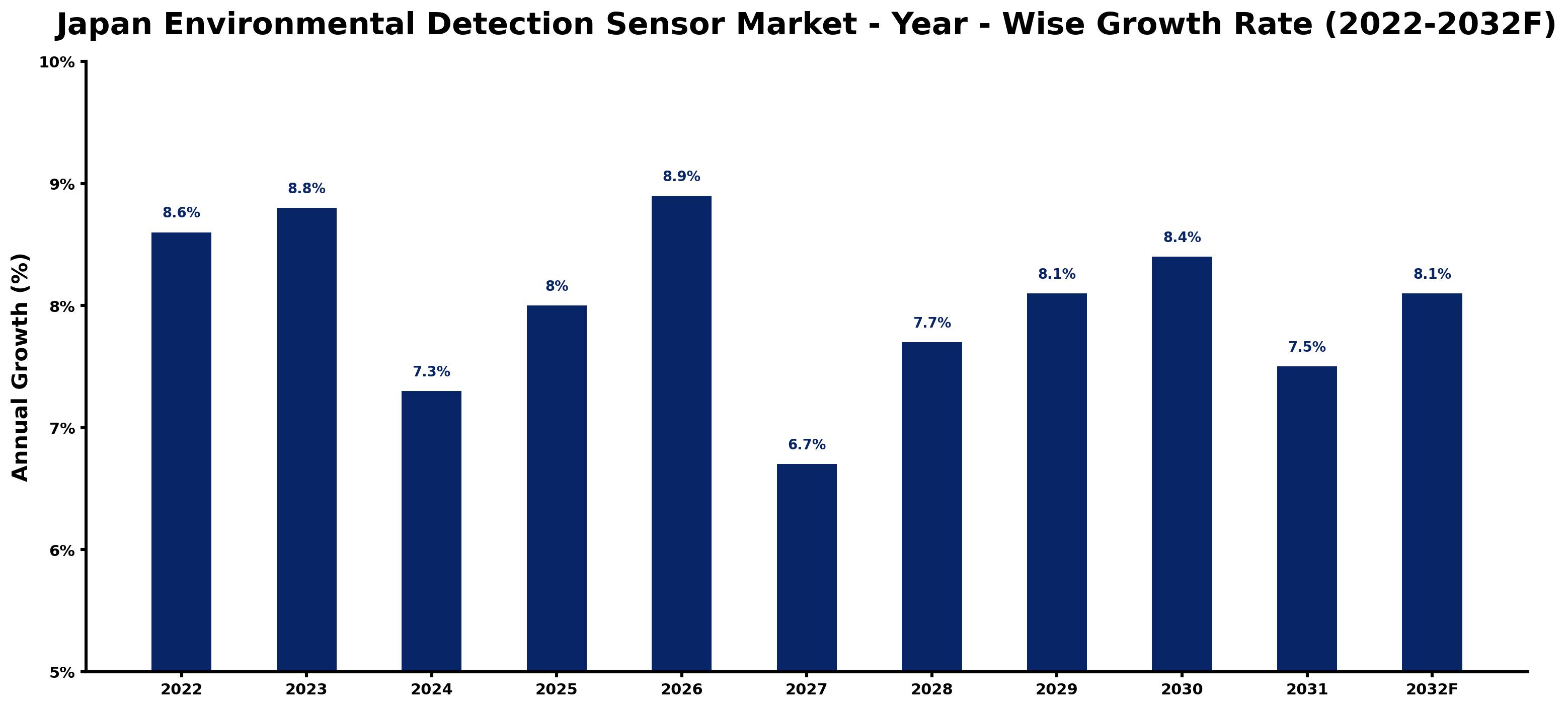
For each year, the table pairs the estimated growth rate with the leading influence on demand, showing how the drivers changed across the period.
| Year | Estimated Annual Growth (%) | Market Rationale |
| 2022 | 8.6 | The market showed strong growth due to rising awareness of environmental issues. |
| 2023 | 8.8 | Demand increased as the installed base of air quality sensors surpassed 100,000 units. |
| 2024 | 7.3 | Growth slowed as the market adjusted to previous rapid expansions in technology. |
| 2025 | 8.0 | The HVAC market's expansion led to increased sensor integration in new systems. |
| 2026 | 8.9 | A surge in environmental regulations is expected to spur demand for compliance monitoring solutions. |
| 2027 | 6.7 | Growth is projected to slow as the market begins to stabilise after peak demand in prior years. |
| 2028 | 7.7 | Increased investments in smart city initiatives will boost sensor adoption in urban areas. |
| 2029 | 8.1 | Demand is expected to rise again as industries seek to improve environmental monitoring capabilities. |
| 2030 | 8.4 | Technological advancements in sensor accuracy will drive further market expansion. |
| 2031 | 7.5 | Growth is projected to slow as the market matures and competition intensifies among suppliers. |
| 2032 | 8.1 | Rising public health concerns will sustain demand for environmental detection sensors. |
Note: Market size estimations and growth projections presented in this report are based on 6Wresearch's proprietary forecasting methodology, utilizing the latest available industry data, government publications, and primary research inputs.
Japan Environmental Detection Sensor Market Synopsis
Environmental detection sensors monitor parameters such as air quality, radiation levels, and moisture content, utilising semiconductor technology and electrochemical methods. The Japan Environmental Detection Sensor Market is expanding, driven by the growth of the HVAC sector and a national allocation of ¥1 billion for sensor technology development. With a total population of approximately 125 million, the demand for air quality monitoring continues to rise, particularly in urban regions like Tokyo and Osaka.
Market Dynamics Impact Analysis (2026–2032)
| Factor | Type | Impact | Primary Segment Affected |
| Increasing regulatory standards for air quality monitoring | Driver | High | Gas Sensors |
| Growth in smart city initiatives integrating IoT solutions | Driver | High | Moisture Sensors |
| Investment in environmental monitoring technologies | Opportunity | High | Radiation Sensors |
| Rising demand for compliance with air quality regulations | Opportunity | High | PM2.5 |
| High initial investment costs for advanced sensor technologies | Restraint | Medium | Particulate Sensors |
| Limited awareness of sensor benefits among smaller industries | Restraint | Medium | NOx |
| Competition from alternative monitoring technologies | Challenge | High | VOC |
| Supply chain disruptions affecting sensor availability | Challenge | Medium | Humidity |
Evaluation of Drivers in Japan Environmental Detection Sensor Market (2026–2032)
Below are the drivers that matter most for revenue growth, with supporting evidence.
| Drivers | Primary Segment Affected | Why It Matters (Evidence) |
| Rising awareness of air quality issues | Gas Sensors | Japan's total population of approximately 125 million drives demand for improved air quality monitoring solutions. |
| Increased investment in smart city projects | Moisture Sensors | The Smart City initiative promotes the integration of IoT and environmental sensors for urban management, with funding of ¥1 billion. |
| Regulatory compliance requirements for emissions monitoring | Radiation Sensors | Nuclear facilities in Japan must use radiation sensors for safety compliance, ensuring stringent monitoring standards. |
| Technological advancements in sensor capabilities | PM2.5 | The installed base of air quality sensors in Japan exceeded 100,000 units in 2023, improving monitoring effectiveness. |
| Growth in HVAC market driving sensor integration | CO2 | The HVAC market in Japan is projected to grow, increasing the demand for moisture and gas sensors. |
Most of the extra volume comes from rising awareness of air quality issues, as Japan's total population of approximately 125 million drives demand for improved monitoring solutions. Technological advancements in sensor capabilities have led to an installed base of over 100,000 air quality sensors in 2023, improving monitoring effectiveness. Growth in the HVAC market will further increase demand for moisture and gas sensors.
Evaluation of Restraints in Japan Environmental Detection Sensor Market
The main factors holding the market back are set out below.
| Market Restraint | Primary Segment Affected | Why It Matters (Evidence) |
| High production costs due to labour expenses | Gas Sensors | Japan's minimum wage of JPY 1,055 per hour raises production costs, impacting pricing for buyers. |
| Limited local suppliers for advanced components | Radiation Sensors | Supply chain disruptions occur due to a shortage of local suppliers, delaying project timelines. |
| Compliance costs with JIS Z 8801 standard | Moisture Sensors | Manufacturers can incur expenses of up to ¥500 million to comply with standards, delaying product launches. |
| Outdated technology affecting efficiency | PM2.5 | Many existing units fail to meet modern standards, increasing operational costs for industries reliant on accurate data. |
| Slow adoption of new innovations | CO2 | The reluctance to upgrade technology hampers the efficiency of environmental detection sensors. |
Japan Environmental Detection Sensor Market Challenges
Japan's conservative approach to adopting modern sensor technology results in many outdated units failing to meet current air quality standards. This reluctance to innovate leads to operational costs of up to ¥500 million for industries requiring precise environmental data. A shortage of local suppliers for advanced sensor components creates supply chain delays, causing buyers to wait up to three months for critical deliveries. Rising production costs, driven by a national minimum wage of JPY 1,055 per hour, further erode profit margins for producers, ultimately leading to higher prices for buyers.
Trends in the Japan Environmental Detection Sensor Market
The trends below show where the Japan Environmental Detection Sensor Market is heading.
- Shift towards IoT Integration in Urban Management: The Smart City initiative is driving the integration of IoT and environmental sensors in urban areas, with an investment of ¥1 billion for development. This trend improves real-time monitoring capabilities for city planners.
- Increased Focus on Air Quality Compliance: As air quality regulations tighten, industries are prioritising compliance with standards like JIS Z 8801, leading to a surge in demand for air quality sensors. This shift is vital for maintaining public health.
- Growth in Safety Standards for Nuclear Facilities: The rising emphasis on safety in nuclear facilities is prompting the adoption of advanced radiation sensors, ensuring compliance with stringent regulations. This trend is essential for operational integrity.
- Technological Advancements in Sensor Accuracy: Innovations in sensor technology are improving accuracy and reliability, driving demand for advanced monitoring solutions. This development is important for industries seeking to enhance environmental compliance.
Investment Opportunities in the Japan Environmental Detection Sensor Market
The opportunities below stand out in the Japan Environmental Detection Sensor Market for new entrants and existing suppliers.
- Supply of Advanced Environmental Sensors: The demand for advanced environmental sensors is rising, with a market size projected to reach USD 368 million by 2032. Collaborating with IoT device manufacturers in Tokyo can facilitate market entry.
- Investment in Smart City Projects: Smart City initiatives are creating opportunities for sensor integration, with ¥1 billion allocated for development. Engaging with urban planners in Osaka can lead to successful partnerships.
- Expansion of HVAC Systems: With the HVAC market projected to grow, there is an opportunity for moisture and gas sensor suppliers. Partnering with HVAC OEMs can enhance market presence.
- Focus on Compliance Solutions for Nuclear Facilities: Nuclear facilities require advanced radiation sensors for safety compliance, creating a niche for suppliers. Establishing joint ventures with local manufacturers can streamline entry.
Government Initiatives in the Japan Environmental Detection Sensor Market
The Industrial Standardization Act, enacted in 1949 and amended in 2019, governs the Japanese Industrial Standards (JIS) for environmental detection sensors. Compliance with these standards is mandatory for manufacturers, ensuring product reliability and safety in environmental monitoring.
In 2023, Japan allocated ¥1 billion for the development of environmental sensor technology, overseen by the Ministry of the Environment. This funding supports innovation and compliance in air quality monitoring, benefiting various industries.
Future Insight of the Japan Environmental Detection Sensor Market
Investment in environmental sensor technology will increase, with ¥1 billion allocated for development in 2023. This funding will stimulate demand for advanced sensors, especially in urban areas like Tokyo and Osaka, where the Smart City initiative promotes IoT integration. By 2032, the installed base of air quality sensors will surpass 100,000 units, driven by regulatory compliance and the growing HVAC market. The emphasis on safety in nuclear facilities will necessitate improved monitoring technologies across various sectors.
Market Segmentation Analysis
Japan Environmental Detection Sensor Market report covers a detailed analysis of the following market segments:
By Sensor Type – Gas Sensors Lead, Radiation Sensors Expected to Grow Fastest
According to Saurav Kr Singh, Senior Research Analyst at 6Wresearch, Gas Sensors accounted for 38% of the market by sensor type in 2025. Gas sensors hold the largest share in the market due to their essential role in monitoring air quality and emissions, particularly in major urban areas like Tokyo and Osaka. The installed base of over 100,000 units demonstrates their critical importance in environmental monitoring. Over 2026–2032, Radiation Sensors are expected to post the fastest growth, at a CAGR of 11.4%. Radiation sensors are experiencing rapid growth as they are essential for safety compliance in nuclear facilities, which are mandated to use these devices. The increasing focus on stringent safety regulations in Japan's nuclear sector will likely boost this segment's growth further. This indicates that suppliers should focus on enhancing gas sensor technologies to meet the high demand for air quality monitoring.
By Detected Element – CO2 Leads, NOx Expected to Grow Fastest
With 44% of detected element revenue in 2025, CO2 was the largest category. CO2 sensors dominate the market as they are extensively used in HVAC systems to monitor indoor air quality, reflecting the high demand from residential and commercial sectors. This widespread application underscores their importance in maintaining air quality standards. NOx is set to record the highest CAGR in this split, 10.8% over 2026–2032. NOx sensors are growing quickly due to their significance in emissions monitoring for industrial applications, especially with stricter regulations in place. This trend indicates a shift towards more stringent environmental compliance measures in Japan's industrial sector. Buyers should prioritise acquiring NOx sensors to align with evolving emissions regulations.
By Distribution Channel – Online Stores Lead, Sensor Suppliers Expected to Grow Fastest
The largest distribution channel category in 2025 was Online Stores, at 36% of revenue. Online stores lead the distribution channel as they provide a convenient platform for purchasing environmental sensors, catering to both individual and business customers. The growth of e-commerce in Japan has significantly improved accessibility to these products. The quickest growth will come from Sensor Suppliers, forecast to expand at a CAGR of 10.0% between 2026 and 2032. Sensor suppliers are rapidly expanding as they directly provide essential components for various applications, reflecting a shift towards specialised sourcing. This trend suggests a preference for obtaining tailored solutions directly from manufacturers. Suppliers should enhance their direct sales channels to capitalise on the increasing demand for specialised sensor products.
By End User – IoT Device Manufacturers Lead, Nuclear Facilities Expected to Grow Fastest
IoT Device Manufacturers took 40% of end user revenue in 2025, more than any other category. IoT device manufacturers represent the largest end user group as they integrate environmental sensors into smart solutions, driving demand in various sectors. The rise of smart city initiatives in Japan further fuels this trend, highlighting the importance of IoT in environmental monitoring. Nuclear Facilities are projected to grow fastest, at a CAGR of 10.2% during 2026–2032. Nuclear facilities are the fastest-growing end user segment, driven by stringent safety and regulatory compliance requirements that necessitate the use of advanced sensors. This focus on safety in the nuclear sector will likely lead to increased investments in sensor technologies. Suppliers should target nuclear facilities to meet the heightened demand for safety compliance solutions.
Key Attractiveness of the Report
- 10 Years of Market Numbers
- Historical Data Starting from 2022 to 2025
- Base Year 2025
- Forecast Data until 2032
- Key Performance Indicators Impacting the Market
- Major Upcoming Developments and Projects
Key Highlights of the Report:
- Japan Environmental Detection Sensor Market Outlook
- Market Size of Japan Environmental Detection Sensor Market, 2025
- Forecast of Japan Environmental Detection Sensor Market, 2032
- Historical Data and Forecast of Japan Environmental Detection Sensor Revenues & Volume for the Period 2022-2032F
- Japan Environmental Detection Sensor Market Trend Evolution
- Japan Environmental Detection Sensor Market Drivers and Challenges
- Japan Environmental Detection Sensor Price Trends
- Japan Environmental Detection Sensor Porter's Five Forces
- Japan Environmental Detection Sensor Industry Life Cycle
- Historical Data and Forecast of Japan Environmental Detection Sensor Market Revenues & Volume By Sensor Type for the Period 2022-2032F
- Historical Data and Forecast of Japan Environmental Detection Sensor Market Revenues & Volume By Gas Sensors for the Period 2022-2032F
- Historical Data and Forecast of Japan Environmental Detection Sensor Market Revenues & Volume By Radiation Sensors for the Period 2022-2032F
- Historical Data and Forecast of Japan Environmental Detection Sensor Market Revenues & Volume By Moisture Sensors for the Period 2022-2032F
- Historical Data and Forecast of Japan Environmental Detection Sensor Market Revenues & Volume By Particulate Sensors for the Period 2022-2032F
- Historical Data and Forecast of Japan Environmental Detection Sensor Market Revenues & Volume By Detected Element for the Period 2022-2032F
- Historical Data and Forecast of Japan Environmental Detection Sensor Market Revenues & Volume By CO2, NOx, VOC for the Period 2022-2032F
- Historical Data and Forecast of Japan Environmental Detection Sensor Market Revenues & Volume By Alpha/Beta for the Period 2022-2032F
- Historical Data and Forecast of Japan Environmental Detection Sensor Market Revenues & Volume By Humidity for the Period 2022-2032F
- Historical Data and Forecast of Japan Environmental Detection Sensor Market Revenues & Volume By PM2.5, PM10 for the Period 2022-2032F
- Historical Data and Forecast of Japan Environmental Detection Sensor Market Revenues & Volume By Distribution Channel for the Period 2022-2032F
- Historical Data and Forecast of Japan Environmental Detection Sensor Market Revenues & Volume By Online Stores for the Period 2022-2032F
- Historical Data and Forecast of Japan Environmental Detection Sensor Market Revenues & Volume By Sensor Suppliers for the Period 2022-2032F
- Historical Data and Forecast of Japan Environmental Detection Sensor Market Revenues & Volume By OEMs for the Period 2022-2032F
- Historical Data and Forecast of Japan Environmental Detection Sensor Market Revenues & Volume By Electronics Distributors for the Period 2022-2032F
- Historical Data and Forecast of Japan Environmental Detection Sensor Market Revenues & Volume By End User for the Period 2022-2032F
- Historical Data and Forecast of Japan Environmental Detection Sensor Market Revenues & Volume By IoT Device Manufacturers for the Period 2022-2032F
- Historical Data and Forecast of Japan Environmental Detection Sensor Market Revenues & Volume By Nuclear Facilities for the Period 2022-2032F
- Historical Data and Forecast of Japan Environmental Detection Sensor Market Revenues & Volume By HVAC OEMs for the Period 2022-2032F
- Historical Data and Forecast of Japan Environmental Detection Sensor Market Revenues & Volume By Air Monitoring Units for the Period 2022-2032F
- Japan Environmental Detection Sensor Import Export Trade Statistics
- Market Opportunity Assessment By Sensor Type
- Market Opportunity Assessment By Detected Element
- Market Opportunity Assessment By Distribution Channel
- Market Opportunity Assessment By End User
- Japan Environmental Detection Sensor Top Companies Market Share
- Japan Environmental Detection Sensor Competitive Benchmarking By Technical and Operational Parameters
- Japan Environmental Detection Sensor Company Profiles
- Japan Environmental Detection Sensor Key Strategic Recommendations
Market Covered
Segments analysed in this report are listed below.
By Sensor Type
- Gas Sensors
- Radiation Sensors
- Moisture Sensors
- Particulate Sensors
By Detected Element
- CO2
- NOx
- VOC
- Alpha/Beta
- Humidity
- PM2.5
- PM10
By Distribution Channel
- Online Stores
- Sensor Suppliers
- OEMs
- Electronics Distributors
By End User
- IoT Device Manufacturers
- Nuclear Facilities
- HVAC OEMs
- Air Monitoring Units































