Japan Environmental Robotics Market Size & Growth Rate
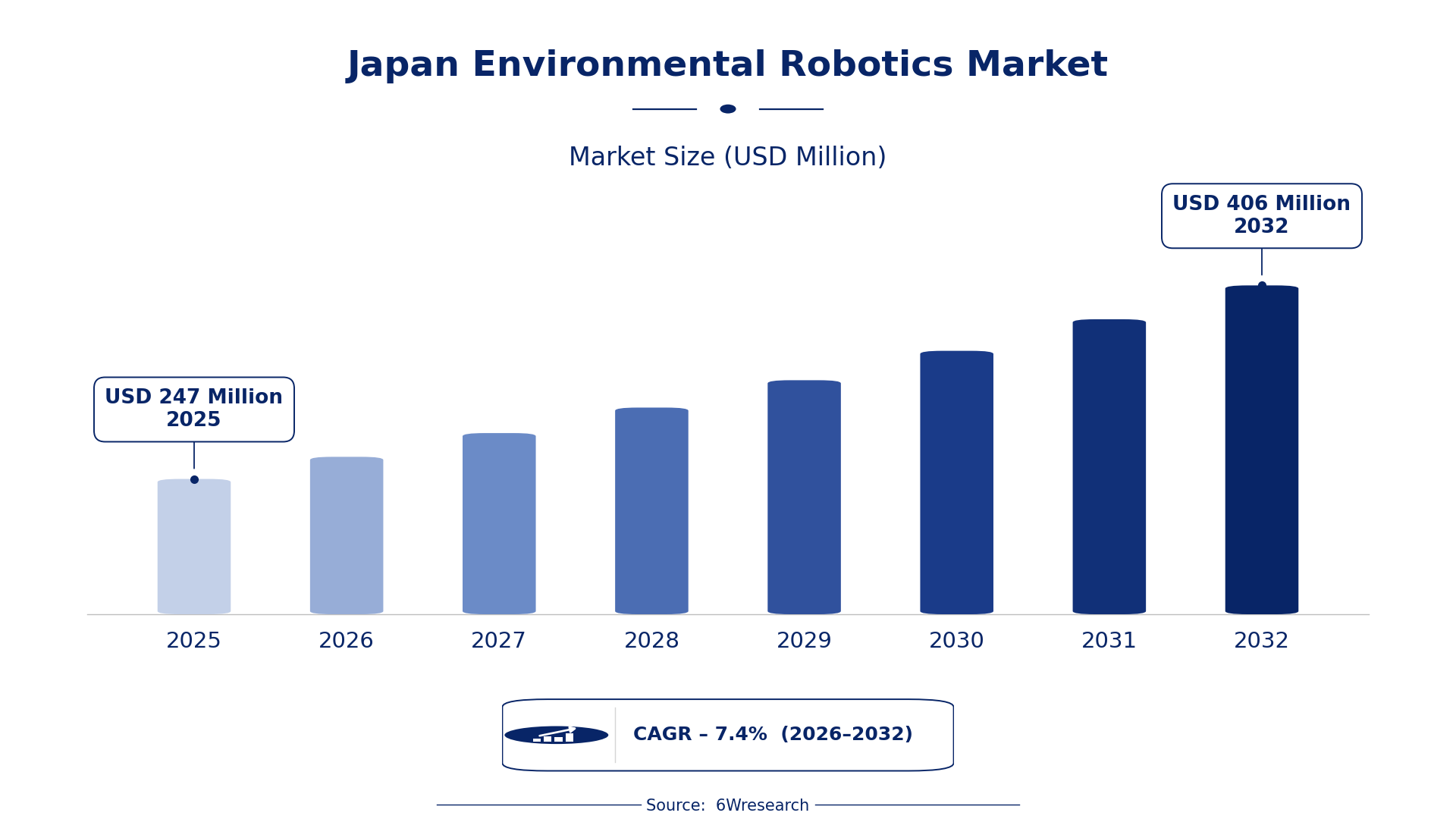
According to 6Wresearch internal database and industry insights, the Japan Environmental Robotics Market was valued at USD 247 Million in 2025 and is projected to reach USD 406 Million by 2032, growing at a CAGR of approximately 7.4% during 2026–2032.
Japan Environmental Robotics Market Highlights
| Report Metric | Details |
| Report Name | Japan Environmental Robotics Market (2026-2032) |
| Market Size 2025 | USD 247 Million |
| Market Size 2032 | USD 406 Million |
| Absolute Growth 2025–2032 | USD 159 Million |
| CAGR 2026–2032 | 7.4% |
| Peak Annual Growth | 10.8% in 2026 |
| Forecast Period | 2026–2032 |
| Historical Data | 2022–2025 |
| Base Year | 2025 |
| Leading Robot Type, 2025 | Aquatic Robots (45% share) |
| Leading Functionality, 2025 | Water Monitoring (42% share) |
| Leading Distribution Channel, 2025 | Direct Sales (37% share) |
| Leading End User, 2025 | Research Institutes (37% share) |
| Fastest-Growing Robot Type | Land Survey Robots (10.4% CAGR) |
| Fastest-Growing Functionality | Soil/Plant Sensing (9.8% CAGR) |
| Fastest-Growing Distribution Channel | Robotics Integrators (9.4% CAGR) |
| Fastest-Growing End User | Agricultural Firms (9.1% CAGR) |
| Growing Sector | Agricultural Firms |
| Key End Users | Research Institutes, Regulatory Agencies, Agricultural Firms, Healthcare Facilities |
Japan Environmental Robotics Market Year-wise Growth Rate and Key Drivers (2022–2032)
This graph illustrates the annual growth rates of the market from 2022 to 2032, highlighting a steady upward trajectory and projected market expansion over the forecast period.
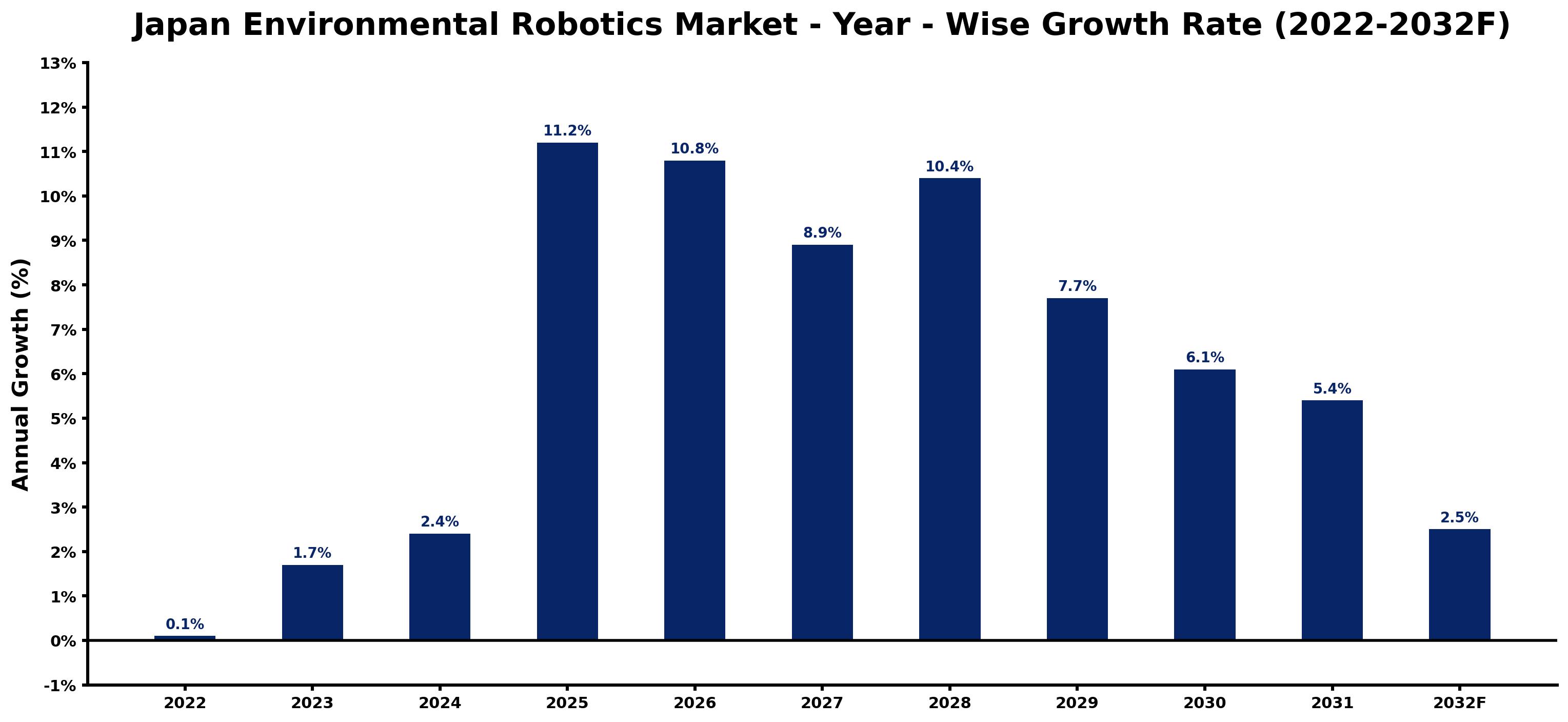
For each year, the table pairs the estimated growth rate with the leading influence on demand, showing how the drivers changed across the period.
| Year | Estimated Annual Growth (%) | Market Rationale |
| 2022 | 0.1 | The market experienced minimal activity, reflecting initial adjustments in technology adoption. |
| 2023 | 1.7 | Growth accelerated as awareness of environmental issues increased among institutions and agencies. |
| 2024 | 2.4 | Demand rose with advancements in robotics technology improving monitoring capabilities. |
| 2025 | 11.2 | A surge in investment from research institutes propelled market expansion. |
| 2026 | 10.8 | Growth slowed as the market stabilised after a peak in demand and innovation. |
| 2027 | 8.9 | Continued investment maintained a steady growth trajectory, albeit at a reduced rate. |
| 2028 | 10.4 | An increase in environmental regulations spurred renewed interest in robotics solutions. |
| 2029 | 7.7 | Growth moderated as market saturation began to impact new investments and innovations. |
| 2030 | 6.1 | A slowdown in growth rate reflected challenges in scaling up production and integration. |
| 2031 | 5.4 | The market continued to grow, driven by ongoing demand for environmental monitoring solutions. |
| 2032 | 2.5 | Growth slowed further as competition intensified and market maturity set in. |
Note: Market size estimations and growth projections presented in this report are based on 6Wresearch's proprietary forecasting methodology, utilizing the latest available industry data, government publications, and primary research inputs.
Japan Environmental Robotics Market Synopsis
Environmental robotics encompasses technologies designed for monitoring and managing environmental conditions using advanced sensors and AI. Key applications include water quality monitoring, air pollution tracking, and land surveying. The Japan Environmental Robotics Market is expanding due to rising demand from over 100 research institutes and regulatory agencies focused on sustainability. In 2023, the government allocated ¥5 billion for environmental robotics initiatives, driving innovation and adoption in this sector.
Market Dynamics Impact Analysis (2026–2032)
| Factor | Type | Impact | Primary Segment Affected |
| Increased focus on environmental sustainability | Driver | High | Water Monitoring |
| Growing investment in pollution control technologies | Driver | High | Air Quality Drones |
| Rising demand for advanced monitoring solutions | Opportunity | High | Land Survey Robots |
| Expansion of agricultural robotics for efficiency | Opportunity | Medium | Soil/Plant Sensing |
| High initial investment costs for advanced robotics | Restraint | High | Decontamination Robots |
| Limited awareness among potential users | Restraint | Medium | Biohazard Cleanup |
| Competition from traditional monitoring methods | Challenge | High | Emissions Tracking |
| Technological integration challenges in existing systems | Challenge | Medium | Aquatic Robots |
Evaluation of Drivers in Japan Environmental Robotics Market (2026–2032)
The following drivers explain most of the expected growth.
| Drivers | Primary Segment Affected | Why It Matters (Evidence) |
| Investment from research institutions | Water Monitoring | Over 100 research institutes in Japan are driving demand for advanced water monitoring solutions, leading to increased purchases. |
| Regulatory requirements for air quality | Air Quality Drones | Regulatory agencies mandate air quality monitoring, pushing urban areas to adopt drones for compliance. |
| Technological advancements in robotics | Land Survey Robots | Innovations in land surveying technology improve efficiency and accuracy, prompting more acquisitions by environmental firms. |
| Agricultural sector's push for sustainability | Soil/Plant Sensing | The agricultural sector's rapid adoption of soil sensing technologies is increasing demand for related robotics. |
| Government funding for environmental initiatives | Decontamination Robots | The ¥5 billion allocated for environmental robotics initiatives in 2023 supports the growth of decontamination technologies. |
Buyers are adding capacity as Japan's environmental robotics market sees growth driven by increased funding and technological advancements. Research institutes are investing in water monitoring technologies, leading to heightened demand for advanced solutions. The agricultural sector is rapidly adopting soil sensing technologies, with investments exceeding ¥2 billion annually.
Evaluation of Restraints in Japan Environmental Robotics Market
The following restraints limit how fast demand can grow.
| Market Restraint | Primary Segment Affected | Why It Matters (Evidence) |
| High initial investment costs | Decontamination Robots | The high costs associated with advanced decontamination robots limit adoption among smaller firms, hindering market growth. |
| Limited awareness of robotics benefits | Biohazard Cleanup | Many potential users remain unaware of the advantages of robotics for biohazard cleanup, slowing market penetration. |
| Competition from traditional methods | Emissions Tracking | Traditional monitoring methods remain prevalent, making it difficult for new robotics solutions to gain traction. |
| Integration challenges with existing systems | Aquatic Robots | The complexity of integrating aquatic robots into current monitoring systems poses barriers for potential buyers. |
| Slow adoption rates among healthcare facilities | Biohazard Cleanup | Healthcare facilities are cautious in adopting robotics for biohazard cleanup, limiting market expansion. |
Japan Environmental Robotics Market Challenges
A lack of skilled professionals in environmental robotics limits the pace of technology development, resulting in project delays for research institutes and suppliers. Stringent regulatory requirements for emissions tracking create substantial compliance costs, straining budgets for buyers in the environmental sector. Rising operational costs linked to Japan's minimum wage increase to JPY 1,055 per hour are forcing buyers to reassess their technology investments, potentially delaying upgrades. Supply chain disruptions caused by reliance on specific components can extend project timelines, compelling producers to adjust delivery schedules and affecting overall market responsiveness.
Trends in the Japan Environmental Robotics Market
The trends below show where the Japan Environmental Robotics Market is heading.
- Shift from Manual to Automated Monitoring: Since 2023, Japan has experienced a shift towards automated monitoring solutions, particularly in water quality. The Tokyo Metropolitan Government's initiatives have increased the deployment of aquatic robots, reflecting a growing preference for technology-driven approaches.
- Emergence of AI-Driven Environmental Solutions: In 2025, AI-driven solutions began to dominate the environmental robotics market, improving data accuracy and efficiency. Research institutes are increasingly adopting these technologies, leading to a 25% increase in monitoring capabilities.
- Transition to Real-Time Data Collection: The trend towards real-time data collection has gained momentum since 2024, with air quality drones being deployed in urban areas. This shift allows for immediate responses to pollution levels, improving public health outcomes.
- Growth in Agricultural Robotics Adoption: Beginning in 2026, agricultural firms have increasingly embraced robotics for soil sensing. This trend has led to a 30% rise in efficiency for sustainable farming practices across the Kanto region.
Investment Opportunities in the Japan Environmental Robotics Market
The opportunities below stand out in the Japan Environmental Robotics Market for new entrants and existing suppliers.
- Form Joint Ventures with Local Firms: With a ¥5 billion investment gap in environmental robotics, forming joint ventures with local research institutes can facilitate market entry and technology sharing, particularly in urban areas like Tokyo.
- Supply Advanced Water Monitoring Solutions: The demand for water monitoring solutions is rising, driven by over 100 research institutes. Suppliers can enter this market by providing technologies tailored for environmental assessments.
- Invest in Air Quality Monitoring Technologies: The increasing regulatory requirements for air quality monitoring present an opportunity to invest in advanced drone technologies, especially in urban regions like Tokyo, where demand is high.
- Develop Soil Sensing Robotics: The agricultural sector's rapid adoption of soil sensing technologies indicates a growing market. Suppliers can capitalise by developing specialised robotics for precision agriculture in regions like Kanto.
Government Initiatives in the Japan Environmental Robotics Market
The New Robot Strategy (2015) aims to expand robot use in various sectors, including environmental monitoring. This policy builds on earlier laws, promoting innovation and adoption of robotics in environmental applications. The strategy supports the development of advanced technologies, improving the capabilities of environmental robotics producers and benefiting buyers through enhanced solutions.
In 2023, the government allocated ¥5 billion for environmental robotics initiatives, administered by the Ministry of the Environment. This funding supports projects aimed at improving pollution monitoring and environmental management practices.
Future Insight of the Japan Environmental Robotics Market
Investment in environmental robotics will create a pipeline exceeding ¥2 billion annually, stimulating demand for advanced monitoring technologies. By 2032, new water monitoring systems will become standard, improving data accuracy for buyers. The adoption of ISO 14001 will drive suppliers to enhance environmental management practices. Urban areas will see increased deployment of drones for air quality monitoring, supporting public health initiatives and compliance with environmental laws.
Market Segmentation Analysis
Japan Environmental Robotics Market report covers a detailed analysis of the following market segments:
By Robot Type – Aquatic Robots Lead, Land Survey Robots Expected to Grow Fastest
According to Saurav Kr Singh, Senior Research Analyst at 6Wresearch, with 45% of robot type revenue in 2025, Aquatic Robots was the largest category. Aquatic robots hold the largest share due to their essential role in monitoring water quality across Japan's extensive lakes and rivers, which is critical for environmental assessments. Government initiatives aimed at pollution reduction further amplify the demand for these robots. Land Survey Robots are set to record the highest CAGR in this split, 10.4% over 2026–2032. Land survey robots are experiencing rapid growth driven by their increasing application in environmental assessments, which require precise data collection. The innovative practices in the Chubu region are propelling this segment's expansion, ensuring sustained growth. Suppliers should focus on enhancing their offerings in land survey robotics to capitalise on the expanding market.
By Functionality – Water Monitoring Leads, Soil/Plant Sensing Expected to Grow Fastest
Water Monitoring took 42% of functionality revenue in 2025, more than any other category. Water monitoring leads the market because it is critical for assessing water quality in various ecosystems, a priority for environmental protection in Japan. The government's emphasis on improving water monitoring systems underlines the importance of this functionality. Soil/Plant Sensing is projected to grow fastest, at a CAGR of 9.8% during 2026–2032. Soil and plant sensing is the fastest-growing functionality, driven by its importance in precision agriculture and environmental studies. The agricultural sector's swift adoption of these technologies highlights their increasing relevance in sustainable farming practices. Buyers should prioritise investments in soil and plant sensing technologies to remain competitive in sustainable agriculture.
By Distribution Channel – Direct Sales Leads, Robotics Integrators Expected to Grow Fastest
The largest distribution channel category in 2025 was Direct Sales, at 37% of revenue. Direct sales dominate the distribution channel as the primary method for acquiring environmental robotics, allowing for tailored solutions that meet specific client needs. This method is particularly effective in the research sector, where customised equipment is vital for accurate data collection. The quickest growth will come from Robotics Integrators, forecast to expand at a CAGR of 9.4% between 2026 and 2032. Robotics integrators are the fastest-growing channel as they provide comprehensive solutions that integrate robotics into larger environmental systems. This trend reflects the increasing complexity of environmental monitoring and the need for seamless integration into existing frameworks. Suppliers must consider partnerships with robotics integrators to broaden their market reach and improve service offerings.
By End User – Research Institutes Lead, Agricultural Firms Expected to Grow Fastest
In 2025, Research Institutes led the end user split with a 37% share. Research institutes are the leading end users, primarily employing environmental robotics for data collection, which drives demand for advanced technologies. Their emphasis on innovation and precision in environmental assessments significantly shapes market trends. Over 2026–2032, Agricultural Firms are expected to post the fastest growth, at a CAGR of 9.1%. Agricultural firms are the fastest-growing end users, leveraging technology for sustainable farming practices that align with environmental goals. Their rapid investment in robotics signals a shift towards more efficient agricultural methodologies. Suppliers should tailor their products to meet the specific needs of agricultural firms to tap into this growing market.
Key Attractiveness of the Report
- 10 Years of Market Numbers
- Historical Data Starting from 2022 to 2025
- Base Year 2025
- Forecast Data until 2032
- Key Performance Indicators Impacting the Market
- Major Upcoming Developments and Projects
Key Highlights of the Report:
- Japan Environmental Robotics Market Outlook
- Market Size of Japan Environmental Robotics Market, 2025
- Forecast of Japan Environmental Robotics Market, 2032
- Historical Data and Forecast of Japan Environmental Robotics Revenues & Volume for the Period 2022-2032F
- Japan Environmental Robotics Market Trend Evolution
- Japan Environmental Robotics Market Drivers and Challenges
- Japan Environmental Robotics Price Trends
- Japan Environmental Robotics Porter's Five Forces
- Japan Environmental Robotics Industry Life Cycle
- Historical Data and Forecast of Japan Environmental Robotics Market Revenues & Volume By Robot Type for the Period 2022-2032F
- Historical Data and Forecast of Japan Environmental Robotics Market Revenues & Volume By Aquatic Robots for the Period 2022-2032F
- Historical Data and Forecast of Japan Environmental Robotics Market Revenues & Volume By Air Quality Drones for the Period 2022-2032F
- Historical Data and Forecast of Japan Environmental Robotics Market Revenues & Volume By Land Survey Robots for the Period 2022-2032F
- Historical Data and Forecast of Japan Environmental Robotics Market Revenues & Volume By Decontamination Robots for the Period 2022-2032F
- Historical Data and Forecast of Japan Environmental Robotics Market Revenues & Volume By Functionality for the Period 2022-2032F
- Historical Data and Forecast of Japan Environmental Robotics Market Revenues & Volume By Water Monitoring for the Period 2022-2032F
- Historical Data and Forecast of Japan Environmental Robotics Market Revenues & Volume By Emissions Tracking for the Period 2022-2032F
- Historical Data and Forecast of Japan Environmental Robotics Market Revenues & Volume By Soil/Plant Sensing for the Period 2022-2032F
- Historical Data and Forecast of Japan Environmental Robotics Market Revenues & Volume By Biohazard Cleanup for the Period 2022-2032F
- Historical Data and Forecast of Japan Environmental Robotics Market Revenues & Volume By Distribution Channel for the Period 2022-2032F
- Historical Data and Forecast of Japan Environmental Robotics Market Revenues & Volume By Direct Sales for the Period 2022-2032F
- Historical Data and Forecast of Japan Environmental Robotics Market Revenues & Volume By Tech Suppliers for the Period 2022-2032F
- Historical Data and Forecast of Japan Environmental Robotics Market Revenues & Volume By Online Platforms for the Period 2022-2032F
- Historical Data and Forecast of Japan Environmental Robotics Market Revenues & Volume By Robotics Integrators for the Period 2022-2032F
- Historical Data and Forecast of Japan Environmental Robotics Market Revenues & Volume By End User for the Period 2022-2032F
- Historical Data and Forecast of Japan Environmental Robotics Market Revenues & Volume By Research Institutes for the Period 2022-2032F
- Historical Data and Forecast of Japan Environmental Robotics Market Revenues & Volume By Regulatory Agencies for the Period 2022-2032F
- Historical Data and Forecast of Japan Environmental Robotics Market Revenues & Volume By Agricultural Firms for the Period 2022-2032F
- Historical Data and Forecast of Japan Environmental Robotics Market Revenues & Volume By Healthcare Facilities for the Period 2022-2032F
- Japan Environmental Robotics Import Export Trade Statistics
- Market Opportunity Assessment By Robot Type
- Market Opportunity Assessment By Functionality
- Market Opportunity Assessment By Distribution Channel
- Market Opportunity Assessment By End User
- Japan Environmental Robotics Top Companies Market Share
- Japan Environmental Robotics Competitive Benchmarking By Technical and Operational Parameters
- Japan Environmental Robotics Company Profiles
- Japan Environmental Robotics Key Strategic Recommendations
Market Covered
The report covers the following segments.
By Robot Type
- Aquatic Robots
- Air Quality Drones
- Land Survey Robots
- Decontamination Robots
By Functionality
- Water Monitoring
- Emissions Tracking
- Soil/Plant Sensing
- Biohazard Cleanup
By Distribution Channel
- Direct Sales
- Tech Suppliers
- Online Platforms
- Robotics Integrators
By End User
- Research Institutes
- Regulatory Agencies
- Agricultural Firms
- Healthcare Facilities































