Japan Environmental Sensor AI Market Size & Growth Rate
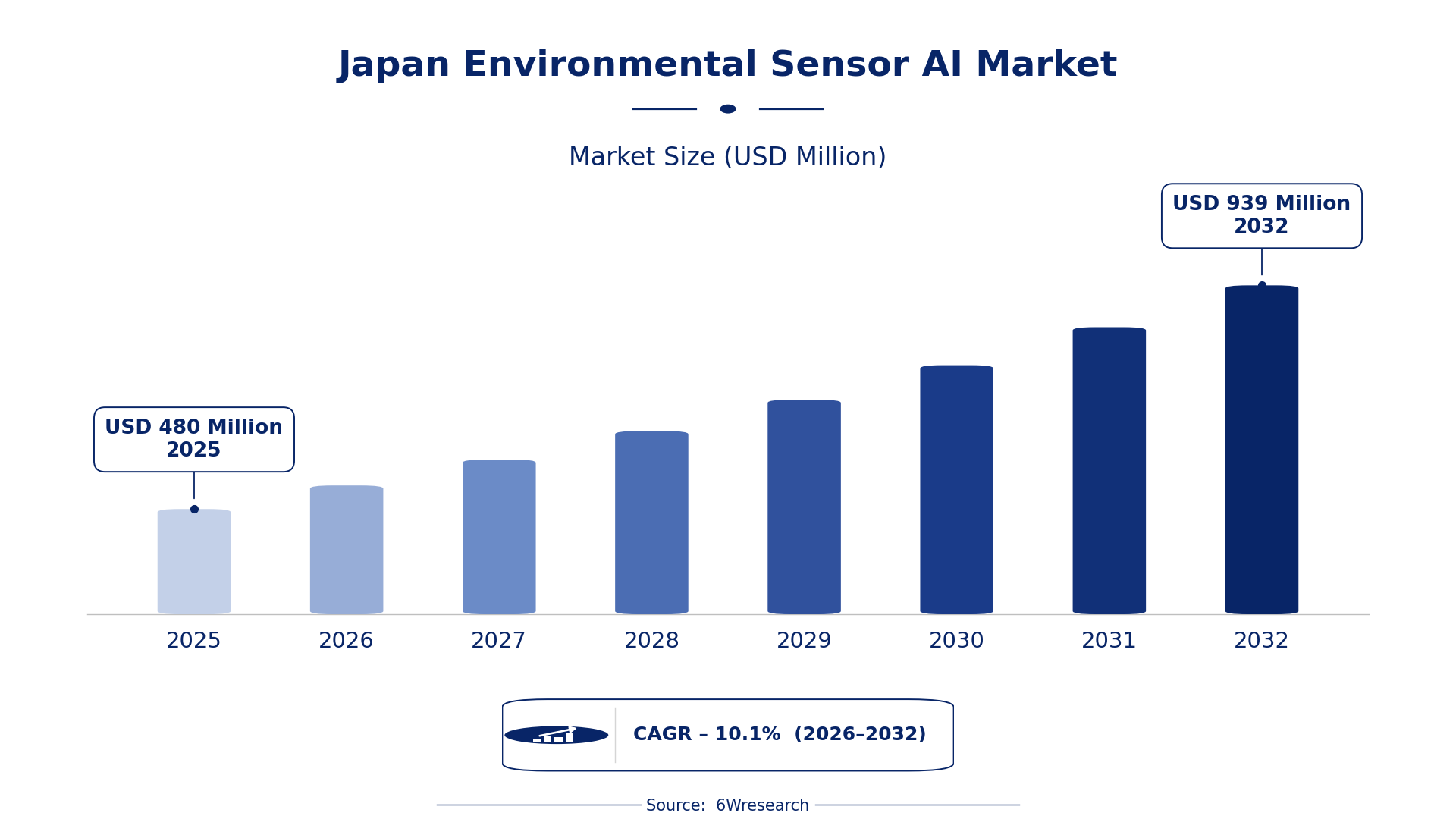
According to 6Wresearch internal database and industry insights, the Japan Environmental Sensor AI Market was valued at USD 480 Million in 2025 and is projected to reach USD 939 Million by 2032, growing at a CAGR of approximately 10.1% during 2026–2032.
Japan Environmental Sensor AI Market Highlights
| Report Metric | Details |
| Report Name | Japan Environmental Sensor AI Market (2026-2032) |
| Market Size 2025 | USD 480 Million |
| Market Size 2032 | USD 939 Million |
| Absolute Growth 2025–2032 | USD 459 Million |
| CAGR 2026–2032 | 10.1% |
| Peak Annual Growth | 11.1% in 2028 |
| Forecast Period | 2026–2032 |
| Historical Data | 2022–2025 |
| Base Year | 2025 |
| Leading AI Type, 2025 | Predictive AI (33% share) |
| Leading Sensor Application, 2025 | Pollution Forecast (47% share) |
| Leading Distribution Channel, 2025 | SaaS Platforms (47% share) |
| Leading End User, 2025 | Smart City Operators (37% share) |
| Fastest-Growing AI Type | Anomaly Detection (15.5% CAGR) |
| Fastest-Growing Sensor Application | Hazard Alerting (14.4% CAGR) |
| Fastest-Growing Distribution Channel | OEM Integration (13.4% CAGR) |
| Fastest-Growing End User | Industrial Sites (13.7% CAGR) |
| Growing Sector | Environmental monitoring |
| Key End Users | Government agencies, industrial sites, smart city operators, environmental agencies |
Japan Environmental Sensor AI Market Year-wise Growth Rate and Key Drivers (2022–2032)
This graph illustrates the annual growth rates of the market from 2022 to 2032, highlighting a steady upward trajectory and projected market expansion over the forecast period.
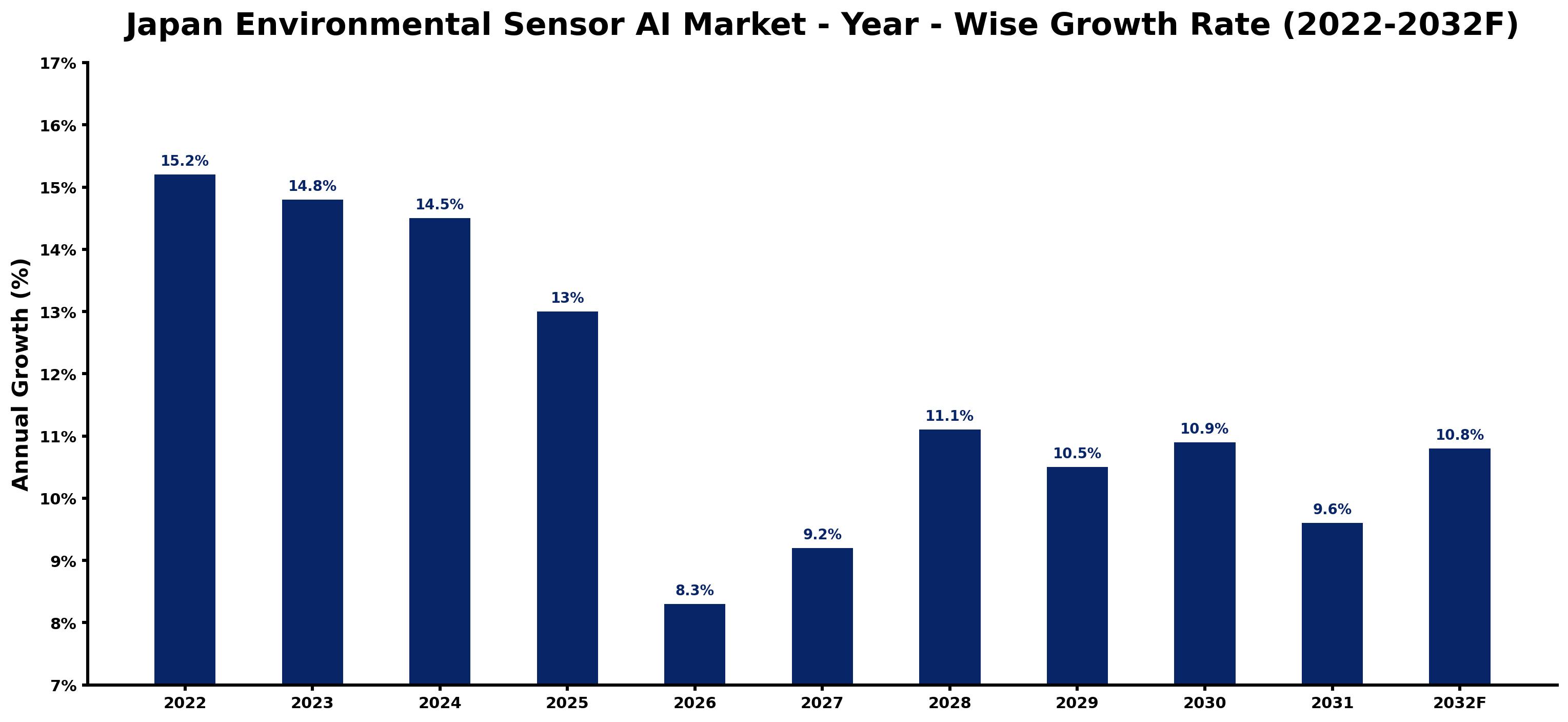
For each year, the table pairs the estimated growth rate with the leading influence on demand, showing how the drivers changed across the period.
| Year | Estimated Annual Growth (%) | Market Rationale |
| 2022 | 15.2 | The market experienced strong demand from government agencies and industrial sites. |
| 2023 | 14.8 | Growth slowed slightly as the market adjusted to previous peaks in demand. |
| 2024 | 14.5 | Continued growth stemmed from persistent environmental monitoring needs across sectors. |
| 2025 | 13.0 | Demand remained steady, supported by the rollout of smart city initiatives. |
| 2026 | 8.3 | Growth is expected to slow further as market saturation begins to impact new orders. |
| 2027 | 9.2 | Demand is projected to increase as more advanced sensor technologies are adopted. |
| 2028 | 11.1 | The market is expected to see a resurgence in growth driven by improved pollution forecasting. |
| 2029 | 10.5 | Growth is anticipated to slow again as competition intensifies among technology providers. |
| 2030 | 10.9 | Demand is expected to rise as urban areas focus on achieving CO2 reduction targets. |
| 2031 | 9.6 | The market will experience slower growth as buyers become more selective. |
| 2032 | 10.8 | Demand is projected to increase as environmental regulations become more stringent. |
Note: Market size estimations and growth projections presented in this report are based on 6Wresearch's proprietary forecasting methodology, utilizing the latest available industry data, government publications, and primary research inputs.
Japan Environmental Sensor AI Market Synopsis
Environmental Sensor AI employs artificial intelligence to analyse data from diverse sensors, offering insights into environmental conditions. Key buyer groups include government agencies and industrial sites, which drive demand through initiatives like the Environmental Agency's focus on air quality monitoring and Tokyo's smart city programme. The Japan Environmental Sensor AI Market is growing due to increasing awareness of pollution issues and the need for compliance with environmental regulations, with over 60% of industrial sites adopting these technologies.
Market Dynamics Impact Analysis (2026–2032)
| Factor | Type | Impact | Primary Segment Affected |
| Rising demand for pollution monitoring | Driver | High | Pollution Forecast |
| Increased adoption of AI technologies in urban planning | Driver | High | Smart City Operators |
| Growing investment in environmental technology | Opportunity | High | Environmental Agencies |
| Expansion of smart city initiatives | Opportunity | Medium | Smart City Operators |
| High compliance costs for industrial sites | Restraint | High | Industrial Sites |
| Limited awareness of advanced sensor capabilities | Restraint | Medium | Environmental Agencies |
| High initial investment for AI integration | Challenge | High | Industrial Sites |
| Capacity constraints in sensor manufacturing | Challenge | Medium | OEM Integration |
Evaluation of Drivers in Japan Environmental Sensor AI Market (2026–2032)
The factors lifting demand, and the evidence behind each, are summarised below.
| Drivers | Primary Segment Affected | Why It Matters (Evidence) |
| Increased regulatory focus on air quality | Pollution Forecast | The Environmental Agency's initiatives drive demand for advanced monitoring solutions, resulting in higher purchases from industrial sites, with over 60% adopting these technologies. |
| Smart city projects prioritising environmental management | Smart City Operators | Tokyo's smart city initiative promotes the adoption of AI technologies, resulting in increased demand for environmental sensors, with a target to reduce CO2 emissions by 30% by 2030. |
| Growing public awareness of environmental issues | Environmental Agencies | As Tokyo's population approaches 14 million, demand for pollution monitoring solutions rises, with more agencies seeking advanced technologies. |
| Technological advancements in sensor capabilities | Real-Time Optimization | Improvements in AI algorithms enhance monitoring efficiency, prompting industrial sites to invest in upgraded systems, with over 60% now utilising advanced sensors. |
| Government funding for environmental technology | Environmental Agencies | The ¥5 billion allocated for development in 2023 encourages the adoption of new monitoring solutions, facilitating compliance with regulations. |
Behind the steady rise in orders is demand from government agencies and industrial sectors for improved environmental monitoring solutions. With Tokyo's population approaching 14 million, there is a strong push for pollution monitoring, resulting in over 60% of industrial sites implementing advanced sensors. The government allocated ¥5 billion for environmental technology development in 2023, encouraging investment in enhanced monitoring systems. Technological advancements in sensor capabilities are prompting industrial sites to upgrade their systems to comply with stringent regulations and boost operational efficiency.
Evaluation of Restraints in Japan Environmental Sensor AI Market
The key brakes on demand, and where they bite hardest, are shown below.
| Market Restraint | Primary Segment Affected | Why It Matters (Evidence) |
| High compliance costs for environmental regulations | Industrial Sites | Over 60% of industrial sites face increased expenses to meet strict environmental regulations, affecting their budgets significantly. |
| Limited awareness of advanced sensor capabilities | Environmental Agencies | Many agencies lack knowledge about the latest AI technologies, which slows adoption rates and hampers progress. |
| Challenges in integrating AI with existing systems | OEM Integration | Manufacturers struggle with the costs and complexity of integrating AI into current sensor technologies, delaying deployment. |
| Market saturation limiting new investments | Pollution Forecast | As the market matures, fewer new entrants are willing to invest in environmental sensor technologies, reducing innovation. |
| Dependence on government funding for innovation | Environmental Agencies | Many agencies rely heavily on government support, which can be unpredictable and limit growth in technology adoption. |
Japan Environmental Sensor AI Market Challenges
In Japan, over 1,000 environmental monitoring stations encounter technology limitations, leading to inaccurate data that deprives producers of valuable insights. Skills shortages in AI and data analysis cause delays for government agencies, hindering timely responses to pollution alerts. High operational costs for maintaining advanced sensor networks strain budgets for local authorities, with expenses increasing by 15% annually. Stringent regulations from the Ministry of the Environment complicate compliance processes, resulting in potential fines reaching ¥10 million for businesses that fail to meet standards.
Trends in the Japan Environmental Sensor AI Market
Four trends stand out in the Japan Environmental Sensor AI Market.
- Tokyo's Smart Cities Initiative Driving AI Adoption: Tokyo's Smart Cities initiative, launched in 2023, is driving the integration of AI in urban planning. This programme aims to improve environmental monitoring, with a target to reduce CO2 emissions by 30% by 2030.
- Shift Towards Real-Time Environmental Monitoring: The demand for real-time optimization in environmental monitoring has increased. As a result, industrial sites are adopting advanced sensor technologies to improve compliance and efficiency, with over 60% of sites now utilising these solutions.
- Growing Focus on Pollution Forecasting: The trend towards enhanced pollution forecasting has gained momentum since 2023, with the Environmental Agency launching new programmes. This shift is expected to lead to increased investments in AI-driven monitoring solutions across Japan.
- Rise of Anomaly Detection Technologies: Anomaly detection technologies are becoming essential for timely responses to environmental changes. This trend is reflected in the growing adoption of these systems by industrial sites, with a CAGR of 15.5% projected.
Investment Opportunities in the Japan Environmental Sensor AI Market
Investors looking at the Japan Environmental Sensor AI Market should consider the following areas.
- Investment in Environmental Technology Development: The government allocated ¥5 billion for environmental technology development in 2023, creating an opportunity for suppliers. Environmental agencies are seeking solutions to improve monitoring capabilities and compliance.
- Expansion of Smart City Projects: With Tokyo's population driving demand for pollution monitoring, there is a gap for advanced sensor solutions. Smart City Operators are looking for local partners to implement AI technologies effectively.
- Growth in Industrial Compliance Solutions: As over 60% of industrial sites utilise environmental sensors, there is a pressing need for compliance solutions. Suppliers can enter this market by forming joint ventures with local manufacturers.
- Emerging Demand for Real-Time Optimization: The increasing focus on real-time optimization presents an opportunity for technology providers. Industrial sites are actively seeking advanced solutions to improve their monitoring systems.
Government Initiatives in the Japan Environmental Sensor AI Market
The Semiconductor and Digital Industry Strategy, introduced in June 2021, strengthens existing regulations by focusing on domestic semiconductor manufacturing. This measure supports the development of AI technologies for environmental sensors, ensuring compliance with national standards and improving monitoring capabilities.
Environmental agencies utilise the Economic Security Promotion Act (2022) to secure supply-chain resilience for critical products. This act enables agencies to access funding for environmental monitoring solutions, facilitating compliance with regulations and promoting technological advancements.
Future Insight of the Japan Environmental Sensor AI Market
By 2032, Japan's environmental sensor AI market will experience a policy-driven shift as the government enhances air quality monitoring with ¥5 billion allocated for technology development. The Smart Cities Japan initiative will encourage suppliers to innovate in urban planning and management. Tokyo's target to reduce CO2 emissions by 30% by 2030 will drive demand for advanced monitoring solutions. Collaboration between academia and industry will flourish, with over 100 research projects annually using sensor data to improve environmental technologies.
Market Segmentation Analysis
Japan Environmental Sensor AI Market report covers a detailed analysis of the following market segments:
By AI Type – Predictive AI Leads, Anomaly Detection Expected to Grow Fastest
According to Saurav Kr Singh, Senior Research Analyst at 6Wresearch, Predictive AI took 33% of ai type revenue in 2025, more than any other category. Predictive AI holds the largest share as it is widely utilised for forecasting environmental changes, which is vital for urban planners and government agencies. Its deployment in numerous environmental monitoring stations across Japan underscores its importance in informed decision-making. The quickest growth will come from Anomaly Detection, forecast to expand at a CAGR of 15.5% between 2026 and 2032. Anomaly Detection is witnessing rapid growth due to its ability to identify unusual patterns in environmental data, essential for prompt responses to pollution events. The recent initiative to enhance air quality monitoring is likely to further stimulate demand for this technology. This indicates that suppliers must focus on enhancing predictive capabilities to meet the increasing demands of urban planners and government agencies.
By Sensor Application – Pollution Forecast Leads, Hazard Alerting Expected to Grow Fastest
The largest sensor application category in 2025 was Pollution Forecast, at 47% of revenue. Pollution Forecast is the leading application as it is vital for predicting air quality and pollution levels, particularly in densely populated regions like Tokyo. The city's smart city initiative prioritises this application to safeguard public health and ensure safety. Hazard Alerting is projected to grow fastest, at a CAGR of 14.4% during 2026–2032. Hazard Alerting is the fastest-growing application due to heightened awareness and the necessity for timely notifications regarding environmental hazards. The government's dedication to improving air quality monitoring has intensified focus on this application. Buyers must invest in advanced hazard alerting systems to comply with emerging regulations and improve public safety.
By Distribution Channel – SaaS Platforms Lead, OEM Integration Expected to Grow Fastest
SaaS Platforms held 47% of the Japan Environmental Sensor AI Market by distribution channel in 2025. SaaS Platforms lead the distribution channel as they provide essential software solutions for environmental monitoring, making them crucial for various users, including government entities. Their scalability and accessibility have resulted in widespread adoption across multiple sectors. Over 2026–2032, OEM Integration is expected to post the fastest growth, at a CAGR of 13.4%. OEM Integration is growing swiftly as it allows for the seamless integration of sensors into devices, addressing the rising demand for smart environmental solutions. This trend is driven by the necessity for more connected and efficient monitoring systems. This suggests that suppliers should consider forming partnerships with OEMs to expand their market presence and improve their product offerings.
By End User – Smart City Operators Lead, Industrial Sites Expected to Grow Fastest
With 37% of end user revenue in 2025, Smart City Operators was the largest category. Smart City Operators represent the largest end user group as they utilise advanced technologies for urban environmental management, especially in major cities like Tokyo. Their commitment to sustainability and adherence to environmental regulations drives the demand for sophisticated environmental sensor technologies. Industrial Sites are set to record the highest CAGR in this split, 13.7% over 2026–2032. Industrial Sites are the fastest-growing end user segment, heavily relying on advanced technologies for compliance and monitoring to meet strict regulations. The increasing adoption of environmental sensors across industrial sites further fuels this growth. Buyers in industrial sectors must prioritise compliance solutions to align with government regulations and improve operational efficiency.
Key Attractiveness of the Report
- 10 Years of Market Numbers
- Historical Data Starting from 2022 to 2025
- Base Year 2025
- Forecast Data until 2032
- Key Performance Indicators Impacting the Market
- Major Upcoming Developments and Projects
Key Highlights of the Report:
- Japan Environmental Sensor AI Market Outlook
- Market Size of Japan Environmental Sensor AI Market, 2025
- Forecast of Japan Environmental Sensor AI Market, 2032
- Historical Data and Forecast of Japan Environmental Sensor AI Revenues & Volume for the Period 2022-2032F
- Japan Environmental Sensor AI Market Trend Evolution
- Japan Environmental Sensor AI Market Drivers and Challenges
- Japan Environmental Sensor AI Price Trends
- Japan Environmental Sensor AI Porter's Five Forces
- Japan Environmental Sensor AI Industry Life Cycle
- Historical Data and Forecast of Japan Environmental Sensor AI Market Revenues & Volume By AI Type for the Period 2022-2032F
- Historical Data and Forecast of Japan Environmental Sensor AI Market Revenues & Volume By Predictive AI for the Period 2022-2032F
- Historical Data and Forecast of Japan Environmental Sensor AI Market Revenues & Volume By Anomaly Detection for the Period 2022-2032F
- Historical Data and Forecast of Japan Environmental Sensor AI Market Revenues & Volume By Sensor Calibration AI for the Period 2022-2032F
- Historical Data and Forecast of Japan Environmental Sensor AI Market Revenues & Volume By Real-Time Optimization for the Period 2022-2032F
- Historical Data and Forecast of Japan Environmental Sensor AI Market Revenues & Volume By Sensor Application for the Period 2022-2032F
- Historical Data and Forecast of Japan Environmental Sensor AI Market Revenues & Volume By Pollution Forecast for the Period 2022-2032F
- Historical Data and Forecast of Japan Environmental Sensor AI Market Revenues & Volume By Hazard Alerting for the Period 2022-2032F
- Historical Data and Forecast of Japan Environmental Sensor AI Market Revenues & Volume By Data Correction for the Period 2022-2032F
- Historical Data and Forecast of Japan Environmental Sensor AI Market Revenues & Volume By Networked Sensors for the Period 2022-2032F
- Historical Data and Forecast of Japan Environmental Sensor AI Market Revenues & Volume By Distribution Channel for the Period 2022-2032F
- Historical Data and Forecast of Japan Environmental Sensor AI Market Revenues & Volume By SaaS Platforms for the Period 2022-2032F
- Historical Data and Forecast of Japan Environmental Sensor AI Market Revenues & Volume By OEM Integration for the Period 2022-2032F
- Historical Data and Forecast of Japan Environmental Sensor AI Market Revenues & Volume By Online Tools for the Period 2022-2032F
- Historical Data and Forecast of Japan Environmental Sensor AI Market Revenues & Volume By Direct Sales for the Period 2022-2032F
- Historical Data and Forecast of Japan Environmental Sensor AI Market Revenues & Volume By End User for the Period 2022-2032F
- Historical Data and Forecast of Japan Environmental Sensor AI Market Revenues & Volume By Smart City Operators for the Period 2022-2032F
- Historical Data and Forecast of Japan Environmental Sensor AI Market Revenues & Volume By Industrial Sites for the Period 2022-2032F
- Historical Data and Forecast of Japan Environmental Sensor AI Market Revenues & Volume By IoT Device OEMs for the Period 2022-2032F
- Historical Data and Forecast of Japan Environmental Sensor AI Market Revenues & Volume By Environmental Agencies for the Period 2022-2032F
- Japan Environmental Sensor AI Import Export Trade Statistics
- Market Opportunity Assessment By AI Type
- Market Opportunity Assessment By Sensor Application
- Market Opportunity Assessment By Distribution Channel
- Market Opportunity Assessment By End User
- Japan Environmental Sensor AI Top Companies Market Share
- Japan Environmental Sensor AI Competitive Benchmarking By Technical and Operational Parameters
- Japan Environmental Sensor AI Company Profiles
- Japan Environmental Sensor AI Key Strategic Recommendations
Market Covered
Coverage by segment is as follows.
By AI Type
- Predictive AI
- Anomaly Detection
- Sensor Calibration AI
- Real-Time Optimization
By Sensor Application
- Pollution Forecast
- Hazard Alerting
- Data Correction
- Networked Sensors
By Distribution Channel
- SaaS Platforms
- OEM Integration
- Online Tools
- Direct Sales
By End User
- Smart City Operators
- Industrial Sites
- IoT Device OEMs
- Environmental Agencies































