Japan Enzyme Preparation Market Size & Growth Rate
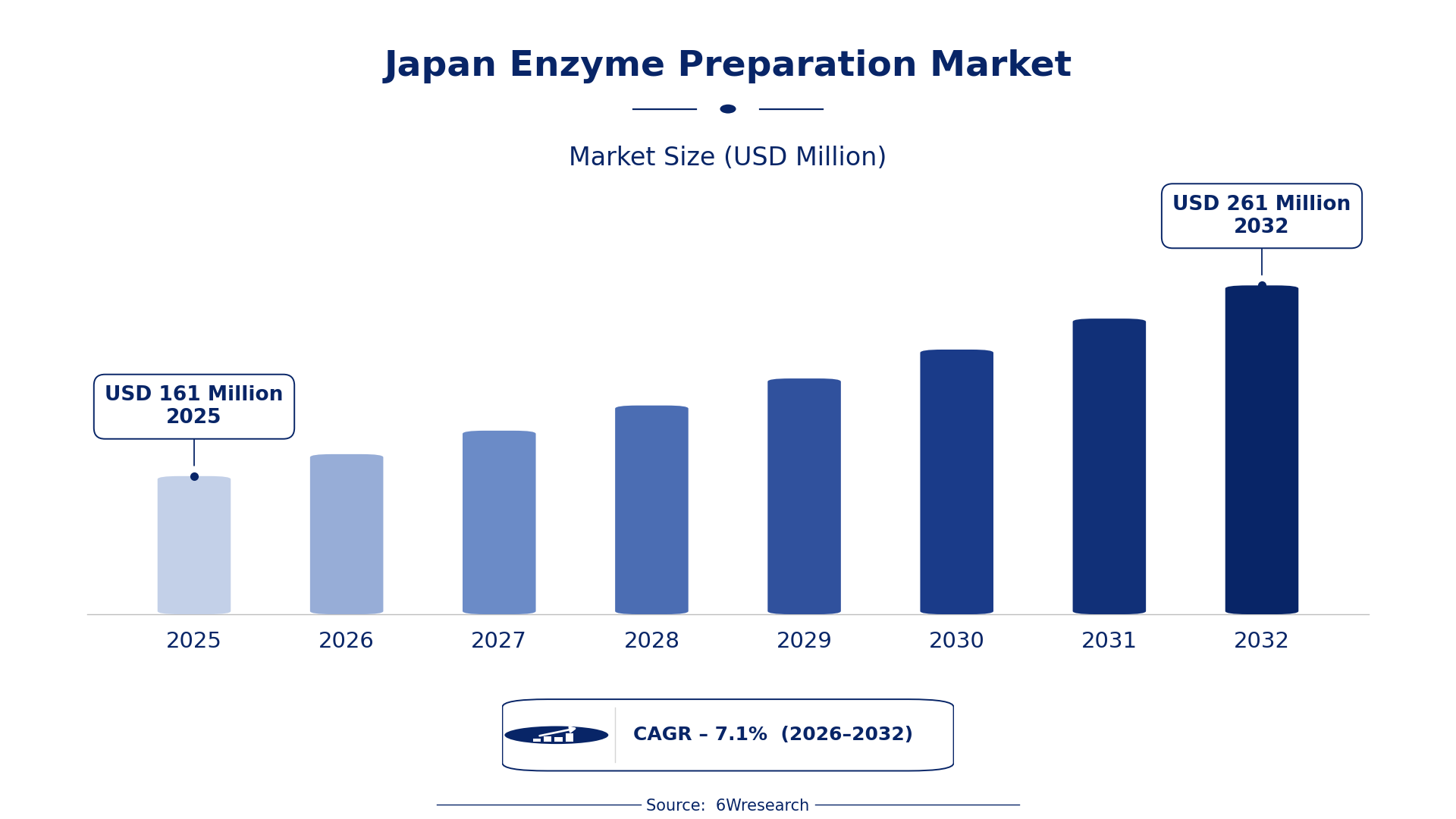
According to 6Wresearch internal database and industry insights, the Japan Enzyme Preparation Market was valued at USD 161 Million in 2025 and is projected to reach USD 261 Million by 2032, growing at a CAGR of approximately 7.1% during 2026–2032.
Japan Enzyme Preparation Market Highlights
| Report Metric | Details |
| Report Name | Japan Enzyme Preparation Market (2026-2032) |
| Market Size 2025 | USD 161 Million |
| Market Size 2032 | USD 261 Million |
| Absolute Growth 2025–2032 | USD 100 Million |
| CAGR 2026–2032 | 7.1% |
| Peak Annual Growth | 7.8% in 2026 |
| Forecast Period | 2026–2032 |
| Historical Data | 2022–2025 |
| Base Year | 2025 |
| Leading Enzyme Type, 2025 | Protease (49% share) |
| Leading Application Area, 2025 | Food Processing (37% share) |
| Leading Form, 2025 | Powder (41% share) |
| Leading End User, 2025 | Food Industry (51% share) |
| Fastest-Growing Enzyme Type | Amylase (9.8% CAGR) |
| Fastest-Growing Application Area | Biofuel Production (8.7% CAGR) |
| Fastest-Growing Form | Liquid (10.2% CAGR) |
| Fastest-Growing End User | Biofuel Plants (9.3% CAGR) |
| Growing Sector | Biofuel Production |
| Key End Users | Food Industry, Biofuel Plants, Textile Industry, Chemical Firms |
Japan Enzyme Preparation Market Year-wise Growth Rate and Key Drivers (2022–2032)
This graph illustrates the annual growth rates of the market from 2022 to 2032, highlighting a steady upward trajectory and projected market expansion over the forecast period.
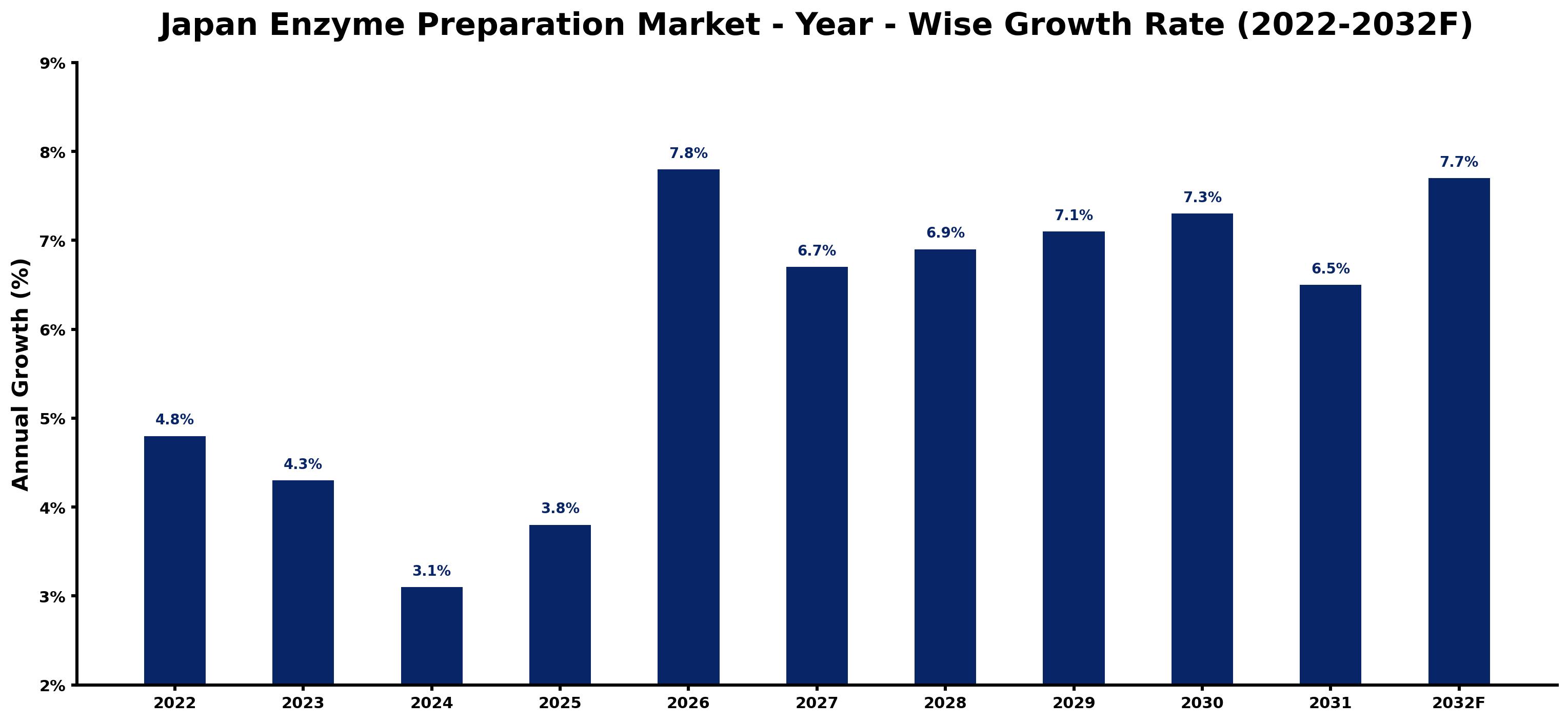
The table below sets out the estimated growth rate for each year and the main factor behind it.
| Year | Estimated Annual Growth (%) | Market Rationale |
| 2022 | 4.8 | The food processing sector showed strong enzyme demand, driven by consumer preferences for processed foods. |
| 2023 | 4.3 | Growth slowed as food processing plants faced challenges in adapting to new technologies. |
| 2024 | 3.1 | Market expansion continued but at a slower pace due to competitive pressures in enzyme production. |
| 2025 | 3.8 | Demand increased as more food processing plants adopted enzyme technologies for efficiency. |
| 2026 | 7.8 | Investment in biofuel production facilities is expected to surge, enhancing enzyme usage. |
| 2027 | 6.7 | Growth is projected to moderate as the biofuel sector adjusts to operational standards and technologies. |
| 2028 | 6.9 | Demand is expected to rise again as biofuel plants expand enzyme usage for production efficiency. |
| 2029 | 7.1 | The enzyme preparation market will continue to grow, driven by sustainable practices in food processing. |
| 2030 | 7.3 | Investment in enzyme technologies is expected to increase, aligning with government support for the sector. |
| 2031 | 6.5 | Growth is projected to slow as the market begins to stabilise amid increasing competition and market saturation. |
| 2032 | 7.7 | Demand is set to rise again as new biofuel plants come online, utilising advanced enzyme solutions. |
Note: Market size estimations and growth projections presented in this report are based on 6Wresearch's proprietary forecasting methodology, utilizing the latest available industry data, government publications, and primary research inputs.
Japan Enzyme Preparation Market Synopsis
Enzyme preparations are biological catalysts produced through fermentation processes that accelerate chemical reactions. The Japan Enzyme Preparation Market is growing due to strong demand from the food industry, which represented around 60% of enzyme consumption in 2022. The biofuel sector is expanding, with a 15% rise in production capacity since 2020, prompting further investments in enzyme technologies. Government initiatives, including a programme launched in 2023 to promote enzyme use in food processing, are likely to sustain this growth.
Market Dynamics Impact Analysis (2026–2032)
| Factor | Type | Impact | Primary Segment Affected |
| Growing demand for enzyme preparations in food processing | Driver | High | Food Processing |
| Increased investment in biofuel production technologies | Driver | High | Biofuel Production |
| Rising adoption of enzymes in textile treatments | Opportunity | Medium | Textile Treatment |
| Expansion of biofuel plants adopting enzyme technologies | Opportunity | High | Biofuel Production |
| Regulatory compliance costs for enzyme production | Restraint | High | Protease |
| Market competition leading to price pressures | Restraint | Medium | Protease |
| High costs of enzyme research and development | Challenge | High | Protease |
| Challenges in scaling up enzyme production | Challenge | Medium | Protease |
Evaluation of Drivers in Japan Enzyme Preparation Market (2026–2032)
The table below links each growth driver to the segment it affects and the evidence for it.
| Drivers | Primary Segment Affected | Why It Matters (Evidence) |
| Increased consumer demand for processed foods | Food Processing | In 2022, the food processing sector accounted for approximately 60% of enzyme demand, prompting producers to supply more enzymes. |
| Government support for biofuel production | Biofuel Production | The biofuel production capacity in Japan increased by 15% since 2020, resulting in higher enzyme usage in biofuel plants. |
| Sustainability trends in the textile industry | Textile Treatment | Japan's textile industry is adopting enzymes for eco-friendly practices, driving demand for enzyme preparations, with many firms integrating enzymes into their processes. |
| Technological advancements in enzyme production | Protease | ISO 9001 certification is commonly adopted, ensuring quality and driving demand for certified enzyme products. |
| Growth of food processing plants | Food Processing | Japan has over 1,000 food processing plants utilizing enzyme preparations, increasing overall market demand. |
Orders keep climbing as consumer preferences shift towards processed foods, with the food processing sector accounting for approximately 60% of enzyme demand in 2022. Investment in biofuel production has surged, with a notable increase in capacity since 2020, encouraging biofuel plants to adopt enzyme technologies. The textile industry is increasingly focusing on sustainable practices, driving enzyme adoption for eco-friendly treatments. Over 1,000 food processing plants in Japan are utilising enzyme preparations, further boosting demand. Quality assurance through ISO 9001 certification builds market confidence, resulting in increased orders from manufacturers.
Evaluation of Restraints in Japan Enzyme Preparation Market
These restraints slow adoption and weigh on supplier margins.
| Market Restraint | Primary Segment Affected | Why It Matters (Evidence) |
| High costs associated with regulatory compliance | Protease | Compliance with the Chemical Substances Control Law incurs costs for producers, affecting pricing strategies. |
| Intense market competition leading to price pressures | Protease | With numerous suppliers, price competition has increased, impacting profit margins for manufacturers. |
| Challenges in meeting quality standards | Food Processing | Producers must adhere to strict JIS standards, which can delay production and increase costs. |
| Limited awareness of enzyme benefits in some sectors | Textile Treatment | The textile industry is slowly adopting enzymes, resulting in slower growth compared to food processing. |
| Dependence on specific applications limiting market expansion | Biofuel Production | The biofuel sector's reliance on enzymes for specific processes restricts broader market growth. |
Japan Enzyme Preparation Market Challenges
High production costs pose challenges for enzyme preparation manufacturers, as fermentation processes require substantial investments in technology and raw materials, potentially reducing profit margins for suppliers by up to 20%. Supply chain disruptions arise from dependence on imported microorganisms, causing delays of several weeks for producers and limiting enzyme availability in the market. Regulatory challenges stem from compliance with the Food Sanitation Act, necessitating additional time and resources for manufacturers, which can delay product launches by an estimated three months. Limited skills in biotechnology restrict the workforce available to innovate, affecting the efficiency of clinics and plants in enzyme application.
Trends in the Japan Enzyme Preparation Market
Several trends are reshaping the Japan Enzyme Preparation Market; the most important are set out below.
- Shift towards Eco-Friendly Practices: Japan's textile industry is increasingly adopting enzymes for sustainable treatments, reflecting a shift towards eco-friendly practices. In 2022, around 30% of textile firms began integrating enzymes into their processes, supporting sustainability efforts.
- Increase in Biofuel Production Capacity: Since 2020, Japan's biofuel production capacity has risen by 15%, resulting in greater enzyme adoption in biofuel plants. This trend indicates a growing focus on renewable energy sources and the role of enzymes in production.
- Growing Preference for Liquid Enzymes: Liquid forms of enzymes are gaining popularity in food processing due to their ease of use. In 2023, liquid enzymes accounted for approximately 45% of the market, reflecting changing buyer preferences.
- Rising Demand for Enzyme Certifications: The demand for ISO 9001 certification in enzyme manufacturing is on the rise, with more producers seeking compliance. In 2023, about 50% of manufacturers pursued this certification to improve market credibility.
Investment Opportunities in the Japan Enzyme Preparation Market
The following areas offer the clearest openings for investors and suppliers in the Japan Enzyme Preparation Market.
- Investment in Biofuel Technologies: With a 15% increase in biofuel production capacity since 2020, there is a notable opportunity for investment in enzyme technologies. Biofuel plants are actively seeking partnerships to enhance efficiency.
- Expansion of Food Processing Facilities: Japan's food processing sector, which accounted for 60% of enzyme demand in 2022, presents a promising opportunity for suppliers. Collaborating with local food manufacturers can facilitate market entry.
- Growing Need for Sustainable Textile Solutions: As the textile industry shifts towards eco-friendly practices, there is a growing need for enzyme solutions. Suppliers can enter this market by partnering with textile manufacturers focused on sustainability.
- Investment in Quality Assurance: The increasing emphasis on JIS certification opens opportunities for suppliers to invest in quality assurance. Collaborating with certification bodies can help manufacturers meet market expectations.
Government Initiatives in the Japan Enzyme Preparation Market
The Ministry of Health, Labour and Welfare's Chemical Substances Control Law and PRTR Law require compliance from enzyme producers, ensuring safety and environmental standards. This framework supports the enzyme preparation market by promoting safe manufacturing practices and protecting consumers. Compliance costs can be substantial, impacting production budgets.
The New Energy and Industrial Technology Development Organization (NEDO) supports enzyme research with funding of approximately USD 10 million annually. This agency facilitates advancements in enzyme technologies, benefiting producers and improving market capabilities. The funding is aimed at advancing innovation in enzyme applications across various sectors.
Future Insight of the Japan Enzyme Preparation Market
The upcoming biofuel facilities will increase enzyme adoption by 2032, driven by government investment in this sector. The New Energy and Industrial Technology Development Organization will enhance research initiatives, promoting advancements in enzyme applications. The Ministry of Agriculture, Forestry and Fisheries will continue its programme to promote enzyme use in food processing, creating new market opportunities. By 2030, increased investments in biofuel production capacity will encourage suppliers to innovate, while buyers will seek eco-friendly solutions to meet rising consumer demand.
Market Segmentation Analysis
Japan Enzyme Preparation Market report covers a detailed analysis of the following market segments:
By Enzyme Type – Protease Leads, Amylase Expected to Grow Fastest
According to Saurav Kr Singh, Senior Research Analyst at 6Wresearch, Protease accounted for 49% of the market by enzyme type in 2025. Protease holds the largest share due to its extensive use in food processing and detergents, with over 1,000 food processing plants in Japan relying on it. This widespread application underscores its importance in meeting the demands of both the food industry and cleaning products. The quickest growth will come from Amylase, forecast to expand at a CAGR of 9.8% between 2026 and 2032. Amylase is experiencing rapid growth as it is essential for starch breakdown in food, driven by the increasing focus on efficiency in food processing. With the government's recent programme promoting enzyme use, amylase's adoption is likely to surge further. Suppliers should prioritise amylase development to capitalise on its growing demand in the food sector.
By Application Area – Food Processing Leads, Biofuel Production Expected to Grow Fastest
The largest application area category in 2025 was Food Processing, at 37% of revenue. Food processing holds a dominant position in Japan's enzyme preparation market, as it plays a critical role in improving food quality and production efficiency. The presence of over 1,000 food processing plants highlights the sector's heavy reliance on enzyme preparations for various applications. Biofuel Production is projected to grow fastest, at a CAGR of 8.7% during 2026–2032. The biofuel production sector is rapidly expanding, with a notable 15% increase in production capacity since 2020. This growth is further accelerated by government initiatives that promote the adoption of enzyme technologies within the industry. Suppliers should focus on developing enzyme solutions specifically for the biofuel sector to leverage its growth opportunities.
By Form – Powder Leads, Liquid Expected to Grow Fastest
In 2025, Powder led the form split with a 41% share. Powder form is the most common for enzyme preparations, widely used in various applications including food processing and detergents. Its established presence in the market solidifies its position as the leading form of enzyme preparation. Over 2026–2032, Liquid is expected to post the fastest growth, at a CAGR of 10.2%. Liquid forms are gaining traction due to their ease of use in food processing, aligning with industry trends towards convenience and efficiency. This shift indicates a growing preference for liquid enzymes among manufacturers. Suppliers should consider expanding their liquid enzyme offerings to meet the increasing demand from food processors.
By End User – Food Industry Leads, Biofuel Plants Expected to Grow Fastest
Food Industry held 51% of the Japan Enzyme Preparation Market by end user in 2025. The food industry is the largest end user of enzyme preparations in Japan, underscoring its vital role in food manufacturing and processing. This sector's substantial demand for enzymes reinforces its leading status in the market. Biofuel Plants are set to record the highest CAGR in this split, 9.3% over 2026–2032. Biofuel plants are increasingly adopting enzyme technologies, motivated by the shift towards renewable energy and supportive government policies aimed at enhancing biofuel production. This trend indicates a significant transformation in energy production practices. Buyers in the biofuel sector should actively pursue enzyme technologies to enhance production efficiency and meet sustainability goals.
Key Attractiveness of the Report
- 10 Years of Market Numbers
- Historical Data Starting from 2022 to 2025
- Base Year 2025
- Forecast Data until 2032
- Key Performance Indicators Impacting the Market
- Major Upcoming Developments and Projects
Key Highlights of the Report:
- Japan Enzyme Preparation Market Outlook
- Market Size of Japan Enzyme Preparation Market, 2025
- Forecast of Japan Enzyme Preparation Market, 2032
- Historical Data and Forecast of Japan Enzyme Preparation Revenues & Volume for the Period 2022-2032F
- Japan Enzyme Preparation Market Trend Evolution
- Japan Enzyme Preparation Market Drivers and Challenges
- Japan Enzyme Preparation Price Trends
- Japan Enzyme Preparation Porter's Five Forces
- Japan Enzyme Preparation Industry Life Cycle
- Historical Data and Forecast of Japan Enzyme Preparation Market Revenues & Volume By Enzyme Type for the Period 2022-2032F
- Historical Data and Forecast of Japan Enzyme Preparation Market Revenues & Volume By Protease for the Period 2022-2032F
- Historical Data and Forecast of Japan Enzyme Preparation Market Revenues & Volume By Amylase for the Period 2022-2032F
- Historical Data and Forecast of Japan Enzyme Preparation Market Revenues & Volume By Cellulase for the Period 2022-2032F
- Historical Data and Forecast of Japan Enzyme Preparation Market Revenues & Volume By Lipase for the Period 2022-2032F
- Historical Data and Forecast of Japan Enzyme Preparation Market Revenues & Volume By Application Area for the Period 2022-2032F
- Historical Data and Forecast of Japan Enzyme Preparation Market Revenues & Volume By Food Processing for the Period 2022-2032F
- Historical Data and Forecast of Japan Enzyme Preparation Market Revenues & Volume By Biofuel Production for the Period 2022-2032F
- Historical Data and Forecast of Japan Enzyme Preparation Market Revenues & Volume By Textile Treatment for the Period 2022-2032F
- Historical Data and Forecast of Japan Enzyme Preparation Market Revenues & Volume By Detergents for the Period 2022-2032F
- Historical Data and Forecast of Japan Enzyme Preparation Market Revenues & Volume By Form for the Period 2022-2032F
- Historical Data and Forecast of Japan Enzyme Preparation Market Revenues & Volume By Powder for the Period 2022-2032F
- Historical Data and Forecast of Japan Enzyme Preparation Market Revenues & Volume By Liquid for the Period 2022-2032F
- Historical Data and Forecast of Japan Enzyme Preparation Market Revenues & Volume By Granules for the Period 2022-2032F
- Historical Data and Forecast of Japan Enzyme Preparation Market Revenues & Volume By Encapsulated for the Period 2022-2032F
- Historical Data and Forecast of Japan Enzyme Preparation Market Revenues & Volume By End User for the Period 2022-2032F
- Historical Data and Forecast of Japan Enzyme Preparation Market Revenues & Volume By Food Industry for the Period 2022-2032F
- Historical Data and Forecast of Japan Enzyme Preparation Market Revenues & Volume By Biofuel Plants for the Period 2022-2032F
- Historical Data and Forecast of Japan Enzyme Preparation Market Revenues & Volume By Textile Industry for the Period 2022-2032F
- Historical Data and Forecast of Japan Enzyme Preparation Market Revenues & Volume By Chemical Firms for the Period 2022-2032F
- Japan Enzyme Preparation Import Export Trade Statistics
- Market Opportunity Assessment By Enzyme Type
- Market Opportunity Assessment By Application Area
- Market Opportunity Assessment By Form
- Market Opportunity Assessment By End User
- Japan Enzyme Preparation Top Companies Market Share
- Japan Enzyme Preparation Competitive Benchmarking By Technical and Operational Parameters
- Japan Enzyme Preparation Company Profiles
- Japan Enzyme Preparation Key Strategic Recommendations
Market Covered
The following segment groups are covered in the report.
By Enzyme Type
- Protease
- Amylase
- Cellulase
- Lipase
By Application Area
- Food Processing
- Biofuel Production
- Textile Treatment
- Detergents
By Form
- Powder
- Liquid
- Granules
- Encapsulated
By End User
- Food Industry
- Biofuel Plants
- Textile Industry
- Chemical Firms































