Japan Enzyme Production Market Size & Growth Rate
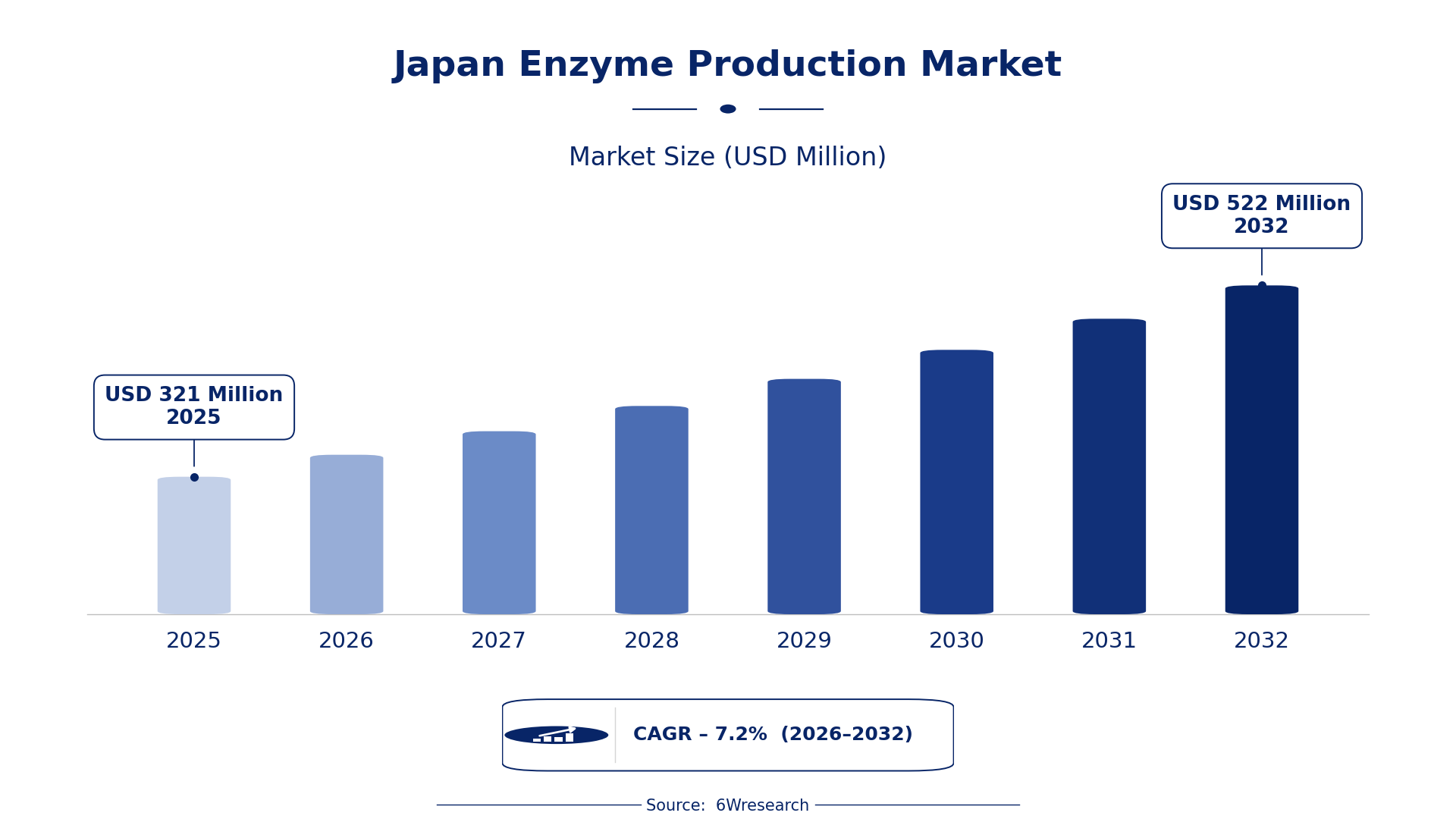
According to 6Wresearch internal database and industry insights, the Japan Enzyme Production Market was valued at USD 321 Million in 2025 and is projected to reach USD 522 Million by 2032, growing at a CAGR of approximately 7.2% during 2026–2032.
Japan Enzyme Production Market Highlights
| Report Metric | Details |
| Report Name | Japan Enzyme Production Market (2026-2032) |
| Market Size 2025 | USD 321 Million |
| Market Size 2032 | USD 522 Million |
| Absolute Growth 2025–2032 | USD 201 Million |
| CAGR 2026–2032 | 7.2% |
| Peak Annual Growth | 8.7% in 2032 |
| Forecast Period | 2026–2032 |
| Historical Data | 2022–2025 |
| Base Year | 2025 |
| Leading Production Type, 2025 | Microbial (41% share) |
| Leading Source Organism, 2025 | Fungi (49% share) |
| Leading Fermentation Type, 2025 | Submerged (52% share) |
| Leading Application Area, 2025 | Food Industry (47% share) |
| Fastest-Growing Production Type | Plant-Based (10.3% CAGR) |
| Fastest-Growing Source Organism | Plants (10.1% CAGR) |
| Fastest-Growing Fermentation Type | Solid-State (10.6% CAGR) |
| Fastest-Growing Application Area | Pharmaceuticals (9.1% CAGR) |
| Growing Sector | Food Industry |
| Key End Users | Food processors, pharmaceutical manufacturers, biopharmaceutical companies, research institutions |
Japan Enzyme Production Market Year-wise Growth Rate and Key Drivers (2022–2032)
This graph illustrates the annual growth rates of the market from 2022 to 2032, highlighting a steady upward trajectory and projected market expansion over the forecast period.
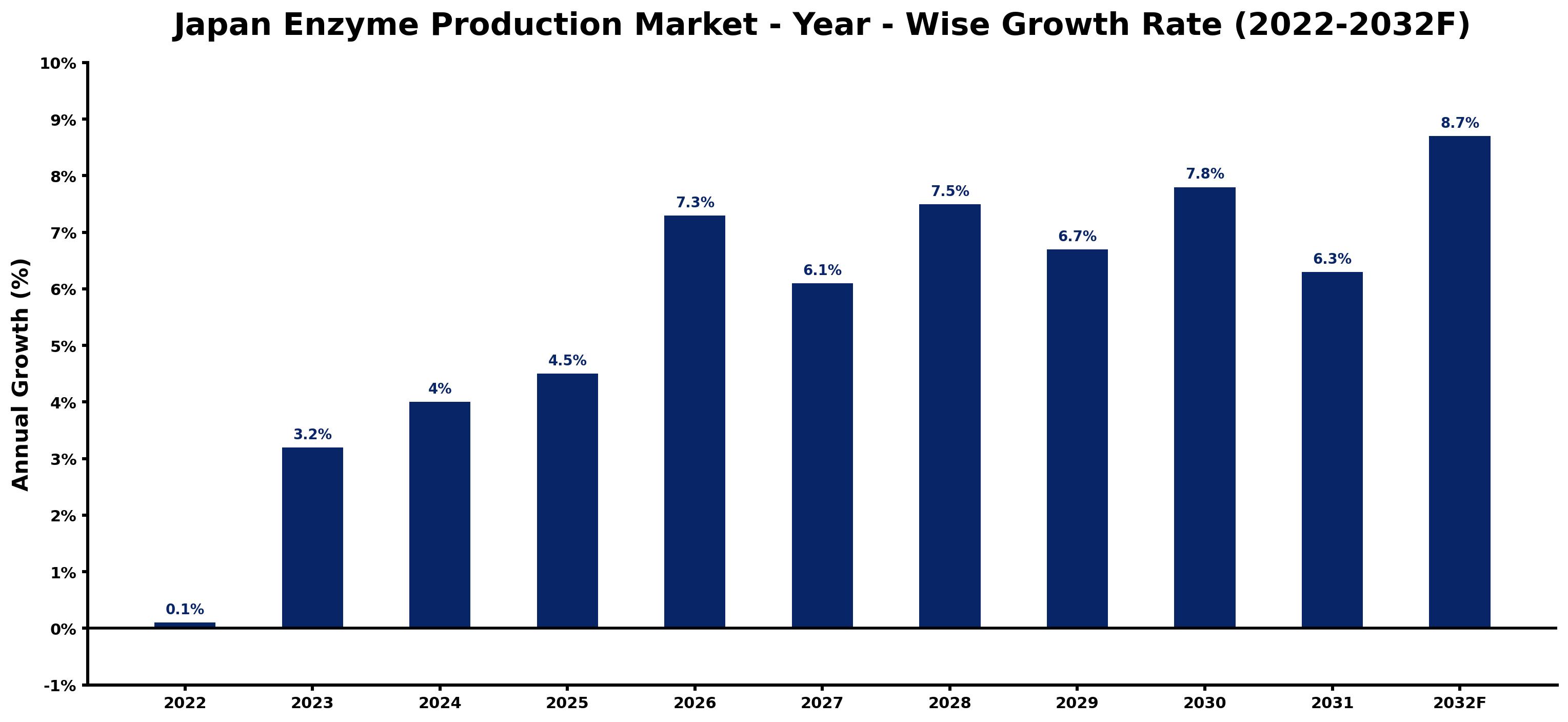
Each row of the following table gives one year's estimated growth and the event or demand shift that explains it.
| Year | Estimated Annual Growth (%) | Market Rationale |
| 2022 | 0.1 | The market showed minimal growth, reflecting stable demand in the enzyme sector. |
| 2023 | 3.2 | Growth accelerated due to increased enzyme usage in food processing and pharmaceuticals. |
| 2024 | 4.0 | Continued expansion was driven by rising consumer interest in health and nutrition. |
| 2025 | 4.5 | The market peaked historically as food industry demand surged. |
| 2026 | 7.3 | Growth is expected to rise further with advancements in biotechnology applications. |
| 2027 | 6.1 | A slowdown is anticipated as the market adjusts to previous high growth rates. |
| 2028 | 7.5 | An increase in demand for biopharmaceuticals will boost market activity again. |
| 2029 | 6.7 | Growth will slow slightly as the market stabilises after rapid expansion. |
| 2030 | 7.8 | A resurgence in growth is projected as new enzyme applications emerge. |
| 2031 | 6.3 | The market will experience a slowdown as it matures and competition increases. |
| 2032 | 8.7 | The peak growth year will be driven by strong biopharmaceutical demand. |
Note: Market size estimations and growth projections presented in this report are based on 6Wresearch's proprietary forecasting methodology, utilizing the latest available industry data, government publications, and primary research inputs.
Japan Enzyme Production Market Synopsis
Enzyme production involves microbial fermentation, primarily using fungi, to create enzymes for food, pharmaceuticals, and other industries. In Japan, the food industry accounts for 60% of enzyme usage, supported by a population of approximately 125 million. The Japan Enzyme Production Market is growing due to rising demand from food processing and biotechnology sectors, alongside government initiatives aimed at boosting innovation in biotechnology. By 2032, the market will reach USD 522 million, driven by advancements in production methods and increasing applications in health and nutrition.
Market Dynamics Impact Analysis (2026–2032)
| Factor | Type | Impact | Primary Segment Affected |
| Rising demand for biopharmaceuticals drives enzyme production growth. | Driver | High | Recombinant |
| Increasing health consciousness among consumers boosts enzyme use in food products. | Driver | High | Microbial |
| Growing investment in biotechnology innovation presents opportunities for new enzyme applications. | Opportunity | High | Recombinant |
| Expansion of enzyme applications in the food industry creates demand for specialized enzymes. | Opportunity | High | Food Industry |
| Limited local production of specialized enzymes constrains market growth. | Restraint | High | Microbial |
| High production costs for enzymes can restrict market entry for new players. | Restraint | Medium | Recombinant |
| Supply chain disruptions can affect enzyme availability for manufacturers. | Challenge | High | Microbial |
| Technological advancements require continuous investment, posing challenges for smaller firms. | Challenge | Medium | Recombinant |
Evaluation of Drivers in Japan Enzyme Production Market (2026–2032)
The following drivers explain most of the expected growth.
| Drivers | Primary Segment Affected | Why It Matters (Evidence) |
| Increased biopharmaceutical applications drive demand for recombinant enzymes. | Recombinant | The pharmaceutical sector is expanding, leading to a higher need for specialized enzymes, with biopharmaceuticals growing rapidly. |
| Growing health awareness boosts demand for microbial enzymes in food. | Microbial | The food industry is incorporating enzymes to improve product quality, resulting in higher purchases. |
| Technological advancements in enzyme production methods improve efficiency. | Submerged | Improvements in submerged fermentation techniques allow for larger-scale production, meeting rising demand. |
| Consumer interest in functional foods increases enzyme usage. | Food Industry | As consumers seek healthier options, food manufacturers are incorporating more enzymes to improve nutritional profiles. |
| Research and development in enzyme technologies is supported by government initiatives. | Recombinant | Funding for biotechnology innovation encourages the development of new enzyme applications, driving demand. |
The strongest pull on demand comes from the pharmaceutical sector, which is expanding rapidly, with biopharmaceutical applications increasing. In 2022, Japan produced over 100,000 tons of enzymes, reflecting the growing need for microbial enzymes in food processing. The food industry accounted for 60% of enzyme usage, as manufacturers strive to improve product quality. Advancements in submerged fermentation methods have improved production efficiency, allowing for larger-scale output. Support for biotechnology innovation is driving research and development, creating new enzyme applications and further increasing demand.
Evaluation of Restraints in Japan Enzyme Production Market
The key brakes on demand, and where they bite hardest, are shown below.
| Market Restraint | Primary Segment Affected | Why It Matters (Evidence) |
| Limited domestic production of specialized enzymes restricts market growth. | Microbial | Japan relies on imports for certain enzymes, which can create supply issues and limit availability. |
| High production costs for enzymes can deter new entrants into the market. | Recombinant | Smaller firms may struggle to compete due to the investment required for enzyme production. |
| Supply chain disruptions can lead to enzyme shortages for manufacturers. | Microbial | Global supply chain issues may affect the timely availability of raw materials needed for enzyme production. |
| Regulatory compliance can increase operational costs for enzyme producers. | Recombinant | Producers must adhere to stringent safety regulations, which can add to production expenses. |
| Market saturation in certain enzyme categories may limit growth potential. | Microbial | As competition increases, it can become challenging for producers to differentiate their products. |
Japan Enzyme Production Market Challenges
Producers in Japan incur higher costs due to competition from imported enzymes, which can reduce local market prices by 15%, affecting profit margins. Suppliers struggle with skills shortages in enzyme production, causing operational inefficiencies that delay product development by six months. Stringent safety regulations from the Ministry of Health, Labour and Welfare require extensive documentation, raising overhead costs by 10% for manufacturers. Supply chain disruptions for specialized enzymes can lead to delivery delays of two to three weeks for pharmaceutical buyers, hindering their production schedules.
Trends in the Japan Enzyme Production Market
The shifts below are changing how Japan Enzyme Production Market products are bought and supplied.
- Shift towards Sustainable Enzyme Production: Japan is prioritising sustainable practices in enzyme production, with an emphasis on reducing environmental impact. A government initiative launched in 2023 aims to promote biotechnology innovations that align with sustainability goals, supporting a transition to greener production methods.
- Emergence of Plant-Based Enzymes: The market is experiencing a rise in the use of plant-based enzymes, driven by consumer demand for natural ingredients. With a projected CAGR of 10.3%, this trend reflects a shift towards more sustainable and health-conscious food products.
- Increased Adoption of HACCP Standards: Adoption of HACCP-based hygiene management is becoming mandatory for food businesses, improving safety in enzyme production. This regulatory shift, fully implemented since June 2021, ensures higher quality and safety standards in food processing.
- Growth of Biopharmaceutical Applications: The pharmaceutical sector is increasingly utilising enzymes for drug development, with a focus on biopharmaceuticals. This area is projected to grow at a CAGR of 9.1%, reflecting the rising importance of enzymes in medical applications.
Investment Opportunities in the Japan Enzyme Production Market
Several openings in the Japan Enzyme Production Market merit attention from investors.
- Biotechnology Research Facilities: Investment in biotechnology research facilities is critical now, with government support for innovation. The Japanese Society for Enzyme Engineering promotes advancements, creating opportunities for partnerships in research and development.
- Food Processing Sector: The food processing sector is actively seeking enzyme solutions to improve product quality. With a growing focus on health, producers can invest in enzyme technologies to meet consumer demands.
- Government Grants for Innovation: Now is an ideal time to explore government grants for enzyme production innovation. The Ministry of Health, Labour and Welfare offers funding to improve safety standards, presenting opportunities for producers to enhance their processes.
- Partnerships with Research Institutions: Collaborating with research institutions can yield benefits for enzyme producers. By forming joint ventures, companies can access new technologies and improve their product offerings.
Government Initiatives in the Japan Enzyme Production Market
The Food Recycling Law, enacted in 2000, mandates food businesses to reduce waste and recycle it into feed, fertiliser, and energy. This law complements the Food Sanitation Act amendments from 2018, which introduced a system for ensuring safety and quality in food packaging materials, impacting enzyme production processes.
In 2023, the government allocated USD 10 million to support biotechnology research initiatives. The Ministry of Health, Labour and Welfare oversees these efforts, ensuring that funding is directed towards projects that improve enzyme safety and innovation.
Future Insight of the Japan Enzyme Production Market
By 2032, government initiatives will drive advancements in biotechnology, prompting suppliers to adopt cutting-edge fermentation technologies. Enhanced ISO 9001 standards will elevate quality assurance, positively impacting both buyers and suppliers. Increased funding for research will enable the development of specialised enzymes, catering to the pharmaceutical sector's specific demands. The feed processing industry is expected to experience a rise in enzyme applications, improving animal health and creating new business opportunities.
Market Segmentation Analysis
Japan Enzyme Production Market report covers a detailed analysis of the following market segments:
By Production Type – Microbial Leads, Plant-Based Expected to Grow Fastest
According to Saurav Kr Singh, Senior Research Analyst at 6Wresearch, Microbial took 41% of production type revenue in 2025, more than any other category. Microbial fermentation dominates enzyme production in Japan, accounting for a substantial portion of the over 100,000 tons produced in 2022. This method is essential for food and pharmaceutical applications, which are the primary consumers of enzymes. The quickest growth will come from Plant-Based, forecast to expand at a CAGR of 10.3% between 2026 and 2032. The plant-based segment is experiencing notable growth as industries increasingly prioritise sustainability. Government initiatives aimed at boosting biotechnology innovation will likely accelerate the expansion of this segment in the coming years. Suppliers should consider diversifying into plant-based enzymes to meet the market's shifting preferences.
By Source Organism – Fungi Leads, Plants Expected to Grow Fastest
Fungi held 49% of the Japan Enzyme Production Market by source organism in 2025. Fungi serve as the main source of enzymes in Japan, largely due to their extensive application in the food industry, which accounted for 60% of enzyme usage. This established reliance on fungi ensures a robust market presence and stability. Over 2026–2032, Plants are expected to post the fastest growth, at a CAGR of 10.1%. The plant segment is set for growth as niche applications are explored and developed, supported by ongoing research efforts focused on utilising plant sources for enzyme production. This trend indicates a shift towards more sustainable enzyme options. Buyers should explore the potential of plant-derived enzymes as they become increasingly viable and accessible.
By Fermentation Type – Submerged Leads, Solid-State Expected to Grow Fastest
With 52% of fermentation type revenue in 2025, Submerged was the largest category. Submerged fermentation is the common method for large-scale enzyme production, facilitating the substantial output seen in Japan's enzyme market. Its efficiency in producing enzymes for the food industry underscores its dominance. Solid-State is set to record the highest CAGR in this split, 10.6% over 2026–2032. Solid-state fermentation is expected to grow as it is increasingly recognised for its advantages in producing specific enzyme types. This method aligns with the rising demand for specialised enzymes in various applications. Suppliers should invest in solid-state fermentation capabilities to cater to the growing need for specialised enzymes.
By Application Area – Food Industry Leads, Pharmaceuticals Expected to Grow Fastest
In 2025, Food Industry led the application area split with a 47% share. The food industry is the largest consumer of enzymes in Japan, extensively using them for food processing and enhancement. This sector's significant share highlights the persistent demand for enzyme applications in food production. Pharmaceuticals are projected to grow fastest, at a CAGR of 9.1% during 2026–2032. Pharmaceutical applications are rapidly expanding, particularly with the increasing emphasis on biopharmaceuticals. This growth is driven by the rising demand for advanced enzyme solutions in drug development and formulation, indicating a shift in application focus. Suppliers must focus on the pharmaceutical sector to capitalise on the growing demand for enzymes in drug applications.
Key Attractiveness of the Report
- 10 Years of Market Numbers
- Historical Data Starting from 2022 to 2025
- Base Year 2025
- Forecast Data until 2032
- Key Performance Indicators Impacting the Market
- Major Upcoming Developments and Projects
Key Highlights of the Report:
- Japan Enzyme Production Market Outlook
- Market Size of Japan Enzyme Production Market, 2025
- Forecast of Japan Enzyme Production Market, 2032
- Historical Data and Forecast of Japan Enzyme Production Revenues & Volume for the Period 2022-2032F
- Japan Enzyme Production Market Trend Evolution
- Japan Enzyme Production Market Drivers and Challenges
- Japan Enzyme Production Price Trends
- Japan Enzyme Production Porter's Five Forces
- Japan Enzyme Production Industry Life Cycle
- Historical Data and Forecast of Japan Enzyme Production Market Revenues & Volume By Production Type for the Period 2022-2032F
- Historical Data and Forecast of Japan Enzyme Production Market Revenues & Volume By Microbial for the Period 2022-2032F
- Historical Data and Forecast of Japan Enzyme Production Market Revenues & Volume By Plant-Based for the Period 2022-2032F
- Historical Data and Forecast of Japan Enzyme Production Market Revenues & Volume By Animal-Based for the Period 2022-2032F
- Historical Data and Forecast of Japan Enzyme Production Market Revenues & Volume By Recombinant for the Period 2022-2032F
- Historical Data and Forecast of Japan Enzyme Production Market Revenues & Volume By Source Organism for the Period 2022-2032F
- Historical Data and Forecast of Japan Enzyme Production Market Revenues & Volume By Fungi for the Period 2022-2032F
- Historical Data and Forecast of Japan Enzyme Production Market Revenues & Volume By Plants for the Period 2022-2032F
- Historical Data and Forecast of Japan Enzyme Production Market Revenues & Volume By Animals for the Period 2022-2032F
- Historical Data and Forecast of Japan Enzyme Production Market Revenues & Volume By Bacteria for the Period 2022-2032F
- Historical Data and Forecast of Japan Enzyme Production Market Revenues & Volume By Fermentation Type for the Period 2022-2032F
- Historical Data and Forecast of Japan Enzyme Production Market Revenues & Volume By Submerged for the Period 2022-2032F
- Historical Data and Forecast of Japan Enzyme Production Market Revenues & Volume By Solid-State for the Period 2022-2032F
- Historical Data and Forecast of Japan Enzyme Production Market Revenues & Volume By Batch for the Period 2022-2032F
- Historical Data and Forecast of Japan Enzyme Production Market Revenues & Volume By Continuous for the Period 2022-2032F
- Historical Data and Forecast of Japan Enzyme Production Market Revenues & Volume By Application Area for the Period 2022-2032F
- Historical Data and Forecast of Japan Enzyme Production Market Revenues & Volume By Food Industry for the Period 2022-2032F
- Historical Data and Forecast of Japan Enzyme Production Market Revenues & Volume By Pharmaceuticals for the Period 2022-2032F
- Historical Data and Forecast of Japan Enzyme Production Market Revenues & Volume By Feed Processing for the Period 2022-2032F
- Historical Data and Forecast of Japan Enzyme Production Market Revenues & Volume By Bioresearch Labs for the Period 2022-2032F
- Japan Enzyme Production Import Export Trade Statistics
- Market Opportunity Assessment By Production Type
- Market Opportunity Assessment By Source Organism
- Market Opportunity Assessment By Fermentation Type
- Market Opportunity Assessment By Application Area
- Japan Enzyme Production Top Companies Market Share
- Japan Enzyme Production Competitive Benchmarking By Technical and Operational Parameters
- Japan Enzyme Production Company Profiles
- Japan Enzyme Production Key Strategic Recommendations
Market Covered
The report covers the following segments.
By Production Type
- Microbial
- Plant-Based
- Animal-Based
- Recombinant
By Source Organism
- Fungi
- Plants
- Animals
- Bacteria
By Fermentation Type
- Submerged
- Solid-State
- Batch
- Continuous
By Application Area
- Food Industry
- Pharmaceuticals
- Feed Processing
- Bioresearch Labs































