Japan Equipment Finance Software Market Size & Growth Rate
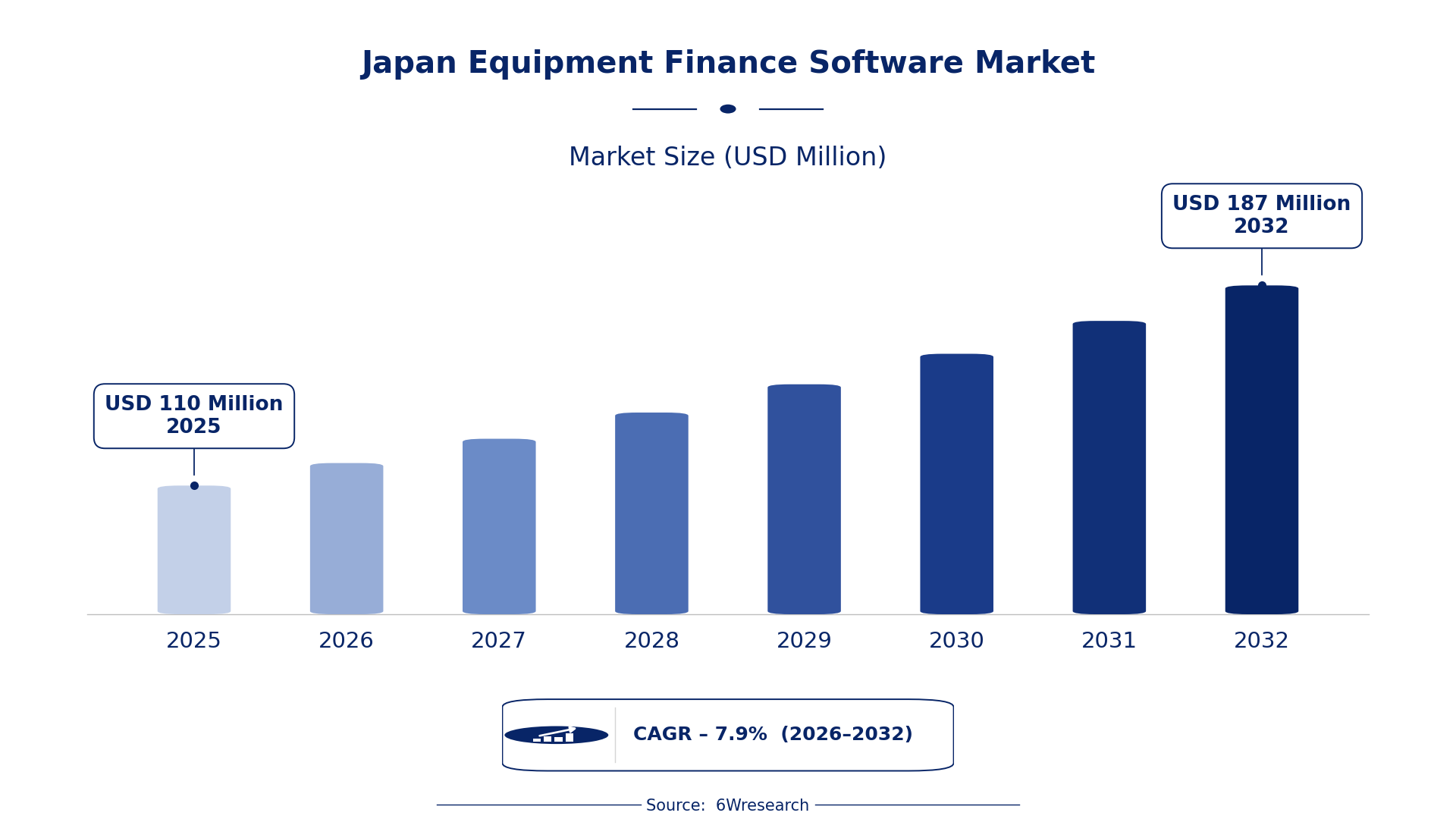
According to 6Wresearch internal database and industry insights, the Japan Equipment Finance Software Market was valued at USD 110 Million in 2025 and is projected to reach USD 187 Million by 2032, growing at a CAGR of approximately 7.9% during 2026–2032.
Japan Equipment Finance Software Market Highlights
| Report Metric | Details |
| Report Name | Japan Equipment Finance Software Market (2026-2032) |
| Market Size 2025 | USD 110 Million |
| Market Size 2032 | USD 187 Million |
| Absolute Growth 2025–2032 | USD 77 Million |
| CAGR 2026–2032 | 7.9% |
| Peak Annual Growth | 8.7% in 2030 |
| Forecast Period | 2026–2032 |
| Historical Data | 2022–2025 |
| Base Year | 2025 |
| Leading Software Type, 2025 | Lease Accounting (36% share) |
| Leading Deployment Mode, 2025 | SaaS (33% share) |
| Leading Feature Set, 2025 | Automated Bookkeeping (38% share) |
| Leading Target Clients, 2025 | Leasing Firms (34% share) |
| Fastest-Growing Software Type | Analytics Platform (11.6% CAGR) |
| Fastest-Growing Deployment Mode | Cloud (11.7% CAGR) |
| Fastest-Growing Feature Set | Risk Assessment (10.5% CAGR) |
| Fastest-Growing Target Clients | Financial Lenders (10.4% CAGR) |
| Growing Sector | Equipment financing |
| Key End Users | Leasing Firms, Financial Lenders, SME Lenders, Equipment Financers |
Japan Equipment Finance Software Market Year-wise Growth Rate and Key Drivers (2022–2032)
This graph illustrates the annual growth rates of the market from 2022 to 2032, highlighting a steady upward trajectory and projected market expansion over the forecast period.
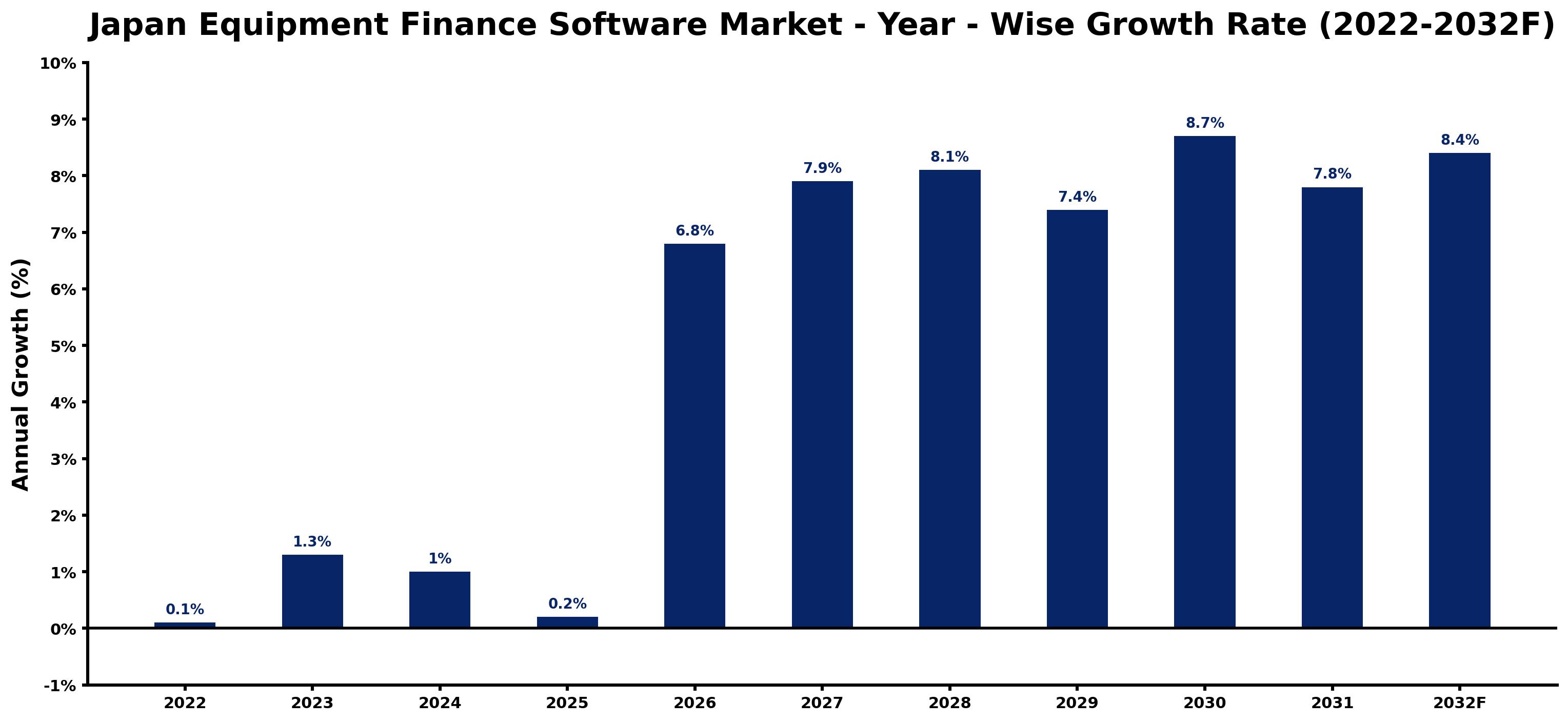
The table below sets out the estimated growth rate for each year and the main factor behind it.
| Year | Estimated Annual Growth (%) | Market Rationale |
| 2022 | 0.1 | The market showed minimal growth as firms adjusted to economic conditions. |
| 2023 | 1.3 | Growth accelerated due to increased leasing activity in the Tokyo metropolitan area. |
| 2024 | 1.0 | Growth slowed as firms faced tighter budgets and cautious spending. |
| 2025 | 0.2 | The market continued to grow slowly as firms awaited clearer economic signals. |
| 2026 | 6.8 | Demand is expected to surge as financial institutions invest more in technology solutions. |
| 2027 | 7.9 | The rise in financing volume is projected to contribute to stronger market performance. |
| 2028 | 8.1 | Growth is expected to remain strong as cloud-based solutions gain wider adoption. |
| 2029 | 7.4 | A slight slowdown is projected as firms reassess their technology investments. |
| 2030 | 8.7 | The peak growth year will be driven by advancements in software capabilities. |
| 2031 | 7.8 | Growth will moderate as the market begins to stabilise after rapid expansion. |
| 2032 | 8.4 | The market is expected to grow steadily as digital transformation continues. |
Note: Market size estimations and growth projections presented in this report are based on 6Wresearch's proprietary forecasting methodology, utilizing the latest available industry data, government publications, and primary research inputs.
Japan Equipment Finance Software Market Synopsis
Equipment finance software manages the financial aspects of leasing and financing equipment, including lease accounting and asset management. The Japan Equipment Finance Software Market is growing due to rising demand from leasing firms and financial lenders, especially in the Tokyo metropolitan area, which represents 30% of leasing activities. Cloud-based solutions, accounting for 60% of new deployments in 2023, are driving technology investments, improving efficiency and accessibility for users.
Market Dynamics Impact Analysis (2026–2032)
| Factor | Type | Impact | Primary Segment Affected |
| Increased leasing activity in urban areas | Driver | High | Lease Accounting |
| Growing adoption of cloud solutions | Driver | High | Cloud |
| Rising demand for automated bookkeeping features | Opportunity | High | Automated Bookkeeping |
| Expansion of financial lenders in metropolitan regions | Opportunity | Medium | Financial Lenders |
| Budget constraints among SMEs | Restraint | High | SME Lenders |
| Regulatory compliance costs for software updates | Restraint | Medium | Lease Accounting |
| High competition among software providers | Challenge | High | Equipment Financers |
| Evolving technology standards requiring constant updates | Challenge | Medium | Asset Mgmt Suite |
Evaluation of Drivers in Japan Equipment Finance Software Market (2026–2032)
The factors lifting demand, and the evidence behind each, are summarised below.
| Drivers | Primary Segment Affected | Why It Matters (Evidence) |
| Increased leasing activity in urban areas drives demand for software solutions that manage lease agreements effectively. | Lease Accounting | The Tokyo metropolitan area accounts for 30% of Japan's leasing activities. |
| Growing adoption of cloud solutions improves operational efficiency and flexibility for users. | Cloud | Cloud-based solutions accounted for 60% of new software deployments in 2023. |
| Rising demand for automated bookkeeping features streamlines financial processes for firms. | Automated Bookkeeping | Over 70% of financial lenders use automated bookkeeping features in their software. |
| Expansion of financial lenders increases the need for effective financial management tools. | Financial Lenders | The Equipment Leasing and Finance Association reported a 5% increase in financing volume in 2023. |
| The number of SMEs in Japan, around 3.8 million, represents a significant client base for financing. | SME Lenders | SMEs often require tailored financing solutions to manage their equipment needs. |
Much of the new demand traces back to the Tokyo metropolitan area, where leasing activities are concentrated. The increase in financing volume, reported at 5% in 2023, signals a growing need for effective financial management tools. The presence of approximately 3.8 million SMEs in Japan creates a substantial client base, driving further demand for equipment finance software tailored to their needs. Financial institutions are increasingly adopting solutions that improve operational flexibility. The ongoing shift towards cloud solutions enhances accessibility for users, allowing firms to manage their equipment financing needs more efficiently.
Evaluation of Restraints in Japan Equipment Finance Software Market
The table below lists the restraints and the evidence behind each.
| Market Restraint | Primary Segment Affected | Why It Matters (Evidence) |
| Budget constraints among SMEs limit their ability to invest in new software solutions. | SME Lenders | SMEs often face financial limitations that restrict technology upgrades. |
| Regulatory compliance costs for software updates can burden financial institutions. | Lease Accounting | Compliance with standards like ISO 9001 requires ongoing investment in software. |
| High competition among software providers pressures pricing and margins. | Equipment Financers | Firms must continuously innovate to maintain market share. |
| Evolving technology standards require constant updates to stay compliant. | Asset Mgmt Suite | Firms face challenges in keeping up with rapid technological changes. |
| Limited awareness of software benefits among potential users hampers adoption. | Financial Lenders | Some financial institutions remain hesitant to invest in new technologies. |
Japan Equipment Finance Software Market Challenges
Producers encounter stringent regulations from the Financial Services Agency, leading to compliance delays that can extend project timelines by as much as six months for financial institutions. Buyers, particularly SMEs, face rising software costs, which have surged by an average of 15%, affecting their budgeting capabilities. Technology adoption remains slow, with only 60% of new deployments being cloud-based, hindering operational efficiency for financial lenders. Supply chain issues stemming from outdated systems result in service delivery delays that can prolong project timelines by up to three months for equipment financing firms.
Trends in the Japan Equipment Finance Software Market
Several trends are reshaping the Japan Equipment Finance Software Market; the most important are set out below.
- Shift from On-Premise to Cloud Solutions: Since 2023, the trend towards cloud-based solutions has accelerated, with 60% of new deployments being cloud-based. This shift allows firms to improve accessibility and reduce IT overhead, making it easier for users to manage their equipment financing needs.
- Emergence of Automated Bookkeeping Features: The growing demand for automated bookkeeping features has become apparent, with over 70% of financial lenders now utilising them. This trend streamlines financial record-keeping processes, allowing firms to focus on core operations and improve efficiency.
- Increased Focus on Risk Assessment Tools: The rise in financing volume has led to a greater emphasis on risk assessment tools. Financial institutions are increasingly adopting these tools to evaluate financial risks associated with equipment financing, ensuring better decision-making.
- Growth in Analytics Platforms: Starting in 2026, analytics platforms are gaining traction as firms seek to improve data-driven decision-making. The expected CAGR of 11.6% for this segment highlights its importance in the equipment finance software market.
Investment Opportunities in the Japan Equipment Finance Software Market
Below are the investment opportunities with the strongest case in the Japan Equipment Finance Software Market.
- Timing for Investment in Cloud Solutions: With cloud solutions accounting for 60% of new deployments, now is an ideal time to invest in cloud-based software. Financial lenders in urban areas are particularly keen on these solutions, improving their operational capabilities.
- Entry into the Automated Bookkeeping Market: The demand for automated bookkeeping features is rising, presenting a strong opportunity for suppliers. Partnering with financial lenders can facilitate entry into this growing market segment, capitalising on their need for streamlined processes.
- Focus on Risk Assessment Tools: The increasing emphasis on risk assessment tools creates an opportunity for software developers. By targeting financial institutions, firms can provide solutions that improve risk management capabilities, addressing a critical need in the market.
- Expansion into Analytics Platforms: The projected growth of analytics platforms at 11.6% presents a timely opportunity for investment. Suppliers can engage with leasing firms to develop tailored analytics solutions that improve decision-making and operational efficiency.
Government Initiatives in the Japan Equipment Finance Software Market
The Industrial Safety and Health Act mandates that equipment finance software must comply with safety regulations, ensuring that financial institutions manage hazardous substances effectively. Compliance with these regulations requires ongoing investment in software updates and training for staff, impacting operational costs for buyers.
The Digital Agency, established in September 2021, supports the digital transformation of financial services. It oversees initiatives that promote common system standards, providing funding for projects that improve the efficiency of equipment finance software, benefiting both producers and buyers.
Future Insight of the Japan Equipment Finance Software Market
By 2032, cloud-based solutions will dominate new software deployments, shifting demand towards more agile systems. The Ministry of Economy, Trade and Industry will drive digital transformation, leading to improved operational standards across the sector. As the average lease term remains at five years, suppliers will need to provide flexible financing options to meet buyer needs. The adoption of ISO 9001 will improve quality assurance practices, benefiting both buyers and producers in the equipment finance market.
Market Segmentation Analysis
Japan Equipment Finance Software Market report covers a detailed analysis of the following market segments:
By Software Type – Lease Accounting Leads, Analytics Platform Expected to Grow Fastest
According to Saurav Kr Singh, Senior Research Analyst at 6Wresearch, in 2025, Lease Accounting led the software type split with a 36% share. Lease accounting software holds the largest share because it is essential for managing lease agreements and ensuring compliance with regulations. This is particularly relevant for firms that must adhere to standards like ISO 9001, which are widely adopted in the equipment finance sector. Over 2026–2032, Analytics Platform is expected to post the fastest growth, at a CAGR of 11.6%. The analytics platform is experiencing rapid growth as firms increasingly seek data-driven insights for informed decision-making. With a notable percentage of financial lenders utilising automated bookkeeping features, the demand for analytics to support these processes is rising. Suppliers should prioritise the development of analytics capabilities to cater to the increasing demand from financial institutions.
By Deployment Mode – SaaS Lead, Cloud Expected to Grow Fastest
The largest deployment mode category in 2025 was SaaS, at 33% of revenue. SaaS holds the largest share in the market as it offers flexibility and scalability, appealing to users in Japan's dynamic leasing sector. The high concentration of leasing activities in the Tokyo metropolitan area, which represents 30% of the market, reinforces this preference. Cloud is set to record the highest CAGR in this split, 11.7% over 2026–2032. Cloud deployment is experiencing rapid growth due to its accessibility and efficiency, particularly in urban environments. With cloud-based solutions accounting for 60% of new software deployments in 2023, this trend is expected to continue. Suppliers should prioritise cloud-based offerings to meet the increasing demand for accessible and efficient solutions.
By Feature Set – Automated Bookkeeping Leads, Risk Assessment Expected to Grow Fastest
Automated Bookkeeping took 38% of feature set revenue in 2025, more than any other category. Automated bookkeeping features lead the market as they streamline financial record-keeping processes essential for compliance and operational efficiency. This is particularly beneficial for the 3.8 million SMEs in Japan that require accurate financial management. The quickest growth will come from Risk Assessment, forecast to expand at a CAGR of 10.5% between 2026 and 2032. Risk assessment features are gaining traction as firms focus on evaluating financial risks in equipment financing. The 5% increase in financing volume in 2023 underscores the growing need for effective risk management tools. Suppliers need to enhance risk assessment functionalities to better serve the evolving requirements of financial lenders.
By Target Clients – Leasing Firms Lead, Financial Lenders Expected to Grow Fastest
Leasing Firms accounted for 34% of the market by target clients in 2025. Leasing firms represent the largest client base for equipment finance software, as they are the primary users responsible for managing lease agreements. Their substantial presence in Japan's ¥4 trillion leasing market underscores their importance in driving software demand. Financial Lenders are projected to grow fastest, at a CAGR of 10.4% during 2026–2032. Financial lenders are the fastest-growing client segment, utilising software to effectively manage their loan portfolios. With Tokyo hosting the largest number of financial lenders, this segment's growth is expected to accelerate further. Suppliers should tailor offerings to meet the specific requirements of financial lenders to capture this expanding market.
Key Attractiveness of the Report
- 10 Years of Market Numbers
- Historical Data Starting from 2022 to 2025
- Base Year 2025
- Forecast Data until 2032
- Key Performance Indicators Impacting the Market
- Major Upcoming Developments and Projects
Key Highlights of the Report:
- Japan Equipment Finance Software Market Outlook
- Market Size of Japan Equipment Finance Software Market, 2025
- Forecast of Japan Equipment Finance Software Market, 2032
- Historical Data and Forecast of Japan Equipment Finance Software Revenues & Volume for the Period 2022-2032F
- Japan Equipment Finance Software Market Trend Evolution
- Japan Equipment Finance Software Market Drivers and Challenges
- Japan Equipment Finance Software Price Trends
- Japan Equipment Finance Software Porter's Five Forces
- Japan Equipment Finance Software Industry Life Cycle
- Historical Data and Forecast of Japan Equipment Finance Software Market Revenues & Volume By Software Type for the Period 2022-2032F
- Historical Data and Forecast of Japan Equipment Finance Software Market Revenues & Volume By Lease Accounting for the Period 2022-2032F
- Historical Data and Forecast of Japan Equipment Finance Software Market Revenues & Volume By Asset Mgmt Suite for the Period 2022-2032F
- Historical Data and Forecast of Japan Equipment Finance Software Market Revenues & Volume By Mobile Interface for the Period 2022-2032F
- Historical Data and Forecast of Japan Equipment Finance Software Market Revenues & Volume By Analytics Platform for the Period 2022-2032F
- Historical Data and Forecast of Japan Equipment Finance Software Market Revenues & Volume By Deployment Mode for the Period 2022-2032F
- Historical Data and Forecast of Japan Equipment Finance Software Market Revenues & Volume By SaaS for the Period 2022-2032F
- Historical Data and Forecast of Japan Equipment Finance Software Market Revenues & Volume By On-Premise for the Period 2022-2032F
- Historical Data and Forecast of Japan Equipment Finance Software Market Revenues & Volume By Cloud for the Period 2022-2032F
- Historical Data and Forecast of Japan Equipment Finance Software Market Revenues & Volume By Hybrid for the Period 2022-2032F
- Historical Data and Forecast of Japan Equipment Finance Software Market Revenues & Volume By Feature Set for the Period 2022-2032F
- Historical Data and Forecast of Japan Equipment Finance Software Market Revenues & Volume By Automated Bookkeeping for the Period 2022-2032F
- Historical Data and Forecast of Japan Equipment Finance Software Market Revenues & Volume By ROI Tracking for the Period 2022-2032F
- Historical Data and Forecast of Japan Equipment Finance Software Market Revenues & Volume By Client Engagement for the Period 2022-2032F
- Historical Data and Forecast of Japan Equipment Finance Software Market Revenues & Volume By Risk Assessment for the Period 2022-2032F
- Historical Data and Forecast of Japan Equipment Finance Software Market Revenues & Volume By Target Clients for the Period 2022-2032F
- Historical Data and Forecast of Japan Equipment Finance Software Market Revenues & Volume By Leasing Firms for the Period 2022-2032F
- Historical Data and Forecast of Japan Equipment Finance Software Market Revenues & Volume By Financial Lenders for the Period 2022-2032F
- Historical Data and Forecast of Japan Equipment Finance Software Market Revenues & Volume By SME Lenders for the Period 2022-2032F
- Historical Data and Forecast of Japan Equipment Finance Software Market Revenues & Volume By Equipment Financers for the Period 2022-2032F
- Japan Equipment Finance Software Import Export Trade Statistics
- Market Opportunity Assessment By Software Type
- Market Opportunity Assessment By Deployment Mode
- Market Opportunity Assessment By Feature Set
- Market Opportunity Assessment By Target Clients
- Japan Equipment Finance Software Top Companies Market Share
- Japan Equipment Finance Software Competitive Benchmarking By Technical and Operational Parameters
- Japan Equipment Finance Software Company Profiles
- Japan Equipment Finance Software Key Strategic Recommendations
Market Covered
The following segment groups are covered in the report.
By Software Type
- Lease Accounting
- Asset Mgmt Suite
- Mobile Interface
- Analytics Platform
By Deployment Mode
- SaaS
- On-Premise
- Cloud
- Hybrid
By Feature Set
- Automated Bookkeeping
- ROI Tracking
- Client Engagement
- Risk Assessment
By Target Clients
- Leasing Firms
- Financial Lenders
- SME Lenders
- Equipment Financers































