Japan Equipment Monitoring AI Market Size & Growth Rate
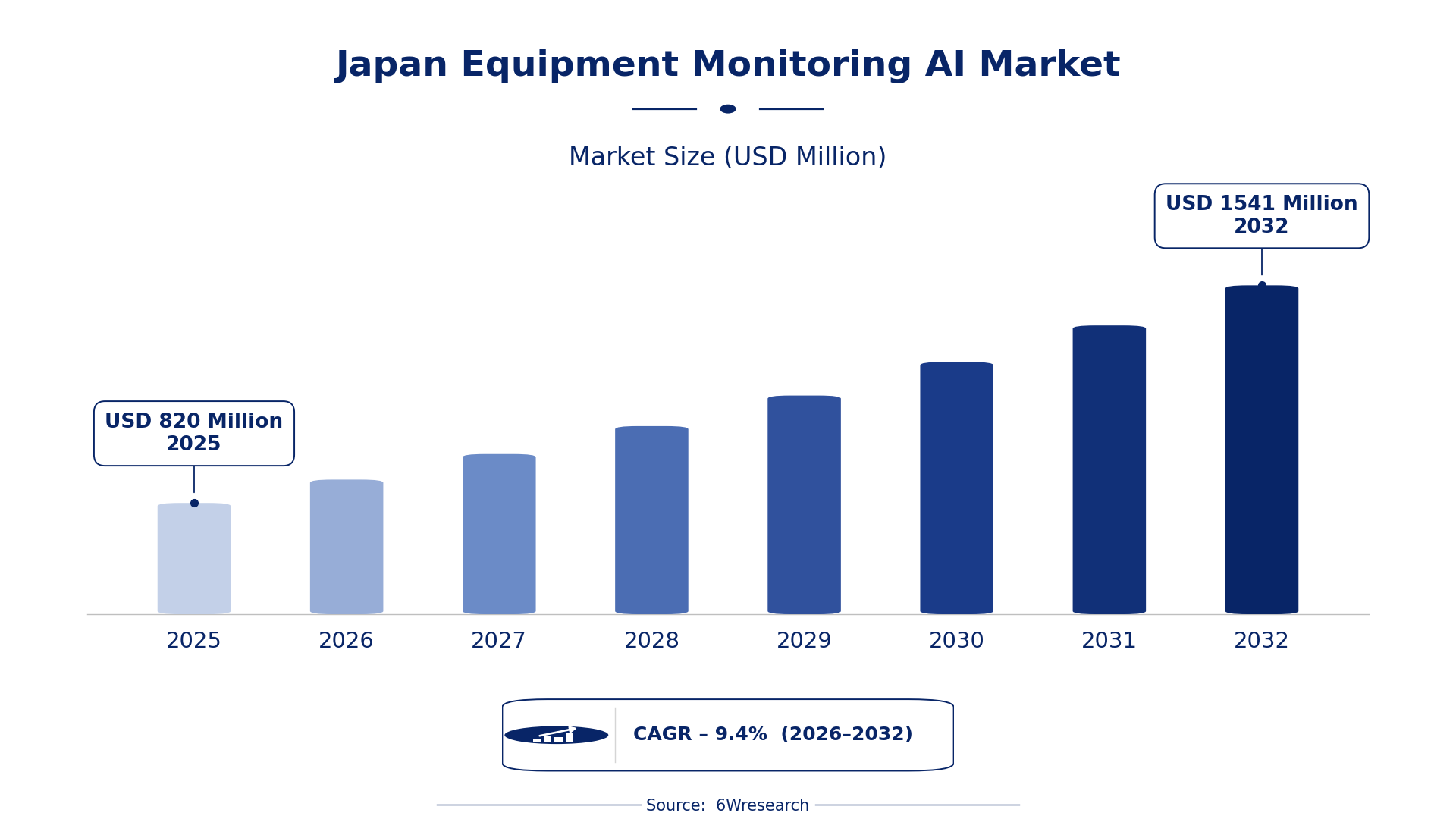
According to 6Wresearch internal database and industry insights, the Japan Equipment Monitoring AI Market was valued at USD 820 Million in 2025 and is projected to reach USD 1,541 Million by 2032, growing at a CAGR of approximately 9.4% during 2026–2032.
Japan Equipment Monitoring AI Market Highlights
| Report Metric | Details |
| Report Name | Japan Equipment Monitoring AI Market (2026-2032) |
| Market Size 2025 | USD 820 Million |
| Market Size 2032 | USD 1,541 Million |
| Absolute Growth 2025–2032 | USD 721 Million |
| CAGR 2026–2032 | 9.4% |
| Peak Annual Growth | 11.4% in 2026 |
| Forecast Period | 2026–2032 |
| Historical Data | 2022–2025 |
| Base Year | 2025 |
| Leading Monitoring Type, 2025 | Predictive (45% share) |
| Leading AI Technique, 2025 | Machine Learning (47% share) |
| Leading Output Type, 2025 | Maintenance Alerts (53% share) |
| Leading Equipment Focus, 2025 | CNC Machines (43% share) |
| Fastest-Growing Monitoring Type | Diagnostic (13.4% CAGR) |
| Fastest-Growing AI Technique | Pattern Recognition (11.8% CAGR) |
| Fastest-Growing Output Type | Fault Detection (12.8% CAGR) |
| Fastest-Growing Equipment Focus | Conveyor Belts (12.3% CAGR) |
| Growing Sector | Manufacturing |
| Key End Users | Heavy industries, automotive sector, precision manufacturing, logistics |
Japan Equipment Monitoring AI Market Year-wise Growth Rate and Key Drivers (2022–2032)
This graph illustrates the annual growth rates of the market from 2022 to 2032, highlighting a steady upward trajectory and projected market expansion over the forecast period.
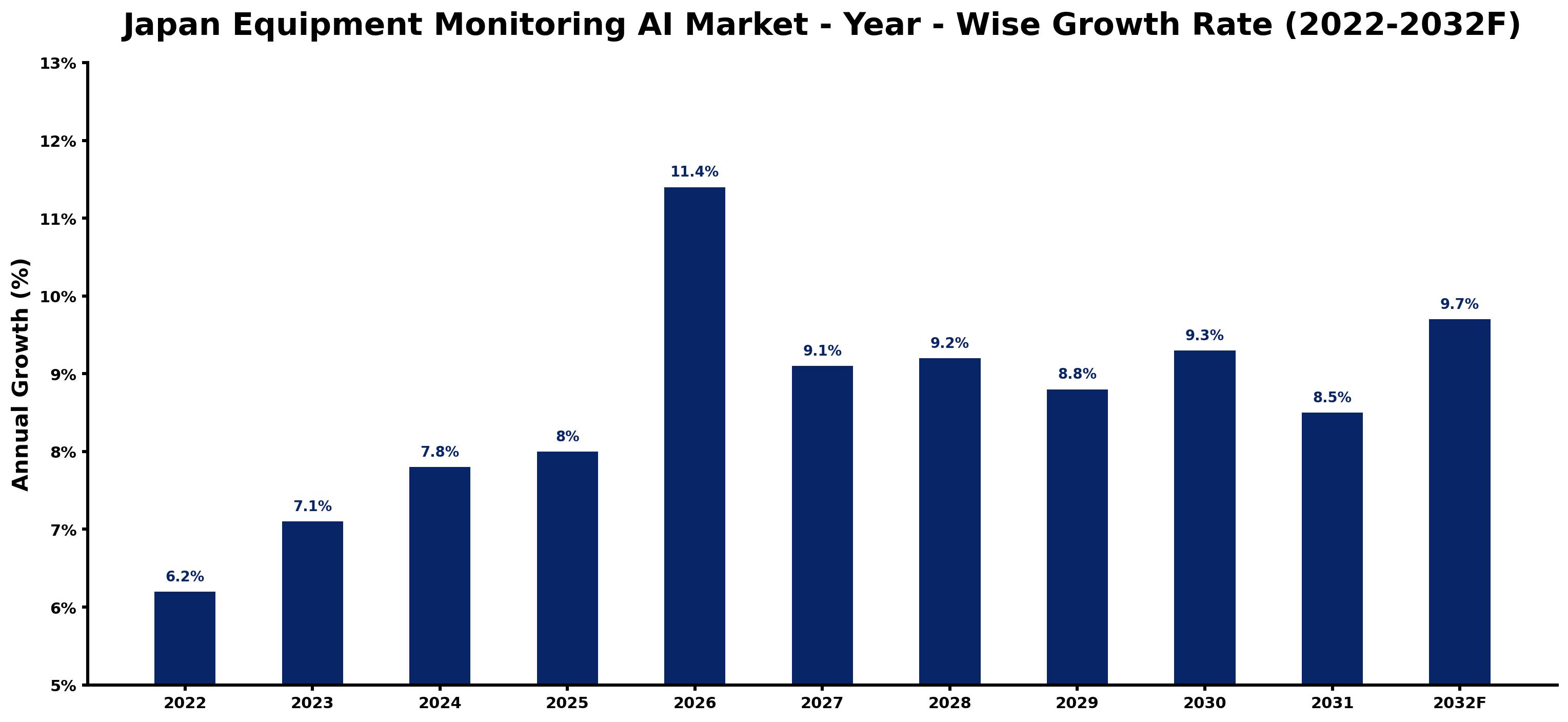
Each row of the following table gives one year's estimated growth and the event or demand shift that explains it.
| Year | Estimated Annual Growth (%) | Market Rationale |
| 2022 | 6.2 | The market experienced steady demand from the manufacturing sector, particularly in heavy industries. |
| 2023 | 7.1 | Growth accelerated due to increased adoption of AI technologies in production processes. |
| 2024 | 7.8 | Demand continued to rise as manufacturers sought to improve operational efficiency through monitoring solutions. |
| 2025 | 8.0 | The market reached a peak growth rate as more companies integrated AI for predictive maintenance. |
| 2026 | 11.4 | Growth surged as investments in AI technologies expanded, particularly in the automotive sector. |
| 2027 | 9.1 | The growth rate is expected to slow slightly due to market saturation in some segments. |
| 2028 | 9.2 | Demand is projected to pick up again as companies focus on productivity and reducing downtime. |
| 2029 | 8.8 | Growth is expected to decelerate as some industries face challenges in implementing new technologies. |
| 2030 | 9.3 | The market is projected to rebound with renewed interest in AI applications for operational optimization. |
| 2031 | 8.5 | Growth is expected to moderate as competition intensifies among monitoring solution providers. |
| 2032 | 9.7 | Demand is projected to rise again as the focus shifts towards advanced monitoring capabilities. |
Note: Market size estimations and growth projections presented in this report are based on 6Wresearch's proprietary forecasting methodology, utilizing the latest available industry data, government publications, and primary research inputs.
Japan Equipment Monitoring AI Market Synopsis
Equipment Monitoring AI employs artificial intelligence to oversee performance and health, combining machine learning and data analytics for predictive maintenance and fault detection. The Japan Equipment Monitoring AI Market is growing, driven by the manufacturing sector's demand for efficiency and the government's commitment to AI adoption, aiming for a 20% efficiency increase in manufacturing by 2023. The Tokyo region's leadership in CNC machine production further stimulates demand for these advanced monitoring solutions, as manufacturers strive to modernise operations and boost productivity.
Market Dynamics Impact Analysis (2026–2032)
| Factor | Type | Impact | Primary Segment Affected |
| Increasing adoption of AI technologies in manufacturing processes | Driver | High | Predictive |
| Rising demand for operational efficiency in heavy industries | Driver | High | Diagnostic |
| Growing need for real-time monitoring solutions | Opportunity | High | Real-Time |
| Expansion of smart manufacturing initiatives in urban areas | Opportunity | Medium | Sensor-Based |
| High initial investment costs for AI integration | Restraint | High | Machine Learning |
| Limited availability of skilled personnel for AI implementation | Restraint | Medium | Anomaly Detection |
| Compliance with stringent industrial standards | Challenge | High | Fault Detection |
| Capacity constraints in scaling AI solutions across industries | Challenge | Medium | Usage Optimization |
Evaluation of Drivers in Japan Equipment Monitoring AI Market (2026–2032)
Key forces behind demand, with the segment each one moves most, are listed below.
| Drivers | Primary Segment Affected | Why It Matters (Evidence) |
| Increased focus on predictive maintenance | Predictive | This shift helps manufacturers reduce downtime, with over 10 million people employed in Japan's manufacturing sector driving demand. |
| Growing interest in fault detection technologies | Diagnostic | Fault detection systems minimise operational disruptions, especially in the automotive industry, where efficiency is critical. |
| Demand for real-time monitoring systems | Real-Time | Real-time solutions improve productivity, leading to higher adoption rates in Japan's automotive sector, which is a major market driver. |
| Integration of AI in energy management | Sensor-Based | ISO 50001 compliance encourages manufacturers to adopt AI for energy efficiency improvements, aligning with industry standards. |
| Rising interest in usage optimization solutions | Usage Optimization | Manufacturers are increasingly analysing usage patterns to improve efficiency and reduce costs, particularly in heavy industries. |
The strongest pull on demand comes from the manufacturing sector's focus on predictive maintenance and fault detection. The average age of CNC machines exceeds 10 years, creating a strong need for modern technologies. Real-time monitoring systems are increasingly adopted in the automotive industry, improving productivity and operational reliability. The integration of AI in energy management aligns with ISO 50001 standards, prompting manufacturers to invest in these technologies.
Evaluation of Restraints in Japan Equipment Monitoring AI Market
These restraints slow adoption and weigh on supplier margins.
| Market Restraint | Primary Segment Affected | Why It Matters (Evidence) |
| High initial investment costs for AI integration | Machine Learning | Many manufacturers face budget constraints, limiting their ability to adopt advanced monitoring technologies, especially in heavy industries. |
| Limited availability of skilled personnel for AI implementation | Anomaly Detection | The shortage of qualified professionals in AI hampers the effective deployment of monitoring solutions across sectors. |
| Compliance with stringent industrial standards | Fault Detection | Manufacturers must navigate complex regulations, which can delay the implementation of monitoring systems. |
| Resistance to change among traditional manufacturers | Usage Optimization | Some companies are reluctant to adopt new technologies, impacting the overall market growth. |
| Integration challenges with existing systems | Predictive | Many manufacturers struggle to integrate AI solutions with legacy systems, hindering efficiency improvements. |
Japan Equipment Monitoring AI Market Challenges
Producers face high costs due to outdated technology, as the average age of CNC machines exceeds 10 years, resulting in inefficiencies and rising maintenance expenses. Many buyers find it challenging to implement advanced monitoring AI due to inadequate existing infrastructure, which delays upgrades and inflates costs for manufacturers. Compliance with ISO 50001 necessitates investment in energy management systems, diverting resources from AI adoption and hindering progress. Increasing operational costs from Japan's national minimum wage rise to JPY 1,055 per hour further constrains budgets, complicating investments in new technologies.
Trends in the Japan Equipment Monitoring AI Market
These developments are changing demand patterns in the Japan Equipment Monitoring AI Market.
- Shift towards Real-Time Monitoring Solutions: In 2023, the Japanese government initiated a programme to promote AI in manufacturing, targeting a 20% efficiency increase. This shift towards real-time monitoring is driving demand for advanced AI solutions across various industries.
- Transition from Traditional to Smart Manufacturing: The Tokyo Metropolitan Government has launched a smart manufacturing initiative, encouraging the integration of AI technologies. This transition is reshaping manufacturing processes, resulting in increased efficiency and productivity.
- Emergence of Predictive Maintenance Technologies: The rise of predictive maintenance technologies is transforming equipment management practices. With over 10 million people employed in Japan's manufacturing sector, the demand for such solutions is expected to grow steadily.
- Prioritisation of Energy Efficiency Standards: ISO 50001 compliance is becoming a priority for many manufacturers in Japan. This focus on energy management is driving the adoption of AI technologies to improve operational efficiency.
Investment Opportunities in the Japan Equipment Monitoring AI Market
The openings below show where demand in the Japan Equipment Monitoring AI Market is visible and how suppliers can enter.
- Local Partnerships for AI Integration: Forming joint ventures with local firms can facilitate AI integration in manufacturing. With Japan's industrial IoT market projected to grow significantly, this offers a valuable opportunity for technology providers.
- Investment in Smart Manufacturing Facilities: The Tokyo region's focus on smart manufacturing creates a demand for advanced monitoring solutions. Suppliers can penetrate this market by collaborating with local manufacturers to enhance operational efficiency.
- Supply of Predictive Maintenance Solutions: The average age of CNC machines in Japan exceeds 10 years, indicating a gap in modern monitoring solutions. Targeting manufacturers in heavy industries can yield substantial returns.
- Development of Training Programs for AI Skills: With a shortage of skilled personnel, investing in training programs can help bridge this gap. Partnering with educational institutions can cultivate a workforce prepared for AI implementation.
Government Initiatives in the Japan Equipment Monitoring AI Market
The Industrial Safety and Health Act (1972) mandates employer responsibilities for hazardous substances and machinery, improving safety standards in equipment monitoring. This law complements the Act on the Rational Use of Energy (1979), which requires large energy users to enhance efficiency and report energy use, further encouraging the adoption of AI technologies in manufacturing processes.
In 2023, the Japanese government allocated substantial funding to support AI integration in industrial processes. The Ministry of Economy, Trade and Industry (METI) oversees this initiative, aiming to boost productivity and operational efficiency across various sectors.
Future Insight of the Japan Equipment Monitoring AI Market
Investment in AI technologies will increase, generating strong demand for advanced monitoring solutions across multiple sectors. By 2032, the industrial IoT market will expand significantly, with equipment monitoring emerging as a crucial segment, backed by government initiatives and industry standards. The Tokyo Metropolitan Government's smart manufacturing initiative will promote AI integration, offering suppliers opportunities to address the evolving needs of producers. Enhanced collaboration among industry stakeholders will facilitate the adoption of modern monitoring systems.
Market Segmentation Analysis
Japan Equipment Monitoring AI Market report covers a detailed analysis of the following market segments:
By Monitoring Type – Predictive Leads, Diagnostic Expected to Grow Fastest
According to Saurav Kr Singh, Senior Research Analyst at 6Wresearch, with 45% of monitoring type revenue in 2025, Predictive was the largest category. Predictive monitoring holds the largest share as it provides crucial insights for proactive maintenance, essential in Japan's manufacturing sector. This is particularly important in facilities employing over 10 million people, where maintaining operational efficiency is critical. Over 2026–2032, Diagnostic is expected to post the fastest growth, at a CAGR of 13.4%. The diagnostic segment is experiencing rapid growth due to increasing demand for analyses that identify root causes of equipment issues, particularly in the automotive industry. This trend is further supported by government initiatives aimed at promoting AI integration in industrial processes. Suppliers should focus on enhancing diagnostic capabilities to meet the growing need for root cause analysis in equipment monitoring.
By AI Technique – Machine Learning Leads, Pattern Recognition Expected to Grow Fastest
Machine Learning accounted for 47% of the market by ai technique in 2025. Machine learning is the leading technique as it is essential for analysing large datasets, significantly improving predictions in equipment monitoring applications. Its widespread use across various sectors solidifies its dominant position in the market. Pattern Recognition is set to record the highest CAGR in this split, 11.8% over 2026–2032. Pattern recognition is witnessing rapid growth as it aids in identifying trends in equipment performance, driven by the increasing adoption of AI technologies across industries. This technique complements machine learning, enhancing overall analytical capabilities. Buyers should prioritise solutions that incorporate machine learning and pattern recognition for improved monitoring effectiveness.
By Output Type – Maintenance Alerts Lead, Fault Detection Expected to Grow Fastest
Maintenance Alerts took 53% of output type revenue in 2025, more than any other category. Maintenance alerts dominate the market because they provide timely notifications for both scheduled and unscheduled maintenance, essential for operational efficiency. This is particularly important in sectors where downtime can lead to considerable losses. The quickest growth will come from Fault Detection, forecast to expand at a CAGR of 12.8% between 2026 and 2032. Fault detection is the fastest-growing output type as it directly addresses the need to reduce downtime by swiftly identifying equipment faults. The increasing complexity of machinery in industries like automotive propels this demand. Suppliers must prioritise the development of advanced fault detection systems to meet the growing interest in minimising operational disruptions.
By Equipment Focus – CNC Machines Lead, Conveyor Belts Expected to Grow Fastest
CNC Machines held 43% of the Japan Equipment Monitoring AI Market by equipment focus in 2025. CNC machines dominate the equipment focus segment due to their extensive use in precision manufacturing, making effective monitoring vital for sustaining productivity. The average age of these machines, which exceeds 10 years, highlights the urgent need for modern monitoring solutions. Conveyor Belts are projected to grow fastest, at a CAGR of 12.3% during 2026–2032. Conveyor belts are the fastest-growing focus area as they play a critical role in logistics and production lines, where operational efficiency is increasingly sought. The rising demand for monitoring solutions in these systems is driven by the need for enhanced productivity. Buyers should consider investing in monitoring solutions specifically designed for conveyor belts to improve efficiency in their operations.
Key Attractiveness of the Report
- 10 Years of Market Numbers
- Historical Data Starting from 2022 to 2025
- Base Year 2025
- Forecast Data until 2032
- Key Performance Indicators Impacting the Market
- Major Upcoming Developments and Projects
Key Highlights of the Report:
- Japan Equipment Monitoring AI Market Outlook
- Market Size of Japan Equipment Monitoring AI Market, 2025
- Forecast of Japan Equipment Monitoring AI Market, 2032
- Historical Data and Forecast of Japan Equipment Monitoring AI Revenues & Volume for the Period 2022-2032F
- Japan Equipment Monitoring AI Market Trend Evolution
- Japan Equipment Monitoring AI Market Drivers and Challenges
- Japan Equipment Monitoring AI Price Trends
- Japan Equipment Monitoring AI Porter's Five Forces
- Japan Equipment Monitoring AI Industry Life Cycle
- Historical Data and Forecast of Japan Equipment Monitoring AI Market Revenues & Volume By Monitoring Type for the Period 2022-2032F
- Historical Data and Forecast of Japan Equipment Monitoring AI Market Revenues & Volume By Predictive for the Period 2022-2032F
- Historical Data and Forecast of Japan Equipment Monitoring AI Market Revenues & Volume By Diagnostic for the Period 2022-2032F
- Historical Data and Forecast of Japan Equipment Monitoring AI Market Revenues & Volume By Real-Time for the Period 2022-2032F
- Historical Data and Forecast of Japan Equipment Monitoring AI Market Revenues & Volume By Sensor-Based for the Period 2022-2032F
- Historical Data and Forecast of Japan Equipment Monitoring AI Market Revenues & Volume By AI Technique for the Period 2022-2032F
- Historical Data and Forecast of Japan Equipment Monitoring AI Market Revenues & Volume By Machine Learning for the Period 2022-2032F
- Historical Data and Forecast of Japan Equipment Monitoring AI Market Revenues & Volume By Pattern Recognition for the Period 2022-2032F
- Historical Data and Forecast of Japan Equipment Monitoring AI Market Revenues & Volume By Deep Learning for the Period 2022-2032F
- Historical Data and Forecast of Japan Equipment Monitoring AI Market Revenues & Volume By Anomaly Detection for the Period 2022-2032F
- Historical Data and Forecast of Japan Equipment Monitoring AI Market Revenues & Volume By Output Type for the Period 2022-2032F
- Historical Data and Forecast of Japan Equipment Monitoring AI Market Revenues & Volume By Maintenance Alerts for the Period 2022-2032F
- Historical Data and Forecast of Japan Equipment Monitoring AI Market Revenues & Volume By Fault Detection for the Period 2022-2032F
- Historical Data and Forecast of Japan Equipment Monitoring AI Market Revenues & Volume By Usage Optimization for the Period 2022-2032F
- Historical Data and Forecast of Japan Equipment Monitoring AI Market Revenues & Volume By Health Reports for the Period 2022-2032F
- Historical Data and Forecast of Japan Equipment Monitoring AI Market Revenues & Volume By Equipment Focus for the Period 2022-2032F
- Historical Data and Forecast of Japan Equipment Monitoring AI Market Revenues & Volume By CNC Machines for the Period 2022-2032F
- Historical Data and Forecast of Japan Equipment Monitoring AI Market Revenues & Volume By Conveyor Belts for the Period 2022-2032F
- Historical Data and Forecast of Japan Equipment Monitoring AI Market Revenues & Volume By Robotic Arms for the Period 2022-2032F
- Historical Data and Forecast of Japan Equipment Monitoring AI Market Revenues & Volume By HVAC Units for the Period 2022-2032F
- Japan Equipment Monitoring AI Import Export Trade Statistics
- Market Opportunity Assessment By Monitoring Type
- Market Opportunity Assessment By AI Technique
- Market Opportunity Assessment By Output Type
- Market Opportunity Assessment By Equipment Focus
- Japan Equipment Monitoring AI Top Companies Market Share
- Japan Equipment Monitoring AI Competitive Benchmarking By Technical and Operational Parameters
- Japan Equipment Monitoring AI Company Profiles
- Japan Equipment Monitoring AI Key Strategic Recommendations
Market Covered
Segments analysed in this report are listed below.
By Monitoring Type
- Predictive
- Diagnostic
- Real-Time
- Sensor-Based
By AI Technique
- Machine Learning
- Pattern Recognition
- Deep Learning
- Anomaly Detection
By Output Type
- Maintenance Alerts
- Fault Detection
- Usage Optimization
- Health Reports
By Equipment Focus
- CNC Machines
- Conveyor Belts
- Robotic Arms
- HVAC Units































