Japan Ergonomic Mat Market Size & Growth Rate
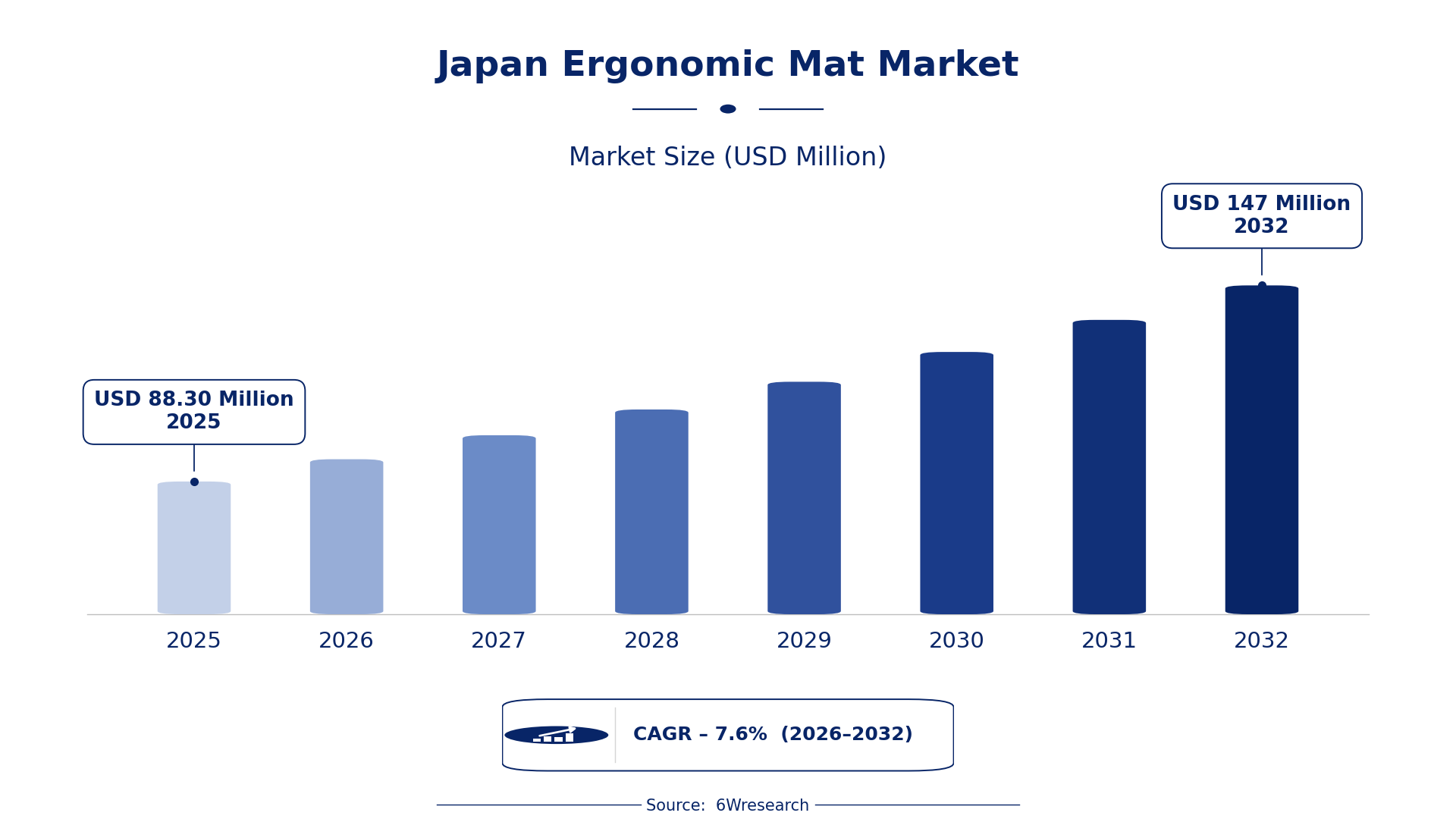
According to 6Wresearch internal database and industry insights, the Japan Ergonomic Mat Market was valued at USD 88.30 Million in 2025 and is projected to reach USD 147 Million by 2032, growing at a CAGR of approximately 7.6% during 2026–2032.
Japan Ergonomic Mat Market Highlights
| Report Metric | Details |
| Report Name | Japan Ergonomic Mat Market (2026-2032) |
| Market Size 2025 | USD 88.30 Million |
| Market Size 2032 | USD 147 Million |
| Absolute Growth 2025–2032 | USD 58.70 Million |
| CAGR 2026–2032 | 7.6% |
| Peak Annual Growth | 8.5% in 2032 |
| Forecast Period | 2026–2032 |
| Historical Data | 2022–2025 |
| Base Year | 2025 |
| Leading Mat Type, 2025 | Anti-Fatigue (47% share) |
| Leading Material, 2025 | Foam (53% share) |
| Leading Usage Environment, 2025 | Commercial Kitchens (50% share) |
| Leading End User, 2025 | Hospitals (43% share) |
| Fastest-Growing Mat Type | Medical Mats (10.7% CAGR) |
| Fastest-Growing Material | Gel (11.2% CAGR) |
| Fastest-Growing Usage Environment | Standing Desks (10.3% CAGR) |
| Growing Sector | Healthcare |
| Key End Users | Healthcare sector, Corporate offices, Commercial kitchens, Manufacturing |
Japan Ergonomic Mat Market Year-wise Growth Rate and Key Drivers (2022–2032)
This graph illustrates the annual growth rates of the market from 2022 to 2032, highlighting a steady upward trajectory and projected market expansion over the forecast period.
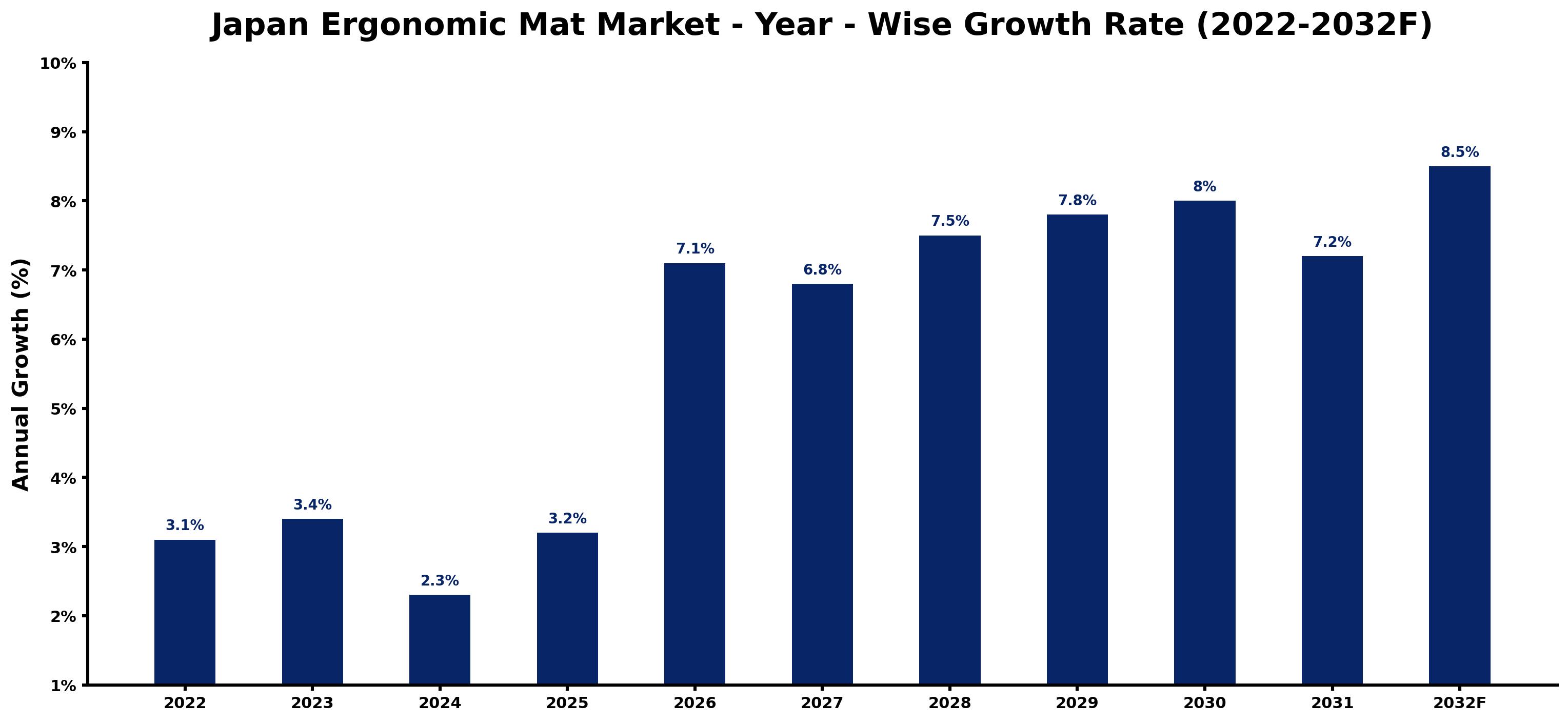
The yearly estimates that follow link every growth rate to its principal driver, so readers can see why the pace changed in each period.
| Year | Estimated Annual Growth (%) | Market Rationale |
| 2022 | 3.1 | The market showed steady demand as ergonomic solutions gained traction in workplaces. |
| 2023 | 3.4 | Growth accelerated due to heightened awareness of workplace wellness initiatives. |
| 2024 | 2.3 | Demand slowed as the market adjusted after a peak in the previous year. |
| 2025 | 3.2 | Growth resumed as more businesses adopted ergonomic mats for employee comfort. |
| 2026 | 7.1 | Demand is expected to surge with increased investments in workplace wellness programmes. |
| 2027 | 6.8 | Growth is projected to decelerate slightly as the market stabilises after rapid expansion. |
| 2028 | 7.5 | Demand will rise again as ergonomic solutions become standard in many sectors. |
| 2029 | 7.8 | The market is expected to continue growing as more facilities recognise the benefits of ergonomic mats. |
| 2030 | 8.0 | Growth will remain strong due to ongoing investments in employee health and comfort. |
| 2031 | 7.2 | Demand is projected to slow as the market reaches a more mature phase of growth. |
| 2032 | 8.5 | The market will peak as ergonomic solutions become essential across various industries. |
Note: Market size estimations and growth projections presented in this report are based on 6Wresearch's proprietary forecasting methodology, utilizing the latest available industry data, government publications, and primary research inputs.
Japan Ergonomic Mat Market Synopsis
Ergonomic mats are designed to alleviate fatigue for individuals standing for long periods, commonly made from foam, gel, or rubber, providing support in various environments. The Japan Ergonomic Mat Market is experiencing growth, driven by the increasing adoption of ergonomic solutions in workplaces, kitchens, and medical settings. The healthcare sector employs over 4 million people, many of whom utilise these mats, while the Tokyo metropolitan area leads in corporate office demand. With continued expansion supported by workplace wellness initiatives and rising awareness of employee comfort, the market is set to thrive.
Market Dynamics Impact Analysis (2026–2032)
| Factor | Type | Impact | Primary Segment Affected |
| Increasing adoption of ergonomic solutions in workplaces | Driver | High | Office Mats |
| Rising demand in commercial kitchens for staff comfort | Driver | High | Kitchen Mats |
| Growing healthcare sector requiring ergonomic solutions | Opportunity | High | Medical Mats |
| Expansion of standing desk usage in corporate environments | Opportunity | High | Standing Desks |
| High competition among manufacturers affecting pricing | Restraint | Medium | Anti-Fatigue |
| Limited awareness in smaller businesses about ergonomic benefits | Restraint | Medium | Anti-Fatigue |
| Challenges in maintaining product quality standards | Challenge | High | Anti-Fatigue |
| Supply chain disruptions affecting material availability | Challenge | High | Anti-Fatigue |
Evaluation of Drivers in Japan Ergonomic Mat Market (2026–2032)
The following drivers explain most of the expected growth.
| Drivers | Primary Segment Affected | Why It Matters (Evidence) |
| Increased focus on employee wellness | Office Mats | This trend drives higher purchases of ergonomic mats in corporate offices, particularly as more companies prioritise employee comfort. |
| High usage rates in commercial kitchens | Kitchen Mats | With 75% of commercial kitchens using anti-fatigue mats, demand rises as kitchen staff prioritise comfort during long shifts. |
| Growth in the healthcare sector | Medical Mats | As over 4 million people work in healthcare, the need for ergonomic mats to improve staff comfort is driving purchases. |
| Rising popularity of standing desks | Standing Desks | The average height of standing desks in Japan is 110 cm, increasing demand for supportive mats to enhance comfort. |
| Compliance with ISO 9001 standards | Anti-Fatigue | Manufacturers adhering to quality standards ensure better product performance, encouraging more purchases from businesses. |
Volumes grow on the back of the increasing focus on employee wellness, particularly in the Tokyo metropolitan area, where ergonomic solutions are becoming standard in corporate offices. Approximately 75% of commercial kitchens utilise anti-fatigue mats, driving demand as kitchen staff seek comfort during long hours. The healthcare sector employs over 4 million individuals, many of whom rely on ergonomic mats for comfort. The rising popularity of standing desks, with an average height of 110 cm, is contributing to the growing need for supportive mats. Compliance with ISO 9001 standards ensures that manufacturers deliver high-quality products, further stimulating purchases in various sectors.
Evaluation of Restraints in Japan Ergonomic Mat Market
The main factors holding the market back are set out below.
| Market Restraint | Primary Segment Affected | Why It Matters (Evidence) |
| High competition causing price pressures | Anti-Fatigue | Intense competition among manufacturers results in lower prices, which can affect profitability for suppliers. |
| Limited awareness of ergonomic benefits in smaller businesses | Anti-Fatigue | Many smaller enterprises do not recognise the advantages of ergonomic mats, resulting in lower sales in this segment. |
| Challenges in maintaining product quality standards | Medical Mats | Manufacturers face difficulties in consistently meeting quality standards, which can deter potential buyers. |
| Supply chain disruptions affecting material availability | Kitchen Mats | Disruptions in the supply chain can lead to delays in production and delivery, impacting sales. |
| Regulatory compliance costs for manufacturers | Medical Mats | Meeting various standards incurs additional costs, which can limit pricing flexibility for suppliers. |
Japan Ergonomic Mat Market Challenges
High-quality ergonomic mats can cost hospitals up to 20% more than standard options, straining their budgets for staff comfort. A shortage of skilled workers in the manufacturing sector results in production delays, causing suppliers to miss deadlines and forcing buyers to endure longer lead times. Adherence to JIS standards requires additional testing and certification, extending the time to market for producers by up to six months. Fierce competition in the market drives prices down, compelling some suppliers to compromise on quality, which ultimately diminishes the durability and performance of mats for buyers.
Trends in the Japan Ergonomic Mat Market
The shifts below are changing how Japan Ergonomic Mat Market products are bought and supplied.
- Shift towards Ergonomic Solutions in Workplaces: Since 2023, there has been a shift towards adopting ergonomic solutions in workplaces, particularly in the Tokyo metropolitan area, where ergonomic mats are now standard. This change is reflected in the growing demand for comfort-focused products, with over 60% of hospitals adopting these mats.
- Increase in Standing Desk Adoption: In 2023, the average height of standing desks in Japan reached 110 cm, leading to a surge in demand for ergonomic mats. This trend is particularly noticeable in corporate offices, where comfort and productivity are prioritised.
- Emphasis on Workplace Wellness Programmes: The launch of the workplace wellness programme by the Japanese government in 2023 has spurred interest in ergonomic solutions. This initiative is driving demand for ergonomic mats across various sectors, including healthcare and hospitality.
- Growing Popularity of Gel Mats: Since 2026, gel mats have gained popularity due to their superior comfort for prolonged standing. This trend is particularly noticeable in the healthcare sector, where staff comfort is critical, contributing to an expected CAGR of 11.2%.
Investment Opportunities in the Japan Ergonomic Mat Market
Investors looking at the Japan Ergonomic Mat Market should consider the following areas.
- Supply of Ergonomic Mats: With the healthcare sector employing over 4 million people, there is an opportunity to supply ergonomic mats tailored for medical environments, especially given the rising demand for comfort solutions.
- Investment in Workplace Wellness: The launch of the workplace wellness programme in 2023 presents an opportunity to invest in ergonomic solutions for various industries, particularly in corporate offices, where comfort is increasingly valued.
- Gap in Awareness of Ergonomic Benefits: With limited awareness in smaller businesses, there is a gap to fill by providing educational resources and ergonomic mats, targeting regions with high concentrations of small enterprises.
- Expansion in Commercial Kitchens: The high usage rate of anti-fatigue mats in 75% of commercial kitchens indicates a need for suppliers to expand their offerings in this sector, focusing on durability and comfort.
Government Initiatives in the Japan Ergonomic Mat Market
The regulatory framework for ergonomic mats in Japan is shaped by several key laws, including the PMD Act, which regulates the quality and safety of medical devices, and the Next-Generation Medical Infrastructure Act of 2017, which promotes the use of modern medical solutions. These laws ensure that manufacturers adhere to strict quality standards, improving the overall safety and effectiveness of ergonomic mats in medical settings.
In 2023, the Japanese government launched a workplace wellness programme that promotes ergonomic solutions, administered by the Ministry of Health, Labour and Welfare. This programme aims to improve employee comfort and productivity across various sectors, with funding allocated to support the adoption of ergonomic mats in workplaces.
Future Insight of the Japan Ergonomic Mat Market
Advancements in material science will revolutionise ergonomic mat production by 2032, leading to improved comfort and support for users. The government's workplace wellness programme will encourage more businesses to adopt ergonomic solutions, increasing demand across various sectors. It is projected that 75% of commercial kitchens will incorporate ergonomic mats by 2030 to support staff well-being. Automation in production processes will enhance efficiency, allowing suppliers to meet rising demand more effectively.
Market Segmentation Analysis
Japan Ergonomic Mat Market report covers a detailed analysis of the following market segments:
By Mat Type – Anti-Fatigue Leads, Medical Mats Expected to Grow Fastest
According to Saurav Kr Singh, Senior Research Analyst at 6Wresearch, with 47% of mat type revenue in 2025, Anti-Fatigue was the largest category. Anti-fatigue mats hold the largest share due to their critical function in alleviating fatigue for workers, particularly in commercial kitchens where staff endure long hours of standing. The substantial reliance on these mats is evidenced by their use in 75% of commercial kitchens across Japan. Medical Mats are projected to grow fastest, at a CAGR of 10.7% during 2026–2032. Medical mats are witnessing rapid growth as hospitals increasingly acknowledge the advantages of ergonomic solutions for both staff and patient comfort. The Japanese government's 2023 workplace wellness program is likely to further accelerate demand for these mats, solidifying their position in the market. Suppliers should focus on the medical mats segment to leverage the growing emphasis on ergonomic solutions in healthcare.
By Material – Foam Leads, Gel Expected to Grow Fastest
Foam took 53% of material revenue in 2025, more than any other category. Foam materials dominate the market because of their superior cushioning properties, making them the preferred choice for ergonomic mats in various settings. This is illustrated by their widespread use in both commercial kitchens and healthcare facilities throughout Japan. Gel is set to record the highest CAGR in this split, 11.2% over 2026–2032. Gel mats are experiencing notable growth due to their exceptional comfort for prolonged standing, appealing to users in both healthcare and office environments. As the trend of standing desks gains traction, the demand for gel mats is projected to rise significantly. Manufacturers should consider expanding their product lines to include gel mats to meet the increasing demand for enhanced comfort in standing applications.
By Usage Environment – Commercial Kitchens Lead, Standing Desks Expected to Grow Fastest
The largest usage environment category in 2025 was Commercial Kitchens, at 50% of revenue. Commercial kitchens represent the largest segment as ergonomic mats are essential for chefs and kitchen staff who spend extended periods on their feet. The high adoption rate of anti-fatigue mats in 75% of these kitchens highlights their importance in enhancing workplace comfort. The quickest growth will come from Standing Desks, forecast to expand at a CAGR of 10.3% between 2026 and 2032. The standing desks segment is expanding rapidly as more offices embrace ergonomic solutions to promote employee well-being. This growth trend is expected to persist as flexible workspaces become increasingly common, driving further demand for ergonomic mats. Suppliers should concentrate on delivering customised solutions for standing desks to capitalise on this expanding market.
By End User – Hospitals Lead and Record the Fastest Growth
Hospitals accounted for 43% of the market by end user in 2025. Hospitals account for the largest share of the market since ergonomic mats are critical for both staff and patient areas to reduce fatigue during long shifts. The healthcare sector in Japan employs over 4 million people, creating a substantial demand for these mats. Hospitals are also forecast to expand faster than any other category, at a CAGR of 9.9% over 2026–2032. Hospitals are also the fastest-growing segment as they increasingly recognise the importance of ergonomic solutions in improving comfort and productivity. The simultaneous growth in this sector reinforces its leading position in the market. Vendors should prioritise partnerships with healthcare facilities to meet the rising demand for ergonomic mats in hospitals.
Key Attractiveness of the Report
- 10 Years of Market Numbers
- Historical Data Starting from 2022 to 2025
- Base Year 2025
- Forecast Data until 2032
- Key Performance Indicators Impacting the Market
- Major Upcoming Developments and Projects
Key Highlights of the Report:
- Japan Ergonomic Mat Market Outlook
- Market Size of Japan Ergonomic Mat Market, 2025
- Forecast of Japan Ergonomic Mat Market, 2032
- Historical Data and Forecast of Japan Ergonomic Mat Revenues & Volume for the Period 2022-2032F
- Japan Ergonomic Mat Market Trend Evolution
- Japan Ergonomic Mat Market Drivers and Challenges
- Japan Ergonomic Mat Price Trends
- Japan Ergonomic Mat Porter's Five Forces
- Japan Ergonomic Mat Industry Life Cycle
- Historical Data and Forecast of Japan Ergonomic Mat Market Revenues & Volume By Mat Type for the Period 2022-2032F
- Historical Data and Forecast of Japan Ergonomic Mat Market Revenues & Volume By Anti-Fatigue for the Period 2022-2032F
- Historical Data and Forecast of Japan Ergonomic Mat Market Revenues & Volume By Kitchen Mats for the Period 2022-2032F
- Historical Data and Forecast of Japan Ergonomic Mat Market Revenues & Volume By Office Mats for the Period 2022-2032F
- Historical Data and Forecast of Japan Ergonomic Mat Market Revenues & Volume By Medical Mats for the Period 2022-2032F
- Historical Data and Forecast of Japan Ergonomic Mat Market Revenues & Volume By Material for the Period 2022-2032F
- Historical Data and Forecast of Japan Ergonomic Mat Market Revenues & Volume By Foam for the Period 2022-2032F
- Historical Data and Forecast of Japan Ergonomic Mat Market Revenues & Volume By Gel for the Period 2022-2032F
- Historical Data and Forecast of Japan Ergonomic Mat Market Revenues & Volume By Rubberized for the Period 2022-2032F
- Historical Data and Forecast of Japan Ergonomic Mat Market Revenues & Volume By Vinyl for the Period 2022-2032F
- Historical Data and Forecast of Japan Ergonomic Mat Market Revenues & Volume By Usage Environment for the Period 2022-2032F
- Historical Data and Forecast of Japan Ergonomic Mat Market Revenues & Volume By Industrial Floors for the Period 2022-2032F
- Historical Data and Forecast of Japan Ergonomic Mat Market Revenues & Volume By Commercial Kitchens for the Period 2022-2032F
- Historical Data and Forecast of Japan Ergonomic Mat Market Revenues & Volume By Standing Desks for the Period 2022-2032F
- Historical Data and Forecast of Japan Ergonomic Mat Market Revenues & Volume By Operating Rooms for the Period 2022-2032F
- Historical Data and Forecast of Japan Ergonomic Mat Market Revenues & Volume By End User for the Period 2022-2032F
- Historical Data and Forecast of Japan Ergonomic Mat Market Revenues & Volume By Manufacturing for the Period 2022-2032F
- Historical Data and Forecast of Japan Ergonomic Mat Market Revenues & Volume By Hotels for the Period 2022-2032F
- Historical Data and Forecast of Japan Ergonomic Mat Market Revenues & Volume By Corporate Offices for the Period 2022-2032F
- Historical Data and Forecast of Japan Ergonomic Mat Market Revenues & Volume By Hospitals for the Period 2022-2032F
- Japan Ergonomic Mat Import Export Trade Statistics
- Market Opportunity Assessment By Mat Type
- Market Opportunity Assessment By Material
- Market Opportunity Assessment By Usage Environment
- Market Opportunity Assessment By End User
- Japan Ergonomic Mat Top Companies Market Share
- Japan Ergonomic Mat Competitive Benchmarking By Technical and Operational Parameters
- Japan Ergonomic Mat Company Profiles
- Japan Ergonomic Mat Key Strategic Recommendations
Market Covered
Coverage by segment is as follows.
By Mat Type
- Anti-Fatigue
- Kitchen Mats
- Office Mats
- Medical Mats
By Material
- Foam
- Gel
- Rubberized
- Vinyl
By Usage Environment
- Industrial Floors
- Commercial Kitchens
- Standing Desks
- Operating Rooms
By End User
- Manufacturing
- Hotels
- Corporate Offices
- Hospitals































