Japan EV Battery Monitoring Market Size & Growth Rate
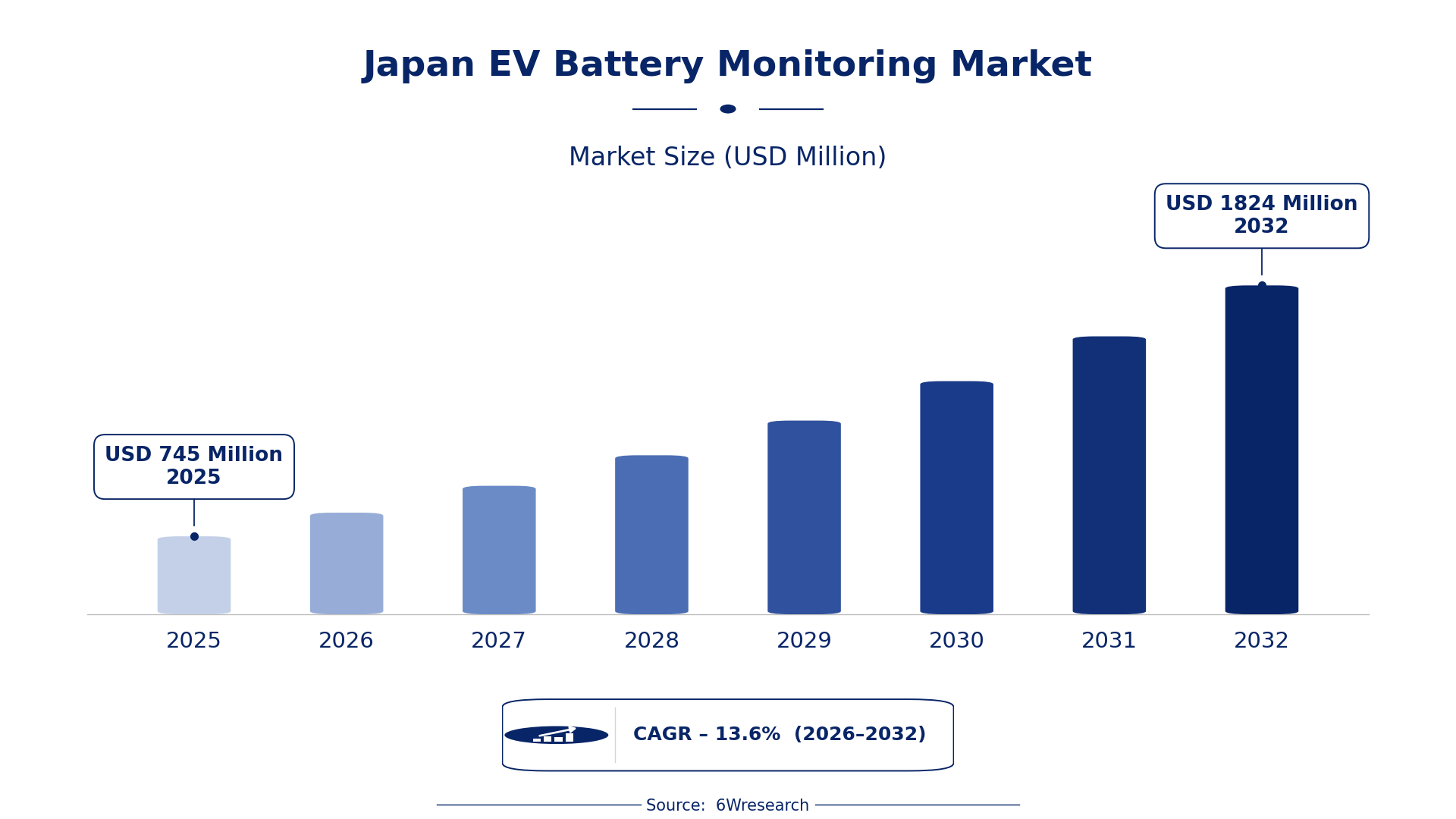
According to 6Wresearch internal database and industry insights, the Japan EV Battery Monitoring Market was valued at USD 745 Million in 2025 and is projected to reach USD 1,824 Million by 2032, growing at a CAGR of approximately 13.6% during 2026–2032.
Japan EV Battery Monitoring Market Highlights
| Report Metric | Details |
| Report Name | Japan EV Battery Monitoring Market (2026-2032) |
| Market Size 2025 | USD 745 Million |
| Market Size 2032 | USD 1,824 Million |
| Absolute Growth 2025–2032 | USD 1,079 Million |
| CAGR 2026–2032 | 13.6% |
| Peak Annual Growth | 16.9% in 2026 |
| Forecast Period | 2026–2032 |
| Historical Data | 2022–2025 |
| Base Year | 2025 |
| Leading Monitoring Type, 2025 | Voltage Tracking (41% share) |
| Leading Feature, 2025 | Cell Level (41% share) |
| Leading Technology Used, 2025 | CAN Interface (42% share) |
| Leading End User, 2025 | OEM Integrators (43% share) |
| Fastest-Growing Monitoring Type | Temperature Check (18.2% CAGR) |
| Fastest-Growing Feature | Thermal Sensor (17.4% CAGR) |
| Fastest-Growing Technology Used | Wireless (19.1% CAGR) |
| Fastest-Growing End User | EV Fleets (17.7% CAGR) |
| Growing Sector | electric vehicle monitoring |
| Key End Users | OEM Integrators, EV Fleets, Battery Makers, EV Startups |
Japan EV Battery Monitoring Market Year-wise Growth Rate and Key Drivers (2022–2032)
This graph illustrates the annual growth rates of the market from 2022 to 2032, highlighting a steady upward trajectory and projected market expansion over the forecast period.
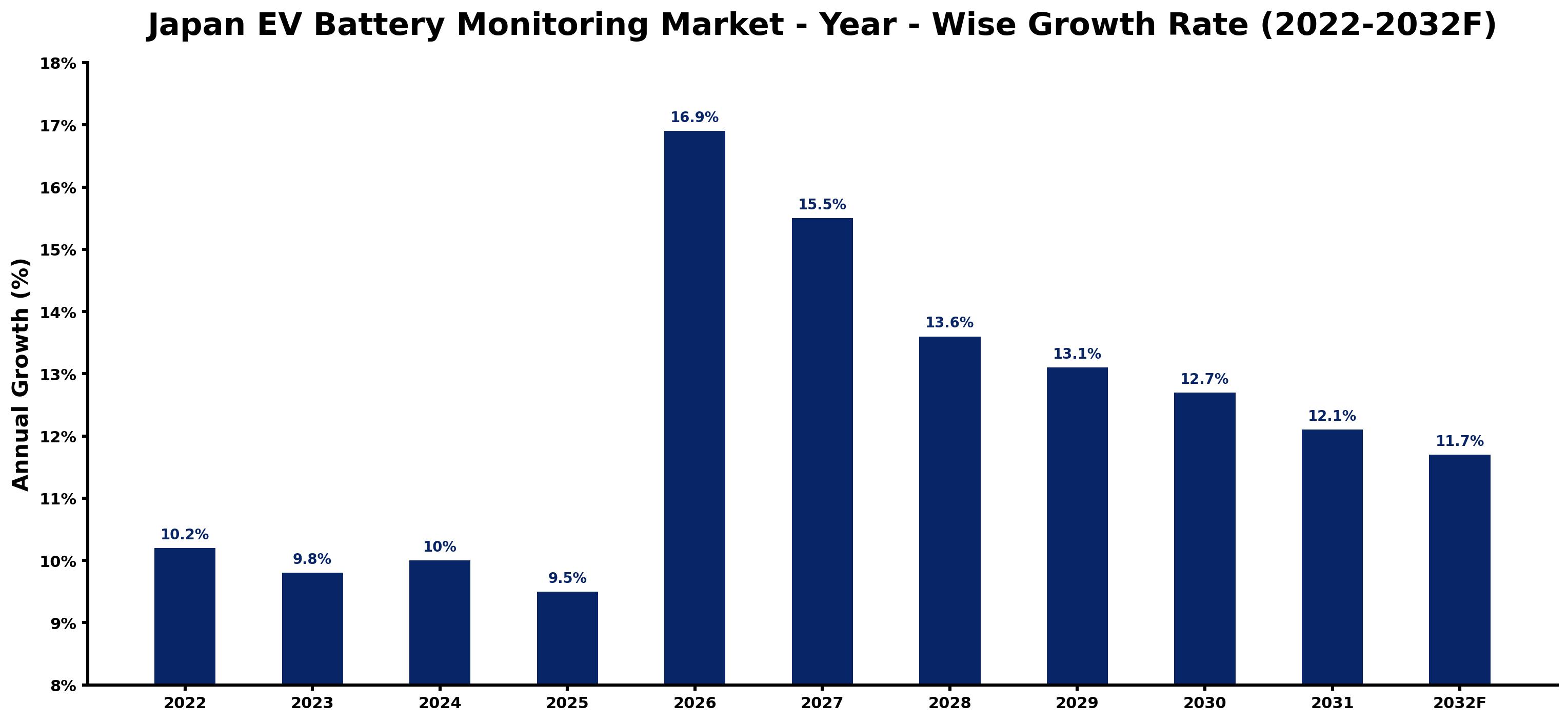
Below, each year's estimated growth is shown next to the factor that most influenced it.
| Year | Estimated Annual Growth (%) | Market Rationale |
| 2022 | 10.2 | The market experienced solid growth due to rising EV adoption and technology advancements. |
| 2023 | 9.8 | Growth slowed slightly as manufacturers adjusted to increased demand and supply chain challenges. |
| 2024 | 10.0 | The market rebounded with improved production capabilities and growing consumer interest in EVs. |
| 2025 | 9.5 | Demand continued to rise, driven by corporate sustainability initiatives and urban EV adoption. |
| 2026 | 16.9 | Growth accelerated as investments in battery technology surged and EV fleets expanded. |
| 2027 | 15.5 | Growth moderated as the market matured, but demand from OEM integrators remained strong. |
| 2028 | 13.6 | Market expansion continued, supported by increasing battery health monitoring requirements. |
| 2029 | 13.1 | A slight slowdown in growth was noted as competition intensified among monitoring solutions. |
| 2030 | 12.7 | Demand remained steady as the government pushed for 100% electrification of new vehicles. |
| 2031 | 12.1 | Growth slowed further, reflecting a more saturated market and evolving consumer preferences. |
| 2032 | 11.7 | The market is projected to stabilise as new technologies are integrated into existing systems. |
Note: Market size estimations and growth projections presented in this report are based on 6Wresearch's proprietary forecasting methodology, utilizing the latest available industry data, government publications, and primary research inputs.
Japan EV Battery Monitoring Market Synopsis
EV Battery Monitoring systems track and manage electric vehicle battery performance through advanced sensors and software. This technology ensures safety, optimises performance, and extends battery life. The Japan EV Battery Monitoring Market is expanding due to rising EV adoption, driven by domestic manufacturers and substantial public and private investment in decarbonisation, targeting JPY 150 trillion over the next decade. Demand from OEM integrators and EV fleets will propel this growth.
Market Dynamics Impact Analysis (2026–2032)
| Factor | Type | Impact | Primary Segment Affected |
| Rising EV adoption drives demand for monitoring solutions to ensure battery performance and safety. | Driver | High | Voltage Tracking |
| Corporate sustainability initiatives are increasing the need for efficient EV fleets, boosting monitoring technology demand. | Driver | High | EV Fleets |
| Growing urbanisation creates a need for wireless monitoring solutions in densely populated areas. | Opportunity | High | Wireless |
| The transition to AI-enabled battery management systems opens new avenues for advanced monitoring solutions. | Opportunity | Medium | AI-enabled BMS |
| Supply chain disruptions can delay the availability of critical monitoring components, affecting production. | Restraint | High | Temperature Check |
| High costs associated with advanced monitoring technologies may limit adoption among smaller manufacturers. | Restraint | Medium | Battery Health |
| Compliance with evolving JIS standards can impose additional costs and complexities for manufacturers. | Challenge | High | SOC Monitoring |
| Capacity constraints in domestic battery manufacturing may hinder the supply of monitoring solutions. | Challenge | Medium | Cell Level |
Evaluation of Drivers in Japan EV Battery Monitoring Market (2026–2032)
The factors lifting demand, and the evidence behind each, are summarised below.
| Drivers | Primary Segment Affected | Why It Matters (Evidence) |
| Increased electric vehicle production requires reliable monitoring solutions to ensure battery safety and performance. | Voltage Tracking | Japan's EV market is projected to reach 1.5 million units by 2025, driving demand for effective monitoring. |
| Corporate sustainability initiatives are pushing companies to adopt efficient EV fleets, increasing monitoring needs. | EV Fleets | The EV fleet segment is expected to grow significantly, increasing demand for monitoring technologies. |
| The need for battery health monitoring is essential for maintaining vehicle performance and longevity. | Battery Health | The average EV battery life is around 8-10 years under optimal conditions, necessitating effective monitoring. |
| Technological advancements in AI are driving the adoption of more sophisticated battery management systems. | AI-enabled BMS | AI-enabled BMS technology is gaining traction in Japan's automotive sector, improving monitoring capabilities. |
| Urbanisation trends are leading to a growing preference for wireless monitoring solutions in metropolitan areas. | Wireless | Wireless monitoring solutions are increasingly adopted in urban areas, improving convenience for users. |
Volumes grow on the back of rising electric vehicle production, which necessitates reliable monitoring solutions to ensure battery safety and performance. Japan's EV market is projected to reach 1.5 million units by 2025, boosting demand for effective monitoring solutions. The need for battery health monitoring is essential for maintaining vehicle performance and longevity, as the average EV battery life is around 8-10 years under optimal conditions. Urbanisation trends lead to a growing preference for wireless systems, particularly in densely populated areas like the Tokyo Metropolitan area, where adoption is increasing. Technological advancements in AI are further driving the adoption of sophisticated battery management systems, which are gaining traction in the automotive sector, improving monitoring capabilities.
Evaluation of Restraints in Japan EV Battery Monitoring Market
The main factors holding the market back are set out below.
| Market Restraint | Primary Segment Affected | Why It Matters (Evidence) |
| Supply chain disruptions can delay the availability of critical monitoring components, affecting production. | Temperature Check | The total installed base of EVs in Japan is approximately 1 million units as of 2023, creating high demand for components. |
| High costs associated with advanced monitoring technologies may limit adoption among smaller manufacturers. | Battery Health | The average EV battery life is around 8-10 years under optimal conditions, necessitating effective monitoring solutions. |
| Limited awareness of the benefits of advanced monitoring can hinder market penetration. | Cell Level | Many manufacturers still rely on basic monitoring solutions, affecting overall adoption rates and market growth. |
| Compliance with evolving JIS standards can impose additional costs and complexities for manufacturers. | SOC Monitoring | JIS standards govern battery safety and performance metrics, impacting production processes and costs. |
| Competition among monitoring solution providers may lead to price wars, impacting profitability. | Wireless | The increasing adoption of wireless solutions is attracting more players into the market, intensifying competition. |
Japan EV Battery Monitoring Market Challenges
Buyers encounter difficulties integrating advanced monitoring technology, as many systems still depend on outdated methods. High upgrade costs arise from limited access to cutting-edge solutions, delaying implementation by up to two years for manufacturers. Regulatory hurdles stem from JIS standards, which mandate compliance for battery safety metrics, increasing development times and costs for producers. Rising raw material prices, with some components surging by over 20%, inflate production expenses, impacting pricing strategies for buyers. A shortage of skilled technicians in battery monitoring systems can prolong installation timelines, affecting service availability for end-users.
Trends in the Japan EV Battery Monitoring Market
The following changes are redrawing the Japan EV Battery Monitoring Market.
- Shift Towards AI-enabled Battery Management Systems: AI-enabled BMS technology is gaining traction in Japan's automotive sector, with a projected growth rate of 17.7% in the EV Fleets segment. This shift improves battery monitoring capabilities, driving demand for advanced solutions.
- Increase in Wireless Monitoring Solutions: The adoption of wireless monitoring solutions is rising, particularly in urban areas like Tokyo, where convenience is paramount. This trend is supported by a growing installed base of EVs, which is approximately 1 million units.
- Focus on Battery Health Monitoring: Battery health monitoring is becoming essential for maintaining vehicle performance, with the average EV battery life estimated at 8-10 years. This focus is driving demand for advanced monitoring technologies across the sector.
- Growth in Corporate Sustainability Initiatives: Corporate sustainability initiatives are pushing for more efficient EV fleets, increasing the demand for monitoring solutions. The EV fleet segment is expected to expand, reflecting a broader trend towards environmental responsibility.
Investment Opportunities in the Japan EV Battery Monitoring Market
Where to invest in the Japan EV Battery Monitoring Market: the main openings are set out below.
- Gap in Advanced Monitoring Solutions: With Japan targeting a 46% cut in greenhouse-gas emissions by fiscal 2030, there is a notable opportunity for advanced monitoring technologies. OEM integrators are actively seeking solutions to improve battery performance and safety.
- Demand for Wireless Solutions: The Tokyo Metropolitan area presents a prime opportunity for wireless monitoring solutions, given its high concentration of EVs. Suppliers can enter this market by forming local partnerships to enhance distribution and reach.
- Investment in Battery Manufacturing Capacity: The Battery Industry Strategy targets 150 GWh of domestic battery manufacturing capacity by 2030, creating demand for monitoring solutions. Battery makers are looking for reliable partners to meet these needs effectively.
- Emerging Need for AI Technologies: As AI-enabled BMS technology gains traction, there is a growing demand for innovative monitoring solutions. EV startups are particularly interested in these technologies, providing opportunities for collaboration and development.
Government Initiatives in the Japan EV Battery Monitoring Market
The Economic Security Promotion Act (2022) supports supply-chain stability for critical products and materials, impacting EV Battery Monitoring producers by ensuring a steady supply of essential components. This act is vital for maintaining the production of monitoring systems, which rely on specific materials and technologies. Additionally, the Battery Industry Strategy targets 150 GWh of domestic battery manufacturing capacity by 2030, promoting local production and reducing dependency on imports.
The Ministry of the Environment promotes EV adoption through incentives, which directly benefits buyers of EV Battery Monitoring systems. The agency funds various initiatives aimed at increasing the uptake of electric vehicles, thereby boosting demand for monitoring solutions. The GX Promotion Act (2023) further supports this transition by providing a legal framework for decarbonisation efforts, enhancing the overall market for EV technologies.
Future Insight of the Japan EV Battery Monitoring Market
Investment in decarbonisation will reach approximately JPY 150 trillion over the next decade, driving demand for EV battery monitoring systems. By 2032, widespread adoption of wireless monitoring solutions will enhance real-time data access for users. The target of 100% electrification of new vehicles by 2035 will necessitate effective monitoring systems to ensure optimal battery performance. Integration of advanced technology will streamline operations, enabling suppliers to improve management practices and extend battery life.
Market Segmentation Analysis
Japan EV Battery Monitoring Market report covers a detailed analysis of the following market segments:
By Monitoring Type – Voltage Tracking Leads, Temperature Check Expected to Grow Fastest
According to Saurav Kr Singh, Senior Research Analyst at 6Wresearch, Voltage Tracking took 41% of monitoring type revenue in 2025, more than any other category. Voltage tracking is essential for monitoring battery performance, making it the preferred choice among manufacturers. This method is vital for the approximately 1 million EVs installed in Japan, ensuring optimal functionality and safety. Temperature Check is projected to grow fastest, at a CAGR of 18.2% during 2026–2032. Temperature checks are increasingly critical as they prevent overheating, which can significantly impact battery longevity. The adoption of wireless monitoring solutions in urban areas is driving this segment's rapid growth. Suppliers should prioritise the development of temperature check solutions to meet the rising demand for effective battery management.
By Feature – Cell Level Leads, Thermal Sensor Expected to Grow Fastest
Cell Level accounted for 41% of the market by feature in 2025. Cell level monitoring is crucial for detailed performance analysis, establishing it as the leading feature among users. This granularity is particularly important for OEM integrators who require precise data for optimisation and safety compliance. Over 2026–2032, Thermal Sensor is expected to post the fastest growth, at a CAGR of 17.4%. Thermal sensors are becoming increasingly vital as they effectively manage battery temperature, which is essential for maintaining performance. The expanding EV market will further accelerate the demand for these effective thermal management solutions. Buyers should seek solutions that incorporate advanced thermal sensors to ensure optimal battery performance and longevity.
By Technology Used – CAN Interface Leads, Wireless Expected to Grow Fastest
With 42% of technology used revenue in 2025, CAN Interface was the largest category. The CAN interface is the standard for automotive communication, making it the dominant technology in battery monitoring systems. Its extensive use among OEM integrators guarantees reliable data transmission for effective performance tracking. Wireless is set to record the highest CAGR in this split, 19.1% over 2026–2032. Wireless technology is gaining traction due to its convenience, allowing for real-time monitoring without physical connections. As urban areas see an increase in EV adoption, this technology's growth will be propelled by the need for seamless integration. Suppliers must invest in wireless technology to align with the preferences of end users seeking convenience and efficiency.
By End User – OEM Integrators Lead, EV Fleets Expected to Grow Fastest
OEM Integrators held 43% of the Japan EV Battery Monitoring Market by end user in 2025. OEM integrators are the primary users of battery monitoring solutions, as they require these systems to ensure vehicles meet safety and performance standards. The robust EV market in Japan, projected to reach 1.5 million units by 2025, underscores their importance in the industry. The quickest growth will come from EV Fleets, forecast to expand at a CAGR of 17.7% between 2026 and 2032. EV fleets are rapidly expanding as companies focus on operational efficiency and sustainability, leading to increased demand for advanced monitoring solutions. This growth is further fuelled by the rising emphasis on corporate sustainability initiatives. Suppliers should tailor their offerings to meet the specific needs of EV fleets, capitalising on this growth opportunity.
Key Attractiveness of the Report
- 10 Years of Market Numbers
- Historical Data Starting from 2022 to 2025
- Base Year 2025
- Forecast Data until 2032
- Key Performance Indicators Impacting the Market
- Major Upcoming Developments and Projects
Key Highlights of the Report:
- Japan EV Battery Monitoring Market Outlook
- Market Size of Japan EV Battery Monitoring Market, 2025
- Forecast of Japan EV Battery Monitoring Market, 2032
- Historical Data and Forecast of Japan EV Battery Monitoring Revenues & Volume for the Period 2022-2032F
- Japan EV Battery Monitoring Market Trend Evolution
- Japan EV Battery Monitoring Market Drivers and Challenges
- Japan EV Battery Monitoring Price Trends
- Japan EV Battery Monitoring Porter's Five Forces
- Japan EV Battery Monitoring Industry Life Cycle
- Historical Data and Forecast of Japan EV Battery Monitoring Market Revenues & Volume By Monitoring Type for the Period 2022-2032F
- Historical Data and Forecast of Japan EV Battery Monitoring Market Revenues & Volume By Voltage Tracking for the Period 2022-2032F
- Historical Data and Forecast of Japan EV Battery Monitoring Market Revenues & Volume By Temperature Check for the Period 2022-2032F
- Historical Data and Forecast of Japan EV Battery Monitoring Market Revenues & Volume By SOC Monitoring for the Period 2022-2032F
- Historical Data and Forecast of Japan EV Battery Monitoring Market Revenues & Volume By Leakage Detect for the Period 2022-2032F
- Historical Data and Forecast of Japan EV Battery Monitoring Market Revenues & Volume By Feature for the Period 2022-2032F
- Historical Data and Forecast of Japan EV Battery Monitoring Market Revenues & Volume By Cell Level for the Period 2022-2032F
- Historical Data and Forecast of Japan EV Battery Monitoring Market Revenues & Volume By Thermal Sensor for the Period 2022-2032F
- Historical Data and Forecast of Japan EV Battery Monitoring Market Revenues & Volume By Battery Health for the Period 2022-2032F
- Historical Data and Forecast of Japan EV Battery Monitoring Market Revenues & Volume By Safety Signal for the Period 2022-2032F
- Historical Data and Forecast of Japan EV Battery Monitoring Market Revenues & Volume By Technology Used for the Period 2022-2032F
- Historical Data and Forecast of Japan EV Battery Monitoring Market Revenues & Volume By CAN Interface for the Period 2022-2032F
- Historical Data and Forecast of Japan EV Battery Monitoring Market Revenues & Volume By Wireless for the Period 2022-2032F
- Historical Data and Forecast of Japan EV Battery Monitoring Market Revenues & Volume By AI-enabled BMS for the Period 2022-2032F
- Historical Data and Forecast of Japan EV Battery Monitoring Market Revenues & Volume By Embedded Software for the Period 2022-2032F
- Historical Data and Forecast of Japan EV Battery Monitoring Market Revenues & Volume By End User for the Period 2022-2032F
- Historical Data and Forecast of Japan EV Battery Monitoring Market Revenues & Volume By OEM Integrators for the Period 2022-2032F
- Historical Data and Forecast of Japan EV Battery Monitoring Market Revenues & Volume By EV Fleets for the Period 2022-2032F
- Historical Data and Forecast of Japan EV Battery Monitoring Market Revenues & Volume By Battery Makers for the Period 2022-2032F
- Historical Data and Forecast of Japan EV Battery Monitoring Market Revenues & Volume By EV Startups for the Period 2022-2032F
- Japan EV Battery Monitoring Import Export Trade Statistics
- Market Opportunity Assessment By Monitoring Type
- Market Opportunity Assessment By Feature
- Market Opportunity Assessment By Technology Used
- Market Opportunity Assessment By End User
- Japan EV Battery Monitoring Top Companies Market Share
- Japan EV Battery Monitoring Competitive Benchmarking By Technical and Operational Parameters
- Japan EV Battery Monitoring Company Profiles
- Japan EV Battery Monitoring Key Strategic Recommendations
Market Covered
This report examines the market across the segments below.
By Monitoring Type
- Voltage Tracking
- Temperature Check
- SOC Monitoring
- Leakage Detect
By Feature
- Cell Level
- Thermal Sensor
- Battery Health
- Safety Signal
By Technology Used
- CAN Interface
- Wireless
- AI-enabled BMS
- Embedded Software
By End User
- OEM Integrators
- EV Fleets
- Battery Makers
- EV Startups































