Japan Fashion Security Labels Market Size & Growth Rate
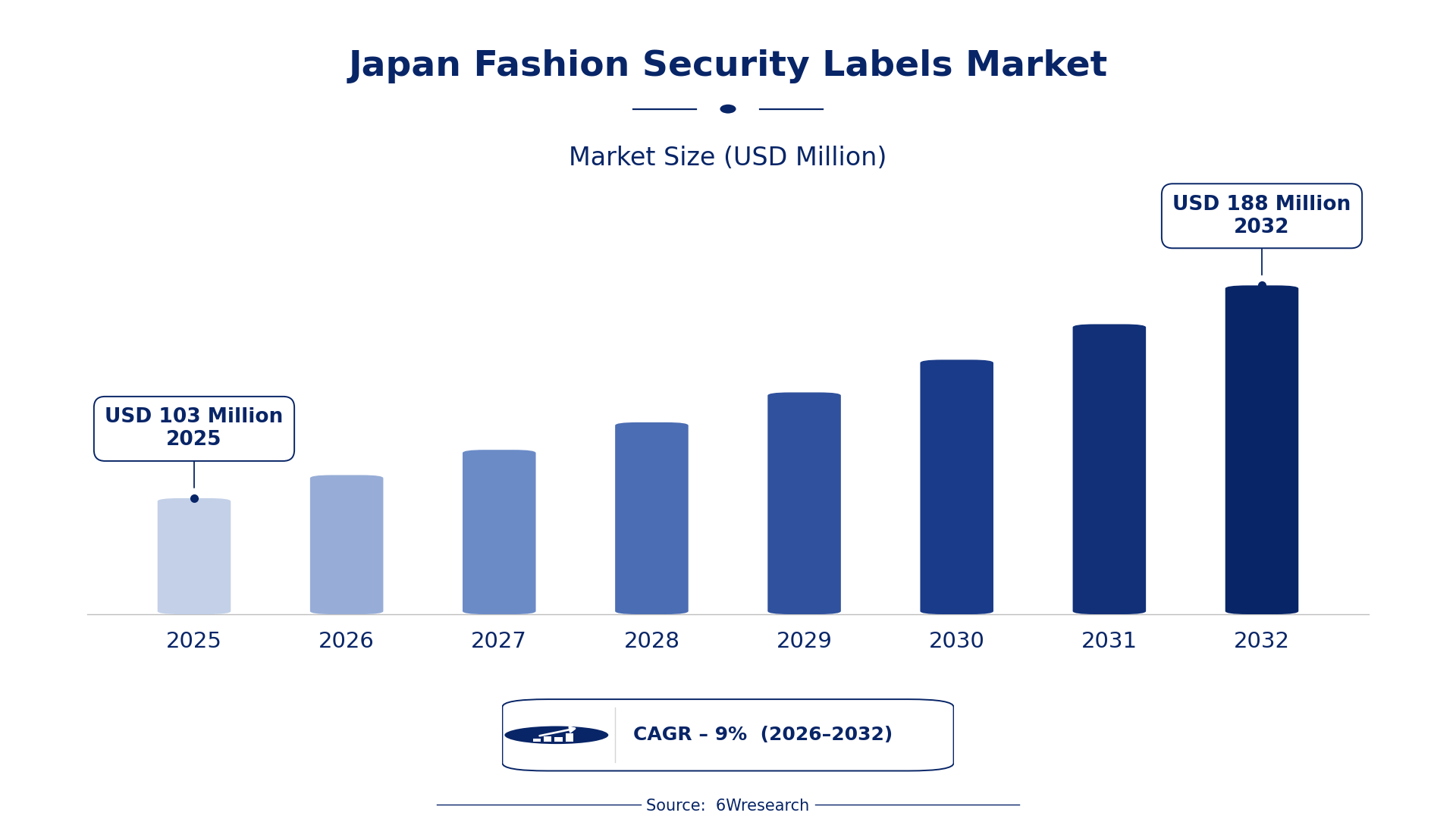
According to 6Wresearch internal database and industry insights, the Japan Fashion Security Labels Market was valued at USD 103 Million in 2025 and is projected to reach USD 188 Million by 2032, growing at a CAGR of approximately 9% during 2026–2032.
Japan Fashion Security Labels Market Highlights
| Report Metric | Details |
| Report Name | Japan Fashion Security Labels Market (2026-2032) |
| Market Size 2025 | USD 103 Million |
| Market Size 2032 | USD 188 Million |
| Absolute Growth 2025–2032 | USD 85 Million |
| CAGR 2026–2032 | 9% |
| Peak Annual Growth | 11.6% in 2032 |
| Forecast Period | 2026–2032 |
| Historical Data | 2022–2025 |
| Base Year | 2025 |
| Leading Label Type, 2025 | RFID Tags (36% share) |
| Leading Technology Used, 2025 | Radio Frequency (46% share) |
| Leading Distribution Channel, 2025 | OEM Suppliers (43% share) |
| Leading End User, 2025 | Retailers (48% share) |
| Fastest-Growing Label Type | QR Code Labels (12.5% CAGR) |
| Fastest-Growing Technology Used | Near-Field Comm. (13.0% CAGR) |
| Fastest-Growing Distribution Channel | Online Orders (11.7% CAGR) |
| Fastest-Growing End User | Anti-counterfeit Units (11.5% CAGR) |
| Growing Sector | retail industry |
| Key End Users | retailers, luxury brands, fashion brands, anti-counterfeit units |
Japan Fashion Security Labels Market Year-wise Growth Rate and Key Drivers (2022–2032)
This graph illustrates the annual growth rates of the market from 2022 to 2032, highlighting a steady upward trajectory and projected market expansion over the forecast period.
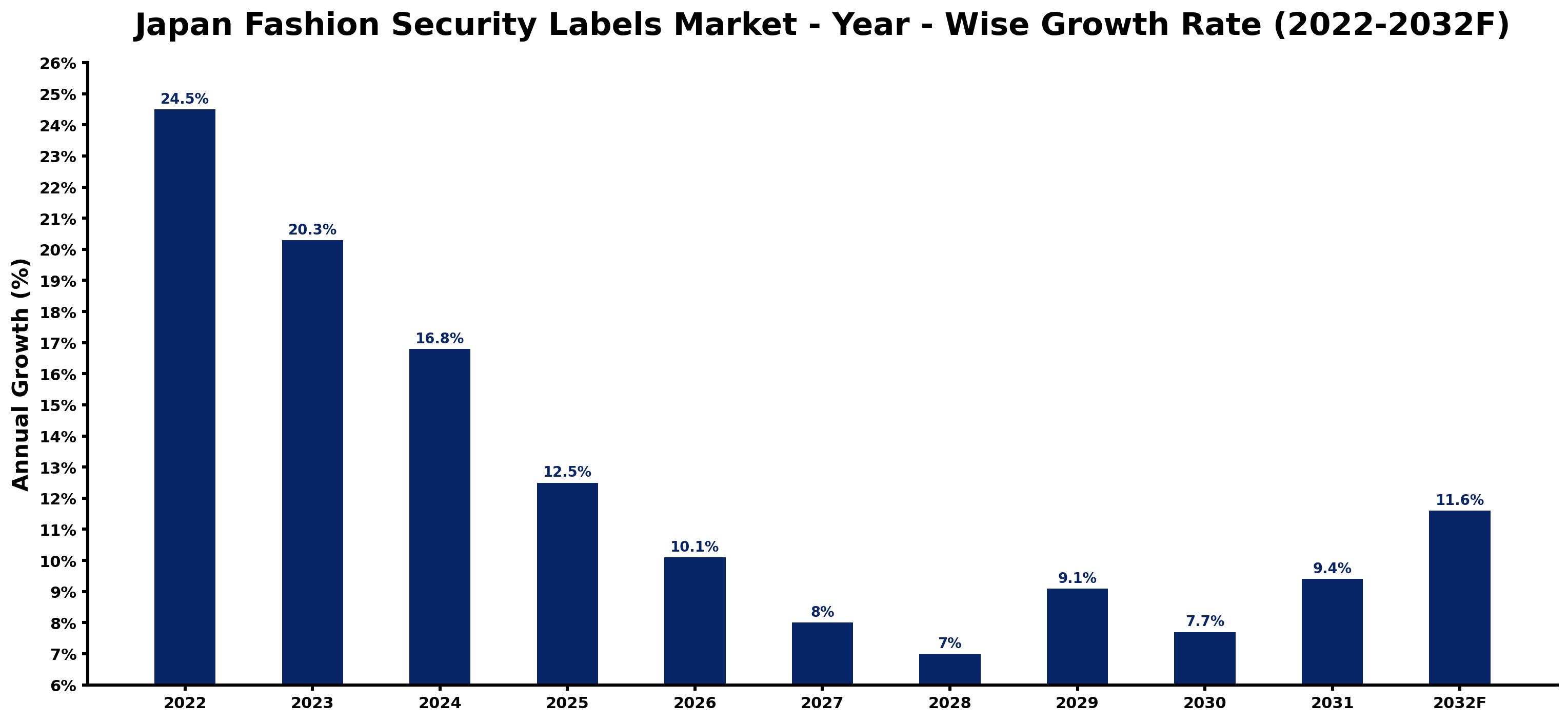
The yearly estimates that follow link every growth rate to its principal driver, so readers can see why the pace changed in each period.
| Year | Estimated Annual Growth (%) | Market Rationale |
| 2022 | 24.5 | The market experienced strong demand from retailers and luxury brands, leading to growth. |
| 2023 | 20.3 | Growth slowed as the market adjusted to previous high levels of demand and inventory management practices. |
| 2024 | 16.8 | The continued focus on anti-counterfeiting measures maintained interest in security labels, though growth decelerated. |
| 2025 | 12.5 | Demand remained steady, driven by the retail sector's ongoing need for effective theft prevention solutions. |
| 2026 | 10.1 | Market growth is expected to slow further as retailers focus on optimising existing security measures rather than new investments. |
| 2027 | 8.0 | The market is projected to continue growing, albeit at a slower pace, as businesses adapt to changing consumer behaviours. |
| 2028 | 7.0 | Growth is anticipated to stabilise as the adoption of technology in retail begins to plateau, impacting new purchases. |
| 2029 | 9.1 | An increase in digital engagement trends is expected to boost demand for QR code labels, leading to a recovery in growth. |
| 2030 | 7.7 | The market is projected to see a slight slowdown as retailers reassess their inventory strategies and label technologies. |
| 2031 | 9.4 | A resurgence in interest for innovative security solutions is expected to prompt a faster growth rate as brands seek differentiation. |
| 2032 | 11.6 | The peak growth year is driven by heightened consumer awareness regarding product authenticity and security. |
Note: Market size estimations and growth projections presented in this report are based on 6Wresearch's proprietary forecasting methodology, utilizing the latest available industry data, government publications, and primary research inputs.
Japan Fashion Security Labels Market Synopsis
Fashion security labels are essential tools in the retail industry, primarily used to prevent theft and counterfeiting. The Japan Fashion Security Labels Market is expected to grow, driven by the increasing adoption of RFID technology and the rising demand from domestic retailers and luxury brands. Valued at approximately 16 trillion yen, the fashion retail market in Japan is a key driver, along with initiatives like the Tokyo Fashion Week that highlight security's importance.
Market Dynamics Impact Analysis (2026–2032)
| Factor | Type | Impact | Primary Segment Affected |
| Growing adoption of RFID technology for inventory management | Driver | High | RFID Tags |
| Increasing consumer demand for product authenticity | Driver | High | Hologram Labels |
| Rising interest in digital engagement through QR codes | Opportunity | High | QR Code Labels |
| Expansion of online retail channels increasing label demand | Opportunity | Medium | Online Orders |
| Compliance costs associated with strict regulations on product authenticity | Restraint | High | RFID Tags |
| Market saturation in RFID technology limiting new investments | Restraint | Medium | RFID Tags |
| Consumer reluctance to adopt new technologies | Challenge | High | NFC Tags |
| Limited awareness of the benefits of security labels among smaller retailers | Challenge | Medium | Label Distributors |
Evaluation of Drivers in Japan Fashion Security Labels Market (2026–2032)
Key forces behind demand, with the segment each one moves most, are listed below.
| Drivers | Primary Segment Affected | Why It Matters (Evidence) |
| Increased investment in RFID technology by retailers | RFID Tags | Investment is projected to reach a 30% adoption rate by 2025, improving inventory tracking capabilities. |
| Growing consumer awareness about counterfeiting | Hologram Labels | As consumers demand authenticity, luxury brands are increasingly adopting hologram labels to protect their products. |
| Rising digital engagement trends | QR Code Labels | The demand for QR code labels has surged as brands seek to improve customer interaction and provide product information. |
| Expansion of e-commerce platforms | Online Orders | The shift towards online shopping has increased the need for security labels to prevent fraud. |
| Focus on brand reputation management | Luxury Retailers | Luxury retailers are investing in security measures to maintain their brand integrity and consumer trust. |
Purchasing is picking up as retailers invest heavily in RFID technology, with adoption projected to reach 30% by 2025. This shift improves inventory tracking and theft prevention, prompting luxury brands to adopt hologram labels to combat counterfeiting. The demand for QR code labels is rising due to increased digital engagement, enabling brands to provide product information effectively. E-commerce growth drives the need for security labels, as online platforms require effective anti-fraud measures. Luxury retailers focus on brand reputation, leading to heightened investments in security solutions.
Evaluation of Restraints in Japan Fashion Security Labels Market
The table below lists the restraints and the evidence behind each.
| Market Restraint | Primary Segment Affected | Why It Matters (Evidence) |
| Compliance costs associated with strict regulations on product authenticity | RFID Tags | Japan's regulations require rigorous testing and certification, which increases operational costs for producers. |
| Market saturation in RFID technology limiting new investments | RFID Tags | As the market matures, many retailers are hesitant to invest in new RFID systems, affecting growth. |
| Consumer reluctance to adopt new technologies | NFC Tags | Despite potential benefits, consumers remain cautious about using NFC for payments and authentication. |
| Limited awareness of the benefits of security labels among smaller retailers | Label Distributors | Smaller retailers often overlook the importance of security labels, impacting overall market demand. |
| High competition among label suppliers leading to price wars | OEM Suppliers | Intense competition can erode profit margins, making it challenging for suppliers to sustain growth. |
Japan Fashion Security Labels Market Challenges
Japan's saturated fashion security label market compels producers to compete fiercely on price, limiting their capacity to invest in advanced technologies. This scenario arises from the high number of market players, leading to profit margins often falling below 5%. A lack of skilled workers in the sector hinders the adoption of sophisticated security solutions, causing product development delays that can extend up to six months for producers. Rising raw material costs, particularly for holographic labels, can inflate production expenses by 15%, affecting pricing strategies for distributors. Buyers face heightened risks of counterfeit products, as stringent regulations impose penalties that can reach millions of yen for non-compliance, jeopardising brand integrity.
Trends in the Japan Fashion Security Labels Market
Below are the shifts with the largest effect on the Japan Fashion Security Labels Market.
- Shift towards Digital Engagement with QR Code Labels: The Tokyo Metropolitan Government's 2023 program encourages retailers to adopt QR code labels, improving customer interaction. This trend reflects the growing importance of digital engagement in the fashion sector.
- Increased Adoption of RFID Technology in Retail: Since 2022, retailers have increasingly adopted RFID technology, with a projected 30% adoption rate by 2025. This shift is essential for improving inventory management and theft prevention.
- Growing Importance of Hologram Labels in Luxury Goods: Hologram labels have gained traction in luxury retail since 2023, with a notable increase in usage to combat counterfeiting. This trend reflects the industry's focus on maintaining brand integrity.
- Expansion of Online Sales Channels for Security Labels: As e-commerce continues to grow, online orders for security labels have surged, with an 11.7% CAGR expected through 2032. This shift is vital for meeting the demands of digital retail.
Investment Opportunities in the Japan Fashion Security Labels Market
Where to invest in the Japan Fashion Security Labels Market: the main openings are set out below.
- Gap in RFID Technology Adoption: With only 30% of retailers adopting RFID by 2025, there is a notable opportunity for investment in this technology to improve inventory management and theft prevention.
- Growing Demand for QR Code Labels: The increasing trend of digital engagement presents a timely opportunity to supply QR code labels, which improve customer interaction and product information access.
- Need for Advanced Anti-Counterfeit Solutions: As counterfeiting remains a pressing issue, there is a strong need for advanced security labels, particularly hologram labels, to protect brand integrity.
- Expansion of E-commerce Platforms: The growth of online retail channels creates a demand for security labels, particularly for online orders, presenting an opportunity for suppliers to enter this market.
Government Initiatives in the Japan Fashion Security Labels Market
The Act against Unjustifiable Premiums and Misleading Representations, established in 1962, protects buyers by prohibiting misleading labelling and advertising of goods, ensuring that fashion security labels accurately represent product authenticity. This law compels producers to adhere to strict labelling standards, enhancing consumer confidence and reducing the risk of counterfeiting in the fashion industry. The Industrial Standardization Act, amended in 2019, governs the JIS product and test standards, requiring security labels to meet specific criteria, which helps maintain high-quality benchmarks in the market.
The Japan Fashion Association utilises the Digital Agency's initiatives to promote the adoption of security labels among retailers, ensuring compliance with JIS standards. The Tokyo Metropolitan Government's 2023 programme to enhance retail security supports local businesses in implementing effective anti-counterfeiting measures. This initiative aims to reduce counterfeit incidents by 20% over the next five years, benefiting both producers and consumers by fostering a safer shopping environment.
Future Insight of the Japan Fashion Security Labels Market
By 2032, the integration of RFID technology is projected to reach a 30% adoption rate among retailers, significantly improving inventory management and reducing theft risks for buyers. The Tokyo Metropolitan Government's initiative to bolster retail security will promote the implementation of advanced security measures. Suppliers will increasingly comply with the JIS standard, ensuring higher levels of product authenticity and reliability. The growing trend towards digital engagement will heighten the demand for NFC technology, enabling buyers to authenticate luxury goods with ease.
Market Segmentation Analysis
Japan Fashion Security Labels Market report covers a detailed analysis of the following market segments:
By Label Type – RFID Tags Lead, QR Code Labels Expected to Grow Fastest
According to Saurav Kr Singh, Senior Research Analyst at 6Wresearch, RFID Tags held 36% of the Japan Fashion Security Labels Market by label type in 2025. RFID Tags command the largest share as they are crucial for real-time inventory tracking and theft prevention, particularly for retailers in urban centres like Tokyo. This technology is essential for maintaining security standards in the competitive fashion retail market. The quickest growth will come from QR Code Labels, forecast to expand at a CAGR of 12.5% between 2026 and 2032. The rapid growth of QR Code Labels is fuelled by increasing digital engagement trends, allowing consumers to easily access product information. Retailers are increasingly integrating QR codes into their marketing strategies to enhance customer interaction and drive sales. Suppliers should focus on developing advanced QR code solutions to meet the rising demand for digital engagement in the retail sector.
By Technology Used – Radio Frequency Leads, Near-Field Comm. Expected to Grow Fastest
With 46% of technology used revenue in 2025, Radio Frequency was the largest category. Radio Frequency technology is vital for the functionality of RFID tags, which are widely adopted in Japan's fashion retail industry. Its significance is highlighted by the sector's emphasis on effective inventory management and theft prevention strategies. Over 2026–2032, Near-Field Comm. is expected to post the fastest growth, at a CAGR of 13.0%. Near-Field Communication is quickly gaining traction as it enhances mobile applications for product interaction, appealing to a tech-savvy consumer base. This growth reflects the broader trend of integrating technology into the shopping experience to improve customer satisfaction. Buyers should consider investing in NFC technology to improve customer engagement and streamline their shopping processes.
By Distribution Channel – OEM Suppliers Lead, Online Orders Expected to Grow Fastest
The largest distribution channel category in 2025 was OEM Suppliers, at 43% of revenue. OEM Suppliers lead the market by providing essential labels for various fashion brands, ensuring a consistent supply chain. Their established relationships with manufacturers make them integral to the distribution of security labels in the industry. Online Orders are projected to grow fastest, at a CAGR of 11.7% during 2026–2032. Online Orders are experiencing rapid growth due to their convenience and accessibility for retailers looking to purchase security labels. This trend aligns with the increasing shift towards e-commerce in the retail landscape. Suppliers must enhance their online presence to capture the growing demand for convenient purchasing options in the market.
By End User – Retailers Lead, Anti-counterfeit Units Expected to Grow Fastest
Retailers accounted for 48% of the market by end user in 2025. Retailers are the primary end-users of fashion security labels, relying on them to protect inventory and maintain brand reputation. With over 1 million individuals employed in the fashion sector, the demand from this group remains strong and consistent. Anti-counterfeit Units are set to record the highest CAGR in this split, 11.5% over 2026–2032. Anti-counterfeit Units are witnessing the fastest growth as they focus on preventing product fraud, driven by Japan's stringent regulations on product authenticity. This heightened awareness of counterfeiting issues is prompting more resources to be allocated to anti-counterfeit initiatives. Suppliers should tailor their offerings to meet the specific needs of anti-counterfeit units to capitalise on this expanding segment.
Key Attractiveness of the Report
- 10 Years of Market Numbers
- Historical Data Starting from 2022 to 2025
- Base Year 2025
- Forecast Data until 2032
- Key Performance Indicators Impacting the Market
- Major Upcoming Developments and Projects
Key Highlights of the Report:
- Japan Fashion Security Labels Market Outlook
- Market Size of Japan Fashion Security Labels Market, 2025
- Forecast of Japan Fashion Security Labels Market, 2032
- Historical Data and Forecast of Japan Fashion Security Labels Revenues & Volume for the Period 2022-2032F
- Japan Fashion Security Labels Market Trend Evolution
- Japan Fashion Security Labels Market Drivers and Challenges
- Japan Fashion Security Labels Price Trends
- Japan Fashion Security Labels Porter's Five Forces
- Japan Fashion Security Labels Industry Life Cycle
- Historical Data and Forecast of Japan Fashion Security Labels Market Revenues & Volume By Label Type for the Period 2022-2032F
- Historical Data and Forecast of Japan Fashion Security Labels Market Revenues & Volume By RFID Tags for the Period 2022-2032F
- Historical Data and Forecast of Japan Fashion Security Labels Market Revenues & Volume By QR Code Labels for the Period 2022-2032F
- Historical Data and Forecast of Japan Fashion Security Labels Market Revenues & Volume By NFC Tags for the Period 2022-2032F
- Historical Data and Forecast of Japan Fashion Security Labels Market Revenues & Volume By Hologram Labels for the Period 2022-2032F
- Historical Data and Forecast of Japan Fashion Security Labels Market Revenues & Volume By Technology Used for the Period 2022-2032F
- Historical Data and Forecast of Japan Fashion Security Labels Market Revenues & Volume By Radio Frequency for the Period 2022-2032F
- Historical Data and Forecast of Japan Fashion Security Labels Market Revenues & Volume By Barcoding for the Period 2022-2032F
- Historical Data and Forecast of Japan Fashion Security Labels Market Revenues & Volume By Near-Field Comm. for the Period 2022-2032F
- Historical Data and Forecast of Japan Fashion Security Labels Market Revenues & Volume By Visual Security for the Period 2022-2032F
- Historical Data and Forecast of Japan Fashion Security Labels Market Revenues & Volume By Distribution Channel for the Period 2022-2032F
- Historical Data and Forecast of Japan Fashion Security Labels Market Revenues & Volume By OEM Suppliers for the Period 2022-2032F
- Historical Data and Forecast of Japan Fashion Security Labels Market Revenues & Volume By Label Distributors for the Period 2022-2032F
- Historical Data and Forecast of Japan Fashion Security Labels Market Revenues & Volume By Online Orders for the Period 2022-2032F
- Historical Data and Forecast of Japan Fashion Security Labels Market Revenues & Volume By Direct Sales for the Period 2022-2032F
- Historical Data and Forecast of Japan Fashion Security Labels Market Revenues & Volume By End User for the Period 2022-2032F
- Historical Data and Forecast of Japan Fashion Security Labels Market Revenues & Volume By Retailers for the Period 2022-2032F
- Historical Data and Forecast of Japan Fashion Security Labels Market Revenues & Volume By Fashion Brands for the Period 2022-2032F
- Historical Data and Forecast of Japan Fashion Security Labels Market Revenues & Volume By Luxury Retailers for the Period 2022-2032F
- Historical Data and Forecast of Japan Fashion Security Labels Market Revenues & Volume By Anti-counterfeit Units for the Period 2022-2032F
- Japan Fashion Security Labels Import Export Trade Statistics
- Market Opportunity Assessment By Label Type
- Market Opportunity Assessment By Technology Used
- Market Opportunity Assessment By Distribution Channel
- Market Opportunity Assessment By End User
- Japan Fashion Security Labels Top Companies Market Share
- Japan Fashion Security Labels Competitive Benchmarking By Technical and Operational Parameters
- Japan Fashion Security Labels Company Profiles
- Japan Fashion Security Labels Key Strategic Recommendations
Market Covered
The study includes the following segmentation.
By Label Type
- RFID Tags
- QR Code Labels
- NFC Tags
- Hologram Labels
By Technology Used
- Radio Frequency
- Barcoding
- Near-Field Comm.
- Visual Security
By Distribution Channel
- OEM Suppliers
- Label Distributors
- Online Orders
- Direct Sales
By End User
- Retailers
- Fashion Brands
- Luxury Retailers
- Anti-counterfeit Units































