Japan Fashion Supply Chain Market Size & Growth Rate
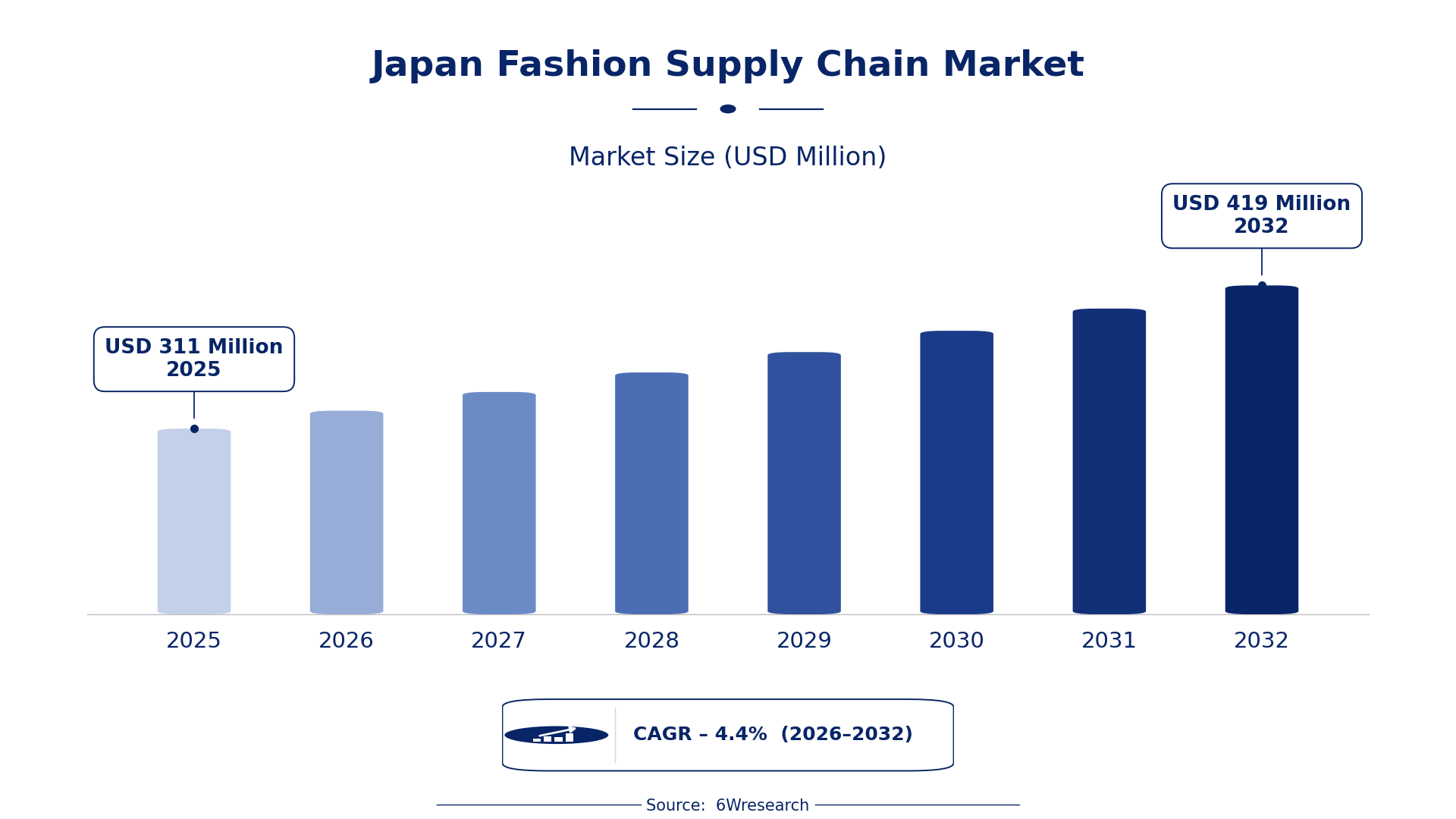
According to 6Wresearch internal database and industry insights, the Japan Fashion Supply Chain Market was valued at USD 311 Million in 2025 and is projected to reach USD 419 Million by 2032, growing at a CAGR of approximately 4.4% during 2026–2032.
Japan Fashion Supply Chain Market Highlights
| Report Metric | Details |
| Report Name | Japan Fashion Supply Chain Market (2026-2032) |
| Market Size 2025 | USD 311 Million |
| Market Size 2032 | USD 419 Million |
| Absolute Growth 2025–2032 | USD 108 Million |
| CAGR 2026–2032 | 4.4% |
| Peak Annual Growth | 5.7% in 2028 |
| Forecast Period | 2026–2032 |
| Historical Data | 2022–2025 |
| Base Year | 2025 |
| Leading Chain Type, 2025 | Raw Material Supply (43% share) |
| Leading Tier Level, 2025 | Tier 1 (44% share) |
| Leading Distribution Channel, 2025 | Textile Sourcing (53% share) |
| Leading End User, 2025 | Clothing Makers (40% share) |
| Fastest-Growing Chain Type | Apparel Manufacturing (6.2% CAGR) |
| Fastest-Growing Tier Level | Tier 2 (5.8% CAGR) |
| Fastest-Growing Distribution Channel | OEMs (5.9% CAGR) |
| Fastest-Growing End User | Private Labels (5.7% CAGR) |
| Growing Sector | Private Labels |
| Key End Users | Clothing Makers, Private Labels, Brand Warehouses, Consumers |
Japan Fashion Supply Chain Market Year-wise Growth Rate and Key Drivers (2022–2032)
This graph illustrates the annual growth rates of the market from 2022 to 2032, highlighting a steady upward trajectory and projected market expansion over the forecast period.
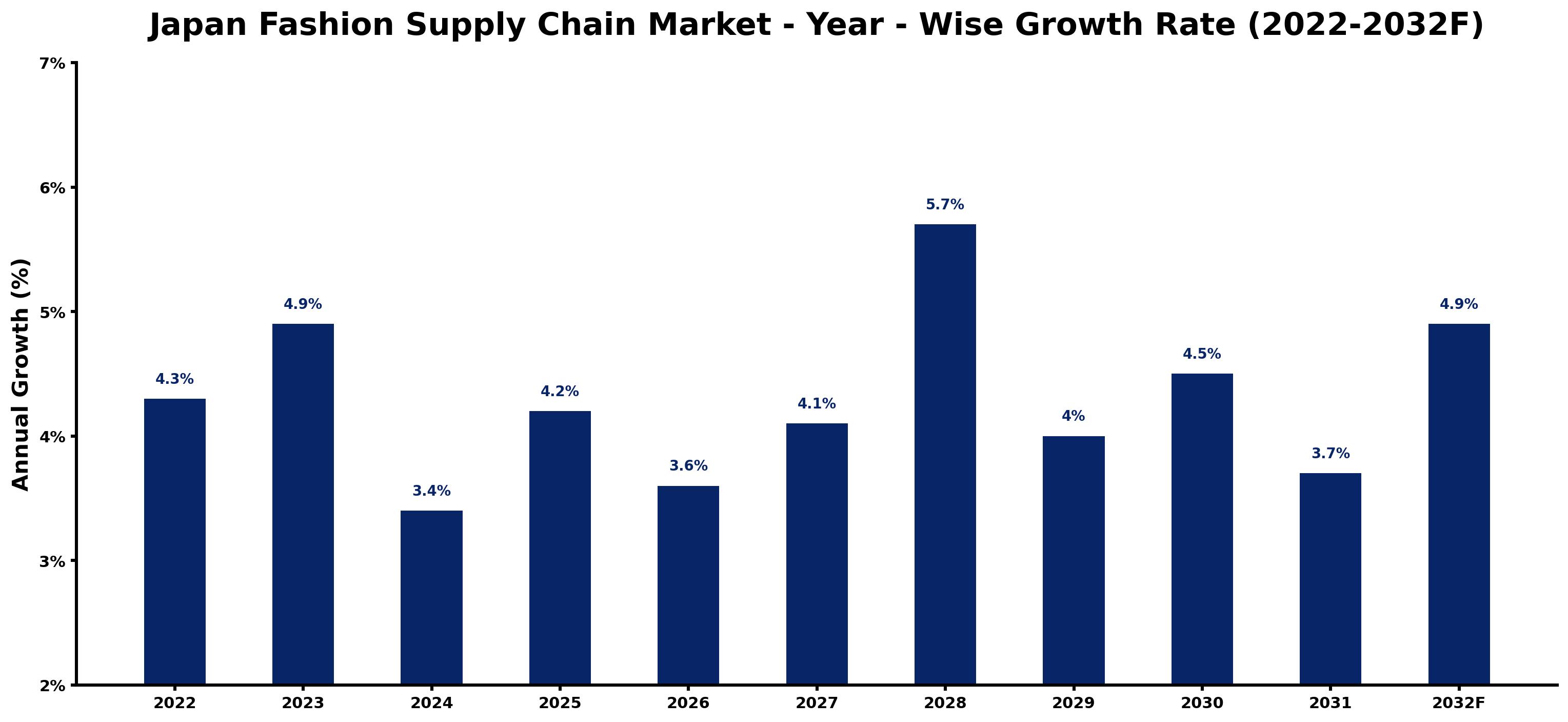
Year by year, the estimates below pair each growth rate with the development that shaped it.
| Year | Estimated Annual Growth (%) | Market Rationale |
| 2022 | 4.3 | The market experienced steady activity, driven by ongoing demand from domestic clothing makers. |
| 2023 | 4.9 | Growth accelerated as consumer interest in fashion increased, boosting retail sales. |
| 2024 | 3.4 | A slowdown occurred as global supply chain disruptions affected material availability and production timelines. |
| 2025 | 4.2 | Demand rebounded, supported by the recovery of the apparel manufacturing sector and rising consumer spending. |
| 2026 | 3.6 | Growth is expected to slow slightly due to stabilising market conditions and increased competition among suppliers. |
| 2027 | 4.1 | The market will see renewed interest as investments in sustainable practices gain traction among manufacturers. |
| 2028 | 5.7 | A peak in growth is projected, driven by heightened consumer demand for new fashion products. |
| 2029 | 4.0 | Growth is expected to decelerate as market saturation begins to impact new product introductions and consumer choices. |
| 2030 | 4.5 | An uptick in growth is projected, supported by advancements in technology and logistics within the supply chain. |
| 2031 | 3.7 | The market will experience a slowdown as consumer preferences shift towards more sustainable and ethical fashion options. |
| 2032 | 4.9 | Growth is expected to rebound as innovations in textile recycling and sustainability initiatives gain momentum. |
Note: Market size estimations and growth projections presented in this report are based on 6Wresearch's proprietary forecasting methodology, utilizing the latest available industry data, government publications, and primary research inputs.
Japan Fashion Supply Chain Market Synopsis
The Fashion Supply Chain encompasses the entire process from raw material sourcing to retail fulfillment, involving textile production, apparel manufacturing, and distribution. The Japan Fashion Supply Chain Market is growing due to rising consumer spending, with the clothing market valued at approximately 10 trillion yen in 2022. Growth is further driven by the rise of private labels, which account for over 30% of retail clothing, and government initiatives promoting sustainable practices, such as textile recycling efforts launched in 2023.
Market Dynamics Impact Analysis (2026–2032)
| Factor | Type | Impact | Primary Segment Affected |
| Rising consumer spending on fashion products | Driver | High | Clothing Makers |
| Increased investment in sustainable practices | Driver | High | Apparel Manufacturing |
| Growing demand for eco-friendly products | Opportunity | High | Private Labels |
| Expansion of online retail channels | Opportunity | High | Online Retail |
| Supply chain disruptions affecting material availability | Restraint | High | Raw Material Supply |
| Increased competition among suppliers | Restraint | Medium | Distribution Centers |
| High operational costs for manufacturers | Challenge | High | Apparel Manufacturing |
| Technological adoption lagging behind global standards | Challenge | Medium | Textile Sourcing |
Evaluation of Drivers in Japan Fashion Supply Chain Market (2026–2032)
The main growth drivers and the segments they affect most are set out below.
| Drivers | Primary Segment Affected | Why It Matters (Evidence) |
| Increased consumer spending on fashion products | Clothing Makers | In 2022, Japan's clothing market was valued at approximately 10 trillion yen, prompting higher purchases from clothing makers. |
| Investment in sustainable practices | Apparel Manufacturing | Sustainable fashion initiatives are encouraging manufacturers to adopt eco-friendly production methods, improving supply chain efficiency. |
| Growth of online retail channels | Online Retail | Online retail sales in fashion reached 2 trillion yen in 2022, driving demand for efficient supply chain solutions. |
| Rise of private labels | Private Labels | Private label products accounted for over 30% of the retail clothing market, increasing competition and demand for efficient supply chains. |
| Technological advancements in logistics | Distribution Centers | Innovation in textile technology is improving logistics efficiency and inventory management, benefiting distribution centers. |
Several shifts outside the market lift sales. Rising consumer spending on fashion products, with the clothing market valued at approximately 10 trillion yen in 2022, drives higher purchases from clothing makers. Investment in sustainable practices is increasing as manufacturers adopt eco-friendly methods, aligning with consumer preferences. The rise of private labels, accounting for over 30% of the retail market, necessitates efficient supply chains. Technological advancements in logistics are improving efficiency in distribution centers, supporting overall market growth. Online retail channels are expanding, with sales reaching 2 trillion yen in 2022, prompting demand for effective supply chain solutions.
Evaluation of Restraints in Japan Fashion Supply Chain Market
These are the pressures that could keep growth below its potential.
| Market Restraint | Primary Segment Affected | Why It Matters (Evidence) |
| Intense competition from low-cost manufacturers abroad | Apparel Manufacturing | This competition leads to reduced profit margins, which can shrink by up to 15% for local brands. |
| Supply chain disruptions due to reliance on imported materials | Raw Material Supply | These disruptions can cause delays in production timelines that extend lead times by over three weeks for manufacturers. |
| Skills shortages in textile technology | Apparel Manufacturing | These shortages hinder innovation, resulting in a 20% decrease in efficiency for producers trying to adopt new processes. |
| Rising prices due to increased domestic production costs | Clothing Makers | Retail prices may rise by 10% in response to these pressures, affecting consumer purchasing. |
| Limited access to advanced technology | Distribution Centers | This limitation can slow down the implementation of efficient logistics solutions, impacting overall supply chain performance. |
Japan Fashion Supply Chain Market Challenges
Increased production costs for local producers arise from competition with low-cost international manufacturers, which can shrink profit margins by 15% for domestic brands. Supply chain disruptions occur due to reliance on imported materials, leading to production delays that extend lead times by three weeks for manufacturers. A shortage of skilled workers in textile technology hampers innovation, resulting in a 20% drop in efficiency for producers attempting to implement new processes. Buyers experience rising retail prices as domestic production costs increase, with potential price hikes reaching 10% due to these pressures.
Trends in the Japan Fashion Supply Chain Market
Several trends are reshaping the Japan Fashion Supply Chain Market; the most important are set out below.
- Shift towards Sustainable Fashion Practices: The government launched a programme in 2023 to improve textile recycling efforts, promoting sustainability within the industry. This shift attracts environmentally conscious consumers, driving demand for eco-friendly products.
- Growth of Online Retail Channels: Online retail sales in fashion reached 2 trillion yen in 2022, reflecting a notable shift towards digital shopping. This trend reshapes how consumers access fashion, prompting suppliers to adapt their strategies accordingly.
- Increased Focus on Private Labels: Private labels are gaining traction, accounting for over 30% of the retail clothing market. This trend indicates a shift in consumer preferences towards affordable yet stylish options, significantly influencing supply chain dynamics.
- Technological Advancements in Textile Production: The Japan Textile Federation advocates for innovation in textile technology, improving production efficiency. This trend streamlines operations, benefiting manufacturers and consumers alike.
Investment Opportunities in the Japan Fashion Supply Chain Market
The following opportunities in the Japan Fashion Supply Chain Market pair current demand with a clear way in.
- Clothing Makers Seeking Sustainable Solutions: Clothing makers are increasingly looking for sustainable materials, with the market for eco-friendly textiles projected to grow. Collaborating with local suppliers can effectively meet this demand and improve supply chain sustainability.
- Expansion of Distribution Centers: The Tokyo region is a major hub for apparel manufacturing and distribution, presenting opportunities for new distribution centres. Investing in logistics infrastructure can significantly improve supply chain efficiency.
- Rising Demand for Online Retail Solutions: With online retail sales projected to reach 3 trillion yen, there is a growing need for efficient supply chain solutions. Suppliers can enter this market by partnering with e-commerce platforms to broaden their reach.
- Investment in Textile Recycling Initiatives: The government's textile recycling programme offers opportunities for investment in sustainable practices. Engaging with local manufacturers can facilitate compliance and drive innovation in recycling technologies.
Government Initiatives in the Japan Fashion Supply Chain Market
The Economic Security Promotion Act (2022) supports supply-chain resilience for critical products, ensuring that producers can maintain stable operations. This measure encourages manufacturers to invest in local sourcing and sustainable practices, improving overall supply chain efficiency and stability. The act aims to strengthen domestic production capabilities, ultimately benefiting local economies and job creation.
The Ministry of Economy, Trade and Industry oversees the implementation of the PRTR Law, which requires businesses to report chemical substance releases. This regulation helps buyers ensure compliance and promotes transparency in the supply chain, building trust between manufacturers and consumers while encouraging sustainable practices.
Future Insight of the Japan Fashion Supply Chain Market
The government's textile recycling programme will support sustainability initiatives, enabling suppliers to meet the demand for eco-friendly products. By 2032, advancements in textile technology will improve production efficiency for manufacturers. The adoption of ISO 14001 standards will attract buyers focused on sustainable sourcing. With online retail sales in fashion reaching 2 trillion yen in 2022, suppliers will need to adapt to digital platforms to engage with buyers effectively.
Market Segmentation Analysis
Japan Fashion Supply Chain Market report covers a detailed analysis of the following market segments:
By Chain Type – Raw Material Supply Leads, Apparel Manufacturing Expected to Grow Fastest
According to Saurav Kr Singh, Senior Research Analyst at 6Wresearch, Raw Material Supply took 43% of chain type revenue in 2025, more than any other category. Raw Material Supply holds the largest share due to its critical function in production processes, with a strong reliance on both local and imported materials. The employment of approximately 200,000 individuals in Japan's textile industry highlights the foundational importance of this segment. The quickest growth will come from Apparel Manufacturing, forecast to expand at a CAGR of 6.2% between 2026 and 2032. Apparel Manufacturing is experiencing rapid growth as domestic clothing makers increasingly focus on local production to meet consumer preferences. The substantial valuation of Japan's clothing market at approximately 10 trillion yen underscores the rising significance of this sector. Suppliers should prioritise partnerships with raw material providers to secure a competitive edge.
By Tier Level – Tier 1 Leads, Tier 2 Expected to Grow Fastest
The largest tier level category in 2025 was Tier 1, at 44% of revenue. Tier 1 maintains the largest share as primary suppliers to manufacturers, ensuring the quality and availability of essential materials. Their established relationships with major clothing makers in Japan reinforce their dominant position within the supply chain. Over 2026–2032, Tier 2 is expected to post the fastest growth, at a CAGR of 5.8%. Tier 2 is witnessing rapid growth as secondary suppliers increasingly support Tier 1 with innovative solutions and materials. This growth is driven by rising demand for sustainable practices, as reflected in government initiatives promoting textile recycling. Buyers should consider diversifying their supplier base to include Tier 2 for enhanced flexibility and innovation.
By Distribution Channel – Textile Sourcing Leads, OEMs Expected to Grow Fastest
With 53% of distribution channel revenue in 2025, Textile Sourcing was the largest category. Textile Sourcing leads the market as it is fundamental for obtaining necessary fabrics, which are crucial for the entire supply chain. The ongoing support from the Japan Textile Federation for innovation further solidifies this segment's prominence. OEMs are set to record the highest CAGR in this split, 5.9% over 2026–2032. OEMs are experiencing rapid growth as they adapt to changing market demands and streamline manufacturing processes. The surge in retail sales, reaching 2 trillion yen in 2022, highlights the need for efficient manufacturing partnerships. Suppliers must enhance their sourcing strategies to align with the evolving demands of OEMs.
By End User – Clothing Makers Lead, Private Labels Expected to Grow Fastest
Clothing Makers accounted for 40% of the market by end user in 2025. Clothing Makers dominate as the main end users of the supply chain, directly influencing production trends and market dynamics. Their significant presence in the Tokyo region, a hub for apparel manufacturing, exemplifies their leading role in the industry. Private Labels are projected to grow fastest, at a CAGR of 5.7% during 2026–2032. Private Labels are growing quickly, driven by consumer preference for affordable yet fashionable options. Their increasing market share, accounting for over 30% of the retail clothing market, highlights their competitive advantage. Suppliers should focus on developing relationships with private labels to tap into this growing segment.
Key Attractiveness of the Report
- 10 Years of Market Numbers
- Historical Data Starting from 2022 to 2025
- Base Year 2025
- Forecast Data until 2032
- Key Performance Indicators Impacting the Market
- Major Upcoming Developments and Projects
Key Highlights of the Report:
- Japan Fashion Supply Chain Market Outlook
- Market Size of Japan Fashion Supply Chain Market, 2025
- Forecast of Japan Fashion Supply Chain Market, 2032
- Historical Data and Forecast of Japan Fashion Supply Chain Revenues & Volume for the Period 2022-2032F
- Japan Fashion Supply Chain Market Trend Evolution
- Japan Fashion Supply Chain Market Drivers and Challenges
- Japan Fashion Supply Chain Price Trends
- Japan Fashion Supply Chain Porter's Five Forces
- Japan Fashion Supply Chain Industry Life Cycle
- Historical Data and Forecast of Japan Fashion Supply Chain Market Revenues & Volume By Chain Type for the Period 2022-2032F
- Historical Data and Forecast of Japan Fashion Supply Chain Market Revenues & Volume By Raw Material Supply for the Period 2022-2032F
- Historical Data and Forecast of Japan Fashion Supply Chain Market Revenues & Volume By Apparel Manufacturing for the Period 2022-2032F
- Historical Data and Forecast of Japan Fashion Supply Chain Market Revenues & Volume By Distribution Centers for the Period 2022-2032F
- Historical Data and Forecast of Japan Fashion Supply Chain Market Revenues & Volume By Retail Fulfillment for the Period 2022-2032F
- Historical Data and Forecast of Japan Fashion Supply Chain Market Revenues & Volume By Tier Level for the Period 2022-2032F
- Historical Data and Forecast of Japan Fashion Supply Chain Market Revenues & Volume By Tier 1 for the Period 2022-2032F
- Historical Data and Forecast of Japan Fashion Supply Chain Market Revenues & Volume By Tier 2 for the Period 2022-2032F
- Historical Data and Forecast of Japan Fashion Supply Chain Market Revenues & Volume By Tier 3 for the Period 2022-2032F
- Historical Data and Forecast of Japan Fashion Supply Chain Market Revenues & Volume By Tier 4 for the Period 2022-2032F
- Historical Data and Forecast of Japan Fashion Supply Chain Market Revenues & Volume By Distribution Channel for the Period 2022-2032F
- Historical Data and Forecast of Japan Fashion Supply Chain Market Revenues & Volume By Textile Sourcing for the Period 2022-2032F
- Historical Data and Forecast of Japan Fashion Supply Chain Market Revenues & Volume By OEMs for the Period 2022-2032F
- Historical Data and Forecast of Japan Fashion Supply Chain Market Revenues & Volume By B2B Logistics for the Period 2022-2032F
- Historical Data and Forecast of Japan Fashion Supply Chain Market Revenues & Volume By Online Retail for the Period 2022-2032F
- Historical Data and Forecast of Japan Fashion Supply Chain Market Revenues & Volume By End User for the Period 2022-2032F
- Historical Data and Forecast of Japan Fashion Supply Chain Market Revenues & Volume By Clothing Makers for the Period 2022-2032F
- Historical Data and Forecast of Japan Fashion Supply Chain Market Revenues & Volume By Private Labels for the Period 2022-2032F
- Historical Data and Forecast of Japan Fashion Supply Chain Market Revenues & Volume By Brand Warehouses for the Period 2022-2032F
- Historical Data and Forecast of Japan Fashion Supply Chain Market Revenues & Volume By Consumers for the Period 2022-2032F
- Japan Fashion Supply Chain Import Export Trade Statistics
- Market Opportunity Assessment By Chain Type
- Market Opportunity Assessment By Tier Level
- Market Opportunity Assessment By Distribution Channel
- Market Opportunity Assessment By End User
- Japan Fashion Supply Chain Top Companies Market Share
- Japan Fashion Supply Chain Competitive Benchmarking By Technical and Operational Parameters
- Japan Fashion Supply Chain Company Profiles
- Japan Fashion Supply Chain Key Strategic Recommendations
Market Covered
The following segment groups are covered in the report.
By Chain Type
- Raw Material Supply
- Apparel Manufacturing
- Distribution Centers
- Retail Fulfillment
By Tier Level
- Tier 1
- Tier 2
- Tier 3
- Tier 4
By Distribution Channel
- Textile Sourcing
- OEMs
- B2B Logistics
- Online Retail
By End User
- Clothing Makers
- Private Labels
- Brand Warehouses
- Consumers































