Japan Fashion Tech Market Size & Growth Rate
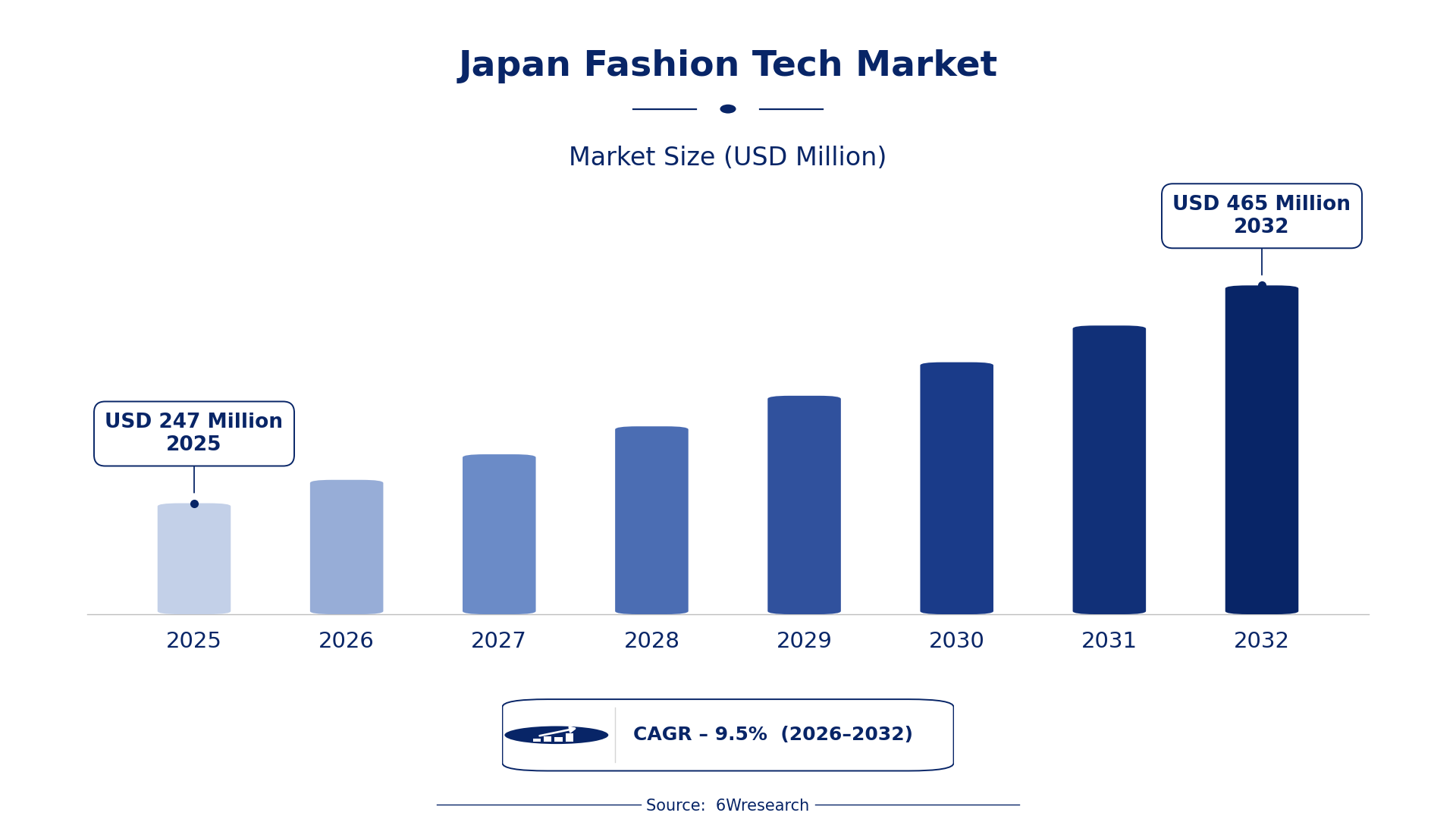
According to 6Wresearch internal database and industry insights, the Japan Fashion Tech Market was valued at USD 247 Million in 2025 and is projected to reach USD 465 Million by 2032, growing at a CAGR of approximately 9.5% during 2026–2032.
Japan Fashion Tech Market Highlights
| Report Metric | Details |
| Report Name | Japan Fashion Tech Market (2026-2032) |
| Market Size 2025 | USD 247 Million |
| Market Size 2032 | USD 465 Million |
| Absolute Growth 2025–2032 | USD 218 Million |
| CAGR 2026–2032 | 9.5% |
| Peak Annual Growth | 12.8% in 2026 |
| Forecast Period | 2026–2032 |
| Historical Data | 2022–2025 |
| Base Year | 2025 |
| Leading Tech Type, 2025 | Smart Textiles (43% share) |
| Leading Functionality, 2025 | Virtual Fitting (48% share) |
| Leading Distribution Channel, 2025 | Mobile Apps (36% share) |
| Leading End User, 2025 | Online Shoppers (40% share) |
| Fastest-Growing Tech Type | AR Try-On Tools (13.9% CAGR) |
| Fastest-Growing Functionality | Trend Forecasting (12.6% CAGR) |
| Fastest-Growing End User | Designers (12.1% CAGR) |
| Growing Sector | Fashion Tech |
| Key End Users | Online Shoppers, Designers, Fashion Engineers, Fitness Consumers |
Japan Fashion Tech Market Year-wise Growth Rate and Key Drivers (2022–2032)
This graph illustrates the annual growth rates of the market from 2022 to 2032, highlighting a steady upward trajectory and projected market expansion over the forecast period.
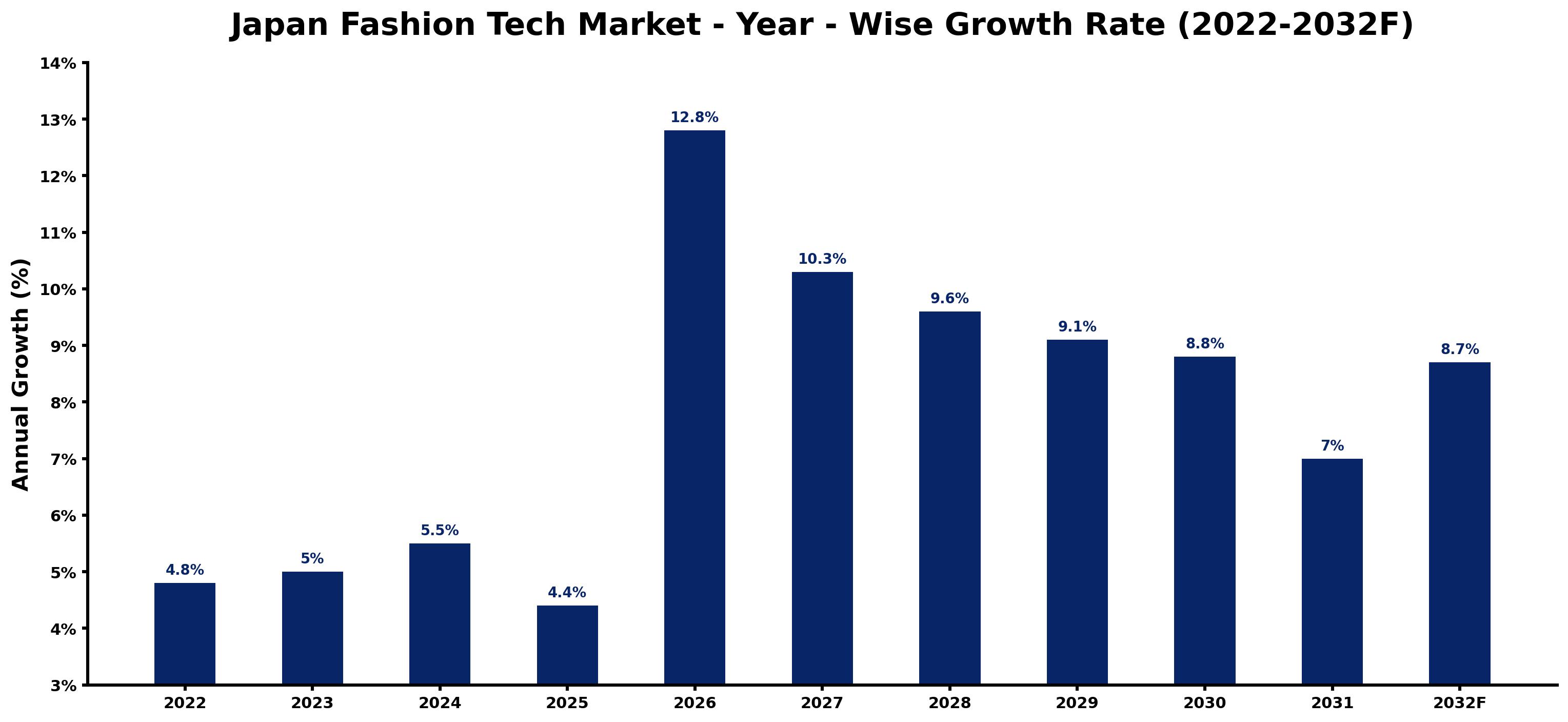
Below, each year's estimated growth is shown next to the factor that most influenced it.
| Year | Estimated Annual Growth (%) | Market Rationale |
| 2022 | 4.8 | The market was characterised by steady consumer interest in fashion solutions. |
| 2023 | 5.0 | Growth accelerated as more consumers embraced technology-enhanced shopping experiences. |
| 2024 | 5.5 | Increased adoption of AR tools further boosted market activity and engagement. |
| 2025 | 4.4 | Growth slowed as the market adjusted to saturation in certain tech areas. |
| 2026 | 12.8 | The introduction of new sustainable technologies sparked a surge in demand. |
| 2027 | 10.3 | Market expansion continued, driven by rising investments in fashion tech startups. |
| 2028 | 9.6 | Growth moderated as the market matured and competition intensified. |
| 2029 | 9.1 | Demand remained strong, supported by ongoing consumer interest in tech integration. |
| 2030 | 8.8 | The market experienced a slowdown as growth stabilised amid evolving trends. |
| 2031 | 7.0 | Growth decelerated as the market reached a more mature phase. |
| 2032 | 8.7 | A renewed focus on sustainability and innovation is expected to drive growth. |
Note: Market size estimations and growth projections presented in this report are based on 6Wresearch's proprietary forecasting methodology, utilizing the latest available industry data, government publications, and primary research inputs.
Japan Fashion Tech Market Synopsis
Fashion Tech encompasses technologies applied in the fashion industry, including smart textiles, augmented reality, and AI-driven design tools. The Japan Fashion Tech Market is expanding due to increased investments in startups, with Tokyo emerging as a hub for innovation. In 2023, the number of online shoppers reached 80 million, while AR technology adoption in retail has increased by 30% since 2022, driving demand for enhanced consumer experiences and personalised fashion solutions.
Market Dynamics Impact Analysis (2026–2032)
| Factor | Type | Impact | Primary Segment Affected |
| Growing consumer interest in sustainable fashion solutions | Driver | High | Smart Textiles |
| Increased investment in fashion tech startups | Driver | High | AR Try-On Tools |
| Rising demand for personalized shopping experiences | Opportunity | High | Virtual Fitting |
| Expansion of online shopping platforms | Opportunity | High | Mobile Apps |
| Challenges in integrating new technologies across the industry | Restraint | Medium | Fashion AI Software |
| Limited awareness of smart textiles among consumers | Restraint | Medium | Smart Textiles |
| High competition among fashion tech startups | Challenge | High | Digital Fabrication |
| Rapid technological advancements may outpace market adaptation | Challenge | High | AR Try-On Tools |
Evaluation of Drivers in Japan Fashion Tech Market (2026–2032)
The following drivers explain most of the expected growth.
| Drivers | Primary Segment Affected | Why It Matters (Evidence) |
| Increased consumer spending on tech-integrated fashion | Smart Textiles | The Japanese fashion industry employs over 500,000 individuals, driving demand for new materials. |
| Growing popularity of online shopping platforms | AR Try-On Tools | The number of online shoppers in Japan reached 80 million in 2023, increasing the need for AR solutions. |
| Rising focus on sustainability in fashion | Fashion AI Software | Fashion AI software is increasingly used in over 70% of design firms in Japan, optimising sustainable practices. |
| Technological advancements in textile engineering | Digital Fabrication | Digital fabrication technologies are being adopted by 40% of fashion brands in Japan, enabling rapid prototyping. |
| Consumer demand for personalised experiences | Virtual Fitting | AR technology adoption in retail has increased by 30% since 2022, improving online shopping satisfaction. |
What keeps demand rising is the increasing consumer spending on tech-integrated fashion, with the Japanese fashion industry employing over 500,000 individuals. The number of online shoppers reached 80 million in 2023, driving the popularity of AR Try-On Tools. Fashion AI software is now used in over 70% of design firms, optimising processes for sustainability. Digital fabrication technologies are adopted by 40% of fashion brands, enabling rapid prototyping. The rising demand for personalised experiences is clear as AR technology adoption in retail increased by 30% since 2022, improving customer satisfaction.
Evaluation of Restraints in Japan Fashion Tech Market
Below are the constraints most often cited by buyers and suppliers, with the segment each affects.
| Market Restraint | Primary Segment Affected | Why It Matters (Evidence) |
| Integration of new technologies remains challenging for many brands | Fashion AI Software | Only 40% of fashion brands have adopted digital fabrication technologies, limiting innovation. |
| Consumer awareness of smart textiles is still low | Smart Textiles | Despite the potential, many consumers are unaware of smart textiles' benefits, hindering demand. |
| High competition among fashion tech startups creates market pressure | Digital Fabrication | With over 300 fashion tech companies, differentiation becomes vital for survival. |
| Rapid technological advancements may lead to obsolescence | AR Try-On Tools | The fast pace of tech evolution can outstrip the ability of brands to adapt. |
| Limited funding for small startups impacts growth potential | Virtual Fitting | Many startups struggle to secure investment, affecting their ability to innovate. |
Japan Fashion Tech Market Challenges
Buyers in the fashion tech market face rising costs due to the increasing price of eco-friendly materials, inflating production expenses by up to 20%. Regulatory hurdles arise from the slow development of JIS standards for smart textiles, delaying product launches and increasing compliance costs for producers. Limited access to innovative products affects buyers as AR technology adoption in retail has only increased by 30% since 2022, restricting their shopping experiences. Suppliers struggle with sourcing sustainable materials, causing disruptions that can delay deliveries for fashion brands, impacting their ability to meet consumer demand.
Trends in the Japan Fashion Tech Market
Four trends stand out in the Japan Fashion Tech Market.
- Shift towards Sustainable Fashion Technologies: The Japanese fashion industry is increasingly prioritising sustainable practices, as evidenced by the Tokyo Fashion Tech Week showcasing over 100 innovations in 2023, reflecting a growing commitment to eco-friendly solutions.
- Rise of Augmented Reality in Retail: Tokyo is becoming a leader in AR technology adoption, with a 30% increase since 2022, improving the shopping experience and driving consumer engagement in the fashion sector.
- Expansion of Mobile Applications for Fashion Tech: Mobile Apps are now the leading distribution channel, holding a 36% share in 2025, as they integrate fashion tech into consumers' daily lives, making shopping more accessible.
- Emergence of AI-Driven Design Tools: Fashion AI Software is increasingly used in over 70% of design firms, optimising design processes and enabling brands to align better with market demands.
Investment Opportunities in the Japan Fashion Tech Market
The following areas offer the clearest openings for investors and suppliers in the Japan Fashion Tech Market.
- Growing Market for Smart Textiles: With the Japanese textile industry focusing on eco-friendly materials, there is a gap for smart textiles, projected to grow by 25% by 2025, particularly among fitness consumers.
- Investment in AR Try-On Tools: The rising number of online shoppers, reaching 80 million in 2023, presents an opportunity for AR technology development, particularly in urban areas like Tokyo.
- Expansion of Digital Fabrication Technologies: As 40% of fashion brands adopt digital fabrication, there is a need for suppliers to provide solutions, particularly in metropolitan regions with high fashion activity.
- Demand for Fashion AI Software: With over 70% of design firms using AI, there is a growing opportunity for software developers to create tailored solutions for designers, especially in major fashion hubs.
Government Initiatives in the Japan Fashion Tech Market
The Semiconductor and Digital Industry Strategy, implemented by the Ministry of Economy, Trade and Industry in June 2021, aims to secure domestic semiconductor manufacturing, which is essential for supporting fashion tech innovations. Additionally, the Economic Security Promotion Act of 2022 strengthens supply-chain resilience for critical products, benefiting fashion tech producers.
In 2022, the Tokyo Metropolitan Government invested 1 billion yen in fashion tech startups, administered by the Tokyo Fashion Tech Lab, which supports collaboration between tech and fashion industries. This funding aims to encourage innovation and growth in the fashion tech sector.
Future Insight of the Japan Fashion Tech Market
Shifts in consumer behaviour will reshape the market by 2032 as the number of online shoppers in Japan is projected to reach 100 million. The government programme promoting sustainable fashion technologies will encourage investment in eco-friendly practices throughout the sector. Adoption of ISO standards for wearable technology will streamline production processes, benefiting suppliers. Increased collaboration through initiatives like the Tokyo Fashion Tech Lab will enable the development of solutions that meet the evolving preferences of consumers for tech-integrated fashion.
Market Segmentation Analysis
Japan Fashion Tech Market report covers a detailed analysis of the following market segments:
By Tech Type – Smart Textiles Lead, AR Try-On Tools Expected to Grow Fastest
According to Saurav Kr Singh, Senior Research Analyst at 6Wresearch, Smart Textiles accounted for 43% of the market by tech type in 2025. Smart textiles hold the largest share due to their widespread use in performance wear, appealing to both fitness enthusiasts and fashion-conscious consumers. This segment thrives particularly in urban centres like Tokyo, where the demand for technologically integrated clothing is pronounced. The quickest growth will come from AR Try-On Tools, forecast to expand at a CAGR of 13.9% between 2026 and 2032. AR try-on tools are experiencing rapid growth as they significantly enhance online shopping experiences for consumers. The notable increase in e-commerce, highlighted by 80 million online shoppers in Japan, drives this demand further. Suppliers should prioritise AR solutions to capture the expanding online retail market.
By Functionality – Virtual Fitting Leads, Trend Forecasting Expected to Grow Fastest
Virtual Fitting took 48% of functionality revenue in 2025, more than any other category. Virtual fitting technology leads the functionality segment as it is crucial for improving customer satisfaction in online retail, effectively reducing return rates. This is especially important in Japan's competitive fashion sector, where enhancing customer experience is vital. Trend Forecasting is projected to grow fastest, at a CAGR of 12.6% during 2026–2032. Trend forecasting is gaining traction as it helps designers align their collections with market demands, ensuring they remain relevant and appealing. This is essential as consumer preferences shift rapidly within the fashion industry. Buyers should invest in trend forecasting tools to stay ahead of market changes.
By Distribution Channel – Mobile Apps Lead and Record the Fastest Growth
Mobile Apps held 36% of the Japan Fashion Tech Market by distribution channel in 2025. Mobile apps dominate the distribution channel as they seamlessly integrate fashion tech into consumers' daily routines, providing convenient access to innovative solutions. The ease of mobile shopping resonates well with Japan's tech-savvy population, reinforcing their popularity. Its lead should widen, with a projected CAGR of 12.0% during 2026–2032, the highest in this split. Mobile apps are also the fastest-growing channel, driven by the increasing number of online shoppers and the rising demand for user-friendly shopping experiences. This dual role strengthens their market position and future potential. Suppliers must focus on mobile app development to meet rising consumer expectations.
By End User – Online Shoppers Lead, Designers Expected to Grow Fastest
With 40% of end user revenue in 2025, Online Shoppers was the largest category. Online shoppers represent the largest user group, extensively utilising AR and virtual fitting technologies to enhance their shopping experiences. This segment's size reflects the overall trend towards digitalisation in the retail sector, showcasing the importance of tech integration. Designers are set to record the highest CAGR in this split, 12.1% over 2026–2032. Designers are the fastest-growing end user group, increasingly adopting advanced design tools to streamline their creative processes. This shift indicates a broader acceptance of technology within the fashion design phase, highlighting its importance. Suppliers should tailor their offerings to meet the specific needs of designers in this growing segment.
Key Attractiveness of the Report
- 10 Years of Market Numbers
- Historical Data Starting from 2022 to 2025
- Base Year 2025
- Forecast Data until 2032
- Key Performance Indicators Impacting the Market
- Major Upcoming Developments and Projects
Key Highlights of the Report:
- Japan Fashion Tech Market Outlook
- Market Size of Japan Fashion Tech Market, 2025
- Forecast of Japan Fashion Tech Market, 2032
- Historical Data and Forecast of Japan Fashion Tech Revenues & Volume for the Period 2022-2032F
- Japan Fashion Tech Market Trend Evolution
- Japan Fashion Tech Market Drivers and Challenges
- Japan Fashion Tech Price Trends
- Japan Fashion Tech Porter's Five Forces
- Japan Fashion Tech Industry Life Cycle
- Historical Data and Forecast of Japan Fashion Tech Market Revenues & Volume By Tech Type for the Period 2022-2032F
- Historical Data and Forecast of Japan Fashion Tech Market Revenues & Volume By Smart Textiles for the Period 2022-2032F
- Historical Data and Forecast of Japan Fashion Tech Market Revenues & Volume By AR Try-On Tools for the Period 2022-2032F
- Historical Data and Forecast of Japan Fashion Tech Market Revenues & Volume By Fashion AI Software for the Period 2022-2032F
- Historical Data and Forecast of Japan Fashion Tech Market Revenues & Volume By Digital Fabrication for the Period 2022-2032F
- Historical Data and Forecast of Japan Fashion Tech Market Revenues & Volume By Functionality for the Period 2022-2032F
- Historical Data and Forecast of Japan Fashion Tech Market Revenues & Volume By Wearable Sensors for the Period 2022-2032F
- Historical Data and Forecast of Japan Fashion Tech Market Revenues & Volume By Virtual Fitting for the Period 2022-2032F
- Historical Data and Forecast of Japan Fashion Tech Market Revenues & Volume By Trend Forecasting for the Period 2022-2032F
- Historical Data and Forecast of Japan Fashion Tech Market Revenues & Volume By 3D Design for the Period 2022-2032F
- Historical Data and Forecast of Japan Fashion Tech Market Revenues & Volume By Distribution Channel for the Period 2022-2032F
- Historical Data and Forecast of Japan Fashion Tech Market Revenues & Volume By Tech Stores for the Period 2022-2032F
- Historical Data and Forecast of Japan Fashion Tech Market Revenues & Volume By Mobile Apps for the Period 2022-2032F
- Historical Data and Forecast of Japan Fashion Tech Market Revenues & Volume By SaaS Providers for the Period 2022-2032F
- Historical Data and Forecast of Japan Fashion Tech Market Revenues & Volume By Software Vendors for the Period 2022-2032F
- Historical Data and Forecast of Japan Fashion Tech Market Revenues & Volume By End User for the Period 2022-2032F
- Historical Data and Forecast of Japan Fashion Tech Market Revenues & Volume By Fitness Consumers for the Period 2022-2032F
- Historical Data and Forecast of Japan Fashion Tech Market Revenues & Volume By Online Shoppers for the Period 2022-2032F
- Historical Data and Forecast of Japan Fashion Tech Market Revenues & Volume By Designers for the Period 2022-2032F
- Historical Data and Forecast of Japan Fashion Tech Market Revenues & Volume By Fashion Engineers for the Period 2022-2032F
- Japan Fashion Tech Import Export Trade Statistics
- Market Opportunity Assessment By Tech Type
- Market Opportunity Assessment By Functionality
- Market Opportunity Assessment By Distribution Channel
- Market Opportunity Assessment By End User
- Japan Fashion Tech Top Companies Market Share
- Japan Fashion Tech Competitive Benchmarking By Technical and Operational Parameters
- Japan Fashion Tech Company Profiles
- Japan Fashion Tech Key Strategic Recommendations
Market Covered
Coverage by segment is as follows.
By Tech Type
- Smart Textiles
- AR Try-On Tools
- Fashion AI Software
- Digital Fabrication
By Functionality
- Wearable Sensors
- Virtual Fitting
- Trend Forecasting
- 3D Design
By Distribution Channel
- Tech Stores
- Mobile Apps
- SaaS Providers
- Software Vendors
By End User
- Fitness Consumers
- Online Shoppers
- Designers
- Fashion Engineers































