Japan Fashion Technology Market Size & Growth Rate
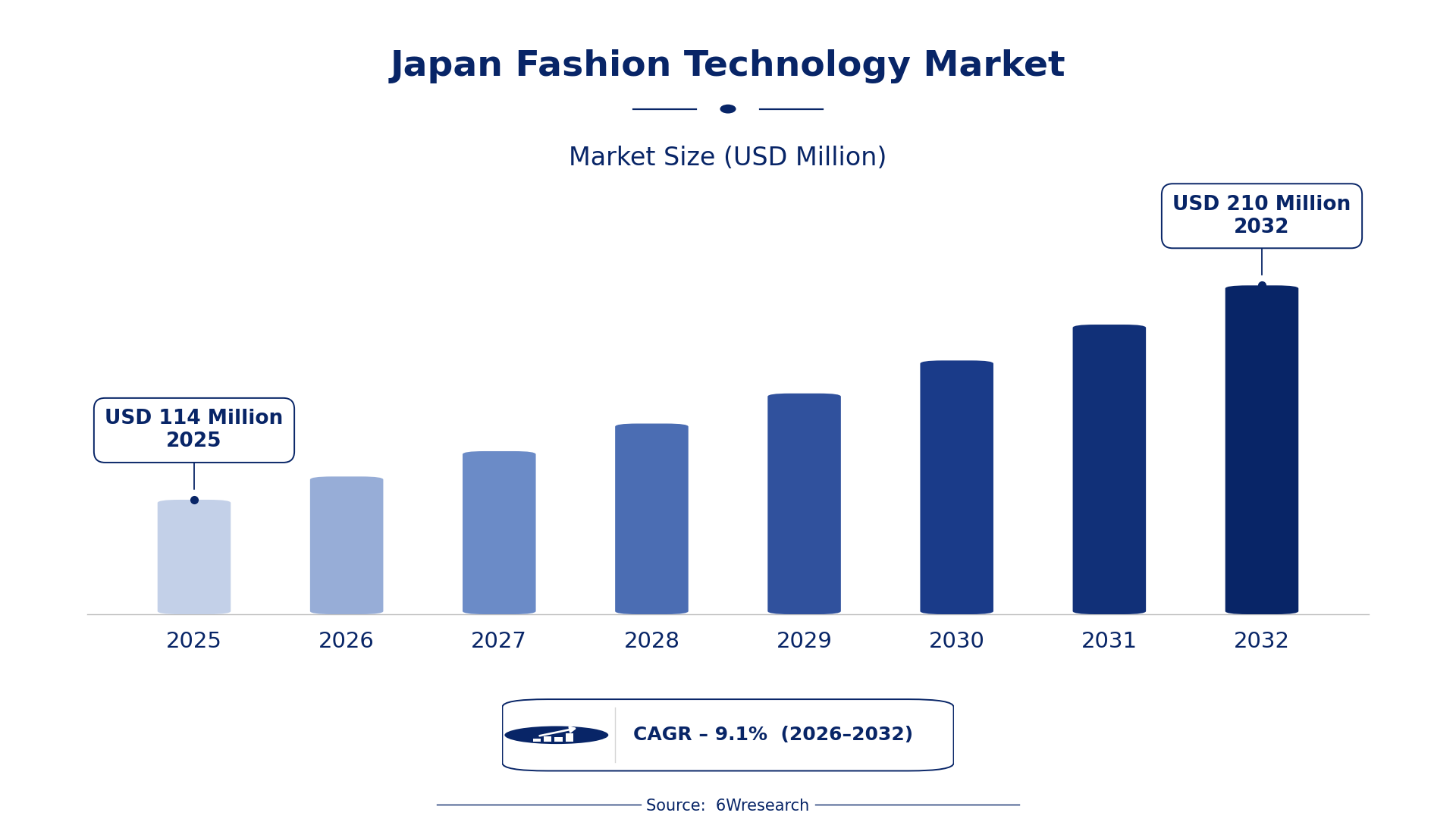
According to 6Wresearch internal database and industry insights, the Japan Fashion Technology Market was valued at USD 114 Million in 2025 and is projected to reach USD 210 Million by 2032, growing at a CAGR of approximately 9.1% during 2026–2032.
Japan Fashion Technology Market Highlights
| Report Metric | Details |
| Report Name | Japan Fashion Technology Market (2026-2032) |
| Market Size 2025 | USD 114 Million |
| Market Size 2032 | USD 210 Million |
| Absolute Growth 2025–2032 | USD 96 Million |
| CAGR 2026–2032 | 9.1% |
| Peak Annual Growth | 10.2% in 2032 |
| Forecast Period | 2026–2032 |
| Historical Data | 2022–2025 |
| Base Year | 2025 |
| Leading Application Area, 2025 | E-commerce Tech (40% share) |
| Leading Technology Type, 2025 | AI Recommendations (39% share) |
| Leading Distribution Channel, 2025 | Online Platforms (34% share) |
| Leading End User, 2025 | Fashion Retailers (40% share) |
| Fastest-Growing Application Area | Smart Clothing (11.6% CAGR) |
| Fastest-Growing Technology Type | 3D Modeling (13.3% CAGR) |
| Fastest-Growing Distribution Channel | Creative Software (12.0% CAGR) |
| Fastest-Growing End User | Fashion Designers (11.8% CAGR) |
| Growing Sector | E-commerce solutions |
| Key End Users | Fashion retailers, apparel factories, fashion designers |
Japan Fashion Technology Market Year-wise Growth Rate and Key Drivers (2022–2032)
This graph illustrates the annual growth rates of the market from 2022 to 2032, highlighting a steady upward trajectory and projected market expansion over the forecast period.
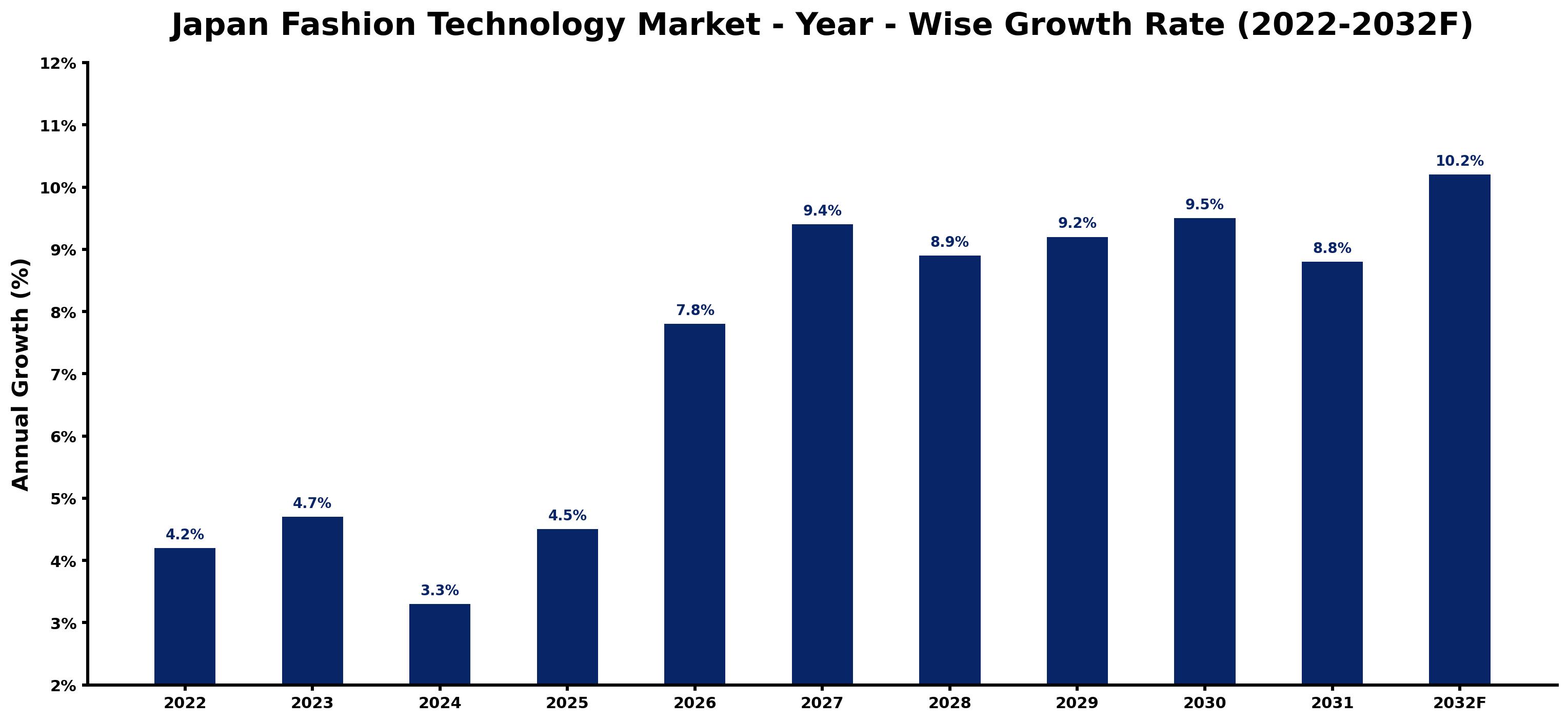
The following figures match every annual growth estimate with the main market development of that year, giving the reasoning behind each rise or slowdown.
| Year | Estimated Annual Growth (%) | Market Rationale |
| 2022 | 4.2 | The market experienced steady growth as consumers increasingly turned to online shopping solutions. |
| 2023 | 4.7 | Growth accelerated due to rising e-commerce sales and increased technology adoption in fashion. |
| 2024 | 3.3 | The growth rate slowed as market saturation began to impact new technology investments. |
| 2025 | 4.5 | A resurgence in growth occurred as fashion retailers embraced new technologies for efficiency. |
| 2026 | 7.8 | Demand is expected to surge with the introduction of advanced manufacturing technologies and smart clothing. |
| 2027 | 9.4 | Continued growth will be driven by the rising popularity of e-commerce and digital fashion strategies. |
| 2028 | 8.9 | Growth is projected to slow slightly as the market adjusts to technological advancements and consumer preferences. |
| 2029 | 9.2 | The market is expected to rebound as fashion designers increasingly adopt creative software tools for design. |
| 2030 | 9.5 | Strong growth will continue with increased investment in automation and robotics in apparel factories. |
| 2031 | 8.8 | The growth rate is projected to moderate as the market matures and competition intensifies among retailers. |
| 2032 | 10.2 | The peak growth year is driven by major technological advancements and consumer demand for new solutions. |
Note: Market size estimations and growth projections presented in this report are based on 6Wresearch's proprietary forecasting methodology, utilizing the latest available industry data, government publications, and primary research inputs.
Japan Fashion Technology Market Synopsis
Fashion technology encompasses innovations such as e-commerce solutions, manufacturing automation, and smart clothing. The Japan Fashion Technology Market is expanding due to rising e-commerce sales, with fashion sector sales reaching 1 trillion JPY in 2022. The integration of technology in fashion is supported by the New Robot Strategy, promoting automation in manufacturing, while over 2,000 apparel factories adopt automation technologies, driving further growth in this sector. This growth is further propelled by a large number of fashion retailers and a strong consumer base in Japan.
Market Dynamics Impact Analysis (2026–2032)
| Factor | Type | Impact | Primary Segment Affected |
| Growing e-commerce sales drive demand for innovative online shopping solutions. | Driver | High | E-commerce Tech |
| Increased automation in apparel factories enhances production efficiency. | Driver | High | Manufacturing Tech |
| Rising demand for smart clothing opens new market opportunities. | Opportunity | High | Smart Clothing |
| Fashion designers increasingly seek advanced creative software for design efficiency. | Opportunity | Medium | Creative Software |
| Market saturation limits growth potential for existing technologies. | Restraint | High | E-commerce Tech |
| High competition among fashion retailers pressures pricing and innovation. | Restraint | Medium | Fashion Retailers |
| High costs of implementing new technologies deter smaller retailers. | Challenge | High | Fashion Retailers |
| Rapid technological changes require constant adaptation from manufacturers. | Challenge | Medium | Manufacturing Tech |
Evaluation of Drivers in Japan Fashion Technology Market (2026–2032)
The following drivers explain most of the expected growth.
| Drivers | Primary Segment Affected | Why It Matters (Evidence) |
| Increased online shopping | E-commerce Tech | E-commerce sales reached 1 trillion JPY in 2022, prompting retailers to invest in technology. |
| Automation adoption | Manufacturing Tech | Over 2,000 apparel factories in Japan implement automation, improving production efficiency. |
| Demand for advanced design tools | Creative Software | Creative software tools are used by 80% of fashion designers, improving design processes. |
| Growth of smart clothing | Smart Clothing | The Smart Clothing Initiative promotes wearable tech, increasing market interest and investment. |
| Fashion events showcasing technology | E-commerce Tech | Tokyo Fashion Week highlights tech-driven innovations, attracting attention to fashion technology. |
Most of the extra volume comes from the growing e-commerce sector, which saw sales reach 1 trillion JPY in 2022, prompting retailers to invest in online shopping solutions. Automation adoption is rising, with over 2,000 apparel factories implementing these technologies to improve production efficiency. Advanced design tools are now utilised by 80% of fashion designers, driving demand for effective design solutions. Events like Tokyo Fashion Week showcase tech-driven innovations, further boosting market visibility and demand.
Evaluation of Restraints in Japan Fashion Technology Market
Several factors work against faster growth; the main ones are summarised below.
| Market Restraint | Primary Segment Affected | Why It Matters (Evidence) |
| Market saturation limits growth potential for existing technologies. | E-commerce Tech | As e-commerce solutions mature, new entrants face challenges in differentiation and innovation. |
| High competition among fashion retailers pressures pricing and innovation. | Fashion Retailers | With over 100,000 retailers in Japan, intense competition leads to price wars and reduced margins. |
| High costs of implementing new technologies deter smaller retailers. | Manufacturing Tech | Smaller apparel manufacturers struggle with the financial burden of adopting advanced technologies. |
| Rapid technological changes require constant adaptation from manufacturers. | Manufacturing Tech | Manufacturers must continuously invest in new technologies to stay competitive, increasing operational costs. |
| Consumer preferences shift quickly, challenging market stability. | Smart Clothing | Fashion trends change rapidly, making it difficult for smart clothing to maintain consistent demand. |
Japan Fashion Technology Market Challenges
Tokyo's fashion retailers face supply chain disruptions, as many depend on a few suppliers for raw materials. This reliance causes production delays, costing retailers up to 15% in lost sales during peak seasons. High operational costs stem from the need for advanced technology integration, with apparel factories incurring expenses that can reach 20 million JPY for automation upgrades. Competition escalates as international brands penetrate the market, compelling local producers to innovate swiftly or risk losing market share. Buyers struggle to find diverse product offerings, as only 30% of factories currently utilise robotics, limiting available styles.
Trends in the Japan Fashion Technology Market
Several trends are reshaping the Japan Fashion Technology Market; the most important are set out below.
- Shift towards E-commerce Solutions: The fashion industry is increasingly moving towards e-commerce solutions, with sales reaching 1 trillion JPY in 2022. This shift is reshaping how retailers engage with consumers, driving investments in technology.
- Rise of Smart Clothing: Smart clothing is gaining traction, with approximately 15% of smart clothing products incorporating embedded circuits, showcasing the integration of technology in fashion.
- Increased Use of Creative Software: Creative software has become essential for fashion designers, with 80% utilising these tools. This trend improves design efficiency and innovation, reflecting the industry's technological evolution.
- Growing Automation in Manufacturing: The adoption of automation technology is rising, with 30% of apparel factories implementing robotics. This trend streamlines production processes and improves operational efficiency across the sector.
Investment Opportunities in the Japan Fashion Technology Market
The openings below show where demand in the Japan Fashion Technology Market is visible and how suppliers can enter.
- Invest in E-commerce Solutions: With e-commerce sales projected to grow, investing in advanced online shopping platforms is essential. Fashion retailers are increasingly seeking solutions to improve customer experiences.
- Supply Smart Clothing Technologies: The demand for smart clothing is rising, with initiatives promoting wearable tech. Fashion designers are looking for suppliers to provide effective smart clothing solutions.
- Enhance Creative Software Offerings: There is a growing need for advanced creative software tools among fashion designers. Investing in this area can cater to the increasing demand for design efficiency.
- Support Automation in Apparel Factories: With over 2,000 apparel factories adopting automation, suppliers can invest in technologies that streamline production processes, meeting the needs of manufacturers.
Government Initiatives in the Japan Fashion Technology Market
The New Robot Strategy (2015) promotes the integration of robotics in manufacturing, services, and agriculture. This initiative supports technology integration in the fashion industry, enhancing productivity among apparel manufacturers. The strategy encourages investment in robotics, which is essential for improving efficiency in production processes. Additionally, the AI Promotion Act (2025) establishes a national framework for AI research and development, further supporting innovation in fashion technology.
The Fashion Innovation Program, launched in 2023, allocates 10 billion JPY for technology adoption in the fashion sector. The Ministry of Economy, Trade and Industry (METI) oversees this programme, ensuring that fashion retailers can access resources to improve their e-commerce capabilities and technology integration.
Future Insight of the Japan Fashion Technology Market
A government initiative will drive technology integration across the fashion sector by 2032. E-commerce sales are expected to reach 2 trillion JPY, reflecting a shift towards enhanced online shopping experiences. The adoption of wearable technology will increase, with smart clothing featuring more advanced functionalities. Events like the 'Fashion Tech Expo' will facilitate partnerships between fashion designers and tech innovators, fostering a collaborative environment that accelerates industry growth.
Market Segmentation Analysis
Japan Fashion Technology Market report covers a detailed analysis of the following market segments:
By Application Area – E-commerce Tech Leads, Smart Clothing Expected to Grow Fastest
According to Saurav Kr Singh, Senior Research Analyst at 6Wresearch, in 2025, E-commerce Tech led the application area split with a 40% share. E-commerce technology holds the largest share as it directly enhances online shopping experiences, crucial for engaging Japan's extensive consumer base. The substantial e-commerce sales of 1 trillion JPY in 2022 illustrate the importance of effective online solutions for fashion retailers. Over 2026–2032, Smart Clothing is expected to post the fastest growth, at a CAGR of 11.6%. Smart clothing is experiencing rapid growth due to initiatives like the 'Smart Clothing Initiative', which encourages the integration of technology into apparel. This focus on functionality is attracting interest from consumers and designers alike, leading to a surge in demand for smart garments. Suppliers should focus on e-commerce solutions to align with the needs of a growing retail sector.
By Technology Type – AI Recommendations Lead, 3D Modeling Expected to Grow Fastest
With 39% of technology type revenue in 2025, AI Recommendations was the largest category. AI recommendations dominate the market as they enhance e-commerce operations by personalising shopping experiences, which is vital for boosting online sales. Their adoption by retailers is increasingly common, indicating a strong reliance on this technology to improve customer engagement. The quickest growth will come from 3D Modeling, forecast to expand at a CAGR of 13.3% between 2026 and 2032. 3D modeling is rapidly growing as it streamlines design processes, enabling designers to create and iterate more efficiently. The widespread use of 3D modeling tools by 70% of design firms highlights a significant trend towards digital solutions in fashion design. Buyers should invest in advanced design technologies to maintain competitiveness in the changing fashion market.
By Distribution Channel – Online Platforms Lead, Creative Software Expected to Grow Fastest
Online Platforms took 34% of distribution channel revenue in 2025, more than any other category. Online platforms are the leading distribution channel, essential for e-commerce operations that cater to a tech-savvy consumer base. Their significance is underscored by the impressive e-commerce sales figures in the fashion sector, reaching 1 trillion JPY in 2022. Creative Software is projected to grow fastest, at a CAGR of 12.0% during 2026–2032. Creative software is rapidly growing as it plays a crucial role in design processes, allowing designers to innovate and streamline their work. The increasing reliance on these tools reflects a shift towards more sophisticated design capabilities in the industry. Suppliers must enhance their online presence to effectively reach fashion retailers and designers.
By End User – Fashion Retailers Lead, Fashion Designers Expected to Grow Fastest
Fashion Retailers held 40% of the Japan Fashion Technology Market by end user in 2025. Fashion retailers are the primary users of fashion technology solutions, driving widespread adoption across the industry. Their significant influence is highlighted by the projected annual growth of 5% through 2025 in Japan's fashion retail market. Fashion Designers are set to record the highest CAGR in this split, 11.8% over 2026–2032. Fashion designers are increasingly adopting new technologies to elevate their design and creativity, reflecting a trend towards tech integration in the creative process. This shift is evidenced by the large population of approximately 50,000 designers actively seeking innovative tools. Suppliers should tailor their offerings to meet the specific needs of fashion designers to capture this expanding segment.
Key Attractiveness of the Report
- 10 Years of Market Numbers
- Historical Data Starting from 2022 to 2025
- Base Year 2025
- Forecast Data until 2032
- Key Performance Indicators Impacting the Market
- Major Upcoming Developments and Projects
Key Highlights of the Report:
- Japan Fashion Technology Market Outlook
- Market Size of Japan Fashion Technology Market, 2025
- Forecast of Japan Fashion Technology Market, 2032
- Historical Data and Forecast of Japan Fashion Technology Revenues & Volume for the Period 2022-2032F
- Japan Fashion Technology Market Trend Evolution
- Japan Fashion Technology Market Drivers and Challenges
- Japan Fashion Technology Price Trends
- Japan Fashion Technology Porter's Five Forces
- Japan Fashion Technology Industry Life Cycle
- Historical Data and Forecast of Japan Fashion Technology Market Revenues & Volume By Application Area for the Period 2022-2032F
- Historical Data and Forecast of Japan Fashion Technology Market Revenues & Volume By E-commerce Tech for the Period 2022-2032F
- Historical Data and Forecast of Japan Fashion Technology Market Revenues & Volume By Manufacturing Tech for the Period 2022-2032F
- Historical Data and Forecast of Japan Fashion Technology Market Revenues & Volume By Design Tech for the Period 2022-2032F
- Historical Data and Forecast of Japan Fashion Technology Market Revenues & Volume By Smart Clothing for the Period 2022-2032F
- Historical Data and Forecast of Japan Fashion Technology Market Revenues & Volume By Technology Type for the Period 2022-2032F
- Historical Data and Forecast of Japan Fashion Technology Market Revenues & Volume By AI Recommendations for the Period 2022-2032F
- Historical Data and Forecast of Japan Fashion Technology Market Revenues & Volume By Robotics for the Period 2022-2032F
- Historical Data and Forecast of Japan Fashion Technology Market Revenues & Volume By 3D Modeling for the Period 2022-2032F
- Historical Data and Forecast of Japan Fashion Technology Market Revenues & Volume By Embedded Circuits for the Period 2022-2032F
- Historical Data and Forecast of Japan Fashion Technology Market Revenues & Volume By Distribution Channel for the Period 2022-2032F
- Historical Data and Forecast of Japan Fashion Technology Market Revenues & Volume By Online Platforms for the Period 2022-2032F
- Historical Data and Forecast of Japan Fashion Technology Market Revenues & Volume By Automation Suppliers for the Period 2022-2032F
- Historical Data and Forecast of Japan Fashion Technology Market Revenues & Volume By Creative Software for the Period 2022-2032F
- Historical Data and Forecast of Japan Fashion Technology Market Revenues & Volume By Tech Retailers for the Period 2022-2032F
- Historical Data and Forecast of Japan Fashion Technology Market Revenues & Volume By End User for the Period 2022-2032F
- Historical Data and Forecast of Japan Fashion Technology Market Revenues & Volume By Fashion Retailers for the Period 2022-2032F
- Historical Data and Forecast of Japan Fashion Technology Market Revenues & Volume By Apparel Factories for the Period 2022-2032F
- Historical Data and Forecast of Japan Fashion Technology Market Revenues & Volume By Fashion Designers for the Period 2022-2032F
- Historical Data and Forecast of Japan Fashion Technology Market Revenues & Volume By Activewear Users for the Period 2022-2032F
- Japan Fashion Technology Import Export Trade Statistics
- Market Opportunity Assessment By Application Area
- Market Opportunity Assessment By Technology Type
- Market Opportunity Assessment By Distribution Channel
- Market Opportunity Assessment By End User
- Japan Fashion Technology Top Companies Market Share
- Japan Fashion Technology Competitive Benchmarking By Technical and Operational Parameters
- Japan Fashion Technology Company Profiles
- Japan Fashion Technology Key Strategic Recommendations
Market Covered
Segments analysed in this report are listed below.
By Application Area
- E-commerce Tech
- Manufacturing Tech
- Design Tech
- Smart Clothing
By Technology Type
- AI Recommendations
- Robotics
- 3D Modeling
- Embedded Circuits
By Distribution Channel
- Online Platforms
- Automation Suppliers
- Creative Software
- Tech Retailers
By End User
- Fashion Retailers
- Apparel Factories
- Fashion Designers
- Activewear Users































