Japan Faux Flower Market Size & Growth Rate
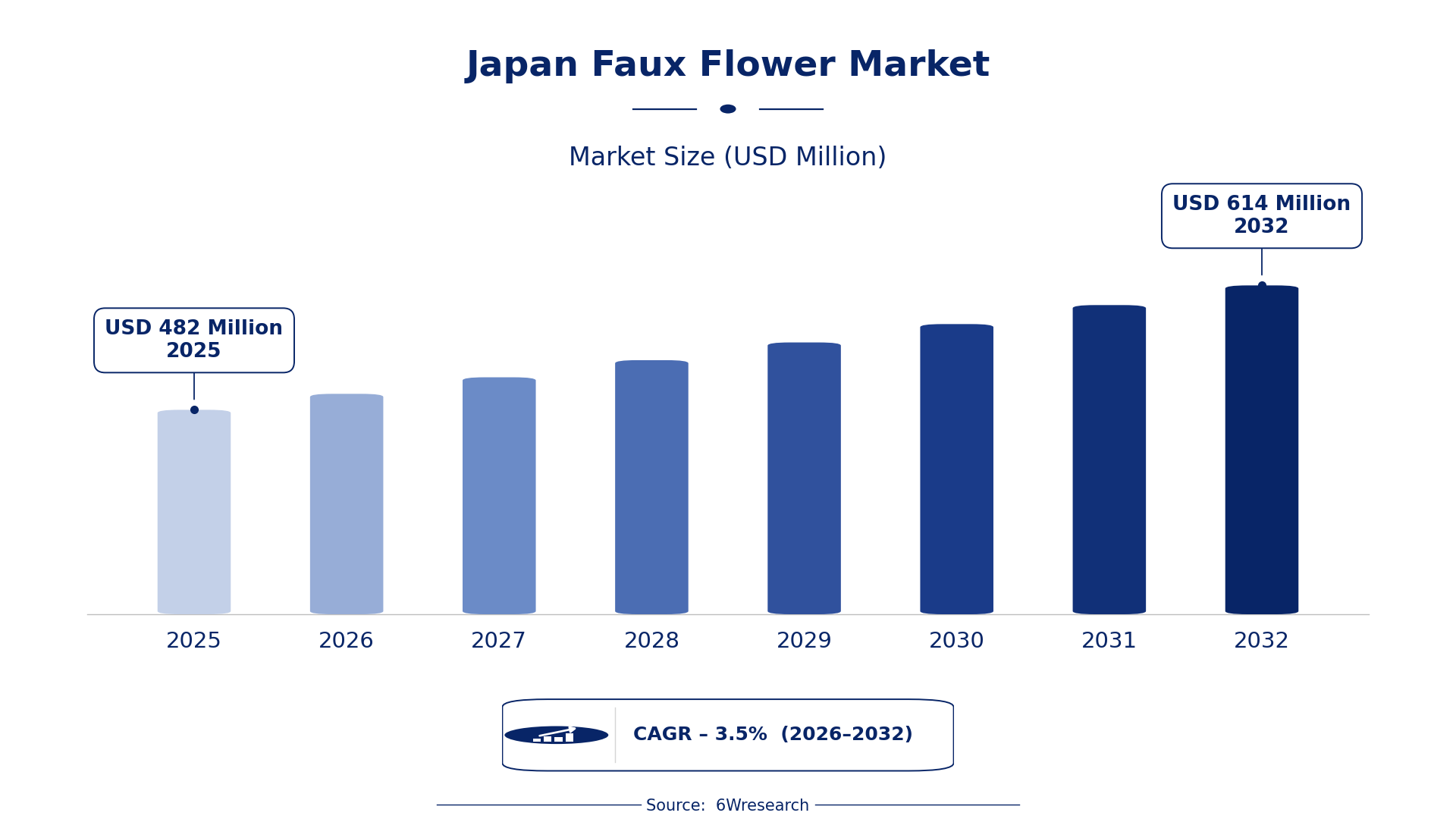
According to 6Wresearch internal database and industry insights, the Japan Faux Flower Market was valued at USD 482 Million in 2025 and is projected to reach USD 614 Million by 2032, growing at a CAGR of approximately 3.5% during 2026–2032.
Japan Faux Flower Market Highlights
| Report Metric | Details |
| Report Name | Japan Faux Flower Market (2026-2032) |
| Market Size 2025 | USD 482 Million |
| Market Size 2032 | USD 614 Million |
| Absolute Growth 2025–2032 | USD 132 Million |
| CAGR 2026–2032 | 3.5% |
| Peak Annual Growth | 4.6% in 2028 |
| Forecast Period | 2026–2032 |
| Historical Data | 2022–2025 |
| Base Year | 2025 |
| Leading Flower Type, 2025 | Silk Flowers (50% share) |
| Leading Material Used, 2025 | Silk Fabric (42% share) |
| Leading Distribution Channel, 2025 | Craft Stores (43% share) |
| Leading End User, 2025 | Event Planners (39% share) |
| Fastest-Growing Flower Type | Plastic Bouquets (4.8% CAGR) |
| Fastest-Growing Material Used | PVC (5.1% CAGR) |
| Fastest-Growing Distribution Channel | E-commerce (4.5% CAGR) |
| Fastest-Growing End User | Households (4.6% CAGR) |
| Growing Sector | event planning |
| Key End Users | households, event planners, DIY crafters, craft stores |
Japan Faux Flower Market Year-wise Growth Rate and Key Drivers (2022–2032)
This graph illustrates the annual growth rates of the market from 2022 to 2032, highlighting a steady upward trajectory and projected market expansion over the forecast period.
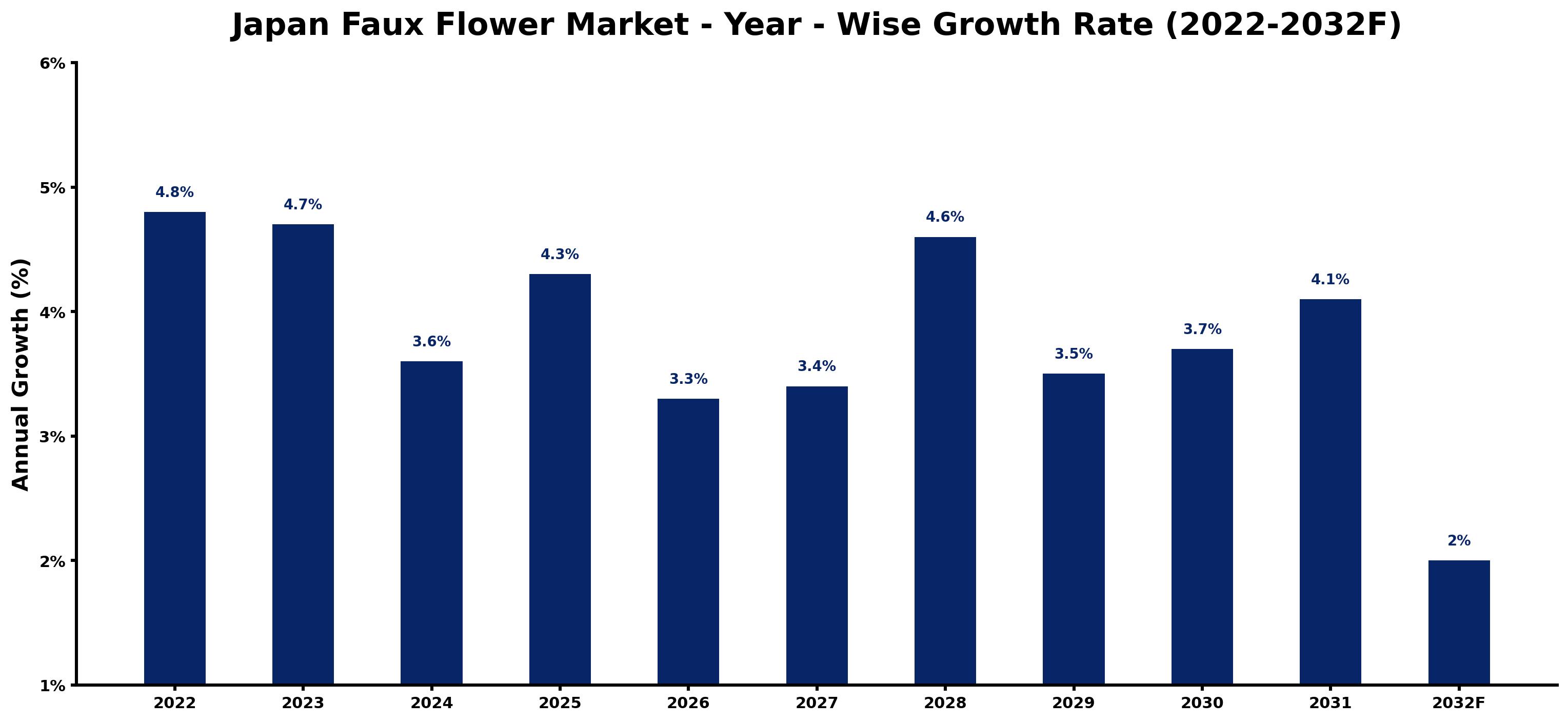
The yearly estimates that follow link every growth rate to its principal driver, so readers can see why the pace changed in each period.
| Year | Estimated Annual Growth (%) | Market Rationale |
| 2022 | 4.8 | The market experienced strong demand from households and event planners. |
| 2023 | 4.7 | Sales growth slowed slightly due to a stabilising market after high demand in 2022. |
| 2024 | 3.6 | Demand continued to slow as consumers adjusted to previous purchasing patterns. |
| 2025 | 4.3 | Growth accelerated again as event planning activities increased. |
| 2026 | 3.3 | Market growth is expected to slow as competition intensifies among suppliers. |
| 2027 | 3.4 | A slight rebound is projected as consumers return to purchasing for events. |
| 2028 | 4.6 | The market peaked due to heightened demand during wedding season. |
| 2029 | 3.5 | Growth is projected to slow as market saturation begins to take effect. |
| 2030 | 3.7 | Demand is expected to increase again as households seek decorative solutions. |
| 2031 | 4.1 | The market is projected to experience renewed growth from rising interest in home decor. |
| 2032 | 2.0 | Growth is expected to slow as the market stabilises after several years of fluctuation. |
Note: Market size estimations and growth projections presented in this report are based on 6Wresearch's proprietary forecasting methodology, utilizing the latest available industry data, government publications, and primary research inputs.
Japan Faux Flower Market Synopsis
Faux flowers are artificial floral arrangements made from materials such as silk, plastic, and foam, produced through processes like molding and dyeing. The Japan Faux Flower Market is growing, with households accounting for 40% of the market. Demand is further supported by event planners using faux flowers for over 70% of their arrangements, along with a notable 20% increase in sales reported by craft stores in 2023.
Market Dynamics Impact Analysis (2026–2032)
| Factor | Type | Impact | Primary Segment Affected |
| Increasing interest in home decoration drives demand for faux flowers. | Driver | High | Households |
| Event planners require faux flowers for a significant portion of their arrangements. | Driver | High | Event Planners |
| Growing e-commerce sales present an opportunity for wider distribution. | Opportunity | High | E-commerce |
| The rise of DIY crafting creates demand for unique faux flower designs. | Opportunity | Medium | DIY Crafters |
| Competition among suppliers may affect pricing strategies. | Restraint | High | Craft Stores |
| Market saturation could limit growth potential in the coming years. | Restraint | Medium | Retail Chains |
| Rising production costs impact profit margins for manufacturers. | Challenge | High | Silk Flowers |
| Consumer preferences shifting towards natural materials may challenge synthetic options. | Challenge | Medium | Plastic Bouquets |
Evaluation of Drivers in Japan Faux Flower Market (2026–2032)
The table below links each growth driver to the segment it affects and the evidence for it.
| Drivers | Primary Segment Affected | Why It Matters (Evidence) |
| Households increasingly seek decorative solutions for their homes. | Households | With a population of approximately 125 million, the growing interest in home decoration drives purchases of faux flowers. |
| Event planners utilise faux flowers for over 70% of their arrangements. | Event Planners | This high usage reflects the demand for cost-effective and durable floral solutions for events. |
| Craft stores report a notable increase in faux flower sales in 2023. | Craft Stores | This growth indicates a rising interest in DIY projects and home decoration among consumers. |
| E-commerce platforms are expanding sales channels for faux flowers. | E-commerce | The convenience of online shopping has led to increased purchases, especially during wedding season. |
| Local initiatives promote the use of local materials in crafting. | DIY Crafters | This initiative encourages the use of faux flowers in creative projects, boosting demand. |
Volumes grow on the back of households increasingly seeking decorative solutions, with a population of approximately 125 million driving demand for faux flowers. Event planners utilise faux flowers for over 70% of their arrangements, reflecting the need for cost-effective solutions. Craft stores reported a notable increase in sales in 2023, indicating rising interest in DIY projects. E-commerce platforms have expanded their sales channels, particularly during wedding season, improving consumer access.
Evaluation of Restraints in Japan Faux Flower Market
The table below lists the restraints and the evidence behind each.
| Market Restraint | Primary Segment Affected | Why It Matters (Evidence) |
| Competition among suppliers may lead to aggressive pricing strategies. | Craft Stores | This competition can squeeze profit margins, impacting the overall market profitability. |
| Market saturation could limit growth potential in the coming years. | Retail Chains | As more suppliers enter the market, the abundance of options may reduce demand for new products. |
| Rising production costs are affecting profit margins for manufacturers. | Silk Flowers | Increased costs can lead to higher retail prices, potentially deterring consumers. |
| Consumer preferences shifting towards natural materials may challenge synthetic options. | Plastic Bouquets | As sustainability becomes a priority, demand for faux flowers may decline. |
| Limited awareness of faux flowers' quality and variety affects sales. | E-commerce | Consumers may hesitate to purchase without seeing products in person. |
Japan Faux Flower Market Challenges
Craft stores report a 20% increase in faux flower sales in 2023, yet skills shortages in floral design limit their ability to meet demand. Rising production costs, particularly for silk, push prices higher, which can deter buyers and shrink overall sales. Regulatory compliance with ISO 9001 standards complicates manufacturing processes, causing delays that impact suppliers' ability to deliver on time. Supply chain disruptions from material shortages lead to extended lead times for event planners, forcing them to seek last-minute alternatives and risking higher costs for their projects.
Trends in the Japan Faux Flower Market
The trends below show where the Japan Faux Flower Market is heading.
- Shift towards E-commerce for Faux Flower Sales: E-commerce platforms are increasingly popular for faux flower purchases, especially during peak seasons. In 2023, this channel experienced a rise in sales, reflecting changing consumer shopping habits.
- Event Planners Favour Faux Flowers: Event planners in Japan are increasingly choosing faux flowers, using them for over 70% of their arrangements. This trend underscores the growing preference for durable and cost-effective floral solutions.
- Rise of DIY Crafting Initiatives: Local government initiatives promoting DIY crafts have sparked increased interest in faux flowers among hobbyists. Community workshops have seen participation grow, encouraging creativity and unique designs.
- Popularity of Silk Flowers: Silk flowers remain the most preferred type in Japan due to their realistic appearance. This preference has led to sustained demand, particularly among households and event planners.
Investment Opportunities in the Japan Faux Flower Market
Investors looking at the Japan Faux Flower Market should consider the following areas.
- Partner with Local Craft Stores: Now is an ideal time to collaborate with local craft stores to supply faux flowers, as they reported a notable increase in sales in 2023. Partnering with these stores can improve market reach.
- Invest in E-commerce Platforms: With a growing trend towards online shopping, investing in e-commerce platforms can boost sales. This approach is particularly beneficial for reaching tech-savvy consumers in urban areas.
- Focus on DIY Crafting: The rise of DIY crafting initiatives presents an opportunity to supply unique faux flower designs. Engaging with community workshops can help tap into this expanding market.
- Expand into Wedding Decor: With event planners using faux flowers for over 70% of arrangements, entering the wedding decor market can be profitable. Establishing connections with wedding planners can facilitate market entry.
Government Initiatives in the Japan Faux Flower Market
The Plastic Resource Circulation Act, enacted in 2021, encourages the reduction, reuse, and recycling of plastics. This law supports the faux flower industry by promoting alternatives such as biodegradable materials, appealing to environmentally conscious consumers. The act aims to improve sustainability in the market and has led to increased interest in eco-friendly faux flower options.
Community workshops promoting DIY crafts are funded by various initiatives, overseen by relevant agencies. These workshops aim to boost creativity and skills, benefiting both producers and buyers in the faux flower market. Support for these initiatives has increased participation, enhancing the overall market.
Future Insight of the Japan Faux Flower Market
Households will increasingly turn to faux flowers for home decoration by 2032, driven by local government initiatives that promote creativity through crafting workshops. E-commerce platforms will expand their offerings, enabling buyers to explore a wider range of products. Event planners will benefit from improved training programs provided by the Japan Craft Association, enhancing their skills in crafting unique arrangements. The average price for a faux flower arrangement in retail chains is expected to remain around 1,500 yen, ensuring continued affordability for consumers.
Market Segmentation Analysis
Japan Faux Flower Market report covers a detailed analysis of the following market segments:
By Flower Type – Silk Flowers Lead, Plastic Bouquets Expected to Grow Fastest
According to Saurav Kr Singh, Senior Research Analyst at 6Wresearch, in 2025, Silk Flowers led the flower type split with a 50% share. Silk flowers hold the largest share due to their high-quality appearance and durability, making them a preferred choice for households and event planners. Their realistic look resonates particularly well with consumers in urban areas like Tokyo and Osaka, where aesthetics are paramount. Plastic Bouquets are set to record the highest CAGR in this split, 4.8% over 2026–2032. Plastic bouquets are rapidly gaining popularity as they provide affordability and versatility for various occasions, especially among budget-conscious buyers. The surge in e-commerce purchases during wedding season has further propelled their growth in the market. Suppliers should prioritise the development of plastic bouquet options to attract the increasing number of price-sensitive consumers.
By Material Used – Silk Fabric Leads, PVC Expected to Grow Fastest
The largest material used category in 2025 was Silk Fabric, at 42% of revenue. Silk fabric holds the largest share as it is commonly used in the production of high-end faux flowers, which are sought after by event planners and households alike. Its premium quality ensures a strong demand in metropolitan regions where decorative standards are high. The quickest growth will come from PVC, forecast to expand at a CAGR of 5.1% between 2026 and 2032. PVC is rapidly gaining market share due to its cost-effectiveness and suitability for producing budget-friendly faux flowers. The increasing interest in DIY crafts has also contributed to the rising popularity of PVC among consumers. Buyers may benefit from exploring PVC options for more affordable yet appealing floral arrangements.
By Distribution Channel – Craft Stores Lead, E-commerce Expected to Grow Fastest
Craft Stores took 43% of distribution channel revenue in 2025, more than any other category. Craft stores are the primary retail channel for consumers, providing a wide selection of faux flowers that meet the needs of households and event planners alike. Their established presence in regions like Tokyo and Osaka makes them a preferred choice for purchasing floral arrangements. E-commerce is projected to grow fastest, at a CAGR of 4.5% during 2026–2032. E-commerce is experiencing notable growth due to its convenience and the extensive variety of faux flowers available, especially during high-demand periods such as wedding season. This shift towards online purchasing is making it easier for consumers to access diverse products. Suppliers must enhance their online presence to take advantage of the growing e-commerce market.
By End User – Event Planners Lead, Households Expected to Grow Fastest
Event Planners held 39% of the Japan Faux Flower Market by end user in 2025. Event planners represent the largest user group for faux flowers, utilising them for over 70% of their floral arrangements due to the need for consistent quality and aesthetic appeal. Their reliance on faux flowers for events drives substantial demand in the market. Over 2026–2032, Households are expected to post the fastest growth, at a CAGR of 4.6%. Households are emerging as the fastest-growing segment, as more consumers seek faux flowers for home decoration, particularly with the rise in interest in DIY crafting. This trend reflects a shift in consumer behaviour towards personalising living spaces. Suppliers should consider targeting household consumers with tailored marketing strategies to capitalise on this growing segment.
Key Attractiveness of the Report
- 10 Years of Market Numbers
- Historical Data Starting from 2022 to 2025
- Base Year 2025
- Forecast Data until 2032
- Key Performance Indicators Impacting the Market
- Major Upcoming Developments and Projects
Key Highlights of the Report:
- Japan Faux Flower Market Outlook
- Market Size of Japan Faux Flower Market, 2025
- Forecast of Japan Faux Flower Market, 2032
- Historical Data and Forecast of Japan Faux Flower Revenues & Volume for the Period 2022-2032F
- Japan Faux Flower Market Trend Evolution
- Japan Faux Flower Market Drivers and Challenges
- Japan Faux Flower Price Trends
- Japan Faux Flower Porter's Five Forces
- Japan Faux Flower Industry Life Cycle
- Historical Data and Forecast of Japan Faux Flower Market Revenues & Volume By Flower Type for the Period 2022-2032F
- Historical Data and Forecast of Japan Faux Flower Market Revenues & Volume By Silk Flowers for the Period 2022-2032F
- Historical Data and Forecast of Japan Faux Flower Market Revenues & Volume By Plastic Bouquets for the Period 2022-2032F
- Historical Data and Forecast of Japan Faux Flower Market Revenues & Volume By Foam Flowers for the Period 2022-2032F
- Historical Data and Forecast of Japan Faux Flower Market Revenues & Volume By Fabric Mixes for the Period 2022-2032F
- Historical Data and Forecast of Japan Faux Flower Market Revenues & Volume By Material Used for the Period 2022-2032F
- Historical Data and Forecast of Japan Faux Flower Market Revenues & Volume By Silk Fabric for the Period 2022-2032F
- Historical Data and Forecast of Japan Faux Flower Market Revenues & Volume By PVC for the Period 2022-2032F
- Historical Data and Forecast of Japan Faux Flower Market Revenues & Volume By EVA Foam for the Period 2022-2032F
- Historical Data and Forecast of Japan Faux Flower Market Revenues & Volume By Polyester for the Period 2022-2032F
- Historical Data and Forecast of Japan Faux Flower Market Revenues & Volume By Distribution Channel for the Period 2022-2032F
- Historical Data and Forecast of Japan Faux Flower Market Revenues & Volume By Craft Stores for the Period 2022-2032F
- Historical Data and Forecast of Japan Faux Flower Market Revenues & Volume By E-commerce for the Period 2022-2032F
- Historical Data and Forecast of Japan Faux Flower Market Revenues & Volume By Specialty Shops for the Period 2022-2032F
- Historical Data and Forecast of Japan Faux Flower Market Revenues & Volume By Retail Chains for the Period 2022-2032F
- Historical Data and Forecast of Japan Faux Flower Market Revenues & Volume By End User for the Period 2022-2032F
- Historical Data and Forecast of Japan Faux Flower Market Revenues & Volume By Event Planners for the Period 2022-2032F
- Historical Data and Forecast of Japan Faux Flower Market Revenues & Volume By Households for the Period 2022-2032F
- Historical Data and Forecast of Japan Faux Flower Market Revenues & Volume By Wedding Decorators for the Period 2022-2032F
- Historical Data and Forecast of Japan Faux Flower Market Revenues & Volume By DIY Crafters for the Period 2022-2032F
- Japan Faux Flower Import Export Trade Statistics
- Market Opportunity Assessment By Flower Type
- Market Opportunity Assessment By Material Used
- Market Opportunity Assessment By Distribution Channel
- Market Opportunity Assessment By End User
- Japan Faux Flower Top Companies Market Share
- Japan Faux Flower Competitive Benchmarking By Technical and Operational Parameters
- Japan Faux Flower Company Profiles
- Japan Faux Flower Key Strategic Recommendations
Market Covered
Coverage by segment is as follows.
By Flower Type
- Silk Flowers
- Plastic Bouquets
- Foam Flowers
- Fabric Mixes
By Material Used
- Silk Fabric
- PVC
- EVA Foam
- Polyester
By Distribution Channel
- Craft Stores
- E-commerce
- Specialty Shops
- Retail Chains
By End User
- Event Planners
- Households
- Wedding Decorators
- DIY Crafters































